Categories
Essay

The Idiot, Goethe, and the Comet

By Helga Neumayer

I believe in stories. I am looking for stories.  And, yes. I can describe myself as a story lover. But, naturally, there are some stories I don’t want to know anything at all about. “Net so genau-au (Not too many details)” as Austrian artist Ostbahn-Kurti used to sing.

Stories have a life of their own. Suddenly, they come and bewitch you. It is useless to ignore them. You are surrounded by them. When you close your eyes, they come back in dreams.

Failing

Offended and frustrated, I left “my” German class. I had offered a proper elected lesson out of a textbook dated 2015 with exercises. The class did not participate.  They made fun of my lesson. They now wanted to learn something about love, etc. One of them complained noisily in front of the class:

“Teachings would be out-of-date!”

That hit!

There was some consolation in the trainers’ room.  My colleagues understand such situations. Anyhow, it affected me. 

I had some questions stashed away into my backpack:

“Do I do antiquated work?”

“What can I still expect from teaching classes?” 

“Is it worth the expenditure?”

Diversion

Anyway, I had to go to the public library.

I had to be surrounded by books. I needed to gaze on the soft hills of the Wiener Wald — the Vienna Forest. They calm me down.  For me, it has the same effect zapping through TV channels.

I can beam myself away, for example, among the bookshelves between I and K, let’s say, between a new Kaminer and an early Kaestner.  Then, I can glance at the DAF/DAZ shelf, at the textbooks for German as a foreign or second language.

Something new?

There was: The Complete Idiot. Simple speech. 

One guy does everything wrong. A drunkard.  Always talking about sex, something that he does not have.  No friendships to care about. Impolite. No luck in life.

Hefty language.  

I took the book. It helped.  For the next lesson, after a weekend of stomach ache and migraine, I had three different proposals for the class. In the so called “open-learning class,” participants are motivated to choose their own learning matter; they will choose what they like to learn at the moment. At the end, they are even allowed to play cards. Cards are in vogue — and, even at break times groups of card-players can be seen focussing on the game at hand.

Not this time. The participants concentrated mainly on the three stories of The Complete Idiot which I had offered them in copy form.  By themselves, they came to ask for expressions in detail, to be sure to understand everything properly.

Two close friends finished the three stories quickly and asked for the whole book, to retire with it in the leisure corner on the sofa. At the end of the lesson, they asked me where to buy the book.

A book!

With this experience, I gathered new courage. Finally, I was not at a very wrong spot.  Not old-fashioned. Not entirely in the wrong universe. 

The story could go on.

A few weeks passed.  The borders of The Complete Idiot — thus mine — could expand, furthermore, in the area of language.

The rail of love is a rail, which does not know limits.

Next time, I found Goethe’s Werther on the shelf.

 An audio book.

I cannot claim that in my younger years classical literature spoiled my love for literature, in general.  Those years just passed by. Consciously, I read one or another text as considered “advanced” only. For example, Goethe’s West-East Divan, after having inhaled Hafez.

It was pure joy.

Werther, however, fell into my hands for the first time now.  It was a simple version for the young people from Africa, Asia, and Eastern Europe whom I had to bring closer to the German language. So, we started with the beginning of the story when you can already adumbrate a passionate approach, but you already feel that the darling sweetheart is in other hands.

Listen two times.

Re-narrate once.

Read once. 

And then it was getting exciting.

How would the story proceed?

The feedback was gorgeous.

Stories over stories.

They embraced continents, generations, and fiction.

Exactly what turns out to be literature.

Prevailing tenor: love is surely no reason for suicide!

The quiet young man from the Ivory Coast in the back row got very emotional. He recounted about his brother, who left all his kin, because his love for the woman of his heart was refused by his family.  He emigrated to Germany and does not even answer the phone when a family member calls. 

A young Syrian woman believes that an arranged engagement with an unloved person can surely be cancelled, and everything will work out fine. And the young Ukrainian — the most radical of all — without further ado — navigates a comet out of the infinite nothing into the ballroom of the society of lovers, and extinguishes the whole raunchy bunch and brings the story to an early end.

And myself?

Well, me, I am now complying with the standard requirements of Marcel Reich-Ranicky,  a canonical literary critic, who in 2002, declared that every literate German speaker must have read Goethe’s “Werther”.  But quite possibly, my version, in simple speech, an audio book, would not have been acceptable to him …

(Translated from the German original to English by the author and Carol Yalcinkaya-Ferris)

Helga Neumayer (Austria) is an ethno-historian, author, editor, translator and multilingual radio activist. She edited a number of anthologies. For more than a decade she has been editing a renowned Austrian feminist magazine ‘Frauensolidarität‘.( Solidarity among Women) She is the co-founder of the radio editorial ‚Women on Air, a multiligual magazine that coveres issues on global power relations. She is a member of P.E.N. Austria and on editorial board of Words &Worlds. Helga Neumayer lives and works in Vienna.

Categories
Essay

Broken Glass and Shattered Dreams: COVID 19 in Bangladesh

By Sohana Manzoor

“Dance on broken glass;

Build castles with shattered dreams

Wear your tears like precious pearls.

Proud.

Strong.

Unshakable.”

–Anita Krizaan

At such a time as ours, I can identify with the first three lines, but not the last three. As I read the poem, I utter instead, “Ah, what dark tunnels are we crossing?”

I can’t believe that it has been six weeks since I have been to my office at the university. It has been more than a month since I was at my newspaper office. Things have been shifted online — without any of us having any preparation or training whatsoever. With the number of coronavirus affected patients rising rapidly in the country, sometimes I pinch myself to see if I am awake or if it’s only a nightmare. As I drift through one day exactly like another, I wonder if it is actually the beginning of a dystopic age. I recall all the science fiction books I have ever read and the movies that I have watched. This reality is more horrific than any of those because I am living in it. According to WHO, the worst is yet to come. And I wonder, I really wonder how my dear Dhaka city will look like after another month. How will Bangladesh feature in the world map after six months? Or next year this time how will the world function?

The governments across the world have declared lockdown and curfew of one kind or another. The situation in Bangladesh is really at a problematic stage. Being one of the most densely populated countries in the world, if not checked, the pandemic will cause a devastation that nobody has yet encountered anywhere. The close proximity and the number of people also are the reasons behind our tension—how to control this mass? The city of Dhaka is home to 160,000,000 people. Even though some have left for their hometowns, the larger portion still abides here. But we are so many in number and most live in such congested houses that it is difficult for them to continue indoors through days and nights. So, at the slightest chance, they slip out of their dilapidated shanties and cluster around half opened tea stalls and shops; they whisper to one another over a biscuit and half a cup of tea about the strange epidemic they can barely comprehend.

They look in apprehension and curiosity at a said narrow street that has been sealed because a family living there has been identified as COVID-19 victims. Then the police arrive with their batons and sticks and start beating people and they run to hide into their holes. Except for a few residential areas, this is the general scenario in Dhaka. People are prohibited from going to work, but who can take away their addas? The Bengalis can go without food but they cannot live without adda and gossip.

Hence, even though the government is dictating social distancing, ours is a culture that disapproves of such distances. The month of Ramadan has begun and for the first time in history, people are not going to the mosque for mass prayer. In all probability, the Eid Jamaat will not be held on the morning of Eid-ul-Fitr. But there is this group of religious leaders that continue to claim that if one dies after going to the mass prayer, they will go straight to heaven. No wonder that just over a week ago, around 100,000 people turned up at the funeral ritual of a senior member of Bangladesh political party, Khelafat Majlish. Some people will always benefit from any kind of disaster and such incidents only testify to that. One might ask, what can one benefit from such mass gathering that might result in extreme suffering and death? Well, the answer is — the ultimate objective of any system is to wield power over others. If it leads to death even, so be it; you have power over the dead and for some leaders at least, human life is expendable.

The biggest problem for us in Bangladesh right now is that in spite of the wide accessibility of the news channels, we are not fully aware of what we are dealing with. I was reading an article just this morning quoting the Director of Transparency International Bangladesh, who observes how the country has failed in protecting its citizens from Coronavirus. The system is so debased that even at this stage of the pandemic, some government officials are busy making money and compromising the situation by buying lower quality equipment for doctors and patients. The public announcement says that Personal Protective Equipment (PPE) has been bought for all doctors and medical staff, but in reality, those have been distributed selectively. The doctors outside of the capital city of Dhaka are mostly purchasing PPE out of their own pockets. Across the country, about 120 doctors have been affected by COVID-19, and among these only a handful are from those chosen hospitals.

There are all sorts of rumours, and because of those, people are ready to ransack hospitals as COVID patients have been admitted there. No wonder that a number of people are refusing to reveal that they are carrying the virus. When even the educated and conscious segment of the society does not know what lies ahead, one can only assume how the working class, who live from hand to mouth feels. Their daily living has been wrenched away from them by an unknown force.

Strangely enough, amidst this chaos a group of people are hopeful that this cannot last forever and something good will surely come up. Many will develop awareness of what they have done wrong. For me, that is only a distant possibility. More prominently looming in the near future are scarcity of jobs, lack of provision, budget cuts and trauma. How hopeful can we actually be when we know at heart that there is nothing bright and hopeful in the coming months?

Sitting at the heart of the city’s posh area, some are congratulating themselves as a few trucks of relief goods are distributed to some lucky ones. What about the rest of the country? How do we know that they are getting to eat? But then, some might counter that these people are half dead anyway and hence it would not matter much if they actually die now. It might sound atrocious and something we do not want to face, but it is the reality.

I used to be a workaholic. But I have not really been able to be productive since the lockdown began. This might be the beginning of a different set of thoughts for me. But I do not yet know what that might be exactly. I certainly am able to concentrate on work or creative writing. I am watching movies and keeping track of the COVID news. I fall asleep at odd hours and keep awake through the night.  

On rare moments, I dream of a cloudless blue sky and endless green pastures, of the not so crowded roads and streets of the late 80s and early 90s, of the people I have lost over the years. I might lose some more in the near future. How do I stand proud, strong and unshakable when the ground under my feet is giving away and I feel that I am drowning?

Sohana Manzoor is an Associate Professor in the Department of English and Humanities at the University of Liberal Arts Bangladesh. She is also the Literary Editor of The Daily Star.

Disclaimer: The opinions expressed are solely that of the author and not of Borderless Journal.

Categories
Essay

Global Pandemic And Global Warming

By Binu Mathew

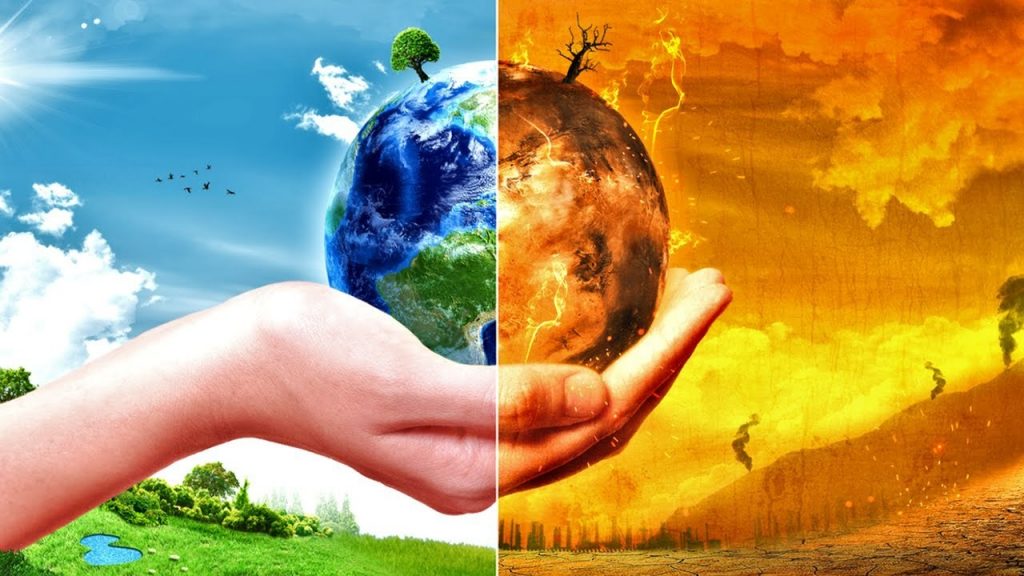
The COVID-19 has taught us that we are in an emergency. In 2019 a teenager named Greta Thumberg was crying hoarse that we are in an emergency and no one was listening. It’s time for us to take stock of the matter. Which is the greater emergency, this COVID-19 emergency or the climate emergency that Greta Thumberg was warning about?

UN report by Intergovernmental Science-Policy Platform on Biodiversity and Ecosystem Services (IPBES) published in May 6 2019 reported:

Up to 1 million: species threatened with extinction, many within decades

>500,000 (+/-9%): share of the world’s estimated 5.9 million terrestrial species with insufficient habitat for long term survival without habitat restoration

>40%: amphibian species threatened with extinction

Almost 33%: reef forming corals, sharks and shark relatives, and >33% marine mammals threatened with extinction

25%: average proportion of species threatened with extinction across terrestrial, freshwater and marine vertebrate, invertebrate and plant groups that have been studied in sufficient detail

At least 680: vertebrate species driven to extinction by human actions since the 16th century

+/-10%: tentative estimate of proportion of insect species threatened with extinction

>20%: decline in average abundance of native species in most major terrestrial biomes, mostly since 1900

>6: species of ungulate (hoofed mammals) would likely be extinct or surviving only in captivity today without conservation measures
Food and Agriculture

Yes this is an EMERGENCY that very few are talking about.

Why are all these species going extinct? Just because of the actions of this invasive dominant species called homosapiens!

The same UN report points out that:

1 degree Celsius: average global temperature difference in 2017 compared to pre-industrial levels, rising +/-0.2 (+/-0.1) degrees Celsius per decade

>3 mm: annual average global sea level rise over the past two decades

16-21 cm: rise in global average sea level since 1900

100% increase since 1980 in greenhouse gas emissions, raising average global temperature by at least 0.7 degree

40%: rise in carbon footprint of tourism (to 4.5Gt of carbon dioxide) from 2009 to 2013

8%: of total greenhouse gas emissions are from transport and food consumption related to tourism

5%: estimated fraction of species at risk of extinction from 2°C warming alone, rising to 16% at 4.3°C warming

Even for global warming of 1.5 to 2 degrees, the majority of terrestrial species ranges are projected to shrink profoundly.

When Countercurrents.org started in 2002, the CO2 level in atmosphere was 370 ppm. Now it stands at 412 ppm. Dr. Andrew Glikson, a climate scientist has pointed out in several articles in Countercurrents that total green house gases in the atmosphere in the atmosphere including CO2, Methane, Nitrous Oxide, Ozone etc has topped 500ppm.

The Paris Agreement’s goal is to keep the increase in global average temperature to well below 2 °C above pre-industrial levels; and to pursue efforts to limit the increase to 1.5 °C.

Coordinated by the World Meteorological Organisation which is also backed by the United Nations Environment Programme and the Intergovernmental Panel on Climate Change, the United in Science report released in September 2019 estimates global emissions are not likely to peak before 2030 on the current trajectory. It says policies to reduce emissions must triple to meet the 2°C target and increase fivefold to keep heating to within 1.5°C.

With the forced COVID-19 lockdown we are well on track to reach the Paris temperature goals. The COVID lockdown taught us what is essential for our sustenance. Most of the carbon emitting vehicles and airplanes are grounded. Our consumption has come down to our basic essentials. Continents jumping tourism has come to a standstill, so has the neoliberal globalisation. It is good time for globalisation to fail and save our planet. Pollution has come down. Cities have become serene. Rivers have become clean. We’ll have to wait for authentic studies to confirm how much carbon footprint did we reduce.

We were living a reckless life like there is no tomorrow, consuming as much as we can and travelling as far as we can. COVID lockdown has put a break to this reckless lifestyle. In fact  it is so much better for the  environment. The COVID lockdown has taught us how much wastage we were making. It also taught us we can live better life with much less than we usually consume.

The COVID lockdown has also taught us we have to do a lot more work to do make our economy resilient. We have to make our local economies resilient. We have to grow our food in our neighbourhood. It will create more local jobs and stop the long haul migration to the cities. The cities too have to become resilient by producing its own food. May be cities itself may not be a good idea and wither away.

The COVID lockdown has given us a sneak preview into the future if we are to meet the global temperature goals. We have no other choice if we are to believe our science experts. Scientists like James Hansen predicts that even the human species may go extinct if we can not control global warming.

Human civilization has seen many pandemics and have won over all of them. We’ll overcome this pandemic too. But I’m not so sure about the battle against global warming. The COVID-19 lockdown has taught us that we can win the battle against global warming too. With a little bit more planning we can do even better.

Binu Mathew is the editor of Countercurrents.org

This article was first published in Countercurrents.org

Disclaimer: The opinions expressed are solely that of the author and not of Borderless Journal.

Categories
Essay

No One Is Tamed, No One Is Equal

Dustin Pickering on Shakespeare’s The Taming of the Shrew

A literary work is often a code that reveals distinct things. Sometimes these things are simply too advanced or the logic of them too cruel. The Taming of the Shrew is one of Shakespeare’s most performed plays and its language is easily read and understood. However, the embedded symbolism may pass by even the most astute mind.

The play is obviously about gender battles, and it seems to some that Kate is tamed by her husband. However, a deeper look at the intricately woven tropes exhumes a critique of culture, a sense of equal justice, and the way institutions impress on our minds. The play extends beyond property relations and the inequality of women. It also poaches one of theatre’s daunting faults. In Shakespeare’s day, women could not play the female roles and instead teenage boys were selected. The theatre was considered dangerous and women too unfit to perform. There was lead in the makeup and the stage action too rough. Theatre was too bawdy.

The Taming of the Shrew contains puns on horses, games, “moveables”, music, and theatre itself. Props or “furniture” signify costumes; there are witty puns revealing the dissembling nature of appearances. In Act IV, Scene III, Petruchio says, “And as the sun breaks through the darkest clouds, / So honor peereth in the meanest habit.” The sun in this respect is the human mind because it is “the mind that makes the body rich”. After Petruchio is delivered a faulty wedding dress, he pontificates on the problem of physical beauty. It is true that he uses this reasoning to tame Katherina. It is part of the ploy to obfuscate her with a list of her own faults. He seeks to embody her worst aspects so she can learn from them how devilish they are. This discussion concerning the gown further moves toward critiquing the use of teenage boys to fill roles meant for females. Again, Petruchio: “is the adder better than the eel, / Because his painted skin contents the eye?” I remind the reader of the lead makeup.

Perhaps Shakespeare intends to remind us real world experience supplements bookish learning. When Vincenti is confused with a young virgin boy by Katherina (Act IV, Scene V), she realizes her error and admits to being “bedazzled with the sun”. Taking up from the aforementioned sun symbolism, Katherina’s error stands in as a trope for pure reason. With pure reason absent of categories, all things merge without identity or qualities. Her vision of green is one of seeing the world “light”. Much of the symbolism in The Taming of the Shrew references binaries such as bottom/top and heavy/light. There is a wild pun on the nature of matter. Actualities contain density while potentialities are ethereal. In an early passage, Tranio prescribes a middle way between the Stoics and Ovid. He advises Lucentio, “The mathematics, and the metaphysics, / Fall to them as you find your stomach serves you: / no profit grows where no pleasure is ta’en.”

Other engaging puns bring to mind property relationships of the Elizabethan era. A role reversal encouraged by Petruchio, of Katherina and Dian, and the playful engagement of dungeon metaphors parody imprisonment. I doubt it can be said with certainty what sort of political statement Shakespeare is making. Is he reflecting the faults of that era, or is he acclimatised to them? The bandying about concerning an imprisoned Kate, her shrewness, and the several occasions where property relations speak on their own behalf invite me to this conclusion: the play is comedic not just in form, but it is a satire of an unequal socio-political environment.

Continuous role reversals, contradictions, and allusions to myths concerning rape and chastity lead me to assume the play indicates that property relations sever our deepest humanity. Katherina can either be her husband’s chattel slave, or she can remain chaste. Both these options are not appealing and neither can be safely ruled out. Perhaps Petruchio marries for the dowry, or maybe he realises his error. After all, the play puns and moralises on looking beyond surface appearances.

Katherina is intent on remaining a shrew but Petruchio is set in taming her. Perhaps in the process both learn something new.

Dustin Pickering is the founder of Transcendent Zero Press and editor-in-chief of Harbinger Asylum. He has authored several poetry collections, a short story collection, and a novella. He is a Pushcart nominee and was a finalist in Adelaide Literary Journal’s short story contest in 2018. He is a former contributor to Huffington Post. 

Categories
Essay

COVID-19: Governance And Scientific Temper In India

By K.P. Fabian

The media, the Indian as well as the international, have  covered the continuing plight of the inter-state migrants resulting from the nation-wide lock-down announced with a calculated abruptness, not uncharacteristic of the Government of India (GOI) judging from the disastrous demonetization and the hurried and thoughtless implementation of GST.

Yet, none in the media has given a proper explanation for the failure of the GOI to anticipate the plight of the millions of inter-state migrants. It has been pointed out that these poor citizens come to the attention of the government only when there is an election. However, there is another explanation which the mainstream media, more or less intimidated by the establishment, do not dare to say: Any such major decision should have been taken based on a cabinet paper as the Rules of Business of GOI mandate. Such a cabinet paper  would have been prepared by the relevant Department/Ministry and submitted by its Secretary to the Cabinet Secretary who would have circulated it to the departments concerned, and even consulted with the states, as they have to implement the decision. That paper would have argued the pros and cons, listed out the actions to be taken before the announcement, and thereafter. It would have listed the anticipable problems such as the plight of inter-state migrants, the supply chain management and more. It certainly would not have recommended an announcement at 8P.M. to be effective at midnight.

Therefore, we conclude that the lock-down decision is not an instance of good governance. The lock-down was necessary. But in government even a good and necessary decision has to be taken and implemented  in the right way. Government procedures are there for a reason. Unless there are extenuating circumstances, the procedure should be respected.

The Finance Minister said that she barely got 36 hours to come out with a financial package. Looking at the half-baked package, her complaint is legitimate.

Let us now look at the strategy of GOI to address the Covid-19 pandemic. The sad truth is that there was no strategy because no attention was paid to the looming disaster though we have a National Disaster Management Act enacted in 2005. On 30th January 2020 the first case in India was detected in the State of Kerala. The patient had returned from Wuhan where she was a student. By 3rd February, two more students who had returned from Wuhan tested positive.

Let us look at the response of the Government of Kerala (GOK) and GOI.  Five days before the first case, the State Health Minister K.K. Shailaja, set up a high-level committee. On 4th February, GOK declared a ‘state disaster’.

The GOI did not take note of what was happening in Kerala. Is there a system of a state government sending an urgent report on such matters to the GOI? Whether it is there or not, the media covered the cases in Kerala, and nothing should have prevented the GOI from asking for an urgent report. Whether such a report was asked for or not, sent or not, the Union Ministry of Health issued an advisory on travel to China only on 17th January. It said that Indians going to China should take care in view of the contagion. On 25th January, a second advisory said that travel to China should be for ‘essential’ purposes only. There was no advisory in February. The third advisory was on 5th March, advising against travel to China.

Question: Why was there such delay? Our Embassy in China would have reported about the raging contagion. Taiwan took prompt action by medically screening arriving passengers from Wuhan, initially informally, and formally after China informed the W.H.O. of the contagion on 31st December.  What is even more important is that Taiwan started making testing kits as a precaution. Surely, our trade office in Taiwan would have reported all this.  By 20th January, the W.H.O.  published the action under way in Thailand, Japan, and South Korea. Our missions in the three countries would have reported on all this.  Our Permanent Mission in Geneva would have reported on all this though the web site of the organization was giving the information.

We conclude that the GOI was not alert.  President Trump and P.M. had a five-hour long session on 25th February. Trump had disallowed flights from China in early February. Did they discuss this contagion?

A related question: Why did Trump come at all, if he had made up his mind to indefinitely postpone a trade deal? Was the sole purpose to get an over-choreographed reception in Ahmedabad to a large gathering who might not have understood what he said as there was no interpretation? What was the raison d’etre of this Wagneraian opera at some cost to the people of India? To show GOI’s support for the candidate Trump? If so, is it wise to pick a side in the election in another country? Good diplomacy advises against such action.

Another instance of the deficit of good governance is that the resourceful military has not been mobilized to assist with the supply chain and the manufacturing of testing kits, PPE (Personal Protection Equipment) and much more.

There is a basic confusion in the mind of the GOI. Lock-down is required only to the extent it produces the conditions necessary for social distancing. Lock-down per se is not desirable.  The imaginary cabinet paper would have had three lists of economic activities:

1) Activities compatible with social distancing with minor modifications.

2) Activities that need more modification to be made compatible with social distancing.

3) Activities not compatible with social distancing.

Talks with the sectors of the economy and its representative bodies would have started on day one of the lock-down if not prior to it.  We see that the corporate sector is finding it difficult to accommodate the workers inside the plant or even to arrange for their transport. Democracy implies dialogue between the government and the rest of the society the initiative for which should be taken by the former. India has an excellent, or potentially excellent bureaucracy and sadly it has not contributed as much as it can into decision-making and implementation. Why is it so?

Above all, we need a scientific temper to successfully deal with such crises. Such temper seems to be absent among a section of the Delhi elite as seen from a WhatsApp message that went around:

The candle flames have temperatures in the range of 400° to 500° Celsius. When so so so many candles will light for 9 minutes, imagine the impact on the environment and the heat so generated will decimate the virus. Why 9 mins, 9 P M and 5th Apr (5+4)?9 in the numerology is an adamant digit, which cannot be destroyed.

It was Jawaharlal Nehru who coined the phrase ‘ the scientific temper’ that he defined in 1946 in The Discovery of India as follows:

“What is needed] is the scientific approach, the adventurous and yet critical temper of science, the search for truth and new knowledge, the refusal to accept anything without testing and trial, the capacity to change previous conclusions in the face of new evidence, the reliance on observed fact and not on pre-conceived theory, the hard discipline of the mind—all this is necessary, not merely for the application of science but for life itself and the solution of its many problems.”

It will be most useful if the P.M. in one of his addresses to the nation draws attention to article 51 of the Constitution which requires the citizens to cultivate such a temper.

This is not the time to find fault for the sake of finding fault. But unity of action in a democracy comes only when the government is self-confident enough to listen to criticism and benefit therefrom.

Let us work unitedly under the leadership of the P.M and C.M.s. India is too large a country to be micro-governed from the capital.

K.P Fabian is a former Ambassador

This article was first published in Countercurrents.org

Categories
Essay

Rebuilding After Corona

By John Scales Avery

A better world is possible!

It is hard to predict how long the terrible COVID-19 pandemic will last, but at some time in the future it will end, and we will be faced with the problem of rebuilding the world after the enormous economic and human destruction which the disease will have left in its wake. The pandemic has thrown light onto the world’s political and economic systems, and has shown them to be wanting. Most people today do not wish to return to the old normal. That “normal” was part of the problem. The post-pandemic world must be a new and changed world!

Is a better world possible? Of course it is! Our present world is filled with an almost unimaginable amount of injustice, greed and folly. Why is our present world so full of glaring faults? One reason can be found in the slow rate of change of genetic evolution, compared with the lightning-like rate of cultural evolution. We face the problems of the 21st century with an emotional nature that has not changed much since our ancestors lived in small tribes, competing for territory on the grasslands of Africa. Our emotional nature contains an element of tribalism to which militarists can all too easily appeal.

Recovery offers climate action opportunities

When the COVID-19 pandemic is over, governments will be faced by the task of repairing the enormous economic damage that it has caused. The situation will be similar to the crisis that faced US President Franklin D. Roosevelt when he took office during the Great Depression of the 1930’s. Roosevelt, encouraged by John Maynard Keynes, used federal funds to build much-needed infrastructure around the United States. His programs, the New Deal, ended the Great Depression in his country.

Today, the similar concept of a Green New Deal is being put forward globally. This concept visualizes government-sponsored programs aimed at simultaneously creating both jobs and urgently-needed renewable energy infrastructure. The Green New Deal programs could be administered in such a way as to correct social injustices.

A sustainable economic system

Economists, with a few notable exceptions, such as Nicholas Georgescu-Roegen, Aurelio Peccei and Herman Daly, have a cynical tendency to confine their discussions to the short-term future. With self-imposed myopia, they refuse to look more than a few decades into the future. This allows them to worship growth, and to advocate perpetual growth. But endless growth of anything physical, on a finite earth, is a logical impossibility.

Our present financial system is unsustainable, and it works for the interests of a few very rich people.  For the sake of the long-term future, we must build a sustainable, steady-state economic system, an economic system which reduces inequality, and which serves the broad public interest, an economic system with both a social conscience and an ecological conscience.

A new freely downloadable book

I would like to announce the publication of a book, which discusses the changes that we must make to create a better world after the pandemic has ended. The book may be freely downloaded and circulated by clicking on this link.

http://eacpe.org/app/wp-content/uploads/2020/04/Rebuilding-After-Corona-by-John-Scales-Avery.pdf

Other books and articles about  global problems are on these links

https://wsimag.com/authors/716-john-scales-avery

https://wsimag.com/authors/716-john-scales-avery

I hope that you will circulate the links in this article to friends and contacts who might be interested.

I hope that you will circulate the link in this article to friends and contacts who might be interested.

John Scales Avery is a theoretical chemist at the University of Copenhagen. He is noted for his books and research publications in quantum chemistry, thermodynamics, evolution, and history of science. His 2003 book Information Theory and Evolution set forth the view that the phenomenon of life, including its origin, evolution, as well as human cultural evolution, has its background situated in the fields of thermodynamics, statistical mechanics, and information theory. Since 1990 he has been the Chairman of the Danish National Group of Pugwash Conferences on Science and World Affairs. Between 2004 and 2015 he also served as Chairman of the Danish Peace Academy. He founded the Journal of Bioenergetics and Biomembranes, and was for many years its Managing Editor. He also served as Technical Advisor to the World Health Organization, Regional Office for Europe (19881997). http://www.fredsakademiet.dk/ordbog/aord/a220.htm. He can be reached at avery.john.s@gmail.com. To know more about his works visit this link. http://eacpe.org/about-john-scales-avery/

First Published in Countercurrents.org

Categories
Essay

Begum Akhtar: The ‘Mallika-e-Ghazal’

By Bhaskar Parichha

‘When I decided to be a singer, my mother warned me I’d be alone a lot. Basically we all are. Loneliness comes with life.’

-Whitney Houston

For Begum Akhtar loneliness came rather belatedly — after her marriage to barrister Ishtiaq Ahmed Abbasi. With marriage came the ban — no music, no concert. How can a Begum sing publicly?

However, Akhtaribai Faizabadi, as she was known before marriage, couldn’t have lived a day without a recital because she was born for it.

Her first guru was Ustad Imdad Khan, a great sarangi exponent. She was also trained under Ata Mohammed Khan. But it was in Kolkata in the early thirties that her musical career took a big twirl. She began learning music from such classical stalwarts like Mohammad Khan, Abdul Waheed Khan and Ustad Jhande Khan. There was no going back after that.

Begum Akhtar gave her first public performance at a very early age — fifteen to be precise and she took the music world by storm.  Sarojini Naidu — the nightingale of India — was so moved   by Begum Akhtar’s singing during a concert organised in the aid of victims of Bihar earthquake that she prophesied the materialisation of a great singer in the young Akhtaribai.

Ghazal singing was Begum’s forte. She cut her first disc for the Megaphone Record Company in the mid-thirties followed by a number of gramophone records carrying her ghazalsdadrasthumris.  What is little known about the ‘Queen of Ghazals’ is that she was a feminist to the core.  Begum lived her life like no other woman till her death in 1974. She had dared to play around with the freedom to make choices in life, revealing a true feminist soul.

With the advent of the talkie era in India, Begum Akhtar acted in a few Hindi movies. In fact, she was the leading lady in films of those times. Ek Din Ka Badshah (An Emperor for a Day) was her first film produced by the East India Film Company of Calcutta. Then came Nala Damayanti (1933).  Like others of her genre, she herself sang her songs. She continued acting and there were a couple of memorable films to her credit: Ameena (1934), Mumtaz Begum (1934), Jawaani Ka Nasha (The Drunkenness of Youth, 1935), Naseeb Ka Chakkar (The Circle of Destiny, 1935). She acted in Roti (1942) — produced and directed by Mehboob Khan — for which she sang six ghazals. The music was composed by melody maestro Anil Biswas.

Begum Akhtar’s association with films continued even after a face-off with Mehboob Khan. Music Director Madan Mohan gave her a chance to sing in two of his films– Daana Paani (Food-Water,1953) and Ehsaan (Favour,1954). Satyajit Ray’s Bengali film Jalsaghar (The Music Room, 1958) was her very last role where she played the role of a classical singer. Begum Akhtar alternated between Bombay and Lucknow in pursuit of her career. She had a stint in theatre too. But her voice needed to be regularly hoisted up. So, she gave up acting in theatre.

Begum Akhtar’s voice matured with time, adding richness and depth. She sang ghazals and light classical pieces in her inimitable style. She has nearly four hundred songs to her credit — an incredible inventory for someone who grew up amid harsh conditions.

A regular performer on All India Radio, she invariably composed her own ghazals and most of her compositions were raga– based. Begum Akhtar had a deep, husky and richly-timbered voice with nasal intonations. In her thumris she blended the Purab and Punjabi styles. She did not resort to taan patterns in a fast tempo. Her dadras were infused with a sprightly mood; her ghazals were thumri-oriented with much scope for improvisation.

The peculiar charm of her voice was easier felt than described. Hers was an extraordinary voice — not ‘round or petal-soft but angular and pincer-like.’ She was known to use a momentary split in her voice, called ‘patti’, which appeared like a crack in the upper register. It is said that her admirers waited for the ‘patti’ to come out when she sang.
Begum Akhtar was a scholar of Urdu poetry too. Her favorite poets were Ghalib, Dadh, Faiz Ahmed Faiz, Jigar Moradabadi, Shakeel Badayuni, and Kaifi Azmi. Many small poets rose to prominence when she selected their lyrics. It speaks highly of her music that she had an impressive following even in regions where Urdu or Hindi was not properly understood. In later years she sang in Bengali and Gujarati too. She taught for a trice at the Bhatkhande College of Music in Lucknow. Her disciples included Shanti Hiranand, Rita Ganguly, Vasundhara Pandit, and Rekha Surya.

The singing sensation’s last concert was held in Ahmedabad. It was here that she fell ill and had to be rushed to a hospital. Death came her way on the 30th of October, 1974 leaving a big void in ghazal singing. She was posthumously awarded the Padmabhushan, the third highest civilian award in India.

Begum Akhtar’s name is synonymous with the notion of ghazal gaayaki*. She immortalized her own definitive style of singing — a style that few have been able to be equivalent. She is fittingly called — Mallika-e-Ghazal.

*The mode of rendition

Bhaskar Parichha is a Bhubaneswar-based  journalist and author. He writes on a broad spectrum of  subjects , but more focused on art ,culture and biographies.His recent book ‘No Strings Attached’ has been published by Dhauli Books. 

Categories
Essay

The Economy, Lemurs And Us

By Sally Dugman

The underlying human horror and destruction from the nearly worldwide COVID-19 disease is truly daunting. Not to undercut the seriousness of the devastation, but this type of happening is hardly new. For example, consider the Black Plague that wiped out half of Europe and the fact that many British people are immune to Smallpox unlike many Native Americans whose ancestors were never exposed to the disease.

All the same, there are many other horrific events afflicting people and members of other species. Indeed, we all face floods, famines, pestilence, tornadoes, hurricanes, water shortages, tsunamis  and more. It seems that these sorts of events have existed since almost times immemorial for some dire happenings.

We also have another type of trouble and it involves decimation of the natural world. There is nothing new in that pattern either except that we have ever so many more people than in earlier times trying to eek out a living by dismantling the world’s forests, meadows, waterways and so on to have self-economic advances for oneself, family members and others.

In relation, it seems to me that desire for great self-gains indirectly accounts for greedy money mongers, people with giant homes filled with belongings and ditto for their vacation homes, vacation travel and other perks associated with having wealth.

Further there exist game shows in the USA wherein people compete for money. In some shows, the money to be potentially gained is a lot and in others — a little.  And some of the people in these programs act covertly or overtly savagely to get that moola for themselves. How nasty! … Civility can be quite far from the surface in these programs, and you can see the lack through body language, eyes, tone of voice, pretense, etc. (Such behaviors can sometimes be fascinating to watch as they show some degree of depravity in my opinion.)

All considered, it is not surprising one iota when a friend sent me this analysis titled “Your brain evolved to hoard supplies and shame others for doing the same.” It demonstrates in a way the desire to get ever more for oneself.

Two excerpts:

“The media is replete with COVID-19 stories about people clearing supermarket shelves – and the backlash against them. Have people gone mad? How can one individual be overfilling his own cart, while shaming others who are doing the same?

As a behavioral neuroscientist who has studied hoarding behavior for 25 years, I can tell you that this is all normal and expected. People are acting the way evolution has wired them.

“At the same time they’re organizing their own stockpiles, people get upset about those who are taking too much. That is a legitimate concern; it’s a version of the “tragedy of the commons,” wherein a public resource might be sustainable, but people’s tendency to take a little extra for themselves degrades the resource to the point where it can no longer help anyone.

“By shaming others on social media, for instance, people exert what little influence they have to ensure cooperation with the group. As a social species, human beings thrive when they work together, and have employed shaming – even punishment – for millennia to ensure that everyone acts in the best interest of the group.”

So let’s look at lemurs in this ravenous backdrop:

I saw in an environmental documentary that there are only around 20,000 left in the world with numbers dwindling (as their land is increasingly snapped up by humans) as compared to around 7.8 billion humans with the number of the latter kind growing. And blood samples were taken from them for study and possible drugs to be developed for humans.

Why? It is because they get many of the same ailments like Parkinson’s and Alzheimer’s as people do and how could that be so?

Look at your juxtaposed thumb. It came from natural selection based on a mutation and it is from lemur ancestors. In other words, the wild lemurs are your very distant cousins.

This has long been suspected as being the case. Yet it was only recently that two, yes — two, fossil samples prove it. After all, we are the only species with the opposed thumbs, which are very useful in myriad ways. And the fossilized evidence satisfactorily proves it since they have our thumbs.

Now, it is fine enough in my opinion that some people want to literally believe that humans derived from Adam and Eve. It is fine that they believe that life originated from some being standing on a turtle shell or aliens from outer space seeding our planet with life.

All power to them if such ideas bring comfort and joy. Good for them!

Meanwhile I like looking at my thumb while marveling at its origins. That view in light of empirically derived facts suffices for me.

Sally Dugman lives in MA, USA.

This piece was first published in Countercurrents.org

Categories
Essay

After the Pandemic

By Devraj Singh Kalsi

Our admiration, interest, and respect spikes for countries where the spread of Covid-19 is flattened or limited with early measures. As we track global statistics on a daily basis, any country with less than 1000 cases makes us react with Wow and How. As we scroll further down the list, those with 500 or less than 100 cases make us feel positive and we conclude: This is the place to live. These may or may not be counted as fantasy lands or ideal destinations in normal times, but when it comes to survival, we salute them for keeping citizens safe in these dark times.  

When I discussed this with some friends in an online chat, they are reluctant to bat for developed and advanced nations now. Countries more efficient in the management of crisis and saving human lives, countries more benevolent towards the poor, countries with more nature-friendly policies, countries where a citizen is considered much more than a statistic are weighed against the traditional heavyweights. When the pandemic subsides and people have lesser emotional stress, perhaps the same set of questions will have completely different answers. Or maybe, the magnitude of this crisis enables us to imagine grief more closely and we are compelled to revise our assessment of growth, development, and quality living. 

While the recovery phase will take its time, the nations least affected will have having a clear advantage over the severely affected ones. Whether they will be able to leverage on their strengths and give the world the option of a better life with limited but sufficient resources remains to be seen.   

Economists and artists will get busy mapping the COVID-19 impact on people once the pandemic is contained. GDP predictions, recession, relief packages and stimulus will form the key discussions. The wealthy of every nation will look for growing economies to park their funds and they will come together to create rich economies — lured by maximum plough back of profits. They will look for economies with double-digit annual growth or for high single-digit economies with enormous potential to double up in the short term itself.

Job losers and fresh job seekers will migrate in search of better and stable options anywhere in the world. The top ten nations for immigrants will be another interesting development. Many new countries will enter this list and many big names will be excluded from the list. Globalisation will become a word of caution for some nations while the rest of the world will begin to harness its potential.  

Tragedies inspire artists. The political class that creates global tragedies will be defeated by nature this time. Man-made tragedies kindle the angst in artists far more than the natural ones, even if the extent of damage remains the same or even greater. Being lovers of nature, the community of artists will not be ruthless towards the eco systems. They will blame mankind for being unkind, for the excesses against nature, and treat every natural disaster as the planet’s brave attempt to heal or reclaim what it lost. Artists will remind people and countries to be friendlier towards the Earth as will environmentalists, who have always emphasised harmonious co-existence with nature. This enthusiastic drive will continue with full force.

As soon as the element of greed raises its ugly head and the countries become competitive to provide a ‘better life’ or restore the ‘better’ life, the return towards normal will start. Although we live under greater threat, we have greater confidence that we will survive every kind of threat. The resumption of the predictable cycle will make us return to our lives of consumerism, to flaunt fancy gadgets or something precious to suggest our material abundance. The lessons from COVID-19 will be forgotten and buried.

Rich countries fear the death of their privileged status more than the death of thousands and millions of people. Those who survive will need to live in the same country with pride in its strengths. A country with the highest casualties will continue to say it is far below the expected numbers. If a million die, they will boast of saving many millions more. They will boost the morale of the nation with solidarity drives and keep them upbeat about a quick bounce back. It is a humongous task that brings a battery of opinion makers, public relation strategists and pliant media to play a constructive role in helping governments build – or rebuild – their image.

However, as critical assessment will have lesser tolerance, masses will expect their governments to do what is required. In such times, elected leaders will get the opportunity to showcase their potential. State leaders will grow in stature through their performance. National leaders will find suitable roles other than criticising the government. Social service measures to benefit the poor will help them connect better. Instead of lampooning the governments, people should be seen aligned with the government. These images will linger in the public mind for long. And a new class of leaders will emerge as viable alternatives –some reaching the helm through sacrifice, some reaching it through service.    

It will not matter whether democracies deliver the best care or totalitarian regimes perform better. Any kind of governance will find resonance if the citizens conclude their leaders prevented severe loss of human lives. At the end of the day, survival matters. The political class has understood it is not only important to do enough, but it is equally important to be seen you are doing enough. When one game seems lost, the other has to be won.

Global leaders are trying their best to tell their citizens they have a responsive and proactive government. When elected leaders get affected by the virus, they appear vulnerable as individuals. When they get cured faster, they prove their stronger ability to fight and survive. A subtle message that the nation is safe in their hands.


Devraj Singh Kalsi works as a senior copywriter in Kolkata. His short stories and essays have been published in Deccan Herald, Tehelka, Kitaab, Earthen Lamp Journal, Assam Tribune, and The Statesman. Pal Motors is first novel.  

Categories
Essay

Strangers in Our Midst

By Dustin Pickering

( dedicated to President Donald Trump)

In the uncertain and unsettling time of the COVID-19 crisis, we may be wise to consider our good fortune and family. We are fortunate, in fact, that our family bonds exist and we have loved ones at all. This testifies to God’s ever shining mercy. However, in the current crisis we should also consider those who are distant from us and less fortunate. A variety of faiths teach mercy to the needy.

The word family originally referred to domestic servants under one roof. It only emerged in its current meaning in the 1600’s. Strangely, the word familiar also has a unique history:

mid-14c., “intimate, very friendly, on a family footing,” from Old French famelier “related; friendly,” from Latin familiaris “domestic, private, belonging to a family, of a household;” also “familiar, intimate, friendly,” a dissimilation of *familialis, from familia (see family).

From late 14c. as “of or pertaining to one’s family.” Of things, “known from long association,” from late 15c. Meaning “ordinary, usual” is from 1590s.

The noun meaning “demon, evil spirit that answers one’s call” is from 1580s (familiar spirit is attested from 1560s); earlier as a noun it meant “a familiar friend” (late 14c.). The Latin plural, used as a noun, meant “the slaves,” also “a friend, intimate acquaintance, companion.”

— Online Etymology Dictionary

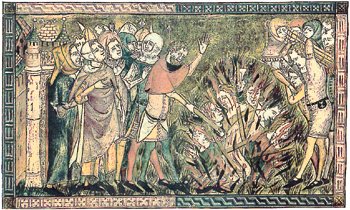
Family and familiar share a common background apparently. Suspected witches, burned in numerous witch trials, had their familiar spirits. Some speculate that the European psyche was traumatised by the Black Death that depopulated the land, and such widespread trauma led to the historic witch hunts. Fear has a way of unraveling the human psyche and creating an atmosphere of unrest. We are facing similar conditions now.

When our social ties loosen, we turn on one another. Strangers are seen in every human face. Yet what is a stranger? What makes a person a stranger? Are strangers only those who cross borders? Is it the distance separating him or her? Is it a transformation of self that makes another person strange?

Recent foreign policy blunders have shaken the world and created a refugee crisis that only time or God could sort through. From Arab Spring and Mubarak, to Assad and Syrian protests, horrific deaths and destabilizing events shook the Middle East as well as Europe. Refugees fled and were welcomed by Germany, Canada, and the United States, but to the dismay of much of those countries’ populace. Quite possibly, these events brought by the Obama administration are a cause for Brexit as well as tightened immigration policies. France, as recently as 2018, imposed tougher immigration policies and included assimilation and learning French in their priorities for accepted refugees.

The question of nationalism is a heated one. However, even the founder of The Huffington Post, Arianna Huffington, once opposed lax immigration policy though she is an immigrant herself. The debate concerning immigration policy revolves around culture, law, human trafficking, employment, and human rights. Why do nations safeguard  a certain identity for themselves? Why is “the Other” to be feared, misunderstood, deported?

Is there something integral to nation states that they desire to protect themselves from those outside them?

All across the world we are asked to practice “social distancing”, to quarantine ourselves to protect against the spread of COVID-19. To “flatten the curve”, experts say, we must work at home and venture out only for essential tasks, and then we must keep our distance from others. As can be expected, people are lonely and restless. The virus has generated conspiracy theories, shut down events and outdoor activities, and emptied stores of wares, especially toilet paper.

 According to Rene Girard, an anthropological philosopher, the plague was often blamed on those of the Jewish faith. Many Jews practiced medicine, and their ability to heal also made them suspect. They were believed to cause the illness they could treat. They were accused of poisoning community wells. It turns out the plague was actually carried by fleas on rats. Hysteria distorts our perceptions of one another. Where there is no perceived explanation, we invent one from our fears and suspicions.

Does a quality of strangeness arouse suspicion? If so, what defines the quality? Is strangeness something within us, not so much outside? When facing inner transformations, do our surroundings alienate us? In what sense are we even masters of our environment, so heated by political strife?

One thing is certain: President Trump told Mexican President Enrique Peña Nieto that his border wall was at the bottom of the priority list. However, couldn’t he tone down the divisive rhetoric? Or is this the way he befuddles a hostile press?    

American Historian Howard Zinn wrote, “Nations are not communities and never have been. The history of any country, presented as the history of a family, conceals the fierce conflicts of interest (sometimes exploding, often repressed) between conquerors and conquered, masters and slaves, capitalists and workers, dominators and dominated in race and sex. And in such a world of conflict, a world of victims and executioners, it is the job of thinking people, as Albert Camus suggested, not to be on the side of the executioners.”

 Recall the etymology of family and familiar. The strangeness of the Other is the strangeness of our haunted psyche. We project our fears and naked ambitions onto the Other, or the outsider, who we construe secretly to harbour those same things within. Does the Other become our double? Considering our eusocial nature, Othering may be the psychological stumbling block we put our heads on before the executioner arrives.

President Trump insisted on calling COVID-19 “the Chinese virus” during this crucial period of trade negotiations with the Chinese government. In his briefing, he informs the press and public that his negotiations are going well. In what sense is he, as President, Othering China? Do we Other him in our recoil against his rhetoric? Perhaps he is the doppelgänger of our country’s hideous history coming to bite us back. Perhaps he is the voice of the forgotten, as his adviser Stephen Miller told CNN.  In being the voice of the forgotten working class, has he saved the working class at all or only confused things more?

One thing is certain: we are strangers to ourselves if we cannot answer these questions.

Dustin Pickering is the founder of Transcendent Zero Press and editor-in-chief of Harbinger Asylum. He has authored several poetry collections, a short story collection, and a novella. He is a Pushcart nominee and was a finalist in Adelaide Literary Journal’s short story contest in 2018. He is a former contributor to Huffington Post. 

Disclaimer: The opinions expressed are solely that of the author and not of Borderless Journal.