Categories
Review

The Chronicler of the Hooghly and Other Stories

Book Review by Gracy Samjetsabam
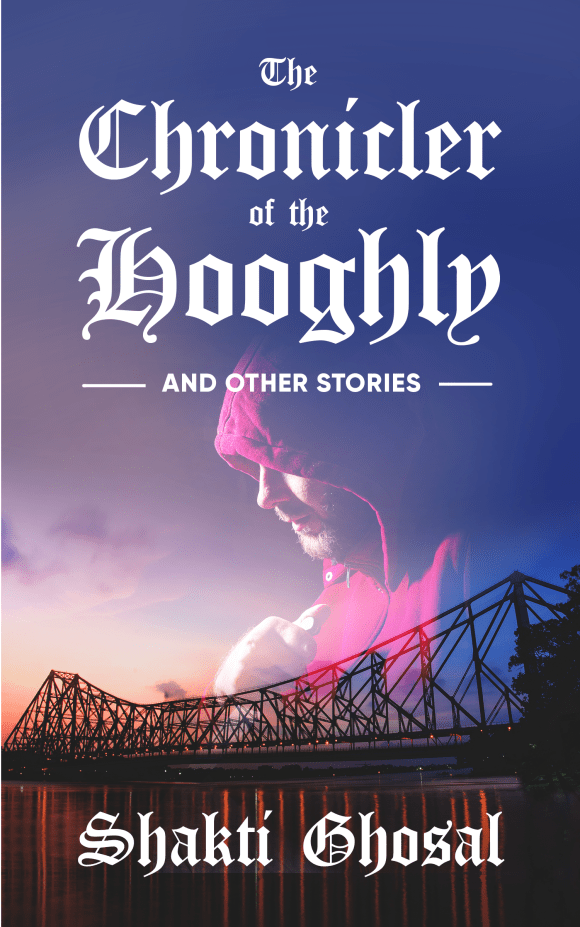
Book: The Chronicler of the Hooghly and Other Stories

Author: Shakti Ghosal

Publisher: Half Baked Beans, 2020

The Chronicler of the Hooghly and Other Stories by Shakti Ghosal is a collection of four compelling stories that hover around people in different times and places around the majestic Hooghly in Kolkata. As the river flows, the narratives flow with the current as long as there are storytellers and listeners.

Shakti Ghosal, an MBA from IIM, Bangalore, is a seasoned corporate personnel with more than four decades of experience both in India and abroad. The globetrotting Ghosal and his passion to explore new places and cultures are vividly imbued in his writing. The Chronicler of the Hooghly and Other Stories,  is a well-researched debut book entrenched in history.

His stories help us make sense of our realities. Ghosal admits that intense and traumatic events in life have contributed to the creation of these stories. Part-memoir, part-historical, Ghosal paints the stories with strokes of personal experiences and from chapters of India’s long history, selecting those that converse about Kolkata. This tapestry makes the readers more aware of the nuances of history and vividly recreates these scenes in the imagined reality. Ghosal impressively weaves history and imagination to blend fiction and reality, thereby providing a voice of the unrecorded, the myths and legends around what happened on the other side of known history during the colonial period in pre-independent India or at present.  

‘Ashtami’, the first story starts with a nightmare, a dream Lord Curzon had since his childhood days setting the tone of the story. The story opens in 1912 with Sujit, a Junior Clerk in the British administration and his wife Bina as they are all set to relocate to Delhi. Weaving the story in close quarters with the time of Ashtami during the Durga Puja festival of Bengal, Ghosal raises the idea of birth and death, beginning and ending in the personal lives of the characters along with the history of the nation, thus proposing life coming in full circle with fragments of joys and sorrows. Change is the only constant that is destined in the uncertain future.

From 1912 to 1947 and after, Sujit and Bina witness progress in life through their journey from Kolkata to Delhi with their children, the double irony of the life of the youngest child Shanti is a touching twist. A human error of a delivery gone wrong, makes Shanti a differently-abled child. As a result, he is mistreated, ignored, and judged by siblings and society but at heart, he is a sensitive soul. Shanti’s home schooling, errands, plea for help as his brother is murdered in an unjustifiable situation during the communal violence of the Great Kolkata Killings, an aging mother’s concern for a differently-abled child and the death of his mother leaving him helplessly alone, makes him and, subsequently, the reader, wiser on life and life’s little ironies. The lighter notes on the Howrah, Lal Qila, horse drawn tonga rides at Civil Lines, interstate train journeys, Burra Bazaar to Chandi Chowk, typical dust storms in Delhi, Durga Puja, food and communication through postcards make the story flavourful.             

‘Pandemic’ moves through different time zones within a century, dealing with similar situations in history. Dipen in 1919 is caught in the mahamari at Khidderpore docks where he is a labour supervisor. Indranil from Gurgaon in 2020 is caught in the pandemic situation in the middle of a safari trip with his wife in the Dooars forest region of West Bengal. Although a hundred year apart, the stories highlight similarities and differences in the human condition. Amidst the pandemic, Dipen is caught in all that happens between his home and the dockyard. Ghosal touches upon health issues both physical and mental, quarantine, human emotions, personal secrets, sacrifice, and life choices. Ghosal also beautifully brings out the gender readings as he sheds light on life as a widow or a widower, childlessness and society, and of perceptions on ill-luck and how ironically, the characters deemed as unlucky or  how just what is deemed as bad luck convert to beacons of hope and goodwill. Through Indranil, Ghosal discusses lockdown and cytokines, the science and signs of the disease along with the issues of present-day work and marriage and brings to light different aspects of youth, the working class, newer trends that govern passions, aspirations, families and priorities.         

In ‘Fault Lines’, a deadly gas explosion changes Anjan’s life forever. The accident broke the artificial shell that Anjan and Jaya made their home in and the realities that lay hidden in his subconscious haunts him in disguise of Savio, Anjan’s friend. Set in the idyllic Middle-East, and shuttling back and forth in time and between places, Anjan finds enlightenment through lessons on karma. Jaya closes the story with the understanding that nothing good can be built on the foundations of deceit and hurt.

The titular story, the last one in the book, ‘The Chronicler of the Hooghly’, has the protagonist, Samir, reacting to his dying mother who utters a panic-stricken whisper, “mukto malar abhishap” or the curse of the pearl necklace. Here Ghosal intricately and imaginatively spins history and myth to take us into a string of narratives strewn in their pathway by the fabled curse of the necklace. The ‘Chronicler’, or narrator, mystically and mysteriously asks, “What could be behind you taking this trip today and me telling you this tale?” He narrates the stories to Samir in the breath-taking boat ride on the Hooghly with a feeling both of nostalgia and curiosity, swaying between past and present to highlight the bigger picture. He touches upon England and Calcutta (1842-1846), Murshidabad palace of Siraj ud Daula in June 1756, Chandernagore (1757), Plassey (1757), and Calcutta (1846-55), along with the present day beautifully guiding the reader to the climax of the story.   

What is most fascinating is the telling of the stories in an alternative voice making the readers experience history with a fictitious veneer that magically brings into sight the hitherto unknown facets. Despite being set in a different time frames and in different situational events of history, the timeless elements in Ghosal’s stories are priceless.

The elements in the stories such as the anxieties of moving to a new place, the concerns of leaving behind old parents, the generational gap on how one looks at traditions, reflections on crisis and resilience on issues ranging from the Partition to communal violence to casteism to the pandemic and more, changing belief systems over time and experience, old age, diseases, mental health, loss and grief of a child or a partner, a parent’s concerns for their children, on the importance of empathy and decision-making,  on acknowledging uncertainties, on karma and enlightenment, finding home or solitude, or coming to terms with oneself – Ghosal sprinkles confetti of his coaching in life skills into the storytelling to create a set of modern-day tales that are easily relatable and palatable. The style and the settings are like fresh air that enlightens as it entertains. The stories are vibrant and close to current realities, making them a worthy read.

These are stories of changing times and a reminder that life is short, and that time will not wait for us. But we need to be positive, hopeful and be aware of the best we can do for ourselves and for others.     


.

Gracy Samjetsabam teaches English Literature and Communication Skills at Manipal Institute of Technology, MAHE, Manipal. She is also a freelance writer and copy editor. Her interest is in Indian English Writings, Comparative Literature, Gender Studies, Culture Studies, and World Literature. 

.

PLEASE NOTE: ARTICLES CAN ONLY BE REPRODUCED IN OTHER SITES WITH DUE ACKNOWLEDGEMENT TO BORDERLESS JOURNAL

Categories
Poetry

Mystical reconnections: Reading Tagore

By Sunil Sharma

I know not what playmate of mine in the sky sends them down
the air to race with my boats!
When night comes I bury my face in my arms and dream that my
paper boats float on and on under the midnight stars.

Rabindranath Tagore

Trapped inside the cage, I look up at the sky 
and am, somehow, by cultural memory
reminded of the above lines of the
Immortal Bard who guides me on
in this astral voyage of recovery of
the  self and  the dim
pathways, out there, now visible again,
modes, perceptions leading directly
to the realities of the heavens and 
the heavenly songs, in our midst.
Gurudev! Pronam!
You restore -- in the post-modern,
post-industrial, consuming unit,
recipient -- a sense of the lost
grandeur, wonder, joy;
a promise of an
uplifting presence around
and, of the missing
 bliss that flows from
ordinary moments of the
enraptured
gazing at the stars from
a locked-down home’s
barred windows, thereby, 
that very moment, feeling
reassured of that
playmate for me, us, in
a single instant of reading,
viewing, experiencing
mystical reconnections
with an original vision,
heritage,
roots,
idiom of the lived lives,
profound
civilizational truths
in these cynical times!

Sunil Sharma is an Indian academic and writer with 22 books published—some solo and joint. Edits the online monthly journal Setu. Currently based in MMR (Mumbai Metropolitan Region).

.

PLEASE NOTE: ARTICLES CAN ONLY BE REPRODUCED IN OTHER SITES WITH DUE ACKNOWLEDGEMENT TO BORDERLESS JOURNAL
Categories
Essay

Rabindranath and the Etchings of His Mind

Anasuya Bhar explores the various lives given to a publication through the different edited versions, translations and films, using Tagore as a case study and the work done to provide these online .

Rabindranath’s first efforts at writing poetry, what he refers to as padya or rhymes, were made when he was merely a boy of seven or eight years. This is what he has to say about his maiden experience, the magic and the awe with which it surprised him –

“I had, until then, only witnessed rhymes in printed books. Without any scratches, mistakes, nor any signs of thought even – there seemed to be no sign of any of the earthy weaknesses either. I dared not imagine that these rhymes could be produced by one’s own efforts. … But when the skilful mixing of a few words gave rise to the rhythm of the ‘payar’, the magic of making rhymes remained no longer an illusion. “(My translation from Jibansmriti ‘The Poetry Beginnings’, VB, 27)

The above excerpt from Jibansmriti is significant in many ways. The memoir was written when Rabindranath was in his fiftieth year, in 1911. A careful study reveals that there are three manuscript versions to the text of Jibansmriti and the one available on print (and published by Visva Bharati), is the third and the latest version. Jibansmriti (My Reminiscences) is a piece of Rabindranath’s own life writing, along with two other pieces in book form: Chelebela (My Boyhood Days, 1940) and Atmaparichay (The Self Revealed, 1943).  

Rabindranath was a reluctant biographer of himself. Perhaps his first conscious efforts at autobiography is to be found in an essay called Atmaparichay that was first published in 1904, wherein he had consistently defended his wishes to not fuss over his life. In fact, he had wanted to keep separate his jiban and brittanto, that is the biological nitty-gritty of his life and the descriptive and analytical of his creative life. He believed that a poet’s life inheres in his poetry; that there is no need to separately concern oneself about his life details. This was re-iterated in more than one places. Nevertheless, although Rabindranath was reluctant of a conscious autobiography, he has revealed much of himself in his letters, and other non-fiction and travel essays. He was a self-conscious writer with a great emphasis put towards self-expression as well as expression of the self.  To know about him one needs to scour through these writings.

My intention in this essay, however, lies not in the history of Rabindranath’s life writing. I would, instead, like to dwell on those scratchings, mistakes and etchings of the poet’s mind that made Rabindranath ponder about the final version of any of his manuscripts. He was a relentless revisionist of his own writings. My interest lies in that branch of study, quite recent in academic scholarship, which tries to examine the various changes that each text suffers before being available for the final print. The changes might take place in the manuscript or during the correction of proofs. The successive texts, the manuscripts, the proofs, and finally the printed text all seem to have their own dynamics and seem to possess an autonomy and character of their own. This seems true of all texts of all writers and those of Rabindranath are no exception. Between the ideas and their writing, between the manuscript and the print, between the printed text and its translation into other language(s), a particular text seems to have many distinct lives. Until a short time ago, these fell within the purview of textual criticism and editorial scholarship of a text. Now, they may be considered under the rubric of ‘alternative readings of a single text’. Walter Benjamin (1892 – 1940), the German Jewish philosopher, talks about the ‘afterlife’ of a text in his essay ‘The Task of the Translator’ when it is translated, that is to say, a text assumes a different and separate life, with its own dynamics and dimensions when it is translated, from the original. The lives of a text then, multiply when multiple translations take place.

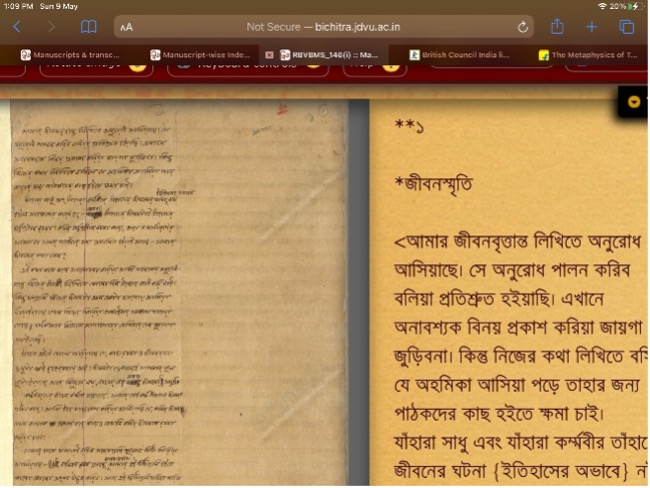
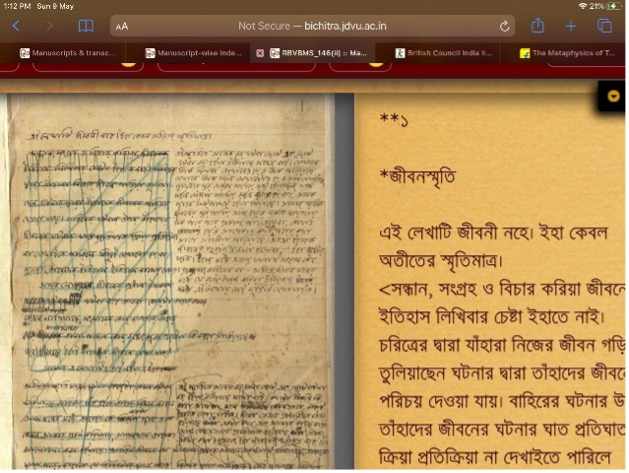
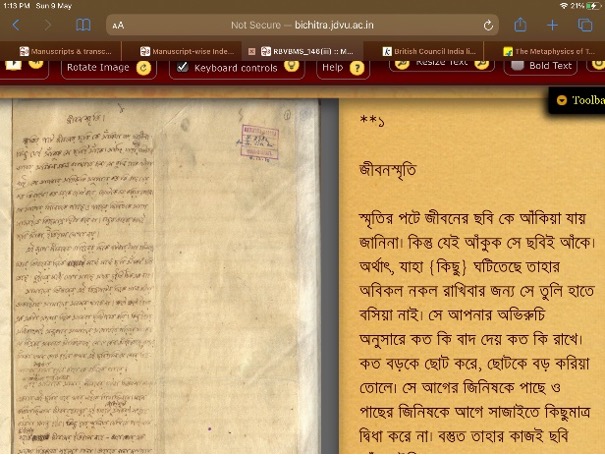
If one studies the three manuscripts of Jibansmriti, one notices three separate beginnings: the first two distinctly pointing to his life proper and his unwillingness to share details of it, while the third and the printed version has a more abstract vision of a painter-like selection of memorable incidents from his life.  The text as it exists in Bangla now, begins in medias res, as it were, with the recollections of his early childhood, as becomes permissibly natural for the memory of a fifty-year-old person. What is interesting are the insights that time and aesthetic distance have provided. Editorial and textual scholarship of Jibansmriti as revealed in Rabindra Rachanabali (Volume 17, Visva Bharati), ‘Grantha parichay’ (introducing the text) cites the minute changes and differences in the three versions of the text. I enclose photographs of all the three versions of the text:

The first manuscript of Jibansmriti. Source: Bichitra

The second manuscript of Jibansmriti. Source: Bichitra

The third and final manuscript of Jibansmriti. Source: Bichitra

The different variations and all the manuscripts of not only ‘Jibansmriti’, but the entire Rabindranath Thakur corpus, including his plays, fiction, non-fiction, drama and poetry in English as well as in Bangla, are now available in the Online Tagore Variorum, Bichitra, which was inaugurated by the then President of India, (Late) Shri Pranab Mukhopadhyay, as a part of the Sesquicentenary (150 years) celebrations of Rabindranath Thakur’s birth, in the year 2011. The programme of the digital archives for Rabindranath was co-ordinated by Sukanta Chaudhuri, Professor Emeritus of English, Jadavpur University, and prepared by the School of Cultural Texts and Records, Jadavpur University. The digital archives bring together all the available versions of all his works and makes provision for their collation, thus allowing the researcher or anyone interested in the world-poet to look through the vast stretch and range of his works. Hence the aptness of its name ‘Bichitra’, meaning ‘various’. It is a unique venture of literary scholarship as well as of software engineering and has been put together by young members all below the age of 35, and academic degree holders mostly from Jadavpur University. It is a rare and pioneering achievement in the field of Digital Humanities in this part of the world.

Any given text may have three or four kinds of an ‘afterlife’. They may be interpretative or of the hermeneutic kind, for instance, those spelt by Rabindranath’s manuscript versions. Another may be achieved through translation, as mentioned earlier. The next may be when a text is being performed. The performance text, the play text, or even the screen play of any text, are effectively different texts in the new scheme of textual afterlives. Each of Rabindranath’s texts then, automatically have different autonomous afterlives as practically all of them have been translated and have several versions as well. Along with these familiar afterlives, the hypertext now, also adds a yet newer dimension. The study of afterlives of a text gains in an all-new dimension when a new text is created based on an older text, by retaining its title or its literary essence. For instance, Aparna Sen’s film Ghare Baire Aaj (2019), is not only an afterlife of Rabindranath’s text of the novel Ghare Baire (The Home and the World, 1916), but also one on Satyajit Ray’s 1984 film Ghare Baire. The study of the afterlives of a text is a never ending and rich treasure trove and affords endless intellectual curiosity and study. The English Gitanjali (1912), too, is a unique example of a text with many afterlives, even after a hundred years of its literary history. I have written about its complicated trajectory, elsewhere.*  

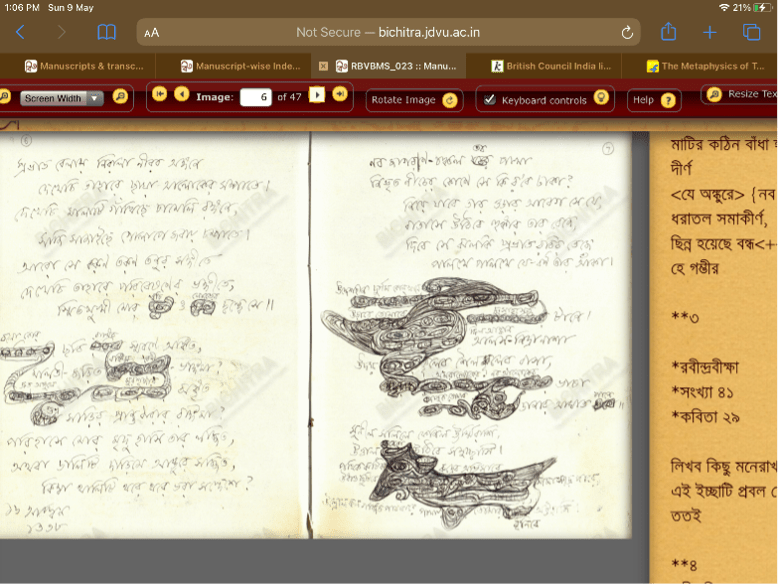
Sukanta Chaudhuri’s book The Metaphysics of Text (Cambridge University Press, 2010) provides significant and perhaps, pioneering insights on this newest aspect of textual scholarship.  Among other aspects of a text, Chaudhuri dedicates one whole chapter on Rabindranath’s ‘katakuti’ (pen scratches and crossings) which invariably were shaped into diagrammatical forms, which Chaudhuri identifies by the name of ‘doodles’. The printed texts do not showcase these pictorial designs or doodles.

A description of Rabindranath’s doodles in one of his manuscripts. Source: Bichitra

The visual aspect of these manuscript pages afford yet another dimension to the working of the poet’s mind while he was working on a poem or a song. They are creative outputs of a different kind, which remain hidden from the printed version of the text, thus disallowing the reader the privilege to dwell with the thoughts of the poet, his seemly and unseemly corrections, as it were. The digital archive Bichitra make all these easily available to us. Understanding, teaching and enjoying Rabindranath’s works become a more gratuitous experience for all of us. If translation is one way of making Rabindranath easily available to most corners of the world, this is yet another move to make his works and all his manuscripts available in every home of all corners of the world. A hundred and sixty years have passed and the magic of Rabindranath or his works remain undiminished and ever contemporary.

.

*Bhar, Anasuya. ‘The Many Lives of Gitanjali’ in Evolving Horizons, Volume 5, November 2016, pp. 20-27, ISSN 2319-6521

.

Dr. Anasuya Bhar is Associate Professor of English and Dean of Postgraduate Studies, at St. Paul’s Cathedral Mission College Kolkata, India. She has many publications, both academic and creative, to her credit.

.

PLEASE NOTE: ARTICLES CAN ONLY BE REPRODUCED IN OTHER SITES WITH DUE ACKNOWLEDGEMENT TO BORDERLESS JOURNAL. 

Categories
Poetry

Tribute to Tagore

By Mike Smith

All Things Are Connected

Touch this web
We call the world
However lightly
With your God-finger
And see
From each concentric strand
The dew is shaken
 
Not one strained string
There is that does not shimmer
With that motion
 
Even the hollow centre
Ring of nothingness
Into which we fall
Moves
 
And the guy-line cables
That hold this universe in place
                    Tremble.

(Published first in Acumen Magazine in 2006 and then in its anthology, First Sixty.)

.

Mike Smith lives on the edge of England where he writes occasional plays, poetry, and essays, usually on the short story form in which he writes as Brindley Hallam Dennis. His writing has been published and performed. He blogs at www.Bhdandme.wordpress.com 

.

PLEASE NOTE: ARTICLES CAN ONLY BE REPRODUCED IN OTHER SITES WITH DUE ACKNOWLEDGEMENT TO BORDERLESS JOURNAL
Categories
Young Persons' Section

Sara’s Selections, May 2021

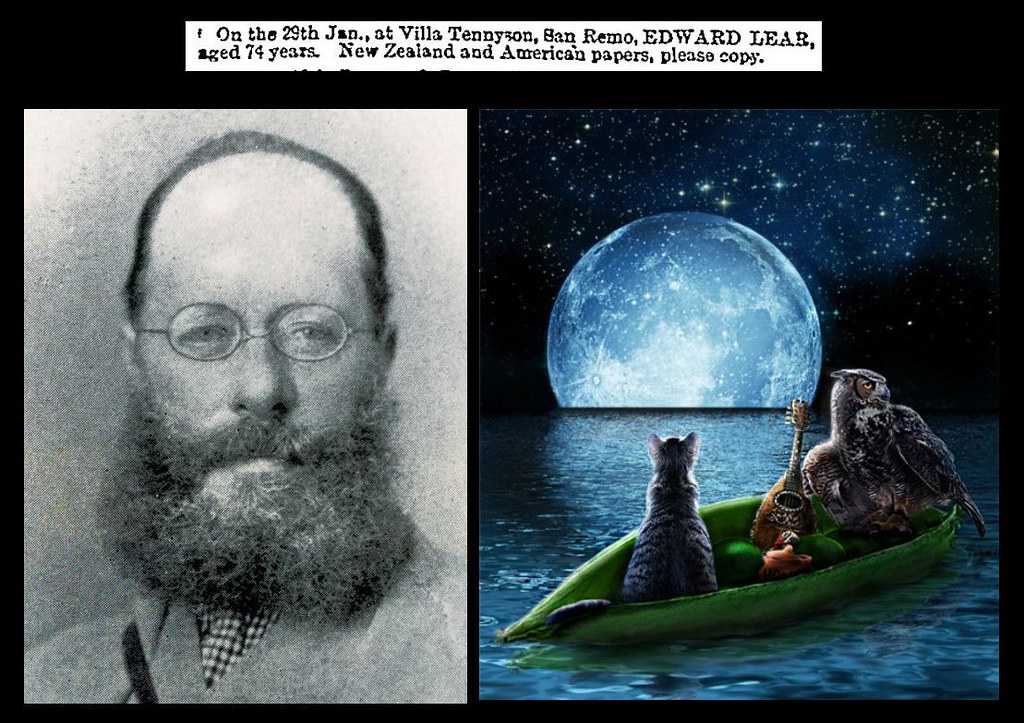
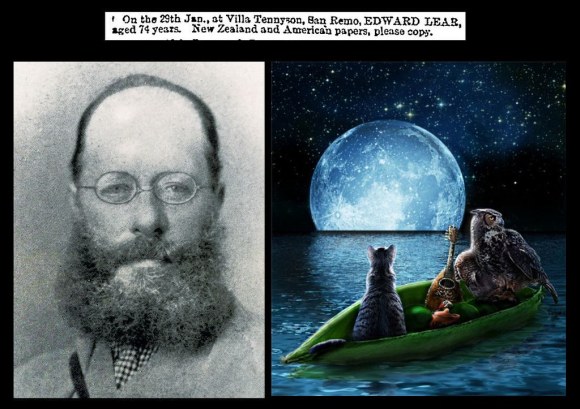
Edward Lear with a painting of his famous poem, Owl & the Pussycat. Courtesy: Creative Commons

Greetings!

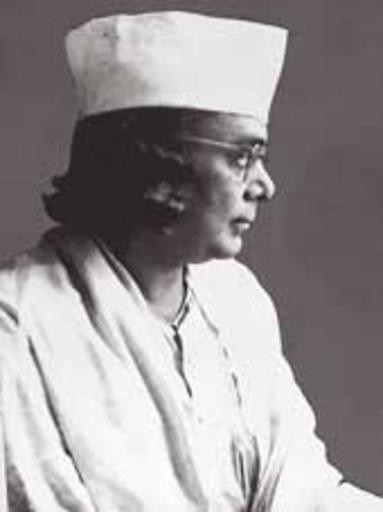
Other than hosting the World Laughter Day, this month also houses the birth anniversary of at least three great writers. On May 7th, 1861, was born the first Asian Nobel Laureate, Rabindranath Tagore. Do you know he even wrote a book to teach young children Bengali with rhymes and poems for young children? Then, on May 12th, 1812, Edward Lear was born in England. He painted, drew, wrote funny poems and popularised limericks. You might have read Owl and the Pussycat by him. May 25th, 1899, was the birthdate of Kazi Nazrul Islam. He was a Muslim who married a Hindu and wrote for harmony intermingling the lore of both these religions. With three famous poets born in May, it is perhaps time we stepped into poetry here. Let us begin. And here is the fantastic Ms Sara. So what do we have this time?

This time we have a strange mix! Penguins and rainbows and much more… Let us start with poetry.

Poetry

Eight-year-old Harshika Khanna, from Kolkata pens an enticing poem about edible rainbows! What flavour would you want?

If I could taste the colours of the rainbow
By Harshika Khanna

If I could taste the colours of the rainbow…

I think that the violet would taste like mouth-watering grapes,

Indigo, like tiny sparkly blueberries,

Blue, like a fresh drink of blue lagoon,

Green, like the pretty pastel in shade matcha,

Yellow, like dreamy butterscotch,

Orange, like the delicious delight of freshly pressed orange juice.

Nine-year-old Vedika Sriram from Bangalore had tea for the first time and she loved it so much, she wrote a poem about it! Isn’t that Tea-rriffic!

The First time I had tea
By Vedika Sriram

The First time I had tea it was just amazing,
It was super hot and very pleasing.

It made me ask my mom for more tea,
Which meant for me to plea and plea.

She made tea every day just for me,
So that I could be happy.

I just loved tea like anything,
And for me it was everything.

So there I was, the tea lover of the world
In happiness, I swirled and twirled.

Full five-and-a-half-year-old Wrishik Ghosh from Kolkata loves to write poems. And his favourite subject is his dad! 

My Dad, My Hero
By Wrishik Ghosh

My dad is my friend,
He is always there at my end.
He spoils me a lot,
By giving lots of toys.
He is the best in the world,
His heart is made of gold.
Dad, I love you, you are my hero,
And you love me too.

Stories

Now we have these imaginative stories. Eight-year-old Prathmesh Chokhani, a Bookosmian from Kolkata makes us laugh with a funny story about a sweet teacher who forgets the way to school! 

The Teacher Who Forgot The Way To School

By Prathmesh Chokani

There was once a teacher named Priya. She loved to teach children and was very kind hearted. The children loved her classes. She was very punctual at school. But she had one problem-her terrible sense of direction!

Even though she went to school everyday she still needed a map to reach there.

One day, she had to be early at school. She woke up early in the morning, took a map, wore her prettiest dress and started walking to school.

She was holding the map. Then suddenly, a breeze came and the map flew out of Priya’s hand. She began to chase the map. But before she could, a dog caught it and ate it. Then she said to the dog in an angry voice “Eh! naughty dog,” and began advising the dog as if it was one of her naughty students in class.

Though the map was lost, she knew where the school was. But then by mistake, she stepped on the dog’s tail. Then the dog began chasing and barking at Priya.

Finally, the dog stopped chasing her and left her alone. She was now, completely muddled and had lost her way.

Then she remembered, she had her phone. She tried switching it on, but it had run out of charge. As usual, she had forgotten to charge the phone!

Now she had no option, but to ask someone for directions. She asked a person the direction and he said. “Take the right then you will reach a by-lane, then go straight and then you’ll reach the school.”

She walked and walked until she reached. She went inside the classroom and wished her students a good morning, but it was too late as it was dismissal time!

Priya joined the students as they all laughed at the incident. She may not have had a good sense of direction but she was the best at keeping the class in good spirits!

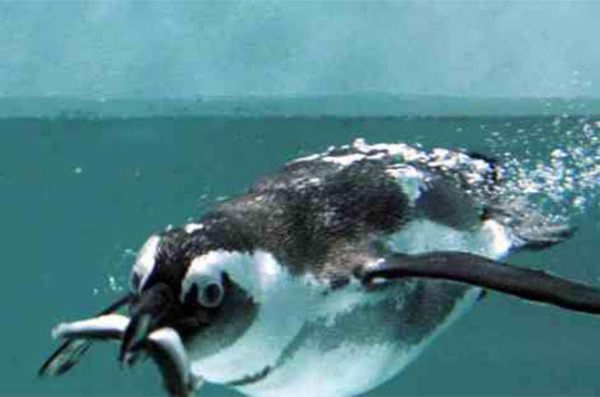
Penguins! Do you like penguins? Nine-year-old Aashritha Surya Prakash from Bangalore writes a cute little piece about a baby penguin’s sweet and happy life. Let’s get on to our happy feet too!

The happy life of a baby penguin

By Ashrita Surya Prakash

Crack! Crack! Wow what a beautiful place!

I just came out of my plain, white and warm shell into a magical place full of colours! Haaa! What a warm place! But why am I in between the legs of this person? Why do I like it here? Ohh this is my dad! But, but where is my mom? The one who laid my white, warm egg? Well now, I am a bit hungry.

Now…wow! What a nice surprise! There comes my mom! She got me some yummy fish and squid! I love it! Thank you mom! Now, after that yummy meal, I will go and meet my friends.

We played all day, my friends and I, and I am tired now, but I loved it! Tomorrow, my mom says I have to go to penguin school. There, we will learn how to fish, swim and ride on our belly down the hills full of snow!

I am so excited!

Today I went to school! It was awesome! My new teacher is great! She is very kind.

In recess, we learnt how to slide on our belly! It was very fun! I am going out to practice now, so bye!

Nine-year-old V Avyukkt from Hyderabad writes a powerful story about handling bullies. 

Learning To Face My Bullies

By V Avyukt

I am a zebra named Jack and I had three friends named Jane, Alex and Phillips. They always used to bully and tease me as I did not know how to walk on a tightrope like them.

After some days, I felt sad and suddenly a zebra was walking by. I asked his name. He said his name was Zebby. Zebby said, “I saw your friends bullying you.”

I told him it was because I can’t walk on a tightrope.

“I know tightrope, I can teach you,” he said.

Zebby tied both the ends of rope to sticks. I was not able to do it at first but I kept practicing for some days, weeks and months.

One fine morning, my heart was beating with hope. I decided to try it. I took my first step and continued walking on the rope without looking down.

Finally, I reached the end! I thanked Zebby and I told him it’s time to show the three bullies. To my surprise, he said it’s not over yet. Zebby said it was now time to learn to walk a tightrope over a fire. I was nervous but I trusted Zebby.

I closed my eyes took a deep breath and took my first step. Nothing happened so I reached the end and opened my eyes. I had done it! I looked at Zebby who was so proud of me.

I thanked him and decided to show the bullies what I could but to my surprise, Zebby said not to. He said I knew that I could walk on a tightrope over a fire and that’s all mattered.

I got over my fear of bullies and found a new best friend! 

Essays

And just as we learn to tackle bullies, we learn never to give up. Twelve-year-old Kavya Mehta from Mumbai writes an inspiring essay about not giving up despite the hurdles that come your way.

An Expert Was Once A Beginner

By Kavya Mehta

Do you think that every expert was born skilled or were they a beginner at first and had to go the extra mile to achieve their ambition? Learning is life. To achieve something, we have to burn the candle at both ends. Giving up is the path towards deterioration.

If every beginner gave up when things got tough, there would be no expert. Every time we hit a roadblock, we cannot simply throw up our hands and say, “I Quit,” you would never get past that. When you know you have failed, you would understand where you made a mistake. You can only learn, never feel discouraged by your failures and also never stop learning. Try to learn from the mistakes and be the best you can be.

If you want to succeed, never draw any conclusion from those who have achieved. They are not lucky. They may make success look easy, but no one knows how much hard work has gone into making them reach this position. Everyone starts as a beginner and takes that first step, and only by moving forward can they reach that expert level.

Late. Dhirubhai Ambani was one of the biggest examples. Dhirubhai Ambani-the son of a poor village teacher achieved his ambition by his confidence and passion. He faced numerous failures, but by his efforts and hope he started a business and thereafter gained huge success.

Ambani suffered through many hurdles in his life but he never gave up and fought tooth and nail. Following that, today his company is among the world’s best. This shows us that whether you are rich or poor you will get many obstacles as you move towards success and you have to choose the correct path without limiting yourself.

To push yourself to the next level, you need to put in the extra effort. With proper dedication, persistence, consistency, we learn to do our best. The same is the case with reaching your goal. It is not that difficult, and anyone can do it with a will to learn and implement.

Therefore, just believe in yourself and you can do the impossible.

So, before you give up always remember,

‘An expert in anything was once a beginner!’

 Eight-year-old Vedant Garg from Noida pens a heartwarming essay about a little hamster who found his home with him.

My New Pet Hamster

By Vedant Garg

It was a sunny morning when I was walking in the park. While returning home, I saw a small hamster pecking on pieces of apple that were littered on the grass.

The hamster was lonely but was contentedly enjoying his meal. He was stout-bodied, with a tail shorter than his body, tiny furry ears, and wide feet. He had very soft and silky fur.

I took the little hamster in my hands and carried him home. I was going to keep it as a pet. The little thing struggled to get out of my grip. I petted him and kept walking.

When I reached home, I rushed in and exclaimed, “Mom, Dad, see what I have got with me!”

My parents came to the living room where I had been playing with the hamster who had now fallen asleep. When they saw him, they shrieked in fear. I told them that there was nothing to worry about, it was just an ordinary hamster. But that didn’t comfort them at all. They got brooms and tried to shoo him away. I blocked their way and promised them that I would keep the hamster away from them. They agreed and stormed off.

From the very first day, I started to call the hamster Fluffy. Fluffy was very happy staying with us now. For him, it was a new dreamy life. But I was still facing some problems with him. He kept running around the house and aggravated my parents. Feeding him was very difficult too as he never wanted to eat anything, and I had to force him to eat to keep him healthy. I still had to keep him away from my parents though.

Whenever my parents would come, he would pretend to sleep but I knew that he had found a true friend in me and an affectionate house to stay.

In his hearts of hearts, Fluffy liked troubling my parents as much as I did.

I had found my companion too.

This beautiful essay by eight-year-old Jia Kataria from Kolkata, succinctly lays out the extraordinary bond we share with our mothers.

My Mother, My Best Friend

By Jia Kataria

My mother is my best friend, with whom I share all my secrets. Like a true friend she is always there with me in good and bad times.

She makes sure there is always a smile on my face and I am always free of all troubles.

She pampers me with good food, toys, dresses and a lot of love.

My mother’s presence always makes me happy and in her absence I feel very lonely.

I hope this bond blooms with every passing year.

And with that we wind up our young persons’ section for the month of May, which heralds the start of summer in the Northern hemisphere and winter in Southern. Have you even thought that while you sweat it out people in Australia would be wearing sweaters!

( This section is hosted by Bookosmia)

.

PLEASE NOTE: ARTICLES CAN ONLY BE REPRODUCED IN OTHER SITES WITH DUE ACKNOWLEDGEMENT TO BORDERLESS JOURNAL.

Categories
Index

A Tribute to Edward Lear: Humour, Limericks & More…

The Owl & the Pussycat. Courtesy: Creative Commons

Edward Lear, born 209 years ago on 12th May, not only popularised limericks, but wrote fabulous humorous verses to laugh away our fears. Rhys Hughes, on our editorial board, has written an essay to contextualise the poem to our modern day needs and even offered a hilarious conclusion to the poem. Click here to read his tribute to the great humorist, Edward Lear (1812-1888) in Poetry, Poets and Rhys Hughes.

As a tribute to the wonderful world created by Edward Lear, we are also publishing two limericks here, contextualising the humour to our needs and times.

1
Amidst the new wave of coronal graves, 
A secret  was withheld, even waived. 
People who vote 
Will turn into goats
And thus, be from the pandemic saved.

2
It came to pass in the distant land of Tierds, 
Wisdom was measured by the length of beards. 
They let it grow in undeterred ways
Till it became quite the craze
To participate tripping in a hirsute race unsteered.

Humour is the best weapon to battle fear. Click here to read some more limericks we brought out to battle our pandemic fears in Limericks: Of Donkeys & Corona.

.

PLEASE NOTE: ARTICLES CAN ONLY BE REPRODUCED IN OTHER SITES WITH DUE ACKNOWLEDGEMENT TO BORDERLESS JOURNAL
Categories
Poets, Poetry & Rhys Hughes

Lear and Far

The Owl and the Pussy-cat went to sea
In a beautiful pea-green boat,
They took some honey, and plenty of money,
Wrapped up in a five-pound note.
The Owl looked up to the stars above,
And sang to a small guitar,
“O lovely Pussy! O Pussy, my love,
What a beautiful Pussy you are,
         You are,
         You are!
What a beautiful Pussy you are!”

Pussy said to the Owl, “You elegant fowl!
How charmingly sweet you sing!
O let us be married! too long we have tarried:
But what shall we do for a ring?”
They sailed away, for a year and a day,
To the land where the Bong-Tree grows
And there in a wood a Piggy-wig stood
With a ring at the end of his nose,
          His nose,
          His nose,
With a ring at the end of his nose.

“Dear Pig, are you willing to sell for one shilling
Your ring?” Said the Piggy, “I will.”
So they took it away, and were married next day
By the Turkey who lives on the hill.
They dined on mince, and slices of quince,
Which they ate with a runcible spoon;
And hand in hand, on the edge of the sand,
They danced by the light of the moon,
          The moon,  
          The moon, 
They danced by the light of the moon.

Beyond the Owl and the Pussycat

Courtesy: Creative Commons

The most famous poem written by the grand nonsense versifier, Edward Lear, is the one about the owl and the pussycat eloping together, and with the possible exception of ‘The Jumblies’ it is his best too. One of the curious things about this marvellous flight of silly fantasy is how it seems to demand a sequel. And sequels have been provided, one by Lear himself. Why this should be the case remains a minor mystery. No one to my knowledge has ever tried to write a sequel to his other poems, not even he.

It is not enough to state that the original story of the owl and pussycat lacks a convincing resolution. So do most of his other poems. No, there is a special quality about this work, about the adventure of two animals, one feathery, the other furry, that encourages further speculation on what might happen to them next. We extrapolate the action in our minds and frequently we are tempted to write down what we think could be a suitable or surprising continuation. But none of the sequels have become well-known.

The owl and the pussycat went to sea, they were married and danced in the light of the moon. So far, so good. Lear originally wrote the poem for a three year old girl, Janet Symonds, who was the daughter of a close friend. Might a young child have understood words such as ‘runcible’? No, but that word is an invented one anyway, coined by Lear for this poem, and though it has entered the dictionary nobody is quite clear as to what it means. My own dictionary, a battered old dusty thing, claims that a ‘runcible spoon’ is a curved fork. I have the option to believe that definition and I decline.

Lear liked the word he had coined so much that he spent it freely in other poems, obscuring the meaning still further. The enthusiastic reader can find a ‘runcible hat’, ‘runcible wall’, ‘runcible cat’, ‘runcible goose’ and ‘runcible raven’ in his extensive works. It is a satisfying word and that is sufficient to justify its frequent use by him or anyone else. Lear was a primarily a visual artist and often illustrated his own poems and there exists his own drawing of the famous ‘runcible spoon’ in the beak of a bird known as the ‘dolomphious duck’ who employs it to scoop up frogs.

That should have settled the matter. The ‘runcible spoon’ is a type of ladle. But in fact nothing was settled. British national newspapers published letters from readers demanding to know what the thing was. Other readers answered with all the knowledge, or fancy, at their disposal. It became a spoon named after a butler who obsessively polished cutlery until it changed shape. Or it was a spoon with a sharp cutting edge that ought to remind the person who used it of the Roncevaux and the battle fought there with swords that feasted on the tasty morsels inside the tin can armour of the troops engaged in the fighting. And yet speculations like these are doomed to defeat. ‘Roncevaux’ sounds nothing like ‘runcible’ and the quince enjoyed by the owl and pussycat certainly has a taste different from that of fallen hacked knights.

To focus on one word in a marvellous verse narrative that includes perilous ocean crossings, forbidden romance, mercantile pigs and serenades seems petty in the extreme. Let us agree that ‘runcible’ is a fine word and leave the deeper question to future generations to solve. It will surely be more fruitful to consider the epic journey freed from the mooring ropes of semantics. The owl and the pussycat set out to sea in a ‘pea-green boat’. It is not revealed whether this boat belongs to them or whether they have requisitioned it. They carry supplies with them in the form of honey and plenty of money and it is stated plainly that this money is ‘wrapped in a five-pound note’. Now that is a peculiar assertion for Lear to make. Why wrap money inside more money? Five-pound notes back in his day were large, more like small towels than the kinds of banknotes we are familiar with. Have these two intrepid beasts turned the five-pound note into a parcel that contains gold coins? It is hardly a safe place to conceal valuables. A thief who steals the five-pound note will take the rest unintentionally. And they are at sea. Are there no pirates in these waters?

I will say nothing about the fact that owls and cats are not generally known for forming amorous relationships with each other. That would be crass. But it is true that the larger species of owl is a menace to the domestic cat and would rarely hesitate to swoop and grab one for lunch. Yet love flourishes in the most unlikely of settings and circumstances. Better to mind our own business and not pry into private matters. The owl and pussycat wish to elope and our duty is to stand aside and let them do so. The owl turns out to be a competent musician despite lacking fingers and plays the guitar for the pussycat while singing songs of charm and sweetness. Compliments are exchanged between the pair and the pussycat soon urges marriage as a most desirable development. Yes, the owl is willing but the couple have no ring. Impediment!

They sail away for a year and a day to a land ‘where the Bong-tree grows’. To spend so long at sea without making landfall in such a tiny vessel is really an achievement. How much honey did they take with them to last so long? It seems feasible that they supplemented their diet with fish caught fresh from the ocean or perhaps with migrating birds that the owl would be able to intercept. We who live on land have no right to criticise. On the island they discover a pig with a ring in his nose. Yet he is a free pig, owned by no one, and presumably the ring is decoration rather than a symbol of servitude. We see in our modern age how many people wear jewellery in their flesh that has no deeper meaning than style and fashion. Buccaneers originally wore gold earrings to pay for their funerals if they were killed in a skirmish. Contemporary men wear earrings perhaps to look like buccaneers. In the first case, the purpose is more important. In the second case, it is the appearance that matters. Who can say what reason the pig has for his ring? Lear tells us that this pig is actually a ‘Piggy-wig’ and there might be a clue to some esoteric status in that suffix.

The pig agrees to sell the ring for ‘one shilling’. It is doubtful whether the pig has any spare change in such a remote location. Therefore the shilling must be a coin, part of the money wrapped in the five-pound note. Why protect the token of lesser value with the token of greater? It makes no sense. The paper banknote is likely to have been splashed by water during the crossing. It would be very improbable for a sea voyage of 366 days to be entirely storm free. Paper turns soggy, metal does not. To cover the five-pound note with the shillings is the sensible thing to do, and store them in the driest part of the boat. But who am I to give advice to these characters? They have been successful in all they have so far attempted. The transaction is made and the ring is handed over. A turkey who lives on a hill agrees to marry them the next day. The ceremony is completed and the nuptial night is celebrated by a modest feast and a corybantic dance on the sand in the bright moonlight.

How marvellous! How wonderful! Why do we feel that more needs to be told? The narrative is incomplete, of course. Too many questions remain to be answered. But why do we insist on learning more about the owl, the pussycat, the world that is theirs? Once again, I maintain that this curiosity extends to no other of Lear’s poems. We read about the ‘Dong with the Luminous Nose’ and we are satisfied with what we are given. None of the limericks demand further action. Could it be simply that the poem is so nice we wish it to continue? That we are dissatisfied with its brevity? Lear must have felt the same way because he began writing a long sequel but it was never finished. What remains is truly a peculiar work. Although it is never stated explicitly that the owl is male and the pussycat female, it is certain that this is a heterosexual pairing because in Lear’s fragmentary sequel the couple have children. ‘The Children of the Owl and the Pussy-cat’ was published posthumously in 1938, long after Lear’s death. Let us now consider what happens in that narrative.

The children of the two voyagers are part fowl and part feline. They love to catch and eat mice. They take up the story and reveal that they live on the shore of Calabria. Does this mean that the land where the Bong-tree grows is part of Italy? Or did the couple move from the place where the pig married them? The cat climbs a tree one day and falls to her death. The owl is now a single parent but he rallies and does his best to look after the children. “Our owly father long was ill from sorrow and surprise / But with the feathers of his tail he wiped his weeping eyes. / And in the hollow of a tree in Sila’s inmost maze / We made a happy home and there we pass our obvious days.”

Other owls visit them and bring them news of the outside world, but this is regarded as nothing to be grateful for because the children “take no interest in poltix of the day”. The money has almost run out but the owl still plays on the guitar and sings songs to nobody in particular. The sequel breaks off abruptly. It is a rather sad set of rhymes but the tale it tells is no more implausible than the original elopement. The pig and the turkey play no part in the events. Nor is it revealed exactly how many children there are.

Beatrix Potter, however, did write more about the pig. ‘The Tale of Little Pig Robinson’ is a prequel that relates the background of the pig. No one has seen fit to write in greater depth about the turkey and that is a shame. But over the decades that followed, a few more details emerged about the owl and the cat. In the 1977 animated film, The Many Adventures of Winnie the Pooh, the character Owl mentions that it was a relative of his who went to sea in the pea-green boat. Eric Idle, former member of the Monty Python team, has penned an apocryphal work about what occurred between the owl and pussycat’s marriage and the fatal accident. ‘The Quite Remarkable Adventures of the Owl and the Pussycat’ features a tense episode in which the couple are attacked by a band of ravenous rats. A heretical text published in the Roald Dahl Treasury is set in an alternate world in which the owl offers gin to the pussycat and so she rejects him. The comedian Stewart Lee has also created an extended version of the story. None of these sequels dispel the feeling that there is a lot more to be told about the remarkable owl and pussycat.

I have made three or four attempts to write a sequel myself. I will leave you with arguably the most appropriate one.

“Mayday! Mayday!” hooted the Owl
as the pea-green boat began to sink.
“We’re low on honey and plenty of money
won’t serve for a life-raft, I think!
The Pussy-cat can’t swim and even I won’t
be able to flap as far as the shore.
We’re in the drink of an appalling bay
and drowning seems the only way
        that this unfunny day
         is going to finish at all.”

“Don’t panic,” said the confident voice
over the crackling radio static.
“The Royal National Lifeboat Institutional Society for the  
      Protection of Talking Fictional Animals is coming to you 
       without delay.”

            And so it was.

Rhys Hughes has lived in many countries. He graduated as an engineer but currently works as a tutor of mathematics. Since his first book was published in 1995 he has had fifty other books published and his work has been translated into ten languages.

.

PLEASE NOTE: ARTICLES CAN ONLY BE REPRODUCED IN OTHER SITES WITH DUE ACKNOWLEDGEMENT TO BORDERLESS JOURNAL
Categories
Index

Tagore Anniversary, 2021

Celebrating the 160th birth anniversary of the polymath, Kobiguru Rabindranath, we offer our readers a selection of translations of his songs and stories and some essays on and around him. For more exhaustive translations and coverage on Tagore, do visit our new section — Tagore & Us.

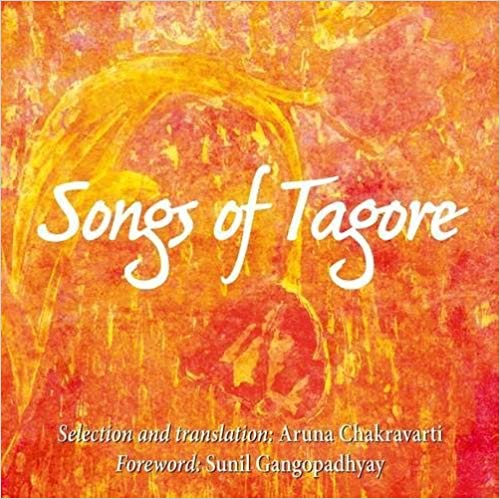
We launched this section with the translation of seven of his songs by the gifted Sahitya Akademi winning translator and author, Aruna Chakravarti.

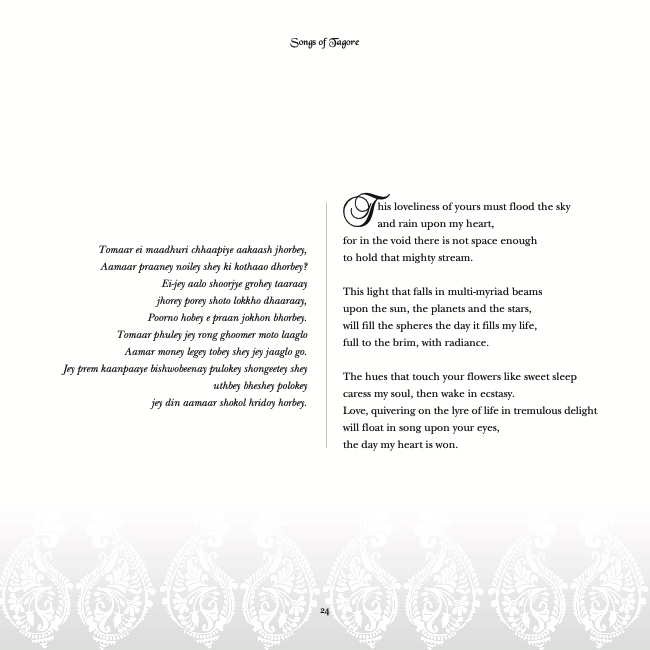
Songs of Tagore: Translations by Aruna Chakravarti

This selection of seven songs has been excerpted from Songs of Tagore translated by Aruna Chakravarti and brought out by Niyogi books. Click here to read.

Tagore Translations: One Small Ancient Tale

Rabindranath Tagore’s Ekti Khudro Puraton Golpo (One Small Ancient Tale) from his collection Golpo Guchcho ( literally, a bunch of stories) has been translated by Nishat Atiya. Click here to read.

Tagore Songs in Translation

To commemorate Tagore’s 160th birth anniversary, we translated five of his songs from Bengali to English. Click here to read, listen and savour.

At Home in the World: Tagore, Gandhi and the Quest for Alternative Masculinities

Meenakshi Malhotra explores the role of masculinity in Nationalism prescribed by Tagore, his niece Sarala Debi, Gandhi and Colonials. Click here to read.

A Tale of Devotion and Sacrifice as Opposed to Jealousy and Tyranny

Sohana Manzoor explores the social relevance of a dance drama by Tagore, Natir puja. We carry this to commemorate Tagore’s birth anniversary. Click hereto read

Categories
Tagore Translations

Songs of Tagore: Translations by Aruna Chakravarti

Title: Songs of Tagore

Author: Rabindranath Tagore, translated by Aruna Chakravarti

Publisher: Niyogi Books

About the Book:

This publication of one hundred and twelve select songs of Rabindranath Tagore is primarily for the Indian and non-Indian listeners who have no access to the original language of the Poet, but enjoy listening to his songs and would like to understand what the song says.

Author’s Bio:

Rabindranath Tagore, sobriquet Gurudev, was a Bengali polymath who reshaped Bengali literature and music, as well as Indian art with Contextual Modernism in the late 19th and early 20th centuries. Author of Gitanjali and its “profoundly sensitive, fresh and beautiful verse”, he became the first non-European to win the Nobel Prize in Literature in 1913.He is sometimes referred to as “The Bard of Bengal”.

Translator’s Bio:

Aruna  Chakravarti  has been  Principal of a prestigious Women’s College of Delhi University for ten years. She is also a well- known academic, creative writer and translator with fifteen published books on record. They comprise four novels, one book of short stories, two academic works and eight translations. Her first novel The Inheritors (published by Penguin)was shortlisted for the Commonwealth Writers’ Prize and her third, Jorasanko (by Harper Collins)received critical acclaim and also became a best seller. Her translated works include an anthology of songs from Rabindranath Tagore’s Gitabitaan, Saratchandra Chattopadhyay’s Srikanta  and Sunil Gangopadhyay’s Those days, First Light and Primal Woman: Stories. Daughters of Jorasanko, a sequel to Jorasanko, has sold widely and received rave reviews.Her latest work, a novel titled Suralakshmi Villa, has been published by Pan Macmillan Ltd under the Picador imprint, last year in 2020.

Among the various awards she has received are VaitalikAward, Sahitya Akademi  Award and Sarat Puraskar.

She is also a script writer and producer of seven multi- media presentations based on her novels. Comprising dramatized readings interspersed with songs and accompanied by a visual presentation by professional artists and singers, these programmes have been widely acclaimed and performed in many parts of India and abroad.

For more details on the book: Click here

Categories
Covid 19

Have We Moved Forward?

Here are some of the most poignant, amazing and gripping stories around COVID from 2020 on our pages. Some are even tinged with humour or irony. How much have things improved over the past year? Write in your responses and tell us what you think.

Corona in my Teacup by Nidhi Mishra. Click here to read.

God Survives Corona by Devraj Singh Kalsi. Click here to read.

Broken Dreams and Shattered Glass By Sohana Manzoor. Click here to read.

People Matter More than Money by Keith Lyons. Click here to read.

Notes from Maynmar: Humans versus COVID by San Lin Tun. Click here to read

Corona & My Uncle by Archana Mohan. Click here to read

Notes from Balochistan: Volunteers for Humanity by Ali Jan Masood. Click here to read.

New Normal & Corona Puja by Nishi Pulugurtha. Click here to read.

Time & Us by Anasuya Bhar. Click here to read.

COVID-19: Days by the Arabian Sea by Gracy samjetsabam. Click here to read.

The Dawning of a New Era by Mitali Chakravarty. Click here to read.

Pandemic Tales: The Diary of a Hypochondriac by Mayuresh V Belsare. Click here to read.

From A Lockdown Diary to the Lightness of Being by Sunil Sharma. Click here to read.

Return of the Dead by Gita Vishwanathan. Click here to read.

Maya & the Dolphins by Mohin Uddin Mizan. Click here to read.

At Par in the Pandemic by Nabanita Sengupta. Click here to read.

A relook at The Plague by Camus by Rakhi Dalal. Click here to read.

Schumpter, Luddites & the Post-Covid Workforce by Avik Chanda. Click here to read

How the Young And Ms Sara battled Covid: An interview with the founders of Bookosmia to see how they kept people’s spirits up during COVID. Click here to read.

Limericks: Of Donkeys & Corona. Click here to read.