Categories
Poetry

Spring of Sorae Port

by Eui Joong Kim

The wingings of seagulls are light

Among the beams of sunlight fluttering

With the cold wind.

.

The smile of the Spring that I suddenly meet

Though sunlight is still weak

To awaken the sleeping earth.

.

Sorae Port, where the living things at the risk of their lives

In the repeated ebb and flow of the tides,

Live in harmony.

.

Spring doesn’t push the winter away

But melts it holding it in the breast

Slowly, softly and warmly.

.

Eui Joong Kim was granted a Rookie Award for poetry in the magazine of Monthly Hanmaek Literature and Hong Kong Dongshin Literature Prize. He is a member of Hanmaek Writers’ association and Incheon Writers’ association. 

.

PLEASE NOTE: ARTICLES CAN ONLY BE REPRODUCED IN OTHER SITES WITH DUE ACKNOWLEDGEMENT TO BORDERLESS JOURNAL.

Categories
The Literary Fictionist

In search of Lewis Carroll

Sunil Sharma travels through pages of a classic with ease and aplomb demystifying literary lore to unravel the identity of a man that never was

…but Alice had got so much into the way of expecting nothing but out-of-the-way things to happen, that it seemed quite dull and stupid for life to go on in the common way.

So she set to work, and very soon finished off the cake.

`Oh, you can’t help that,’ said the Cat: `we’re all

mad here. I’m mad. You’re mad.’

`How do you know I’m mad?’ said Alice.

`You must be,’ said the Cat, `or you wouldn’t

have come here.’

“Who are YOU?’ said the Caterpillar.

This was not an encouraging opening for a

conversation. Alice replied, rather shyly, `I – I hardly

know, sir, just at presen t– at least I know who I

WAS when I got up this morning, but I think I must

have been changed several times since then.’

`What do you mean by that?’ said the Caterpillar…

“So, who is Lewis Carroll?”

This question cannot be easily answered by me or anybody else. But Grace wanted a quick answer. She just finished Alice in the Wonderland and wanted to know about its wonderful creator who went by this name.

“Did he ever exist?” She asked me, eyes wide open—the way only nine-year-olds can. I said I would find out for her soon.

“It is not a real name,” Grace said.

“What is the real name?” I asked.

“Oh! I forgot!”

“No problem, honey.”

“But why do folks use other names? If I use a name not my official one, will it not be understood as something wrong?” she asked.

Being a lawyer, I had told her of cases where people using false names got caught — and punished by the law.

“It is literature,” I said.

“But rules are rules—for everyone, in every field,” Grace persisted. “You are trying to conceal your true identity.”

“In literature, rules are different,” I said tamely. “It is a different territory.”

“OK. Who is Carroll?”

We were back to square one.

“Give me some time,” I said.

That set me off on a strange journey. A literary odyssey that required the navigation of the choppy area between the imagined and real; the persona and the individual; social mores and  the transmuted artistic expression; sense and non-sense; fantasy and fact; historical and transcendental; the physical and the parallel universes; meaning and its production, creation and destruction… and lot more. Kind of investigation that a literary detective has to undertake.

“We find signs of its age in a serious literary work,” says Homocus (Not his real name, says he with a wink).

Can we?

Alice in Wonderland was published in the year 1865. “In a sense it mocks all the expected norms of novel reading and writing; it demolishes them and renews them for others. Very few works could overturn those norms set by Carroll — even he, himself could not through his other iconic work,” says Homocus Mirabilis over coffee in his well-appointed drawing room in Rome. “Although written in the Victorian age, echoes of our age are also traceable in a great book.”

How? 

“First thing first. The age when the book got written leaves its mark in that literary book,” claimed Homocus, considered to be a foremost authority on Alice and Carroll, two famous fictional characters for me.

He explains patiently to me his interesting hypothesis, “Let us talk about the book.”

All right.

“It is an escape from the prim and ‘propa’ Victorian world into a world of freedom. Freedom from the restrictions, stifling norms and stilted conventions of an imperialist society and its totalising binary imagination.”

Now, that is too much!

“Alice the book is full of riddles and signs that you have to interpret for yourself and the book speaks through the prism of time.”

How?

“You find the echoes of your time in that book. Only thing — be alert!”

Now, a pompous — for me — Homocus Mirabilis can be jarring on the nerves!

“Now, let us talk Alice, the Victorian girl.”

Go ahead, I say.

“Alice is almost seven-and –a- half-year-old girl who, bored on the morning of May 4th, finds herself falling through a rabbit hole and into a strange world. And the journey starts that still continues to delight adults and children alike across the world.

“During the dreamed adventure, little Alice — curious, questioning, courteous and believing — encounters the normal world in a new and fresh way. It is a world inverted, made strange, for the rationalists.”

Here is how, says Homocus:

“The talking rabbit with a pocket watch and a hall with locked doors of all sizes are all symbols — like much of the book Alice and much of literature. The fully-clothed rabbit leads the child on to a big adventure of sights and sounds. It destabilises all our expectations of looking at the normal world and experiencing it through language—itself a system of conventions. In a way, the scenes after changing scenes baffle our commonsensical view of things seen and repeatedly emphasise the arbitrary nature of symbol, sign and convention.”

Please explain.

“The rabbit stands for swiftness, speed and velocity. Metaphorically. Carroll, in order to render the experienced prim world of the Victorian era upside down, makes the rabbit as a creature speak and thus create a new symbol. The unexpected does the work of the expected; the impossible becomes possible; the illogical is nothing but logical in a strange world. It is purely arbitrary decision by Carroll to assign a new shocking value to rabbit operating as an old symbol in an underground realm where the young trusting viewer Alice expects only out-of-the-way things to happen because those happenings make the conventional life exciting and no longer dull and stupid in its common way for her. A gregarious female child experiences the restricted world in a newer way, a world where everyday realities are not prevalent but mad things rule. The book turns down everything topsy-turvy, on its head.”

Sorry!

“It is how every new literary artistic product behaves. You can see the Alice book anticipating the Cubists and continuing the tradition of Don Quixote.”

Hmm!

“By adding speech and clothes and waist-pocket watch, the rabbit becomes a new symbol rather than a tired cliché and infuses more energy into the funny narrative. But how a rabbit can talk, you ask. Why not? Carroll seems to say. Literature is a particular way of looking at the things and the world. Your realism might not be my realism. For a child, a fable or fairy-tale is more real, plausible than a work by Dickens. And how real is the real in these realistic novels? Is it not a mere illusion?”

Well, okay. Go on…

“So, once we expect the legitimacy of a parallel world created only by the extra-ordinary creative mind of a great artist, then we expect things occurring in that world as perfectly sane, logical and normal. In a fairy-land, every winged creature is normal; only a wingless human is abnormal.”

Good!

“So a talking rabbit is a novelty that ceases to be such after an initial encounter.”

What about the hall?

“Simple. It signifies the restricted environment for a female child then and now. It has got locked rooms of different sizes. Rooms that can lead to different realms but are locked in a big hall that closes down upon the looker. You need initiatives big or small to open that restricted space. Hence, she shrinks and grows bigger.”

Stretching it a bit?

“Not at all. We produce our own meanings out of a sacred text in every age. Criticism is like that only. A sacred text speaks in multiple tones to multiple folks.”

For a lawyer, this is all Greek!

“It is in our hands to manufacture a wonderland out of the rational and mundane. Alice the book proves that. Take the scene of Caucus race where everybody is going in circles and nobody is a winner. Middle-class existence in a post-modern society resembles that Caucus race only: Moving around in circles.”

Sounds intriguing!

“The Cheshire Cat!”

What about it?

“It shows that symbols are arbitrarily assigned their symbolism; meanings to objects. Red rose for love? Why not for hatred? You have no answers. A grin without a cat in fact suggests the gap between object and its assigned meaning by us; it suggests that it is all decided by community of users in an arbitrary way only. The entire language, symbols, signs — they all function like that.”

How?

“The meanings, symbolism get finally separated in an evolved sophisticated complex sign-system — linguistic and literary. A grin, the signified — separate from cat, its signifier — hints at the function of any given code — mathematical, musical, scientific, folk — evolved to communicate ideas.”

What else is there in this marvelous book?

“A lot. The Caterpillar and the Cheshire Cat dialogues are all pointers in this direction. The Mad Hatter’s Tea Party is another intriguing scene. The take on the word mad is revealing. Don Quixote also examines this state.”

What is the message?

“Frightening change! We all change in the process of our experience — for good or for worse. But change we all on this earth, a brief adventure, for some mad; for some, sane. Boundaries are never fixed; they change rapidly for us. Words lose meanings and gain much. Innovative ideas once considered insane get accepted as sane in the long run. Mad become sane; sane become insane. Arts help quicken metamorphosis. Alice the book is more effective than any other solid earthly experience for some like Alice, the little question curious girl, who has got two sides to her.”

Hmm.

“Literature can bring transformations deep via their imagery and emotions, visual appeals.”

What is the message for you, of this book of fiction?

“Well, simple. The real education is done through experiencing the world. There are and can be bizarre and eccentric characters, low and high, articulate and dull, rational and irrational in a rich tapestry and they all can teach a child and us a thing or two about life and the world. We keep on changing fast — sometimes shrinking; sometimes expanding; sometimes small, sometimes big — it is all a big rollercoaster and you enjoy the eccentricities and delights of this short journey between dreaming and waking before you leave your earthly coil for good!”

Impressive, dear Homocus Mirabilis, my dear literary friend, a devotee of Cervantes, Borges, Marquez, Spielberg, Tolkien and Rowling– creators of the so-called marvellous for every generation. One Thousand and One Nights is his favourite. So is Panchtantra.

And what is marvellous?

“Well, well. It is the other side of realism. The upside down of reality, of human perceptions. As the jungle looks strange at night –taking on different forms; the trees and shrubs and hills look bizarre, outlandish or like giants in the inky darkness — for the traveler trapped there but reverts to its original shape the next morning and becomes less threatening than the one at night, it is the same with the marvellous. It is the exaggerated real and designed to defy logic and a sense of rational for the pure delight of telling a story, a fable. There are no giants we all know but we tend to believe in such stories, yarns or fables. The idea is to delight in the unknown and the mysterious and to creatively explore the free-flowing, unstructured side of human imagination. In other words, creating an alternative reality for the reading/viewing mind and an escape route from the regimented grimness of a rational, calculating world into the delightful realms of art.”

Marvellous!

Last question.

Yes.

Who is Lewis Carroll?

“The guy who overturned a tradition and created a new one of story-telling. The great innovator! He insisted that a medley of riddles, pun, poems, neologism and queer creatures in a fun narrative can also be quite an interesting method of communicating certain truths. He saw things largely unseen by his society and he made them vivid through a new style and presentation. Truths are truths, whatever be their forms of expression. If the factual can be valid, why not the fantastic for the artist and the wider reading public? In fact, he interrogates the conventions of evolving mode of realism and produces his version of realism— portmanteau realism.”

Illustration?

“He created a sur-realistic world much before Dali…Like, to give an example not from the book but to make a lawyer like you to understand, combining different things in one figure to make it bizarre: Adding cat/dog- whiskers to a mirror.

“Or, a Caterpillar smoking a hookah? I like those classic lines:

“‘I can’t explain MYSELF, I’m afraid, sir’ said Alice, `because I’m not myself, you see.’

“`I don’t see,’ said the Caterpillar.”

This exchange is profound. So is the startling image of a smoking Caterpillar. It is unusual, is it not?

“Yes, It is. You are right, my lawyer friend from India.”

Who was he in life? Our dear Carroll?

“He never existed.”

What?

“Yes. He is not historical.  A mere invention, a linguistic category only.”
Then who wrote the book?

“Lewis Carroll only.”

Now you sound like the Cheshire Cat or the Caterpillar.

“Not at all.”

Please explain.

“Carroll was/is an extension of the historic Charles Lutwidge Dodgson, a mathematician, logician, dean, author and photographer of the Victorian age. He wrote under the pen name of Lewis Carroll. Former was a rationalist; Carroll, a romanticist. The first, a complex logical thinker thinking in abstract terms, solving problems of math. The second, a romancer playing with the imagination, words, logic, situations, norms most playfully, like our playful post-modernists. Two opposing sides! An interesting dualism not uncommon in artistic field.”

Hmm! Not very clear yet…

“He was two persons in one man — like most of the artistes. What Carroll could see the staid Dodgson could not; what the math teacher could see, the writer could not. Both were separated, yet unified in a single breast — like the meaning is in the word, the word is in the object; the object is in the mind, the mind in the matter…”

STOP!

.

Sunil Sharma is Mumbai-based senior academic, critic, literary editor and author with 21 published books: Seven collections of poetry; three of short fiction; one novel; a critical study of the novel, and, eight joint anthologies on prose, poetry and criticism, and, one joint poetry collection. He is a recipient of the UK-based Destiny Poets’ inaugural Poet of the Year award—2012. His poems were published in the prestigious UN project: Happiness: The Delight-Tree: An Anthology of Contemporary International Poetry, in the year 2015.

.

PLEASE NOTE: ARTICLES CAN ONLY BE REPRODUCED IN OTHER SITES WITH DUE ACKNOWLEDGEMENT TO BORDERLESS JOURNAL

Categories
Review

How Non-nonsensical is Sukumar Ray’s Nonsense Verse?

Book review by Nivedita Sen

Title: Habber-Jabber Law:  Nonsense Adventure.

Author: Sukumar Ray; translated from Bengali to English by Arunava Sinha  

Publisher: Speaking Tiger Books, 2020

It is believed by and large that Ha Ja Ba Ra La (1921) by Sukumar Ray, the father of Satyajit Ray, was attempted as an adaptation of Lewis Carroll’s Alice in Wonderland. Both start with the child protagonist going off to sleep out of doors on a hot summer’s day, under the shade of a tree, and entering a dreamscape in which creatures that are a mix of the real and the fantastic live out their lives. These characters are caught in situations where they constantly argue with one another and the protagonist about the strangest of words, events and ideas. Yet the very normalcy, credibility and sanity offered through the voice of the first person protagonist, juxtaposed and tested against the curious and the implausible in their formulations, is portrayed satirically, critical of some of the assumptions and values we take for granted, and interrogated for their logical fallacies.

Although Alice travels down a rabbit hole that leads her to Wonderland, Sukumar Ray changed everything from this point onward to match the ambience of an Indian, more specifically Bengali, way of life. And in the process, he not only crafted an original which is a milestone in the genre of nonsense writing in Bengali for children but offered food for adult thought to anyone who could read between the lines.

The book has an attractive cover and design and includes all the delightful original illustrations by the author. But it is a colossal task to actually translate line by line, if not word by word, this early twentieth century Bengali classic into English. Over the last forty years, language based translations have moved to culture based translations. This initial spadework was taken care of by Sukumar Ray in his adaptation of Alice.

When Arunava Sinha translates this text into English, we can assume that it is meant for an Indian readership. A crow (read human being) that traces its upper caste pedigree to the pure-blooded Rex Ravenus, a man who coyly appeals to people not to ask him to sing only because he wants his singing to be heard, and a court case for defamation in which the number of witnesses goes up because they get paid (bribed) for the ‘work’ are not unfamiliar across a pan-Indian spectrum. But the facetiousness and irony also extends to a universal human predicament in which the child encounters the worldly wisdom of ‘money is time’ that has to be factored in every calculation (reminiscent of a railway journey scene in Caroll’s Through the Looking Glass), when he iterates a multiplication table correctly but naively. Or in the utopian make-believe of making the world a happier place, when he learns, to his bewilderment, of an odd reversal in which the ages of people turn backward after they are forty, so that nobody dies old age.

Sukumar Ray’s Ha Ja Ba Ra La provides undiluted amusement to child readers but communicates more seriously to adult readers. Ashish Lahiri, an academic and writer, in an essay in 1982 in a magazine called Prabashi, had underlined the significant dichotomy between the first and second parts of the story. In the first, the current ‘scientific culture’ with its discourses of temporal and spatial relativity is tried to absurd extremes by the nonsensical utterances of the cat, the crow and the two dwarfish brothers. To start with, the handkerchief-turned-cat deconstructs our accepted structures of logic and common sense by arguing that he can be called cat chief, kerchief or capital zed, and extending its reasoning to spell out the ridiculous combination of alphabets that can identify it. Exact nomenclatures and absolute definitions are challenged in this episode.

Similarly, in keeping with findings in astrophysics and geography about the rotation of the earth, the cat says that we will never find anyone where we expect to find them, because no creature remains rooted in the anticipated spot, even if they are stationary. This hilarious observation while looking for someone called Big Tree Brother dwells on the relativity of time. It is corroborated by the logic of the crow who says that seven times two is not always fourteen because time is forever on the move and the arithmetical calculation changes by the time one works it out. Yet, all the bodily measurements of the first-person protagonist are fixed at twenty-six inches by the very creatures who make a case for the idea and practice of relativity, perhaps because he carries a baggage of absolute and rigid assumptions imposed on him by the adult world of common sense.

Hzzbuzzbuzz (whose original Bengali name Hijibijbij suggests hijibiji, a scribble that is garbled and meaningless) connects the two parts of the story with his compulsive need to laugh at the most hypothetical and incredible of situations. The second part, set in the open air courtroom of fantastic creatures, is resonant of human society at large for its dishonesty and deceit. It keeps the reader’s focus on the incongruity, dissonance and comicality of everything we ever learned or cultivated, from science and philosophy to the legal arbitration of civilised, educated, middle class life.

The court scene includes the moss-ridden coat or camouflage of the fraudulent lawyer, the book of law that epitomises a theoretical and meaningless justice and the owl-judge who cannot see things that are obvious by the clear light of day but only when they are under cover of nocturnal darkness. The crocodile’s convoluted questions for the sake of questions and his own weird interpretations suggest the ambivalences and distortions involved in the legal process. That the entire organisation of law and other human institutions and systems is based on big, unintelligible and fancy words that are absurd lies is critiqued in Hzzbuzzbuzz’s incoherent, unrelated but irreverent ramblings that tickle his funny bone. These anomalies, it suggests, are extant not only in law but every template of our civic rights and duties.

The transference of culture, except for very Bengali-specific ways of talking, social and professional behaviour, is not required in an Indian context. The simplicity and transparency of the situations would also not be difficult to translate verbatim if they were not based on tongue in cheek utterances that are apparently nonsensical. The translator’s credit lies in his translating each and every one of the nonsense rhymes, and much of the word play, including alliteration, assonance, puns, internal rhymes and onomatopaea. Evaluating what is technically termed as the aesthetic equivalence of the source text against the target text, these word and sound-related fragments are commendably done.

Sinha has, at times, morphed the nonsense expressions to equally incredible but compatibly bizarre sounding words and phrases that maintain an altered meter and matter in an attempt to integrate the English language within the coordinates of an indigenous linguistic culture. In a rhyme, for instance, that uses three different words for female ghosts – petni pishi, shankchuni and ultaburi, for example, the translator uses banshee aunty, ghouless and crone to cover all of them. Rhythms and cadences can hardly be the same in both languages, but Sinha struggles with and juggles the nonsense vocabulary by muting certain words, mutating others but also ends up mutilating a few. That, of course, is unavoidable in the linguistic upheaval of such a landmark of nonsense prose.

.

Nivedita Sen is Associate Professor in English at Hansraj College, University of Delhi. She works on Bangla children’s literature, and has translated authors like Tagore, Sukumar Ray, Asha Purna Devi, Leela Majumdar and others for Harvard University Press, Vishwabharati Press, Sahitya Akademi, Katha, Tulika and more. Some of her works on children’s literature are Family, School and Nation: The Child and Literary Constructions in Twentieth Century Bengal. (Routledge, 2015), The Gopal-Rakhal Dialectic: Colonialism and Children’s Literature in Bengal (Tulika, 2015), translated from Sibaji Bandyopadhyay’s book, and articles on Alice in Wonderland and Alice Through the Looking Glass in Alice in a World of Wonderlands (New Castle: Oak Knoll Press, 2015) and Libri et Liberi: Journal of Research on Children’s Literature and Culture (2016).

.

PLEASE NOTE: ARTICLES CAN ONLY BE REPRODUCED IN OTHER SITES WITH DUE ACKNOWLEDGEMENT TO BORDERLESS JOURNAL. 

Categories
Poetry

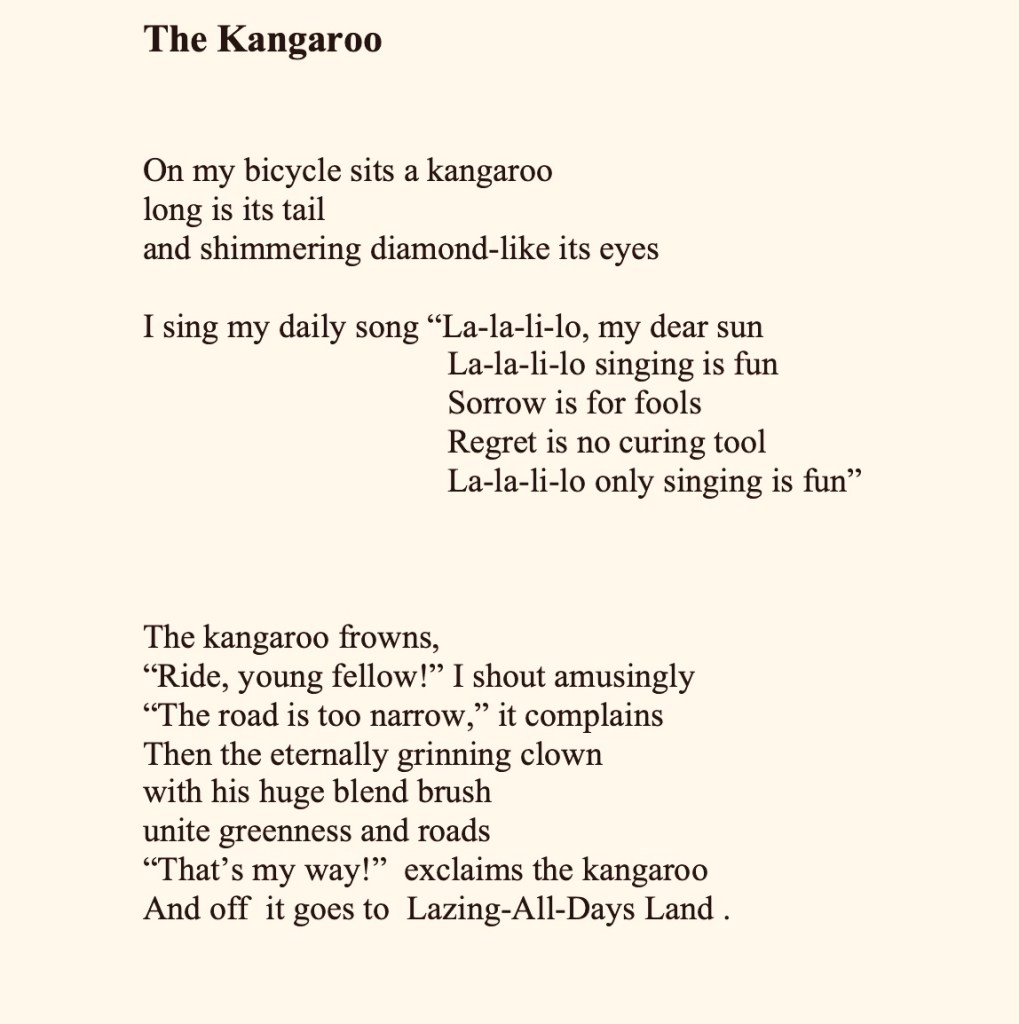
The Kangaroo

By Vatsala Radhakeesoon

Vatsala Radhakeesoon was born in 1977 in Mauritius. She has authored 10 poetry books  including Unconditional Thread ( Alien Buddha Press, USA,2019), Tropical Temporariness (Transcendent Zero Press, USA, 2019) and Whirl the Colours (Gibbon Moon Books UK/Kenya, 2020). She is one of the representatives of Immagine and Poesia, an Italy based literary movement uniting artists and poets’ works. She has been selected as one of the poets for Guido Gozzano Poetry contest from 2016 to 2019 and nominated for Rilke Prize 2019, USA. She currently lives at Rose-Hill and is a literary translator, interviewer and artist.

.

PLEASE NOTE: ARTICLES CAN ONLY BE REPRODUCED IN OTHER SITES WITH DUE ACKNOWLEDGEMENT TO BORDERLESS JOURNAL. 


Categories
Excerpt

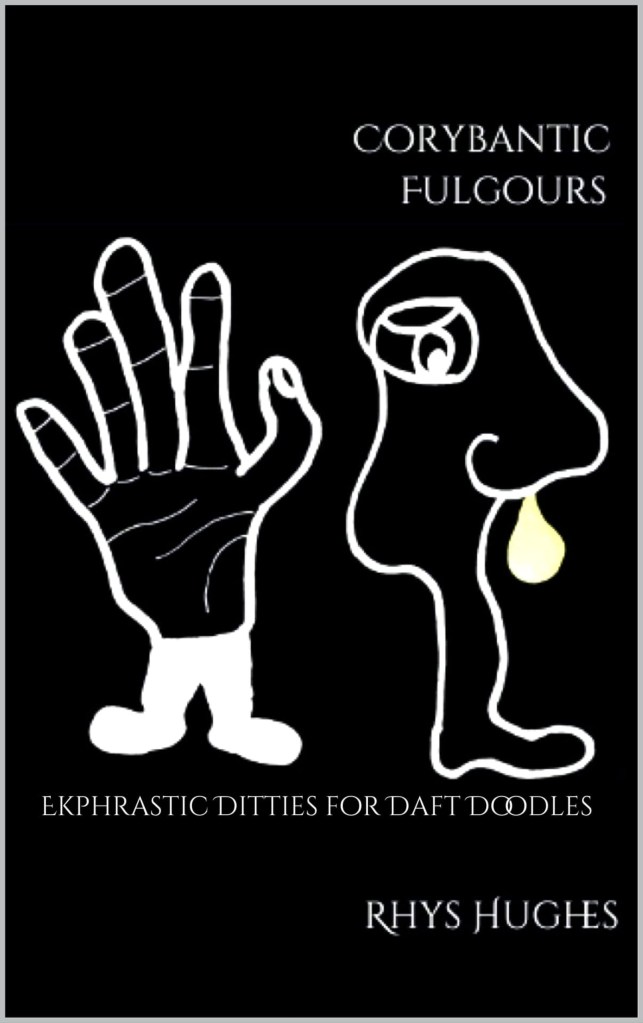
Corybantic Fulgours

Rhys Hughes introduces us to the delights of doodling poetry in his new book with a name that I would not dare to pronounce, Corybantic Fulgours.

I ought to explain the title. It’s a title I have wanted to use for a book for a number of years. I often write down titles for later use and I usually have no firm idea what the books or stories or poems will be like until I write them. I just like the music of the words and that’s sufficient reason for me to write the titles down. ‘Corybantic’ means to dance wildly but I can’t recall where I first learned its meaning. A ‘fulgour’ is a light or glow and I’m sure I picked the word up from M.P. Shiel or one of those other writers of ‘weird fiction’ from the late 19th and early 20th Centuries who loved to overindulge in archaic or abstruse words. I have always found it amusing that those writers tried so hard to be wilfully obscure. They were often very good writers but strove to make themselves less palatable to a popular audience rather than more popular. I admire this eccentricity. My favourite among them is Clark Ashton Smith, who never used one simple word when a dozen complex ones would serve.

So the title came first. Then I had to provide a rationale for using it. The book turned out to be a set of poems to accompany some drawings I had done. The drawings were all of monsters. I justified the title by declaring that these monsters were made from curdled light and that they danced a lot. Let’s say that I cheated in order to find an adequate reason for using the title, Corybantic Fulgours. I don’t mind admitting that this stratagem was highly contrived. Monsters themselves are highly contrived too, so it all fits together well. I have drawn monsters most of my life. But I must add a disclaimer here too. I don’t believe that I can really draw. What I actually do is doodle. I doodle a lot and the majority of my doodles turn out to be monsters. It is easier to draw monsters than anything else. The great thing about drawing monsters is that any mistakes will contribute to the monstrousness of the final image. Therefore those who can’t draw are better able to represent such entities monstrously.

In other words, I didn’t let the fact that I can’t draw well hold me back. I have long been interested in combinations of texts and imagery. Recently I obtained a volume of writings and drawings by the wonderful Mervyn Peake entitled Peake’s Progress that features work from the full span of his life, including projects he never completed. One section of the book is called ‘Moccus Poems’, written in 1929 or thereabouts, a set of drawings of monsters with simple short verses to accompany them. There are only six of them. Maybe there were more originally, but if so they have been lost. The drawings are excellent. Peake was an illustrator of genius. The poems are nonsensical and good fun. I decided that I wanted to attempt to create a book along the same lines. I know I can’t match Peake in image or verse, but I decided to amuse myself anyway.

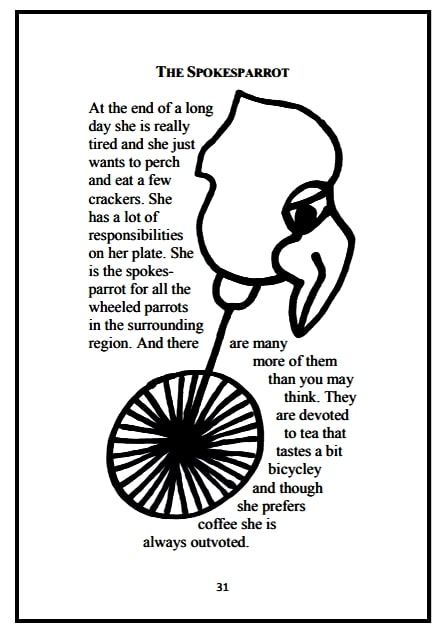
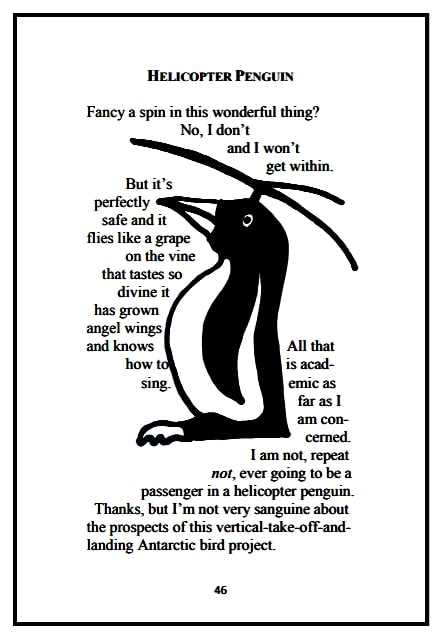
I thought that if I doodled one monster every day, and wrote a poem for it, the book would be completed after two months or so. But I found that I was doodling more than one a day, sometimes four or five. I decided to stop only when I ran out of blank pages in the notebook I was using for my doodles. The result is that there are 54 monsters. One of the monsters, the ‘Unfeasible Space Giraffe’, covers three pages because he has such a long neck. He can stand on the surface of one planet and nibble the leaves of the trees that grow on another planet. But all the other monsters occupy one page to themselves. I wrote poems for each doodle as I went along. The monsters came first every time. The shape and size of each monster determined the length and structure of each poem, because I had to fill the remaining space with words and sometimes the remaining space wasn’t very much. I often curled and curved the poems around the bodies of the monsters and I allowed myself to enjoy certain typographical tricks, such as having text upside down or in the shape of a wave.

Poetry written for images that already exist is called ‘ekphrastic verse’. I didn’t know that until shortly before I began this project. The book took only two weeks before it was done. I am pleased with it. The hardest part was formatting the poems so that they followed the contours of the forms of the monsters, or at least appeared on the page in a manner that seems a little more interactive with the image than merely descriptive. Might I do a sequel one day or another similar book? I see no reason why not. What surprised me most was how purely enjoyable the creation of ‘Corybantic Fulgours’ was. Some books are headaches to write. This one was quite a delight. It turned out better than I had hoped.

Rhys Hughes has lived in many countries. He graduated as an engineer but currently works as a tutor of mathematics. Since his first book was published in 1995 he has had fifty other books published and his work has been translated into ten languages.

.

PLEASE NOTE: ARTICLES CAN ONLY BE REPRODUCED IN OTHER SITES WITH DUE ACKNOWLEDGEMENT TO BORDERLESS JOURNAL. 

Categories
Poetry

Beyond Words

By Ashok Suri


Words spoken are sweet,

Those unspoken may be sweeter.

My lips often fumble

With thoughts that run deeper.

.

O, beauties of the Earth,

Mysteries of the universe,

Whose hands are at work!

How I will express?

.

How will I describe

Tears of joy flowing from the champion’s eyes,

Hunger of the hapless child,

Whose mother pats his back when he cries?
.

There are depths,

Where words cannot peep.

A soft touch, a tender look

Can make even a stone weep!
  .                              

Mr. Ashok Suri did MA (English) from Kurukshetra University in Haryana. He retired from Revenue Service in Mumbai in 2014. He has a passion for reading and is particularly interested in reading biographies and poetry. He loves to write also, but he is not a published writer.

.

PLEASE NOTE: ARTICLES CAN ONLY BE REPRODUCED IN OTHER SITES WITH DUE ACKNOWLEDGEMENT TO BORDERLESS JOURNAL. 

Categories
Review

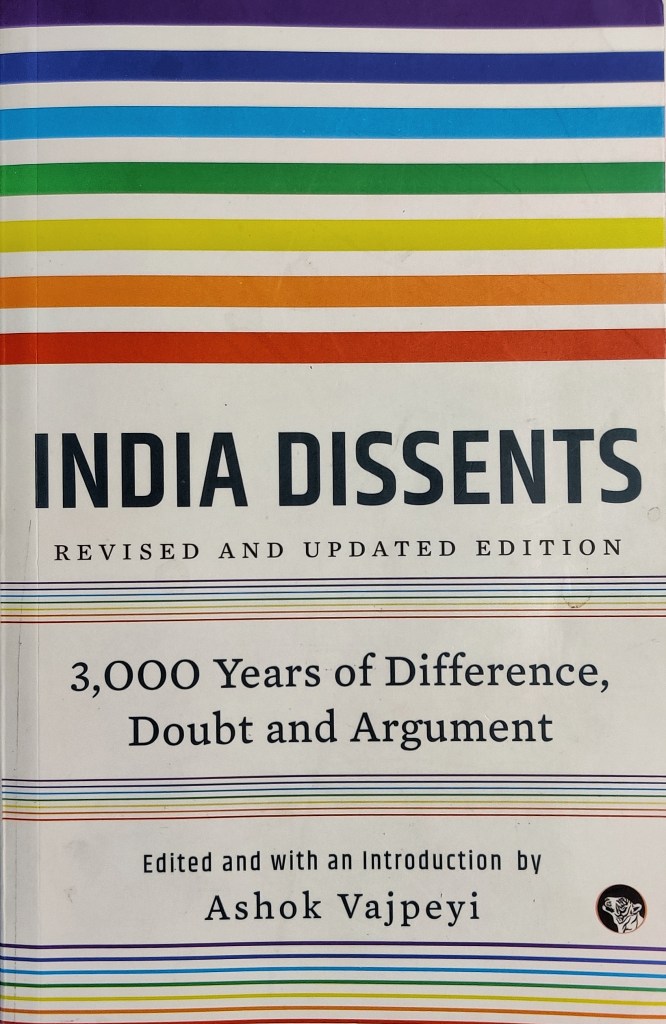
The Dissent of Man –Asserting Humanity by Raising Voices

Book review by Debraj Mookerjee

Title: India Dissents — 3,000 Years of Difference, Doubt and Argument

Editor: Ashok Vajpeyi

Publisher: Speaking Tiger, 2020

Every man loves liberty and freedom.
Do not interfere with another’s freedom.

– Gautam Buddha

They say inside the heart of a black hole there is a point of singularity. A point of singularity is where no laws of nature exist, like in the instant before the big bang. That point is so powerful that it obliterates all the rules of the universe. It is a place where the laws of nature collapse. We cannot know what happens inside a black hole, because we do not have the tools with which to predict what might be happening inside. There is no physics. Essentially there are no bearings. There is a lesson in the analogy presented here. When power becomes absolute, it freezes everything within its domain. The only way to prevent power from becoming absolute is to check it. Edited, and with an introduction, by poet Ashok Vajpeyi, India Dissents (Revised and updated edition: 2017, 2020) is a critically important book at a time when many believe India might be hurtling towards its own tryst with ‘singularity’. This timely tome is an attempt to articulate the contrarian views inherent in the Indian tradition, spanning from times of yore, to the present. It is an attempt to chart the organic link between freedom and the courage to check power and its manifestations, whether spiritual, social or political.

The most effective way to check power, as demonstrated by this compendium of ‘3,000 years of difference, doubt and argument’, is to call it out. Dissent is at the heart of the human desire for freedom. And without freedom, we are not human. Lord Acton (who’s by and large more quoted than understood) defines liberty thus: “the assurance that every man shall be protected in doing what he believes his duty against the influence of authority and majorities, custom and opinion” (The History of Freedom in Antiquity).

Critical moments in history have seen the suppression of freedoms. The progress of the human race has not been linear. Ancient India experienced great enlightenment in thought and philosophy. Those who have had to endure the attempt – by contemporary media platforms and concomitant experts – at manufacturing consent vis-à-vis a  narrow world with narrow identities, via appeals to visceral emotions and spurious theories of hurt and cultural assault,  might be surprised to read from the Brihaspati Sutra (foundational text of the Charavak school of Indian philosophy, composed in 600 BCE):

“There is no heaven, no final liberation, not any soul in another world,
Nor do the actions of the four castes, orders or priesthoods produce any real effect.
The Agnihotra, the three Vedas, the ascetic’s three staves, and smearing one’s self with ashes,
Were made by Nature as the livelihood of those destitute of knowledge and manliness …”

The Classical Age saw the birth of Democracy in ancient Greece. Absolute power was kept in check by the voice of the people within the Senate. In India, the counsel of wise voices ensured virtuous actions by Kings. When power heeded the voice of the people or the counsel of the wise, society remained enlightened. But there were intermittent periods of darkness, such as the 1,000 year long dark ages in Europe. The modern world had apparently understood this, which is why modern societies were founded on the principles of liberty, fraternity and equality, the call of the French Revolution against the singularity of power enjoyed under feudalism. But that world is at risk, not only in India but in so many other nations that are otherwise functioning democracies.

Vajpeyi’s book does weigh heavily on recent dissenters whose works are widely in circulation. There is no new ground broken here. And yet it is important for those who have not transcended the plethora of voices that are constantly articulating views smoke-screened by the cacophony of mainstream opinions, championed uncritically by the media, that has long forgotten its mandated role as the Fourth Estate. Some attention is also paid to the freedom struggle, and the thinkers and freedom fighters who left with us a rich legacy of dissent. Amartya Sen traces India’s argumentative nature to our ancient text. He observes how the national penchant for dharnas (strikes) and protests are seared into souls by the struggle against colonial oppression. These voices feature in the book. But the real meat of the book is in the voices of minor poets and dissenting voices (little voices if you like) from our past, unknown perhaps to most.

Here are some voices from the book for you to gauge the diversity of dissent articulated in it. Ghalib in his plaint against God, “Whenever I open my mouth you snap: And who are you? / Is it your culture that I must not speak, only listen to you?” Raja Rammohun Roy against social customs: “Men are in general able to read and write and manage public affairs by which means they easily promulgate such faults women occasionally commit but never consider as criminal the misconduct of men towards women.” And then there is Kazi Nazrul, who along with Tagore, is revered as Bengal’s poetic voice:

“Blow your horn of universal cataclysm!
Let the flag of destruction
Rise amidst the rubbles of prison walls
Of the East!
Who’s the master? Who’s the king?
Who is it that gives punishment
Having snatched away the truth of freedom?”

These words of Nazrul would speak to power, were they to be voiced today. Whether it is Gandhi’s articulation of dissent against colonial rule, or Tagore’s denunciation of the idolisation (literally the worship of the nation as Mother, venerated via the slogan: ‘Vande Mataram’) of the nation over humanity, or even Periyar’s cry against superstition and caste oppression, and of course Bhagat Singh’s sharp critique of the world of oppression around him, India Dissents reminds us of what lies at the core of who we are: a plural society shaped by myriad traditions and cultures bearing the influence of peoples from faraway places. No one ruler, no one rule, no one singular identity, can ever define ‘the wonder that is India’ (to misquote A L Basham slightly).

Particularly amusing is the inclusion of the ‘obscenity’ trial against Chugatai and Manto (who was a born dissenter), presented in Chugtai’s voice. The presiding judge being perceptive decided he needed to talk to the contestants in his chambers and had drawn them therein. Chugtai: “The judge called me into the anteroom attached to the court and said quite informally, ‘I’ve read most of your stories. They aren’t obscene. Neither is ‘Lihaf’. But Manto’s writings are littered with filth.’ ‘The world is also littered with filth,’ I said in a feeble voice. ‘Is it necessary to rake it up then?’ ‘If it is raked up it becomes visible and people feel the need to clean it up.’” The judge laughed. Today, no anchor on prime news TV would laugh if told someone needs to rake up what’s wrong with our system so that we could work together to fix it.  Such a person would be labelled ‘anti-national’. 

India is at the crossroads. Not because its politics is troubled. Politics is all about rotation, and every moment in history is contested by that which is to follow. The world so far has witnessed many ups and downs and so shall India. What is troubling is the anger throbbing inside the people who are ready to rake offense, at almost anything. This is particularly true of the entitled, the middle classes — those with a modicum of education and material wealth. The facile credulity of the great mass of people who can be led by fake news, ‘What’s App University’, misogyny and the willing suspension of disbelief is what is truly threatening I contemporary India. To dissent is to grow. To accent without questioning is to shrink. To read India Dissents is in a way therefore an attempt to try and rediscover India’s soul.

India’s strength lies in its diversity, best explained in the words of Maheswata Devi’s words, reproduced from the book: “Indian culture is a tapestry of many weaves, many threads. The weaving is endless as are the shades of the pattern. Somewhere dark, somewhere light, somewhere saffron, somewhere as green as the fields of new paddy, somewhere flecked with blood, somewhere washed cool by the waters of a Himalayan spring. Somewhere the red of a watermelon slice. Somewhere the blue of an autumn sky in Bengal. Somewhere the purple of a musk deer’s eye. Somewhere the red of a new bride’s sindoor. Somewhere the threads from words in Urdu, somewhere in Bengali, somewhere in Kannada, somewhere in Assamese, yet elsewhere in Marathi. Somewhere the clothes frays. Somewhere the threads tear. But still it holds. Still. It holds.”

Diversity and dissent go hand in hand. To be able to dissent is also to be able to accept the dissent of others. Dissent is not always angry. It is questioning and it is curious. It is at the heart of what it means to be human. It is what makes us modern and free of the prejudices that have often laid civilization low. It is Des Cartes’ great call ‘Cogito Ergo Sum’ (I think therefore I am). The method of doubt foregrounded by the advent of reason, as it were, led not just to political emancipation, but also to the great scientific discoveries that define modern existence. Dissent is the source of discovery and research. Dissent is our door to adulthood, our way of finding ourselves. Any society that demonises dissent shuts the door to what it can become; it shuts the door to as yet unmapped possibilities. By crushing dissent, a society seals its tryst with negativity and slides into the prison-house of its worst fears and anxieties.

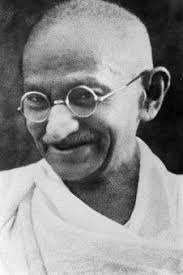
But then who is the most distinguished dissenter among them all? My choice is clear: It is none other than Mahatma Gandhi himself. To understand the nature of Gandhi’s dissent, one must first recognise the fact that perhaps along with Emperor Ashoka and the Prophet Muhammad, he was among those who believed in the imperitive of morality in politics, and in the politics of morality. Said he: “In my opinion, non-cooperation with evil is as much a duty as is cooperation with good.” By imbuing a moral quality to political action, Gandhi brought to bear exacting standards to politics, unheard of in the modern era. His very politics dissents against the existing dictum of political action: That politics is the art of the possible.

But Gandhi’s is not merely a great dissenter in politics. He is, in the words of the author of the internationally recognised novel Samskara (1965), and litterateur, UR Ananthamurthy, a ‘critical insider’. Gandhi, avers Ananthamurthy, allowed himself to be absorbed by the traditions of India, and from within that position, articulated his critique of what he saw as wrong with that tradition. He was a devout Hindu who was secular to a fault, and against the evils inherent in Hindu society. It is precisely because of this that Gandhi was so successful in mobilising India both politically and socially.

Alas today, those who are critical are seen as outsiders: westernised, liberal, socialists, and so on. And those who are insiders are not critical: they are viewed as provincial, obsequious, bigoted and belligerent. India will have to find the will to shake itself free of the straight jacket it finds itself in at the moment. That can happen with only more, and not less, dissent.

.

Debraj Mookerjee has taught literature at the University of Delhi for close to thirty years. He claims he never gets bored. Ever. And that is his highest skill in life. No moment for him is not worth the while. He embraces life and allows life to embrace him.

.

PLEASE NOTE: ARTICLES CAN ONLY BE REPRODUCED IN OTHER SITES WITH DUE ACKNOWLEDGEMENT TO BORDERLESS JOURNAL.

.

Disclaimer: The opinions expressed are solely that of the author.

Categories
Poetry

Deathless Death

By Nirmal Kumar Thapa

Taking the first sight of this planet, a glance around the world;

With your first cry

Shouting the demands of joy,

Even without smelling the sagacity;

Your demand with horrific tears

Being meaningless,

I can sense the deeper entails of your crying;

Perhaps, you are grieved with fear of death

Unknowingly.

A journey from the cradle to the grave,

From a reckless infant to a mystic older soul,

From a brighter shine to a stout pale ray, I know your vexation;

For a lavish survival,

How to guard your soul;

Dido for savouring equanimity,

And where are you going?

Stepping moments towards a grave!

You can’t catch all.

Everything is accompanying you, your serenity, safety

and leading you to the bone yard;

Before death arrives,

Get delighted with festive being-ness, forgetful of your aim;

Don’t rush your existence, too meaningless,

If you couldn’t tap your feet under the blissful shine,

No realisation can ever let you smell the iciness of the grave,

So, don’t miss the great songs of life.

Feel the rhythm and dance, before you go a deep-sleep,

Dance without songs and music,

Cheer-up from your silent world;

You may stir your own-ness melody

Music, far away from Beethoven’s.

Cherishing a divine music of Cosmic flute,

But such silence is hard to keep, relish those very moments,

While you lived silently

It brings completeness, intensely.

Then you comprehend those moments,

A death of deathlessness;

Graveyard is the aim but death is not,

While you endured wholly,

A journey to enjoy deep into the self

Can also enjoy the journey to the grave;

Are you missing the eternal principle of life?

The real fruit of life?

You’re stepping towards a mere departure of your life.

Uttering with tears,

You surprised me.

don’t lose your own joy

that you can sense sitting alone silently,

Death seeks a normal visit,

That you most welcome and celebrate;

For an ultimate challenge of the unknown

Enter in death enjoying a silent song.

Then death is no more a fear of the soul.

Take it as a sutra

A mantra of life, like ~

OM MANE PADME HUM

SATYEM SHIVAM SUNDARAM

And exert it in your own inner space,

Where your beloved one has placed;

Live adventurously, with a wild wisdom,

Cheer up your Laughter without gags,

A great joke laughs at me.

Birth is nothing but live it with a source of passion,

Reunite your passion with the next ardour.

.

Nirmal Kumar Thapa from Nepal is a unique poet, famed for his spiritual blend into contemporary life. He lives in Kathmandu. His edited work COVID-19, an anthology of short stories featuring 26 authors, has recently been published under the ‘Nepal Centre International’ Banner.

.

PLEASE NOTE: ARTICLES CAN ONLY BE REPRODUCED IN OTHER SITES WITH DUE ACKNOWLEDGEMENT TO BORDERLESS JOURNAL.

Categories
Essay

‘If humanity is to progress, Gandhi is inescapable’

By Rakhi Dalal

Vaishnav jan to tene kahiye je 
Peed paraayi jaane re 
Par-dukhkhe upkaar kare toye 
Man abhimaan na aane re (Vaishnava)

One who is a Vaishnav (Devotee of Vishnu)
Knows the pain of others
Does good to others
without letting pride enter his mind.

Vaishnava-janatho-(With-English-Translation)

It is a 600 years old devotional poem by Gujrati poet-saint Narsinh Mehta and we know it probably because it is known to be Mahatma Gandhi’s favourite bhajan or devotional song. He loved it because it speaks about humanity, truth and empathy among humans; traits which he thought were indispensable for harmonious living and which could create a world living in tranquility and peace. His convictions in these humanist traits make his stance on non-violence more comprehensible and relevant to us today. Especially today, when all across the world we witness the grisly play of vicious might bent on establishing hegemony by creating animosity among people, unleashing violence not only in action but also in thought.

The 2010s saw a rise in fascism across the globe. Characterised by ultra-nationalism, unquestioning adherence to a single party/leader, hostility towards minorities, suppression of dissenting voices and people’s civil liberties, this decade’s worse fears have been made worst by the exploitation of social media to spread fascist propaganda. Over the years, most of the platforms have indulged in giving a free pass to hateful messages simply for the sake of maximum engagement and shareholder return or for the sake of not losing business in respective countries where they operate. Even the mainstream media, including news-channels and newspapers, have resolutely carried out the objectives of such propaganda thereby aiding the spread of hatred in society.

In a recent documentary called The Social Dilemma on Netflix — many individuals, who once worked with big giants like Google, Facebook and Twitter, come forth to talk about the threats that our societies now face in the wake of frightening explosion that media has wilfully abetted. Besides addiction to social media, rise in anxiety and depression among people, what these individuals are really troubled about is the onslaught of fake propaganda on social media, which they worry, could lead to civil wars.

According to The Social Dilemma, fake news or propaganda gets viral six times faster than genuine news. This has given a way to effortless creation of polarised factions of people in the virtual world. As a result, sometimes a carefully engineered hatred, which if escalated, can be easily employed to provoke the factions into indulging in actual violence. It does really make for a very powerful tool in the hands of fascist regimes, which is exactly what we are witnessing around us. Social media has helped escalate it. The othering of people on the basis of caste, religion, class and communities has always existed in societies, even in democracies. Now this list also includes people having different opinions than a majority. It seems we have reached a point of no return. We have lost the sight of what social media had initially really intended to do – to bring people closer and connect them.

We have forgotten that violence only begets more violence.

But perhaps, collectively, mankind was never a kind species. Did we ever believe in vasudhaiva kutumbakam, the world is one family? A look back at history is sufficient to prove that, as a species, we have never lived congenially with each other. Neither World Wars nor the consequences of environmental destruction have been enough to make us realise the value of living in accord with each other or with nature. Perhaps that is why saints like Gautama Buddha, Guru Nanak Dev or Kabir searched for a spiritual path, one that could steer more people towards love   and compassion. That is why Mahatma Gandhi realised that violence could never be an answer to anything, not even to the fight for independence. BR Nanda, a scholar on Gandhi, has confirmed in an essay on ‘Gandhi and Non-violence‘:

“He (Gandhi) objected to violence not only because an unarmed people had little chance of success in an armed rebellion, but because he considered violence a clumsy weapon which created more problems than it solved, and left a trail of hatred and bitterness in which genuine reconciliation was almost impossible.”

And don’t we all know it first-hand? Recall any of your fights with your friends, even as a child, which turned physical. Can you remember what you felt after the fight was over? After one of you lay down on ground, wounded and defeated. And whether you were able to easily reconcile with that friend afterwards, without a feeling of bitterness inside your heart? We know better, don’t we? We do realise that violence is seated in something much more innate. Engaging in violence is always an easier option because it comes from a place of feeling superior, and not equal, with respect to other. Violent action is usually preceded by violent thoughts. And such thoughts never leave a person at peace. Neither the aftermath of a violent scuffle ever leaves us calm.

Jiddu Krishnamurti says: “It is violence when we use a sharp word, when we make a gesture to brush away a person. So violence isn’t merely organized butchery in the name of God, in the name of society or country. Violence is much more subtle, much deeper.”

On the other hand, choosing non-violence requires courage; it requires a sense of equanimity, kindness, empathy and the necessity to stand true to a notion of higher purpose, which we humans believe is our goal in this world. Gandhiji placed satyagraha and ahimsa at the centre of force of life which can sustain humankind and present an approach to curb the world of brute force of violence. These ideas are eternal because they are inevitable in coming to terms with human condition.

Gandhiji did not only postulate the idea of non-violence, including non-cooperation and civil disobedience, as a form of resistance against colonial occupation, but also against long held prejudices in the social system. He understood it too well that it wasn’t only against colonisers that India was fighting. He conceived violence in its elemental form as anything which is inflicted to hurt, whether physically or mentally. Therefore, he emphasised upon ahimsa as a way of life, upon harmony between people of different religions and upon being kind-hearted. He changed his stance on the practice of caste system in Hindu religion, which he once believed in, later in life.

According to Gandhi, non-violence is the greatest and most active force in the world,” writes Subrata Sharma, a scholar. He quotes Gandhi while defining non-violence and explains the perspective of this great leader:”‘Avoiding injury to any creature in thought, word and deed’. It is a positive force, when positively put it means love in the largest sense that means love for all without discrimination of good doers and evil doers. Non-violence does not mean meek submission to the will of the doer. Rather, it inspires man to stand against the will of the tyrant. It not only enables us to conquer the opponent but also unites with all our fellow men.”

In the chaotic times that we find ourselves in at present, Gandhiji’s ideas assume greater importance because we have already suffered the consequences of indulging in violence, even on social media. We are forced towards fascism, towards submitting to brute force of authoritarianism, resisting which, in the most assertive and non-violent way has become an absolute necessity. We stand at the junction where we may either decide to put at stake the future of our coming generations, this country and the world at large by giving in to the violent forces of fascism and enmity or we may decide to follow Gandhian principles of non-violence, truth and humanity. 

“If humanity is to progress, Gandhi is inescapable. He lived, thought and acted, inspired by the vision of humanity evolving towards a world of peace and harmony. We may ignore him at our own risk.”Martin Luther King Jr.

.

Rakhi Dalal is an educator by profession. When not working, she can usually be found reading books or writing about reading them. She writes at https://rakhidalal.blogspot.com/ . She lives with her husband and a teenage son, who being sports lovers themselves are yet, after all these years, left surprised each time a book finds its way to their home.

.

PLEASE NOTE: ARTICLES CAN ONLY BE REPRODUCED IN OTHER SITES WITH DUE ACKNOWLEDGEMENT TO BORDERLESS JOURNAL.

.

 Disclaimer: The opinions expressed are solely that of the author.

Categories
Poetry

An Entreaty

By Hem Bishwakarma, translated to English from Nepali by the poet himself

Hem Bishwakarma

My feet are chasing me persistently

Laying my life down under

From then to now!

.

Please,

While I’m passing by this life

Since I am as small as a thread

Do not walk by my side

For I might be broken

.

I might be in a deep contemplation

I might be sketching my country map

Or, writing a poem

Dedicated to you

Try not to stick to me

So that the air will not pass

Try not to walk by my ears

Though you are on a vehicle

Try not to splash a smile at my eyes

The air that lets me a hold to stand

Might fall down!

.

I can give you a whole universe to walk on

Except the soil that my feet stride

Or, walk on the trees

Or, walk on the chests of rivers

You have a tall mountain to trail

Or, it’ll be alright,

If you walk just before or after me.

Giving up this vast geography,

Please do not stick to my skin and walk

.

I would have burnt to ashes

The road would have been habituated

I would walk without a movement

I would watch the flowers—

Please try not to encompass and walk

Being as narrow as yourself!

.

I would be walking with a storm in my eyes

Please do not walk breaking the silence in the air.

.

Hem Bishwakarma is a poet from Nepal. His poems are published in different national and international poetry journals.

.

PLEASE NOTE: ARTICLES CAN ONLY BE REPRODUCED IN OTHER SITES WITH DUE ACKNOWLEDGEMENT TO BORDERLESS JOURNAL