Categories
Poetry

Mulberry Tales

By Kinjal Sethia

Mulberry Tales

A laundered hope- 
swinging the parental pendulum. 
From her clasp to him,
day leaps to dusk on the lake. 
A happy fatigue
scratches a smile. Brimming

with an ordinary pride-
being called parents. 
Her eyes turned 
away from the mountains.
He scans the mist,
an ice cream truck, a madari* 

for me. 

They laugh 
as I paint mulberry our world. 
The centre of their universe
is stained purple. 
White that she will scrub 
clean in the hotel room.

*Madari -- Juggler

Kinjal Sethia is a freelance writer-editor based in Pune. Her work has appeared in Nether Quarterly and EKL Review. She is the fiction editor at The Bombay Literary Magazine and is a part of the poetry community The Quarantine Train

.

PLEASE NOTE: ARTICLES CAN ONLY BE REPRODUCED IN OTHER SITES WITH DUE ACKNOWLEDGEMENT TO BORDERLESS JOURNAL
Categories
Poetry

Taking Over

By Reena R

Taking Over

She lay still on the kitchen floor.
He came to see why dinner wasn't announced.

The girl twirled in a new dress in her room; the door locked from inside. 
The boy, intent on his laptop, won game after game.

Nothing moved for a while,
no one too.

It made little difference to them
and none perhaps to her.

Inconvenient as death is, yet it is a full stop.
An illness kills time, money and patience,
especially when there is no love.

The kitchen was washed,
Prayers chanted,
a homely enough photograph found, garlanded.

The next week, a maid cooked their favourite biriyani,
 stepping over the memory of the fallen body.

Reena R. lives in Sharjah, United Arab Emirates. She has co-edited two anthologies and is a practicing poet.

.

PLEASE NOTE: ARTICLES CAN ONLY BE REPRODUCED IN OTHER SITES WITH DUE ACKNOWLEDGEMENT TO BORDERLESS JOURNAL
Categories
Slices from Life Stories

Adoption

By Jeanie Kortum

He begins speaking the moment he enters the room.  “I had to crawl under the bed and call 911 when my daddy was hitting my mommy,” Jeremy announces.  Skin as brown as California hills in summer, a quick bright smile despite what he has just announced.

He examines us.  “I’ve been waiting for a mommy and a daddy for a long time,” he confides.  “I told my social worker I wanted parents who would love me, I wanted to be read to at night and I wanted a teddy bear and the nightlight.” Jeremy lays out a row of miniature toy cups.  “Would you like a cup of coffee?” he asks.  We nod and he pretends to pour coffee. 

We walked out of that office that first day unable to talk, arrowheads of love sent straight into our hearts. 

Adopting a child from social services is a debilitating process.  Months and months of looking at pictures of children in a small office.  At first I yearned for each and every face, but by page fifty or so, sitting in that stifling room, I became hard.  I was a consumer of the very worst kind, a consumer of kids. 

Then one day we turned the page and there he was.  “That’s the one!” my husband and I said almost at the same time. 

This was our second marriage.  Mike had three kids and I had one.  Our children were grown and we had room in our lives and hearts to raise one more. 

In the weeks to come, waiting for him to move in, I showed Jeremy’s picture—big smile, wearing a little dinosaur T-shirt—to everyone I met until the paper became crumpled and creased at the edges.  I practiced saying the word “son” over and over again; the word filled my mouth with sweet music.  As though absorbing his story would make him more mine, I read the reports from social services over and over again.  Addiction, domestic abuse, now seven years old, he had lived in six different homes in the past ten years.  The trio of his brother and sister and him twice given back from permanent homes until a bold judge decided to separate the kids and place them in individual homes for adoption. 

I made a room for him with a brave cowboy motif.  A lampshade with bucking broncos, a rodeo quilt, a clothes hanger that said the word cowboy and yes, a nightlight. 

He called me mommy immediately.  At first it was so easy, my days filled with joy, the love I felt bright, uncomplicated and complete.  We watched insects crawl across grass blades, played in the pool, walked the dogs, told stories to each other about the shapes of clouds, moments so perfect I did not want to be doing anything else.  His face bloomed a full bouquet of smiles.  I told long romantic tales that softened up the edges of his story.  “Look at your feet,” I told him.  “Maybe they came from your grandfather, a farmer walking through hot brown soil.”

Our bodies opened towards each other.  He came easily into my lap.  We did three-people hugs.  “It’s dark in here,” he would say in a muffled voice and we laughed happily, knowing what he was really saying was that it was safe in our arms.  Every day he unfurled a little bit more. 

“I am your son from another mommy,” he said to me one day, and I found myself blinking back tears.  He reached for my hand with that easy and nonchalant assumption of safety and protection every child should have.  “You chose the right guy.”

One afternoon Mike and I had gone for a walk on the short walk with the dogs when far off in the distance we heard him calling.  “Mommy, mommy,” a lost boy sound on the wind.  As fast as I could I ran back to him, wrapped my arms around him.  “I’ll never leave you,” I whispered.  “I am your forever mommy.”

But it wasn’t always easy.  When you adopt a child you do not have the long ropes of familiarity to climb back into time, to comfort and explain.  You will not recognize the face of your husband in an expression that crosses your child’s face, will not see your grandfather in his hands.  And if that child has been hurt, you don’t start at zero, you often start at minus one, undoing rather than doing.  It is the elemental clay of human nature – sometimes what you find will frighten you, sometimes it will inspire.

We learned quickly that trouble wrestled deep in the biological bedrock of this little boy’s soul.  There was a black hole at the center of him and every morning we woke to the very real assignment of trying to fill that hole. 

He had fits and we never knew when one would detonate.  We could hear his thoughts through his physicality, would know just by the sound of his steps on the stairs or the lilt of his voice whether it was going to be a good or bad day.  He would kick the walls, sometimes tear at his skin with his fingers.  When we went hiking he would suddenly stop on the trail in front of me and when I would bump into him he would fall apart.  He had arrived finally to his forever home and yet he tried to break it. 

We hung tough, however, and I was happy.  It was like creating a sculpture from raw elements, polishing up the good in this little boy, hoping that a heart fully loaded could reach back and heal his previous wounds.

It was at the end of middle school that Jeremy began to complain more, blame more, see the dark side of everything.  The only brown boy in the all-white classroom, he had never done well socially.  No one came to play in the swimming pool, a few listless birthdays now and then but no best friend. 

I tried to dismiss it.  Who could blame him? How could I presume to know what it was like to walk down the street as a Latino male? All around him were smug youngsters plumped with entitlement, multiple gadgets in their bedrooms, soccer camps, private tutors, $40 haircuts.  No one had lived his life so delineated into a sharp before and after, no one had lived those years of fierce wanting, dragged his particular bag of sorrow behind them. 

But as the months went by, Jeremy began to close himself off from us.  Loneliness laminated his surfaces, made him unreachable.  Though we tried hard to excavate his sorrow and talk it through, he refused.  A corrosive teasing entered our dynamic, a hard taunting jeer in his voice that held pieces of flint, igniting sparks of incendiary opinions and behaviors calculated to alarm.

He was one of the best things that had ever come into my life, and yet I was losing him. 

The one constant in all these years was Jeremy’s affinity for religion.  Though different from my beliefs—more connected to the large madrone tree near our house then to any kind of building—I’ve always encouraged his love of God: I thought it gave him another kind of home, a spiritual breathe he could lean against and calm his anger.  My husband, an emigrant from Ireland, had returned to the Catholic church after many years away, attending a small agrarian church with a maverick priest where he was allowed to ask questions. 

We found a small high school that was a bit religious, but with a sweet culture where spiritual safety mattered more than the colour of one’s skin.  It seemed perfect.  We did due diligence, everyone said it was a good school and apolitical.

From the very first week Jeremy loved it.  Its tidiness seemed to comfort him, some origin of biological sin to be monitored with the rules and severity of Christian cause-and-effect thinking.  And at first we didn’t mind too much.  If we could get him through these difficult teenage years, the rest of the sloppy, restless world would wait for him.  He was nicer around the house.  We began to have mighty conversations about existence and religion, and at first the conversations were fair and thoughtful. 

It was slight at first, a few comments he repeated from school, a teacher who publicly supported Trump in the classroom.  When I called the school to complain about the spillage of politics mixed with religion, they were noncommittal. 

Slowly but purposefully, the school turned our son against us. 

Feeding his need for identity, Jeremy began to wear a huge cross around his neck.  He filled notebooks with drawings of Jesus hanging from the cross dripping blood.  He branded himself with a huge tattoo drawn in felt pen down one arm, enormous box letters that proclaimed John 41. 

I did not expect a son with a Burning Man sense of anarchy, but I certainly did not expect this angry soldier of Christ.  For the first time he belonged more to his religion than to us.  When he told us we would burn in hell because we had not accepted Jesus as the son of God, I called the school.  Does it have to be so grim, I asked? Imagine a boy who had waited seven years for a forever family, only to be told that he would be alone again in eternity.

I became known as a parent they needed to pray for.

Jeremy became increasingly provocative.  He used current events to define himself.  Maybe Trump was right and we should build that wall.  Though his father had come from Nicaragua, though he had been rescued by a safety net of social-service programs, Jeremy thought we should cut money for children. 

He supported a new president who lived out his own oppositional temper tantrums in soundbites…I was grieving the fate of our country, now in the hands of those whose views on just about everything went directly against mine.  And now they had my son.   

The war on our house escalated.  We started to talk about getting him out of that school, but he refused and we thought we might do more damage by ripping him away from the one place where he was happy.  We took him to a family therapist but he refused to go back.  Though I knew intellectually he was hurting others because he was so hurt himself I did not discipline myself. 

As the months went by, the sweet boy I had known hardened in a furnace of rage.  No more three-people hugs; he retreated to a room I was too disheartened to ask him to clean, a midden of old food and dirty clothes emanating the odor of despair. 

My friends tried to normalize what we were experiencing.  “It’s just teenage rebellion,” they said.  “Let the world teach him.  It’s not personal.” But I sensed somehow it was deeper than this. 

Though I knew it wasn’t good parenting I retreated, protecting myself from attacks.  I closed off my face, smiled a little less often, learned to weaponize my silence.  Grieving the little boy who was no longer, frightened of the man he was becoming, I fell into loss and fear.  Trump’s America had entered our home, a sinister cynicism, a license to attack, even to hate.  I felt selfish, severe, angry, small, berated myself for being so out-of-control, for not having the courage to change our dynamic. 

What was wrong with me? Why couldn’t I learn to love this man he was becoming? Was I only looking for the me inside of him, towards the places where we were the same?

My husband, recognizing that I was disintegrating, and worried as well about the effect the many battles were having on Jeremy, stepped in and became the primary contact.  I tried to follow Mike’s lead.  I learned how to duck and weave, not take everything on, develop a small chorus of noncommittal listening grunts.  But as we drifted into our separate silences, terrible awkward dinners where no one spoke, the not-so-neutral accord and careful politeness began to seem as cruel as the raging world war used to be. 

*


It is now a year later.  We decided to pull Jeremy out of the school and enrolled him in a place of wide green lawns, an organic garden, a social-justice teacher who encourages discord, and a mission statement of diversity.  In solidarity with other high schools, students walked out to protest guns.  A transgender student was elected homecoming queen. 

It is been a difficult transition for Jeremy, jarring, but he is doing well.  A’s and B’s.  He has made friends, signed up for model UN.  He has returned to sketching, and his intricate details of hands no longer hold crosses.  He still goes to church every Sunday but is more generous around other people’s beliefs.  He even allowed me to hug him in Macy’s when I took him shopping.

Can we pass Jeremy into the years beyond us intact, healthy, maybe even happy?  Will he live in the bright light of possibility and hope or will he sculpt his life from wounds, define himself from loss.  College, marriage, jobs, his own children…maybe the last few years of war were just a brief furrow in the arc of his life, all those years of challenging just his way of testing us, another form of stopping in the middle of the trail so that I would bump into him and he can fall apart. 

Last night, after dinner, I went out on our deck, watched the mountains grow soft with twilight.  Our dog padded out with a clatter of nails.  Frogs began to croak, the leaves in the old madrone rattled, stars appear in the night sky.  A light comes on in Jeremy’s bedroom.  He has a math test tomorrow and he is studying. 

“Mommy, mommy,” I still hear on the wind. 

I take a deep breath.  “He’ll be all right,” I think to myself for the first time in years.

.

Jeanie Kortum is an author, journalist, and humanitarian. She has written two novels Ghost Vision which is based on her experience in Greenland and Stones which is about Female Genital Mutilation.

.

PLEASE NOTE: ARTICLES CAN ONLY BE REPRODUCED IN OTHER SITES WITH DUE ACKNOWLEDGEMENT TO BORDERLESS JOURNAL

Categories
Review

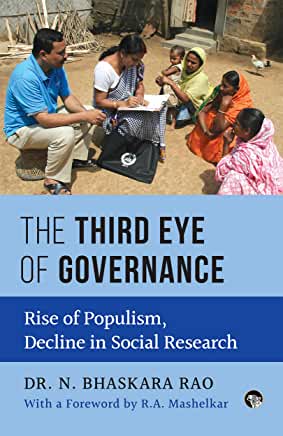
The Third Eye of Governance

Book review by Bhaskar Parichha

Title: The Third Eye of Governance

Author: Dr N Bhaskara Rao

Publisher: Speaking Tiger Books, 2021

Populism may be   a decent expression for politicians; but social science researches would give a damn to the way government policies are planned shorn of any rationality and wisdom. Research is key to whatever social development one talks about because that gives an edge to the expected change. This book takes forward precisely the idea of good research and the downsides of not having an investigation into the way governments’ function.

The Third Eye of Governance–Rise of Populism, Decline in Social Research by Dr N Bhaskara Rao is an eye-opening book because it is written by a pioneer of social research in India. Being  Founder Chairman of the Centre for Media Studies (CMS) and of Marketing and Development Research Associates (MDRA), Rao  built up the equally prestigious Operations Research Group (ORG) as its CEO.A member of the National Population Policy Committee and one who reorganized the media units of the Information and Broadcasting ministry, Rao has authored a couple of other books : Social Impact of Mass Media, A Handbook of Poll Surveys in Media , Sustainable Good Governance, Development and Democracy, Citizen Activism in India and The TRP Trick: How Television in India Was Hijacked. 

A first-of-its-kind history and analysis of social research in India from Independence to the present, this book discusses India’s most important research projects, and the policies based on them. That includes the family planning programme, the five-year plans and the decennial census which has been put on hold because of the pandemic. 

According to Dr Rao, there has been a steady decline in social research with the rise of populism in Indian politics, and there is an utter disregard for transparency and accountability. The volume shows how data, statistics, analysis and research have become politically sensitive and belligerent. Rao argues that if the current refrains about development and progress are backed by applied social research, India can reach new heights in democracy, development, and governance.

Forthright to the core, Rao says with political parties dominating policies, there has been a greater emphasis on winning elections. And this trepidation has to become the priority for research. He contends that research is a distinctive form of enquiry — and that is why he calls it ‘third eye of governance’. The book is a valuable investigation of public policy successes and failures of governments led by different PMS, from Nehru and Indira Gandhi to Manmohan Singh and Narendra Modi. 

Writes Rao: “Populism is an outlook of leaders, and a methodology and strategy of those in power to control, command, and exert their authority. What we are witnessing today is an altogether new populism where ideology has little importance. The new instruments of communication and network have changed the course so much that populism is being made to appear or sound synonymous to democracy and development, when in fact it can turn out be a countervailing phenomenon.

“What is being regarded as a boom may turn out to be a bubble. This depends on the leaders’ grip or control over the instruments of administrative authority or political power. In populism, the difference between ends and means becomes blurred.”

Terming the new wave of populism sweeping across the nation ‘rhetoric-centered’, he argues: “It purports people as masses but is led by a few who are masters of rhetoric. Here, institutions matter less, as do future implications and research and feedback. Populism depends on revisiting the past rather than focusing on the future beyond three-five years. Polarizing people through destabilization is part of the strategy. Perpetuating hate, anger, and resentment form the core of populism and help sustain the phenomena. Double-talk also comes handy in this process.”

Academically comprehensive, the book cites the example of how the ‘melting pot’ idea of American society in the mid-20th century was studied closely by sociologists and contributed to the assimilation process that changed the course of American social progress by changing the mindset. In India, however, Rao says, despite Nehru embarking on the idea of assimilation, people continue more divided, and development has not reached a large number. Part of the reason, according to him, is the lack of critical research and independent appraisal of policies and plans.

While acknowledging the potential of the development themes echoed by Prime Minister Modi, Rao points out the glaring gaps between the stated intention and actual practice. The ideas have to be backed by “high-quality independent and unbiased research”. Slogans and themes such as ‘Sabka Saath, Sabka Vikas (united, we progress)’ deserve to be followed up far more seriously, consistently, and critically.

The government’s recent campaigns such as Swachh Bharat (clean India) or Smart Cities has brought about a new research. He calls it “Endorsement research” or supportive research. Whether research is independent is no longer the preferred criteria. Even the credibility of independent institutions, which have been the primary sources for the country’s statistics, have come under questioning. There has been more reliance on audit-based method than evaluative research in recent years, according to the book.

Divided into ten chapters and running through a little more than 300 pages, the book unequivocally tells how credible public institutions of the country are being reduced to the level of drum beaters. “Covid numbers being doled out by state after state reminds the extent political leaders stoop to suit their immediate advantages. As if we are reviving a regime of numbers.”

The book further says, citizen activism, debates, deliberations, and checks and balances are no longer virtues, and may even be snubbed. Populism does not care so much for self-correctives or plurality. He goes to the extent of saying populism needs an imaginary or a virtual villain or an enemy to prompt realignments. It submits a polarization that thrives in terms of ‘We of now’ and ‘They of the past’.

Dr Rao delves into the history, successes, and failures of research since Independence. He seeks to “regroup social sciences towards a trajectory of good governance, development and democracy, so that social research can lead towards a citizen-centric, society-sensitive future than one focused on just the market and consumer”.

With a foreword by Dr RA Mashlekar, former Director General Council of Scientific and Industrial Research (CSIR), the book is in-depth, fetching and has a broad sweep. It looks at the outlines of public and social research in India through a critical lens. An indispensable read.

.

Bhaskar Parichha is a journalist and author of No Strings Attached: Writings on Odisha and Biju Patnaik – A Political Biography. He lives in Bhubaneswar and writes bilingually. Besides writing for newspapers, he also reviews books on various media platforms.

.

PLEASE NOTE: ARTICLES CAN ONLY BE REPRODUCED IN OTHER SITES WITH DUE ACKNOWLEDGEMENT TO BORDERLESS JOURNAL
Categories
Poetry

In the Echo

By Emalisa Rose

in the echo


in puddled pictorials
they touch
then detach

simultaneously

in this drip drop
calligraphy

rain takes my eyes

for a ride.

Emalisa Rose enjoys crafting and hiking when not writing poetry. She volunteers in animal rescue. Her latest collection is “On the whims of the cross currents,” published by Red Wolf Editions. 

.

PLEASE NOTE: ARTICLES CAN ONLY BE REPRODUCED IN OTHER SITES WITH DUE ACKNOWLEDGEMENT TO BORDERLESS JOURNAL

Categories
The Literary Fictionist

Scarecrow

By Sunil Sharma

Now imagine this scene, dear reader:

A serpentine road, unpaved, badly lit, and completely deserted; a damp chilly early-night of December; the moon-lit fields running down to the distant horizon, a gleaming railway track parallel to the long gloomy stretch, and a lonely traveler walking briskly along the empty road to a distant suburb, lights beckoning.

The main town is tucked away far behind, receding, merging with shadows, finally swallowed by the wintry darkness. An occasional fire illuminates a remote gypsy camp, on the left side of the railway tracks and a faint folk song can be heard.

There are stars in the clear sky and a biting wind eerily blowing into the face of the young and thin male traveler. Then the traveler suddenly becomes aware of another man, walking a few paces behind, along the empty road.

Where has he sprung from?

Maybe he has come on the road from many of the short cuts.

He is just a few paces behind. There is nobody around. Mild darkness. Thicket of trees harbors other figures.

Is he safe out here? The traveler has no answer—no defense, either.

The man is quickening his pace. He is trying to be level with me. Who is he? Let me not hurry to show to him that I have panicked. Here he comes… one-two-three … He is now walking by my side: a head taller than me, stout, bearded, with a glowing cigarette in his hand.

I search for another man along that stretch of road. No, none is there. He is quietly walking beside me. I am getting upset. Who can he be? A fellow traveler? But why is he walking side by side? Why does he not walk either ahead of me or behind me as people normally do? Only friends walk like this, not strangers.

Look, he is slightly unsteady.

Drunk! He sure is.

I abruptly stop, reach for my cigarette packet, take out one from it. He has also slowed down. Let me light it…he has stopped a few paces ahead. The match is unsteady in my hand, the wind blows it off. He is there patiently standing…these bloody matches, the wind is too powerful for them. Oh, God! That bearded stout man is coming towards me.

Tonight, I am going to be mugged by him.

My fault. I love taking evening walks along this completely deserted road. I love its deathly silence, the ghostly fields around it, the moon and the stars — the touch of nature which is missing in the heavily congested small town where I live, with its back-to-back houses, twisted narrow lanes and overcrowded bazaars. I love open spaces, the solitude of ploughed fields and the cold wind buffeting me in my face and chest. A sort of communion with nature; of meditation on life in the tranquilized moments — these are things I discover almost daily in my night walks.

Tonight, it will be a different story. He is here, reaching for his pocket. Goodness, he is going to kill me with a knife. Sweat stands out on my forehead.

“Hello? Let me light your cigarette with my lighter,” the stranger says to me in a thick voice, lighting my cigarette from a red-coloured lighter. Paralysed, I obey him.

We both exhale a ring of smoke and smile. And resume walking side by side.

“It is raw here in the outdoors,” he observes, his voice slurring slightly.

“Yes, it is cold tonight,” I return almost mechanically, my mind racing: What are his intentions? Why did he stop to light my cigarette? What does he want with me? I do not have cash with me. Suppose he gets angry after learning that I have only two rupees with me and starts hitting me. I will hit back.

A lonely stretch, no soul around. “A bit frightening, isn’t it?”

“Frightening?”  he is asking the obvious.

“No, not exactly,” I say, trying to steady my voice, “I love the quiet of a lonely place. It is so charming, so heavenly.”

“Ha-ha-ha. You sound romantic. What are you? A poet?”

“Yes, I write poems, stories and…”

“V-e-r-y good. Where do you live?”

I see. So, he is interested in knowing my address so that he can burgle it. He is a patient mugger. Enjoys stalking a hapless stranger.

“I live in the main town”.

“Everyone lives in a town or in a village. Ha-ha-ha. Where exactly in a town?”

“Near the clock tower. A bit crowded. I do not like crowded places”.

“Near the clock tower. That is near the vegetable market”.

I have given him false address. I changed the topic.

“And where do you live brother?”

“Me? I live in a village three kilometers away from here.”

“Will you walk down to your village?”

“I often do. I come to the town to visit my elder brother, spend few hours, toss down a couple of drinks and return to my village on foot. I enjoy these walks”.

I am feeling a little reassured by his friendly voice. But can it be deceptive? I do not know. These criminals come in different disguises. I must be on my alert. Why is he so gregarious?

The road stretches far into the night.

I ask him, “Are you not afraid?”

“Of whom?”

“Of, er, robbers,” I say, bit hesitant. “Muggers. Chain snatchers. Druggies.”

He stops suddenly, his huge body lurching. He fumbles in his coat-pocket and brings out a spring-actuated knife. My stomach chums. Now, I am trapped. Only God can save one from this drunken mugger. “This is a knife. This cuts into your belly and you are dead meat. And I am an expert with a knife. Tell me now: who should be afraid? Me or the robber?”

“Of course, the other party,” I sound to be normal, despite cold sweat and churning in my stomach. How to get rid of him? I suddenly see a moonlit short-cut going through the fields.

I hit upon a plan. “Okay, dear friend, here we part. I will take back this path to my home. Already it is cold. I must hurry up.”

The man stops too. He grins broadly. “Why are you making a fool of me?”

I freeze then and there, “What do you mean?”

“You are lying to me. You say you live in the town but no normal person will come to this place except those who live in the outlying neighbourhoods over there.”

I laugh away the truth, “Why should I tell a lie? I live in the town and often come here for my customary evening walks.”

He eyes me for some seconds — an eternity for me — and then says, “Okay. But do not return by this short cut. Can be dangerous for a townsman. Come with me till the next crossing and there I will point out a shortcut which is more frequented. Come.”

Again, feeling paralysed, I automatically begin walking by his side. Next crossing. At least, a seven-to-ten minutes walk. Enough time for him to mug me. I should be cautious. In case he threatens me, I can break into a run. Old stories come into my mind — dangerous or lunatic men waylaying innocent people and then doing them physical harm. Here I have a friendly and drunk highwayman with a knife. He seems to be enjoying his hold over me. Fear can make a man completely robotic!

“I also take this road,” he says in a natural manner, “I also love walking. Does a lot of good to your body. Often, I run into total strangers here and we talk, while walking. It helps while away the time”.

My suspicions grow stronger, “What do you do, Mr.?”

“I am a farmer.”

“Then you would be quite well-off.”

“By His grace, I am rich. I have many bighas (acres) of farm. 1 also have a shop at the town. Yes, we are well-off’.

“You must be having lots of enemies?”

“Why should I?”

“Because folks in a village are hot-tempered and pick quarrels easily.”

“They know me very well. My name inspires terror. I was jailed for a couple of years for a minor offence. I had murdered a thug in the open…in the day light. A goonda terrorizing the poor.”

That settled everything!

I do not have the nerve to further probe him for his past. I look sideways at him. He looks ordinary like a stout bearded farmer we come across in the bazaar. We walk quietly. He is lurching a little. The empty and silent road stretches ahead of us. All around us is deep tranquility.

The brilliant moon is shining in a cloudless sky. Now, far off, faint silhouettes of some houses spring into view. The crossing also is getting visible. We can see paan (betel leaf) shops and tea shops. One or two rickshaws are standing idle. A well-lit square has people in it. I feel greatly relieved. Thank God, I have been spared a painful experience on this deserted road. My companion has not hurt me. We reach the square. He insists that I must have a paan and a cigarette from one of the small shops. The owner greets him respectfully. They exchange pleasantries. I critically study my recent friend in the light of the shop: he is middle-aged, pockmarked, bearded and stout man of good height; an impressive man.

He looks harmless now in the changed context.

The paan-and-cigarette ritual over, the man writes down his name and the name of the shop and hands me the slip, “Well, you are welcome at my shop during evenings. I come down there in the afternoon and remain till evening. Come any day, buddy. I like poets.”

He smiles broadly, shakes my hand and bids me good night.

I start back from the square to my colony, a few paces from the next turning, which is ten-minute walking distance, I put the chit carefully into my hip pocket.

Relieved, I grin broadly. I am no longer afraid. Things become ‘normal’ again. I pat the chit.

One day I am going to visit him and explain my urban fears that can be spine chilling when I meet a fellow human being on an empty road on a moonlit wintry night.

.

Sunil Sharma is an Indian academic and writer with 22 books published—some solo and joint. Edits the online monthly journal Setu. Currently based in MMR (Mumbai Metropolitan Region).

.

PLEASE NOTE: ARTICLES CAN ONLY BE REPRODUCED IN OTHER SITES WITH DUE ACKNOWLEDGEMENT TO BORDERLESS JOURNAL. 

Categories
Poetry

A Confessional Poet

By Rhys Hughes

A KIND OF POET

I wait in this box
without locks
for sinners to come
and whisper into
my unseen ear
a list of the deeds
they have done
and undone deeds
they want to do.

And while I wait
it’s true that I write
little verses in lieu
of muttering curses
in response to what
they reveal. I am a 
quiet kind of helper,
a professional father
who strives to heal
the souls that would
rather wallow in sin.

Yes, in this blessed
hollow wooden bin
I convert failures of
the spirit into mildly
satiric lyrics. I am
a confessional poet.


DINOSAUR D’JOUR

The dinosaur
of the day is standing
   in our way.
There are men
on the menu for him
and we are those
    men. But if
you sing one of your
    awful songs
it won’t be very long
before he goes
   away and keeps
      on going.


THE CONFECTIONARY SHIP

The confectionary ship
was once a normal schooner
that was dipped in a vat
of chocolate and should
have been pulled out sooner
than it was but it wasn’t.

Captain Candy is at the helm
and he is lord of the realm
of sweet things but his crew
don’t like him very much.

The problem is that he has
cream for blood and as a
result is very rich, and rich
men tend to look down on
the poor. Whether he is truly
haughty, who knows? But
he is certainly toffee-nosed.


THE TIGHTROPE WALKER

The rope is slack,
I can’t cross the canyon
on that. The rope
    should be taut.

      Taut what?

That’s a question easily
answered. Physics,
geography, economics,
the history of political
intervention.

      Anything else?

Geology, biology and
medical attention.
Please find an educational
establishment
willing to enrol ropes.

     Yes, I will.

Good.
This rope
should be taut
by reputable teachers.


.

Rhys Hughes has lived in many countries. He graduated as an engineer but currently works as a tutor of mathematics. Since his first book was published in 1995 he has had fifty other books published and his work has been translated into ten languages.

.

PLEASE NOTE: ARTICLES CAN ONLY BE REPRODUCED IN OTHER SITES WITH DUE ACKNOWLEDGEMENT TO BORDERLESS JOURNAL. 

Categories
Musings

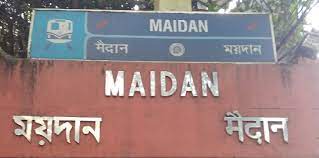
A Stroll through Kolkata’s Iconic Maidan

Fort William was constructed by the British from 1696 to 1706 with permission from Emperor Aurangzeb. The old fort was damaged during the Siege of Calcutta. A new one was rebuilt (1757-81) near the restored building. The old one became the customs house from 1766 and a post office post-independence and the newer one went to the Indian army. Nishi Pulugurtha roamed the grounds near the fort or the Maidan with a camera & recapped a post covid world as it was in December, 2020.

It is a strange time that we are living in. And it seems to be getting even stranger with every passing day. It has become difficult to concentrate, to work, to deal with things as news keeps coming in. Suffering and death all around, the very sound of the ambulance last evening shook me as I was dealing with the loss of two dear friends. Both gone too early, both to the virus that seems to be wrecking lives in these times.  Staying at home is not an option for all, staying safe and doing things that would keep each safe is difficult for many. The bizarreness of the world we live in haunts and troubles.

As each of us struggle trying to hold on, my mind goes back to a walk one winter morning, towards the end of 2020 (I have been looking through older photographs these days, trying to hold on). One morning last December, I decided to go out for a long walk. Not in my neighbourhood, but a little further away. The city has a few places that one could be in the morning — places that are very familiar and have a charm of their own. Winters in Kolkata are crisp and pleasant. In the heart of the city is what is called the Maidan, a huge expanse of green. It is called Gorer Mathh in Bengali which translates into fort’s grounds. These are the grounds of the Fort William which is just across. The Kolkata General Post Office (GPO) is located near the site of the old Fort William.

Courtesy: Nishi Pulugurtha

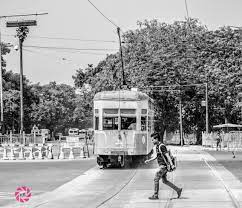
The Maidan is an iconic Kolkata location, one gets to see it in films, songs and photographs. The tram trundles along the grounds. It is one of the most scenic tram routes in the city. I have travelled past it myriads of times just to enjoy the ride along so much of green in the heart of the city. However, I do not recall walking there at all.

Courtesy: Nishi Pulugurtha

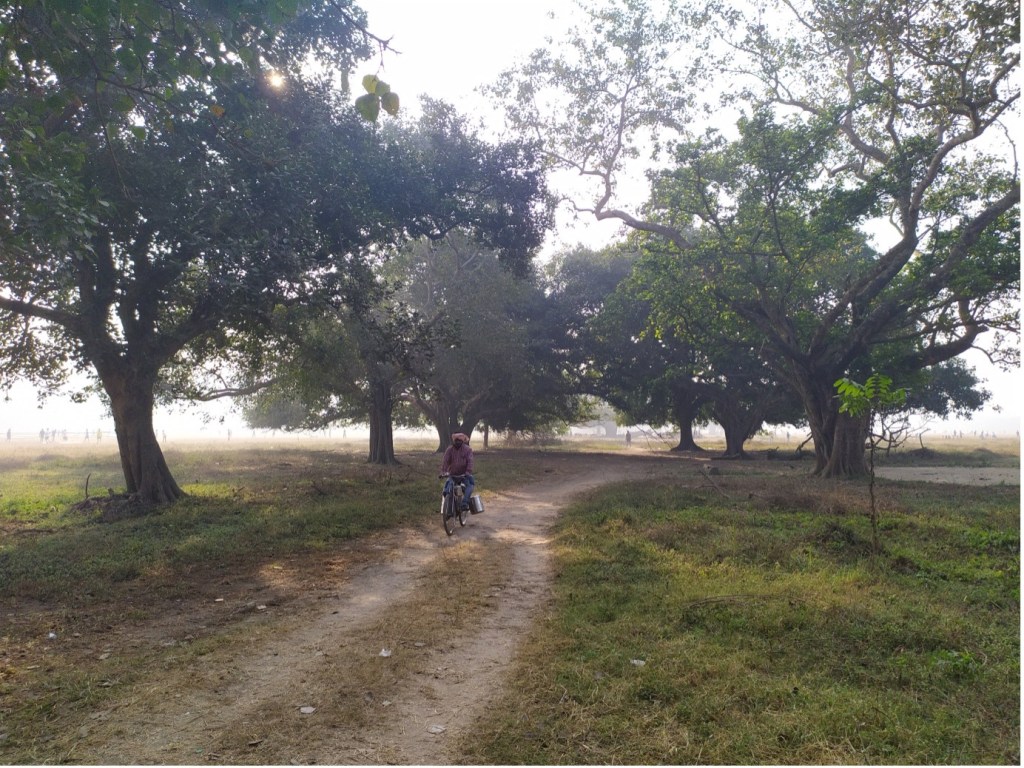
Well, there I was finally, that December morning. As I walked along one end of the Maidan, with the Chowringhee skyline clearly visible and the tramline running past, the scenes that I saw felt nice. There was the lone milk man on his work routine. No rest for him.

Courtesy: Nishi Pulugurtha

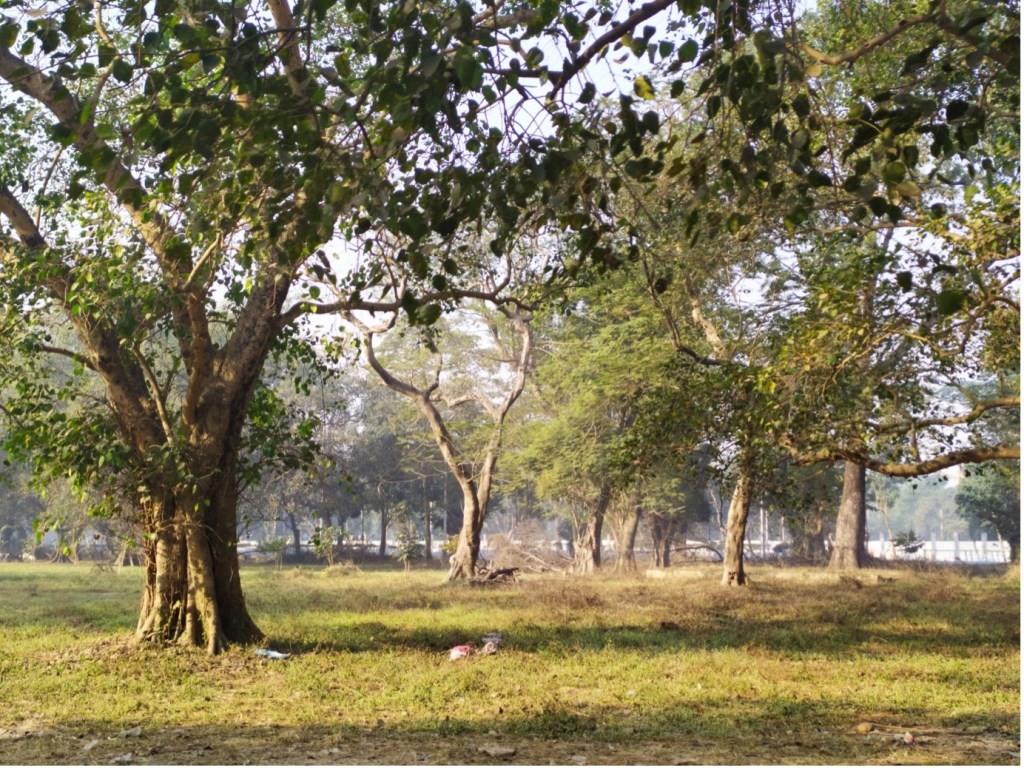
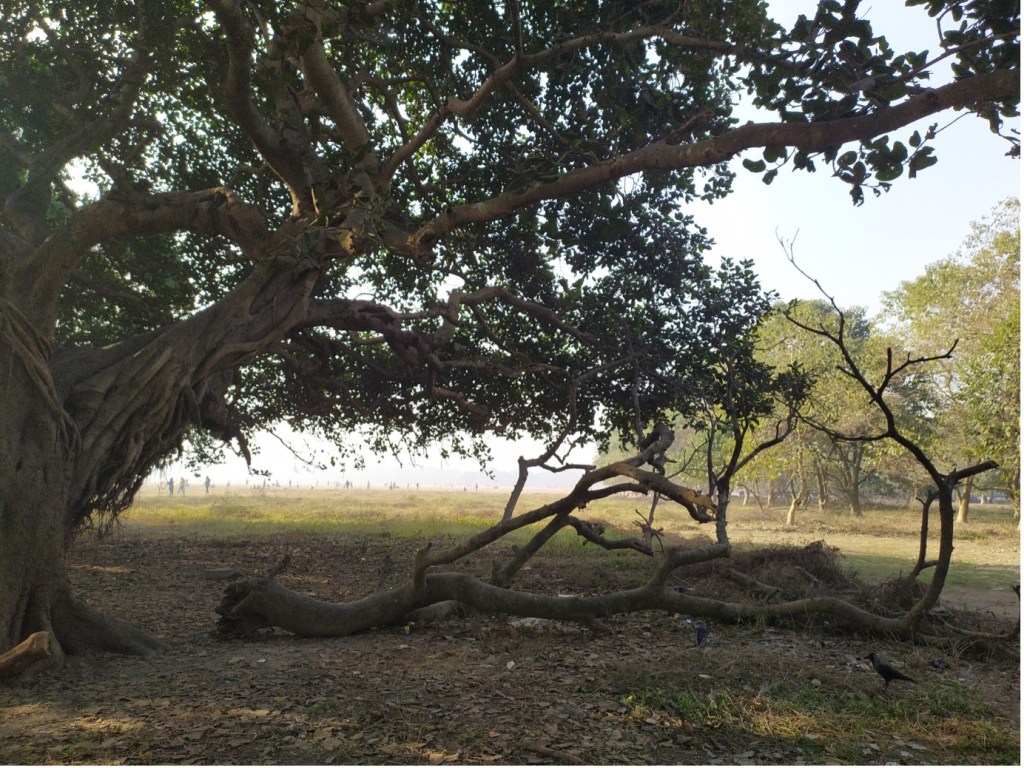
Quite a number of branches were lying around, most of them dry. They create strange shapes here and there. As I walked down from the northern side to the southern and back again, feeling the breeze, sitting down on a broken branch for a while, it sure felt nice being out in the open.

Courtesy: Nishi Pulugurtha

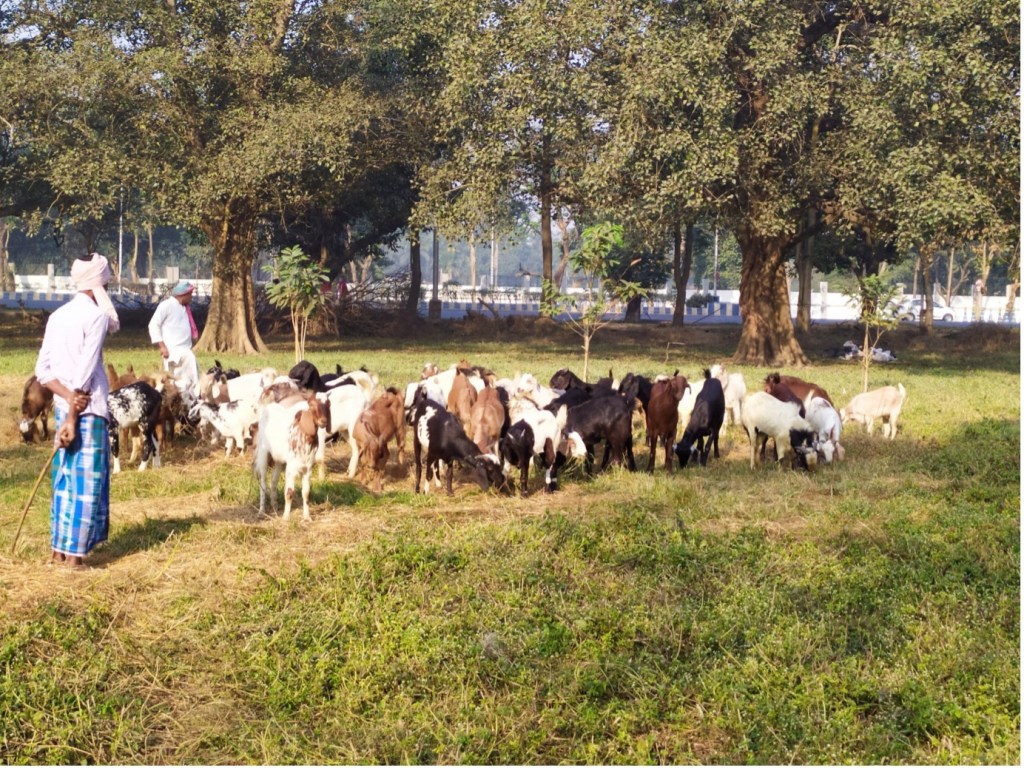
There seemed to be a sense of calm with the sheep out for grazing with the men herding them, the sound of a few jingling bells, the men catching up on some conversation – all in a day’s work.

Courtesy: Nishi Pulugurtha

In another part of the Maidan, a few young people were at a game of football.  A couple of cricket matches were on somewhere else, as the tall buildings look over the green.

Courtesy: Nishi Pulugurtha

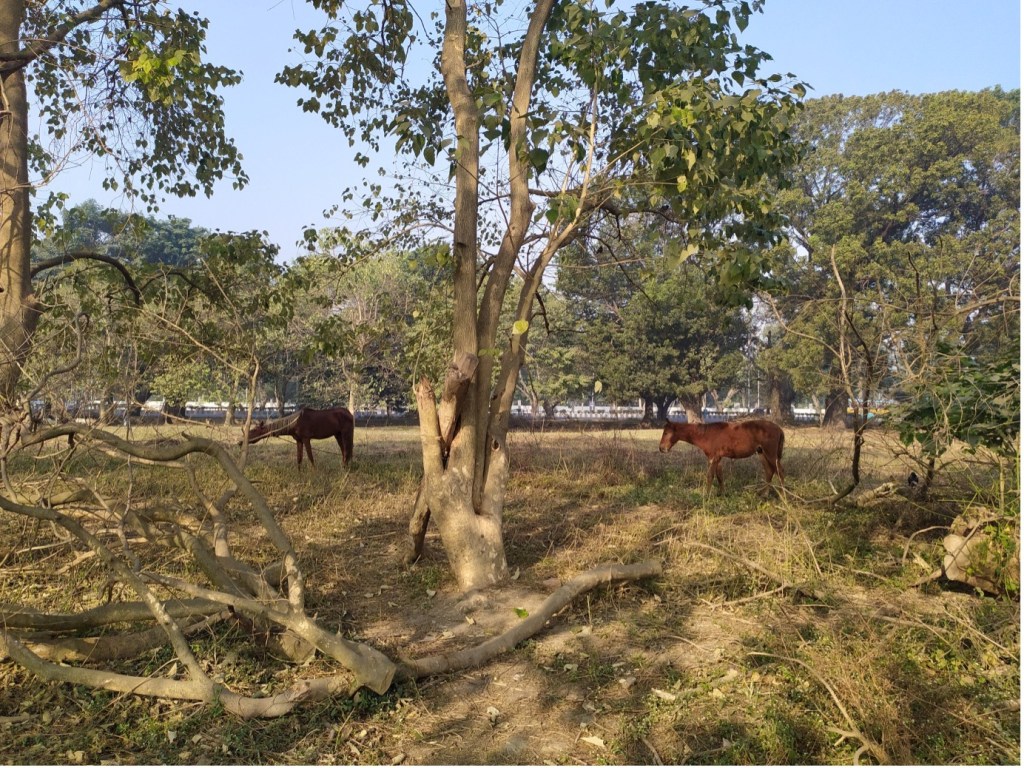
A few horses were grazing in another part of the open ground, before being yoked to the carriages that are used for joyrides.

Courtesy: Nishi Pulugurtha

Three men in orange were out on a mission it seemed as they walked real fast cutting across the vast expanse, through the shade towards the road lining the tram tracks.

On some other parts of the Maidan, one could see people resting. On a concrete platform someone was enjoying a siesta.  A jhaalmuri vendor with his spicy, savoury snacks and the tea seller walking around looking for customers provided a respite from languor and more activity as life moved on.

.

Nishi Pulugurtha’s works include a monograph Derozio, travel essays Out in the Open, edited volume of travel essays Across and Beyond, and The Real and the Unreal and Other Poems

.

PLEASE NOTE: ARTICLES CAN ONLY BE REPRODUCED IN OTHER SITES WITH DUE ACKNOWLEDGEMENT TO BORDERLESS JOURNAL. 

Categories
Nature's Musings

Down the Path of Nostalgia

Penny Wilkes gives us a glimpse of how she was started on her romance with nature & photography by her father, almost a decade after the end of World War II

My father left earth 44 years ago on November 22. I shared his love, creativity, and friendship for 31 years. He continues to inspire each day. I hear his laugh, his lyrical call, “Oooh Hoo,” when he wanted my attention or entered a room to find me. When I turn a corner, often a phantom whiff of Old Spice brings me joy.

When I search in a mirror, his features beam.

My father loved to take photographs. I watched, eager to learn how to capture moments as we traveled around the world.

Before my eighth birthday, I asked for a Brownie camera. I had seen the square, brown one that would fit in my hand. Also, it could hang around my neck on a braided string. I showed my father photos from American Girl magazine.

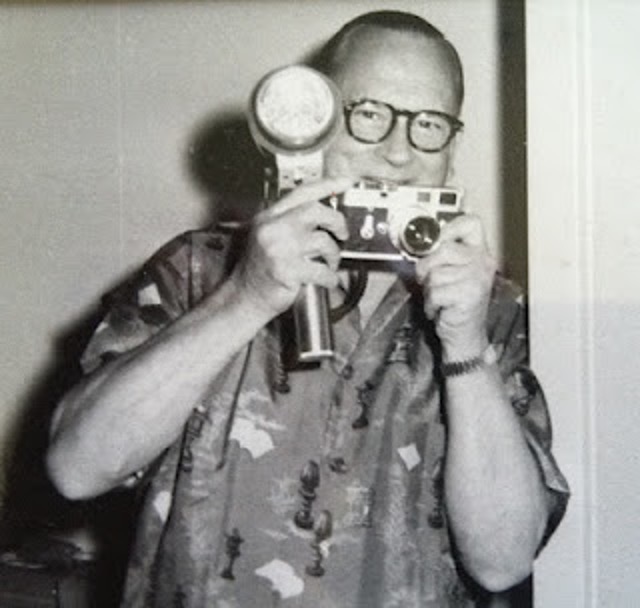
The S.S. President Monroe* became our home on my birthday that year. My father gave me a square package. When I opened my gift, I discovered a Leica camera. 

A pout revealed my disappointment as I set it aside.  

“Come on Petsy, get your camera and let’s go on deck,” my father sighed and grabbed his camera and mine.

Once we reached the top deck, he positioned the camera in my hands. He moved it to my eyes so the viewfinder would reveal a capture of the sea rough with white caps and animated clouds above. Then he left it to me.

I clicked on and on. Flying fish presented their show to my delight. Then it seemed the photo roll had ended.

“What happened?” I asked.

As my father examined the camera, he discovered the cap still on the lens. 

“Really?” His anger flared as he removed the cap. 

I cried as we descended to our room. He showed stern frustration I’d not experienced from him before.

Later, as the sky dimmed, he suggested we return to the top deck. He installed more film, storing the cap in his pocket. 

Click. Click. Click our cameras sung. He spoke of the sun as the “great ball of fire.”  As the clouds danced in red and orange hues, he pointed out sky dragons at play.

We moved around to take in the clouds and colors and our bonding moments began.

 He shared more stories of creatures in the sky and encouraged me to find shapes to turn into stories. 

Once I worried when he needed to stay in bed with the flu. He encouraged me, “No worries. I can’t leave till my work on earth is done.” 

I believe he had much more work left to do. Today, the world would benefit from his exuberance.

We continue to share sunsets and I create stories.

Tie the Memories

I let go of a yellow balloon 

my father puffed to life

He tied it to my wrist

.

I untied it 

and my fingers clutched

slippery air

.

It floated

beyond limbs of sycamores

to circus animal clouds

.

He smiled when I asked, “Why?”

We’d talked about that before.

.

We found merry-go-rounds

in Paris and Kyoto.

Laughed atop a Ferris wheel 

stuck in Brighton beach

.

I burned the lamb chops

in adolescent heart break

He put on more mint jelly

.

No answers in corridors

gray as shrouds

when his twilight spread

on raven wings

.

I let go the string

this tug more desperate

than his breath.

* The author travelled on the ship President Monroe after it was decommissioned in 1954.

.

Penny Wilkes,  served as a science editor, travel and nature writer and columnist. An award-winning writer and poet, she has published a collection of short stories, Seven Smooth Stones. Her published poetry collections include: Whispers from the Land, In Spite of War, and Flying Lessons. Her Blog on The Write Life features life skills, creativity, and writing:  http://penjaminswriteway.blogspot.com/ . Her photoblog is @: http://feathersandfigments.blogspot.com/

.

PLEASE NOTE: ARTICLES CAN ONLY BE REPRODUCED IN OTHER SITES WITH DUE ACKNOWLEDGEMENT TO BORDERLESS JOURNAL

Categories
Stories

Magnum Opus

By Ahsan Rajib Ananda

Rony was all by himself, waiting for an airplane to pass overhead as he twiddled the knob of his DSLR* camera. He was sitting on a stool in his balcony. The railings were about waist-high, and one could have easily toppled over. He aspired to be a photographer of extreme proportions, but he believed his magnum opus had yet to be captured. He took pride in his work because it was only photographers who could keep a moment in time infinitely suspended. They stopped not only a tide on an ocean but the very fabric of time from wilting. He just needed to capture one great moment.

None of his photographs had ever been selected for any exhibitions but he was somewhat well known in the community for he was very sociable. He did manage to get a fair number of paid jobs, but not of the artistic kind. He usually got gigs for taking landscape and architectural photography, a lot of them for calendars. Whenever he talked about getting his photos into an exhibition, the curators somehow brushed the topic off.

Even though he made a generous sum of money every month, he was quite jealous of the younger photographer from his university. This person left his studies because he could not afford it, but somehow, he became very well-known. His work was often displayed at the best exhibitions across Asia. He rose to be regarded as a young talent. Everyone seemed to be talking about him. Rony craved that kind of attention, but he was not a peacock, flaunting his talents from a distance, and concealing them in front of others, to establish a fake sense of humility. Zaid was like that, pretended to be humble, but he was one of the most arrogant men. He flaunted and lured people to himself, and then masqueraded as if they flocked of their own accord. 

Rony recalled an event that he would never forget. He was taking photographs near a train station that night. He noticed a man in a black shirt inconspicuously dragging a dog down the rail tracks. Upon closer inspection, he noticed the dog was battered, and almost dying. He stealthily moved towards the injured dog. The man in the black shirt quickly turned on hearing his footsteps and indicated that he needed help. Rony could not see the man’s face clearly as it was too dark and the man wore a hat with a wide brim, but he drew close to pick up the dog. As soon as he touched it, he heard some clicks. The man had taken some photos of Rony reaching out to the dog. Rony also noticed there was a machete on the ground beside him. The man laughed out loud and said in a strange, muffled voice, “Haha, the dog butcher of Kamalapur!” as he stared at the photo in the camera’s viewfinder.

Rony got up and tried to attack the man with bare fists, but he stopped in his tracks when he heard a train approach. He did not even get the time to get the dog off the tracks. The two men saved their own lives, as the blood of the dog splattered all over them. Rony heard a few more clicks as he stared dumbfounded at the train that passed by. He felt enraged and helpless. It was late but he noticed a few people, staring at them. The man beside him had disappeared too. He later discovered the man’s identity when “The Dog Butcher of Kamalapur” was exhibited. The photo showed Rony’s back, so his own identity remained a secret.

But with time, Rony did become better known. He met Zaid more often, mainly at big exhibitions across town. Their encounter from that night etched Zaid’s smug and proud face into his memory, and he had always hated the sight of him every time they met. For Zaid, on the other hand, Rony was almost non-existent. Zaid did not reveal the identity of the so-called butcher, and neither did Rony, for obvious reasons. Rony did not know what to do about Zaid, he simply silently abhorred that man.

He still did not know why Zaid’s was so cruel to the dog. Obviously, he had not wanted to save him. Perhaps, he wanted to take a photo, but Rony’s presence had interfered. As usual he turned it to his advantage. Rony often wanted to ask him, but he hated him, and he was scared that he would harm him more, not actively, but perhaps do something that would cause Rony to harm himself. Rony looked down on himself partly for the unreasonable fear he experienced.  

Rony detested Zaid’s shrewd characteristics, and his drive to rise to the top. Zaid was not a talented photographer, and he lacked the pristine technic that Rony possessed, yet he could speak with his photography.

Rony could not give up, he decided.  He needed to shoot the greatest photo he had ever taken. He had decided to rise above notions of morality like Zaid because if it meant he could win against Zaid, it would be worth it. However, Rony could not bring himself to shame or hurt to another person or even an animal. If guilt and shame were to come at a certain time in his life, it should not be of an act harming others. An artist must make sacrifices to achieve greatness, and he knew what he could do. He needed to get over his fear as only the ones with the courage to make sacrifices achieve greatness.

So, Rony turned on the timer of his camera and turned the lens towards his face, holding the camera as far as he could with his two hands. He presses the shutter button. 

When the timer started ticking, 10, 9, 8…, Rony jumped off the balcony. He would have captured a moment perhaps no artist could ever have done. That would be his magnum opus — an expression that could only be captured within a brief frame of time. His fame would be posthumous; a man like Zaid would never be able to top this. This would be the greatest photo of the year.

Falling was not easy and uniform, and Rony realised his mistake as his camera fell from his grasp. It was exactly that moment that he experienced extreme fear for the first time in his life. Even more fearful than death was the sight he had under his eyes, a man with a camera taking continuous shots of his fall. 

Zaid had again won that year, he has captured an expression no photographer ever achieved before; he calls it, “A Portrait of Terror”. He said the photo embodies the terror of facing death, and he hoped it would make people to think twice before committing suicide. Zaid planned a series of anti-suicide campaigns, which were later acknowledged internationally as a humanitarian. 

The photograph is still known as Zaid’s magnum opus. Even though Rony failed to create a masterpiece himself, he had become one.

.

*D-SLR: Single-lens reflex (adjective): Denoting or relating to a reflex camera in which the lens that forms the image on the film also provides the image in the viewfinder

.

Ahsan Rajib Ananda is a music teacher and composer from Dhaka, who writes poetry and fiction as a hobby. He completed his Masters from University of Liberal Arts, Bangladesh with a focus on Creative Writing.

.

PLEASE NOTE: ARTICLES CAN ONLY BE REPRODUCED IN OTHER SITES WITH DUE ACKNOWLEDGEMENT TO BORDERLESS JOURNAL