Categories
Poetry

Iron Maiden Voyage  

By Ryan Quinn Flanagan

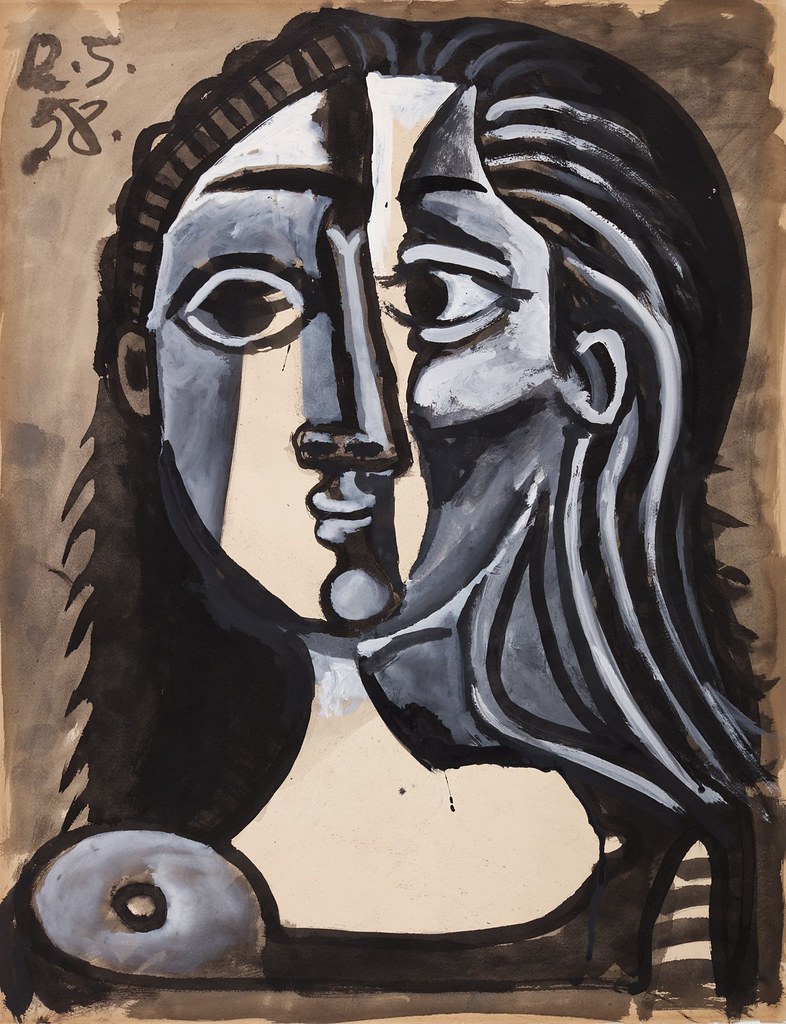
A Woman’s Head(1958) By Pablo Picasso (1881-1973). Courtesy: Creative Commons
IRON MAIDEN VOYAGE

That faded band shirt way 
you wait for your order, 
got your whole life wrapped up  
in condiments  
 
the stark raver behind the cash 
with that falling fire escape of hair, 
on the run from everything but the law; 
it's one smile out the door and some 
butcher block cut up for the diary 
 
and you hear some power slave  
get his number called, 
some chunky oil slick wife beater  
with a fistful of straws instead of dollars 
 
and that ship has sailed  
somewhere in time  Ontario
as the fry hat emo kid slams a tray down 
in front of you -- 
 
that smell of stake ketchup blotted  
over all the tables  
as you search out some sodium spilled  
shanty by the bathroom; 
 	
a parking lot full of rust boxes  
pulled in on the lean,  
steering wheels hot to the touch 
from clutch to column  
under some heavy nowhere sun  
that just won't stop. 

Ryan Quinn Flanagan is a Canadian-born author residing in Elliot Lake, Ontario, Canada with his wife and many bears that rifle through his garbage.  His work can be found both in print and online in such places as: Evergreen Review, The New York Quarterly, Borderless Journal, GloMag, Red Fez, and The Oklahoma Review

.

PLEASE NOTE: ARTICLES CAN ONLY BE REPRODUCED IN OTHER SITES WITH DUE ACKNOWLEDGEMENT TO BORDERLESS JOURNAL
Categories
Poetry

The Sentimentalist

By Ramesh Dohan

THE SENTIMENTALIST

Dawn was his greeting time.
Welcome back, he said quietly.
He couldn't believe
what day it was.
He ate lunch in a
glass box, a kind of
winter cafe.
Someone before him
had left a little
Saucer of salt, with a wooden spoon
Like a tiny oar in white sand.

Ramesh Dohan lives in Toronto, Canada with his partner and an exceptionally perfect dog. When he is not writing in his favourite café, he is seen reading, hiking, and travelling the world. 

.

PLEASE NOTE: ARTICLES CAN ONLY BE REPRODUCED IN OTHER SITES WITH DUE ACKNOWLEDGEMENT TO BORDERLESS JOURNAL

Categories
Poetry

A Vain Monsoon

By Rituparna Mukherjee

A VAIN MONSOON

Your thoughts make me vain,
It is not a kind emotion,
I try to look for myself
In every verse that inhabits your mouth,
Like a stranger, asking for directions
In the lanes of an intimate city
Littered with cramped shops,
Streetlights glimmering in latent desire
In your weak, wary eyes.

A city dwells in me.
You touch it through all seasons
With tepid drops of rain
Turning it muddy in places,
Heaving with warm sighs in others.
You knock on random doors at other times,
With furious hail and fierce winds,
Smashing glass,
Seeping through curtains wet,
Lying in pools of unquenched ardour,
Near my feet,
Too tender to be wiped dry.

Clouds of longing reign in dirty gutters,
Where I send you ruined poetry,
Folded neatly in childish boats,
Wishing they would travel
To your window,
Through which you glance in evenings,
At the golden redolent skies
That stretch between the two of us.

Rituparna Mukherjee is a faculty of English and Communication Studies at Jogamaya Devi College, under the University of Calcutta. She is currently pursuing Doctoral degree in Gendered Mobilities in west African and Afro-Diasporic Literature at IIIT Bhubaneswar. She works as an ELT consultant, translator and ESL author outside of her work and research schedule.

.

PLEASE NOTE: ARTICLES CAN ONLY BE REPRODUCED IN OTHER SITES WITH DUE ACKNOWLEDGEMENT TO BORDERLESS JOURNAL

Categories
Musings

Remnants of Time Once Spent Together

By Sayali Korgaonkar

I thought I was never really close to my Aaji (grandmother). She became paralysed and suffered from many illnesses ever since I was too young to remember, so we barely interacted. When she passed away a few years back, I did not cry. I could not grieve as much as my mother did, or as my uncles and aunts did. I guess I am a bit like my father in that sense, not too emotional. A few years earlier when my grandfather had passed away, I remember everyone in my house crying, even those who barely knew him. I remember my father walking in from work, straight-faced, he touched my grandfather’s feet and went in to change. I thought my father wasn’t grieving his own parent’s death, but I have come to realise that everyone has their own way of dealing with grief.

Similarl, I think I still sometimes grieve my Aaji’s passing. I have come to realise I was closer to this woman in my life than I thought. When I was born, my Aaji stitched one of her sarees into a blanket for me. It was violet in colour and the softest fabric you’ll ever touch in your life. I have since grown out of the blanket by many inches, but I still keep it beside me as I sleep. On nights that I find it difficult to sleep, I hold the blanket close to me. I like to think of the immense warmth it gives as the love my Aaji filled it with when she first stitched it. I am 20 years old now, and I still cannot find peaceful slumber without the violet blanket.

My Aaji suffered from memory loss for about ten years. It got worse every day. The one thing I remember most though is that she would even forget her own sons and husband and mistake them for nurses or doctors. But in the twelve years that she was that way, she never forgot me. She always remembered me as her granddaughter, Sayali. I don’t think I appreciated that enough. And I think I still grieve for that to this day.

I have been fortunate enough to not lose too many people close to me yet. I have not experienced grief as much as many near me have, but I think I understand the weight it carries. The loss of a person is beyond anything that can be expressed in words. It is, however, something that is inevitable far too many times in one’s life. Elizabeth Kubler-Ross (1926-2004), a pioneering psychiatrist on near-death studies, once said that one will “grieve forever. There is no ‘getting over’ the loss of a loved one. We simply learn to live with it.” That quote has stuck in my head ever since her death. The loss stays with you forever, and it changes you in ways big or small. Just like my Aaji left behind the violet blanket of comfort for me, everyone will leave a part of their life with you to grieve over, the remnants of the time you once spent together. It might feel like a burden, in the beginning, but you come to accept it as part of your life eventually. It makes you strive to be a better person than you were yesterday.

Sayali Korgaonkar is a  writer at heart and an aspiring journalist, who is passionate about telling stories.

.

PLEASE NOTE: ARTICLES CAN ONLY BE REPRODUCED IN OTHER SITES WITH DUE ACKNOWLEDGEMENT TO BORDERLESS JOURNAL.

Categories
Stories

Until we meet again

By Shivani Shrivastav

River Beas in Manali. Courtesy: Creative Commons

“Whatsoever is needed on the Path is always supplied.”

~ OSHO

I read the lines again. And yet again. They spoke to me. I felt like I knew the person who had written them, even though I had not met her. Reaching out, I gently touched the lilac handmade paper on which the poetry was written in purple ink. The lines touched my heart: it was an original poem, but unfinished.

I had never felt such spontaneous poetry coming from myself, but reading these lines, I felt some lines forming spontaneously in my head. I pulled out a pen and started writing some words in the space left on the paper. The stranger’s lines and mine now matched beautifully.

*

I had come to Manali on a whim. I was between jobs — just having had my fill of my first one and not yet wanting to start the next one. Idly looking at my Instagram feed, I had seen so much of the beautiful mountains, attractive waterfalls and serene cloudscapes that I just had to get on a bus and come to Manali. I could not believe that I, Kabir Kulshrestha, in all of my twenty-eight years on earth, had not thought of visiting this slice of heaven before. Up until now, I had been passively aggressive in my daily life, cribbing about the boring routine, the never-ending work pressures and imagining that everyone besides me had near perfect lives, as evidenced by their Instagram feeds and the stories and reels they shared. For the first time ever, I felt that belief dilute a little, as I finally felt more alive with a new awareness and appreciation of my surroundings growing automatically, as I watched the greens, blues and whites of nature all around me. 

I had taken the overnight bus from Delhi to Manali. When the bus passed Kullu, I did not know, but when we reached Manali and I opened my eyes as we were entering it, I was in heaven. Or as close to heaven on earth as I could get.

All around were green mountains, tall 50-60 feet high trees, ancient paths leading to god-knows-where and the endless, cloudy blue sky. I inhaled deeply and felt some of the lethargy and humdrum sameness of the past months slide away.

Deliberately, I had not booked any hotel online, preferring to choose one upon reaching the place. The bus had dropped me in the middle of new Manali. I felt a little disappointed, surveying the hotels there. It all appeared like any other tourist town at the first glance – the same greasy restaurants, the shops selling cheap touristy memorabilia and tawdry conveniences. Fortunately, I had packed light — just a backpack of essentials and my camera bag. I decided to go off in search of a better place to stay – somewhere more authentic and closer to the real Manali experience.

After walking through a road going up and passing beside an untouched meadow with tall pines, I decided to cross over the river Beas to the other side and look for interesting homestays that I had seen pictures of on Instagram. Walking up the mountain, down the steps leading to the bridge across the raging Beas was a pleasure as I felt a bit stiff after the overnight bus ride. The tall, silent trees, some more than two arm-spans wide (yes, I had tried to hug one!) the birdcalls, the early morning pristine silence pervading the mountains and the tumultous Beas below, all framed a beautiful picture in my mind. Along the shores of the Beas were orange blossoms; I was surprised by their tenacity. Also, along the old Manali side were what looked like very interesting cafes, with names such as Nirvana, Café 1947, Bella Pasta, Dylan’s etc. Their menu boards were brightly handwritten notices or sometimes, simply blackboards on which the day’s menus were handwritten in white chalk. Their signboards were vivid splashes of hand-painted pictures, and Bob Marley and his ‘Ganja Gun’ anthem could be heard from many a café. Add to these, the colourful flowers growing beside the Beas and in the planters of the cafés by the window seats. It is not just an unforgettable scene but a nuanced one.

I promised to myself that I would visit them all one by one. Crossing over the bridge, I stopped to admire the scene — a slice of heaven on earth — the blue sky, the raging river foaming white at the edges and the tall, green, graceful sentients as far as I could see. Yes, I would definitely be back later, with my camera, but for the moment, I just wanted to enjoy being there, present with beauty inundating my senses.

With a deep breath of contentment — even the air smelled different here — I crossed over and started walking up the steep path. On both sides, cafés, restaurants and interesting shops continued up the road. I didn’t know what I was looking for, but I knew that I would know when I found it.

More than halfway up the path, I paused and stood under a tree, to rest a moment. As I looked around, I saw a vibrantly painted, two-storied wooden house. It had red doors and blue windows! It was a little distance away from the main lane, with a tiny winding path of its own. I could see feathered dreamcatchers waving in the wind, on its second-floor wraparound balcony. Automatically, my feet turned to that path. Reaching the house, I had raised my hand to knock on the door when a voice called out to me, “Hi! What are you looking for?”

Looking up, I saw a young woman, a little older than me, walking towards me. ‘Colourful’ seemed to be the theme of the place, as even she was dressed like a rainbow, albeit an aesthetic one! Her multiple bracelets and necklaces of brass and colourful threads swayed as she came nearer. She was followed by three Pahadi Bhotia dogs, in varying shades of brown.  I smiled and said, “Hi, I’m Kabir. I’m looking for a place to stay for a few days and don’t want to stay at a hotel. Could you recommend a homestay or something similar? For some reason, I was drawn to your place the moment I saw it from the path. Cute dogs there, by the way!”

The lady smiled and replied, “Thanks! I’m Ragini. This is my home and my homestay. You can stay here if you want. Are you coming from Delhi?”

“How did you guess?”

She gave a hearty laugh and said, “That is where we get most tourists from.”

“I’m from Delhi, yeah, but I’d appreciate it if you didn’t call me a tourist. I prefer traveller!”

“Woohoo! Then we are kindred spirits! I think you will like it here. Come, I’ll show you the two rooms that are available. The rest are filled by a group of travellers from Spain.”

“Great! Lead the way!”

I found a home away from home there. Ragini turned out to be a wonderful host, having created a warm, welcoming space that immediately made everyone feel right at home. Having chosen the room at the back, which faced towards the mountains, I settled in. The homestay also had a small but varied library and a music corner, which hosted many impromptu musical duets in the evenings, where many a language and accent were heard.

The meals at her homestay were from all over the world.  Ragini and her helper Jigme had a real talent in that department. Every breakfast was a medley of tastes from Lebanese to Italian to South Indian, and of course, the staple offered in all mountain towns — aloo paratha[1]with tomato chutney!

I had expected the typical Maggie or paratha option for breakfast, but these were veritable feasts! Lunches I preferred to have outside, wherever I happened to be at the moment, like the other day when I followed the main path in old Manali leading up all the way to the top, past the wooden Manu temple. At the top I found a Japanese man with a modest restaurant, making sushi, which turned out to be out of this world! The second day, I went the opposite way, towards the riverbank, and had the best tiramisu of my life, after a meal of falafel and gyros.

My trip was turning out to be a discovery of tastes. Between mealtimes, I explored outside and within myself, for it was also turning out to be a time of self-discovery; I had never felt closer to myself. I met people from different walks of life, exchanging life stories and travel experiences. I walked to various places. I hiked up various slopes, sometimes to just sit at the top, admiring the landscape and letting it soothe my soul, writing, taking pictures, meditating or simply sitting.

I found that the more I sat with myself, the more I was able to appreciate the without, and the better became the quality of my creations. I went where my feet led me, sometimes by myself, sometimes with other people I met at the cafés, restaurants and stores. I was developing quite an eclectic mix of friends — there was Pedro from Mexico, hitchhiking his way through Peru, Bangladesh and now India. He had met and befriended Francine, a French professor on a sabbatical of self-study, come to India to explore yoga in Rishikesh, Tiruvannamalai and later Goa, somehow ending up in Manali! She too, had interesting stories of her own travels to share. Then there was Loki, whose Japanese name was difficult to pronounce and hence shortened to Loki, who had made Manali his home for the past two months. He was slightly temperamental – some days jolly enough to sing with us in the evenings, the others sitting with his old ukulele and playing some nameless tune over and over again.

I admired the way these people lived, following the flow and just taking in all life had to offer. The evenings were spent either with these people or with the Spanish group back at Ragini’s, with music or a night of storytelling after a delicious dinner. And such stories they were!  Enough to cause itchy feet in the most stalwart of homebodies!

I was enthralled to hear about the diverse backgrounds all the guests came from. At first glance, they appeared like hippies, with their ragged jeans, loose kurtas, thread anklets and jute bags, but one was a particle physicist, another a music teacher, and still another a biologist! I promised myself to never, ever again to judge a book by its deceptive cover. It could be hiding the most riveting personality behind its carefree façade.

The experience dispelled my long-standing bias to an extent too, that people are as good as they appear. This belief was further shattered by a teacher from England, who had been travelling to India every year for the past 15 years, to teach English to Ladakhi children, that too without any financial interest. This year, before heading back to his home country, he had decided to go to Delhi via Manali.

I was learning that people made choices, often difficult ones, leaving comfort and the complacency of lucrative jobs to do what their hearts guide them to do. I was learning, melting down prejudices and emerging with a more open mind and heart.

It was in this frame of mind that I went out each day to shoot pictures, capturing the natural beauty of the place and the simplicity of the people living there. I also found that there was in actuality, very little that one needs to live a full life — a good set of friends, good food, an open space to sit and contemplate and live with nature to embark on a journey of introspection and reflection.

One day, I sat in a riverside café after a successful morning of breathtaking photography session. I had just finished a gruelling session of yoga with Francine and then hiked to a special place that someone had told me about, to take pictures of a waterfall. Later, I had photographed the trees – pines and oaks. I believed some of the images taken that day managed to capture the silence emanating from the trees. Totally satisfied with a morning well spent, I ordered a sumptuous lunch of tofu sandwiches with an avocado salad, to be followed by a slice of apple pie. I had never eaten so much in one meal back home! I noticed also that so much of walking around was helping my body become much healthier, even though I was eating amazing meals at least three times a day, without worrying about calories.

While waiting for my food, my eyes fell on a notice board on one of the bright yellow walls of the café. It had a big notice board on it. As I walked over to it, I heard strains of ‘Bella Ciao‘ being played on a mandolin, from a corner of the café. A local group was singing there for the evening. There were various papers stuck to the board — advertisements, people wanting a homestay, people wanting to sell stuff, like watches, a guitar and even a Canon Mach III! I found the fantastic mix of things here a sharp relief from the overly organised things back home.

As the strains of the song got more energetic, I returned to the present. I noticed that on the lilac-coloured sheet, a few lines of poetry were written in Hindi. It appeared out of place amongst the notes in English, Spanish, French and Russian. The lines were –

“It is just a bubble of water,

Which loses itself in but a moment”

As I read, I felt some words forming in my mind. I took out my green felt tip and in my bold scrawl, which I liked to believe was very artistic, jotted down some lines on the sheet –

“So live fully in the moment, don’t be sad,

These are the moments of life, don’t lose them”

 Satisfied and feeling some kind of connection to the original writer, I came back to my table to find that my order had arrived. For a while, the tofu sandwich and the food I had ordered managed to hold my full attention. But after a while, I found myself thinking about the lines on the paper as I ate.

I tried to create a mental picture of the person who had written the lines and found that I could only conjure a shadowy image. That image accompanied me as I paid at the counter, picked up my backpack and my camera and went down the path towards the river. I could not get enough shots of the foaming, dancing, raging river. In my mind, it seemed to be a young girl, full of life and poetry, dancing as she flowed through life.

The next day, for some reason, I felt pulled towards the same café. I tried to convince myself that it was because I wanted to try their Lebanese platter, but the lilac-coloured paper floats in front of my eyes. I was curious, “Would she have replied? Will I find more lines added to the poem?”

As I entered, I tried hard not to let the board be the first thing I saw, but even as I tried this, my eyes lifted that way of their own volition. And a jolt of electricity went through me — there were some more lines there! Even before ordering my food, I headed over to read them.

I smiled as I read, for even as I read, I was formulating the next few lines. And this went on, till we had completed three poems, and I had tasted all the dishes in the café. I felt as if I really knew her, but I did not write my number or pen a request to meet. I did not want to scare her away with my ardour.

The next day, I had this weird feeling, a type of intuition, as if something was changing, something was about to end and a new phase about to begin. Although I could not understand the feeling, I went about my day as I usually would. There was a crowd in the corner of the café that held the board.

I waited for the people to move away so I could see the board. As the people shifted, I caught a glimpse of the board. There was a single fresh lilac sheet there. Only one line appeared to be written on it. I rushed near and read it. It said – “Whatsoever is needed on the Path is always supplied.” It was a quote by Osho.

Suddenly, I felt a prickling sensation at the back of my neck, like someone was looking at me. I immediately turned back. As I did so, I saw a girl turn towards the door and step out. She held a lilac paper in her hand — the last completed poem. It took a little while for me to get through the throng of people crowding the place. That day was a live show, so there was a big crowd there.

As I opened the door and stepped out into the dusky evening, a sudden brisk shower started. I saw her get into an auto and move across the bridge. I tried going after her, but the sudden downpour had increased the traffic on the bridge and she blended into the crowd. I rushed back inside the café, to the single sheet on the board, took it off and scanned it hurriedly, as if to find some hint of who she was, her name, number, something, anything! As I turned it over, I found two words written in the same purple ink. ‘Leh Market’. I smiled. I had my next destination. I knew I would be meeting her again. When, how, I did not know. But somehow, I also liked the not knowing. And the search began again. With a new poem, in a new city!


[1] Wheat flatbread stuffed with spicy potatoes

 Shivani Shrivastav is a a UK CGI Chartered Secretary and a Governance Professional/CS. She loves meditation, photography, writing, French and creating.

PLEASE NOTE: ARTICLES CAN ONLY BE REPRODUCED IN OTHER SITES WITH DUE ACKNOWLEDGEMENT TO BORDERLESS JOURNAL

Categories
Notes from Japan

The Boy and the Cats: A Love Story

By Suzanne Kamata

My son wanted a dog, as boys often do.

But one day, my husband said, “How about a cat?” His high school friend, who was a veterinarian, had an American long-haired kitten to give away. His children had found it abandoned by the side of the road, scared and shivering, and brought it home. It was black – an unpopular colour due to its bad luck connotations. The colour of a witch’s familiar.

“Yes!” my son, now fifteen, said. By this time, he would have been happy with a hedgehog or a salamander – any pet at all.

Although I love cats, I was more reluctant. After all, I’d just bought a brand-new sofa and love seat with some book money I’d gotten. I could just imagine what a cat’s claws would due to those leather cushions.

Nevertheless, my husband and son set out for the vet’s office. They came home later with the kitten cuddled against my son’s chest and all the accoutrements – food dish, cat toys, scratching post, and a multi-tiered tower that my husband immediately assembled.

From the beginning, like a duckling that imprints on the first thing that it sees, the kitten, which we named Sumi (the Japanese word for the black ink used in traditional calligraphy) liked my son the best. My early rising husband may have been the one to fill his food dish every morning, and my daughter sometimes coaxed him into her room for sleeping, but my son was his favourite. Sumi would leap from my lap to greet him at the door when he returned from school, and mew plaintively and persistently at his bedroom door until he was admitted. Sumi was skittish and inclined to hiss at strangers. He’d run away and hide under a bed when my sister-in-law dropped by for a visit. But he crooned a greeting when my son walked into the room. They bumped their heads together with mutual affection.

Of course, I grew to love Sumi as well even though, predictably, he clawed the new sofa, scratched the wallpaper, and regurgitated his food on our freshly installed tatami mats.

My husband tried to discipline Sumi, sometimes by holding him immobile and roaring at him, but instead of becoming docile and obedient, Sumi began avoiding him or hissing in his presence. My husband began to grumble that a dog would have been better.

One afternoon, a couple of years later, my son came home with another kitten. She was a tiny, mewling thing with blue eyes and white fur, with a smudge of black on her face – a Siamese, by the looks of her.

Jio (Suzanne’s son) & Mii. Photo courtesy: Suzanne Kamata

“She followed me,” my son said. He’d been down by the riverbank, pitching a baseball against a brick wall, when the tiny creature had found him. “I couldn’t just leave her there.”

Apparently, she’d been recently abandoned, her trust and innocence still intact. She wasn’t skittish and shy like Sumi. She was adorable, but we all knew that Sumi wouldn’t welcome her, and one cat was really enough. How much more violence could our sofa and wallpaper endure? Besides, my son, a sophomore in high school, was taking off the very next day for a four-day school trip to Tokyo. Who would deal with the kitten?

However, she quickly grew on us humans (though Sumi, now quite large, was terrified of the little ball of fur). We ended up keeping her, and she quickly adapted, co-opting the litter box, happily eating kibble – and tomatoes! And broccoli! — from the same dish as Sumi and hopping up onto the nearest warm lap. My daughter named her “Mii.” But she, too, had a special relationship with my son, her saviour. He taught her to fetch – like a dog! And she came when he called her, like a dog.

We tried to keep her safely indoors. But one day, she managed to escape. Hours later, she turned up, limping. We took her to the vet, who said that she had gotten into a fight. He gave her some antibiotics. For a couple days, she lost interest in going outdoors.

But a week later, she got out again! This time she was gone overnight, I searched all over the neighbourhood, calling her name, but she didn’t come.

That evening, rain started to fall. Suddenly, we heard her distinctive mewling. My son grabbed a flashlight and we went in the direction of her voice. We found her stranded on the tile roof of a nearby house and pounded desperately on the door. Finally, it creaked open to reveal an elderly woman in her nightclothes. I wonder what she thought, seeing two foreign-looking strangers on that rainy dark night.

“Our cat’s on your roof,” my son explained. “Can we go into your yard?”

The woman kindly provided us with a ladder, and we got the kitten down.

As my son began his last year of high school and began thinking about applying to universities in distant cities, we couldn’t help but think about the cats. They’d be so lonely without our boy.

“You should take Sumi with you,” my husband joked, as if any student apartment would allow such a pet. As if a cat would be happy confined to a tiny college dorm.

When he was accepted into a university in the far north of Honshu, in a city without a direct flight to our own, my husband ordered our son to get rid of all the stuff he didn’t need.

“You’ll be gone for good,” he said, “and we don’t want to have to deal with all of your junk.”

I knew that my husband’s gruffness was a front meant to conceal his sadness at our son’s departure. Our daughter would be leaving, too. Our nest would be empty. He was gearing himself up for grief.

“We’ll take Sumi off somewhere and dump him,” my husband said darkly. Sumi glared at him from underneath the table as if he’d understood, but I knew that the threat was empty. The cats would stay. They would keep us company after our children had left.

Already I was imagining the anxious queries from the north about Sumi and Mii, the photos that I would send by smartphone, the joyous meows at the beginning of university breaks.

“We have to keep the cats,” I told my husband, “so that our son will come back.”

Suzanne Kamata was born and raised in Grand Haven, Michigan. She now lives in Japan with her husband and two children. Her short stories, essays, articles and book reviews have appeared in over 100 publications. Her work has been nominated for the Pushcart Prize five times, and received a Special Mention in 2006. She is also a two-time winner of the All Nippon Airways/Wingspan Fiction Contest, winner of the Paris Book Festival, and winner of a SCBWI Magazine Merit Award.

PLEASE NOTE: ARTICLES CAN ONLY BE REPRODUCED IN OTHER SITES WITH DUE ACKNOWLEDGEMENT TO BORDERLESS JOURNAL

Categories
Poetry

Poetry by Ratnottama Sengupta

SUN DAY

I gifted myself a
Sunday morning
Today.
When I opened my eyes
The sun was racing
To get a hold
Of the sky.
Monday, Tuesday, Wednesday,
I hold up that sky
For my world.
Thursday, Friday, Saturday,
I outrun the sun.
I outshine the lamp,
I stay up
Half the night,
There's a story to send.
I wake up and jump
To my feet,
There's tiffin to be made,
A wedding -- or a funeral
To attend;
Dents on the car 
Clogged drains
Flickering lights
CESC, KMC, TataSky*,
Landline, WiFi
Bills to be paid,
Fines to be avoided...
Today I will give a miss
To all that.
Today I will not answer calls,
Today I will not be
At any seminar.
Today I will stay in bed
And look out of the window
Today I will gift the sun
The whole run
Of the sky.

*CESC: Calcutta Electric Supply Corporation
KMC: Kolkata Municipal Council
TataSky:  An Indian direct broadcast satellite service provider

Ratnottama Sengupta, formerly Arts Editor of The Times of India, teaches mass communication and film appreciation, curates film festivals and art exhibitions, and translates and write books. She has been a member of CBFC, served on the National Film Awards jury and has herself won a National Award. 

.

PLEASE NOTE: ARTICLES CAN ONLY BE REPRODUCED IN OTHER SITES WITH DUE ACKNOWLEDGEMENT TO BORDERLESS JOURNAL

Categories
Tagore Translations

Skit by Rabindranath: The Treatment of an Ailment

Translated from Bengali by Somdatta Mandal, this satirical skit was part of Hasyakoutuk[1] (1914) or ‘Humour’ by Tagore

Courtesy: Creative Commons

Scene One

Enter Haradhan panting and limping.

Haradhan: God! Today I’ve really been heckled in trying to steal duck’s eggs from the English doctor’s stable. I thought I’ll die in the way he chased me. Scared, I tried to escape and fell inside a ditch. My leg is fractured but I’m not sad about it. I’m satisfied in being able to run away alive. The doctor kills all his patients as soon as he gets the opportunity; he wants to finish me off though I don’t have an ailment. From now on, I will not steal duck’s eggs everyday. I will steal the duck once and for all and it will lay eggs in our house.

From inside: Haru!

Haradhan: (fearfully) Oh, father has come. If he finds me limping in one foot, he will beat me so much that the other one will also become lame.

Enter Father.

Haradhan: (advancing) Yes, father.

Father: Why are you limping?

Haradhan scratches his head.

Father: (annoyingly) How did you break your leg?

Haradhan: I didn’t break it deliberately.

Father: I know that. But tell me how you broke it.

Haradhan: I don’t know, father.

Father: You don’t know how you broke your leg? Will the oilman Gobra from the other locality know?

Haradhan: I did not realise when it got broken.

Father: Is it so? If I break your head with this stick, will you know then?

Haradhan: (quickly shielding his head with his hand) No, father. I broke the leg in trying to save this head.

Father: I’ve understood. Like the other day, did you go to the English doctor’s house to steal duck’s eggs and they have broken your leg?

Haradhan: (rubbing his eyes) Yes, father. I am not to be blamed. I did not break my own leg, they broke it.

Father: Shameless boy! Will you never be conscious?

Haradhan: What is consciousness, father?

Father: You want to know what consciousness is? (Hits him on the back) This is called consciousness.

Haradhan: I get that every day.

Father: I can see that you will die in jail.

Haradhan: No, father. If I get consciousness everyday, then I will die at home.

Father: Oh, I cannot cope with you.

Haradhan: (looking at the basket) Father, for whom have you brought that palm fruit? Can I eat it?

Father: (whacking his back) Here, have it.

Haradhan: (rubbing his back) I did not like it.

From inside: Haru!

Haradhan: Yes, mother?

Mother (from inside): I’ve made palm fruit fries for you. Come and have it.

                                               [Haradhan goes out limping]

Scene Two

Haradhan is about to steal the duck in the doctor’s stable.

Father: (from afar) Haru!

Haradhan: Oh my god! Father is coming. What should I do?

Haradhan has a long bag dangling from his neck to his stomach. He puts the duck quickly inside the bag.

Father: Haru! (silence) Hara! (silence) Hero!

Haradhan: Yes, sir.

Father: Why has your tummy swollen up like that?

Haradhan: After eating the palm fruit fries yesterday, father.

Father: Why is there a quacking sound?

Haradhan: The intestines inside are making that noise.

Father: Well, let me feel it with my hand.

Haradhan: (quickly) No, no. Don’t touch it. It’s too painful.

Quacking sound heard from the tummy again.

Father: (to himself) I’ve understood everything. I’ll have to teach this naughty boy a lesson. (To Haru) Your ailment is not very simple. Come son, let me take you to the hospital.

Haradhan: No, father. This happens sometimes but gets cured on its own.

Quack, quack, quack.

Father: What happened? This is gradually increasing. Come, no more waiting.

Drags him and goes out.

Scene Three

Haradhan, Father and Mother.

Mother: (crying) What has happened to my poor boy?

Father: Listen, don’t create so much trouble. He will be cured once he’s taken to the hospital.

Mother: Am I creating too much trouble or is your son’s stomach creating too much trouble? (scared) He’s quacking like a duck. My dear Haru, I’ll never give you duck’s eggs to eat – there’s a duck quacking in your tummy. What will happen?

Haradhan: (quickly) No, mother. It’s not a duck but the palm fruit fries. Who told you it was a duck? It can’t ever be a duck. OK, let’s have a bet whether it is the palm fruit fries or not.

Mother: Do palm fruit fries call in that manner?

Haradhan: Mother, please keep quiet. My stomach is calling even more because you are creating such a commotion.

Father: I have some work in the Bose household. I’ll take Haru to the hospital after that.

Quack, quack, quack.

Mother: Oh my god, this is gradually increasing. Oh Mukherjee Babu!      

Enter Mr.Mukherjee.

Mukherjee: What’s the matter?

Mother: My poor son’s pain is increasing gradually. Please take him quickly to – what you call it – your hospital.

Mukherjee: I’ve been saying that right from the beginning. Haru’s father has been delaying the whole thing. (To Haru) Come, get up. Let’s go.

Haradhan: No, grandpa. I won’t go to the hospital. Nothing has happened to me.

Mukherjee: What do you mean nothing has happened? The whole locality is upset by the call of your tummy. It seems that the three elements – rheumatism, cough and bile – have all combined together to create a war in your stomach.

                                                                 [Takes him out by force.]

Scene Four

In the hospital. The English doctor and Haradhan.

Doctor: What has happened to your stomach?

Haradhan: Nothing, Sahib. You forgive me this time sahib, nothing has happened to me.

Doctor: If nothing has happened, then what is this?

Pokes his tummy and the quacking sound doubles.

(laughing) I have completely understood your ailment.

Haradhan: I am touching your body and promising you sahib. I do not have any ailment. I’ll never do such a thing again.

Doctor:  You have a serious ailment.

Haradhan: Don’t I know my ailment? You know?

Quack, quack.

(He beats the bag with anger). Oh god! This quacking never stops.

Doctor: (brandishing a huge knife) You have a stealing ailment and it will not be cured without this knife.

He tries to cut open his stomach.

Haradhan:(cries and takes out the duck) Sahib, here’s your duck. My stomach could not tolerate your duck in any way. The eggs were better instead.

The doctor beats Haradhan.

Sahib, there is no need for it. My ailment is completely cured.


[1] Translated from “Rog-er Chikitsya” (Jaisthya 1292 B.S.) by Somdatta Mandal

Somdatta Mandal is a former Professor of English and ex-Chairperson, Department of English, Visva-Bharati, Santiniketan, India. A recipient of several prestigious fellowships like the Fulbright Research and Teaching Fellowships, British Council Charles Wallace Trust Fellowship, Rockefeller Residency at Bellagio, Italy, Salzburg Seminar and Shastri Indo-Canadian Faculty Enrichment Fellowship, she has been published widely both nationally and internationally. She has also an award from Sahitya Akademi for the All India Indian Literature Golden Jubilee (1957-2007) Literary Translation Competition in the Fiction category for translating short stories series ‘Lalu’ by Sarat Chandra Chattopadhyaya.

.

PLEASE NOTE: ARTICLES CAN ONLY BE REPRODUCED IN OTHER SITES WITH DUE ACKNOWLEDGEMENT TO BORDERLESS JOURNAL
Categories
Excerpt

O, Terrible Angel

Title: O, Terrible Angel

Author: Michael R. Burch

Publisher: Ancient Cypress Press

Enigma
 
(for Beth)
 
O, terrible angel,
bright lover and avenger,
full of whimsical light and vile anger;
wild stranger,
seeking the solace of night, or the danger;
pale foreigner,
alien to man, or saviour.
 
Who are you,
seeking consolation and passion
in the same breath,
screaming for pleasure, bereft
of all articles of faith,
finding life
harsher than death?
 
Grieving angel,
giving more than taking,
how lucky the man
who has found in your love, this—our reclamation;
fallen wren,
you must strive to fly though your heart is shaken;
weary pilgrim,
you must not give up though your feet are aching;
lonely child,
lie here still in my arms; you must soon be waking.
 
(Published by mojo risin’ magazine (the first poem in its issue), Silly Bear, Love Poems and Poets, The Kitchen Sink, and in a YouTube reading by Jasper Sole)
 
Are You the Thief
 
(for Beth)
 
When I touch you now,
O sweet lover,
full of fire,
melting like ice
in my embrace . . .
 
when I part the delicate white lace,
baring pale flesh,
and your face
is so close
that I breathe your breath
and your hair surrounds me like a wreath . . .
 
tell me now,
O sweet, sweet lover,
in good faith . . .
are you the thief
who has stolen my heart?
 
(Originally published as “Baring Pale Flesh” by Poetic License/Monumental Moments)
 
She Gathered Lilacs
 
(for Beth)
 
She gathered lilacs
and arrayed them in her hair;
tonight, she taught the wind to be free.
 
She kept her secrets
in a silver locket;
her companions were starlight and mystery.
 
She danced all night
to the beat of her heart;
with her tears she imbued the sea.
 
She hid her despair
in a crystal jar,
and never revealed it to me.
 
She kept her distance
as though it were armor;
gauntlet thorns guard her heart like the rose.
 
Love!—awaken, awaken
to see what you’ve taken
is still less than the due my heart owes!
 
(Published by The Neovictorian/Cochlea, Borderless Journal, The Eclectic Muse (Canada), Shabestaneh (Iran), Anthology of Contemporary American Poetry, Famous Poets and Poems, The Chained Muse, Inspirational Stories, Lilac Blossom Collection, English Poetry, Love Poems and Poets, Not Just a Label and Captivating Poetry (Anthology))
 
 
Warming Her Pearls
 
(for Beth, after her bath)
 
Warming her pearls, her breasts
gleam like constellations.
Her belly is a bit rotund . . .
she might have stepped out of a Rubens.
 
(Published by Erosha, The Eclectic Muse, Muse Apprentice Guild, Nisqually Delta Review, Erbacce, Poetry Life & Times and Brief Poems)
 

About the Book: O, Terrible Angel is a collection of love poems written by Michael R. Burch for his wife Beth.

About the Author: Michael R. Burch is an American poet who lives in Nashville, Tennessee with his wife Beth and two incredibly spoiled puppies. He has over 6,000 publications, including poems that have gone viral. His poems, translations, essays, articles, letters, epigrams, jokes and puns have been published by TIME, USA Today, BBC Radio 3, Writer’s Digest–The Year’s Best Writing and hundreds of literary journals. His poetry has been translated into 14 languages, taught in high schools and colleges, and set to music by 22 composers, including three potential operas if the money ever materialises. He also edits www.thehypertexts.com, has served as editor of international poetry and translations for Better Than Starbucks, is on the board of Borderless Journal and has judged a number of poetry contests over the years.


.

PLEASE NOTE: ARTICLES CAN ONLY BE REPRODUCED IN OTHER SITES WITH DUE ACKNOWLEDGEMENT TO BORDERLESS JOURNAL

Categories
Poetry

My Visit to Myanmar in 1997

By Sister Lou Ella Hickman

                my visit to Myanmar 1997

                  so many temples
                      where
                      Buddha                                                               
                       sits
                     his smile 
                 gentle as breath
           his eyes like slivers of moon  
 

Sister Lou Ella Hickman, I.W.B.S. is a widely published poet. She published her first book of poetry in 2015 entitled she: robed and wordless.

.

PLEASE NOTE: ARTICLES CAN ONLY BE REPRODUCED IN OTHER SITES WITH DUE ACKNOWLEDGEMENT TO BORDERLESS JOURNAL