Categories
Review

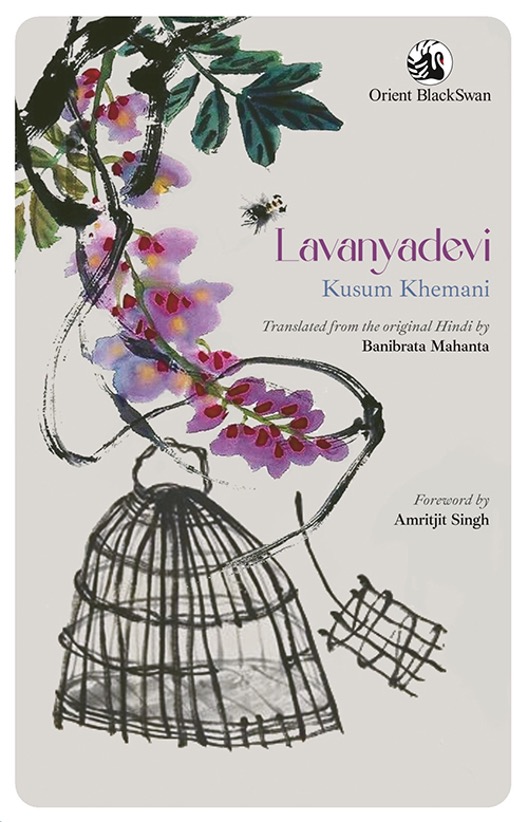
Lavanyadevi: An Epitome of Perfection?

Book Review by Somdatta Mandal

Title: Lavanyadevi

Author: Kusum Khemani (Translated from Hindi by Banibrata Mahanta)

Publisher: Orient BlackSwan Private Limited

Lavanyadevi is an award-winning 2013 novel by Kusum Khemani written in Hindi that chronicles five generations of a traditional aristocratic Bengali zamindar family as it transitions into modernity from British India to the present with the eponymous protagonist as its principal focus. Lavanyadevi—a compelling woman of perfection, extraordinary vision, qualities, and grace—remains real and credible because she is self-aware, self-critical, open to others, and to change. As a Marwari (people originally belonging to Marwar in Rajasthan) living in Kolkata, in Khemani’s fiction the schisms between ‘Bengali’ and ‘Marwari’ blur to reveal a delightfully plural, composite, and distinctively Indian ethos. Lavanyadevi is a story about women and their search for self, about shared laughter and friendships that endure across generations, beliefs and cultures—between mother and daughter, grandmother and granddaughter, and Marwari and Bengali women. Khemani’s women protagonists are strong, clear-sighted, both worldly and sublime, embodying a larger-than-life idealism while being grounded firmly in the everyday.

In his introduction to his novel Kanthapura (1938), Raja Rao had defined it as a sthala-purana[1], which he defined as a “legendary history” in which the old lady narrator in the village took recourse to the traditional Indian narrative technique, digressed at will to bring forth her point. Somehow the way Kusum Khemani takes recourse to multiple narrative techniques in Lavanyadevi and binds the different digressive stories and incidents into one contiguous whole when she tells us about the history of five generations of the Bengali zamindar family, reminds one of Raja Rao’s theory. She uses diverse narrative strategies like flashbacks, diaries, letters and emails, history, memory and the third person narrator to enrich its telling, lending it depth and range. A large part of the narrative revolves around telling us about past history when Lavanyadevi manages to lay her hands on her mother Jyotirmoyidevi’s diaries and finds great pleasure and thrill of reading one’s own family history. Not only do they offer a wonderful eye-witness account of the private and public sphere of Kolkata of those times, but they also make her easy transition into reading about her mother’s youth, her elaborate description of her magnificent wedding and the rituals that spread over almost a month.

The diary as metanarrative and the protagonist as reader/narrator are particularly effective, offering a telescopic perspective. Though at times it rambles a bit, the polyphonic structure of the novel engages Lavanyadevi the granddaughter, the daughter, the wife, the mother and the grandmother in conversations with her preceding and her succeeding generations. One must sometimes go back to the family tree and chart provided at the beginning of the novel to place people in proper perspective.

From the very beginning of the novel, Khemani portrays the character of Lavanyadevi in superlatives and this continues in different phases of her life till the end when she decides to remain incognito in the mountain ashram and yet control the lives of her descendants, well-wishers and others. From a child who always stood first in school and remained wholly ignorant of the real world, to her unusual marriage to a gentleman who moved over to Rangoon and then to London where she acquired many more degrees, till she came back to Kolkata, to rear her three children successfully, she seemed to excel in everything. This is how she is described at one place:

“Lavanyadevi was indefatigable. She administered the work of several institutions, her college and her home efficiently and with ease. She was never seen to panic. She was like Goddess Durga with her many hands – untiring in her zeal, handling all her duties unfailingly, responsibly and meticulously. No one could ever complain of being ignored by her. She loved all and treated everyone with the same degree of love and warmth. Scrupulous and hardworking, always upholding truth, Lavanyadevi was the unmatched standard of excellence in all aspects of life, her words worth their weight in gold.”

After judiciously assigning different welfare projects in the city as well as in far-flung places like Dhaka and the hills in Uttarkashi from the immense money she inherited from the family, and after her husband’s demise, Lavanyadevi decided it was time for her to leave the family premises and go and live in an ashram in the hills. There she did not stay in hibernation but her travels for work grew even more frenetic.

From the very beginning her rootedness and belief in the philosophical framework of Hinduism formed the core of her being. They propelled her to seek answers to questions of satya (truth) and mukti (liberation) that confronted her in the latter half of her life. She decided to transcend immediate personal concerns and address larger universal issues. Her transition from grihastha (householder) to sanyasa (renunciate) harkens back to the Hindu ideal of human life divided into four phases. However, contrary to the conception of life in isolation, Lavanyadevi, free of any kind of worldly considerations in this final phase of life, marshaled material and human resources to create a strong network of seva (social service) across the country and even beyond its borders. The list of her welfare schemes is too long to mention in the purview of this review, but ranged from renovating brothels in Kolkata’s red-light areas, creating self-help centres for rural women in Dhaka, de-addiction centres, eco-friendly schools in the hills, organic farming in South India, etc.

In the latter half of the novel, we find Lavanyadevi successfully transmitting her values and ideals to her children and grandchildren who are called the “Saptarshi Mandal friends” and who carry her legacy forward and emphasise that progress does not always mean breaking from the past. Here the novelist becomes too idealistic and brings in too many issues that seem a bit far-fetched. Issues of inter-caste and inter-religious relationships apart, the list of social welfare missions seems endless. Her “soul-children” unobtrusively usher in change and create space for diversity in relationships and ways of living. Harmonious cohabitation with nature became the foundational principle of all the education centres she built in the hills but the way she invisibly controls the activities of all her soldiers through emails and emphasises the middle path of life makes the advocacy of humanitarian concerns a bit overemphasised. She becomes larger than life for ideas and wish-fulfilment.

A Hindi novel about a Bengali family by a Marwari woman from Kolkata became significant when it was commissioned for translation into English. Winner of the PEN/Heim Translation Grant 2021, the jury called Lavanyadevi an ‘ambitious, far-reaching’ novel, lauding Khemani’s ‘energetic prose, deadpan sense of humor, and exquisite control’, and Banibrata Mahanta’s translation that ‘stretches and manipulates language to produce a vivid text’ and a must-read for lovers of Indian literature. Here one needs to mention the seriousness with which Mahanta gives us the ‘Translator’s Introduction’ at the beginning of the text and again ‘Translator’s Note’ at the end. This reviewer feels that both these could have been combined into one general essay highlighting the significance of the evolution of the Marwaris in Bengal, how Khemani’s novel is a hybrid artefact born out of multiple linguistic and cultural encounters, how the characters in the novel speak in languages other than Hindi produces dialogues in Bangla, Marwari, Haryanvi or Punjabi; and how between a breezy translation and a linguistically nuanced one, wherever possible the translator has eschewed the former and gone for the latter. As he rightly admits, translating this complex narrative into global or even a pan-Indian English is always risky, but Mahanta should be given due credit for overcoming all obstacles and bringing this immensely readable novel to a wide readership.

.

[1] Ancillory texts to Puranic literature

Somdatta Mandal, critic, academic and translator, is a former Professor of English at Visva-Bharati University, Santiniketan, India.

PLEASE NOTE: ARTICLES CAN ONLY BE REPRODUCED IN OTHER SITES WITH DUE ACKNOWLEDGEMENT TO BORDERLESS JOURNAL

Click here to access the Borderless anthology, Monalisa No Longer Smiles

Click here to access Monalisa No Longer Smiles on Amazon International

Categories
Review

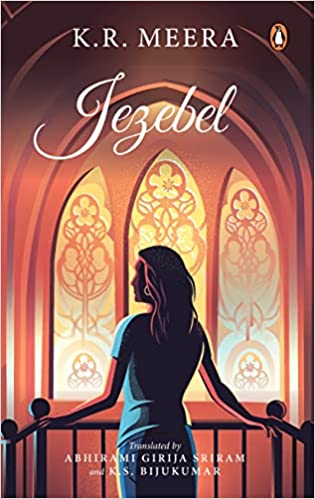
Jezebel

Book Review by Somdatta Mandal

Title:     Jezebel

Author: K.R. Meera, translated from Malayalam by Abhirami Girija Sriram and K. S. Bijukumar)

Publisher: Penguin Random House India

In a multicultural and multilingual country like India, it is very difficult to ascertain the progress of literary creativity in all the regions because of language barriers. Translation is one of the means through which this deficiency can be met. Recently even big publishing houses are paying a lot of attention to translate texts from different bhasha[1] literatures into English so that they can cater to a pan-Indian readership. K.R. Meera’s original Malayalam novel Jezebel is one such recent addition. It has the eponymous protagonist Jezebel, a young doctor in Kerala, struggling against the cruel realities of a patriarchal world –realities that not even her education, resolve or professional brilliance can shield her from. Trapped in an abusive and claustrophobic marriage that had been arranged by one of her relatives for some ulterior motive, the novel begins with a powerful metaphor of suffering and endurance:

“As she stood in the family court, pelted with the blame of having paid a contract killer to murder her husband, Jezebel had this revelation: To endure extreme torture, imagine yourself as Christ on the cross.”

In this novel, which takes the form of a courtroom drama to show us the rich inner worlds of its characters, we see Jezebel reflect on her life and its pivotal points as she takes the stand. Through her memories, we see her grow from a reticent, serious young woman to a rebel who refuses to bend to the conventions of society. In the Old Testament of the Bible, Jezebel was a prophet and she was the only one to challenge prophet Elijah. She was at the same time a strong woman and an accursed one. Like the Biblical story of Queen Jezebel, who was much maligned as a scheming harlot and infamously thrown to her death from her palace window, Jezebel is a novel that asks if independent women can ever live lives that are free of judgement. The marriage between Jezebel and Ahab was an agreement between two communities that worshipped two different gods. Poor King Ahab was a good king who ruled for twenty-two years. His only mistake was to marry the Sidonian princess Jezebel. And that too to improve relations between the two kingdoms and to trade with them. When they got married, Queen Jezebel brought her gods along with her to Samaria. In our protagonist’s case, her already contentious divorce proceedings go suddenly awry, and her unhappy marriage holds complex secrets. Throughout the novel, K.R. Meera’s powerful prose makes resonant allusions to the Bible in different ways that elucidate the correlations between legend and the protagonist’s life while also exploring how sexuality and gender roles are manipulated by the dictates of society.

In the novel we are shown how Jezebel’s arranged marriage with Doctor Jerome George Marakkaran ended in disaster from day one, and in the two and a half years they lived together as husband and wife, their marriage was never consummated. Her father-in-law, George Jerome Marakkaran is a brute straight from TV serials, and starts cursing Jezebel right from the first day believing in his god-ordained mission to punish her in any form whatsoever. The court hearings frame the narrative, with the (very filmy) lawyer’s dramatic queries triggering flashbacks, each a tale of tremendous misery, shocking injustice or unbearable trauma – a veritable catalogue of the woes of a half of the world even in this day and age. The mother-in-law, Lilly George Marakkaran, however, is kind-hearted even if meek, and she too secretly supports her daughter-in-law to break the shackles of patriarchy and go out into the world – something she was unable to do. This inability leads to her suicide in the end. Jezebel’s parents, too, are characters who refuse to come out of clichés. The result is a series of unfortunate events, and they all end up in a family court for divorce. In order to narrate the plight of her protagonist from the very beginning, Meera creates the canvas with plenty of characters, who like Chaucer’s ‘God’s plenty’ fill the pages of the novel from the beginning to the end. Most of these characters are stereotypes and yet they manage to make the story convincing, though melodramatic at times. Jezebel has a difficult childhood growing up with her mother Ammachi who explains every move in Biblical terms and who argues that “a good woman will not ever speak a word” against her husband, however worthless he is; her maternal grandmother Valiyammachi is the one who understands her and asks her to discontinue her marriage immediately and live life on her own terms. Throughout the novel she offers her shoulders for Jezebel to weep upon.

In between, a lot of melodrama is thrown in. The novel itself confesses the soap opera part:

“John’s wedding was a frugal affair. George Jerome Marakkaran stood ramrod stiff, hands clasped behind his back, chin tilted up at a hundred-and-twenty degrees. In his sandalwood-coloured silk jibba and gold-bordered mundu, he looked every bit the father in television serials.”

The rigid patriarch that he is, George Jerome Marakkaran is no exception; almost all characters and situations befit TV serials. There are no surprises, no nuances, no gray between black and white. To give an entire cross-section of society, we have sympathetic characters like Father Ilanjikkal from the nearby church, Jezebel’s uncle Abraham Chammanatt, who was a party to the injustice inflicted upon her and to whom she begs, “Please give me back my life. That’s all. My happiness …my ability to laugh.” We also have sexually abused children, references to other broken marriages, gay relationships, the story of Advait, who had undergone a sex-change surgery to become a man, and who tells Jezebel, “To prove that a man is a man and a woman is a woman, you need a certificate.” On another occasion explains it thus:

“‘Society is a great playwright, Jezebel. Our job is to act out our cliched roles again and again in the ancient play that it has scripted. Every role has its prescribed dress code, make-up, hairstyle, and dialogue. Our job is to play those roles, no matter how ill-fitting the costume, without changing the course of the script. If I decide to change my costume midway through the play, then what will happen to the play? What will the audience, eager to hear a story that they like, do?’ he sighed.”

 Amidst the struggle of Jezebel to come to terms with society, Meera also mentions the flitting relationships that Jezebel undergoes with different men and all of which fizzle out due to different reasons. When her lawyer informs her that the verdict for her divorce suit would come out soon, this is how Jezebel reacts:

“Verdict? What verdict? Verdict against whom? In an instant, Jezebel was flung from heaven to the netherworld. She despaired about the she-who-was, and the she-who-had-been. She felt emboldened thinking about the she-who-would-be, though. Just then, she saw four creatures in the centre of and around the throne under the sea. They had many eyes in the front and the back. The first creature looked like Ranjith, the second had Jerome’s face, the third resembled Nandagopan, the fourth had Kabir’s looks. The four creatures had six wings each, many eyes all around and within. They proclaimed day and night. In their midst, she saw a lamb that looked like it had been slain.”

Each ordeal leads the reader to the next in a highly skilfully woven narrative that becomes unputdownable after the opening. That, arguably, is what Meera is aiming for, getting every reader to care for the fate of the characters no matter how stereotypical they might be. Indeed, their being stereotypes helps in making the story universal, whereas nuances and specifics might have made it different. While Meera’s story-telling abilities are way above average, the simplistic treatment of many subplots may mar the reading experience for a few readers. Paradoxically, that is what at the same time may compel the kind of readers who don’t bother about ‘feminism’ and ‘patriarchy’ to keep reading this novel till the end, and even think through it.


 Jezebel reflects on her life and its pivotal points as she takes the stand. Through her memories, we see her grow from a reticent, serious young woman to a rebel who refuses to bend to the conventions of society. Jezebel is a novel that asks if independent women can ever live lives that are free of judgement. K.R. Meera’s prose, in this elegant translation from the Malayalam by Abhirami Girija Sriram and K.S. Bijukumar, makes resonant allusions to the Bible in powerful ways that elucidate the correlations between legend and the protagonist’s life while also exploring how sexuality and gender roles are manipulated by the dictates of society.

The beginning of the novel is set seven years after that day the Marakkaran family arrives at Jerusalem, Jezebel’s home, to “appraise” her. A broken Jezebel is facing a barrage of questions from Jerome’s lawyer in a family court which is hearing her divorce petition. She feels like Jesus Christ on the cross, enduring extreme torture. There is yet another round of accusations, all built around an alleged attempt to murder her husband. A courtroom saga begins as Jezebel looks back and remembers scenes from her marriage that brought her exciting life and career to a screeching halt.

Jezebel’s is not the only story of suffering in the novel. There is Sneha, a schoolgirl traumatised by the sexual abuse at the hands of her math teacher, and Angel, a four-year-old girl, who survived a mass suicide by her family because of debts, only to be sexually assaulted by her sixty-year-old neighbour. Jezebel is also a story of the will to survive physical and mental wounds and standing up to force the change of a medieval mindset. Anitha, one of the novel’s characters, picks up the brushes to become an artist after both her husband and lover abandon her. And Jezebel stands tall above everybody else while she fights a system rigged in favour of men. The novel is a serious attempt to end the silent suffering of gender injustices in homes and outside, especially when women find themselves always constrained by the limits that patriarchy imposed upon them. Indeed, the work is a testament to the fact that even in this modern age, in India at least, patriarchal social norms wield an inordinate power over women and restrict their ability to exercise their agency and achieve self-determination.

Reading through the 390 pages of a novel is not an easy task but the way K.R. Meera manages to retain the reader’s interest is praiseworthy. Despite having so many stereotypical characters strewn throughout the narrative, Meera’s manner of storytelling is unique and like a detective novel one often goes on guessing what happened next.

The book drags a little towards the end and would have read much better if some sort of precision was adopted in the narrative technique. To remain politically correct and elaborate on the reasons and ramifications of the story line sometimes, such details may have been unnecessary.  

In the author’s acknowledgements section Meera states that she shadowed Dr. Dhanya Lakshmi in her professional life and for verifying the medical facts and interpretations in the novel. In some places these details seem superfluous and could have been avoided. The author also thanks the advocates who accompanied her to Kottayam’s family courts and observed the court proceedings. The way the interjections of the lawyer and the judge are narrated in the novel sometimes seems rather contrived as the author seems to rely on sensationalism as found in films. The translators use informal expressions in Malayalam for the retention of the local idiom and unlike several other translated texts where the reader is often confused because different relationships are addressed in the local lingo, in this novel it does not seem so. Finally, the way issues of ‘feminism’ and ‘patriarchy’ – the two main thrust areas of the novel – that plague contemporary society in Kerala even today, are wonderfully resolved by the author must be mentioned. K.R. Meera tried to break free from Malayalam literary traditions. Jezebel’s reluctance to take a stand for herself in the novel and the consequent adversities in her life tell a tale of epistemic marginalization. According to the author, “I have seen bold, patient women take their time to stand up for themselves. What we often forget is that to sprout wings, one must go through the stages of being a cocoon and a pupa.” The last sentence of the novel therefore speaks of the resilience of Jezebel when she turned her face up to the sun. The old Jezebel was no more. The new Jezebel is one who received the revelation — “And so, the woman adorned with the sun will weep and wail no more.” The novel is recommended to all readers who will find interest in reading about contemporary Christian society in Kerala and realise that societies in other parts of India are also not free from accepting a powerful educated woman who wants to live her life without paying heed to the shackles imposed at every step through patriarchal domination.

[1] Language

Somdatta Mandal, academic, critic and translator, is a former Professor of English at Visva-Bharati University, Santiniketan, India.

.

PLEASE NOTE: ARTICLES CAN ONLY BE REPRODUCED IN OTHER SITES WITH DUE ACKNOWLEDGEMENT TO BORDERLESS JOURNAL

Click here to access the Borderless anthology, Monalisa No Longer Smiles

Click here to access Monalisa No Longer Smiles on Kindle Amazon International

Categories
Excerpt

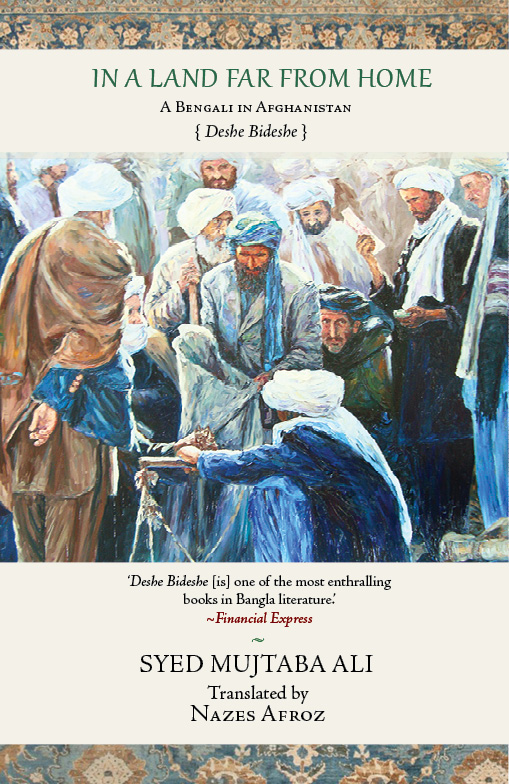
In a Land Far From Home: A Bengali in Afghanistan

Title: In a Land Far From Home: A Bengali in Afghanistan

Author: Syed Mujtaba Ali

Translator: Nazes Afroz

Publisher: Speaking Tiger Books

Over the noise, you could hear the shout that ‘Bacha-e- Saqao is coming, Bacha-e-Saqao has arrived.’ Then we heard the bang of a rifle and the crowd lost all sense of reason. Throwing aside everything they were carrying, people started running for their lives, some landed in the roadside ditch, some slipped time and again while trying to run over the ice on the Kabul river. The blind beggar who used to sit by the road, stood up trying to find his way with his hands in the air.

I somehow managed to leave the road, crossed the ditch and stood on the front porch of a shop. I decided that I would rather die from the bullet on which my name was written rather than be trampled by mad horses or in the stampede of the crowd.

Within a minute another man appeared and stood next to me. An Italian colonello or colonel, aged about sixty, with a long corrugated beard.

He was the first person whom I could ask something cogently. I said to him, ‘I heard that the bandit leader Bacha-e-Saqao was coming to fight for Amanullah. But what is really happening?’

The colonello said, ‘Seems like wrong news. He’s coming to take over the city.’

If that was the case, then why were Amanullah’s soldiers not going to the north of the city to fight him? How did Bacha-e-Saqao arrive in Kabul so suddenly? How many men did he have? Were they carrying only rifles or did they have cannons? The colonello could not answer these questions; he only kept saying, ‘What an odd experience!’

I said, ‘I can understand why the ordinary Kabulis are afraid, but why have the foreigners joined them? Where are they going?’

The colonello replied, ‘To their own embassies or legations—for shelter.’

The sound of rifle shots was drawing closer. By then the crowd was moving in waves rather than in a stream. In between two such waves I told the colonello, ‘Let’s go home.’ He said he would not leave without seeing the last act. Military whim—there was no point in arguing.

Abdur Rahman was waiting for me at the door. His worries disappeared at the sight of me. As soon as I entered the house, he closed the door and started to fortify it with heavy rocks. Intelligent man. He had made all the arrangements for fortification when I was out. I asked, ‘Where is Benoit?’ Abdur Rahman informed me that Benoit had left for the French Legation in a tonga carrying only one suitcase.

By that time the sound of the gunfire had been overpowered by the heavy sound of machine guns. Abdur Rahman brought tea. Listening to the sounds carefully, he said, ‘The king’s soldiers have now attacked. From where would Bacha have gotten hold of machine guns?’

I asked him, ‘The king’s soldiers are facing Bacha this late? How could he reach Kabul so easily?’

Abdur Rahman said, ‘I asked many people while waiting for you at the door, but nobody could say anything clearly. It seems he has arrived without any resistance. He comes from the north of the country; my place is also in the north—Panjshir. I would have got some news of troop mobilisation in that region from my fellow Panjshiris in the bazaar, but there was none. The king’s troops have gone to the east under the command of Ali Ahmad Khan to fight the Shinwaris.’

The exchange of fire continued. Abdur Rahman served me dinner early that evening and then he sat down to tend to the fire in the fireplace. From our chat I could make out that he was worried about my well-being in case Bacha won, which would be followed by anarchy and looting. But clearly he was highly excited and curious—much like a small child when the circus came to town.

But who was this Bacha-e-Saqao? I did not have to ask Abdur Rahman, he told me many stories about him of his own accord. I realised that Abdur Rahman had many qualities—a jeweller of snow, a doctor of frostbite, chef-decuisine—but he certainly was no Boswell. You could have constructed an image of a Robin Hood from what he said about Bacha, but much of it was certainly a figment of imagination and myth.

After filtering through all the stories carefully, I had a glimpse of the life of Bacha; he was the leader of a gang of about three hundred bandits; lived in Kohistan, north of Kabul; he looted the rich and distributed a portion of his booty to the poor. When Amanullah was away in Europe, he became so powerful that he started to collect tax from the traders of Kohistan. After coming back, Amanullah proclaimed a price on his head, ‘Five hundred rupees reward on the head of bandit Bacha-e-Saqao.’ Bacha removed all the posters and put up his own proclamation, ‘One thousand rupees reward on the head of Kafir Amanullah.’

Abdur Rahman asked me, ‘But Sahib, help me solve a riddle. The colonel’s son asked me, if I cut off Bacha’s head and my brother cuts off Amanullah’s, then how much money would we make together? I said, one and a half thousand. He nearly rolled on the floor with laughter; he said, “You won’t get a penny.” Please Sahib, explain why wouldn’t we get any money?’

I consoled him, ‘Because neither of them will be alive to give you the rewards. But you can tell the colonel’s son that the throne of Afghanistan will then be bestowed upon your family.’

I had also heard that only a few days earlier Bacha suddenly turned up in front of some high-ranking officials and swore his allegiance to the king in the fights against the Shinwaris by touching the Koran. By doing so he managed to get hold of about a hundred rifles and then disappeared.

Did he turn those rifles against Amanullah?

About the Book

An intrepid traveller and a true cosmopolitan, the legendary Bengali writer Syed Mujtaba Ali from Sylhet (in erstwhile East Bengal, now Bangladesh) spent a year and a half teaching in Kabul from 1927 to 1929. Drawing on this experience, he later wrote Deshe Bideshe which was published in 1948. Ali’s young mind was curious to explore the Afghan society of the time and, with his impressive language skills, he had access to a cross-section of Kabul’s population, whose ideas and experiences he chronicles with a keen eye and a wicked sense of humour. His account provides a fascinating first-hand insight into events at a critical point in Afghanistan’s history, when the reformist King Amanullah tried to steer his country towards modernity by encouraging education for girls and giving them the choice of removing the burqa. Branded a ‘kafir’, Amanullah was overthrown by the bandit leader Bacha-e-Saqao. Deshe Bideshe is the only published eyewitness account of that tumultuous period by a non-Afghan, brought to life by the contact that Ali enjoyed with a colourful cast of characters at all levels of society—from the garrulous Pathan Dost Muhammed and the gentle Russian giant Bolshov, to his servant, Abdur Rahman and his partner in tennis, the Crown Prince Enayatullah.

About the Author

Born in 1904, Syed Mujtaba Ali was a prominent literary figure in Bengali literature. A polyglot, a scholar of Islamic studies and a traveller, Mujtaba Ali taught in Baroda and at Visva-Bharati University in Shantiniketan. Deshe Bideshe was his first published book (1948). By the time he died in 1974, he had more than two dozen books—fiction and non-fiction—to his credit.

About the Translator

A journalist for over three decades, Nazes Afroz has worked in both print and broadcasting in Kolkata and in London. He joined the BBC in London in 1998 and spent close to fifteen years with the organisation. As a senior editor in the BBC, Nazes was in charge of South and Central Asia for a number of years. He has visited Afghanistan, Central Asia and West Asia regularly for over a decade. A passionate photographer and a compulsive traveller, Nazes quit his job in the BBC and moved back to India in 2013 where he is based in Delhi. Currently he writes in English and Bengali for various newspapers and magazines and is working on a few photography projects.

(Excerpted from In a Land Far From Home: A Bengali in Afghanistan by Syed Mujtaba Ali, translated by Nazes Afroz. Published by Speaking Tiger Books)

Click here to read the review / interview with the translator

.

PLEASE NOTE: ARTICLES CAN ONLY BE REPRODUCED IN OTHER SITES WITH DUE ACKNOWLEDGEMENT TO BORDERLESS JOURNAL