Categories
climate change

‘Climate change matters to me, and it should matter to you too’

Zeeshan Nasir writes of a region whose carbon footprint is next to zero, yet it suffers some of the worst climate-related disasters…
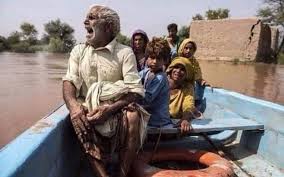
The perennial consequence of climate change is affecting the lives of people all over the world, particularly in the remote and underprivileged parts of Balochistan.

Noora Ali, 14, was oblivious to the temperature shifts because she had grown up in Turbat, a city in the centre of CPEC (China-Pakistan Economic Corridor). They had frequent floods during the monsoon season and blazing heatwaves during summers, with temperatures rising above 51 centigrade. Compared to other cities in Balochistan, Turbat experiences hot summers and typical winters. As a result, the majority of wealthy families in the city travel to Gwadar, Quetta, or Karachi during the sweltering summers and return to Turbat during the winters. The Water and Power Development Authority (WAPDA) moved Noora’s father, who works there, to the neighbouring Gwadar in 2022.

In the February of 2022, the sea seemed calm while boats of the fishermen busily dotted the waters of the Padi Zir (Gwadar’s West Bay). It was a typical Thursday morning when rain started pouring down. The rain was so intense that the sea became wild and uncontrollable. The roads were washed away, bridges collapsed, with streets being inundated with flood water and the port city became completely disconnected with the rest of the country. Back in Turbat, her ancestral hometown was also submerged under flood water.

Noora had also heard from her school fellows that Gwadar and Turbat had never experienced such heavy and intense rainfall before. She knew and felt that the temperature of her native city was rising and that Gwadar beneath flood water didn’t seem normal.  “This is due to climate change.” Her elder brother told her. At the age of 14, typical children in Balochistan have no idea what climate change and global warming are but they are already feeling it impacts.

Like Noora, thousands of children in South Asia, particularly Pakistan, Bangladesh, Nepal, India and Afghanistan are at the risk of climate related disasters, as per the UNICEF 2021 Children’s Climate Risk Index. The report further reiterates that children in these countries have vigorously been exposed to devastating air pollution and aggressive heatwaves, with 6 million children confronting implacable floods that lashed across these countries in the July of 2024.

On the 11th and 22nd November 2024, over 20 youths urged the world leaders to come up with plans to mitigate the impacts of climate change on children at the 2024 United Nations Climate Change Conference (COP 29) held in Baku, Azerbaijan. Among those 20 resolute children was the 14 years old, Zunaira Qayyum Baloch representing the 241.5 million children and women of Pakistan. 

Dressed in her traditional Balochi attire, with a radiant smile in her face and resolute in her commitment, Zunaira Qayyum Baloch, startled everyone. Hailing from the far-flung district of Hub in the Southwest of the Pakistan’s Balochistan, Ms. Baloch went to represent the children of a country whose carbon footprint is next to zero, yet it suffers some of the worst climate-related disasters. Her message to world leaders was clear: step up and combat climate-induced inequalities, particularly those affecting women and children.

She had always remained conscious about the changing climate in her city, observing the floods of 2022 that had wreaked havoc in Hub Chowki, initiating awareness programmes and youth advocacy guide training in her home city to advocate for girls right to education and climate change.

“After my father passed away, my mother became the sole breadwinner. She helped us get an education and met all our requirements.” Zunaira explains. “During the catastrophic rains of 2022, an incident changed my perspective on climate change.  Rainwater had accumulated in the roof of our home and streets were flooded with water. The destruction was so overwhelming that I realised that such events were no longer rare but increasing constantly. “

During the COP29, Ms Baloch expressed her concerns with the experts how Pakistan, particularly Balochistan has been detrimentally affected by climate disasters like frequented floods, heatwaves, hurricanes and droughts. Lamenting that climate change was a child-rights crisis, she told the world how the changes in the climate had jeopardised the lives of millions of women and children throughout the world.

Asking the world leaders to join determined children like her to combat climate change, she addressed them in the COP29: “Climate change matters to me, and it should matter to you too.”

Stark Reality of the Past

Bibi Dureen, 80, is a testimony to how climate is continuously transforming. She hails from the outskirts of the Kech district in a town called Nasirabad.

“The seasons are changing.” She says with her voice laced with sorrow. “The heatwaves have become more aggressive, and floods are common. It all started around 1998 in Turbat. Then in 2007, a devastating flood destroyed our homes, date palm trees, livestock –and worst of all, it took lives.” She pauses, her wrinkled hands trembling.

As she talks to me in front of her thatched cottage, through which sunlight is streaming in, tears well up in her eyes as she recalls a painful childhood memory, “I was young at that time. It was a pitch-black night, and the rain was pouring down mercilessly when a man came shouting that the flood water had reached the fields.” She exclaims with grief. “My mother, desperate to save what little we had, sent her only son, my sixteen-year-old brother, Habib, our family’s only breadwinner, to find the only cow we had in the fields.  Neither the cow nor Habib returned. Later some men found his dead body in the jungle.”

In June 2007, when the Cyclone Yemyin hit the coast of Balochistan, it wrought unprecedented damage to the province, particularly Turbat, Pasni and Ormara and rendered 50,000 homeless within 24 hours, including children. According to reports 800,000 were affected and 24 went missing.

The 2022 floods had a devastating impact across Pakistan, with the province of Balochistan being one of the hardest hit. With 528 children dying nationwide, 336 people died in Balochistan, including children as per the reports of the Provincial Disaster Management Authority (PDMA).

Tragedy struck again in 2024 when torrential rains engulfed 32 districts of Balochistan, particularly, the port city of Gwadar and Kech district. The PDMA put the death toll of children dying due to the flood at 55 out of the total of 170, with 16 others injured.

The Double Crisis Facing Girls

Regions in Balochistan, such as Naseerabad, Jaffarabad, Sohbatpur, Nokundi, Sibi and Turbat have seen severe heatwaves in the past few decades. On May, 2017, the Mercury rose to a record breaking of 53.5 centigrade in Turbat, making the district to be the hottest place of the year after Mitribah, Kuwait. During heatwaves, cases of fainting and health-related illness among residents, particularly children are rarely uncommon. According to a 2023 report by the Pakistan Meteorological Department, Balochistan has seen a 1.8°C rise in average temperature over the past three decades, leading to longer and harsher heatwaves.

Dr Sammi Parvaz, a gynaecologist at the university hospital in Turbat, tells that rising temperatures in the district not only contribute to higher dropout rates among school-girls but their menstrual cycle is also affected.

 “According to the recent research of the National Institute of Health (NIH) , menstruation– a biological process that occurs in females when they reach puberty — is severely affected in countries which are vulnerable to climate change and Pakistan is one them.” She explains. “The menstruation in girl children living in extreme heat, such as, in Turbat and Karachi, becomes very intense, painful and with cramps.”

Dr Sammi further elaborates that this phenomenon is linked to the increased release of cortisol and oestrogen, the hormones which regulate the female reproductive cycle. “Girl children exposed to harsher environments such as severe heat or cold, experience hormonal imbalances leading to irregular periods and severe menstrual cramps. The hospitals in Turbat are frequented by patients suffering from intense cramps or irregular periods.”

Hygiene becomes another pressing issue during floods, especially for young girls. Research published by the International Journal of Environmental Research and Public Health states that floodwater contains lead, polychlorinated biphenyls (PCBs) and other chemicals which are the cause for irregular periods.

During floods thousands of girl children struggle to manage their periods amidst the chaos of the disaster and remain without period products.  For instance, after the 2022 floods, 650,000 pregnant women and girl children in Pakistan were without essential maternal care, with a significant proportion from Balochistan.

Admist all this chaos climate activist like Zunaira Qayyum Baloch raise awareness while women like Maryam Jamali work directly on the ground to ensure that every women has ration in her house and access to menstruation products during catastrophes.

 Madat Balochistan [1]— a non-profit organisation — has supported more than 31,000 people across 34 districts in Sindh and Balochistan. With its major work concentrated in and around Quetta, Dera Bugti, Jaffarabad, Jhal Magsi, Sohbatpur, and Khuzdar, they are a women-led organisation fundamentally prioritising women and young girls in their work because even on the frontlines, they are bearing most of the cost of climate change, according to its co-founder, Maryam Jamali.

 “Our conversations on climate change vulnerability often treat everyone as ‘equal’ in terms of impact, when that is far from the truth. Vulnerability is a multi-dimensional concept and in a country like Pakistan where most of the women and girls are pushed to the margins of society in every way possible — we cannot just overlook their struggles.” Maryam Jamali tells.

“Take the 2022 floods, for example — the most recent catastrophes etched in our memories. Women and girls were responsible for most of the labour when it came to evacuating to safer places. As soon as they did, their needs when it came to menstruation or pregnancy care were completely ignored by aid agencies as they sent out packages or set up medical camps. Most of our work at Madat was compensating for things like this. We worked with midwives to ensure that women, who could not stand in lines for ration, received it regardless or women who did not want to interact with male doctors didn’t have to. In our housing projects, we prioritise women especially those who don’t have a patriarch in the household because that severely limits their access to resources for rehabilitation.”

Floods, heatwaves and other natural calamities are gender neutral. However,  female children are more likely to be affected by them. According to the UN Assistant Secretary-General Asako Okai that when disaster strikes, women and children are 14 times more likely to die than men. In Pakistan, 80% of people displaced by climate disasters are women and children.

 In patriarchal societies in Pakistan, women and female children are the primary caregivers of the family and they are the sole persons to grow crop, do house chores, fetch firewood and water. With little to no potable water nearby, girls have to travel far to help their parents, further exacerbating their vulnerability.

These household responsibilities create an educational gap. Girls are taken out of schools in Balochistan during floods. With Pakistan’s lowest girl literacy rate at just 27 per cent, the International Rescue Committee (IRC) reported that the province of Sindh and Balochistan have seen greater educational disruptions due to heatwaves and floods, with the 2022 flood causing more educational institutions closure than the combined two-year COVID-19 pandemic.

Extreme heatwaves and recurrent flooding in Balochistan have further compounded this gap. For instance, the 2022 flood damaged or destroyed 7,439 schools in the province, affecting the education of over 386,600 students and 17,660 teachers and staff members. Reports also mention that most of the government school were used as flood shelters in the province. In the 2024 floods, 464 schools were again damaged.

The destruction of educational infrastructure has forced many children out of school, contributing to the province’s high out-of-school rate.

Monsoon Brides during Floods

 Though floodwater is no longer accumulating in the Mulla Band Ward of Gwadar district in Balochistan, the damage it has wrought will stay with the people for a long time for many years. For Gul Naz[2],16, the loss has been devastating.She was only 16 years at the time when flood water entered their home in 2022. Her father, being a fisherman, struggled to make ends meet, as the sea was completely closed for fishing, cutting off the family’s only source of income.

“I was in the Jannat Market and when I returned home, I was told by my mother that my marriage has been fixed to a man twice my age in exchange for money.” She discloses that her parents were given Rs.50,000 ($178.50) which is a whooping sum for a poor family, who survive on around one dollar a day.

“I have two kids now and I am a child raising a child.”

The sadness in Gul Naz’s voice is palpable and she isn’t alone in her predicament. During floods and emergency situations, families in Balochistan resort to any desperate means for survival. The first and most obvious way is to give their daughters away in marriage for financial relief — a practice that usually surges during the monsoon season, hence, the name monsoon brides.

In the Sindh province of Pakistan, where this trend is more prevalent, there has been a spike in the number of monsoon brides during the last flash floods of 2022. In the Khan Mohammad Mallah Village, Dadu district, approximately 45 were married off in that year, according to the NGO organisation, Sujag Sansar[3], which works to reduce child marriages in the region.

Pakistan stands at the sixth position in the world when it comes to marrying children below eighteen. While there has been a reduction in child marriages in Pakistan in recent years, UNICEF warns that extreme weather patterns put the girl child at risk.

Madat Balochistan has also been on the forefront in the reduction of child marriages in Balochistan, “It’s not intuitive to think of girls’ education or loan relief or housing provision as measures to build climate change resilience, but in our contexts, these are the very things that drive vulnerability to climate change.” Says the Maryam Jamali. “We have been working on supporting farmers with loan relief so that young girls aren’t married off to compensate for the financial burden of loans after a lost harvest. We are also working on initiatives for sustainable livelihoods for women as well as ensuring that young girls in all the communities we work in have access to education despite geographic or financial limitations.”

Jamali thinks that gender inequality is one of the biggest aspects here which makes it absolutely necessary for a region like Balochistan, where physical vulnerability and socio-economic vulnerability is high, to have young girls at the decision-making table.

“Activists like Zunaira can ensure that when we come up with solutions for climate change, we contextualize them through a gender lens and make sure that this does not become another instance of taking away women’s agency but becomes an opportunity to involve them in climate change policy decision-making.” Jamali contends. “It is rewarding to see the girls we support do great things. One of our girls from Musakhel is studying at Cadet College Quetta, the first in her family to be able to pursue education beyond 8th grade.”

The Way Forward

“Extreme weather can fuel conflict and be a threat multiplier,” says Siraj Gul, a lawyer at the Balochistan High Court, Quetta, citing the recent research published in the journal Alternatives: Global, Local, Political. He stresses that the decades long running insurgency in Balochistan stems from human rights violations, inequality and government negligence. “Climate related catastrophes further destabilise the region’s development. For instance, there was a surge in the number of protests during the 2022 floods in Gwadar, Lasbela and Turbat, reflecting the deep frustration and despair of the people.” According to Mr. Gul if children like Zunaira are given a platform to speak and work for Balochistan, they are not merely advocating for the environment, they are working for a more peaceful and tranquil region.

A climate resilient infrastructure and child-oriented disaster relief have become a must in climate-torn regions like Balochistan.

[1] Help Balochistan

[2]Her name has been changed to retain her privacy

[3] Awake World

Zeeshan Nasir is a Turbat-based writer and currently pursuing his MBBS Degree from the Makran Medical college, Turbat. He tweets on X @zeeshannasir972. He has contributed to Daily Dawn, Countercurrents, Pakistan Today, The Diplomat and others. A different version of this essay has been published earlier in Countercurrents and Pakistan Today.

.

PLEASE NOTE: ARTICLES CAN ONLY BE REPRODUCED IN OTHER SITES WITH DUE ACKNOWLEDGEMENT TO BORDERLESS JOURNAL

Click here to access the Borderless anthology, Monalisa No Longer Smiles

Click here to access Monalisa No Longer Smiles on Amazon International

Categories
Feature

Interviewing Bulbul: Remembering Mrinal Sen…

A writer, a painter, an actor too? Which of these have I known in my friend, Bulbul Sharma? Ratnottama Sengupta ponders as she reverses the gear in the time machine

Bulbul Sharma

I have never formally ‘interviewed’ Bulbul Sharma. That’s because I was editing her writings even before I met her, became friends with her, with her brother Dr Ashok Mukherjee, her sister-in-law, Mandira, whose brother-in-law, Amulya Ganguli, was a much-respected political commentator including with The Statesman and The Times of India which I joined after I shifted to Delhi.

There were many journalists in her family. Bulbul herself was a columnist with The Telegraph when I joined the ‘handsome’ newspaper. Her columns on ‘Indian Birds’ would always come with her own illustrations. These later combined to become The Book of Indian Birds for Children – and now she’s penning stories for neo-literates. So I have never been able to separate the two souls of Bulbul – a writer whose books have been translated into French, German, Italian, Finnish, and an artist in the collection of National Gallery of Modern Art, Lalit Kala Akademi, UNICEF, Chandigarh Museum, Nehru Centre, London, National Institute of Health, Washington.

Bulbul, born in Delhi and raised in Bhilai, studied Russian and literature at Jawaharlal Nehru University before going to Moscow for further studies, in 1972. When she returned a year later, she decided to pursue her other love and made a career in art. So, in mid 1980s, once I shifted to Delhi, I got to know the artist Bulbul at close quarters. By then she was an active graphic artist who worked in the Garhi Artists’ Studio.

She would do papier mache items – sculptures, or of day-to-day usage. Then, she was teaching art to children of construction site workers left in the care of the Mobile Creche. Soon she was handholding me in creating monoprints in printmaking workshops, while my son started taking serious interest in art even as he keenly participated in her storytelling sessions.

And then one day Bulbul invited me to join her and Dolly Narang of The Village Gallery in Hauz Khas, to do a workshop with the inmates of Tihar Central Jail, one of the toughest in Asia, which had started off on its reformation trail under the no-nonsense IPS officer, Kiran Bedi, who dreamt of giving convicts “the hope for a better future once they stepped out as free people.”

The other avtar of Bulbul is the one you are most likely to encounter online. A gifted narrator who depicts people and places she has known and seen in person, styled with little complication, to bring out the beauty in everyday life. Her first collection of short stories, My Sainted Aunts (1992) had bewitched me as much as my son, then in his pre-teen years. For, it etched with endearing affection the reality in a Bengali household that abounded — especially in my childhood — with pishimas[1]and mashimas[2] who were eccentric yet lovable. These aunts are easily identifiable and not easily forgettable though few aunts today are widows in white, eating out of stoneware, shunning onions, or an ‘outsider’: caste, creed, chicken and dog — all were barred.

A few years down, Bulbul, a naturalist who grows herbs in her orchard in the folds of Himalaya and often etches carrots and onions, came out with The Anger of Aubergines (1997) which had cuisine and recipes layering the text. It is a collection of stories about women for whom food is passion, or obsession. “For some it is a gift, for some a means of revenge, and for some it is a source of power,” as Bulbul herself might summarise. Once again, my gourmet family loved it.

Food is the most elementary aspect of human society and culture. And Bulbul has repeatedly capitalized on this multi-contextual significance of food. Not surprising, when I was editing an Encyclopedia of Culture, for the publishing house Ratna Sagar, I directly went to Bulbul for the chapter on ‘Cuisine’. In quite the same way, when a literature festival in Amritsar’s Majha House got Bulbul and me together on a panel, it was to talk about food as an expression of culture.  “Learn everything you can, anytime you can, from anyone you can. There will always come a time when you will be grateful you did…” Bulbul once told a classful of students what she herself has practiced through life.

But with all this, I had virtually forgotten that Bulbul had acted in a film by Mrinal Sen[3]. Bulbul herself reminded me of this after reading my interview with Suhasini Mulay[4] occasioned by the ongoing birth centenary of the director of watersheds in Indian cinema like Bhuvan Shome[5]. I promptly wrote to her asking her to remember the salient ‘truths’ she had learnt by acting in the first of Sen’s Calcutta Trilogy[6].

Interview (1971) was a slim tale – a uni-linear storyline that unfolds on screen as a non-linear narrative. Stylistically it was the opposite of Calcutta 71 (1972), the second of Sen’s Calcutta trilogy, which built on stories by eminent authors like Manik Bandopadhyay, Prabodh Sanyal, and Samaresh Bose. Interview was about Ranjit, whose love interest Bulbul, was enacted by Bulbul Sharma.

The story went thus: A personable, smart but unemployed Ranjit is assured, in Calcutta of the post-Naxal years, of a lucrative job in a foreign firm by a family friend – if he shows up in a suit. It can’t be such a big ‘IF’, right? Wrong. He can’t get his suit back from the laundry because of a strike by the labour union. His father’s hand-me-down doesn’t fit him. He borrows from a friend but, on his way home, a fracas ensues in the bus and the net result is Ranjit is without a suit to appear in for the critical Interview. Will he, must he, go dressed in the hardcore Bengali attire of dhuti-panjabi?

Just the year before, Pratidwandi (1970) had been released, and it too had an interview at the core of the script. The first of Satyajit Ray’s Calcutta trilogy[7], it had cast newcomer Dhritiman Chatterjee, who would play the pivotal role in Padatik (1973), the clinching film in Sen’s trilogy. But Interview had cast another newcomer who was crowned the Best Actor at Karlovy Vary for playing Ranjit. In subsequent years, he became a megastar of the Bengali screen whom Ray too cast in his penultimate film, Shakha Prosakha (1990). And even as he was scoring a century in films, Ranjit Mallick’s daughter, Koel, was scaling heights as a lead actress.

Bulbul Sharma and Ranjit Mallick in Interview: Photo provided by Ratnottama Sengupta

Contrast this with Bulbul: She did not pursue a career in acting. So how had she come to play the Bulbul of Interview? Let’s hear the story in her own voice.

Bulbul Sharma: I was visiting my cousin sister Sunanda Devi — Banerjee who was a very renowned Bengali actress in the 1950s. She had featured in New Theatre’s Drishtidan[8] (1948), directed by Nitin Bose; Anjangarh[9] (1948), directed by Bimal Roy; opposite Uttam Kumar in Ajay Kar’s Shuno Baranari[10](1960) and Chitta Basu’s Maya Mriga [11](1960).

Sunanda Didi and her husband[12], who was a film distributor, had produced Mrinal Sen’s first film, Raat Bhore[13](1957). Mrinalda had come to her house to discuss something with her husband and he saw me. He asked my cousin if I would like to act in a Bengali film. I was 18 years old and a student at JNU then. I was thrilled but my parents were not keen at all. However, though reluctantly, they agreed since it was Mrinal Sen. By this time he had won national and international awards with Bhuvan Shome. 

Me: How did you prepare for the character? Did Mrinalda brief you? I don’t think he had a script in hand…

Bulbul: I did not do anything to prepare. My name in Interview is ‘Bulbul’, and Ranjit Mallick is ‘Ranjit’. Mrinalda said, “Be your natural self. Don’t try to act.” In fact I am an art student in the film. The only problem was that since I had lived all my life in Delhi, my Bengali accent was not very good. He often teased me about it. “Keep that smile for my camera,” he would say to me.

Me: Tell me about your co-actors Bulbul. Do you recall any incident that stays on in memory?

Bulbul: I remember my co-actor, Ranjit Mallick, was a serious, very quiet person. I think he got fed up of my constant chatter. He asked me once if everyone in Delhi talked so much. I was not surprised that he became one of the biggest stars in Bengali cinema but we did not keep in touch, alas.

Me: Why did you not think of pursuing acting as a career?

Bulbul: Acting was not something I had ever thought of doing. This film just happened by chance. Painting and creative writing was my passion and still is. But don’t lose hope! Recently I was offered a role of a grandmother. I might just do it!

Me: How did you respond to Interview when it released more than 50 years ago? And how do you respond to it now?

Bulbul: When I saw the film almost fifty years ago I don’t think I really understood what a brilliant film it was. I was 18 and just happy to see myself on the big screen.

Now when I saw Interview again, I really admired the way the everyday situations in a middle class Bengali home are played out. The scene when Ranjit’s mother, the great actress Karuna Banerjee – who had played Apu’s mother in Pather Panchali – searches for the dry cleaner’s receipt is just heart breaking.

The interview scene itself is so sensitively done. You want Ranjit to get the job but you know it will not happen. There is such understated humour, anger and sadness in that scene. I wish I could tell Mrinalda all that today!

Me: Interview, the first of Mrinalda’s Calcutta Trilogy, is considered a milestone in his oeuvre because of its socio-political content as well as its naturalistic form. How does it compare with the other two films of the Trilogy – Calcutta 71 and Padatik?

Bulbul: Unfortunately I have not seen these two films.

Me: Would you compare it with Ray’s Pratidwandi which also centred on a job interview?

Bulbul: Yes, Ray’s Pratidwandi also deals with the theme of unemployment during that turbulent period – 1969 to 1971 – in Kolkata. Yet they are not at all similar.

I think Mrinalda’s slightly impish, dark humour is lacking in the other film. Both are amazing films by our most brilliant directors. Films you very rarely get to see now.

Okay Bulbul, now my son and I will both wait to meet your onscreen Grandma avtar!

[1] Paternal aunts

[2] Maternal aunts

[3] Indian filmmaker,

[4] Actress, had her break in films when she was picked by Mrinal Sen for Bhuvan Shome

[5] 1969 film directed by Mrinal Sen (1923-2018)

[6] Three films by Mrinal Sen: Interview (1971), Calcutta 71 (1972), Padatik (The Guerilla Fighter, 1973)

[7] Known collectively as the Calcutta trilogy, The Adversary (1970), Company Limited (1971) and The Middleman (1975) documented the radical changes Calcutta.

[8]  Translates to ‘Donating eyes’

[9] Translates to ‘Unknown Fort’

[10] Translates to ‘Listen, Wealthy Woman’

[11] Translates to ‘Illusory Fort’

[12] S. B. Productions

[13] Translates to ‘Night and Dawn’

Ratnottama Sengupta, formerly Arts Editor of The Times of India, teaches mass communication and film appreciation, curates film festivals and art exhibitions, and translates and write books. She has been a member of CBFC, served on the National Film Awards jury and has herself won a National Award. 

.

PLEASE NOTE: ARTICLES CAN ONLY BE REPRODUCED IN OTHER SITES WITH DUE ACKNOWLEDGEMENT TO BORDERLESS JOURNAL

Click here to access the Borderless anthology, Monalisa No Longer Smiles

Click here to access Monalisa No Longer Smiles on Amazon International

Categories
Slices from Life

‘When will we ever learn? Oh, will we ever learn?’

Pete Seeger (1919-2014) lamented about the futility of war, but he also imparted hope, says Ratnottama Sengupta, as she recalls her memorable meeting with folk legend Seeger, in a tete-a-tete with friends

Courtesy: Creative Commons

Last week, as people crowded the Kiev railway station to flee the Ukrainian capital, visuals started trending of the giant staircase inside the pedestrian bridge over the Yauza River to the Kiev Railway Station, the deepest station in the world. It reminded Sonia, my batchmate from Elphinstone College, of the hours she’d spent on the fabulous stairs that take you all the way down with her father who had an attack of trachycardia as they arrived in Kiev by a train from Moscow. “With great difficulty we made our way to the waiting hall from which you have to descend by this enormous staircase. I remember all the Ukrainians helped us, just as all the Russians would help us. And father kept taking Calmposes until I supported him down the stairs into a cab that took us from the station to the hotel.”

Only after that Sonia had called for an ambulance. But why not do that two hours ago? “Because father did not want me to engage with the local health authorities as we didn’t know whether they would have the drugs he used and had forgotten in India,” she explained. “And as soon as I made that call, within five minutes the ambulance was there – with that drug.” Only after that Sonia found out that Kiev has the fastest ambulance service in the world – “and the finest,” she added – “because of what they faced in WWII…” 

All through those few hours Sonia felt so supported by the local people. “I didn’t have to explain anything to the cab driver or the hotel staff – we were whisked into our room and then I went back to check in!” So today Sonia wonders how people in the bunkers are coping with small necessities such as brushing their teeth. Even as she sends Kiev her love and prayers, she feels that “peace keeping forces have to go in rather than arming Ukraine.”

“But who will stand in the line of fire?” quips Liz George, another college mate. “So, may God help the people who are facing such terrible times!” she echoes Sonia. “May god protect everyone in Kiev,” Bhamini Subramanian’s heart goes out to the innocent civilians who lost their lives and the countless families displaced, fleeing and seeking shelter to save their lives…

Watching images of the bizarre war at Kiev opens a floodgate of memories amongst us. “Yet, put aside politics and people anywhere in the world are ready to go out of their way to help people in dire situations,” Sonia sums up. And, like her, I have seen from my travels around the world that people are the same everywhere – they just want the humdrum of a normal, peaceful day to day life. But circumstances – “and policies,” Sonia adds deny a whole lot of them that. “Wish we could find a less harmful way to settle disputes,” we sigh.

*

The mention of the staircase made me think of the Potemkin Steps – the giant stairway in Odessa, another landmark habitation in Ukraine. Originally known as the Boulevard Steps, or the Giant Steps, these are considered the formal entrance into the city from the sea. Odessa, perched on a high steppe plateau, needed direct access to the harbour below which was, in days of yore, connected only by winding path and crude wooden stairs. A hundred years eroded ‘the monstrous stairs’ built with greenish grey sandstone shipped from Italy – and so in 1933, the sandstone was replaced by granite and the landings by asphalt. And in 1955, the Soviet government renamed it as the Potemkin Stairs to honour the 50th anniversary of the mutiny on the battleship Potemkin. After Ukraine gained independence it restored – as it did with many other streets and landmarks — the previous name of Primorsky Stairs.

But why did I recall this bit of history? Because of Sergei Eisenstein’s Battleship Potemkin . “That silent 1925 film is a handbook for every editor!” –  Hrishikesh Mukherjee had said to me as he must have to hundreds of other students of cinema in India. And just seven years ago, in 2015, the European Film Academy put a commemorative plate on the stairs to indicate that the Potemkin staircase is a memorable place for European cinema.

*

Watching the news unfolding tirelessly on the idiot box my friend Shireen Elavia is reminded of the Hindi film Airlift (2016), which had dealt with the evacuation of the Indian expatriates stranded in that state bordering Iraq and Saudi Arabia, at the outbreak of the Gulf War in 1990, when the soldiers of Saddam Hussain’s Iraq had walked into Kuwait and run over it… “In a massive rescue operation in which our friend Raji had also participated, Air India under its regional director Mascarenhas had airlifted 170000 people…” Sonia pitched in. “I was at that time posted in Moscow.”

“It is not a question of the negativity of war,” again Sonia recounted what a dear friend of hers – Polish by birth and Indian by marriage – has said. “Ukraine suffers because of its geopolitical position.” History repeatedly shows that “Countries suffer either because they have a certain geopolitical position or because they sit on earth filled with riches.” How very tragic! For, if they now forget they are all still in East Europe, we all forget that we are inmates of the same home – this planet.

Pete Seeger: Courtesy: Creative Commons

A profound truth that we often overlook – or render to oblivion. A truth that Pete Seeger (1919-2014) had driven home to me in Delhi sometime in 1996. “The point is not to ask for yourself alone — one has to ask for everybody: Either we all are going to make it over the rainbow or nobody is going to make it. And that is how suddenly a song about the greens becomes a song that takes a step forward. This is what I call the folk process.”

*

The human drama unfolding between Russia and Ukraine, the two countries that have been described by a cartoonist as ‘divorced spouses,’ led yet another of my university friends, Usha Kelkar Srivastava, to re-play Where have all the flowers gone (1955), that old Pete Seeger favourite “which turns out to be a Ukrainian folk song”. The poignant melody was a favourite of ours when we went to university – much like Bob Dylan’s Blowin’ in the Wind (1962) and John Lenon’s Imagine (1964) – and for decades after he’d penned it, regardless of which country he was in, the guru of country singing would sing the peace songs and the audience would sing with him. “They would sing the songs in schools and in summer camps. Some of us sang in churches and unions, some sang in coffee houses and people would gather around us and sing with us old songs and new…” Pete had recounted in the course of the four days I was really fortunate to have spent in his company. The legend who sang in defence of humanity, had come to Delhi at the invitation of the Indian Council of Cultural Relations (ICCR) — and when he returned to America, he gifted me a set of CDs signed to me which are among my prized possessions. 

“Just as a river takes the shape of the land it flows through, a song can echo the raw emotions of a land and people,” said Usha culling from her background in Music History. “Rarely has any song touched the world like the simple Where have all the flowers gone…” It has the cyclic structure of another Hebrew folk song about violence that I’d heard in an Amos Gitai film. Pete, while travelling in air, had come across a few lines in Sholokov’s And Quiet Flows the Don: “Where are the flowers, the girls have plucked them. Where are the girls, they’ve all taken husbands. Where are the men, they’re all in the army.” 

The lines from a Caucasian folk song “are sung in the Ukrainian countryside as Tovchu tovchu mak and Koloda Duda,” Usha added. Pete had adapted these words, adding the refrain of ‘Long time passing and Long time ago’ almost as a chorus. At some point in time he combined it with the tune of a traditional Irish lumberjack song – “only, I slowed down the energetic and full of vigour rendition,” and thus was born the haunting song. The three verses were later expanded by other country singers who added two more verses that underscore the tragedy thus: ‘Where have all the soldiers gone? They’re in the graves, everyone of them…and Now the flowers have come back, on the graves…’

“My only complaint is that this song is not specific enough,” Pete once said at a live concert in Sweden. “It’s too easy just to say, ‘When will we ever learn? Oh when will we ever learn?’ without saying what you want people to learn.” Yet, how potent this critique of war is can be gauged by the number of recordings, and the spread of languages in which it has been rewritten. 

The Kingston Trio first recorded it in 1961 not knowing it to be authored by Pete Seeger. In 1962 Marlene Dietrich performed it in English, French and German at a UNICEF concert – “and she sings it even better,” Seeger had said. On a tour of Israel, she rendered it in German, breaking the taboo of using that language publicly in that country. The song has versions in Dutch, Polish, Czech, Croatian, Hungarian, Irish. It has been adapted to the piano, it exists in an instrumental version, and also as a parody! In 1964, Columbia Records released it in the Hall of Fame series and in 2002 Seeger was inducted into the Grammy Hall of Fame in the Folk category. In 2010 New Statesman listed it among the Top 20 Political Songs worldwide.

I had the opportunity to hear the other American icon, Joan Baez, sing the contemporary folk song with operatic flourishes, in Manchester sometime in 1977. The activist songwriter had included the German version in her 1965 album, Farewell, Angelina. The very next year the much-loved voice of Harry Belafonte had recorded it in a Benefit concert in Stockholm. A Russian version was recorded in 1998 by Oleg Nesterov, who founded the Moscow based rock band Megapolis just before Perestroika. In the present century Olivia Newton-John recorded it in her 2004 album Indigo: Women of Song while Dolly Parton recorded it in 2005 for her album Those Were the Days. On August 9, 2009, it was sung at the funeral of Harry Patch, the last surviving British soldier of WW1.

In Kolkata, where I now live, Anjan Dutt had covered “the old but always relevant song” in Rawng (Colour) Pencil, going on to remind us at the outset of the Gulf War, “Ekii chinta Bangla tey korechhe Lalon, Notun korey eki gaan geyechhe Lenon, Shei eki katha aaj gaichhe Suman, gaichhi aami shei eki gaan (The same thought had inspired the Baul Lalon Fakir; the American John Lenon, and Kolkata’s own Suman and me, to ask — When will they ever learn?)” As for Kabir Suman, who penned the Bengali version, Kothay gelo tara: he had himself rendered it on stage with Pete during that India tour of 1996.

Back then Pete was “very happy that the Berlin Wall came down so peacefully”. I distinctly recall asking the self-effacing giant if the wide reach of Where have all the flowers gone indicates that the world is finally learning about not going to war. The Times of India had carried his answer: “I don’t know whether songs really change things. All I do know is that throughout history, leaders have been particular about which songs they want sung!” And then the balladeer sang of a youth who was asked the same question, to say, ‘I don’t know if I can change the world… But I will make sure the world doesn’t change me…’ 

“That was a good song,” Pete had concluded. “When people around the world say that — that’s when the world will be changed.” 

Notes:
Shlokov received the Nobel prize for And Quiet Flows the Don in 1965. The book came out in four parts from 1928 to 1940.

Ratnottama Sengupta thanks the people mentioned here: Both Sonia Singh and Raji Sekhar are her batchmates from Elphinstone College, Bombay (now Mumbai). They worked in Air India. Usha Srivastava and Elizabeth George (then Vergese) were singers in Pranjyoti Choir. Usha Kelkar Srivastava, trained in Western classical music, later went on to give lessons in Music History at the American Embassy School, New Delhi. Bhamini Subramaniam is a designer while Shireen Elavia. Havewala, is a retired banker.

.

Ratnottama Sengupta, formerly Arts Editor of The Times of India, teaches mass communication and film appreciation, curates film festivals and art exhibitions, and translates and writes books. She has been a member of CBFC, served on the National Film Awards jury and has herself won a National Award. 

.

PLEASE NOTE: ARTICLES CAN ONLY BE REPRODUCED IN OTHER SITES WITH DUE ACKNOWLEDGEMENT TO BORDERLESS JOURNAL

Categories
Essay

Potable Water Crisis & the Sunderbans

By Camellia Biswas

Many projected climate change impacts, including sea-level rise, temperature increase, heavy rainfall, drought and cyclone intensity, is increasing yearly flooding, riverbank erosion, salinity intrusion, etc. These pose severe impediments to the socio-economic development of India, especially the coastal areas. The coastal area of India, especially the Bay of Bengal, is located at the tip of the northern Indian Ocean. It is frequently hit by severe cyclonic storms, generating long tidal waves aggravated by the shallow bay.

At least one major tropical cyclone strikes the Eastern/south-eastern coast each year with powerful tidal surges. The Chakraborty et al (2016, 13-19) report states almost 2.3 million people were affected by Cyclone Aila more than a decade ago in May 2009. Many people were stranded in flooded villages. The tidal surge was about 10-13metres in height. It washed away enormous number of households, lives, livestock, crops and all other resources of the affected region. Aila was not a powerful storm, but its heavy incessant rains and storm surges were enough to swamp the mouths of the Ganges in both Bangladesh and India (Biswas 2017).

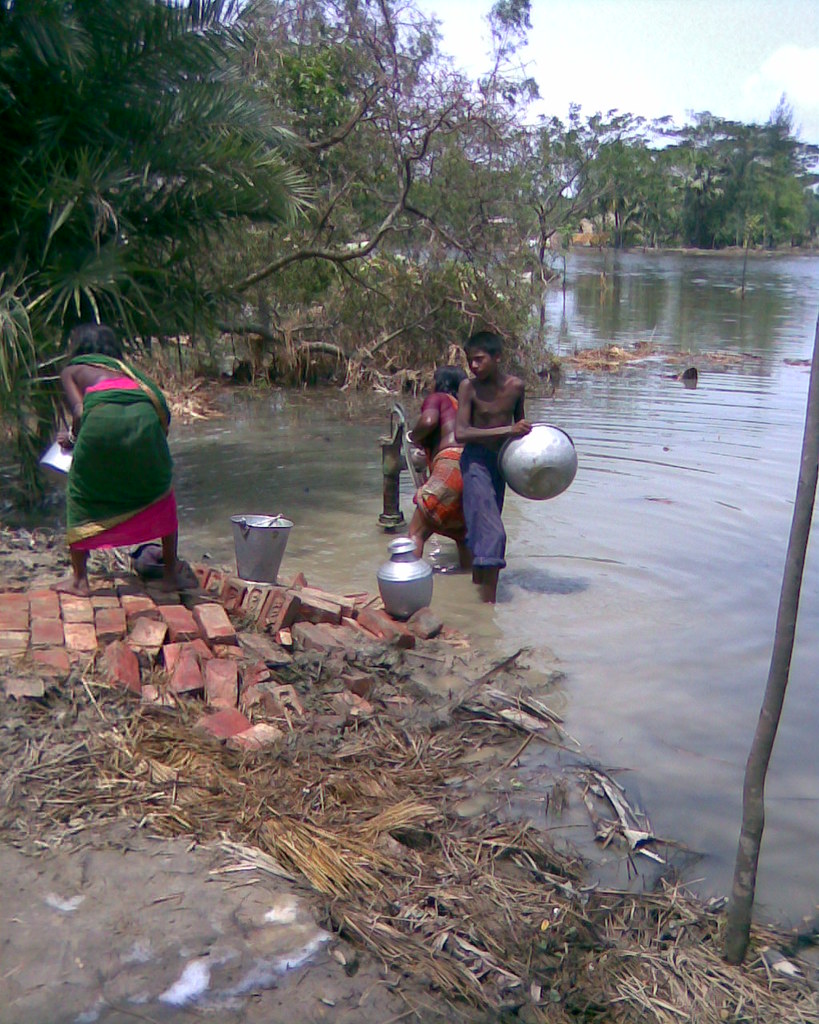
Some islands in the Bay of Bengal and the mangrove forests of the Sundarbans region were wholly submerged underwater. This catastrophe happened within a brief period, which resulted in people becoming homeless, leaving their assets in the households. A tiny percentage of the affected people could take shelter in the nearby cyclone shelter or schools during the cyclonic event. However, in several discussions, the affected people criticised that most cyclone shelters were built post-Aila and schools had only ground floors, which was anyways inundated. Most people thus took refuge on elevated roads. The extreme flooding also resulted in thousands of people losing access to safe drinking water and exposure to floodwaters containing untreated wastewater, dead animals and fish.

Impacts on water systems and water quality are often not visualised as chronic damage to property or the landscape. And thus, most treatments to these problems are temporary and short-lived. Potable water scarcity is a cumulative problem in the coastal region of India, especially Sundarbans, as it is revolving saline water slowly. Climate-induced disasters like rainfall, cyclone and storm surge, flood etc., are making the situation worse. Coastal people gradually depend on groundwater due to surface water salinity. As a result, groundwater extraction is increasing day by day. For that reason, the shallow aquifer has also been contaminated by salinity intrusion.

I have witnessed the horrific situation of women and children wailing for drinking water and waiting for relief distribution while spending my summer holidays at my native house in Sundarbans. The 14-year-old me then was horrified by the helpless situation of my own people, my kin and kept wondering whether disaster management conditions would be better or worse in due course of time especially when it concerns marginal communities of Dalits and Adivasis.

The memories of Aila keep flashing back to these Sundarban islanders every time they are hit by a cyclone or post-cyclone flood. Some of the stories they shared with me during my doctoral fieldwork made me revisit my Aila memories. As a native researcher, it gave a new stance towards the importance of water beyond its economic value and enhancing communities’ socio-cultural ties. Water, which has often served as an agency to conflict and dispute, during Aila it stimulated the sense of brotherhood and togetherness among the Samsernagar village residents.

Flood Friendship Between India-Bangladesh

Samsernagar is the last village in West Bengal’s Sundarban, bordering Bangladesh by river Kalindi. During Aila, the embankments of Samsernagar broke, resulting in the inundation of the village with the high tide influx from Kalindi. It led to total ruination of the settlement in just a couple of minutes. Samsernagar was submerged in the water, and so were the tube-wells and ponds, which were the only source of drinking water. It is where the villagers from Bangladesh came as harbingers of help.

In the political map, Bangladesh and India are demarcated as two separate nations. However, for people in Samsernagar, their neighboring village will still be the Village Koikhali of Bangladesh. To better understand, I phoned one of my respondent’s relatives who lived on the other side and asked about their experience during Aila regarding the help they provided to the Samsernagar residents. Koikhali residents came to Samsernagar rowing on their boat with barrels of potable water and other essential aids like food, clothes and mats. From several discussion and information interaction, it can be inferred that Samsernagar still recognises their international neighbour’s gesture which didn’t let them die of drinking polluted water. This act showed how, on the one hand, the water acted as a demon to the villagers through flooding and on the other, the barrels of drinking water brought by the neighbouring villages of Bangladesh became a sign of camaraderie and community interest. It went beyond just a mere necessity to live. It showed us how two villages come together, ignoring the human-made international boundary.

The Dilemma of Drinking water Crisis

That this acute drinking water problem can turn into a chronic issue in events like Aila and similar flooding situations is given credence by the fact that underground water also becomes saline due to leaching and seepage. Even after the floodwater recedes, the tube well water remains undrinkable. Sittler (2017), in her study on ‘Floodwater and stormwater can contaminate your water well’ argues that regardless of where storm-water runoff occurs, like floods, it can carry harmful contaminants such as soil, animal waste, salt, pesticides, and oil, potentially impacting drinking water wells and water quality. When discussed these challenges with groundwater experts at Sundarbans, they pointed out that in the Hingalganj Block, where Samsernagar village is situated, many deep tube well weren’t rightly maintained. Excessive contaminant-laden run-off infiltrated these drinking water wells through and assessed that the well casings or caps may not have been completely watertight. Moreover, any potential contaminants into the well can pose at least a short-term risk to water quality and human health.

In 2009, many families in Sundarbans, out of desperation, consumed pond water undergoing some basic filtration, knowing that the pond water stank from carcasses of dead animals. As farmlands remain filled with saline water, paddy yield became meagre the same and following year. Affected people when interviewed spoke of the mismanagement of the state’s relief supply and its lack of providing safe water, on how the local administrations would run some basic filtration like boiling the contaminated water and distributing it. As a result, hundreds of villagers suffered from diarrhea two weeks after drinking contaminated water. According to UNICEF, 28 diarrheal deaths were registered, and over 85,000 cases were reported from the Aila-hit districts of West Bengal.

Water can be considered a symbolic element, a resource, a commercial product, or a service. The interconnections established and the value attributed to water usage serves to build norms and references that influence the decision-making process from individuals to higher levels of social organisation. When considering it a resource for life, its interests and values vary and change across cultures, communities, states, space and time. One may raise an inquiry that spaces like Sundarbans is surrounded by rivers and seas, and that’s presumably the reason why Sundarban locals might not feel impacted by the presence of noble metals in the water.

However, as Sundarban landscape has a mangrove ecosystem, the water quality in and around the area has been found to be of inferior quality (CGWB report, 2014-15). If also, post-Aila most deep wells that were reconstructed at the height of 8-10ft above flood level so that the runoff was less likely to introduce contaminants into these wells, slight amount of saline water still managed to seep into the groundwater. However, it is the persistent presences of high iron and arsenic in the wells within that should raise alarm. So, even though the region is surrounded by water, most of it is toxic. Thus, for the Sundarban islanders, continuous access to safe and potable water is an aspiration that continues a dream for the whole community.

REFERENCES:

.

Camellia Biswas is a doctoral candidate at the discipline of Humanities & Social science, IIT Gandhinagar. She is an Inlaks-RS conservation grantee for the year 2021-22. Her research specialises in Environmental anthropology, focusing on human- Nature Interaction in Indian Sundarban under the larger discourse of Climate disaster.

.

PLEASE NOTE: ARTICLES CAN ONLY BE REPRODUCED IN OTHER SITES WITH DUE ACKNOWLEDGEMENT TO BORDERLESS JOURNAL