Categories
Review

Heart Lamp by Banu Mushtaq

Book Review by Somdatta Mandal

Title: Heart Lamp: Selected Stories

Author: Banu Mushtaq

Translated from Kannada by Deepa Bhasthi

Publisher: Penguin Random House India

After Geetanjali Shree’s Tomb of Sand, the first novel to receive the International Man Booker Prize in 2022 for a work of fiction written in an Indian language and translated into English, history repeated itself once again when this year in 2025, Banu Mushtaq’s book of selected short stories Heart Lamp, written originally in Kannada and translated into English by Deepa Bhasthi, was recipient of the same coveted prize. It proved that translating from Indian bhasha languages to compete worldwide with other canonical literatures has gained maturity to impress the jury who finally evaluate the prize.

In the twelve stories of Heart Lamp, published originally in Kannada between 1990 and 2023, Banu Mushtaq exquisitely captures the everyday lives of women and girls in Muslim communities in southern India. As a journalist and lawyer, most of the stories are women-centric and in all of them she tirelessly champions women’s rights and protests all forms of caste and religious oppression. As a believer in the highly influential literary movement in Kannada during the 1970s and ‘80s – the Bandaya Sahitya tradition – that started as an act of protest against the hegemony of upper caste and mostly male-led writing that was then being published and celebrated, Banu Mushtaq’s literary career therefore gave importance to dissent, rebellion, protest, resistance to authority, revolution and its adjacent areas at par with the movement that urged women, Dalits and other social and religious minorities to tell stories from their own lived experiences.

The author goes on to highlight several harmful social practices that are still prevalent in the Muslim community and even supported by law, which impede girls including women of all ages, from having freedom to make positive choices, thus hampering them from realizing their full potential. In story after story, the deeply patriarchal structure of Muslim society is depicted in such a manner that it is not only applicable to the Muslims living in villages and town in south India but can be applicable elsewhere too. She shows how child marriage is still in practice and mentions the suffering and trauma women experience because of legally sanctioned polygamy which causes social and financial insecurity and hardship for women and their offspring. The curse of teen talaq[1]and the practice of issuing multiple fatwas[2] which are deliberately aimed at constricting women are urgently in need of being addressed legally.

In the very first story, ‘Stone Slabs for Shaista Mahal’, we find Iftikar’s too much effusive declarations of love for his wife Shaista vanish into thin air immediately after her death and he soon marries a young girl leaving all his children to be looked after by his eldest daughter. The ‘Fire Rain’ has mutawalli[3] Usman Saheb heading the community and making hundreds of decisions for others, but when her sister comes begging he refuses to give her the legitimate share of his ancestral house. Whereas the ‘Black Cobras’ has the mutawalli saheb refuse to help a woman whose husband has deserted her for giving birth to three daughters and provide any support for her youngest sick daughter who dies without any treatment. The story ends with a focus on female revolt when his own wife decides to go and have an operation to stop childbirth. In an interesting story ‘A Decision of the Heart’ the author narrates the plight of a man called Yusuf who is unable to balance the love between his wife and his mother and finally decides to arrange a nikah for his mother Mehaboob Bi.

One story that delves deep into Muslim customs that we generally are not aware of, is entitled ‘Red Lungi’. It tells us about a mass circumcision programme at the mosque for the poor where a young boy Arif undergoes the procedure and is cured in due course. His plight is then contrasted with Samad, the son of a rich man who remains weak and unfit despite the elaborate festivities for his circumcision and the gifts.

The titular story ‘Heart Lamp’ centres around Mehrun who is left to fend for herself as her husband falls for another woman. When she goes to her parents’ house for support, her brothers send her back. Leaving the responsibility of her children upon her eldest daughter Salma, she attempts to burn herself to death. The scene where her daughter begs her to stop and so finally, she aborts her suicide attempt, is extremely moving. The depiction of rural Karnataka comes out very clearly in ‘Soft Whispers’. The story narrates in detail the childhood antics of an eight-year-old girl visting her grandparent’s house in Mabenahalli village. Her young playmate, Abid, who would join her to play tricks, turns into the supervisor of a dargah[4]. When he comes to invite her to join the festival, he keeps his head lowered and does not even meet her eye.

Despite mentioning serious social issues pertaining to the average middle and lower-middle class Muslim families, Mushtaq’s stories are laced with a sense of wry humour and pathos. For instance, in ‘High-Heeled Shoes’, Niaz Khan envies his sister-in-law who comes from Saudi Arabia wearing gorgeous high-heeleded shoes and, in the end, manages to buy a pair for his pregnant wife Arifa which does not fit her at all. The difficulty in walking with those shoes on, and the interaction she has with her unborn child in her womb takes this story to a different level altogether. ‘A Taste of Heaven’ has Bi Dadi, who turns into stone after her ja-namaz [5]is soiled, gaining solace by drinking Pepsi and thinking it to be aab-e-kausar, the nectar from heaven, and starts living in a delusory world of her own in the company of her long-lost husband. In ‘The Arabic Teacher and Gobi Manchuri’, the young Maulvi Hazrat’s penchant for eating “gobi manchuri[6]” is the comic fulcrum on which the story turns. Again, Shazia’s desperate attempts in ‘The Shroud’ to locally procure a kafan[7] and sprinkle it with the holy zamzam water from Mecca after having callously forgotten to bring one for poor Yaseen Bua from her Hajj pilgrimage, makes her grief and being conscience-stricken rather ludicrous.  

In the 2025 International Booker Acceptance Speech Mushtaq said: “This book is my love letter to the idea that no story is ‘local’ – that a tale born under a banyan tree in my village can cast shadows as this stage tonight…. [It] was born from the belief that no story is ever ‘small’ – that in the tapestry of human experience, every thread holds the weight of the whole.”

Her observation power is indeed very strong. Muslim women have been victims of deprivation and discrimination in various matters owing to a dearth in education and awareness. To bring a change in the family, a change in mentality is very crucial. The last story of this collection, ‘Be A Woman Once, Oh Lord!’ is a typical tale of male chauvinism, where deprived a dowry, a man throws out his sick wife and children to get married again.

A woman must construct her own identity besides being someone’s daughter, somebody’s wife or someone’s mother. Only education and self-dependence can establish a woman as a human being beyond her religious and family identities. But as her translator rightly points out, it would be a disservice to reduce Mushtaq’s work to her religious identity, for stories transcend the confines of a faith and its cultural traditions. So, she should not be seen as writing only about a certain kind of woman belonging to a certain community, that women everywhere face similar, if not the exact same problems, and those are the issues that she writes about.

Before concluding, a few words need to be written about the translator and the translation too. In the Translator’s Note, titled ‘Against Italics’, Deepa Bhashti reiterates that the “translation of a text is never merely an act of replacing words in one language with equivalent words in another: every language, with its idioms and speech conventions, brings with it a lot of cultural knowledge that often needs translating too.” She mentions that she was very deliberate in her choice to not use italics for the Kannada, Urdu and Arabic words that remain untranslated in English. She believes that italics serve to not only distract visually, but more importantly, they announce words as imported from another language, exoticizing them and keeping them alien to English. She also mentions that there are no footnotes used at all.  

In her separate International Booker Prize Acceptance Speech, Bhasthi also tells us how through the work they could bring out what would otherwise be unread, uncelebrated texts to a new and very different sets of readers. She stated how the story of the world was really a history of erasures. It was “characterized by the effacement of women’s triumphs and the furtive rubbing away from collective memory of how women and those on the many margins of this world live and love.” Therefore, the stories in this collection are recommended for reading not by reducing Mushtaq’s work to her religious identity, but by transcending the confines of a faith and its cultural traditions.

[1] It’s an Islamic practice in which a Muslim man could divorce his wife by uttering the word “talaq” (divorce) three times.

[2] An Islamic law

[3] Manager of a Muslim charity organization

[4] Tomb or shrine of a Muslim saint

[5] A Muslim prayer mat

[6] Manchurian cauliflower

[7] Shroud

Somdatta Mandal, critic and translator, is a former Professor of English at Visva-Bharati, Santiniketan.

PLEASE NOTE: ARTICLES CAN ONLY BE REPRODUCED IN OTHER SITES WITH DUE ACKNOWLEDGEMENT TO BORDERLESS JOURNAL

Click here to access the Borderless anthology, Monalisa No Longer Smiles

Click here to access Monalisa No Longer Smiles on Amazon International
Categories
Review

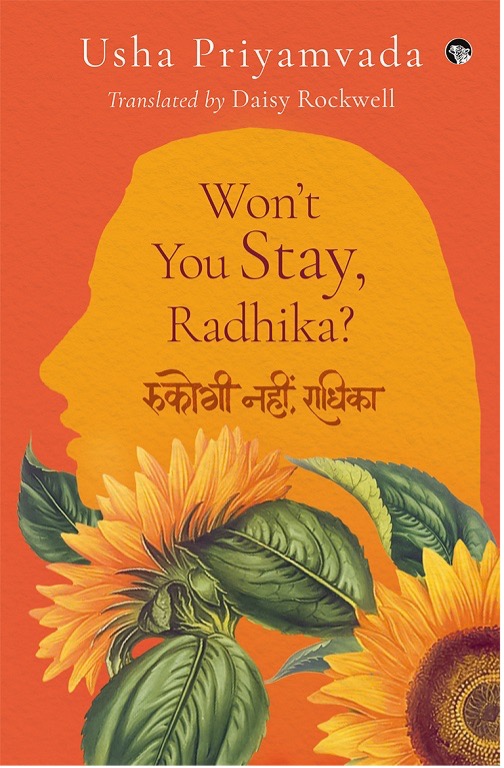
Won’t You Stay, Radhika?

Book Review by Somdatta Mandal

Title: Won’t You Stay, Radhika?

Author: Usha Priyamvada

Translator: Daisy Rockwell

Publisher: Speaking Tiger Books

In an essay written several years ago, the India-born Canadian author Uma Parameswaran had defined the plight of diasporic people by using the mythic metaphor of ‘Trishanku’ borrowed from the Ramayana where this character wanted to go to heaven alive but denied entry there, he was sent back and since then resided neither on earth nor in heaven but was suspended forever in an illusory middle space in-between. The state of diasporic individuals is somewhat similar; they are neither here nor there, and the present novel under review, published way back in 1967, brings out the angst of one such individual who, like the author Usha Priyamvada, herself went for higher studies to the United States and became the usual victim of culture shock. The only difference is that in real life Priyamvada stayed back in America and spent her long teaching career in universities there, whereas the protagonist of her novel Won’t You Stay, Radhika? went there only for a couple of years.

The storyline of the novel, originally written in Hindi, is rather simple. After her widowed father marries a younger woman called Vidya, Radhika’s world falls apart. She feels betrayed—the emotional and intellectual bond that she had forged with her father since the early death of her mother breaks with that sudden marriage. This is because their bond was not just emotional, but intellectual, as Radhika helped her father with his art history writing. To escape the unbearable situation at home—the growing rift between her and her father—Radhika fought for her personal freedom. Finding a simple way to avenge her father, she moved to Chicago along with an American teacher called Dan to pursue her master’s in fine arts. By leaving her father and going to live with Dan, Radhika had acquired several years of experience and matured quickly. But her living with Dan had only been a means to an end.

She returned to India two years later, burdened by a sense of alienation and homesickness, only to realise that while nothing had changed in her country, everything had. A growing sense of despair engulfed her. She started wondering whether she had a home anywhere. The family that she had longed to be reunited with barely acknowledged her arrival. The sense of belonging was missing, leaving her in ‘an emotional state of in-between-ness, of universal unbelonging’. As days pass, Radhika is paralysed with ennui, which is not just boredom. She avoids people, romance, family, as she lies still, or wanders listlessly through her neighbourhood. This sense of unbelonging tinges all her relationships—romantic or filial. So, she lies listlessly on her takht[1], bored, immobile, and uninspired.

This is not to say that Radhika is without love interests in the novel; after all there are three men in her life. She does not always feel detached from these men; there are many situations in the novel when we as readers feel that she has overcome her ambivalence or boredom or ennui, that she will start living a more meaningful life, but nothing positive takes place in the end. She seems to jell well with Akshay for a while and thinks probably she might marry him as there is no room in her life for a playboy. She wants a partner, someone steady, generous, someone who will accept her with all her flaws. But though she has great respect for him, she finally decides not to fall into the traditional trap of marriage. Akshay, like a traditional Indian male, also cannot subconsciously stop thinking about Radhika’s past. He feels confused as the more he wants to steer clear of Radhika, the more he feels she looms over his life. He also keeps on thinking about her past affairs with other men.

The other gentleman with whom Radhika had developed a relationship was Manish, who was diametrically opposite in nature to Akshay. They knew each other for a long time in many different contexts. Manish had also desired her, but Radhika had kept him at a distance. After several indecisive moments, she openly turned down his marriage proposal too, stating that she didn’t want to get involved again. Though she felt warmed by Manish’s touch, she did not turn to look at him. But Manish decided to wait till such time she changed her mind and voluntarily went to him. This ambivalence continues till the end of the novel, which Priyamvada leaves rather open-ended.

Though the title of the novel refers to a particular scene in the end when Radhika goes to meet her father once again and he wants his daughter to stay with him like before, that question mark hovers over the entire work: What will you do Radhika? Will you get up off the takht? Will this ennui ever come to an end? She was surprised at how her emotions had become so dull that she felt very little at all.

An extraordinary chronicler of the inner lives of the urban Indian woman, Usha Priyamvada is a pioneering figure in modern Hindi literature. Won’t You Stay, Radhika? written so many years ago, expertly explores the stifling and narrow-minded social ideals that continue to trap so many Indian women in the complex web of individual freedom, and social and familial obligation. A sense of alienation is also famous not only as a hallmark of Hindi literature of the 1960s, where it is usually traced to urbanization and the breakdown of traditional family structures, but also finds representation in Indian English novels too. Here one is reminded of Anita Desai’s famous novel Cry, the Peacock, published in 1963, that also delves deep into human emotion by focusing on topics like existential depression, psychological discontent, and the fragility of sanity as expressed through the female protagonist Maya. Though the theme of incompatibility and lack of understanding in marital life is one of the main themes of Desai’s novel, one notices a similarity of dealing with trapped feminine psyche in both the novels. Of course, reading the story of Priyamvada so many decades later, it seems nothing has changed in the Indian context and the situation in which the characters find themselves is equally true even today.

Before concluding, one must specifically put in a word of appreciation for the translation as well as the translator. On the first impression one is surely bound to think whether an American writer is the appropriate choice for translating a novel in Hindi. Apart from holding a PhD in South Asian literature from the University of Chicago and writing her doctoral dissertation on the Hindi author Upendranath Ashk, Daisy Rockwell has over the years to her credit translations of several Hindi authors including Usha Priyamvada’s debut novel Fifty-five Pillars, Red Walls (2021). But what brought her into limelight was her translation of Geetanjali Shree’s Tomb of Sand (2018) which became the first novel translated from an Indian language to win the International Booker Prize in 2022.  Thus, apart from bringing this poignant Hindi novel to a new set of readers fifty-five years later, Rockwell’s expertise in translation makes one feel that this is not translated text at all. Though not a mystery thriller, her narrative skill makes the novel a definite page-turner and one will surely be tempted to finish reading it as fast as possible.

.

[1] Bed

Somdatta Mandal, an academic critic and a translator, is a former Professor of English at Visva-Bharati, Santiniketan, India.

PLEASE NOTE: ARTICLES CAN ONLY BE REPRODUCED IN OTHER SITES WITH DUE ACKNOWLEDGEMENT TO BORDERLESS JOURNAL

Click here to access the Borderless anthology, Monalisa No Longer Smiles

Click here to access Monalisa No Longer Smiles on Kindle Amazon International

Categories
Review

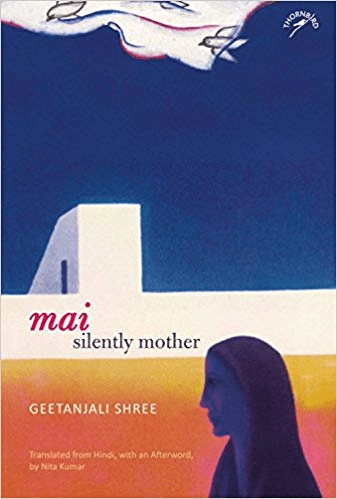
Geetanjali Shree’s Mai

Rakhi Dalal reviews Geetanjali Shree’s Mai, Silently Mother, a Sahitya Akademi winning translation of the Hindi novel by Nita Kumar

Title: Mai, Silently Mother

Author: Geetanjali Shree, Translator: Nita Kumar

Publisher: Niyogi Books

To live in a South Asian country means to grow up with an absolute idea of a mother. A mother is always giving, nurturing, sacrificing and working. Her day begins and ends with looking after the household. In context with India, this notion also seems to be defined by the structures of caste and class. Although an opinion of her position, based upon the ideas imbedded in conscience, takes on different interpretations when seen broadly from the lenses of patriarchy or feminism. With the former, it is more of a responsibility or duty that is taken for granted and in many cases not even given a second thought. In the case of latter, it might be considered as oppression in some situations, where the mothers are deliberately subjugated into drudgery of family grind by the patriarchal structure.

Mai by Geentajali Shree presents to us the complexities brought about by the conflict between both of these ideas in a domestic realm. However more than that it compels us to think when we talk of a mother, exactly whose opinions are being discussed and whether we also explore it from the point of view of the mother herself.

It is the debut Hindi novel of the author and is centred on the world of a mother as observed by her daughter. The English translation of Mai by Nita Kumar had won Sahitya Academy Award in 2002 and was shortlisted for the Crossword Book Award in 2001. Ret Samadhi by Geetanjali Shree, whose English translation Tomb of Sand by Daisy Rockwell won International Booker this year, also has at its centre a mother.

Shree writes stories and novels in Hindi. Her much acclaimed novels Tirohit and Khali Jagah have also been translated into English. She has written a biography of Premchand in English and is also associated with theatre. Nita Kumar, the translator of Mai, is a Brown Family Professor of South Asian History at Claremont McKenna College, Claremont, California. She has also authored several books and is engaged in innovative education in Varanasi since 1990.

The household in Mai is a typical middle class in a small North-Indian town where the patriarch set the diktats rolling for a joint family. Governed by the binaries of outside and inside, the roles of each member are clearly defined. ‘Outside’ is a world to be conquered by the men whereas the confines within the house are to be looked after and cared for by the women. Three generations of a family living under the same roof offer resonance with confirmations and contradictions inherent to the structure they are bound by.

With this backdrop, the author successfully pulls strings to present an image closer to the familiar realities of such a household. Silently mother, the subtitle of Mai, is the identifier which Sunaina, the third generation daughter, associates with her mother. From her early childhood, she has watched her mother attending to the call of her family silently. Always bent, always working, from behind her purda, the mother seemed weak. Slowly however, and with much subtlety, Shree offers the reader certain glimpses into the character of silent Mai. Instances which, as Kumar suggests, mean that her silence does not equate with being speechless. At the most crucial points, we witness the mother speaking up for her children, even if it is only a single word or sentence is being uttered. She never questions their choices or decisions, thereby giving them freedom to get on with their own lives, something which makes them closer to her than to their father or grandparents.

The reader also finds that mother does have her own moments of joy when she retires at night to the bedroom she shares with her children, lets go off her veil and laughs at their jokes, when she appears in the forbidden courtyard humming a song or when she takes on the responsibility of entire house after her husband meets a tragic accident.  

For Sunaina and her brother Subodh however, her silence equates with oppression. They are obsessed with the idea of rescuing her from the fetters which they believe are afflicted upon her. So much so that it becomes the sole purpose of their lives. With passage of time, their mission nevertheless remains unaccomplished as they realise in frustration that their mother doesn’t need to be saved. It is only towards the end that they realise her strength and contribution in building their lives.

In the afterword, Kumar says, “We do not know ‘what’ mothers are, we do not know if a given mother is ‘fulfilled’ in what she does, or what else she ‘wants’. But we could progressively know whether to ask certain questions, how to ask some others, what any of them might imply, how to refrain from asking and retrack, how to pause and begin to comprehend little glimpses better. We could start evaluating silence differently from what we do in our dichotomous, rationalist world, like Subodh and Sunaina’s tells us to. We could question agency, strength and weakness anew.” 

With an impressive 50 page critique of Mai, the afterword is an added treat to the reader. Kumar writes on the matter of mother and looks at it from the point of history and anthropology. She discusses the challenges associated with the task of translation and her discourse engages the reader, bringing focus on her work which is done exceptionally well. 

This splendid novel by Geetanjali Shree, with its nuanced portrayal of sensibilities across class, gender and age, invites the reader to look closely into the preconceived as well as acquired notions around ‘mother’. It stresses profoundly that the mothers are not only made invisible by the veil which patriarchy forces upon them but also by the partial and opinionated understanding of their desires. Maybe if we try to catch the little glimpses better, we may start seeing her coming out of shadows.

.

Rakhi Dalal is an educator by profession. When not working, she can usually be found reading books or writing about reading them. She writes at https://rakhidalal.blogspot.com/ .

.

PLEASE NOTE: ARTICLES CAN ONLY BE REPRODUCED IN OTHER SITES WITH DUE ACKNOWLEDGEMENT TO BORDERLESS JOURNAL.