Categories
Review

“…in order to hear the Earth, we must first learn to love it…”: Amitav Ghosh

Book Review by Somdatta Mandal

Title: Wild Fictions: Essays

Author: Amitav Ghosh

Publisher: HarperCollins (Fourth Estate)

How can a 470-page long book turn into a page-turner when it is neither a historical novel nor a whodunit thriller that compels the reader to go on reading as quickly as he/she can? That too when it is a motley collection of twenty-six essays written on different occasions and on different topics for the last twenty-five years. The answer is of course Amitav Ghosh who can literally mesmerise his readers with his multi-faceted interests and subjects ranging from literature and language, climate change and the environment, human lives, travels, and discoveries. Divided into six broad sections, Ghosh clearly mentions in the Introduction that the pieces in this collection are about a wide variety of subjects, yet there is one thread that runs through most of them: of bearing witness to a rupture in time, of chronicling the passing of an era that began 300 years ago, in the eighteenth century. It was a time when the West tightened its grip over most of the world, culminating ultimately in the emergence of the US as the planet’s sole superpower and the profound shocks that began in 2001.

A subject very close to his heart and that is reflected in all the books that he has been writing over the last decade or more, the six essays of the first section are on “Climate Change and Environment.” Ghosh writes about different aspects of migration (both in the sub-continent and in Europe), about the storm in the Bay of Bengal, cyclones, the tsunami affecting the Andaman and Nicobar Islands, and about Ternate, the spice island in Indonesia. According to him, by knowing about anthropogenic greenhouse emissions and their role in intensifying climate disasters, it is no longer possible to cling to the fiction of there being a strict division between the natural and the political. Climate change and migration are, in fact, two cognate aspects of the same thing, in that both are effects of the ever-increasing growth and acceleration of processes of production, consumption and circulation.

According to Ghosh, each of the six essays in the second section entitled “Witnesses” grew out of the research he undertook for his four historical novels, The Glass Palace, and the Ibis Trilogy. All the essays in it “are attempts to account, in one way or another, for the recurrent absences and silences that are so marked a feature of India’s colonial history”. While looking for accounts written by Indian military personnel during the First World War, Ghosh came across two truly amazing books, both written in Bengali, on which three pieces in this section are based. The first of these books is Mokshada Devi’s Kalyan-Pradeep (‘Kalyan’s Lamp’; 1928), an extended commentary on the letters of her grandson, Captain Kalyan Mukherji, who was a doctor in the Indian Medical Service. The second, Abhi Le Baghdad (‘On to Baghdad’), is by Sisir Sarbadhikari, who was a member of the Bengal Ambulance Corps, and is based on his wartime journal. Both Mukherji and Sarbadhikari served in the Mesopotamian campaign of 1915-16; they were both taken captive when the British forces surrendered to the Turkish Army in 1916 after enduring a five-month siege in the town of Kut-al-Amara – the greatest battlefield defeat suffered by the British empire in more than a century. He also writes about how these two prisoners of war witnessed the Armenian genocide.

Regarding the exodus from Burma, Ghosh narrates the plight of one Bengali doctor, Dr. Shanti Brata Ghosh from whose diary (written in English) we are given incidents of events that are a striking contrast to British accounts of the Long March. What the doctor remembered most clearly were his conflicts with his white colleagues and his diary represents a personal assertion of the freedom that his nation’s hard-won independence had bestowed upon him.

Section Four entitled “Narratives” consists of three essays. Speaking about the etymology of the word ‘banyan’, and a short personal anecdote about 11 September 2001, we come to the essay from which the title of this collection – Wild Fictions – is taken. It shows us how the policies and administrative actions have divided landscapes between the ‘natural’ and the ‘social.’ Discussing several environmental issues related to the manner in which over many decades there has been a kind of ethnic cleansing of India’s forests and how the costs of protecting nature have been thrust upon some of the poorest people in the country, while the rewards have been reaped by certain segments of the urban middle class, Ghosh warns us why the exclusivist approach to conservation must be rethought. Before environmental catastrophe happens, we have to find some middle way, one in which the people of the forest are regarded not as enemies but as partners. The idea of an ‘untouched’ forest is none other than a wild fiction.

As mentioned in the beginning, Ghosh’s intellectual curiosity ranges from exploring themes of history, culture, colonialism, climate change and the interconnectedness of human and natural worlds and the readers will get a sample of these different topics in this rich collection. Over the years, we had read some of the essays in journals like Outlook, The New Yorker, The New York Times, The Hindu, The Economic and Political Weekly, The Massachusetts Review, Conde Nast Traveller and so on, and some of the articles have been the product of his detailed research before he commenced writing a novel. The five essays in the penultimate section titled “Conversations” begins with a long correspondence that Ghosh had with Dipesh Chakraborty via email after Provincilaizing Europe was published in 2000. The two never met personally as Chakraborty was in Australia at that time, but the exchanges between these two scholars on such wide-ranging issues is surely a reader’s delight. The pieces on Shashi Tharoor’s An Era of Darkness and Priya Satia’s Time’s Monster which were written as reviews also form parts of ongoing dialogue. As Ghosh states, Sattia’s work “has given me new ways of understanding the role that ideas like ‘progress’ have played in the gestation of this time of monsters”. In ‘Storytelling and the Spectrum of the Past’, we are told about the historians versus the novelists view of seeing and documenting themes.

The final and sixth section comprises of three pieces that were originally conceived as blogposts or presentations, accompanied by a succession of images – “the texts that accompany my presentations are scripts for performances rather than essays as such”. In the first one, Ghosh gives us new insights from his diary notes (the Geniza documents) about how he chose to study social anthropology and how In an Antique Land was made—about the Muslim predominance in the Arab village where he stayed and how he evaded the attempt at conversion. In a lecture he delivered at Indian Institute of Technology, Kharagpur, Ghosh asks us to think back for a moment to the intellectual and historical context that led to the foundation of such institutions as the IITs, the IIMs and the outstanding medical institutions of contemporary India. He tells us how we cannot depend on machines alone to provide the solution to our social problems and talks about mercenaries, prisons, the hegemony of the Anglo-American power and how the empires kept close control over rights to knowledge. One of the great regrets of Ghosh’s life was that he never met A.K.Ramanujan and in the concluding essay of this section, he tells us how he considered Ramanujan to be “one of the foremost writers and intellectuals of the twentieth century and how one of the most important aspects of his work is the context from which it emerged.

In the introduction to this collection Ghosh wrote that we were now in a time between the ending of one epoch and the birth of another – ‘a time of monsters’, in the words of Antonio Gramsci. In the Afterword he mentions how the strange thing about this interstitial era is that it could also be described as a ‘time of benedictions’ in that it has suddenly become possible to contemplate, and even embrace, potentialities that were denied or rejected during the age of high modernity. He reiterates that it is the elevation of humans above all other species, indeed above the Earth itself, that is largely responsible for our current planetary crisis. “The discrediting of modernity’s anthropocentricism is itself a part of the ongoing collapse that we are now witnessing.” The only domains of human culture where doubt is held in suspension are poetry and fiction. Though it is not possible to discuss all other aspects that Ghosh deals with in this anthology as the purview of the review is rather limited, I would like to conclude it by quoting the last couple of sentences written by Ghosh himself when he categorically states: “High modernity taught us that the Earth was inert and existed to be exploited by human beings for their own purposes. In this time of angels, we are slowly beginning to understand that in order to hear the Earth, we must first learn to love it.”

.

Somdatta Mandal is a critic and translator and a former Professor of English at Visva-Bharati, Santiniketan, India.

.

PLEASE NOTE: ARTICLES CAN ONLY BE REPRODUCED IN OTHER SITES WITH DUE ACKNOWLEDGEMENT TO BORDERLESS JOURNAL. 

Click here to access the Borderless anthology, Monalisa No Longer Smiles

Click here to access Monalisa No Longer Smiles on Kindle Amazon International

Categories
Notes from Japan

Weekend in Futaba at the Japan Writers Conference

Narrative and photographs by Suzanne Kamata 

Many years ago, when my children were small and I was working on my first-to-be-published novel Losing Kei, I joined an online writing group made up of members of the Association of Foreign Wives of Japanese. Since I live off the beaten track, on the island of Shikoku, this group was a godsend for me. Not only was I able to connect with non-Japanese women raising biracial kids in a supposedly homogenous country, but I could also connect with others writing in English. 

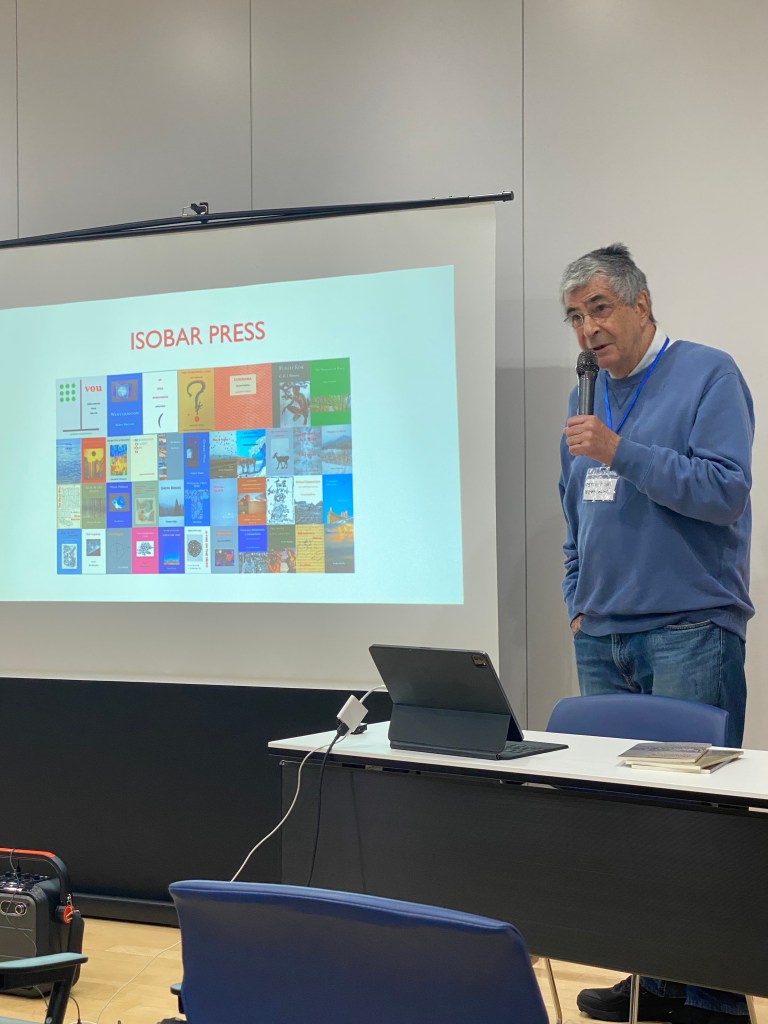
I ultimately finished my novel. I was not the only member of this group who went on to publish books. In addition to writing and publishing, another wonderful thing that came out of this now defunct virtual community was the Japan Writers Conference, which was first held in 2008. One of the members, poet and writer Jane Joritz-Nakagawa, whose most recent book is the searing LUNA (Isobar Press, 2024), proposed a grassroot gathering of writers in Japan. There would be no keynote speaker, no fees for participants, and no payments for presenters. We would just get together and share our writing and our expertise. 

Another member, Diane Hawley Nagatomo, who recently published her second novel, Finding Naomi (Black Rose Writing, 2024) after an illustrious career in academia, volunteered to host the initial conference at her university. Chanoyu University, in Tokyo, is famously the institution attached to the kindergarten attended by the Japanese royal family. It was also the site of the first Japan Writers Conference. 

Since then, the conference has been held at various universities and colleges around the country, including in Okinawa, Hokkaido, Kyoto, Iwate, and at Tokushima University, hosted by me in 2016. Over the years, many notable speakers have appeared, such as Vikas Swarup, whose novel Q & A became the film Slumdog Millionaire, popular American mystery writer Naomi Hirahara, and Eric Selland, poet and translator of The New York Times bestseller The Guest Cat by Takashi Hiraide. The list goes on and on. 

This past year, the conference was held not at a university, but at the Futaba Business Incubation and Community Centre. 

When I told my husband that I was going to Futaba, he looked it up on a map. 

“That’s in the exclusionary zone,” he said, somewhat alarmed. 

Indeed, the conference would be held on the coast in Fukushima Prefecture, not too far from the site of the nuclear power plant which was hit by a tsunami in 2011. For years, there have been concerns about radiation, however the area is staging a comeback. The host of this year’s conference would be the Futaba Area Tourism Research Association, an organisation committed to “promoting tourism and land operations, inviting people to rediscover the charms of Fukushima’s coastal areas. The company’s mission is to bring people worldwide to this unique place that has recovered from a nuclear disaster.” 

“I don’t think they would hold the conference there if it wasn’t safe,” I told him.  

The JWC website reported that although the town had been evacuated after the 2011 Great East Japan Earthquake and the meltdown at the Fukushima Daiichi Nuclear Power Station, evacuation orders had been lifted for about 10% of the town on August 30, 2022.  Decontamination efforts are still underway. New homes are being built, new businesses are emerging, and the annual festival Daruma-Ichi resumed in 2023. The areas hosting the JWC had been deemed safe, “with radiation levels regularly monitored and within acceptable limits.” I reserved a room at the on-site ARM Hotel and went ahead with my plans. 

Getting to Futaba from my home in Tokushima took all day. I got up before the sun and took a bus, a plane, then a succession of trains. As I got closer to my destination, I noted the absence of buildings along the coast. I tried to imagine the houses that might have been there before the grasses had gone wild. Later, the appearance of earth-moving equipment suggested future development.   

From the nearly deserted train station, I took a bus, and then lugged my suitcase to the hotel’s registration desk. There was nothing around besides the convention center and the hotel. I saw a very tall breakwater, blocking my view of the ocean. I felt as if I were on the edge of the world. 

The evening before the conference began, I had dinner at the hotel restaurant, where I met up with some writers I had gotten to know at past conferences. Ordinarily, we might have moved on to a bar to continue our literary discussions, but after the restaurant closed at eight, there was nowhere else to go. There was some talk of going to the beach. A few of us went out into the night and sat on the seawall, sipping Scotch from paper cups, and talking under the stars. At one point, we contemplated the waves below, all those who were washed out to sea and remained missing. 

The conference began the following morning. I was amazed that, in spite of the effort that it had taken to get there, presenters had come from all over the world – a Syrian poet who was based in Canada, a poet from Great Britain, a Japanese writer and translator who lived in Germany, a Tunisian writer and motivational speaker who’d flown in from UAE. 

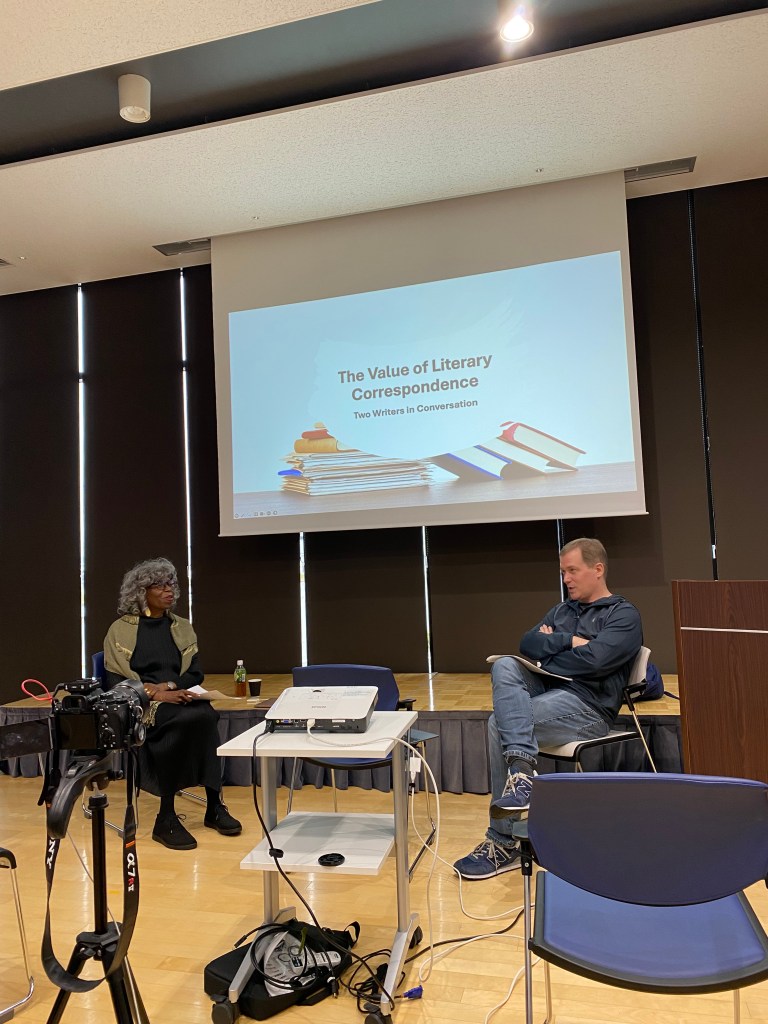
I gave a presentation on writing for language learners and shared my haiku in another session. Others presented on a variety of topics including literary correspondence, storytelling and tourism, climate fiction, and writing the zuihitsu[1]. In between sessions, I caught up with old friends and met new ones. On Saturday night, there was a banquet with bentos featuring delicacies such as smoked duck, mushroom rice, and salad with Hokkigai clams. 

In retrospect, it was especially meaningful to attend the conference in Futaba, and to feel that we were able to play some small part in the rejuvenation of the area. It was also exciting to interact with writers who came from so far away. Although it’s still very much a grassroots event, it has become truly international. 

(To find out about the next Japan Writers Conference and sign up for the mailing list, go to https://japanwritersconference.org/

[1] A loose collection of personal essays

Suzanne Kamata was born and raised in Grand Haven, Michigan. She now lives in Japan with her husband and two children. Her short stories, essays, articles and book reviews have appeared in over 100 publications. Her work has been nominated for the Pushcart Prize five times, and received a Special Mention in 2006. She is also a two-time winner of the All Nippon Airways/Wingspan Fiction Contest, winner of the Paris Book Festival, and winner of a SCBWI Magazine Merit Award.

PLEASE NOTE: ARTICLES CAN ONLY BE REPRODUCED IN OTHER SITES WITH DUE ACKNOWLEDGEMENT TO BORDERLESS JOURNAL

Click here to access the Borderless anthology, Monalisa No Longer Smiles

Click here to access Monalisa No Longer Smiles on Amazon International

Categories
Essay

One Life, One Love, 300 Children

Keith Lyons writes of Tendol Gyalzur, a COVID 19 victim, a refugee and an orphan who found new lives for many other orphans with love and an ability to connect.

Tendol Gyalzur: “My religion is wiping children’s noses.”

This story is about how one person found joy and happiness, not in accumulating material possessions or going viral on social media, but in finding her purpose through doing service, and making a difference to many, many lives.

Yet it might have turned out differently for Tendol Gyalzur. Her parents and brother were killed as they fled Tibet. As an orphaned refugee she was adopted in Europe. She had every reason to be bitter, every reason to hold a grudge, every reason to hate. It took great courage for her to return to her childhood homeland which had been invaded by China. It took huge sacrifice for her to work with those occupiers who’d orphaned her. And it took a deep love for her to admit that sworn enemies were actually capable of love.

I first met Tendol nearly 20 years ago while I was travelling in the Tibetan borderlands of north-west Yunnan province, in a place which later changed its name to Shangrila in a shrewd move to attract tourists in search of the fictional place of James Hilton’s Lost Horizon (1933). In Zhongdian, a predominantly-Tibetan town which sits at a literally breath-taking 3,300m above sea level, the owner of my guesthouse drew me a rough hand-drawn map on a blank back page of Lonely Planet China showing the route from the Old Town to the ‘Gū’ér yuàn’ (solitary nursery).

I made my way through the rough cobblestone lane maze of the Old Town, past steamy yak hotpot restaurants and karaoke bars where red-robed monks drank beers and barley spirits, to the much-larger New Town with its wide boulevards, guarded bank buildings and muddy construction sites.

After turning right at a new 4-star hotel, skirting alongside a placid lake, and halting just before the town’s new traffic-light junction, I spotted a sign for the orphanage. The arrows took me behind a primary school into a residential area, and up to a walled compound. I knocked on the gate metal door, a couple of guard dogs inside started barking, and eventually, the door was opened by someone in a cook’s apron and sporting the trademark Tibetan alpine rosy cheeks. “Welcome,” she said, and I presented my offering of a bag of warm winter hats, scarves and gloves. “Come in, and I will get Tendol.”

I’ve watched enough television and late-night charity ads in my life to assume that any orphanage will have poor, sad, bedraggled kids confined in drab quarters, but I was not expecting the light, spacious and clean courtyard, with a basketball court and stable with horses. Bright Tibetan motifs of the sun and moon and swirly cloud patterns decorated the trim of buildings, while in small gardens orange and yellow flowers reached for the clear blue skies above.

From one of the buildings out came a woman who, after stopping to tie up the shoelaces of a small child and send them off to play with a hug, introduced herself to me as Tendol. She ushered me into a small reception area where I was given tea, and after explaining about her work, she showed me around the facility, which had spartan but well-maintained tidy dormitories, classrooms for after-school study, and a cosy kitchen.

I was surprised not just at the uplifting environment and its positive vibe, but also at just how content the dozens of children seemed. As a deliberate policy, two aspects of the orphanage’s operation were aimed at mainstreaming and protecting the children. Rather than become a closed institution like most other orphanages in China, the children went to school at the nearby school next to the orphanage, so they could integrate with their peers. To give greater security and remove the fear of being further displaced, Tendol committed to keeping all the children in her care safe from being put up for adoption.

It was one big family, and the children regarded each other as brothers and sister, with the house-parents and Tendol and her husband Losang referred to as parents, aunty or uncle. While most of the children were Tibetan, some were from seven other ethnic minorities including Naxi, Yi, Lisu, and Han Chinese. With orphans found abandoned on the street, or having lost parents, she said how Children’s Charity Tendol Gyalzur doesn’t discriminate on the ethnic origin, the colour of skin, or religion. “Instead we accept those who are most in need of our help and protection.”

While most Tibetans practice Tibetan Buddhism, Tendol was brought up in Europe with Christian values, but her mission was never religious and the orphanages were non-denominational. In an interview she once said her work was practical and pragmatic rather than religious, “My religion is wiping children’s noses.”

“I am the happiest person on Earth,” Tendol would often tell me when I visited her bringing donated clothes and food, or guests. “Really, I am the happiest person,” she would declare, wrinkles appearing around her deep dark twinkling eyes as she smiled, while outside youngsters playing tag, improvised soccer and hopscotch shrieked and chortled. “You can write that down.”

I did take note of her genuine proclamation and was curious to learn about her story, not just of her tangible ‘bricks and mortar’ achievements, but also of her personal transformation which made her in my books more saintly and less dogmatic than the likes of Mother Teresa (now known as Saint Teresa of Calcutta).

So how did an exiled orphan return from Switzerland to establish orphanages and nomadic schools across Tibetan areas during the last three decades? That journey, going full circle, from being an orphan herself to caring for hundreds of orphans, is Tendol’s story. The short answer is that was obviously very hard work, requiring dedication, perseverance, and boundless love. Tendol was supported by her family, especially her husband Losang Gyalzur and two sons, as well as donors throughout the world.

Given Tendol’s tough, turbulent childhood as an exile, refugee and orphan, you might expect her to hold a grudge against those who orphaned her. Yet she was possibly the kindest-hearted person you might ever meet.

I wanted to know about her life and struggles, and how she overcame the obstacles. When I stayed in Shangrila for 18 months, and later lived in the nearby town of Lijiang for a dozen years, I came to appreciate the difficulties for outsiders to live and work in China. For me and many other foreigners, the cost of visas and frequent visa-runs were higher than the actual cost of living.

Every year or so, someone I knew would be fined and deported. Several Tibetan-focused NGOs operating in Lhasa were kicked out, re-establishing in Yunnan, only to face more scrutiny and barriers. Tendol no doubt had to make some compromises in her work, but her continued ‘licence to operate’ seemed to come from her outstanding reputation, key connections and ultimately, from her record of success: she provided a social service for those most in need.

Tendol fled Tibet in 1959 during the suppression of the uprising against Chinese rule, escaping across the Himalayas with her parents and brother. Along the way, during the treacherous journey, her parents and brother died, and at one stage the group of refugees she travelled with left her behind in a remote village. She realised her plight, and ran after the caravan, making it through Bhutan to India, where she was placed in a refugee camp. She didn’t know the names of her parents or brother, nor did she know the date or year of her birth. Her age was only estimated based on the number of baby teeth.

The events of 1959 left tens of thousands dead and saw over 80,000 Tibetans, including the 14th Dalai Lama, flee to India. Tendol was transferred to an orphanage in Dharamsala run by the Dalai Lama’s sister and was chosen to be part of a group of a dozen children to go to Europe in 1963. Before departing to Munich, the Dalai Lama spoke to the children, hoping that one day they would be able to return to help rebuild Tibet and spread happiness, as ‘flowers that would later bloom in Tibet’.

She was adopted by a young German couple, both doctors, and grew up near Konstanz. As well as suffering culture shock and racial abuse for the darker colour of her skin, her less traumatic early memories include being invited to lunch with the mayor of Munich only to be served a bland meal of hominy grits, and being sick from eating too much chocolate at Easter.

In Germany, she met her husband, Losang, a fellow Tibetan refugee who had fled to Switzerland in 1972. They moved to near Zurich in Switzerland (the country with one of the largest populations of Tibetans) and started a family.

When her sons were still young, and when Tendol was 36 years old, she returned to Tibet for the first time in 1990, this time bearing the distinctive bright red Swiss passport with its bold white cross. While other visitors in the capital Lhasa were marvelling at the enchanting Tibetan Buddhist architecture and magnificent high-altitude scenery, she came across two dishevelled children rummaging through trash. She took them to a nearby place to eat, but at first, the manager refused to let them in.

“It was then, for the first time in my life, I realised that the only thing I wanted to do was fight for the rights of these abandoned children,” she said. “I know there are orphans all over the world, but I am Tibetan, and I wanted to help the orphans of Tibet.”

When she described her vision of establishing an orphanage in Tibet to her family and friends back in Switzerland and Germany, many argued it was an impossible dream. After all, she was just a surgical nurse, with little money, up against seemingly insurmountable obstacles to set up a private institution in bureaucratic and xenophobic Communist China.

Haunted by the images of the scavenging Tibetan street-children, which triggered her own memories of being an orphan, she took out her savings and some of her husband’s pension, sought donations and loans from family and friends, and secured some financial support from the Tibet Development Fund. Within three years of that pivotal moment in Lhasa, she returned in 1993 to open Tibet’s first private orphanage at Toelung just outside Lhasa. It started with just six children.

She opened a second orphanage in her husband’s hometown of Shangri-la in 1997, and five years later established a centre in western Sichuan for the children of nomadic herders.

Back in Europe, particularly in Switzerland, Germany, Austria and France, she gained more support from those inspired by her work. After dividing her time between both worlds she eventually moved to Shangri-la, spending time at the two other facilities and returning to Europe to report on progress and fundraise.

Although the authorities appreciated her work, and would often find or refer children to her care, the local government didn’t provide much in the way of resources. I remember one time Tendol showing me a large screen television gifted to the orphanage by officials, and lamenting the lack of government support for her humanitarian work. In later years, the government was more supportive, offering to fund teachers’ salaries and helping with clothing, food, housing and transportation. Chinese have been among the sponsors and volunteers, though the vast majority of the funds to maintain the operation have always come from abroad.

While some children’s charities gain sympathy and support by showing emotive images of deprived downtrodden children, Tendol didn’t rely on this tactic to attract donors. Instead, the charity showed the children doing activities, playing, and having fun, with some before and after photos showing the transformative for some of the orphans found abandoned on the streets.

Her husband joined her in Shangrila, and one of her sons, who had been a professional ice hockey player in Switzerland, relocated to establish a craft brewery, one of the highest in the world, which also employs adult orphans as part of a training and apprenticeship scheme. Songtsen’s two restaurants also give skills to youngsters in the tourism-oriented economy.

As the children in the orphanage grew older, some went on to tertiary study, vocational training and jobs. One of the former orphans from her Lhasa home became house parent in Shangrila. Tendol once confessed to me the challenges of seeing the children grow into adults. “It was a big change for me, from looking after them as children, to seeing them start careers, get married and have families.”

She hoped that in the family-atmosphere of the homes the children would not only strengthen their identity and independence but also live and work peacefully together. Each child had daily and weekly duties including keeping the premises clean, with teenagers, often seen hanging out laundry, helping the cooks prepare meals or playing for younger residents.

Volunteers were enlisted to help teach the Tibetan language, which was in danger of dying out, and as well as completing homework the residents were given lessons in Tibetan and English. When I lived in Shangrila I often visited, bringing other travellers to play with the kids. Teachers would devise fun games, musicians would teach new songs, and a juggler would entertain the children. When a new performance hall was completed, the interaction could take place indoors, with the children sometimes welcoming visitors with traditional songs and dances. The openness of the orphanage and its standing in the community meant you were as likely to see Tibetan monks or government officials come to study the innovative model as you were overseas sponsor groups or student volunteers.

After Songtsen joined his parents in 2008, an additional grassland property gave the children more space to run around in. The father of the orphanage, Losang, was an accomplished horseman, and a number of the children learned the skills of Tibetan horse riding, with several winning prizes at Shangri-la’s annual horse-riding festival.

Later when I moved to Lijiang, four hour’s drive away, I would still visit, sometimes taking small groups and families. If Tendol was in town and not away at the other orphanages or back in Europe, she was more often than not in a meeting or doing necessary paperwork. But she always made time, getting up from her desk to give me a big hug, sometimes lapsing into German (she admitted to mistaking me for a German-speaker as this was her main working language in liaising with sponsors and donors).

She was proud of all of her children. Around the walls of her office, certificates and prizes awarded her children joined photographs of her Swiss family and birth sons. Tendol had a big family that went beyond her own and her homes. She was also quick to point out that her endeavours weren’t just a one-way exchange, saying she’d learned a lot from the children, and that others might learn how to live in peace from them.

She said at the start she saw the Chinese as enemies. Her children would throw stones at any Chinese. But she was able to turn those enemies into friends and allies, and Chinese have been among those supporting her work.

As she passed retirement age, and Losang turned 70, they gradually closed the orphanages, with the remaining children now under the care of well-run government orphanages, and the couple returned to Switzerland. The Shangri-La Brewery and Soyala restaurant still remain in Shangrila.

Last year Tendol’s achievements were outlined in the German-language book Children of Tibet: The Unbelievable Story of Tendol Gyalzur, published in Switzerland. Publishers Woerterseh would like to release an English translation.

However, the last chapter of Tendol’s life of service in helping 300 children came earlier this month, when she succumbed to coronavirus, and died in Switzerland. The New York Times was one of the media offering a tribute to her life, in its new ‘Those We’ve Lost’ section highlighting the lives of those who have died from COVID-19. In Shangrila, one media outlet praised her inspirational life overcoming many obstacles, poetically declaring, “Love is boundless, and able to turn dry lands into a lush pasture.”

.

Keith Lyons (keithlyons.net) is an award-winning writer, author and creative writing mentor, with a background in psychology and social sciences. He has been published in newspapers, magazines, websites and journals around the world, and his work was nominated for the Pushcart prize. Keith was featured as one of the top 10 travel journalists in Roy Stevenson’s ‘Rock Star Travel Writers’ (2018). He has undertaken writer residencies in Antarctica and on an isolated Australian island, and in 2020 plans to finally work out how to add posts to his site Wandering in the World (http://wanderingintheworld.com).

.

PLEASE NOTE: ARTICLES CAN ONLY BE REPRODUCED IN OTHER SITES WITH DUE ACKNOWLEDGEMENT TO BORDERLESS JOURNAL.