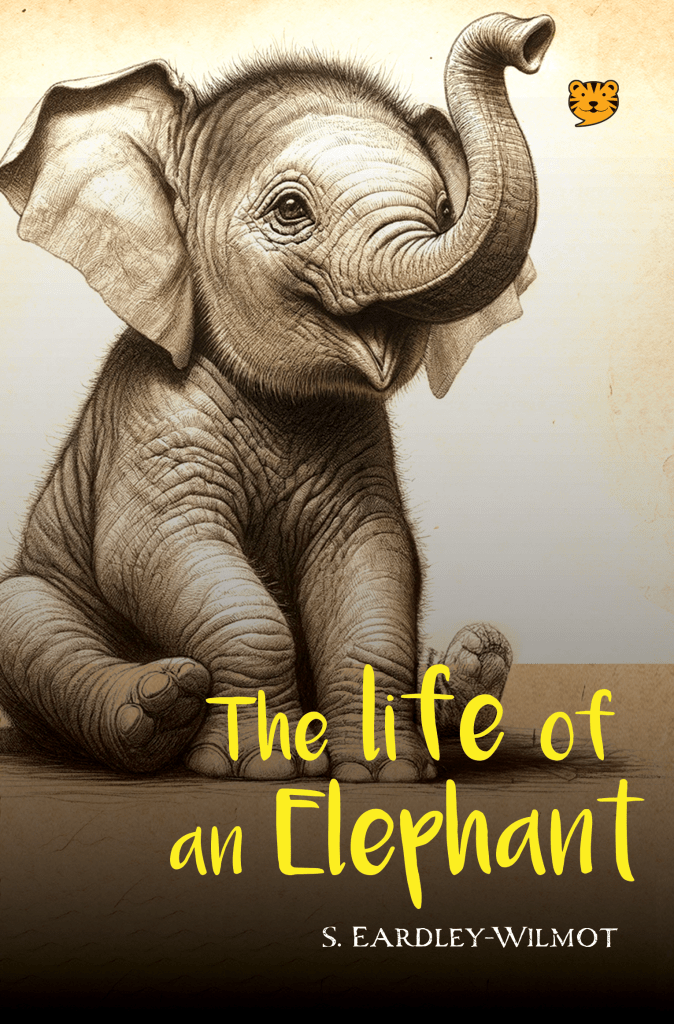
Title: The Life of an Elephant
Author: S.Eardley-Wilmot
Publisher: Talking Cub
CHAPTER I
The Arrival of the Herd
The summit of the hill was crowned with a grove of lofty trees. They had stood thus for centuries, opposing their columned strength against wind and storms, against the onslaught of tropical rainfall, even in spite of earth tremors that made them shiver with apprehension. Their crowns were interlaced, so that they must stand or fall together; it was an effective alliance against the forces of nature, which no single tree could hope to withstand.
Within the grove, where the buttressed trunks rose suddenly from the soft earth, stood an ancient shrine, a hermit’s cell with rough stone walls, and a little temple in whose dim recesses might be seen vaguely some symbol of a demon or god, unknown perhaps to the outside world, but appealing to the hearts of the jungle folk, who, suffering patiently as the animals suffer, like them also blindly sought relief. That rugged track, which led from the hill-top into the depth of the forest below, had been marked out by the feet of the notaries of the shrine, who each, as he left after supplication, cast a stone on the slowly growing mounds at the entrance to the grove.
From the hill-top the forest spread on all sides as far as the eye could reach, and it lost itself in the distant horizon where the purple outline of the hills faded into the azure of the evening sky. There was wave upon wave of hills covered with trees, so that the earth lay hidden, and down in the valleys one saw nothing but the crowns of trees forming an impenetrable carpet of foliage; only along the ridges the light filtered in vertical streaks through the closed-up ranks of tree trunks. If there were villages they were hidden in masses of trees; the forest engulfed them and reigned supreme in this lonely corner of the earth.
The sun sank, and the brilliant light of day was followed by the soft illumination of the stars. The forest became dim and indefinite amid an intense and motionless silence. There was no sound of wind, or of animal life; the dew had not begun to drip from the foliage, and each leaf was still as if arrested in its task. Yet there was no sense of fear or oppression: rather the atmosphere was charged with the vitality of countless millions of plants rejoicing in their growth, struggling against the competition of their neighbours, and seizing every chance which offered to reach towards the life-giving light.
At such a time there came upon any human being dwelling in the forest, first, a conviction of nature’s absolute indifference to his proceedings, and next, the peace conferred by personal irresponsibility, to which, if a man succumbs, he joins the vast army of hermits, religious mendicants, and other parasites; while, if he resists, he is left to work out a strenuous existence in conflict with the wild beasts and against the pressure of overwhelming vegetation.
As night drew on, the cooler air became charged with moisture and wrapped itself in mist. The leaves of the forest trees were weighted with the dampness they exuded; it no longer passed away in invisible vapour, but trickled earthwards in heavy splashes, like the sullen sound of mindless rain. From hundreds of miles of forest came the sound of dripping water in a ceaseless murmur, which increased the weirdness of the scene, and even served to make any other sound more distinct. Thus it was that a movement became audible in the distance, at first so slight as to be indistinguishable; it was as if foliage was being quietly brushed aside, as if the dew-laden grass was being crushed by a gentle yet irresistible force. Standing on the summit pf the hill, one looked down on a pass between the mountains, a curved saddle that invited to an easier passage from valley to valley. Over this low pass the waves of mist eddied to and fro, just as if each valley in turn filled with cloud and overflowed into the next.
From the depths below a herd of elephants were ascending the pass in single file and in silence. The leader, an old female, first appeared in sight, walking quickly along the narrow trail. Her trunk hung limply from her broad forehead, touching the earth lightly alternately to right and to left, and with instant precision the fore-foot was placed on the spot which had been tested, and the oval print of the hind-foot immediately overlapped the rounder track. She passed through the eddies of fog, which at times seemed to swallow her up, at others allowed but the glistening outline of her back to become visible; or again hid all but the ponderous legs which moved with regularity through the dim air.
Following, came others who seemed careless of danger through confidence in their leader. Each set foot in the trail of its predecessor, so that soon there was but one track sunk deep in the soft earth, as if some old-time mammoth of enormous size had passed that way. Females, young calves, youthful tuskers, all passed in succession, each rising into sight and disappearing over the narrow pass, plunged into obscurity on the further side. There was silence in the ranks, for the animals were on the march, intent on changing their quarters ere dawn should break. They might have been so travelling for hours, and might continue their resistless way for many more ere they halted thirty or forty miles from their starting point.
Some hours later there was promise of daylight in the sky. The mist now lay thicker over the forest, it had sunk into impenetrable strata which rested heavily on the land. Above its sharp upper line the tops of hills stood out like islands in a sea of white; along the ridges the crowns of trees appeared as if floating in the waves, their stems were hidden in the fog. Again a movement was heard, and from below a single elephant approached, carelessly following in the trail of the herd.
About the Book
In the wild jungles of India, a tusker is born. Maula Bux—as he is later named—grows up loved and adored amongst his herd, learning all that a young calf must to become a majestic elephant. However, an unfortunate encounter with humans leads to his capture and he is sold. His mahout, Kareem, instantly takes a liking towards the tusker and considers him almost to be a brother. Maula Bux is courageous, agile and magnificent, and he and Kareem have many adventures together—from hauling timber deep in the forest to adrenaline-charged tiger chases. At his advancing age, Maula Bux is even appointed to carry an Indian Prince in procession!
Having spent much of his life in the jungles of India and Burma (now Myanmar) S. Eardley-Wilmot was a keen observer of wildlife and spoke out about the necessity to conserve India’s wild spaces and the mighty beings in them. The Life of an Elephant is a must-read for young and older readers alike—for it is not just an insightful story of one of nature’s noblest beings but also an important text about conservation, empathy, and the treatment of animals.
About the Author
S. Eardley-Wilmot (1852–1929) was a British civil servant, forestry officer and conservationist who worked primarily in India and Burma (now Myanmar) and served as Inspector-General of Forests. He joined the Indian Forest Service in 1873 and was appointed to the old North-West Provinces and Oudh region of colonial India. In recognition of his conservation-lead method and unorthodox approach to forestry in India and Burma, Eardley- Wilmot became a Knight Commander of Order of the Indian Empire in 1911.
Eardley-Wilmot’s published books include—Forest Life and Sports in India (1910), Leaves from Indian Forests (1930), and The Life of a Tiger and The Life of an Elephant (1933).
PLEASE NOTE: ARTICLES CAN ONLY BE REPRODUCED IN OTHER SITES WITH DUE ACKNOWLEDGEMENT TO BORDERLESS JOURNAL




 Borderless