Categories
Essay

Drinking the Forbidden Milk of Paradise…

By Meenakshi Malhotra
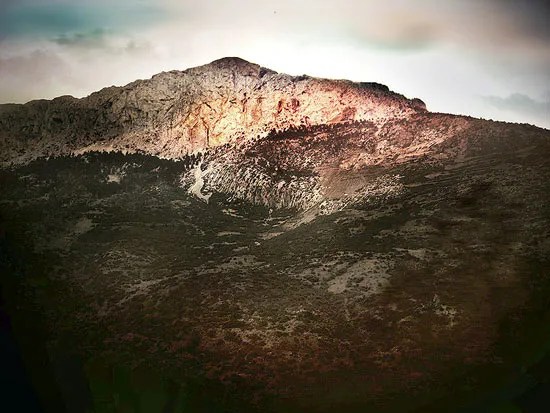
Mount Parnassus in Greece, where the muses were said to gather, was regarded as the home of poetry: From Public Domain

For the longest time, women were uncomfortable occupants of the house of poesy[1], particularly where there were existing canons of poetry established by the institutional gate-keepers and male custodians of literature. At best, they were viewed as Jane-come-latelies who sought to transgress the hitherto hallowed domains of high verse, interlopers to the hallowed heights of Parnassus who dared not “drink the milk of paradise”.

This ‘absence’ of women from the terrain of poetry is in spite of the fact that women have always written poetry, from ancient times to now. Sappho in the western tradition, was a Grecian poet from 5th-6th century BCE who was the pioneer of lyric poetry, a genre which apart from being set to music, also inaugurated the poetic ‘I’. In India, Buddhist nuns in the Mahayana and Theravadas who wrote poems known as the therigathas were early precursors of female poets. These early women poets engaged in the sometimes forbidden, sometimes lascivious charms of verse and versification. Down the ages, there were many others who joined them and kept the lamp of women’s versification lit. However, if women have always been versifiers, why has there been a  resistance and grudging admission for women to the poetic domain, which becomes a sort of “No (Wo)man’s land”? Why do women poets have only a token presence in traditional poetic anthologies?

Some reasons have been offered, not least among them being the preponderance of male poets who have often also been self-proclaimed and self-appointed guardians, legatees and arbiters of poetic tradition. Canonical poetic traditions, many claim, require a knowledge and understanding of Latin and Greek in the West while a knowledge of Sanskrit/Persian in the Asian context was deemed necessary. Thus women, who, for the most part, lacked formal education and had but small Latin and less Greek, could only hover around the margins and fringes of poetry. The situation with Sanskrit and Persian was similar and women remained mostly absent from or shadowy denizens of poetic terrains. Even if and when women were writing, they were doing so in colloquial registers and in the languages of the common people  and not in formal or decorative language, deemed essential for poetry, for the most part. Almost the first group of women writing poetry in India were Buddhist nuns who wrote in Pali, one of the many ancient languages in the ancient Indian subcontinent, which enshrined its own scholarly tradition. Sappho wrote in the Greek Aeolic dialect, which was difficult for Latin writers to translate.

Between 12th and 17th century, there was an advent  of devotional mystic poetry called “Bhakti” and “Sufi” poetry. While the poems were uttered/written in a devotional idiom, the poems and songs were often rebellious and iconoclastic, rejecting institutional religions and social norms. This poetry was rooted in personal and unmediated devotion and rejected formal languages and established societal norms. Some of this poetry was in an informal register, colloquial language and performative with a strong dramatic quality. Thus we have lines in Kannada from Akka Mahadevi (1130-1160) who rejects her earthly husband:

I love the handsome one: He has  no death decay nor form… no end no clan, no land.
Take these husbands who die, decay, and feed them to your kitchen fires.(Vachanas)

Women poets for the longest time had a crisis of identity, identification and non-belonging. They laboured under the anxiety of authorship where they felt the absence of precursors and fore-mothers and the lack of a poetic tradition to which they could belong. They were often made to feel as if they lacked genuine poetic talent or that they were transgressors against womanhood and femininity.

In Aurora Leigh (1855) by Elizabeth Barrett Browning, the eponymous title character, considers  the diverse fields of literature where women can exercise their talent and claim a space. The field of dramatic writing poses a challenge because the former demands that the woman writer be in the public eye in order to promote her plays. Further, to achieve or even aspire to the rank of Poet, Aurora must become capable of  “widening a large lap of life to hold the world-full woe”. Over the course of the long epic poem, she tries to reconcile her femininity with her artistic aspirations. In both cases, she is denied emotional fulfilment. She refuses to accept the role of an obedient wife, since it would mean foregoing the intellectual independence needed to develop as an artist, but then she must also refuse the love of a husband. In Book Five, she mentions three poets, none of whom she admires for their “popular applause”. Yet she admits that she envies them for the time they can devote to their chosen vocation and the adoring women that surround them and provide emotional support and fill their days with glory.

Another issue with women’s writing and poetry is the uncomfortable positioning of women in relation to patriarchal language or male centred language. If as Dale Spender  declares in “Man-made Language”, the masculine is asserted as the norm, where do we position women’s voices? While language is a universal medium of communication, man-made language is full of sexism and chauvinism and expresses reality from a predominantly masculine and patriarchal perspective. If language is a social system which women are persuaded or co-opted to use, how do they work within its confines to express their poetic aspirations? How do they stretch, bend, subvert language to express their own realities? Can we read techniques of irony, satire and other figurative and metaphoric strategies of defiance and subversion and an attempt to undermine from within?

Juliet Mitchell in her essay on ‘Femininity, Narrative and Psychoanalysis’ states that the woman writer/novelist must of necessity be a hysteric, straddling two opposed worlds. One world is that of male definitions and conceptions of femininity  and the other, a resistance and defiance of such conceptualising, accompanied by an attempt to undermine from within. Her defiance and resistance makes her character that of a hysteric, one who defies accepted notions and standards of femininity and is therefore considered transgressive. She troubles fixed gender categories, roles and definitions. She also disrupts and challenges the symbolic order of language, one which insists on rules of grammar and linguistic structures through the semiotic order which uses word play, repetitions and  childish rhymes, in order to express inner desires and drives. The symbolic order deals with the denotative aspects of language and the semiotic order with the affective aspect.

Women’s poetry often houses and accommodates the semiotic, seeming psychobabble that plays with and disturbs fixed notions of femininity and binary gender identities.

What are the popular themes that inform women’s poetry? Some themes are to with women’s search for authentic  self-hood and identity, their search for roots and a space of their own. As we see in Aurora Leigh, much of women’s poetry is self-conscious and self-reflexive, about the act of writing itself, the “awful daring of a moment’s surrender which an age of prudence could never retract.”(T.S.Eliot

Many contemporary women poets, across continents, have evinced a substantial  interest in exploring their poetic self  through their poems. On the one hand is the confessional poetry of Sylvia Plath and Anne Sexton, on the other the brief gnomic utterances of Emily Dickinson. Before the advent of the twentieth century, one hears of Barrett Browning, Emily Dickinson and Christina Rossetti, among many others. Names like Aphra Behn and Anne Bradstreet have been included in many syllabi, often as a token inclusion in an otherwise male centric course.

Women poets have talked about the horrors of war including rape, pillage and destruction. In their critique of war and violence, we find the forging of transnational solidarities, whether it is women’s poetry from Sri Lanka or Birangona (War heroines). 

In India the many names that come to mind are that of  Kamala Das, Eunice D’Souza, Meena Alexander, Sujata Bhatt and Sunuti Namjoshi. Women poets have employed effective means to explore the entire gamut of experience.The private  and the public domain, their process of  self-analysis; the process of poetic creativity and a probe into  poetic identities are all significant fields of exploration. For these women writers, analysing the creative process becomes much more than just a poetic theme. As they unravel the mystery of their poetic psyche in their writings, it becomes an epiphanic journey for the poets and their readers.

[1] Archaic word for poetry

Dr Meenakshi Malhotra is an Associate Professor of English Literature at Hansraj College, University of Delhi, and has been involved in teaching and curriculum development in several universities. She has edited two books on Women and Lifewriting, Representing the Self and Claiming the I, in addition  to numerous published articles on gender, literature and feminist theory.  Her most recent publication is The Gendered Body: Negotiation, Resistance, Struggle.

.

PLEASE NOTE: ARTICLES CAN ONLY BE REPRODUCED IN OTHER SITES WITH DUE ACKNOWLEDGEMENT TO BORDERLESS JOURNAL

Click here to access the Borderless anthology, Monalisa No Longer Smiles

Click here to access Monalisa No Longer Smiles on Amazon International
Categories
Essay

The Lyric Temper

By Jared Carter

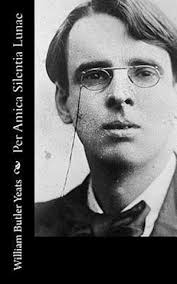
In the last section of that book with the most beautiful of titles, Per Amica Silentia Lunae,[1] the Irish poet Yeats, addressing Iseult Gonne, refers to those moments when he becomes happy – when poetry over brims on the page, and things turn luminous, and time seems to “burn up” in the sense of no longer mattering, no longer having the power to detract or diminish.

He is writing about lyric poetry, of course, and about those special moments that may come upon us at any age or at any time, but which become more recognisable to the poet as he or she grows older, and more experienced and knowledgeable – although they are also becoming, in actuarial terms, more rare.

But perhaps not. Perhaps, with wisdom and insight and acceptance, they actually increase in frequency. Recently I told an old friend, a visitor to my home, that after all these years I have finally begun to understand how to write poems. Put simply, I have gotten better at being patient, and at waiting until they appear. I have learned the necessity of silencing my own thoughts in order to hear the brushing of their wings as they pass overhead.

Or, to change the metaphor – only when the wind dies down can the bee or the butterfly land on the blossom. Genuine lyricism comes only after the self has been quieted. Not put to sleep, or – least of all – “put on hold,” in that ugly modern phrase.

Rather, shifted into neutral. Allowed to drift, and possibly to become something rich and strange.

“It may be an hour before the mood passes,” Yeats writes, in a completely disarming, unexpected passage, “but latterly I seem to understand that I enter upon it the moment I cease to hate.” He goes on to say, “I think the common condition of our life is hatred – I know that this is so with me – irritation with public or private events or persons.”

He attempts to define what he means by not hating, and it is not necessarily loving. Rather, “in those brief intense visions of sleep, I have something about me that, though it makes me love, is more like innocence. I am in the place where the Daimon is, but I do not think he is with me until I begin to make a new personality.”

This new personality is a paradox. Recognisably human – fragile, perishable, transient – it lacks the negative aspects of selfhood. It is no longer selfish or greedy or hateful. It has accepted its present state of being and its eventual death and dissolution.

We are speaking, then, of neither comedy or tragedy, nor their dramatic manifestations in verse, but of the lyric temper in poetry, and of the manner in which the poem is its abode – just as the moth or butterfly, as it seeks to gather up the pollen, finds its momentary resting place in the flower. But there is a dark side to this metaphor, and in any such discussion it cannot be avoided. Even the purest lyric voice is, by its very nature, transitory and perishable.

Honeybees, too, gather up pollen, but these are worker bees, who venture far from the hive, and who overcome all manner of risk in doing so. Within the hive itself, the drones partake of the bounty, but they do nothing to earn their keep. Only one of them will bed the queen. The others, whether they know it or not, are doomed. By autumn, as part of the very nature of things, the workers, understanding that only a finite amount of food is available to see them through the winter, push the drones out of the hive, where they perish amid the thorns and brambles.

Sappho

The works of many a lyric poet, who has dined the summer long on the ambrosia of the imagination, will eventually be subject to sheer circumstance, and drop away from the hive. Sappho[2]’s main works are lost; Keats[3]’s productive years were pitiably few. Madness overtook Smart[4], Hölderlin[5], Clare[6], and dozens more. We know this, and thus each lyric poem we have managed to preserve from past centuries speaks to us in an especially poignant way. However lovely, however evocative, we know it will not last.

The philosopher and poet George Santayana[7] has summed up the situation: “Even the most inspired verse, which boasts not without a relative justification to be immortal, becomes in the course of ages a scarcely legible hieroglyphic; the language it was written in dies, a learned education and an imaginative effort are requisite to catch even a vestige of its original force. Nothing is so irrevocable as mind.”

This is why lyric poetry retains its power to speak to us, down through the ages: because it is perishing before our very eyes, even as our own eyes are perishing. And yet it does not matter. “I am in the place,” Yeats explains, “where the Daimon is.”

And what might that be – the presence of “the Daimon”? Such a term can mystify, but surely this refers to some fundamental antinomy of human existence, some intuition of paradox that lies at the heart of being. Keats called it “negative capability”; F. Scott Fitzgerald[8] praised “that ability to hold two opposed ideas in the mind at the same time, and still retain the ability to function.”

The two ideas? The notion that art itself, in all its fragility, strives to endure. Perhaps another poet, Edwin Arlington Robinson[9], best described the paradox, in his tribute to Walt Whitman[10]: “When we write / Men’s letters on proud marble or on sand,/ We write them there forever.”

To be with the Daimon, to participate in timeless awareness, is why we write lyric poems, why we return to them – and why we revere the great periods of lyric achievement. Undoubtedly there have been many, in different cultures around the world, but we have managed to record only a few.

We treasure the lyric writings of the Sufis and the Elizabethans. We hark back to the time of Wordsworth and Hölderlin, to the T’ang Dynasty [618-906] and to that amazing stretch from Baudelaire to Mallarmé in the second half of the nineteenth century, a time that included Tennyson, Dickinson, Verlaine, Hopkins, Housman, Hardy, and Yeats himself.

Eventually, in the course of time, all these will slip away and be forgotten, which is why they now seem so lovely and memorable. They are that which has managed to survive and come down to us in spite of everything. Wang Wei knew this quite well. As the glories of the T’ang began to crumble and fall away, he paid tribute to that bittersweet awareness that we have come to know as the lyric temper:


Be not disquieted either by kindness or by insult –
          empty joy or sorrow.
Do not count on good or evil – you will only
          waste your time . . .
And why seek advice from the Yellow Emperor
          or Confucius?
Who knows but that we all live out our lives
          in the maze of a dream?


“Per amica silentia lunae” is a line from the Virgil[11]‘s Aeneid. Yeats translates it as “Through the friendly silences of the moon”. It is a most pregnant line. The moon never speaks; its very essence is change. And yet each of us considers it a friend, and we invariably greet it with our innermost being, each time we see it in the night sky. We have carried on this friendship since childhood. Lyric poetry deals with such verities.

The following is by Witter Bynner[12], taken from his masterful introduction to The Jade Mountain: A Chinese Anthology: “. . . if we will be honest with ourselves and with our appreciation of what is lastingly important, we shall find these very same poems to be momentous details in the immense patience of beauty. They are the heart of an intimate letter. They bring the true, the beautiful, the everlasting, into simple, easy touch with the human, the homely, and the immediate.”

A key phrase in this passage is worth repeating and remembering: “The immense patience of beauty.” Surely it is to this that the poet must surrender if the lyric temper is to be made manifest.

[1] Translates to ‘Through the Friendly Silences of Moon’, was written by Yeats (1865-1939) between January and May of 1917, and consists of a Prologue and an Epilogue for Iseult Gonne

[2] Greek poet (630 – 570 BCE)

[3] English poet (1795-1821)

[4] English poet (1722-1771)

[5] German poet and philosopher (1770-1843)

[6] English poet (1793-1864)

[7] American poet and philosopher (1863-1954)

[8] American novelist, essayist, and short story writer (1896-1940)

[9] American poet and playwright (1869-1935)

[10] American poet, essayist, and journalist (1819-1892)

[11] Roman Poet (29-19BCE)

[12] American poet and translator (1881-1968)

Jared Carter’s most recent collection, The Land Itself, is from Monongahela Books in West Virginia. His Darkened Rooms of Summer: New and Selected Poems, with an introduction by Ted Kooser, was published by the University of Nebraska Press in 2014. A recipient of several literary awards and fellowships, Carter is from the state of Indiana in the U.S.

.

PLEASE NOTE: ARTICLES CAN ONLY BE REPRODUCED IN OTHER SITES WITH DUE ACKNOWLEDGEMENT TO BORDERLESS JOURNAL

Click here to access the Borderless anthology, Monalisa No Longer Smiles

Click here to access Monalisa No Longer Smiles on Amazon International

Categories
Poets, Poetry & Rhys Hughes

My Favourite Poem

I am not sure it is wise to choose a favourite poem out of the millions that exist. It would seem to exclude all the others from the imaginary summit of a fictional pillar. The circumference of that pillar means that there is only room for one poem up there and it might be better not to erect the pillar in the first place and leave the literary landscape unobstructed.

But it is too late for me. I have already chosen a favourite poem. In fact, I have chosen a favourite several times. The first poet I read in any depth, Edgar Allan Poe, provided me with my first favourite, not ‘The Raven’ but a slightly less famous work called ‘The Bells’. How I loved the tinkle, jangle and crash of the cadences in the stanzas of that piece!

I read it again recently and found that it retains great musical power and it is still a poem I regard with intense fondness, but it is no longer my favourite of all. That is hardly surprising considering I was reading Poe when I was 15 years old. Our youthful tastes change not only according to our experiences but also as a result of all the other literature we consume. There is surely a tendency to prefer narrative poems when we are small and a diminishing reliance on actual stories as we grow older. Yet it was the music of ‘The Bells’ that fascinated me rather than the febrile images it contains.

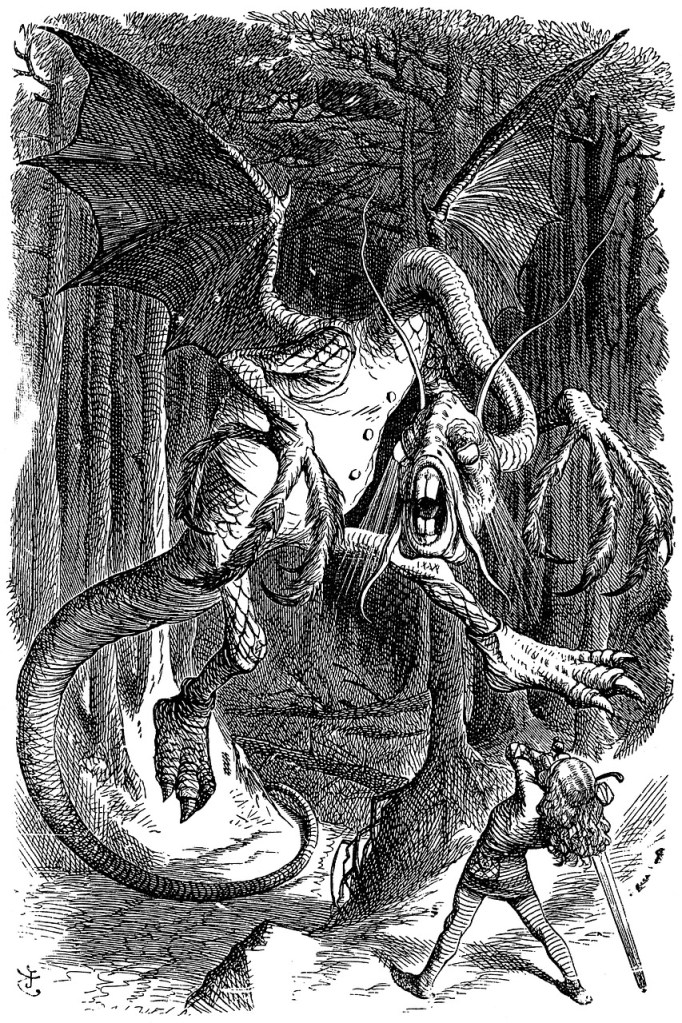
Jabberwocky. Courtesy: Creative Commons

I think my love of euphony has always meant that I relish the way a poem sounds more than I appreciate any meanings it might convey. This is why it was easy for a nonsense poem to become my new favourite and to gently push aside the Poe piece. Lewis Carroll’s ‘Jabberwocky’ became for me the supreme poem and I learned it by heart. It is a poem that makes contextual sense despite all the meaningless neologisms with which it is sprinkled. Somehow, we understand the new words coined by Carroll and there is no need to have them explained. It is a poem that we absorb through osmosis rather than through the normal process of everyday communication. A masterpiece!

When I was 18 years old, I began reading Byron, Shelley, Coleridge and a few other English Romantics, and I discovered ‘Ozymandias’. Now this seemed to me to be a perfect poem. It had music, imagery and a moral, and furthermore it was ironic, an archaic episode with timeless relevance. Again, I learned it by heart, and I found myself in the not uncommon position of reciting it to myself whenever I happened to be confronted with an ancient ruin, whether the blocks of a tumbled castle or shattered torso of a fallen statue. It is a poem that turns a reader into an actor, an introvert into a declaimer. It became my new favourite but only for a short while. The poem that caused it to fall in my estimation was another in the same anthology I was reading.

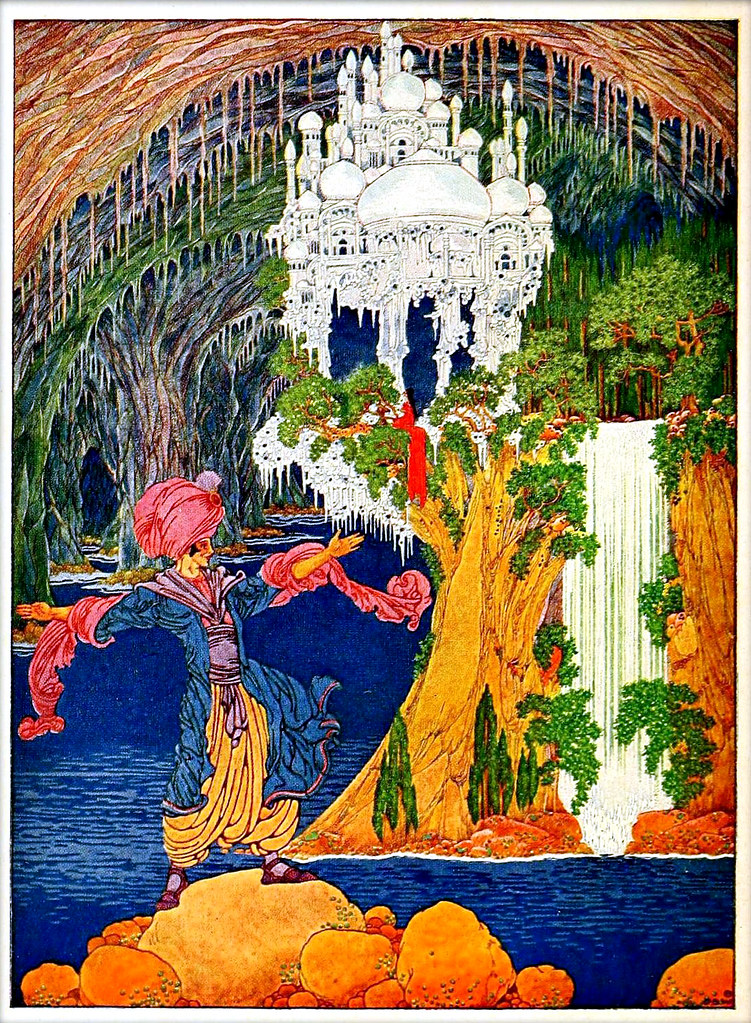
An Illustration from Kubla Khan. Courtesy: Creative commons

Kubla Khan’ struck me as especially appealing because it has a wildness about it that balances out its sense of control. I am not sure why Coleridge affected me to a greater extent than Shelley (and Byron affected me hardly at all) but I was enthralled by the imprecise exoticism and the intimations of doom among paradise in this poem, which is as menacing as it is delightful, as frantic as it is magical. Coleridge himself regarded it as a work in progress, a frustrated potential, unfinished, a burst dream bubble. I wonder if a continuation might have diminished it? The fragmentary nature of the piece adds to its allure by increasing its strangeness. There is atonality here as well as smoothness, like troubling chords inserted in a serene nocturne.

A few years passed and I discovered a new favourite and had to topple poor old ‘Kubla Khan’ from the apex of that idealised pillar and replace it with The Rubáiyát of Omar Khayyám in the first Edward Fitzgerald translation, but whether this series of seventy-five quatrains can be regarded as just one poem is open to debate. Personally, I regard the quatrains as linked inextricably by mood, metaphors as well as theme, and there is a mini-sequence within the whole that gains significant momentum by being treated as a single creation. My ambition once again was to learn the work by heart and recite it at moments that were appropriate but despite my efforts I failed in the endeavour. There was simply too much wordage for me to succeed.

I tried reading more modern poetry, serious and mature work that I failed to understand at first and had to consider very carefully before I could tease out any meaning. I read Akhmatova, Rilke, Pound, Eliot. I tried (but was generally defeated by) Ginsberg, Olsen, William Carlos Williams. This was all well and good but my candidate for new favourite turned out to be something light, an insignificant ditty dashed off by a poet who wrote it as a gift for a friend, and once again it was the music that won me over, the jangling, tinkling, tingling, clipping, clopping, jingly rhythms. ‘Tarantella’ by Hilaire Belloc imitates the sound of a guitar and clapping hands, it clatters along merrily, nostalgically, a tribute to an ephemeral occasion in a mountain tavern that can never be lived again, and the words and their phrasing evoke much of the atmosphere of that night with an appreciable impetus. A candidate for new favourite, yes, but it ultimately failed to displace the Rubáiyát.

That was in my early twenties and soon after I lost interest in poetry, I have no idea why, and rarely read any. Occasionally I would browse an anthology and discover something interesting, but only a few poems made any impression at all on me, and none became my favourite. The Rubáiyát of Omar Khayyám remained at the summit of my appreciation by default. My return to poetry was slow and uneven. The work of Federico García Lorca caught my attention and I chose ‘Canción de Jinete’ to learn by heart, which I did, probably poorly (my Spanish was never fluent). A little later I discovered the precocious genius of Arthur Rimbaud and taught myself ‘Le Coeur Supplicié’ because its torrent of fantastical words appealed to my inner ear.

Unfortunately, what I believed poetry had to offer was something I had no great use for. I misunderstood what it had to offer. That is no great crime, but I did miss out on its delights for a long time. Not until my mid-thirties did I start to return to the pleasures of poetry, and it was the humourist Don Marquis who ushered me back into the heaven I had forsaken, yet it is too much to claim that any of his poems became my favourite. I adore his cycle of poems about the cockroach Archy and the cat Mehitabel, but they must be taken as a whole in an evolving mythos. No individual poem of the cycle is worthy of special attention at the expense of the others. All are good, but together they are brilliant and thus they disqualify themselves from the game.

Now that I was reconciled with poetry, my tastes widened, and I read from a broader set of cultures and times than before. Sappho, Ovid, Catullus, Tagore, Basho, Tu Fu, Housman, Holub, Mandelstam, Eliot, Yeats, Edward Thomas, Dorothy Parker, Ai Ogawa, Ogden Nash, Derek Walcott. I was very enthusiastic about the novels and short stories of Richard Brautigan, so I read his poetry too and found a poem called ‘All Watched Over by Machines of Loving Grace’ that neatly summed up my own hopes for the future of the world. Did it become my new favourite? Not quite. I continued reading. Pessoa enthralled me, Cendrars and Queneau dazzled me. Complicated poetry dealing with the human condition and experimental verse based on mathematics made me nod my head sagely in a close approximation of a deep appreciation.

The City’ by C.P. Cavafy became my new favourite. I had heard his name often mentioned but felt no great desire to explore further. Then by chance I saw this particular poem. What a terrific piece! Hard, bleak even, wrenchingly bitter, but it does not depress the spirits of the reader despite its melancholy message. On the contrary it seems to inspire the reader to action. The poem is quietly and relentlessly insistent that you will never change your life for the better, that you can never escape the circumstances that have trapped you. It issues a challenge to the reader. Prove me wrong, the poem seems to say! I immersed myself in as much of Cavafy’s poetry as I could find. I went out of my way to visit his house in the city of Alexandria in Egypt, so wonderful did I now regard his work. Was this the final destination on my poetic voyage?

Not quite. There was another poem by another poet sunk deep beneath the surface of my awareness and it had been there for a long time. I can say that it had probably been my secret favourite from the beginning. I must have read it in an idle moment and forgotten about it, or thought I had forgotten about it, but it remained on the seabed of my subconscious, and ultimately it wrecked all the poetical vessels that followed, for I was never fully satisfied with any of those I called my favourites. I rediscovered it one unexpected day and it returned with unstoppable force into my affections. It was written by a poet who went to sea and saw the world, who travelled rather aimlessly for a number of years before the urge to write poetry took hold of him.

‘Cargoes’ by John Masefield is evocative and beautiful. It is heady and a little regretful at the same time. It contrasts the supposed splendours of the past with the drab present, and yet ironically in our own age we perceive romance even in the grime and smoke of Masefield’s ‘present’. Three ages are given to us for contemplation, a pre-classical time, the golden age of the Spanish Main, and the very start of the 20th Century, and three ships loaded with merchandise to represent those ages. The ships of Assyria and Spain are loaded with exotic and tropical treasures. They are floating envoys of a pair of widely spaced but equally fabulous cultures. The British ship is grimy and ugly and it wallows through a drab sea on a blustery day, carrying cargo that is practically an insult to the taste of the aesthete. The language employed is perfect for Masefield’s purpose. I know of no poem I like better.

Quinquireme of Nineveh from distant Ophir,
Rowing home to haven in sunny Palestine,
With a cargo of ivory,
And apes and peacocks,
Sandalwood, cedarwood, and sweet white wine…

Cargoes (1903), John Masefield (1878-1967) 

Rhys Hughes has lived in many countries. He graduated as an engineer but currently works as a tutor of mathematics. Since his first book was published in 1995 he has had fifty other books published and his work has been translated into ten languages.

.

PLEASE NOTE: ARTICLES CAN ONLY BE REPRODUCED IN OTHER SITES WITH DUE ACKNOWLEDGEMENT TO BORDERLESS JOURNAL