Categories
Review

Knife by Salman Rushdie

Book Review by Somdatta Mandal
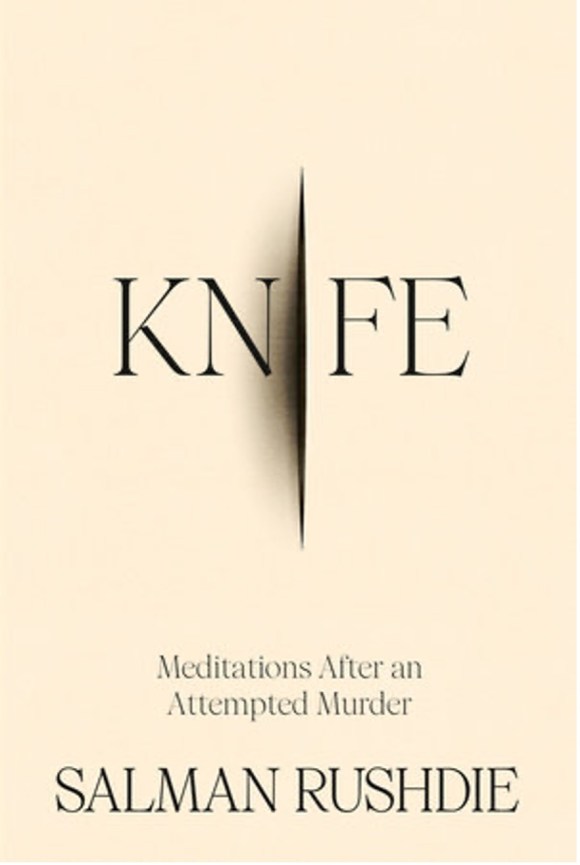
Title: Knife: Meditations After an Attempted Murder

Author: Salman Rushdie

Publisher: Penguin Random House

More than thirty years ago, a fatwa had been declared by Ayatollah Khomeini on the famous writer Salman Rushdie. The charge of blasphemy was labelled after the publication of The Satanic Verses, and since then the author has been living in asylum at different places because he was not safe in his own country. When it was assumed that the incident had died its natural death, the simmering vendetta and violence upsurged suddenly on 12th of August 2022, when Rushdie had gone to participate in a week of events at the Chautauqua Institution in upstate New York titled “More Than Shelter: Redefining the American Home”, and an unidentified man attempted to murder him on stage with a knife.

This horrific act of violence shook the entire world. No one hoped that they would ever be able to read a single line written by the author once again. He was a totally lost case. Now, one-and-a-half years after the incident, and in unforgettable detail, Rushdie writes this first-person memoir Knife where he relives the traumatic events of that day and its aftermath, as well as his journey towards physical recovery. His healing was made possible by the love and support of his present African American wife Eliza, his family, his army of doctors and physical therapists, and his readers worldwide.

Dedicating the book to the men and women who saved his life, the text is neatly divided into two parts, each containing four sections. The first half of the book titled “The Angel of Death” primarily revolves around ‘despair’, whereas the second part, “The Angel of Life,” narrates a vision of ‘hope’ and optimism and Rushdie’s attempt to return to normalcy once again with his indomitable spirit to fight on against all odds.

The opening chapter called ‘Knife’ begins with the description of a beautiful August morning in detail and how the apparent tranquility was shattered when suddenly violence appeared in the form of an unidentified man who rushed at him on the open stage and stabbed him indiscriminately. Totally flabbergasted, Rushdie obviously didn’t know what to do. So, he narrates the rest of the incidents in the form of a collage, with bits of memory pieced together with other eyewitness and news reports and tells us how that morning he “experienced both the worst and the best of human nature, almost simultaneously.” Though the incident of his attempted murder dragged “that” novel back into the narrative of scandal, Rushdie declares that till date he still felt proud of having written The Satanic Verses.

Apart from the day-by-day narration of how things shaped up after the stabbing incident, three things stand out very clearly in this memoir. First is of course the detailed description of his entire eighteen-day long stay initially at the extreme-trauma ward of the hospital and later at the rehab centre titled ‘Hamot’. Though in extreme pain we are told how doing a few simple everyday things for himself lifted his spirits greatly. So, apart from the rehab of the body, there was also the rehab of the mind and spirit. Spending more than six weeks in two hospitals, he could return to the world and so slowly he started feeling optimistic again.

The chapter called ‘Homecoming’ begins with his leaving the hospital at 3 A.M. as quietly as possible and going back home at that unearthly hour to evade any watching eyes.

Emotionally moved, even though he had lost one eye permanently, he felt “100 percent better and healthier immediately. I was home.”

The incident of homecoming is once again closely related to the second important issue during his convalescence –the love, care and bonding with his present wife Eliza. Dedicating a total chapter titled “Eliza”, Rushdie gives us details of how he met the African American poet Rachel Eliza Griffiths entirely unknown to him, through the eminent American writer, Norman Mailer, and how his friendship grew stronger day by day, leading to a secret marriage based on the realisation that it was a relationship not of competitiveness but of total mutual support. They showed that even in this attention-addicted time, it was still possible for two people to lead, pretty openly, a happily private life till the knife incident changed everything. He tells us how the poetical sensibilities of his wife lent extra support to him in such trying times.

The third most significant aspect of this memoir is the way Rushdie devotes an entire chapter addressed to his assassin –“The A”. And it is really at its imaginative best. In it he has recorded a detailed conversation that never actually occurred between himself and “a man I met for only twenty-seven seconds of my life”. After bringing in several intertextual references about other writers and situations, about other murders being committed in the lives of different personalities, in the fourth and final session of his imaginative conversation, Rushdie states, “You don’t know me. You’ll never know me.” After the imagined conversation is over, he no longer has the energy to imagine the assassin, just as he never had the ability to imagine him. He feels that the purgation is complete, and this chapter of his life is closed once and for all.

Interestingly after half a year of nothingness, Rushdie realises that his writing juices had indeed started to flow again. During his sleepless nights at the rehab, he often thought a lot about The Knife as an idea. Talking about different occasions and purposes when the knife is used, he realized that the knife is basically a tool and acquires meaning from the use we make of it. It is morally neutral, and it is the misuse of knives that is immoral. Then he states that language too was a knife for him, and he would use it to fight back. Here he made a resolution that instead of remaining as a mere victim, he would answer violence with art – “Hello, world, we were saying. We’re back, and after our encounter with hatred, we’re celebrating the survival of love. After the angel of death, the angel of life.” But it was hard for him to write about post-traumatic stress disorder at any time especially when his hand felt like it was “inside a glove” and “the eye… is an absence with an immensely powerful presence.” Returning to New York after a ten-day visit to London, he therefore decided to spend the second chance of his life on just love and work. Since several Muslim entities were still celebrating his pitiable condition, he thought to make it clear to his readers that his worldview about God had not changed a bit and so he declares — “My godlessness remains intact. That isn’t going to change in this second-chance life.”

In the final section ‘Closure?’ Rushdie writes that his own anger faded, and it felt trivial when set beside the anger of the planet. He understood that three things had happened that had helped him on his journey towards coming to terms with what had happened – namely — the passage of time, the therapy, and ultimately the writing of this book. Moving along with time, he felt he was no longer certain that he wanted, or needed, to confront and address his assassin in open court and that the “Samuel Beckett moment” no longer seemed significant at all. This is where art and love overcame all barriers. He has successfully moved on and there was no need to look backwards once again.

Written a few years ago, Rushdie’s Joseph Anton: A Memoir narrated the story of how he was living a disturbed life under the pseudonym of Joseph Anton. But that memoir did not create much impact upon the readers, whereas Knife has brought back the powerful and erudite Rushdie as he has risen phoenix-like from the ashes and revealed his erudition without being parochial. Ordinary readers often shy away from his work as it is full of intertextuality and cross-references. But even those who find his writing to be too high-brow will have no problem in understanding the ‘free-associative way’ in which the mind of this writer works even today. The book is a page-turner no doubt and has brought back the popularity of Salman Rushdie once again. The simplistic yet very appealing cover of the book is an added attraction too.

Somdatta Mandal, critic and translator, is a former Professor of English from Visva-Bharati University, Santiniketan, India.

.

PLEASE NOTE: ARTICLES CAN ONLY BE REPRODUCED IN OTHER SITES WITH DUE ACKNOWLEDGEMENT TO BORDERLESS JOURNAL

Click here to access the Borderless anthology, Monalisa No Longer Smiles

Click here to access Monalisa No Longer Smiles on Kindle Amazon International

Categories
Essay

Akbar Barakzai: A Timeless Poet

By Hazaran Rahim Dad

Akbar Barakzai (1939-2022) was born in Shikarpur Sindh, Pakistan. He received his early Education from Karachi and later he graduated from University of Karachi. Barakzai  is considered as one of the most defiant progressive voices in modern Balochi literature. His poetry reflects the objective realities of life and ambitions of his people. Boundless love for masses, profound desire for peace and prosperity, and unwavering resolve to resist and defy the tyranny are some of the commonplace themes of his poetry.

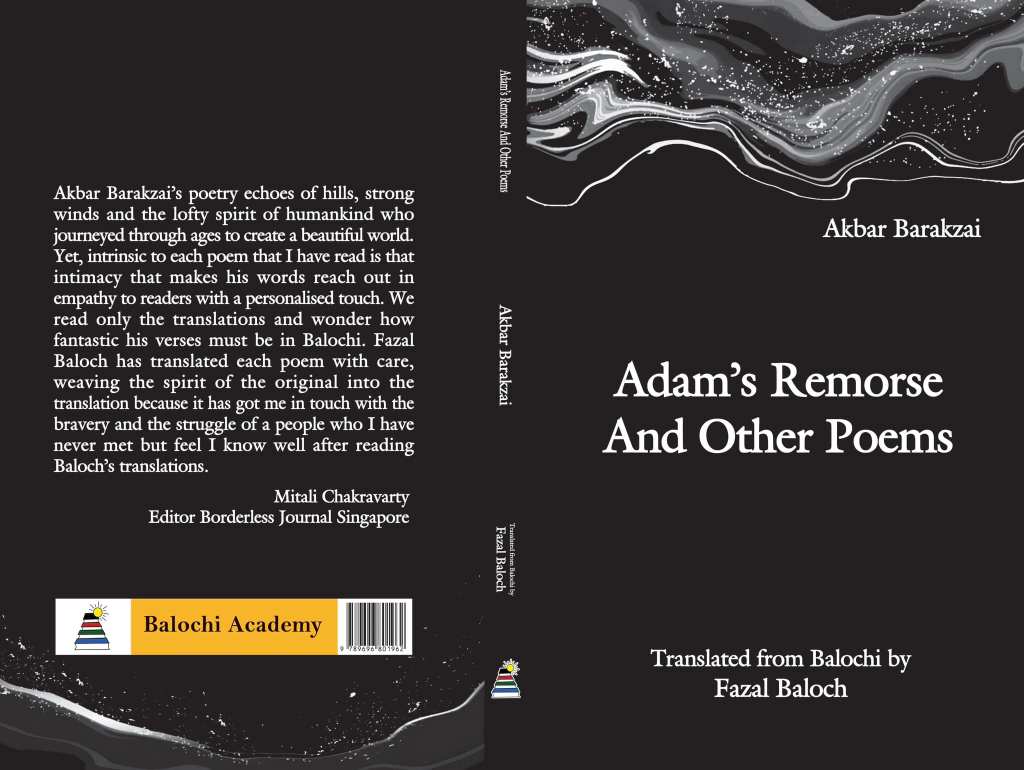
 “Akbar Barakzai belongs to the generation of the poets that witnessed the political and literary activism of Muhammad Hussain Unqa, Sher Mohammad Mari, Mir Gul Khan Naseer and Azat Jamaldini”, writes Fazal Baloch, a renowned translator who most recently brought out the anthology of Barakzai’s translated poems under the title Adam’s Remorse and Other Poems, published by Balochi Academy Quetta in 2023.

In his literary career, which spans over a half century, Barakzai has managed to bring out only two of his anthologies. Some selected poems by Barakzai have been translated from Balochi to English by Fazal Baloch, a college professor in Turbat, and a prominent literary translator.

Akbar Barakzai was an honest and dedicated political and social activist whose aim was progress of Baloch people. He as poet could not only express the human sentiments but could also express their aspirations for their life of Freedom and Dignity. “He served … his people admirably and deserves our respect and love,” says Meer Mohammad Ali Talpur, a Baloch intellectual.

Barakzai’s poems are rich in linguistic and literary expressions. His language is both simple and philosophical. In his poetry, he celebrates resistance, challenges oppression, and expresses a belief in a better future without losing hope. He emphasises resilience to overcome suffering. He writes:

I am the tree of immortality,
O, you tyrant brute!
The more you hew me down,
the more I sprout

The imagery of the tree symbolises the strength and the life cycle of a tree which remains steadfast midst harsh weathers.

In another poem, titled ‘Not Forever’, Barakzai continues to convey themes of resistance and defiance. As he says:

The rule of chains and fetters
Will last only for today, not forever.
The age of tyranny and oppression
Will last only for today, not forever.

He inscribes that the current state of being oppressed or controlled (“rule of chains and fetters,” “tyranny and oppression”) is temporary. Barakzai implies hope for a future where such oppression will end, indicating a belief in the eventual triumph of freedom and justice.

Barakzai sought to reshape the prevailing socio-political views and wrote for freedom and liberty, peace and prosperity and dignity of mankind. His love for human dignity transcends all geographical and cultural frontiers and becomes universal, added Fazal Baloch.

Indeed, Barakzai’s poetry transcends borders and speaks to universal themes. In his poem ‘Who Can Snuff Out the Sun?’ written in response to Che Guevara’s execution, he celebrates Che Guevara’s heroism and the universal struggle for justice and freedom. By acknowledging Che Guevara’s courage and sacrifice, Barakzai connects with a broader global struggle for human rights and liberation.

"Who can snuff out the sun? 
Who can suppress the light?"

And in the last lines of the poem, he notes,

I'm Ernesto Che Guevara
I'm Immortal
Everywhere in the world

“This is not only Barakzai’s most quoted poem, but it is also one of the most remarkable Balochi poems touching the theme of resistance and defiance,” contends Fazal Baloch.

Similarly, in his another poem like ‘I’m Viet Cong’, he expresses solidarity with the people of Vietnam, few lines are written as such:

I'm the spirit of freedom and liberty 
Who can enslave me?
Who can kill me?
After all
I'm Viet Cong I'm Viet Cong.

He might have shown solidarity with Afghanistan in his poem ‘April 1978’. His lines read:

Let's sing for the Saur
Let’s extol the groom
A garden in our heart has bloomed
Doves chant and herald the news
Revolution has arrived
Arrived what we desired

One of the ways in which Barakzai weaves the West and the East into his poetry. He has a poem called ‘Waiting for Godot’. Samuel Beckett’s Godot is emblematic of an ideal that we keep waiting for. Barakzai has captured the essence of the whole play in his poem with his refrain —

Arise! O friends from this deep slumber 
Godot will not, will never show up

In one of his most powerful poems, ‘Word’, Barakzai conveys the power of speaking up for one’s rights and the importance of not remaining silent in the face of oppression. He believes that by voicing one’s grievances and advocating for justice, freedom, and salvation can be achieved, ultimately leading to the end of oppression as these lines indicate:

Don’t ever bury the word
In the depth of your chest
Rather express the word
Yes, speak it out.
The word brings forth
Freedom and providence
Of course, freedom and providence.

In ‘How Long’, Barakzai starts by portraying a bleak situation where life is filled with distress and young people are dying tragically. He inscribes,

For how long
Life will remain in utter distress
Handsome youths keep falling to bullets
And mirror like hearts
Continue to shatter into shards?

Then, he shifts the tone to one of hope and optimism, and writes,

Light-- the very essence of freedom 
Will not forever remain in prison
Life will not suffer distress
The serpent of tyranny
Will vanish evermore
The sapling of envy and hatred
Will wither away.

He suggests that despite the current darkness, better days are ahead. He expresses confidence that “light”, symbolic of freedom, will not remain imprisoned forever. He predicts an end to the suffering and the disappearance of tyranny. The imagery of the “serpent of tyranny” vanishing and the “sapling of envy and hatred” withering away conveys the idea of a brighter future where oppression and negativity are eradicated.

Barakzai’s poetry is a ray of hope in the midst of suffering from atrocities and hatred and envy. His poetry reflects his love for humanity resonating with the voices of the oppressed and for them.

Hazaran Rahim Dad is a poet and writer. She writes on sociopolitical issues focusing on the right of fishermen. Currently she is pursuing her MPhil degree in English literature from Karachi.

PLEASE NOTE: ARTICLES CAN ONLY BE REPRODUCED IN OTHER SITES WITH DUE ACKNOWLEDGEMENT TO BORDERLESS JOURNAL

Click here to access the Borderless anthology, Monalisa No Longer Smiles

Click here to access Monalisa No Longer Smiles on Kindle Amazon International
Categories
Editorial

And This Too Shall Pass…

“April is the cruelest month, breeding
lilacs out of the dead land…”
-- TS Eliot, Wasteland

April and May have been strange months — celebrations withered to anxieties. As the pandemic took on demonic proportions in its second wave, devastating millions with death and darkness, paralysing with the fear of losing friends and relatives or ones’ own life, festivities gave way to mourning. April this time truly seemed like the cruellest month as expressed by TS Eliot in the start of the Wasteland, turning our joyous thoughts on healing to a devastating reality of swirling smoke of pyres and graves that continue to throng certain parts of the world. However, mankind needs hope like the Earth needs rain, hope to survive. Great literature and writing inspire to give just that.

This month is also the birth month of three greats who were able to generate that kind of hope with their work: Rabindranath Tagore, Edward Lear and Kazi Nazrul Islam. We launched our new Tagore section on May 7th with Aruna Chakravarti’s translations of the maestro, Songs of Tagore. Do visit us at Tagore & Us to read them and more. We plan to keep adding to this section on a regular basis. This time we have Bengal Academy Award winner Fakrul Alam’s translations of six seasonal songs of Tagore, a translation from Borderless of a poem by the maestro that is not quite accepted as Rabindra Sangeet as the tune was given by the eminent musician Pankaj Mullick. An essay by Dr Anasuya Bhar highlights different lives given to Tagore’s writing by his own rewrites, translations, and films – an interesting perspective. We also carry tributes to Tagore in verse from Ilwha Choi of Korea, Mike Smith of UK, Himadri Lahiri and Sunil Sharma from the poet’s own homeland.

We celebrated Edward Lear’s birthday with some limericks and Rhys Hughes essay placing the two century old writer’s poetry in the present context and a hilarious conclusion to the sequel of Lear’s famous ‘The Owl and the Pussycat’. Upcoming is the birth anniversary of the rebel poet from Bengal, Nazrul. Sohana Manzoor translated a powerful essay and Shahriyer Hossain Shetu, a poem by this legendary writer who believed in syncretic lore and married a Hindu woman. Now the national poet of Bangladesh, Nazrul even wrote of Hindu Gods in many of his songs and essays – a lore that yearns for revival in the current day where politicians have fragmented the world by building more walls, using the names of religion, race, economics, caste and culture.

We have a poem from Pakistan by eminent poet Akbar Barakzai translated by Fazal Baloch using the lore of Samuel Becket’s Godot and yet another translation from Malayalam by Aditya Shankar of Sujith Kumar’s poem. Our poetry section is exciting with an exquisite poem from Jared Carter on a yeti, resting on the ephemerality of its presence; a funny one from Rhys Hughes and a diversity of poets from many countries, including Bangladesh. We also started a new column called Nature’s Musings which will combine poetry or prose with photographs by award-winning photographer Michael Wilkes and Penny Wilkes, who joins us now as a writer-in-residence.

In stories, we carry a COVID narrative by a real doctor, Shobha Nandavar, based in Bangalore and interestingly another about a doctor, the first women to adopt the medical profession in Bengal. Sunil Sharma in his narrative has highlighted a crisis in humanism. There are many more stories which would make for an interesting read. In musings, other than Devraj Singh Kalsi’s witty take on countries without Nobel Laureates, we have a Canadian writer’s perception of death rituals in Japan. Sybil Pretious has shared with us her strange adventures within China this time. Don’t miss the backpacking granny!

The May issue has a wide range of essays and musings ranging from Candice Louisa Daquin’s write up on the need to trust instincts to Keith Lyon’s residency in the Antarctica with interesting photographs. He writes that you could wear shorts in summers! Bhaskar’s Corner pays a tribute to the Padmashree Odia writer who passed away last month of old age, Manoj Das.

Our book excerpt is from an unusual book by Nabanita Sengupta, A Bengali Lady in England (1885): Annotated Translation with Critical Introduction to Krishnabhabini Das’ Englandey Bangamahila. We also carry reviews by Rakhi Dalal of Feisal Alkazi’s memoir, Enter Stage Right: The Alkazi Padamsee Family Memoir and by Bhaskar Parichha of Raising a Humanist by Manisha Pathak-Shelat and Kiran Vinod Bhatia. Shakti Ghosal’s The Chronicler of the Hooghly and Other Stories has been reviewed by Gracy Samjetsabam.

Our interviews this time are more on practical issues than literary – with the two authors of Raising a Humanist and with someone who supported our Tagore section by inviting us to talk on it in an online festival called Anantha, Sonya Nair. A friend and an academic with decidedly avant garde outlook, she is part of the twenty-year-old peer-reviewed Samyukta Journal that homes many academics. Pause by and have a read to see how they serve.

I would want to give heartfelt thanks to Nidhi Mishra and Archana Mohan for hosting Ms Sara’s Selections from Bookosmia this time as they help many battle the pandemic with hope, especially young children growing up in a world inhibited with masks and social distancing. I would also like to thank all the writers and my whole team for rising above the darkness by helping us get together this issue for our readers who I hope do find solace in our pages. And thank you readers for being with us through our journey.

There is a lot more in our pages than I have written. Do take a peek at this month’s issue and enjoy.

Best wishes,

Mitali Chakravarty

Categories
Essay

Cavorting with Camus and The Myth of Sisyphus

By Rakhi Dalal

Camus, as a writer, receives mixed response from the readers. It is understandable when some readers avoid reading him, because he seems a difficult writer whose works are taken to be disturbing. Some readers appreciate his writings though they do not agree with him. While for some, Camus’ ideas are irrelevant when compared with those proposed by existential philosophers. Although Camus is often categorised as an existential philosopher but he himself never approved of that. In one of his interviews he said:

“No, I am not an existentialist. Sartre and I are always surprised to see our names linked. We have even thought of publishing a short statement in which the undersigned declare that they have nothing in common with each other and refuse to be held responsible for the debts they might respectively incur. It’s a joke actually. Sartre and I published our books without exception before we had ever met. When we did get to know each other, it was to realise how much we differed. Sartre is an existentialist, and the only book of ideas that I have published, The Myth of Sisyphus, was directed against the so-called existentialist philosophers.”*

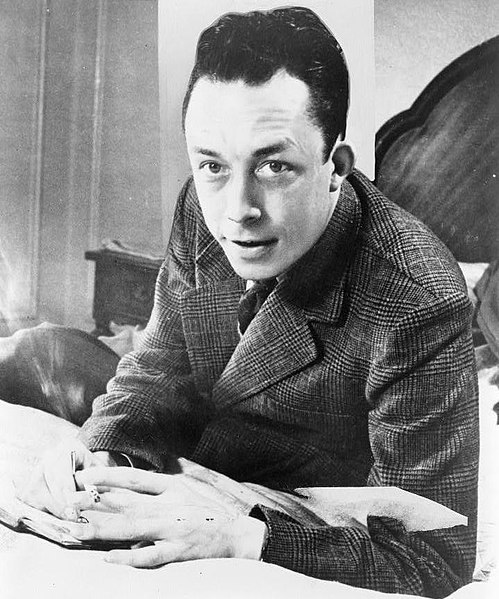
Albert Camus

When compared with different periods of his life, his writings offer an insight into the state of mind Camus was often fraught with. The penning of The Stranger and The Myth of Sisyphus, which he did almost simultaneously, came at a point when he himself faced despair about the kind of life he was living, which included his anxiety about his future as a writer and finding his place in the World. At this time he was in Algiers, his native land, far from the hubbub of Paris. His more mature works , like The Rebel and The Plague, came later on where Rebel dealt with the problem of “murder” as against the problem of “suicide” which he dealt in ‘The Myth of Sisyphus’.  We can notice the change in the focus of the writer, which turned from inner to outer, from individual to social as he moved from one work to the other. As he matured as a writer, Camus himself felt annoyed at his proposed idea of absurd. He said:

“This word “Absurd” has had an unhappy history and I confess that now it rather annoys me. When I analyzed the feeling of the Absurd in The Myth of Sisyphus, I was looking for a method and not a doctrine. I was practicing methodical doubt. I was trying to make a “tabula rasa,” on the basis of which it would then be possible to construct something. If we assume that nothing has any meaning, then we must conclude that the world is absurd. But does nothing have any meaning? I have never believed we could remain at this point.”**

Now this is what keeps me in awe of the writer. He is one writer, who has never been afraid of opening his heart, his thoughts, anything which plagues his mind, before his readers, before this world. In that sense, he may be termed as a radical and approached with scepticism, but it cannot be ignored that the ideas he proposed came to influence the generation of writers engaged in the works of absurd, for example, Samuel Beckett who contributed significantly to the Theatre of Absurd.

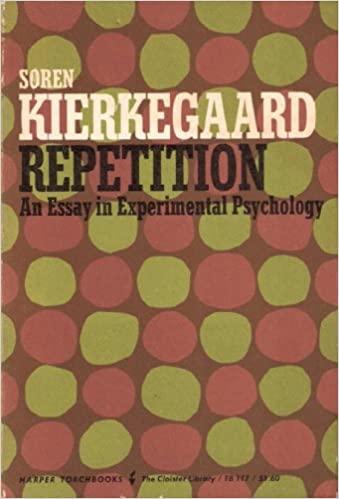
The idea of repetition which he proposed with Sisyphus, which in turn was inspired by Danish philosopher Soren Kierkegaard’s Repetition, is witnessed significantly in the works of Beckett too. What is more, his ideas also, even now influence the readers like me in whose face the “why” of existence suddenly strikes one fine day. It wouldn’t be an overstatement or some form of fervent adherence to the writer if I admit that he inspired the mind to seek more and not be satisfied till the response unites the thought and the experience.

He is not an easy writer to read, agreed, but his writings are not disturbing, specially if one gets to understand that his writing, whether The Stranger or ‘The Myth of Sisyphus’, is a declaration of writer’s notion that the life must be lived fully in awareness of the absurdity of this world.

In the ‘Myth of Sisyphus’, he terms the world as absurd because it doesn’t offer any answer to the question of existence, it being a silent spectator to the suffering of whole humanity. In a universe, divested of meaning or illusions, a man feels a stranger. His exile is without remedy since he is deprived of the memory of a lost home or the hope of a promised land. But does this situation dictate death? Camus ponders upon the problem of suicide and contemplates then whether suicide is the only answer to this absurd world which doesn’t answer anything.  He opines:

In the face of such contradictions and obscurities must we conclude that there is no relationship between the opinion one has about life and the act one commits to leave it. Let us not exaggerate in this direction. In a man’s attachment to life there is something stronger than all the ills in the world. The body’s judgement is as good as the mind’s and the body shrinks from annihilation. We get into the habit of living before acquiring the habit of thinking. In that race which daily hastens us towards death, the body maintains its irreparable lead.

And to kill one self means to allow both life and death to have dominion over one. Hence, the absurd doesn’t dictate death but calls for the awareness and rejection of death. It calls for living it with consciousness —- with revolt, freedom and passion.

Neither religion, nor science for that matter, provides answer to a questioning mind satisfactorily. While the former tends to imbue it with an idea of eternity; an extension of life in heaven, the latter merely tries to explain it by hypothesis. But Camus cannot believe either of them.

Then turning to existential philosophers, he says that they “without exception suggest escape”.

“Through an odd reasoning, starting out from the absurd over the ruins of reason, in a closed universe limited to the human, they deify what crushes them and find reason to hope in what impoverishes them. That forced hope is religious in all of them.”

To further explain this, he presents to us the ideas proposed by different philosophers. For example he says:

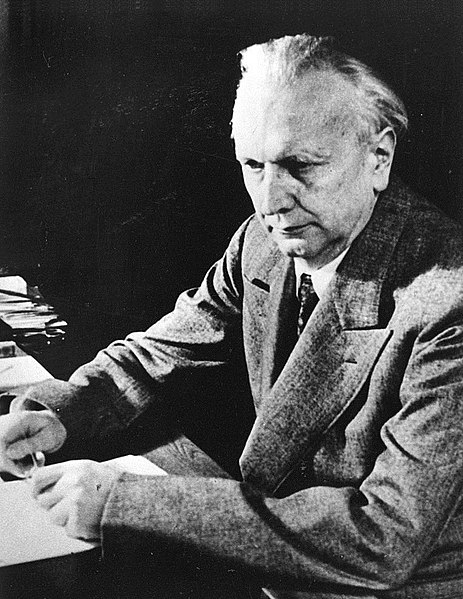
Of Jasper:

Karl Jasper

Karl Jasper, psychiatrist and philosopher, writes: “Does not the failure reveal, beyond any possible explanation and interpretation, not the absence but the existence of transcendence?”

So that Jasper proposes the existence which cannot be defined as “unthinkable unity of the general” and the “inability to understand” as the existence which illuminates everything.

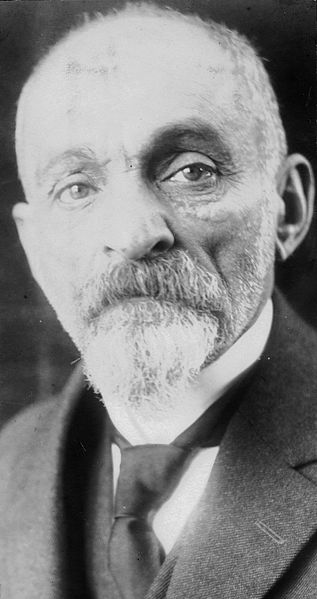
Of Shestov:

Lev Shestov

Lev Shestov, the Russian existentialist philosopher, names the fundamental absurdity by saying: “This is God: we must rely on him even if he does not correspond to any of our rational categories.”

For Shestov, reason is useless but there is something beyond reason, even if that something is indifferent to us.

Of Kierkegaard:

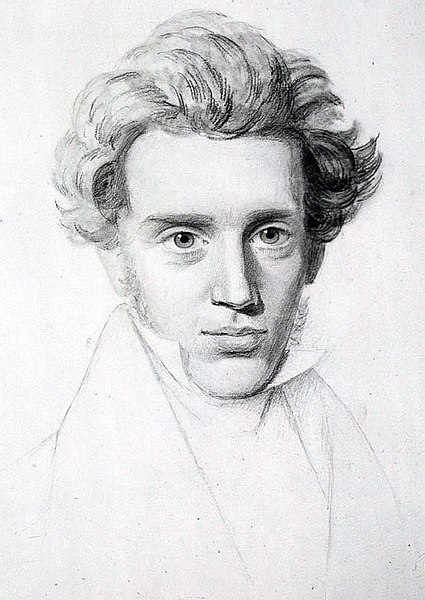
Soren Kierkegaard

Kierkegaard calls for the third sacrifice required by Ignatius Loyola, the one in which God most rejoices: The sacrifice of the intellect. He says, ‘In his failure, the believer finds his triumph.’

Kierkegaard substitutes his cry of revolt for frantic adherence.

Camus doesn’t agree with these philosophers, who did, all of them, tried to understand the absurd but finally gave into that which they found impossible to define. He calls their giving up as philosophical suicide. He cannot believe in Jasper’s idea of Transcendence. In response to Shestov, he says “To an absurd mind reason is useless and there is nothing beyond reason.” He chooses ‘despair’ instead of Kierkegaard’s frantic adherence. He says “I want everything to be explained to me or nothing.”

 So now when faced with absurd and being in consciousness, how best to live the life? Camus advocates the life of a seducer (Don Juanism) actor, conqueror or creator following the three consequences of absurd i.e. revolt, passion and freedom.

 By revolt, Camus means to keep the absurd alive by challenging the world anew every second.  

By freedom, he means losing oneself in that bottomless certainty, feeling henceforth sufficiently removed from one’s own life to increase it and take a broad view of it.

By passion, he means being aware of one’s life, one’s revolt, one’s freedom, and to the maximum.

Though he praises the absurd man in a seducer, actor or conqueror, it was his stance on creator which I drew me towards his ideas. He says:

“Creating is living doubly. The groping, anxious quest of a Proust, his meticulous collecting of flowers, of wallpapers, and of anxieties, signifies nothing else.”

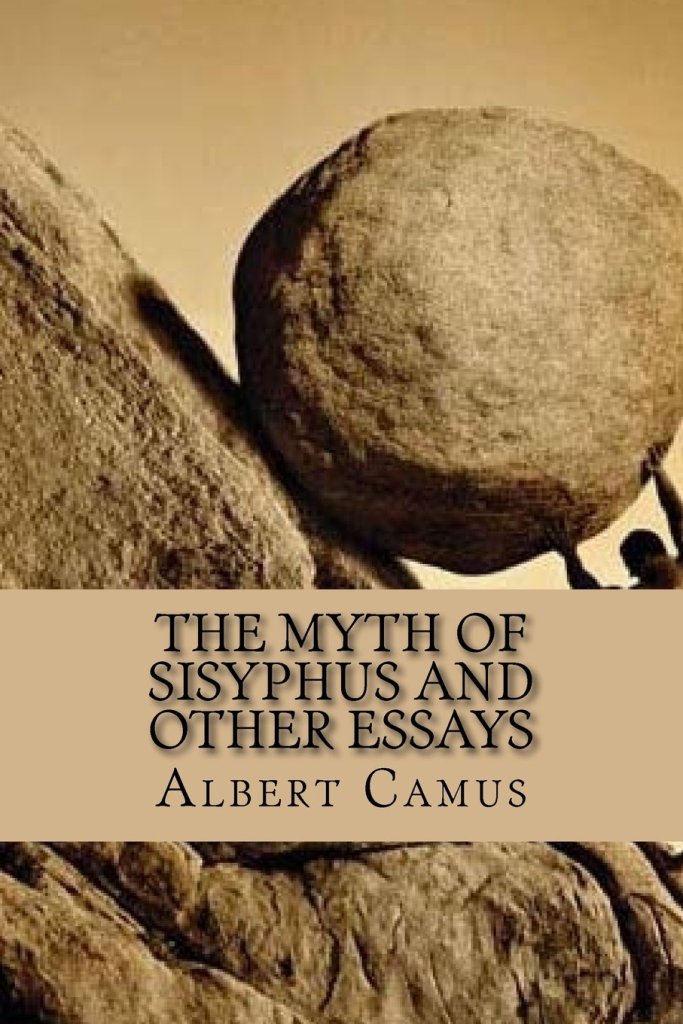
Sisyphus

Towards the end of this essay, he compares absurd with Sisyphus, who, according to the myth, was condemned to rolling a rock to the top of a mountain, only to see it rolling down back every time he reached the top. He says that though Sisyphus is well aware of his fate, of the continuous struggle he has to engage in, but he is still passionate about his life and doesn’t give up. It is during his descent, that Sisyphus’ silent joy is contained.

Likewise, the absurd man, when he contemplates his torment, silences all the idols. In the universe suddenly restored to its silence, the myriad wondering little voices of the earth rise up. Unconscious, secret calls, invitations from all the faces, they are the necessary reverse and price of victory. There is no sun without shadow, and it is essential to know the night. The absurd man says yes and his effort will henceforth be unceasing. If there is a personal fate, there is no higher destiny, or at least there is but one which he concludes is inevitable and despicable. For the rest, he knows himself to be the master of his days. At that subtle moment when man glances backward over his life, Sisyphus returning toward his rock, in that slight pivoting he contemplates that series of unrelated actions which becomes his fate, created by him, combined under his memory’s eye and soon sealed by his death. Thus, convinced of the wholly human origin of all that is human, a blind man eager to see who knows that the night has no end, he is still on the go. The rock is still rolling.

I leave Sisyphus at the foot of the mountain! One always finds one’s burden again. But Sisyphus teaches the higher fidelity that negates the gods and raises rocks. He too concludes that all is well. This universe henceforth without a master seems to him neither sterile nor futile. Each atom of that stone, each mineral flake of that night-filled mountain, in itself forms a world. The struggle itself toward the heights is enough to fill a man’s heart. One must imagine Sisyphus happy.

The other essays in the collection, ‘Summer in Algiers’, ‘The stop in Oran’, ‘Helen’s Exile’ and ‘Return to Tipasa’ are worth reading too. In ‘Return to Tipasa’, we observe Camus prevailed over by nostalgia for home, for his land. It is here that he says:

In the direction of the ruins, as far as the eye could see, there was nothing but pock-marked stones and wormwood, trees and perfect columns in the transparence of the crystalline air. It seemed as if the morning were stabilized, the sun stopped for an incalculable moment. In this light and this silence, years of wrath and night melted slowly away. I listened to an almost forgotten sound within myself as if my heart, long stopped, were calmly beginning to beat again. And awake now, I recognized one by one the imperceptible sounds of which the silence was made up: the figured bass of the birds, the sea’s faint, brief sighs at the foot of the rocks, the vibration of the trees, the blind singing of the columns, the rustling of the wormwood plants, the furtive lizards. I heard that; I also listened to the happy torrents rising within me. It seemed to me that I had at last come to harbor, for a moment at least, and that henceforth that moment would be endless.

What I realized reading these essays over again was that despite of being labelled as the proponent of absurd, it is actually living that he so fervently speaks about; Not just living but living passionately and fully. Living in awareness and questioning. Though he seems to be recommending a negative faith (as James Wood says in introduction) against the religious or existentialist ideologies, he nevertheless demonstrates a distinctive way to the seekers to come to terms with the existence; the way to be chosen henceforth, of course, depending upon the individual, starting every day with an ever new light.

“In the middle of winter, I at last discovered that there was in me an invincible summer.”

*From an interview with Jeanine Delpech, in Les Nouvelles Littéraires, (1945). Cited in Albert Camus: Lyrical and Critical Essays, Vintage (1970)

** From an interview with Gabriel d’Aubarède, in Les Nouvelles Littéraires, (1951). Cited in Albert Camus: Lyrical and Critical Essays, Vintage (1970)

Source : http://www.camus-society.com/albert-camus-existentialism.html

Rakhi Dalal is an educator by profession. When not working, she can usually be found reading books or writing about reading them. She writes at https://rakhidalal.blogspot.com/ . She lives with her husband and a teenage son, who being sports lovers themselves are yet, after all these years, left surprised each time a book finds its way to their home.