Categories
Review

Beyond the Veil: A Book Review by Aruna Chakravarti


Title: Beyond the Veil

Author: Devika Khanna Narula

An important task for those committed to tracking the path of women’s Issues, past and present, is to embark on a study of the academic discourses on gender sparked off by feminist scholars and activists — an area that is fast gaining ground all over the world. Yet there is another dimension to the effort. It also involves an exploration of creative writing generated by sensitive, imaginative feminism. It is important to understand that concepts such as Patriarchy, Agency and Resistance are not limited to feminist debate and discourse. They are equally and dynamically present in poetry and fiction. In India, the field of feminist creative writing is growing rich with promise every day.

One such endeavour is Devika Khanna Narula’s novel Beyond the Veil.  A work of epical dimensions it operates on a vast canvas. Vast both in terms of space and time, it spans half a century, between 1900 and 1950. It offers interesting insights into life as lived by upper class and middle-class women during a momentous period of Indian history. A time when a mass resistance against British rule was spreading all over the country culminating in the independence of India. A movement in which some women also participated.

Spatially the narrative shuttles between two families from two different parts of India linked by marriage. They belong to different cultures though they come from a common stock. They are the Punjabis of Lahore and the Punjabi Khatris of Bandhugarh, a fictional name for Bardhaman, in West Bengal. The founder of the Kapoor family in Bandhugarh, came from Punjab in the sixteenth century and, by sheer dint of merit and hard work, amassed lands and wealth. His progeny followed in his footsteps, established themselves as zamindars and, at some point, were dignified by the title of Rajah by the British.

The Khannas of Punjab and the Kapoors of Bandhugarh seem very different in externals. The first belongs to the ‘small business’ class. The other is related to royalty. One is of pure Punjabi extraction. The other, though from the same genetic type, is highly Bengalised having lived in Bengal over many generations. They speak Bengali, eat Bengali food, dress like Bengalis, worship in Bengali temples and use idioms and expressions that serve to accentuate the effects of defamiliarization and alienness among the daughters-in-law who, in an effort to keep the bloodline pure, are brought from the old pristine stock.

These women face the challenges their upheaval brings in its wake. They are required to come to terms with another kind of life, learn to adapt to a new environment, cope with taunts about their dissimilarities and conquer their fears and insecurities. It works both ways. Roopmati, coming from Punjab has to turn herself into a Bengali in her marital home. Her daughter, brought up as a Bengali in Bandhugarh, is wed to a young man in Lahore and has to adapt to a different set of priorities and values for which she is totally unprepared.

Yet, scratch the surface and the fates of women, whether in Punjab or Bengal, are identical. Denial of education, economic dependence on the male, social conditioning over generations and the suppression of individual identity by an oppressive ‘joint family’ ideology are present across the spectrum. Humiliation and desertion by husbands, violence—physical and mental, molestation and rape both marital and by other males of the family are normalized and hidden from view. Adherence to tradition have rendered other horrors acceptable and inevitable. The custom of Sati and Purdah, female infanticide and neglect of the girl child are part of a patriarchal system that exists in both communities.

The strange thing is that the women who suffer these indignities, day in and day out, are the very ones who are entrusted with perpetuating the system. Males set the rules but females are expected to implement them. And many do. Mindlessly like automatons. Some even enjoy the process. Because this is the only area of dominance men have relegated to women. Women like Bebe of Bandhugarh and Rukmini of Lahore enjoy power through a determined subjugation of the younger women of the family, particularly the daughters-in-law. They also see it is as their duty to break the clay of the other and force it into the patriarchal family mould. 

The world in which the young women of Beyond the Veil live is cold and dark. But occasionally a shaft of sunlight pierces through the clouds. Some women upset the status quo from time to time. These are rebels who expect consideration and fair play. They demand change. The mother and daughter duo Roopmati and Maina are two such women. It is heartening to see that, under their influence, their husbands too develop sensitivity and compassion for the women in their households. Other males follow suit. The curtain falls on a world slowly waking from slumber.

The ambience of both worlds is created with great sensitivity and detail. Descriptions of food eaten, clothes worn, journeys undertaken and the joys and sorrows of day-to-day living are totally credible. The narrative flows smoothly unmarred by jolts and jars. The topography of Lahore, Karachi and Bandhugarh of those days is authentic and accurate. Life as it is lived in, whether it is the Khanna family or the Kapoor, the cultural differences come through with clarity and precision. Events and locales are rooted in history and dates are adhered to. Names of streets, restaurants, railway stations, cinema halls… even the films that were shown in them a century ago… can be put to the test and will not fail. Best of all are the local legends and myths that have grown around communities and families, rivers and lakes, temples and mansions. The book is a storehouse of information of a bye gone era.

.

Aruna Chakravarti has been the principal of a prestigious women’s college of Delhi University for ten years. She is also a well-known academic, creative writer and translator with fourteen published books on record. Her novels JorasankoDaughters of JorasankoThe Inheritors have sold widely and received rave reviews. Suralakshmi Villa is her fifteenth book. She has also received awards such as the Vaitalik Award, Sahitya Akademi Award and Sarat Puraskar for her translations.

.

PLEASE NOTE: ARTICLES CAN ONLY BE REPRODUCED IN OTHER SITES WITH DUE ACKNOWLEDGEMENT TO BORDERLESS JOURNAL
Categories
Poetry

Gandhi & the Robot

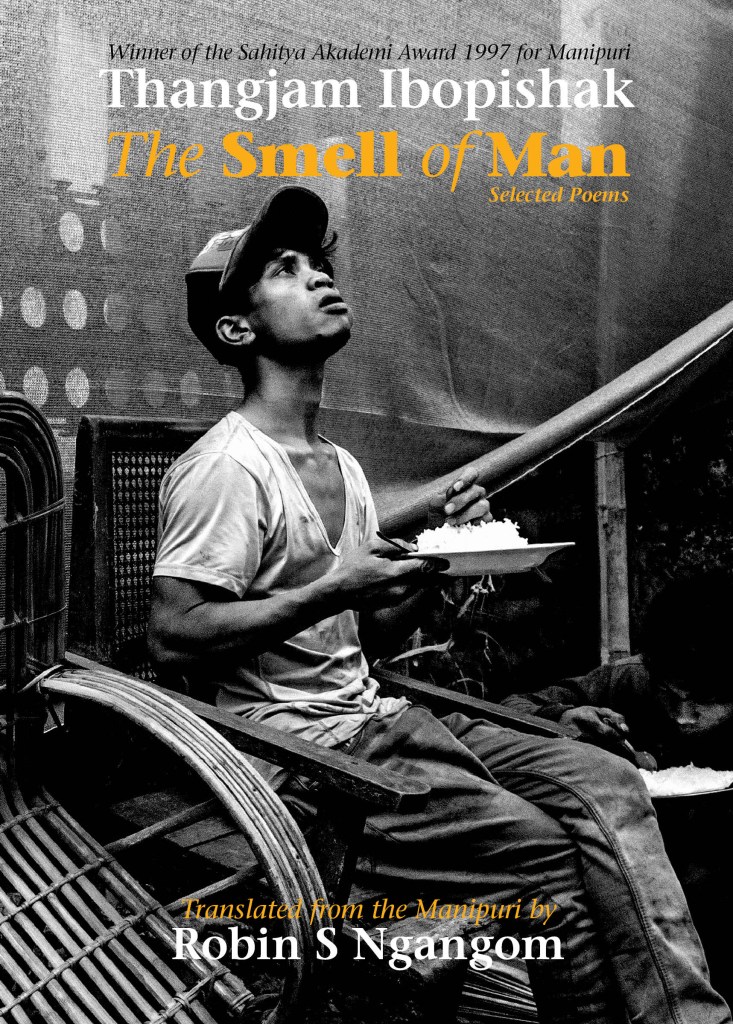
Written in Manipuri by Thangjam Ibopishak, translated by Robin S Ngangom

Gandhi and Robot
 
A long time ago
Nehruji owned a robot gifted by Russia,
that could chant a thousand ‘Hare Ramas’
in a minute!
Vallabhaiji possessed a Gandhi borrowed from Birla,
that could spin ten balls of thread
on the charkha every hour.
Vikram Sarabhai proclaimed on Republic Day:
I’ll create a new pilgrimage site for science 
at Trombay.
 
In Delhi’s Red Fort, donkeys bray
with parched throats on an empty stomach;
the dhobis who rear them feed them
old copies of the ‘Harijan’ newspaper
by tearing them into bits.
 
Today, sadhus announce:
we will build a pagoda at Pokhran
to shelter the ‘New Buddha’.
Elated, I cried:
‘Bravo, Bharat, bravo!’

(from The Smell of Man, Red River, 2021)

Thangjam Ibopishak (b 15 February 1948) is one of the leading Manipuri poets. Based in Imphal, he taught Manipuri literature at GP Women’s College and has published 10 volumes of poetry, three of which earned him some of the most prestigious awards in the state, including the Manipur State Kala Akademi Award in 1986, the Jamini Sunder Guha Gold Medal in 1989, the first Jananeta Irabot Award in 1997 and the Kavi Ratna Dr Kamal Memorial Award in 2012. He has also published two books of essays and a memoir. Ibopishak also won the Sahitya Akademi Award for poetry in 1997 for The Ghost and the Mask, and the Manipur State Award for Literature in 2009.

Robin S Ngangom is a bilingual poet and translator who writes in English and Manipuri. Born in Imphal, he studied literature at St Edmund’s College and the North-Eastern Hill University, Shillong, where he currently teaches. His poems have appeared in The New Statesman (London), Verse (Georgia), Kunapipi (Denmark), Planet: the Welsh Internationalist (Ceredigion), The Literary Review (New Jersey), The HarperCollins Book of English Poetry (HarperCollins India), These My Words (Penguin India), Chandrabhaga (Cuttack), Kavya Bharati (Madurai). Ngangom describes his poetry as ‘mostly autobiographical, written with the hope of enthusing readers with my communal or carnal life — the life of a politically-discriminated against, historically-overlooked individual from the nook of a third world country’. His third book of poetry, The Desire of Roots, was published by Red River.

PLEASE NOTE: ARTICLES CAN ONLY BE REPRODUCED IN OTHER SITES WITH DUE ACKNOWLEDGEMENT TO BORDERLESS JOURNAL. 

Categories
Review Tribute

Under the Shadow of Death: Memoirs of Tagore’s Last Days

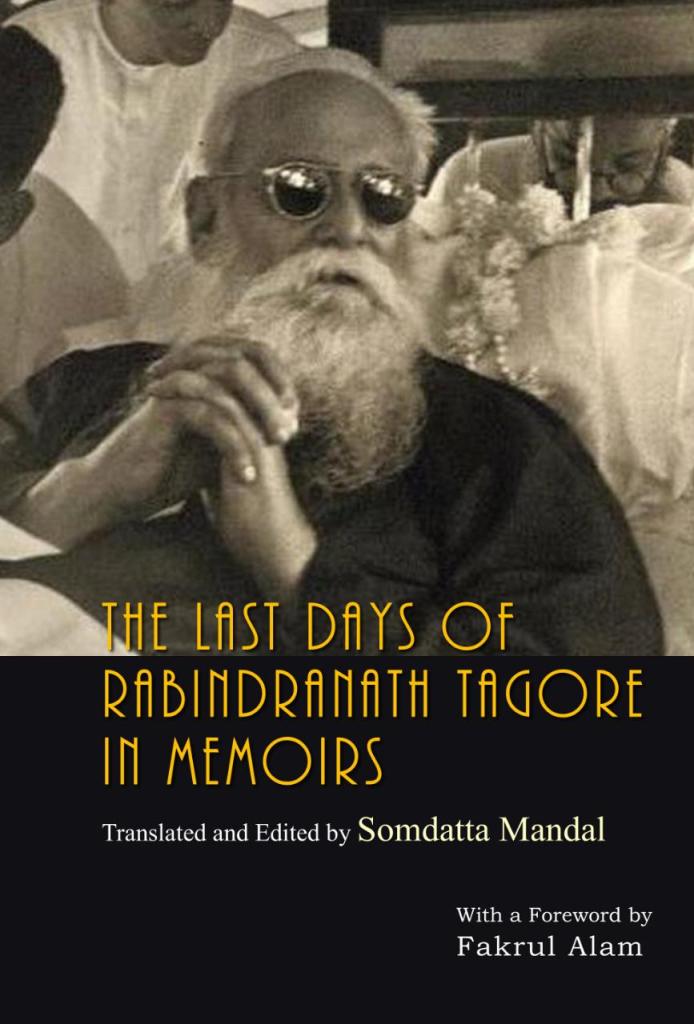
To Commemorate Tagore’s 80th Death anniversary, we present a review of Somdatta Mandal’s translation of memoirs around Tagore’s last days with a forward by Professor Fakrul Alam

Book Review by Meenakshi Malhotra

Title: The Last Days of Rabindranath Tagore in Memoirs

Translator/ Editor: Somdatta Mandal

Publisher: Birutjatio Sahitya Sammiloni, 2021

The Last Days of Rabindranath Tagore in Memoirs, selected, edited, translated, and put together from the original Bangla by Somdatta Mandal, hovers along a fine line between biography, autobiography and perhaps a bit of hagiography around the account of a life lived in the shadow of imminent death. Mandal draws on all these genres to create a rich chiaroscuro of effects, with a chorus of the memoirs of a few caregivers, mostly women, who were in close proximity to Tagore and served and took care of him in the last year of his life.

Criss-crossing between bouts of illness and creativity, the caregivers also doubled as scribes and notetakers, transcribing the precious words of the great poet. Together, they create an incredibly rich web of narratives, which have been very ably selected and translated by Professor Somdatta Mandal. The memoirs also convey a sense and flavour of the place, whether it is Santiniketan, Jorasanko, Kalimpong or Mongpu — the various places and haunts of Rabindranath in the twilight of his life. The interesting thing is that many of these ancillary memoirs were written by young people who later became famous as writers and artists, their talents often nurtured, encouraged and incubated by the greatly revered poet himself.

The titles of their respective memoirs attest to their unique writerly talents: ‘Nirbaan’ by Pratima Devi, representing a release and freedom from a painful state. Rani Chanda, the second section talks about the ‘alapchari’(Musical) Rabindranath and Gurudev, highlighting his sensitivity to and concern for others.  Mongpu-te Rabindranath and Swarger Kachakachi (Rabindranath at Mongpu and Close to Heaven) by Maitreyi Devi are deeply evocative pieces. Nirmalkumari’s “22nd Shravan” is perhaps given the most space by the editor/translator and shows his anxieties about the fate of the university built by him, a unique educational experiment very dear to his heart. Living in the shadow of the great man, it is as if each memoir and person measures up their life which gains in meaning and significance, as a result of the unique legacy bequeathed to them, with love and affection, by the poet.    

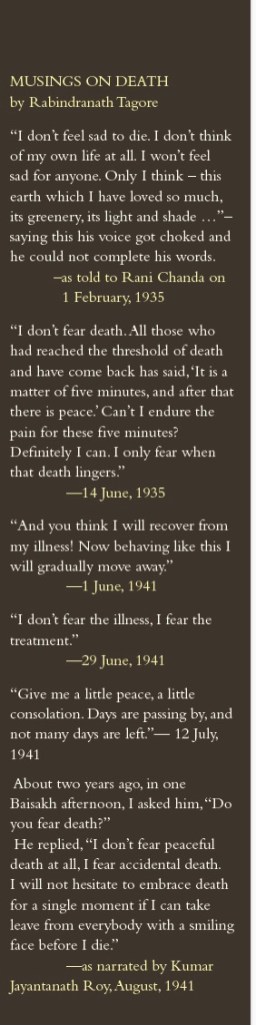
In reflecting and refracting, through the prism of their care and service, the closing year of Rabindranath’s life, the memoirs lay bare several facts. The bard was often a difficult patient, experiencing several crests and troughs as far as his moods — creative and otherwise — were concerned. Too intelligent and perceptive to avoid facts, he could see his imminent death, but did not want his caregivers to be morose and mournful. On them, fell the job of entertaining him, creating laughter and fun, in which he would participate when his health permitted him. He was less scared of death, he said, than of surgery advocated by his very eminent doctors like Dr Bidhan Chandra Roy (later he Chief Minister of West Bengal from 1948-1962) and Dr Nilratan Sarkar.

That this book is a labour of love is evident from Professor Mandal’s careful selection and editing, as well as her meticulous and competent translation. She has presented the momentous and moving final months of Rabindranath Tagore’s eventful life up to the day of his death which witnessed an outpouring of grief from many quarters. It is the final months of his life which is transcribed and inscribed by his memorialists, among whom are Pratima Devi, his daughter-in-law and son Rathindranath’s wife; Rani Chanda, his secretary Anil Chanda’s wife and a writer herself; Maitreyi Devi, the well-known writer and a protégé and favourite of Tagore’s; Nirmalkumari Mahalanabis, whose exchanges with the kobi-guru (great poet) have been detailed in Kobi and Rani (translated by Professor Mandal in 2020) and Amita Thakur, his granddaughter.

The first selection Pratima Devi’s ‘Nirbaan’ (1942) demonstrates his faith in and affection for his conscientious daughter-in-law, who, along with Rani Chanda and others, become an embodiment of care and nurture. He is aware of being a difficult patient and this awareness, which shines through in many of his comments and pet peeves, not only redeems him, but makes him more human. Musing “fondly on the poet’s twilight moments” while punning on the Robi (Bangla for sun) in the poet’s name, Maitreyi Devi, a Sahitya Akademi award-winning novelist writes: “The almost setting sun…was no less pleasant than the glory and radiance of the afternoon sun” and even within the sickroom, the poet continued “playing” his tunes, along with the march of time.

In his sensitive and nuanced foreword, Professor Fakrul Alam points out the memorialists’ refusal to minimize or sentimentalize Gurudev’s illness. In fact, Rani (Nirmalakumari Mahalanobis) expresses her impatience and criticism of the happenings and the people around the poet in the last stages. Amita Thakur, Rabindranath’s granddaughter was a notable exponent of his songs in her time, and he would depend on her to note down the songs as they came to him. Her work is chosen, says Alam, “as a coda for her assemblage of extracts from the memoirs of the five devoted caregivers who were women who had served him selflessly for sustained periods.”

The literary and archival value of such a work is undeniable and its benefits for exploring literary culture is immense. Between its glimpses of a towering giant in the world of letters with a truly international perspective to its comments about Tagore’s closeness to women and his seeking women as caregivers, the collection is also a testament to Tagore’s faith in the selfless capacity of women.

The book and Rabindranath’s close relationship with his many caregivers and later, memoirists, sometimes created a family dynamic of some tension between his natal family and adopted one. At one point, Maitreyi Devi (called “Mongpobi” or “Mitra” by the poet) talks of the negative comments made about her by Indira Debi (Bibi), one of Tagore’s favourite nieces, daughter of Satyendranath Tagore and Jnadanandini Debi. Later however, Maitreyi Devi also mentions the kindness shown to her by Indira Debi when they are together in Santiniketan.

Like in Kobi and Rani, the memoirs of Rani Mahalanobis (called Prathama or first to differentiate her from Rani Chanda who was referred to as Dwitiya or second) show the many facets of the great man himself — his many moods from his mellow moods even when he was in extreme pain to his irascible mood to his playful and humorous moments. It is to the credit of the editor/translator that she has organised and arranged the material very skillfully to bring out his mercurial nature, his flashes of temper and his expectation that his caregivers would wear their responsibilities lightly.

Overtly committed to personal memory, life narratives and biographies occasionally come  close to hagiography. They also lay bare a  performativity inscribed in the very form, implicit in the relationship between the great man/ luminary and those who are satellites in his orbit. The many layers of feeling get reflected in a plurality of forms that are both sedimented and fluid in structure — comprising letters, diaries, poems, fragments. These innovative narrative structures are evolved to convey through an overlapping of various genres: non-fiction, poetry, memoir, autobiography, letters, etc. Extending well beyond any coherent theoretical coordinates to streamline its disparate forms, life narratives are as much constructed by an individual artist — subject as they are the product of her/his intersecting textures of historical, social, political, economic, and cultural contexts.

The socio-cultural context  is specifically that of the progressive environment of Santiniketan and Vishwa Bharati. We see how the ambience of cultural efflorescence and Brahmo liberal ideas helped shape these young women. Perhaps, because of the reformist cast of Brahmo womanhood or the holistic educational schemes fostered by Tagore, in his caregivers, we see the emergence of relatively independent or mobile women, cast in agentic roles of decision making. We see an extraordinary sense of  a tightly-knit community of caregivers whether in Pratima Devi and Maitreyi Devi during the harrowing journey back from Kalimpong to Calcutta when Tagore’s illness worsens, the encounters of Maitreyi Devi with British doctors in Kalimpong or the journey undertaken by Maitreyi from Mongpu along with her young daughter immediately after a landslide, when her husband, Manmohan Sen, undertakes  to get the landslide cleared.

With a vibrant assembly of many pictures and voices, the story emerges from a collage. Piecemeal in bits and pieces, like the oranges sent to Rabindranath by Maitreyi Devi from Mongpu. Each experience, like the fruit, is savoured slowly and with relish. The remaining fruit, both actually and figuratively/symbolically, is given to the students.

A life, even one as extraordinary as Rabindranath Tagore’s, unfolds in time, simultaneously, it also participates in eternity. Thus, even as his nearness and the promise of proximate greatness draws his mentees into his magical orbit, we see him worrying about his imminent death and the fate of Santiniketan. We have to also see the life of the women, details of which get inscribed in their memoirs. The demands placed upon them are often relegated to the margins as they form part of the enchanted circle around the ailing poet, who at times seems to assert his claim on their time, albeit often  in jest, sometimes in a semi-serious way, competing for their attention with their other affections and preoccupations. Their lives, they realise, are given significance and irradiated by his presence, endowed with value through the care they could extend to the great soul.  

Ultimately the collection testifies to the power of great literature and poetry. As the poet himself says:

“Of course, literature is based upon lies — from beginning to end. Whatever I have said, whatever I am saying, how much of that is true? I have done a lot of farming for 80 years. I cannot vouch that all the grains will be stored in the barn. Some will be eaten by rats, but even then, something would be left behind. I cannot say that with certainty, eras change, times change and along with that everything also changes. But I can say with certainty that my songs will last the longest. Especially Bengalis will have no other way except to sing my songs in grief, sorrow, joy and happiness. They will have to go on singing them for ages.”

Kumar Sri Jayantanath is aptly quoted in Appendix B of the memoirs: “There is nothing new to say about Rabindranath because whatever we had to say has already been said by him.” Therefore, we pay a tribute to the poet in the poet’s own words:

You had brought along with you

 Deathless soul

In your death you have

Donated that

You have donated that

In your death.”

.

  Dr Meenakshi Malhotra is Associate Professor of English Literature at Hansraj College, University of Delhi, and has been involved in teaching and curriculum development in several universities. She has edited two books on Women and Lifewriting, Representing the Self and Claiming the I, in addition  to numerous published articles on gender, literature and feminist theory.       

.

PLEASE NOTE: ARTICLES CAN ONLY BE REPRODUCED IN OTHER SITES WITH DUE ACKNOWLEDGEMENT TO BORDERLESS JOURNAL