Categories
A Special Tribute Review

Rabindranath’s Protest Against Violence

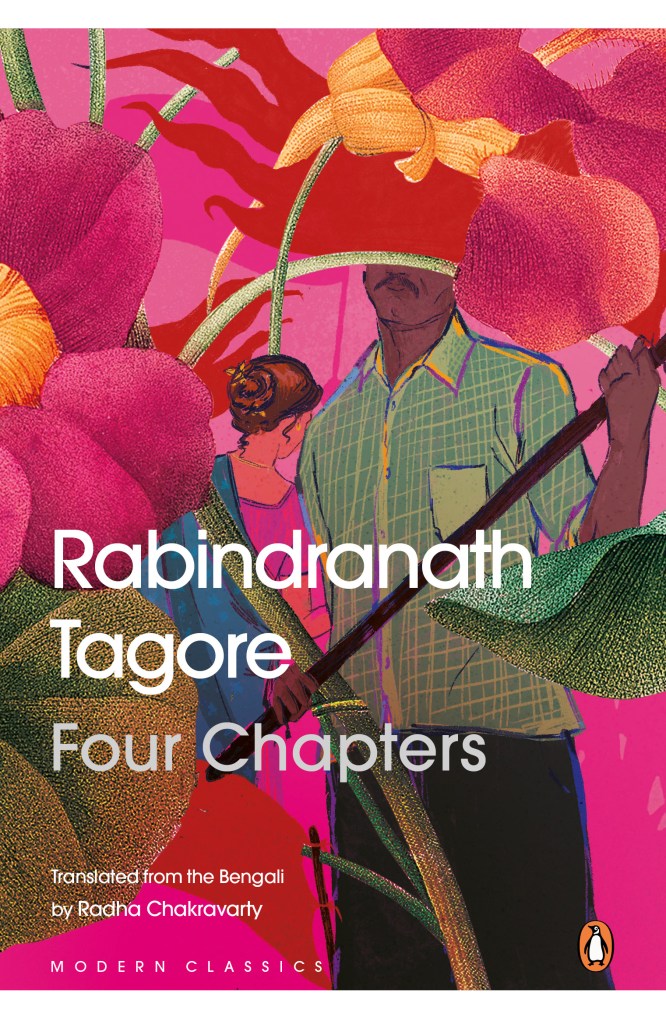
Book review of Tagore’s last novel by Meenakshi Malhotra on his death anniversary

Title: Four Chapters                                           

Author: Rabindranath Tagore

Translator: Radha Chakravarty

Publisher: Penguin

With Char Adhyay (1934, Four Chapters), Tagore’s last novel, he returns to his critique of violence, an almost ubiquitous preoccupation in this last phase of his writing which had earlier  witnessed the production of Ghare Baire (1916, The Home and the World) and his essays on nationalism. Both, The Home and the World and Four Chapters, share an underlying preoccupation about the limits of patriotism and the legitimacy of violence: does love for one’s own country justify violence and revolutionary terrorism? To put it in a philosophical vein: do the ends justify the means?

Like in The Home and the World , Tagore uses a triangulated relationship, if not a tripartite narrative structure. The plot could be summed up thus: Ela, a modern woman, looks for engagement, to give structure and meaning to her existence. At odds initially with her traditional but authoritarian mother, she grows up developing a strong sense of justice and a mistrust of blind superstitions and meaningless rituals, which hardly equip her to fit into a traditional marriage. After losing both her parents, she is under the care of her uncle and aunt, when she meets the charismatic Indranath, a disappointed scientist who has now turned to militancy and revolutionary terrorism. On  the other side is Atindranath or Atin (also called Antu), with whom Ela forms a romantic attachment. In the last segment of the novel, we realise that Ela’s politicisation had also pushed Atin into militancy since Ela’s dedication to the cause had co-opted him into it.

Stylistically this novel is striking. It consists of little narrative but is dialogic for the most part. As such, as the editor-translator mentions, the work acquires a dramatic quality. Also, Four Chapters comes across as a vehicle for ideas and at times, the novel seems to be weighed down by the predominance of ideas. Thus ideas of national regeneration, selfless action circulate in the text  without being directly co-related with the plot and story structure. The characters often are eloquent in their own praise. They seem to be mouthpieces produced as a result of clashing ideologies.

Four Chapters depicts the new, modern woman in all her complexity and confusion, poised on the brink of something new, yet unable to let go completely of the old. Torn between political zeal and romantic passion, Ela represents a model of womanhood which is recognisable and perhaps relatable. Displaying agency, she says she wants to “publicize the increase in women’s rights in the modern age.” Women , she feels, “don’t hesitate to speak the truth now”. In the “new literature, Bengali women’s characters are eloquent in their own praise. They have usurped the clay sculptor’s role of fashioning the images of goddesses.”

Both a scientist as well as a political leader, Indranath surveys human history as a continuing saga of oppression, death and destruction. His cold impersonality is contrasted with the romantic zeal and passion of Atin, who is devoted to Ela beyond doubt. Though Ela reciprocates his passion, she is committed to bow to the overarching cause of the nation and its freedom from subjugation. Yet Ela shows herself capable of great devotion as is evident  in her impassioned exchanges with Atin. She tells him, “You are great. I can see your brilliance, dazzling as a flash of lightning.” Fully aware of his devotion and of his romantic idealisation of her, she contrasts the small details which preoccupy women to the dazzling brilliance of Atin’s mind. In all these exchanges, we see her intelligence shine through. Moreover, she realises the entrapment of women’s biology. Nature, she feels, “has humiliated women from the time of our birth.” “We enter this world bearing destiny’s purpose in our biology, our bodies.”

In contrast to the passionate and emotional Atin is the  character of Indranath, who, seems cold, calculating and two-dimensional and driven by a single ideological narrative.  Indranath, the political zealot is charismatic but professes to be impersonal, commands and considers herself pledged to the nation’s cause. It is he who wins Ela over to the nationalist cause.

Nationalism here serves as a veneer for his revolutionary terrorism. As Radha Chakravarty writes in the ‘Introduction’ to the translated edition, “The novel charts the volatile scenario that arises from the conflict between Ela’s forbidden love and her dangerous involvement with political violence. Through the relationships between Ela, Atin and Indranath, the narrative explores the interface between love and revolutionary politics”. She also adds that the first draft of the novel focused on the romantic plot and did not have the character of Indranath. The character of Indranath is supposedly based upon a scholar-activist who was criticised by Tagore. In a letter written in August 1934, Tagore wrote to Prafulla Nath  Tagore, saying  that the latter must be aware of his eschewal of violence: “You are aware that I  am completely against the oppressive tactics of those who follow the path of terrorism…I have written a work of fiction that is cast as a protest against the terrorists.”

Tagore’s political views and novelistic stance elicited the wrath of many compatriots, political activists, extremists and nationalists who felt that this stance was expressive of his collusion with colonialism. Further, as Chakravarty phrases it, his “challenge to authoritarianism and insistence on freedom of thought” also aroused the suspicion of the British administration in India. Anticipating controversy, Tagore himself took steps to have it translated into English, though it took some time for the translation to see the light of day.

Radha Chakravarty’s recent translation captures the nuances of a complex text. It is one of the rare instances where the translation has rescued the occasional stiltedness of the original and thus fares better in some instances. The novel, which runs the occasional danger of collapsing under the weight of its own ideas in the original Bengali version, is modernised and through this particular translation, the narrative is made more empathetic to the needs of the contemporary reader. This is a translation of a difficult novel which serves to give a fresh lease of life to an important but not a very popular book, and restores it for the modern reader.     

.  


Dr Meenakshi Malhotra is Associate Professor of English Literature at Hansraj College, University of Delhi, and has been involved in teaching and curriculum development in several universities. She has edited two books on Women and Lifewriting, Representing the Self and Claiming the I, in addition  to numerous published articles on gender, literature and feminist theory.       

.

PLEASE NOTE: ARTICLES CAN ONLY BE REPRODUCED IN OTHER SITES WITH DUE ACKNOWLEDGEMENT TO BORDERLESS JOURNAL
Categories
Tribute

Celebrating Tagore

Was he a poet? A writer? A humorist? A social reformer…

At an intellectual plane, we could keep arguing about labelling Tagore. He was truly a polymath. But, the most important thing is he touched our hearts with his words and used that to earn and pour into projects that benefitted the underprivileged. This year, on his 161st birth anniversary, we will explore some lesser known aspects of the maestro: Rabindranath, the social reformer and the humorist weaving both the Gregorian calendar (7th May) and the Bengali calendar (9th May) dates into our celebrations.

Tagore, the Humorist 

Many of us from Bengal grew up reading light pieces by Tagore embracing his creations as a much-loved part of our hearts. We present translations by Fakrul Alam and Somdatta Mandal of Tagore’s humour — a light poem about a giraffe and playlets by the maestro. 

Giraffe’s Dad by Tagore: Giraffer Baba (Giraffe’s Dad), a short humorous poem by Tagore, has been translated from Bengali by Professor Fakrul Alam. Click here to read.

Playlets by Rabindranath Tagore : Two skits that reveal the lighter side of the poet. They have been translated from Bengali by Somdatta Mandal. Click here to read.

Tagore, the Social Reformer

Tagore thought his “life work” lay in developing villages and bridging gaps. A recent book by Uma Dasgupta brought this to light. We have an interview and review of her book, A History of Sriniketan: Rabindranath Tagore’s Pioneering work in Rural Reconstruction Along with that we have some translations of his poetry focussing on his call to bridge gaps — one of them by Fakrul Alam and another that has been mentioned in Dasgupta’s book as a description of his mindset that led to the Sriniketan project. Meenakshi Malhotra’s review of Radha Chakravarty’s translation of Mahasweta Devi’s Our Santiniketan and an interview with translator Somdatta Mandal, an ex-professor of Visva Bharati shifts the focus to Santiniketan. However, the icing on Tagore’s birthday cake is yet another excerpt from Radha Chakravarty’s latest translation of Char Adhyay or Four Chapters, his last and thirteenth novel which takes up issues of nationalism, gender, gaps in upbringing against the setting of a budding romance. The heroine is truly modern in her outlook and passionate about service to humanity. 

Sriniketan: Tagore’s “Life Work” :In Conversation with Professor Uma Das Gupta, Tagore scholar, author of A History of Sriniketan, where can be glimpsed what Tagore considered his ‘life’s work’ as an NGO. Click here to read. (Review & Interview).

Oikotan (Harmonising) has been translated by Professor Fakrul Alam and published specially to commemorate Tagore’s Birth Anniversary. Click here to read.

Ebar Phirao More (Take me Back) a poem that calls for bridging gaps between the rich and poor translated by Mitali Chakravarty … Click here to read.

Mahasweta Devi, Our Santiniketan : Meenakshi Malhotra reviews Mahasweta Devi, Our Santiniketan translated by Radha Chakravarty. Click here to read.

Where the Whole World Meets in a Single Nest: In Conversation with Somdatta Mandal, a translator, scholar and writer who has much to say on the state of Santiniketan, Tagore and more. Click here to read.

Rabindranath Tagore Four Chapters: An excerpt from a brilliant new translation by Radha Chakravarty of Tagore’s controversial last novel Char Adhyay. Click here to read.

Categories
Excerpt

Tagore’s Four Chapters in Translation by Radha Chakravarty

Title: Rabindranath Tagore Four Chapters

Translator: Radha Chakravarty

Publisher: Penguin, May 2022

‘It’s time to utter some harsh truths,’ he declared. ‘Who are you to surrender me, to the nation or to anyone else, I ask you? You had it in your power to surrender the gift of tenderness—a possession that truly belongs to you. Whether you call it service or a boon, it doesn’t matter. If you permit arrogance, I shall be arrogant. If you demand that I come to your door in humility, I can do that too. But today you belittle your own right to offer a gift. You set aside the inner wealth you could have donated from the storehouse of a woman’s glory and say instead that you are handing over the nation to me. It is not yours to give! Not yours, not anyone else’s. The nation can’t be passed around from hand to hand.’

The colour drained from Ela’s face.

‘What do you mean? I can’t quite understand,’ she said. ‘I say that the ambit of women’s glory, even if it seems to be circumscribed, has inner depths that are limitless. It is not a cage. But the space that you had designated as my nest, by giving it the name of the nation—that nation constructed by your party, whatever it may mean to others—that space itself is a cage, at least for me. My own power, because it can’t find full expression within that space, falls sick, grows distorted, commits acts of insanity in its attempt to articulate that which is not truly its own. I feel ashamed, yet the door to escape is closed. Don’t you know my wings are tattered? My legs are tightly shackled. One had the responsibility to find one’s own place in one’s own nation on one’s own strength. I possessed that strength. Why did you make me forget that?’

‘Why did you forget it, Antu?’ asked Ela, her voice full of anguish.

‘You women have an unfailing ability to make one forget—all of you. Else, I would have been ashamed of having forgotten. I insist a thousand times over that you have the capacity to make me forget myself. If I hadn’t forgotten, I would have doubted my own manhood.’

‘If that is so, then why are you rebuking me?’

‘Why? That’s what I am trying to explain. By deluding me, you carry me to your own universe where your own rights prevail. Echoing the words of your own party, you said that you and your small group have determined the only path of duty in the world. Caught in that stone-paved, official path of duty, my life-stream spins in a whirlpool and its waters grow muddy.’

‘Official duty?’

‘Yes, that Jagannath Ratha—that grand, sacred chariot of your swadeshi duty. The one who initiated you into the sacred mantra decreed that your only duty is to hoist a heavy rope onto your shoulders and keep on tugging at it—all of you together—with your eyes closed. Thousands of young men tightened their waistbands, braced themselves and grasped the rope. So many of them fell beneath the chariot wheels; so many were crippled for life. At this juncture, the moment came for the Ratha Yatra—the ceremonial chariot procession—in reverse. The chariot turned around. Broken bones can’t be mended. The masses of crippled workers were swept aside, flung down upon the dust-heaps by the roadside. Their confidence in their own power had been so utterly demolished at the very outset that all of them agreed, with great daring, to let themselves be cast in the mould of puppets of the government. When at the pull of the puppeteer’s strings everyone began to perform the same dance moves, they thought in amazement, “This is what the dance of power is all about!” When the puppeteer loosens the strings ever so slightly, thousands and thousands of human puppets get eliminated.’

‘But Antu, that only happened because many of them began to dance wildly without keeping to the rhythm.’

‘They should have known from the start that humans can’t dance like puppets for long. You may try to reform human nature, though it takes time. But it’s a mistake to imagine that destroying human nature and turning men into puppets will make things easier. Only when one thinks of human beings in terms of their diverse forms of inner power can one understand the truth about them. Had you respected me as such a being, you would have drawn me close, not to your party, but to your heart.’

‘Antu, why didn’t you humiliate and spurn me right at the beginning? Why did you make me a culprit?’

‘That’s something I have told you time and again. Very simply, I longed to be one with you. That hunger was impossible to overcome. But the usual route was closed. In desperation, I pledged my life to a crooked path. You were captivated by it. Now I have realized that I must die on the path I have taken. Once that death happens, you will call me back with open arms—call me to your empty heart, day after day, night after night.’

About Rabindranath Tagore Four Chapters

This is a brilliant new translation of Tagore’s controversial novel. Passion and politics intertwine in Char Adhyay (1934), Rabindranath Tagore’s last and perhaps most controversial novel, set in the context of the freedom struggle in pre-Independent India. Ela, a young working woman, comes under the spell of Indranath, a charismatic political activist who advocates the path of terror. She joins his band of underground rebels, vowing never to marry, and to devote her life to the nation’s cause. But through her relationship with Atindra, a poet and romantic who grows disenchanted after joining the group, Ela realizes the hollowness of Indranath’s machinations. The lovers now face a terrible choice …

This new translation brings Tagore’s text to life in a contemporary idiom, while evoking the charged atmosphere of the story’s historical setting.

About the Author

Rabindranath Tagore, Renaissance man, reshaped Bengal’s literature and music, and became the first non-European to win the Nobel Prize in Literature in 1913. He introduced new prose and verse forms and the use of colloquial language into Bengali literature, thereby freeing it from traditional models based on classical Sanskrit. He was highly influential in introducing the best of Indian culture to the West and vice versa, and was a living institution for India, especially for Bengal.

About the Translator

Radha Chakravarty is a writer, critic, and translator. In 2004, she was nominated for the Crossword Translation Award for In the Name of the Mother by Mahasweta Devi.

PLEASE NOTE: ARTICLES CAN ONLY BE REPRODUCED IN OTHER SITES WITH DUE ACKNOWLEDGEMENT TO BORDERLESS JOURNAL.