Categories
Essay

Reminiscences from a Gallery: The Other Ray

Dolly Narang muses on Satyajit Ray’s world beyond films and shares a note by the maestro and an essay on his art by the eminent artist, Paritosh Sen
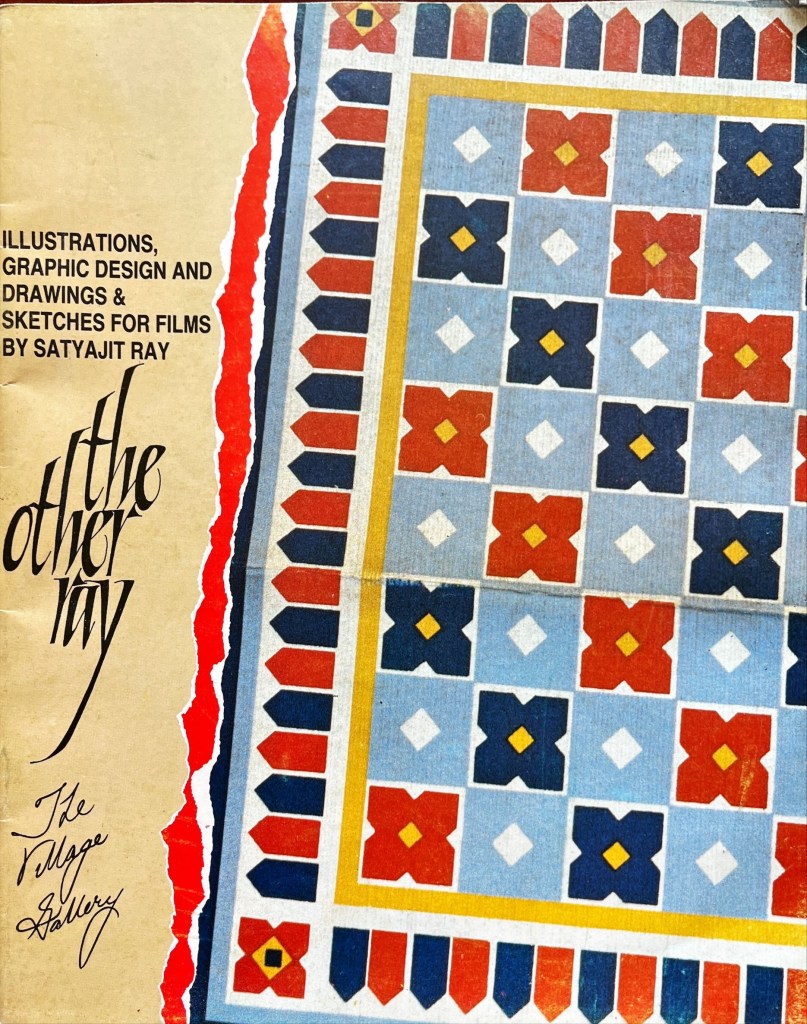
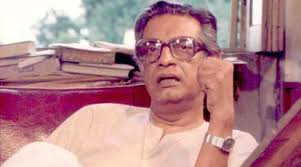
My trunk call from Delhi to Calcutta booked one day before finally materialised.  This was way back in 1990 when trunk calls were the fastest mode of communication. In a coarse voice, the operator demanded a response from the deep, modulated voice on the other end. ‘Satyajit Ray hai[1]?’ she asked, her tone sharp with impatience.

I could hear the legendary filmmaker’s composed response to the operator’s gruff, abrupt tone.  I winced at her brusqueness feeling helpless to intervene and apologise.

When she connected me, I introduced myself to Satyajit Ray and ventured to share my idea of an  exhibition that would showcase a lesser-known yet equally fascinating facet of his oeuvre—his drawings, film sketches, graphic design and more. A visual archive that, though rarely seen by the public, was as significant as his cinematic legacy. He was initially apprehensive—modest about this body of work and uncertain about how it would be received

This initial conversation was followed by a series of follow-up exchanges over trunk calls,  over several months. Each call felt like a step closer to realising the exhibition. I would book trunk calls in the urgent category request for PP (person to person) as they took less time to materialise.  PP calls were specifically for the person whose name was specified.  Still, patience was essential.

Ray, to my surprise and admiration, always answered the phone himself. No secretary, no assistant screening the calls. The simplicity and humility was endearing.

I had first shared the idea of the exhibition with Paritosh Sen one of India’s master painters and a friend of Ray’s of an exhibition of a lesser known yet fascinating facet of Ray’s genius: children illustrations, detailed film sketches, designs for book and magazine covers, typeface designs, his diverse portfolio of graphic work.   Paritoshda, as I affectionately called him who mentored and guided  me as I began my journey into the art world, not only approved of the idea but took it upon himself to speak to Ray, whom he knew personally.  Following the introduction through Paritoshda, I pursued  the idea with the legend.

During the first phone call, I briefly spoke about my concept— an exhibition that would focus  on his rarely seen visual art. His immediate response was  hesitant and guarded, “These are very small works on paper just a few inches in length and width.” he said. “They would be of no interest.”  I ventured  that this was a unique and a first time view into his visual legacy and the size would not take away from the impact.  He further expressed his doubt  about his graphic work having any resonance beyond Bengal, in North India. I   further submitted that his artistic genius and versatility has an appeal beyond Bengal. This exhibition would give a rare insight into the work and thought process of not only the deeply respected and admired film maker that we all know but also of Satyajit Ray the illustrator, the graphic designer, along with revealing the meticulous and detailed planning into his films.

I hoped to bring this body of work — into public view for the first time. The idea was to get  people to see another Ray — not the filmmaker behind the camera, but the artist behind the pen and brush.

I remember Ray had explained that he had a  busy schedule and preoccupied with the editing of Ghare Baire. After several months  of trunk calls and waiting, I booked another urgent, person to person call. Finally the breakthrough I was waiting for, “ Come next week,” he said. His doubts of an exhibition having been cleared through the intervention of Paritoshda and somewhat through my persuasion.   

 As I boarded the Indian Airlines flight to Calcutta the following week, a surge of excitement gripped me. I was given a morning time to meet him at his residence: 1/1  Bishop Lefroy Road. I arrived with some trepidation. Standing outside this tall imposing door, I rang the bell. Soon, I found myself face to face with the master who opened the door himself—his tall, commanding presence matched only by his deep, well-modulated baritone voice greeting me warmly. He led me into his much photographed studio/workplace. He was looking comfortable and relaxed in a white kurta pajama. In contrast to his majestic yet simple presence,  I was nervous and hoping it was well masked.

Thereafter, began a series of visits to his flat. Each time the door was opened by the master himself. And I would be led into his study teeming with books lining the teak wood book shelves.   

He would sit  in a comfortable looking swivel chair with a brown rexine cover, the corners of which were slightly frayed.   Opposite him and within a comfortable arms reach was a small work table with jars tightly packed with paint brushes, pen, pencils.   Here is where he did his drawings to create his vast and varied visual legacy of set design, costume design, make up instructions, graphic design, children’s illustrations for the monthly children’s magazine, Sandesh, started by his grandfather,  He also designed the covers for Sandesh, more books and magazine covers.  

Making of the exhibition

 Working alongside him to sort through his drawings was an enriching and memorable experience—one that offered rare insight into his creative mind. Each meeting felt like a step closer to the exhibition becoming a reality.  I noticed  his interest was slowly growing and he was participating in the selection with increasing enthusiasm and a discerning eye.   He approved some while some he felt need not be exhibited. Our meetings would stretch till lunch time until he was gently summoned by his wife, Bijoyadi, to take his lunchbreak.  He would extend the search and wrapped up a little beyond lunch time. I too was cautious not to overstep limits.

As he began to look in his study, he unearthed these miniature treasures on paper tucked between  books or between their pages, resting on tall teakwood bookshelves. Some were found under sofa cushions. He remembered that many were with his cousin Lila Majumdar[2] and that he would have to ask her. As he delved deeper into his collection he remarked, “I had forgotten I have done all this work.”

During  few initial meetings, I would address him as Mr. Ray, which was beginning to feel formal and somewhat awkward. So I asked if there was another way I could address him.

“Manik,” he asserted. “Everyone calls me Manik.”

From that moment on, I called him Manikda. These recollections return to me vividly as I write this piece.

We turned our attention to his iconic crimson books, neatly stacked in his study. These well-known volumes are a treasure of Ray’s meticulous preparatory work—filled with detailed sketches for his films, costume and set designs, makeup instructions for his makeup artist, architectural notes, and an astonishing range that gave glimpses into his thought and work process.
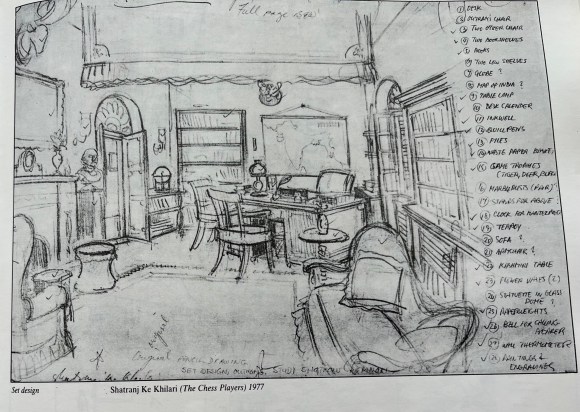
Sourced from the brochure provided by Dolly Narang

We did not want to remove any drawings from these precious notebooks. He selected the drawings that he liked and decided he would ask Nemai Ghosh (1934-2020), his close associate and long-time photographer, to photograph them for the exhibition.

Several drawings, having come loose from the notebooks, were used in their original. We did not want to remove any drawings which were firmly in  place in these volumes. Ray  identified  the drawings that appealed to him and Ghosh photographed them.

Part two of the exhibition was titled “Drawings and Sketches For Films’ and it comprised of both originals and the photographs by Nemai Ghosh  of the drawings chosen by Ray.

I nudged him further and asked if there was anything else he might suggest from his visual repertoire. 

He thought of his film posters. The ones readily available in his flat were  posters of Nayak and Ghare Baire, which were loaned for the exhibition. He was particularly eager to include the poster of Devi, but after searching, he discovered he only had one copy and was reluctant to part with it.
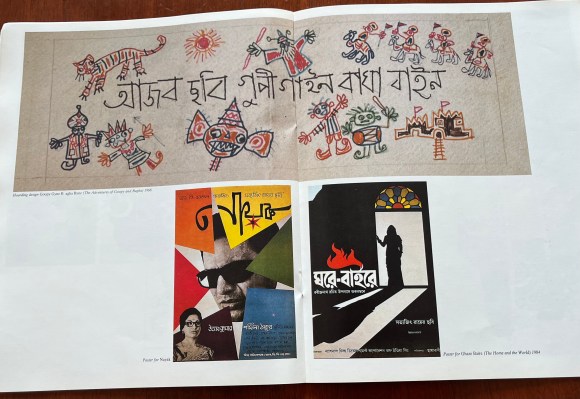
Top: Hoarding of Ray’s film Goopy Gyne Bagha Byne (1969). Below:: Film posters of Nayak(Actor, 1966) and Ghore Baire (Home and the World, 1984). Sourced from the brochure provided by Dolly Narang

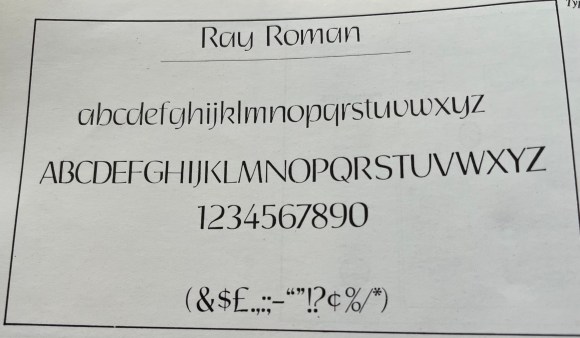
 We tried to include artworks which would represent the different aspects of his visual repertoire.  It seemed there was no end — typefaces he had designed, advertising campaign when he worked for D.J.Keymer.   While searching he realised he did not have the originals of the typefaces he had designed but fortunately they had been preserved in the photographs taken  by Nemai Ghosh.  Later Paritoshda told me that he was given an award for  the typeface by an American foundry and named it after him, Ray Roman.  
Provided by Dolly Narang

An album was discovered containing a silent film he had conceptualised on paper but never brought to life—a silent film on Ravi Shankar with his music in the background.  The album, composed of monochromatic black watercolours, was photographed by Nemaida. It drew great interest, offering a first-ever glimpse into a project that was never realised.

Paritoshda advised  that Ray had composed music for many of his films.  A tape with his compositions was playing continuously and softly in the background at the exhibition.

The exhibition was presented in two parts each had a duration of three weeks.  Part one was devoted to his Graphic design, drawing and part two was about his preparatory sketches for films.

I requested Paritoshda to write an article for the exhibition catalogue, to which he graciously agreed. He penned an insightful essay which was appreciated by Ray himself as well as by fellow artists, critics, and visitors who found his insights both illuminating and deeply  engaging.  When I asked him for his suggestion for a  title for the exhibition, he thoughtfully suggested  — “The Other Ray” — a title both fitting and meaningful.

With the socio-political upheavals around us in Delhi, it wasn’t easy—cataloguing, printing invitation cards, framing, arranging transport to distribute the invitations.  Invitation cards from our mailing list of  over one  thousand had to be hand delivered.

I asked Manikda for names of his friends and associates who he would like invitations to be sent to.  His list included names both in  India and abroad.

About a week before the event, I visited AIFACS[3] to put up a poster for the exhibition. To my surprise and delight, sitting in one of the exhibition halls was none other than M.F.Husain himself. It felt like a godsend—an unexpected opportunity to personally invite him.

He was visibly excited upon hearing about the exhibition and expressed  interest in seeing the artworks immediately wherever they were.   I explained that the pieces were still at home and would be better appreciated once they were displayed on the gallery walls.  But he was insistent—he wanted to see them right away.   We got into my car and drove to my house. Husain viewed the works in thoughtful silence moving from work to work, looking at each with great interest. After perusing them keenly he settled  at the dining  table and began reminiscing about his association with Ray – a moment as historic as it was moving, etched forever in my memory. 

I was not prepared with either a tape recorder or a camera to record this memorable encounter. Fortunately, The Illustrated Weekly, under editor Pritish Nandy, later published his reflections in an article spread over two pages with several illustrations of his graphic work.

Opening to the Public

When the exhibition finally opened at The Village Gallery in New Delhi’s quaint Hauz Khas Village it was received with great enthusiasm and acclaimed  by both critics and the public

 Visitors from all walks of life came to see the “ The Other Ray”.  For many, it was a revelation. The same legendary filmmaker who had given the world The Apu Trilogy had also crafted whimsical illustrations for children, designed  book jackets,  created typefaces. It was exciting for them to get a peek into his creative process as a filmmaker through his detailed film sketches.   

 I made another trunk call to inform him that the article in the brochure by Paritosh Sen had been chosen for The India Magazine’s cover story.   The next day, when I spoke to him again and offered to send him a copy of the magazine, he responded with excitement. He said he couldn’t wait and had already gone to the market to buy a copy for himself.

Once the exhibition—having stirred great excitement in the art world—came to an end, it was finally time to take it down. The last few days were deeply moving. Visitors lingered, often spending long hours in the gallery, reluctant to leave, as if trying to hold on to the experience a little longer. The space was filled with quiet reflection and enriched by heartfelt exchanges.

Looking back, organising this exhibition remains one of the most fulfilling experiences of my life. What I cherish is the memory of the many hours spent in his study carefully selecting the works for the exhibition.  It was a collaborative process, he was open to my suggestions yet he became more and more involved as he delved deeper into his graphic work.

An idea, carefully nurtured, took shape as an exhibition. What was especially fulfilling about the exhibition was how it brought to light a lesser-known facet of Ray’s creative genius—his remarkable visual imagination, his penchant for details, his industriousness. Until this exhibition, only a few of his sketches had appeared in articles and books, leaving much of this work largely unseen. The display offered audiences a rare and intimate glimpse into his visual world as well as his work and thought process, making it especially significant.

The final step was to return the works. I personally placed each delicate sheet into thin plastic sleeves, compiled them into a portfolio, and flew to Calcutta to return them to the master. True to his dignified demeanour, he received the compilation with quiet pleasure. He expressed both satisfaction and a hint of surprise at the enthusiastic response the exhibition had received. I took the liberty of asking him if I could keep as a memento two works from each part of the exhibition. He readily agreed and asked me to choose. I selected one black white illustration for Sandesh and credit title from his film Sonar Kella (The Golden Fort, 1974) .  One more request —  Could he sign these please? To which he graciously agreed.

As I took my leave, I shared a  thought—could we perhaps work on a sequel to The Other Ray? He received the idea warmly, but unfortunately, it never came to fruition. He soon became immersed in Agantuk (The Stranger, 1991), and not long after, his health began to decline.

As I write this, memories come rushing back, and I find myself tempted to echo Manikda’s words of my experience  that  “I had forgotten I had done all this work.”
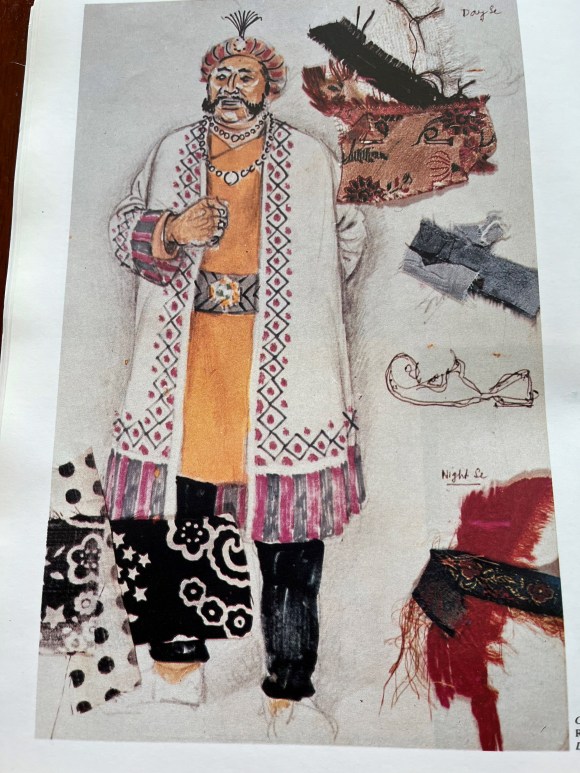
Costume designed and sketched by Ray for Hirak Rajar Deshe (In the Country of the Diamond King, 1980) Sourced from the brochure provided by Dolly Narang
Ray’s Note in the Brochure:

My grandfather was, among other things, a self-taught painter and illustrator of considerable skill and repute, and my father — also never trained as an artist — illustrated his inimitable nonsense rhymes in a way which can only be called inspired. It is, therefore, not surprising that I acquired the knack to draw at an early age.

Although I trained for three years as a student of Kalabhavan in Santiniketan under Nandalal Bose, I never became a painter. Instead, I decided to become a commercial artist and joined an advertising agency in 1943, the year of the great Bengal famine. Not content with only one pursuit, I also became involved in book designing and typography for an enterprising new publishing house.

In time I realised that since an advertising agency was subservient to the demands of its clients, an advertising artist seldom enjoyed complete freedom.

This led me to the profession of filmmaking where, in the 35 years that I’ve been practising it, I have given expression to my ideas in a completely untrammelled fashion.

As is my habit, along with filmmaking, I have indulged in other pursuits which afford me the freedom I hold so dear. Thus, I have been editing a children’s magazine for thirty years, writing stories for it and illustrating them, as well as illustrating stories by other writers.

While preparing a film, I’ve given vent to my graphic propensities by doing sketches for my shooting scripts, designing sets and costumes, and even designing posters for my own films.

Since I consider myself primarily to be a filmmaker and, secondarily, to be a writer of stories for young people, ·I have never taken my graphic work seriously, and I certainly never considered it worthy of being exposed to the public. It is entirely due to the tenacity and persuasiveness of Mrs. Narang that some samples of my graphic work are now being displayed. Needless to say, I’m thankful to Mrs. Narang; but, at the same time, I must insist that I do not make any large claims for them.
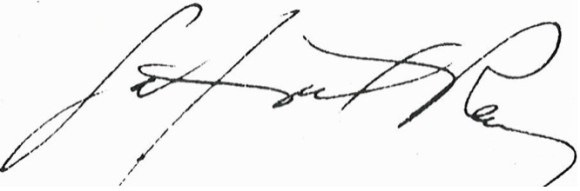
Ray’s signature: Sourced from the brochure provided by Dolly Narang

 SATYAJIT RAY

The Consummate Artist by Paritosh Sen (1918-2008)

(Republished from the brochure of “The Other Ray” exhibition)

It was the summer of 1945. I was holding my third one-man show and my first in Calcutta. On the third day of the exhibition, Prithwish Neogy (a brilliant scholar, now heading the Department of Asiatic Art at the Honolulu University) entered the exhibition hall accompanied by an extraordinarily tall and swarthy young man. I had known Prithwish earlier. The latter was introduced to me as Satyajit Ray. I was vaguely aware of him as the only son of the late Sukumar Ray, the creator of a unique body of nonsense rhymes and humorous prose remarkable for their originality of vision and an extremely sharp intellect and imaginative power. Satyajit was also known as the grandson of Upendra Kishore Ray, one of the inventors of half-tone block making, a pioneering creator of a sizeable body of children’s literature and the founder of the well-known children’s magazine, Sandesh, and a painter of no mean talent either.

Satyajit was then doing a course in painting in Santiniketan under the very able guidance of Benode Behari Mukherjee, a great artist and an equally great teacher. Besides, Ray had also the unique opportunity of coming in close contact with Nandalal Bose, the guru of both Benode Behari and Ram Kinkar, undoubtedly the foremost sculptor of contemporary India.

Earlier he had also received the blessings and affection of Rabindranath Tagore. Although he did not complete the art course in Santiniketan, the experience of being surrounded by these great artists and the unique rural setting of the Santhal Parganas, as portrayed by these artists and the poet, enabled Ray to appreciate nature in all its diverse and glorious manifestations and opened his eyes to the mysteries of creation. This single unprecedented and cherished experience helped him to formulate his ideas about the visual world and to unlock doors of visual perceptions. Added to this was his study and understanding of the classical and folk art, dance and music of our country. The magnificent collection of books in the Santiniketan library of world art and literature also helped him to widen his horizon. It was here that he read whatever books were available on the art of cinema. The seeds of a future design artist and a filmmaker were simultaneously sown here.

Having lost his father early in life, the need for earning a livelihood assumed enough importance to make him leave Santiniketan prematurely and look for a job in the field of advertising art or, as it is better known in modern parlance, graphic design. A latent talent is bound to make its presence felt sooner or later, whatever be the chosen field. As Tagore said in one of his early verses, “Flowers in bloom may remain hidden by leaves but can they hide their fragrance?” Satyajit Ray was appointed by the then D.J. Keymer (now known, as Clarion Advertising Services Ltd.) as a visualiser-cum-designer, often executing the finished design or an entire campaign himself.

Together with two of his contemporaries, O.C. Ganguli and Annada Munshi, Ray was trying to evolve certain concepts not only in illustrations but also in typography which would give their design an overall Indian look. One recalls those highly distinctive newspaper and magazine ads, the magnificent calendars, posters, cinema slides and what not of the late ’40s and ’50s not without a certain nostalgia. If my memory does not fail, I think some of the works of these three artists were even published in Penrose Annual and elsewhere. Here it may be worthwhile to bear in mind that the style evolved by these three artists made a welcome departure from the dull academicism and the stereotypes being practised by most of the advertising agencies of those times. The freshness and vigour displayed in their approach was readily appreciated both by their employers and their clients. Ray was particularly strong in the difficult area of figure drawing, an area in which many graphic designers were found singularly wanting.

Although he was soon to move away from commercial art to embrace his new-found love of filmmaking, he would continue to remain an illustrator of the first order as would be evident from his emergence as a story-teller in the two popular genres of detective and science fiction. (Not many outside Bengal know that Ray’s literary output is in no way less than that of his cinema and that most of his books have already run into thirty to thirty-five editions). He has not only been illustrating his own stories, but over the years he has been designing the covers of his grandfather’s once defunct children’s magazine Sandesh, revived by him nearly two decades ago, which also carried many illustrations by him. But in my opinion his most cherished field is calligraphy, whether that be of the pen or brush variety.
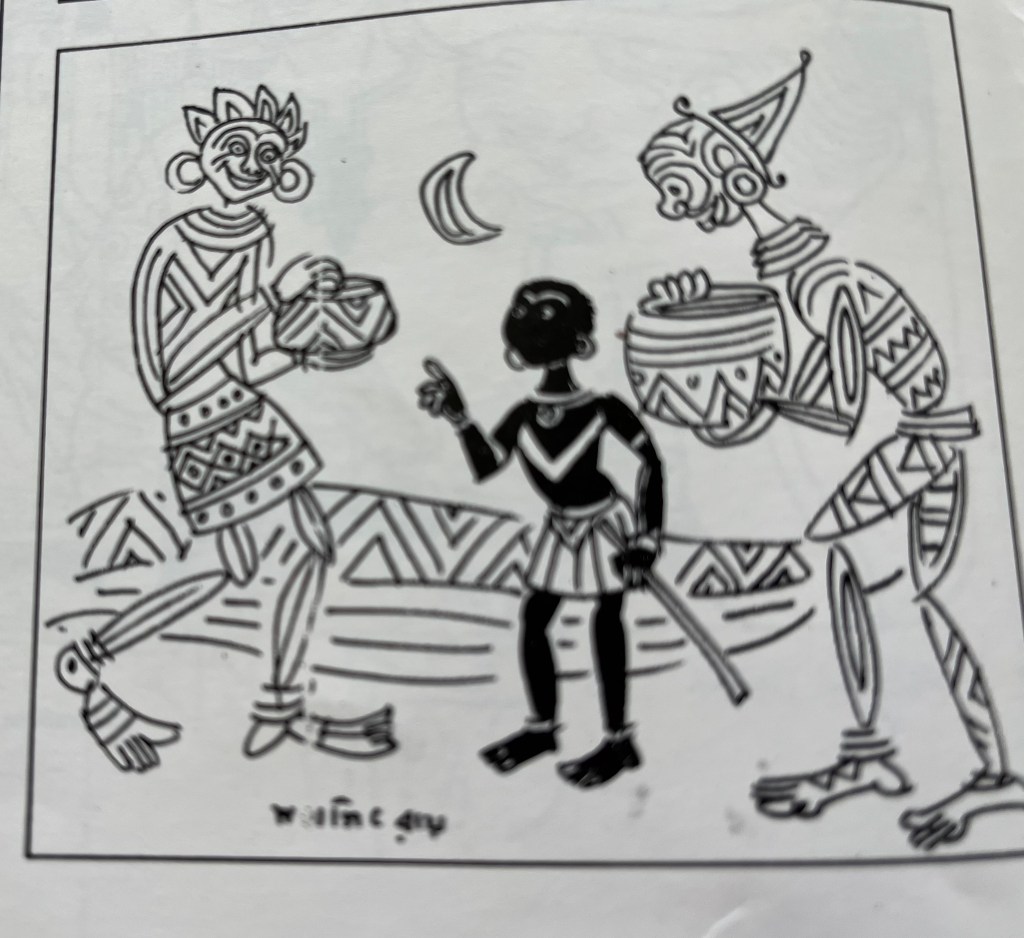
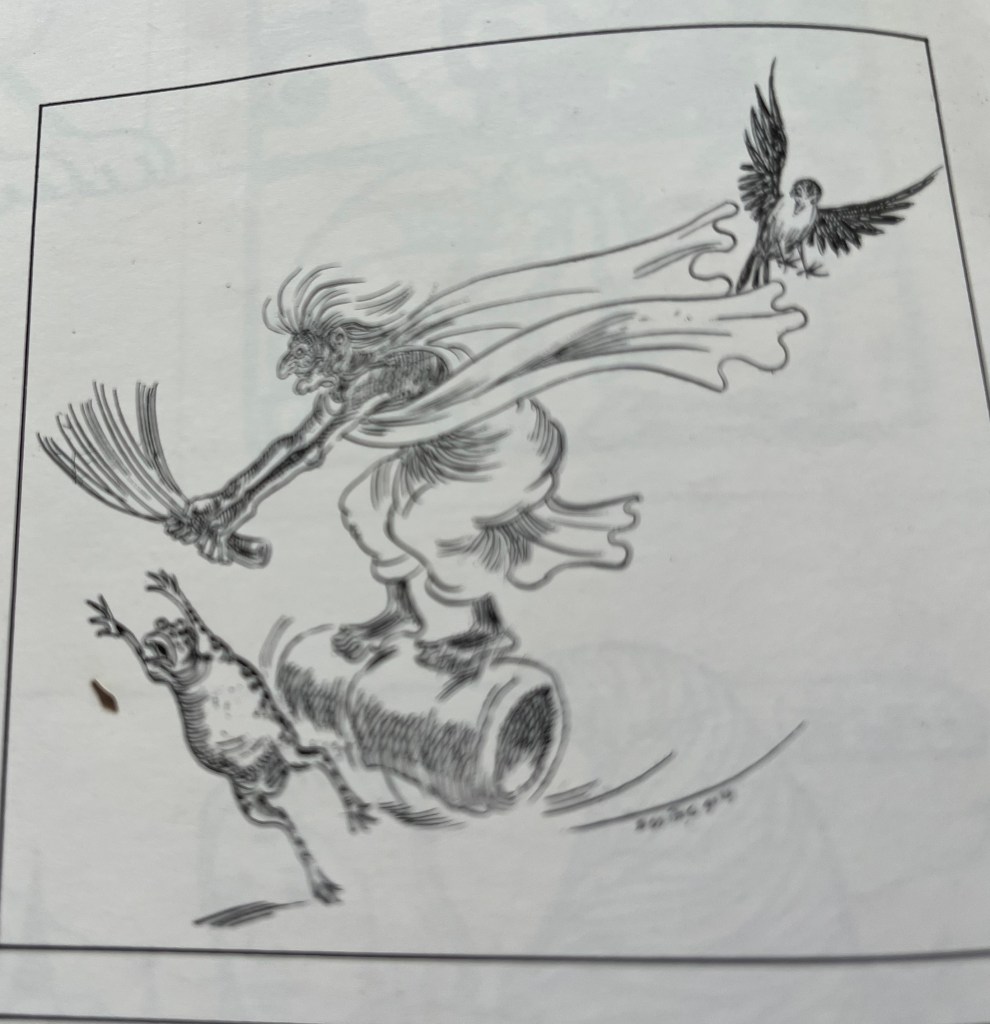
This art he imbibed from his guru Benode Behari Mukherjee. Over the years he had also been studying the art of typography with the scrutinising eye of a highly creative calligrapher. The result has been a series of innovations in both Bengali and English lettering evolved for posters, banners and book covers. These very original works gave a tremendous fillip to graphic design in general and book, magazine and record covers in particular, especially in Bengal. The books Ray designed for the now defunct Signet Press of Calcutta way back in the early ’50s set new trends and were considered as models for book production both in terms of page layout, typography and jacket design, the last being his chosen field where, as I said earlier, his innovations have known no bounds. The covers of the well-known literary magazine Ekshan, which he has been designing for many years, to give only one instance, bear ample testimony to his apparently playful but significant experiments with the forms of three Bengali letters which constitute the name of the magazine. The wide variety of his inventiveness is one of his great achievements in the field of cover design.
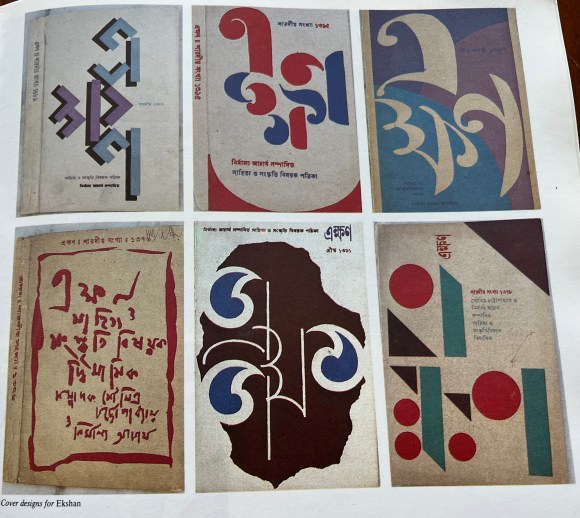
Cover designs for Ekshan. Sourced from the brochure provided by Dolly Narang

Then there are the posters, banners and slides he designed for his own films. These too were eye openers and instant trend setters. Who can ever forget the huge banners and billboards of the Apu trilogy put up at important street junctions of Calcutta! Their freshness of ideas, design concepts and calligraphy were not to be missed even by men and women in the street. Simultaneously with his creative outburst in the art of cinema, his creativity in graphic design reached new heights. What was remarkable was the fact that Ray imminently succeeded in investing all these works with a highly distinctive Indian flavour derived from his awareness of our folk traditions (especially 19th century Bengali book illustrations and woodcut prints of decorative lettering) both in their linear vigour and simplicity as well as in ornamentation.

One of the most outstanding examples of this approach was the publicity material he designed for Devi. The underlying theme of the title expresses itself forcefully both in the highly imaginative design of the lettering and the image. Their fusion is perfect. Not many graphic designers have been as type conscious as Ray. He personifies the printing designer’s gospel “type can talk”. That a letter or a printing type is not only a sign but an image by itself, and if appropriately employed can have immense communicative power and is capable of expressing a whole range of human emotions was known to Ray from the very beginning of his career.

In the enormous range of Roman printing types there are many in the humanist tradition in their simple aesthetic charm, warmth of feeling as well as in their highly elegant but delicate anatomical details. There are also those which are severe, powerful and cold but nonetheless are highly attractive in their own ways.

It is often overlooked by most readers that a letter’s structure and anatomy can be reminiscent of things in the visible world, both natural and man-made. Some can have the gentle rhythm of the rise and fall of a female form, others may have the majestic look of a well-designed edifice-just to give only two similes. Ray not only bore all these considerations in mind but used his calligraphic knowledge, skill and innovative power to their full advantage when he designed the three printing types called Ray Roman, Daphnis and Bizarre for an American type foundry nearly two decades ago.
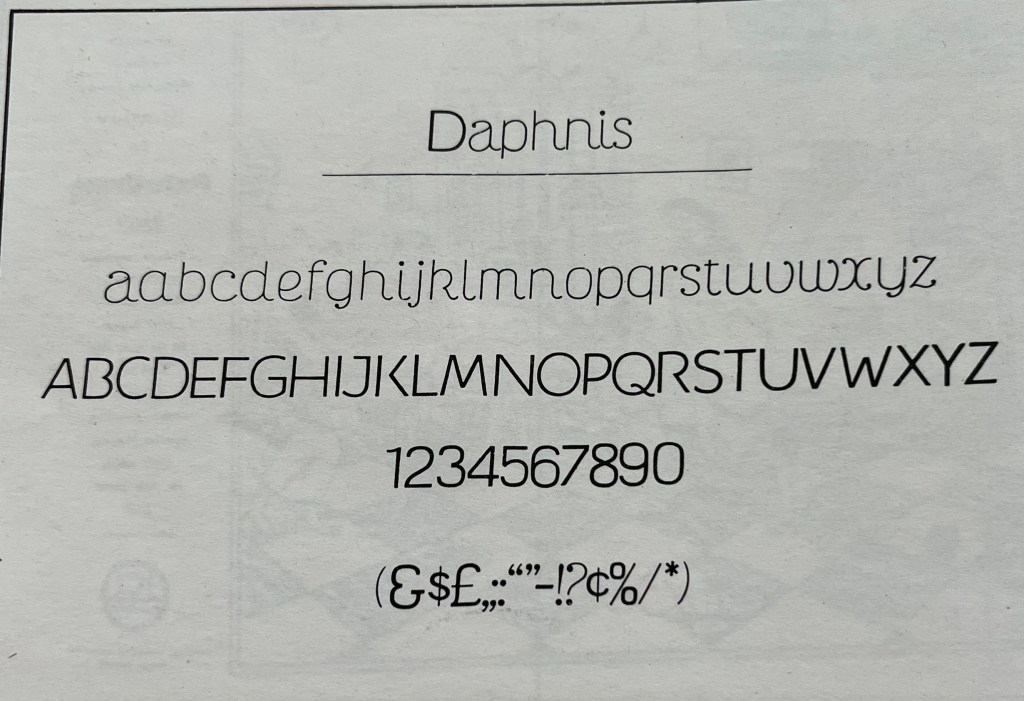
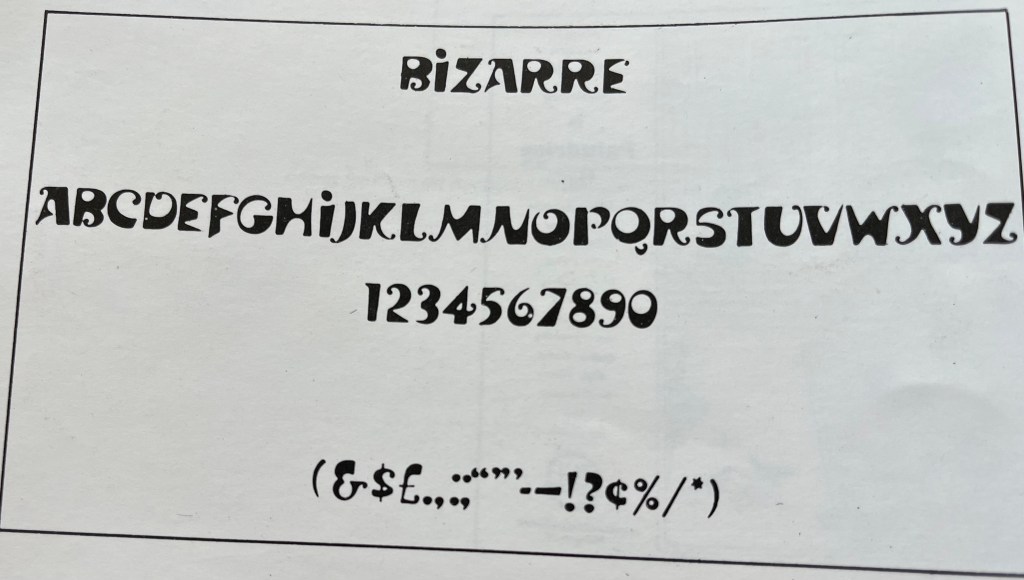
Not many of us know the infinite patience, rigours, discipline and the endless process of trial and error involved in designing a whole series of a printing type. That, in spite of his other demanding preoccupations, he found enough time to design three complete sets of types bears ample proof of his diligence and perseverance and his passionate love for the world of types. Those of us who have known him over the past decades are profoundly admiring of the fact that he is a workaholic in the best sense of the term. His diverse creative output is staggering and would put many a man half his age to shame.

In the ’40s, I met Satyajit periodically as I worked as an art master in Indore. One of the high points of my visits to Calcutta during the long summer or the short winter holidays was to frequent his ground-floor apartment in South Calcutta. It was at his place I first listened to TS Eliot’s recital in the poet’s own voice of The Waste Land which was just brought out by HMV (now known as EMI). It was on such visits I would also have an opportunity to listen to his latest collection of records of European classical music. And it was also on one of such occasions I first heard him toying with the idea of making a film based on Rabindranath Tagore’s novel, Home and the World, a project which was abandoned soon after and was finally realised nearly four decades later.

It was not before1 returned home in 1954 after a five years’ stint in Paris that I came to know of his intense involvement with the making of Pather Panchali[4]. I vividly remember to this day the excitement with which he described it to me and invited me to a screening of the rushes. He brought out all the sketches and doodles he made along with side notes in Bengali not only of the dress, props and characters in the script but also very quick but masterly sketches of frames of each of the sequences, camera movements, etc. I remember asking him why he thought it necessary to make such careful preparations before shooting. To which his quick but significant reply, “One of the foremost but very difficult things in filmmaking is to determine the placement of the camera.” He was equally quick to point out that this is only the first part of shooting a movie and not stills.

Those of us who watched him in action know only too well that although there is always a professional cameraman present in his unit, in reality he becomes the cameraman himself. The visual richness of a film is as important to him as a story well told — the one being inseparable from the other. This is the most distinctive feature of his artistic achievements in all his films.

Ray is a lyricist of the highest order. From his first film Pather Panchali to his latest Shakha Prashakha[5], this lyrical bend binds all his films together in the form of an oeuvre and finds full fruition in his most recent work.

Some of the imperceptibly slow camera movements in this film are sheer poetry. Although not yet released, I had the opportunity of seeing it twice, and apart from anything else, I as a painter was bowled over by its visual richness and its consummate technical finesse. I have reasons to say this. Whenever I see a movie, I try to see it through the lens of the camera and having witnessed many film shootings of some of Ray’s films, it has become a habit with me to follow the movements with great fascination. Thus, it helps me greatly to enjoy watching a film from the aesthetic and technical viewpoint.

I am sure that in order to achieve maximum artistic quality Ray finds the preliminary exercises made primarily in pen and ink very useful. These small and simple sketches, evidently done in quick succession, have all the spontaneity and vigour of something impeccably visualised and bear the unmistakable stamp of a born lyricist. Their linear treatment, unorthodox positioning on paper and an apparent insouciance, at any rate, in my eyes, are the products of a highly creative mind and are designed to meet the needs of a fastidious aesthete.

Among the sketches, one comes across portraits of many of the characters in his films in various moods and postures. These could easily be rated as some of his best works in this group. Only someone with consummate skill can bring out the full characterisation in a postage-stamp format with utmost economy and clarity. The lines which define the contours and other details of the figures are free flowing, sure and firm, the result of years of practice both with the pen and the brush.

One of the most interesting exhibits in the present collection is the album containing one of his earliest essays in visualisation of a film project — the documentary he once wanted to make on Ravi Shankar playing the sitar and on the tabla accompaniment. Ray showed it to me as early as 1954. It is possible that the inspiration came from his viewing Uday Shankar’s ballet film, Kalpana (Imagination) ­-– a film which he studied frame by frame by taking scores of stills in the dark theatre where the film was released. He showed me the entire series one by one and pointed out among other things the unusual camera angles, the dramatic lighting, the magic of black and white, especially in the close-ups of both the dancers and the tabla playing. Although the Ravi Shankar film was never released, I think Ray thoroughly enjoyed the exercise and learnt a lot from it.
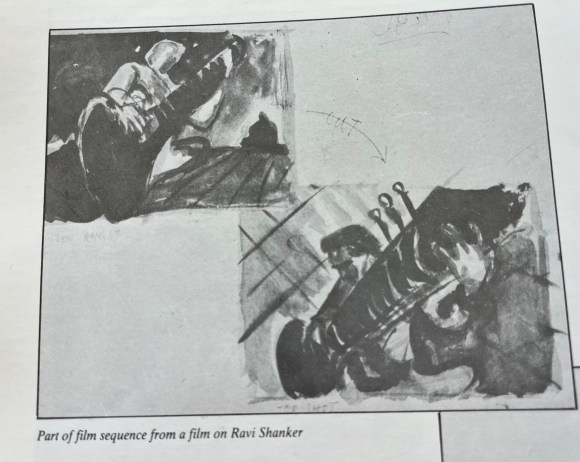
Sourced from the brochure provided by Dolly Narang

This, along with numerous sketches and doodles related to his films, will ever be regarded as something unique in the history of filmmaking in our country.’ Only a few’ and they can be counted on one’s fingers, in world cinema have been such gifted artists too like Eisenstein, Kurosawa, Fellini and a few others. The Village Gallery should be congratulated for presenting to us “The Other Ray – the Consummate Artist.”

[1] Is Satayjit Ray there?

[2] Lila Mazumdar ( 1908-2007, a well-known Bengali writer of children’s stories) 

[3] The All India Fine Arts and Crafts Society

[4] Song of the Road,1955

[5] Branches of a Tree, 1990

Dolly Narang, a gallerist, has conceptualised  innovative  pathbreaking exhibitions. A recent student of sculpture, she has the satisfaction of experiencing both personal and spiritual evolution as a Pranic healer and as a grandmother. 

.

PLEASE NOTE: ARTICLES CAN ONLY BE REPRODUCED IN OTHER SITES WITH DUE ACKNOWLEDGEMENT TO BORDERLESS JOURNAL

Click here to access the Borderless anthology, Monalisa No Longer Smiles

Click here to access Monalisa No Longer Smiles on Kindle Amazon International
Categories
Essay Interview Review

The Ultimate Genius of Kishore Kumar

An exhaustive essay by Shantanu Ray Chaudhuri, one of the best film critics from India, an editor and writer along with an interview with the writers of the book, The Ultimate Biography, on the film legend and genius called Kishore Kumar

Kishore Kumar

Introducing the Genius of Kishore Kumar

Singer, composer, lyricist, director, writer, actor — Kishore Kumar was all this and more. Apart from Satyajit Ray, I can think of no other person in cinema whose talents ranged across so many departments. As a playback singer, he had no parallels – not Mohammad Rafi, not Hemant Kumar, no one came close. As an actor, he was almost surreal in comedies like Half Ticket and Chalti Ka Naam Gaadi[1]. It is only because we do not view comedy as an artform at par with tragedy and melodrama that his contribution as an actor has not been acknowledged. As a director and writer, he balanced the almost surreal Badhti Ka Naam Dadhi [2] with the minimalist Door Wadiyon Mein Kahin[3]. It is immensely sad that he did not have more films and songs to his credit as a composer and lyricist.

Take a look at these dialogues —

Kya dekh rahe ho, Prashant?

(What are you seeing Prashant)

Uss raaste ko jo duur pahariyon ke beech kho gaya.

(I lost myself in that distant road among the hills)

Haan, musafir aur raaste ka gehra sambandh hai. Shayad uss raaste ko dekh kar tum apni naye safar ke shuruwat ke barey me soch rahe hogay.

(Yes, the traveller and the road has a deep relationship. Perhaps seeing that road, you are thinking of a new start for yourself)

Jindegi ek safar hai, Joseph sahab, aur uss raaste ka koi anth nahin. Har purani raah ek nayi raah ko janam deti hai aur manzilon ke silsile kabhi khatam nehi hote. Sirf uska saath denewale musafir badal jatein hai.

(Life is a journey, Joseph sahab, and that way has no ending. A new path is born of old roads and the stories never end. Only the traveller changes.)

Theek kaha tumney, Prashant. Saath denewala musafir hamesha badal jatey hain. Magar na jane kyon log phir bhi jazbaati ho jatein hai. Darasal zindagi ka maqsad hai zindagi ka saath nibhana, par tum in raston ka saath nibhakar chaltey ho. Aisa kyon?

(You are right, Prashant. The travelling companions always change. But people for some unknown reason become emotional. Actually, the goal of life is to be with life, but you walk along the paths. Why?)

Unhi raaston mein hi toh zindagi hai, Joseph sahab … kahin khushi, kahin ansoo, kahin dukh, kahin hahakar, kahin itni bhook aur lachari ki insaan par zindagi bhari hain, aur kahin itni khushiyan ki aadmi sambhal hi nahin sambhalta. Hamein in sab ka saath nibhatey chalna hai … uss anjaney andekhe path par … jiska koi anth nahin…

(Those paths is where you find your life, Joseph Sahab… Our Life is full of happiness, tears, sorrows, despair, sometimes it is full so much hunger and desperation that life becomes a burden and sometimes there is so much happiness that it spills over. That unknown, untrod path knows no end.)

– A sequence from Door Ka Rahi[4], 1971

So entrenched is his reputation as a comic star that it might come as a surprise that this exchange above was scripted, directed and acted by Kishore Kumar in one of his most atypical roles.

In the wake of his madcap antics in Chalti Ka Naam Gaadi (1958) and Jhumroo (1961), and the sustained lunacy of Half Ticket (1962, where he plays Vijaychand vald Lalchand vald Dhyanchand vald Hukumchand alias the child Munna, as also his own mother, in a performance that has no parallel in Hindi cinema), Door Gagan Ki Chhaon Mein [5](1964) was probably what audiences and critics of the era might have least expected from Kishore Kumar.

Why only audiences and critics? As film folklore has it, even elder brother Ashok Kumar was sceptical of his ability to deliver the emotion required for serious songs. Composer Chitragupt had reportedly composed the beautiful ‘Itni badi yeh duniya’ [6](Toofan Mein Pyar Kahan[7],1966) only with Kishore Kumar in mind and even recorded it. Only to have the star of the film, Ashok Kumar, on whom the song was to be picturized, veto it. Ashok Kumar felt that his younger sibling did not have it in him to give the song the pathos it required and that only Mohammed Rafi could do it justice. The song was recorded again, this time by Rafi who did a brilliant job.

And yet in his directorial ventures, Kishore Kumar time and again presented a facet of himself that other filmmakers never tapped and no other producer had the vision to explore. Which is why each of these films had the singer multitasking as producer, director, actor, writer and composer.

Door Gagan Ki Chhaon Mein

Based on the 1958 Western The Proud Rebel, starring Alan Ladd, Door Gagan Ki Chhaon Mein is the story of a soldier, Shankar (Kishore Kumar), who returns from a war to find that his wife and father have perished in a fire that has destroyed his house. The trauma has robbed his ten-year-old son Ramu (Amit Kumar in his maiden film appearance) of his voice. Shankar sets out on a quest to treat his son and restore his voice. On the way, they are waylaid by a villainous Thakur (Raj Mehra) and his thuggish sons (played by Iftikhar and Sajjan). They are rescued by the kind-hearted Meera (Bengali superstar Supriya Devi), who shelters them and becomes a surrogate mother to Ramu.

It is unlike any film that Kishore Kumar had starred in (barring probably Hrishikesh Mukherjee’s Musafir[8]). And though the inspiration may have been James Edward Grant’s story directed by Michael Curtiz, it is the influence of Satyajit Ray that is apparent in the making. The singer-director had reportedly watched Ray’s Pather Panchali[9] thirteen times before embarking on his directorial debut. The setting is rural (barring one sequence set in the city) and the director gives us a close look at the landscape, the ramshackle hutments, the swaying fields, the water rippling in the ponds, even the dog that follows Ramu every step of the way.

The film is of course now part of Hindi film legend because of its songs. Kishore Kumar himself wrote that ultimate father-son anthem ‘Aa chal ke tujhe’, a sequence that in the bonding between the two recalls the final sequences of Ray’s Apur Sansar[10]. Shailendra penned the other classics, including Koi lauta de meray[11]and Jin raaton ki bhor nahin hai[12]and two Asha Bhosle gems. But it is in the way that Kishore Kumar eschews all trappings of his comic persona to capture the little moments around the characters that the film stands out in the midst of the fluffy entertainers that characterised the era. Interestingly enough, Iftikhar, who plays the main villain, also designed and painted the film’s title cards.

The film was critically well-received, with even the impossible-to-please Baburao Patel of Filmindia calling it a film that “just misses out on being a classic”. Though not a big commercial success, the film did well enough, and Kishore Kumar had the last laugh vis-à-vis another film at the time which was expected to be a blockbuster. As Kishore Kumar narrated in his now-cult interview with Pritish Nandy, “It started with an audience of 10 people in Alankar. I know because I was in the hall myself … Even its release was peculiar. Subhodh Mukherjee, the brother of my brother-in-law, had booked Alankar for 8 weeks for his film April Fool[13], which everyone knew was going to be a blockbuster. My film, everyone was sure, was going to be a thundering flop. So, he offered to give me a week of his booking. Take the first week, he said flamboyantly, and I’ll manage within seven. After all, the movie can’t run beyond a week. It can’t run beyond two days, I reassured him. When 10 people came for the first show, he tried to console me. Don’t worry, he said, it happens at times. But who was worried? Then, the word spread. Like wildfire. And within a few days, the hall began to fill. It ran for all 8 weeks at Alankar, house full! Subodh Mukherjee kept screaming at me but how could I let go the hall? After 8 weeks when the booking ran out, the movie shifted to Super, where it ran for another 21 weeks! That’s the anatomy of a hit of mine. How does one explain it? … Can Subodh Mukherjee, whose April Fool went on to become a thundering flop?”

Door Ka Rahi[14]

With Door Ka Rahi (1971), Kishore Kumar goes a step further with his character. Hindi cinema seldom has a drifter as the protagonist. As a people, we do not take to characters who do not have a definite goal in life – in the world of Hindi films that either means pursuing the girl you love or avenging the death of your family and loved ones. Prashant (Kishore Kumar) is unlike any hero in Hindi cinema. He does not have a love interest. He has no family of his own. He refuses to settle down at one place. Prashant reminds me of Larry Darrell, the protagonist of Somerset Maugham’s Razor Edge[15].

The film opens with a sequence of an old man trudging his way through the snow before collapsing. As he breathes his last, he reminisces about his life and the many people he has known and whose lives he has touched. There’s Karuna who wants to set up home with him, there’s a group of orphans he takes care of, there’s his friend Vimal (Abhi Bhattacharya) and his family that includes his wife and her brother Jeetu (Amit Kumar) who are being exploited by their local zamindar and moneylender. In the final episode of the film, he comes across a widow Monica (Tanuja) and her father-in-law Joseph (Ashok Kumar). He reminds them of George, Joseph’s son and Monica’s husband. Even as Joseph proposes that he stay back and make a life with Monica, Prashant has to take a decision on the larger calling that beckons him.

If one thought that Door Gagan Ki Chhaon Mein would be a hard act to follow musically, Door Ka Rahi goes one better with what are possibly the finest philosophical numbers in any Hindi film ever. No other Hindi film in my view has songs that so evocatively capture the essence of a film. If Shailendra’s ‘Chalti chali jaaye[16]’, rendered by Hemanta Kumar in a splendid baritone, echoes the eternal journey that is life, Irshad’s words in ‘Panthi hoon main’, ‘Khushi do ghadi ki’ and the ephemeral ‘Beqarar dil tu gaaye ja’ evoke a spirit that few lyricists in Hindi cinema have managed. There’s also Manna Dey’s ‘Ek din aur gaya’ and the Kishore songlet ‘Mujhe kho jaane do’.

Door Wadiyon Mein Kahin

While Door Gagan Ki Chhaon Mein and Door Ka Rahi marked a break from the standard film fare of the times and Kishore Kumar’s image as an actor, Door Wadiyon Mein Kahin (1980) demonstrated his penchant for experimentation – one that earned the filmmaker plaudits from none other than Satyajit Ray himself.

He not only did away with songs – in itself a huge creative decision given his stature as a singer – he decided to shun music altogether in the film. Thus, you have that rare Hindi film that does not have a background score. Instead, there is a remarkable array of natural sounds filling in – the crunch of feet on snow, the rustle of leaves, the soughing of the breeze, and silences which accentuate the bleak and forlorn ambience of the film. 

The film begins with an extreme close-up of a pair of eyes watching a bird in flight against the vast expanse of the sky, accompanied by the azaan[17] on the soundtrack. The camera pulls back to reveal a man holding on to the bars of a prison window. Aslam (Kishore Kumar) is serving a term in this jail set in the middle of inhospitable mountainous terrain. He talks to the warden (Raza Murad – who is nameless in the film and is always addressed as ‘Inspector Sahab’) about how suffocating imprisonment can be for a man, and how envious he is of birds. At the first opportunity he gets, Aslam makes a run for it with his prison mate Ghulam Ali.

While Ghulam Ali dies during the escape, Aslam finds himself in a farm inhabited by a mother-daughter duo, Olivia (Bindu, in quite a turn with her grating voice, in one of her rare starring roles) and Jennifer (Shyamalee). His presence sets off a chain of events involving the women, both of whom take a fancy to this man from nowhere. Interestingly, if in Door Ka Rahi, Prashant is a free spirit refusing to be tied down to one place or any human attachment, in Door Wadiyon Mein Kahin, Aslam seeks to break free but fails. The escape from the prison only leads him to another one in the form of Olivia and Jennifer’s house. As he tells the inspector at the end, the world, life itself, is a prison. The only difference with his erstwhile prison is in scale. And the only escape lies in death.

Mamta Ki Chhaon Mein[18]

The last of these atypical films that he directed was his final outing too – Mamta Ki Chhaon Mein (1989). Unfortunately, Kishore Kumar passed away while the film was in production and it was Amit Kumar who completed it. Unlike the others in this list, Mamta Ki Chhaon Mein is not a very distinguished piece of filmmaking with a dated story celebrating the greatness of motherhood that belongs more to the hoary 1950s. It is surprising that Kishore, who broke away from established mores in the other films, zeroed in on this hackneyed theme for his swansong, which looks more like a love-letter to wife, Leena Chandavarkar.

The film tells the story of Gauri (Leena Chandavarkar) who brings up her son Niranjan (Amit Kumar) single-handedly. She nurses a secret about Niranjan’s father which forms the crux of the film. Niranjan grows up with the question about his father haunting him all his life. He travels to the nearby town for his higher studies, and it is here that he comes in contact with a man (Raj Babbar) who claims to know Gauri and gives Niranjan an unsavoury take on her past. Niranjan confronts his mother, but she refuses to divulge her secret, leading to the two falling out. The rest of the film deals with the story of Gauri’s past and Niranjan’s realization that he has been unfair to his mother.

It’s a poor film in every respect but it’s impossible not to feel nostalgic about a film that recreates one of Kishore’s cult crazy songs, ‘Allah Allah … Bhagwan bhagwan’ (Hum Do Daku[19], 1967). Or one that has what is probably Kishore’s last playback for Rajesh Khanna (who has a cameo in the film), aptly titled ‘Mera geet adhoora hai’[20]. It was reported in the media at the time that the director had wanted Amitabh Bachchan in the role. However, the star was not forthcoming and that affected the relationship between the two. Kishore in fact hinted at this in an interview at the time and named Manmohan Desai as the one responsible for the rift between him and the star whose voice he was.

Then there is the music of course. A standout album, this has some of Kishore’s most lovingly crafted songs. He himself sings two gems while Amit Kumar has four numbers which count among his best, including ‘Main ik panchhi matwala re[21](which he had earlier rendered in Door Ka Rahi) and the life-affirming ‘Beeti jaaye[22](the mukhda[23] of which harks back to the antara[24] of one of his hits from Jhumroo, ‘Ge ge ge geli jara Timbuktoo’[25]. The composer in Kishore Kumar could not have asked for a better album to bid adieu.

The Call of the Distant Horizon

There are certain aspects that one finds in common across these films. An old man looking back on life. A loner as the protagonist – a man with a love for the road as well as the road less taken. A man with a unique philosophy of life. Time and again in these films you have the protagonist articulating that he does not know who he is, nor where he comes from or is bound for. As the character in Door Ka Rahi says – door ko apne qareeb bula leta hoon aur khud ko apne se door kar leta hoon (I embrace that which is faraway while I distance myself from me). There’s a lingering sense of the fleeting nature of life, a longing for a lost past. These lines from the film that Kishore hums hold true for almost all the protagonists across these films:

Mujhe kho jaane do duniya ki nigahon se parey

Jahan na dhoond sakey koi nazar mera nishaan

Koi awaaz na pahunche, koi aansoo na bahey

Kisi tinke, kisi zarre ko na ho mera ghuman

Meri laash par rakhde kudrat hi ek safed kafan

Rooh ko meri nazaron mein hi kho jaane do

Dastaan meri hawaon ko hi dohrane do[26]

There’s an affinity for birds and the freedom they epitomize, for animals roaming in the wilderness, and for people at the margins, for example, the madman who befriends Ramu in Door Gagan Ki Chhaon Mein. And a genuine feel for harmony. It says something that the protagonist in Door Wadiyon Mein Kahin is a Muslim (the climax has a beautifully understated sequence where Aslam offers namaz while the police officer waits to arrest him) while Christians are pivotal characters in two of these films.

None of these films is set in a city. The cinematography (Aloke Dasgupta in the first two and Nando Bhattacharya in the rest) captures the everyday sight and sound of the countryside. There’s a song in a bullock cart in each of these films (barring Door Wadiyon Mein Kahin) which articulate a philosophy of life and that of the film – Door Ka Rahi and Mamta Ki Chhaon Mein begin with such a song. There’s a feel for the topography that is very ‘Western’ in its look. Parts of Door Ka Rahi evoke Shane [27]as the man rides from one destination to the next (Shane was probably a favourite of the singer as his unfinished film Neela Aasmaan[28]has a song, ‘Akela hoon main is jahan mein[29]’, inspired by Shane’s theme). Door Gagan Ki Chhaon Mein is of course based on a Western and Kishore invokes the look of the original at many places. Door Wadiyon Mein Kahin stands out for some breath-taking shots of the barren snowy terrain against which the drama plays out.

These film of Kishore Kumar may not have been great commercial successes. And his craft as a filmmaker may not secure him a rank among the best. There is however no denying his desire to go out on a limb and give us films that leave you with something to reflect on. He was seemingly unperturbed by the fact that the films wouldn’t run. As he told Pritish Nandy, “I tell my distributors to avoid my films. I warn them at the very outset that the film might run for a week at the most … Where will you find a producer-director who warns you not to touch his film because even he can’t understand what he has made.”

And yet he made them. Why? “Because,” as he said, “the spirit moves me. I feel I have something to say.”

On the evidence of these films, despite their flaws, the spirit behind them has the power to move the viewer too.

Book Review of The Ultimate Biography

Given the range of his contribution and the eccentricities that defined his personal life, a biography of Kishore Kumar that adequately covers his life and times is a tall ask. Anirudha Bhattacharjee and Parthiv Dhar’s exhaustive biography of the legend, audaciously titled The Ultimate Biography, pulls it off – well, almost.

For one, it is a pleasure to come across a biography of a legend like Kishore Kumar that does not seem like an armchair hack job (refer to, say, Aseem Chhabra’s book on Shashi Kapoor, Yaseer Usman’s on Guru Dutt, Rajeev Vijaykar’s atrocious ones on Laxmikant-Pyarelal and Dharmendra and the many banalities that go for biographies these days). At close to 600 pages, this one is a painstakingly researched tome. And it does not even talk about his repertoire as a singer in that great a detail. As co-author Anirudha Bhattacharjee tells me, “If I were to make a selection of even a hundred of his songs – an impossible task – and talk about them, this book would have gone beyond 2000 pages.”

Despite that, what the book covers by way of the trajectory of Kishore’s life is commendable. The authors have gone to great lengths to get first-person accounts, supplementing that with a great eye for trivia and other obscure facts. They incorporate all of this in bite-sized chapters, most of them three to four pages long, so that the reading never gets tedious. It also gives the book that essential quality in an era of short attention spans: you can open to any page and start reading. Though it does come at the cost of a detailed analysis of any one aspect.

And it is a delight to have such detailed indexes – a general one and a song index – in a book. Most publishers have abandoned the index to cut costs.

If I say the authors ‘almost’ pull it off, it is because the language leaves something to be desired. It could have done with a more rigorous copy-edit. The book gets off to an unfortunate start with the preface whose first paragraph had me scratching my head. And the inelegancies continue to haunt the careful, close reader off and on, with erroneous words, wrong sentence construction, often the syntax at odds. The authors seem to get carried away with the information they have to share, and some passages are a trifle overblown.

One would also have loved to see the authors playing it a little less safe, assessing Kishore Kumar vis-à-vis his contemporaries, or providing a more comprehensive reading of his directorial ventures. Or for that matter talking of what accounts for his popularity in the years after his death. During my growing years, I distinctly remember reading about him being dismissed offhand – Naushad’s comments are part of cinematic folklore (he in fact left the jury when it was decided to honour Kishore with the Tansen Samman). I grew up with people who swore by Rafi and Manna Dey, Naushad and Madan Mohan. And Kishore, despite his popularity, was someone who always came off second best in these conversations. Something shifted in the last thirty years. It would have been fascinating to understand what did. In response to my question on this, Parthiv Dhar says, “Nothing changed. Naushad was an aberration.” He goes on to mention the crowds at Kishore’s funeral. Which is not the issue here. Something in the way we consume music has led to a Kishore and RD [30] fandom like it probably never existed during their lifetimes. Why is it that with the opening of the airwaves, so to say, Kishore and RD have ruled almost all channels broadcasting music? None of their contemporaries – not Rafi, not Laxmikant-Pyarelal, definitely not Naushad or Mukesh – have enjoyed the kind of revival they have. 

The authors do not leave anything out – but the text often tends to become a chronological litany of facts. Fascinating, no doubt. And invaluable. But I could never shrug off the feeling that a book that has so much history and offers such delights, with authors who know the subject so well and don’t stint on research, should have been a little more.

Interview

Tell us something about the process of writing the book. Given that all the dramatis personae are long gone, how difficult was it to put information together.

Parthiv Dhar: Anirudha-da and I go a long way. In fact, around 2004-05, we started a campaign for the Bharat Ratna for Kishore Kumar, and did quite a fair bit of work. Probably it was at that time that writing a book on Kishore Kumar crossed our minds. I remember, we were clueless on the structure of the book owing to the multidimensional persona that Kishore was. My visit to Khandwa in 2010 and Anirudha-da’s book on R.D. Burman (with Balaji Vittal) winning the national award provided the much-needed impetus. Graduating to Kishore was a natural progression.

The visit to Khandwa made me realise that it would be a crime not to write a book on him, given the paucity of knowledge. Kishore himself did not help matters much by being extremely economical with the press. The Khandwa and Indore visits brought me close to his friends and their families, his caretaker at the Ganguly House, his college professors who went out of their way in sharing with us breath-taking anecdotes and documents. Fittingly, the book is dedicated to Khandwa. Apart from that we had a fantastic time at Bhagalpur, interacting with his relatives like Ratna-di, daughter of his cousin Arun Kumar, getting a treasure trove of unknown events related to his maternal side. Meeting his secretary Abdul was also a high point in the making of the book.

The decision to structure the narrative by ragas and their times: dawn, afternoon, evening. You slot Aradhana[31] in the evening. I found that interesting.

Anirudha Bhattacharjee: The structure with ragas developed organically given the enormous amount of material we had. The first draft was over a 1000 pages long. Giving it the structure enabled us to get clarity. As for Aradhana appearing under an evening raga … Madhubala passed away in 1969. That was probably a setback. His mother too passed away after a year. Kishore’s tenure as a hero had almost come to an end. He was forty. If we go back in time, K.L. Saigal passed away at the age of forty-two. Critics were urging Lata to stop singing in the late 1960s. She withdrew from the Filmfare awards after 1969. Hence, we equated the time with the evening of their lives. And extrapolated it to Kishore Kumar’s as well. Kishore had great strength of character and turned the tide … but that’s another story.

Would you say that Kishore was the one true maverick genius of Hindi cinema, maybe even Indian cinema? The only other person who comes to mind is Satyajit Ray.

Parthiv Dhar: Kishore Kumar was a phenomenon, the likes of whom you rarely encounter. He was perhaps the only person in showbiz whose reel and real lives were mirror images of each other. Precisely why there was no reason for him to ‘act’. You never knew whether he was acting on screen or being his own self. That held true even for his real life. His ratio of hits to total songs composed must be one of the highest in the world. He tried everything that the camera and the studios offered but unfortunately there were occupational hazards that clipped his wings. Had some of his unreleased songs and movies seen the light of day, he would have been unassailable. That he did all these only by pure observations and without any formal training made him a genius. As Rama Varma told us in a chat, he had the ability to identify shortcomings in a particular guitar string in the midst of a session without even looking at the guitar or the guitarist. Genius would be too small a word for him. However, we have not assumed much in the book and left the readers to judge for themselves.

What in your view is his greatest contribution to the art of playback singing in India? The one thing that sets him apart from all the rest.

Parthiv Dhar: Definitely the fact that he made singing appear so easy that emulation became an everyday affair. The clones would, of course, realise that the songs were after all not everybody’s cup of tea. But everyone would attempt a Kishore song. The very fact that he was an actor made him think like one when he would playback. Also, he was perhaps the only one to develop his texture and baritone with infrastructural progress each decade after independence. This led to him being probably the only one to realize that tragic songs need to make the audience cry, not the singer.

Anirudha Bhattacharjee: All our male singers except Bhupinder and too some extent Yesudas have been tenors. Maybe the timber has varied, but they are tenors, nevertheless. In my opinion, K.L. Saigal, Kishore Kumar and Pankaj Mullick were tenors who had a unique quality in their voice: ‘dhaar’ and ‘bhaar’ (sharpness and weight). This they used to great advantage. For other singers, it was a case of either/or. Hence, Kishore could playback for Dev Anand using his ‘dhaar’ (Hum hain rahi pyaar ke[32]), complement it with some ‘bhaar’ and ‘mizaaz[33]’ when he sang for Rajesh Khanna (Kuch toh log kahenge[34]), and use his ‘bhaar’ when he sang for Amitabh Bachchan (O saathi re[35]). He also had a strong swarranth[36], which gave the songs resonance. Plus, his flux density was unique. Even with such a heavy voice, it would remain steady when negotiating long notes, something very difficult to achieve. I know from experience as I sing.

He sang Saigal’s ‘Dil jalta hai[37]in reverse, set the Malthusian theory to tune, introduced scatting, yodelling, nonsense/gibberish words (bam chik chik) to music in India … where would you place these innovations in his output? Do you think his comic genius came in the way of him being taken seriously as a singer for the longest time?

Parthiv Dhar: He was born to innovate, and his childhood is testimony to that. Lateral thinking and he went hand in hand. Domesticating jackals, singing in reverse, giving nicknames to almost every friend, composer … the list is endless. How he handled the goof-up in Baap re Baap [38]is a terrific example of his innovation. Similarly, making a wardrobe malfunction in Badhti Ka Naam Dadhi the reason for executing anything and everything as a director’s prerogative could be another.

However, it is probably not true that his comic persona had anything to do with his singing. He started his career with several serious songs while simultaneously making people laugh in his movies. He gained recognition as a serious actor courtesy his roles in Bandi[39] and Naukri and was known as a sufficiently good actor. He sang for all the top music directors till as late as 1958. That he had a long gap after that could be attributed to his preoccupation with Madhubala’s health.

Let’s talk about him as an actor … would you agree that as a comic he had no parallels in India? It is only because comedy is not regarded as a genuine art form in India that there has been little recognition of him as an actor.

Parthiv Dhar: A very difficult question and not proper to say that he had no parallels. It should not be forgotten that he was a hero in almost 99 per cent of his films, a fact renowned actors would be proud of. While reviewing Bandi, critics had placed him above his more famous brother (in those days). As mentioned earlier, he did not enact comedy, it was in his DNA although by nature he was an equally serious person. His comedy was a mix of slapstick, mimicry, antics. Very few would enact comic role as a hero for the entire length of time without appearing stale. Kishore Kumar had that quality.

Where would you rank him as a filmmaker? Do you think he tended to overcompensate for his madcap image with his own films which were ‘serious’? Door Wadiyon Mein Kahin is a rather daring experimentation, even if the execution is amateurish. Even Ray commended its sound design. Your comments.

Anirudha Bhattacharjee: As a filmmaker, he was a lateral thinker. He tried unique subjects. But the issue is that he got entangled in too many activities at the same time and could never devote himself properly to making films. Had he concentrated only on filmmaking, he might have made some great films. Door Gagan Ki Chhaon Mein and Door Wadiyon Mein Kahin could have been classics.

You devote an entire chapter to Laxmikant Pyarelal. His songs with LP are not spoken of as much. You correct that, though you focus on their early collaborations…

Anirudha Bhattacharjee: We focused on Mr X in Bombay[40], Sreemaan Funtoosh [41]and Hum Sab Ustaad Hain[42] primarily because these films gave him the dimension of a singer first and a hero later. Till then Kishore was viewed as an actor who also used to sing. People forgot Mr X in Bombay (it was a bad film) but remembered ‘Mere mehboob qayamat hogi[43]. Ditto for Sreemaan Funtoosh and Hum Sab Ustaad hain. Most did not even see these films. But ‘Yeh dard bhara afsana[44]’ and ‘Ajnabee tum jaane pehchane se lagte ho[45] became classics. So, on one side, Kishore emerged as a singer, while the actor gradually faded into the background. LP had a key role in this transformation.

(Originally published in The Telegraph, Kolkata)

Shantanu Ray Chaudhuri is a film buff, editor, publisher, film critic and writer. Books commissioned and edited by him have won the National Award for Best Book on Cinema twice and the inaugural MAMI (Mumbai Academy of Moving Images) Award for Best Writing on Cinema. In 2017, he was named Editor of the Year by the apex publishing body, Publishing Next. He has contributed to a number of magazines and websites like The Daily Eye, Cinemaazi, Film Companion, The Wire, Outlook, The Taj, and others. He is the author of two books: Whims – A Book of Poems (published by Writers Workshop) and Icons from Bollywood (published by Penguin/Puffin).


[1] 1958 movie produced by Kishore Kumar, also the lead actor.

[2] 1974 movie directed by Kishore Kumar, also the lead actor.

[3] In the Distant Valleys, 1980 film directed by Kishore Kumar, also the lead actor.

[4] The Distant Wayfarer, 1971 film

[5] Under the Shelter of the Sky

[6] Such a Large World

[7] Is there Love in Stormy Weather

[8] Traveler, 1957 film where Kishore Kumar played the lead

[9] Song of the Little Road, 1955 Satyajit Ray film

[10] The World of Apu, Satyajit Ray film 1959

[11] Someone return my… lyrics of a song sung by Kishore Kumar

[12]  Where nights do not have a dawn… lyrics of a song sung by Kishore Kumar

[13] 1964 film

[14] The Distant Traveler, 1971 film written, directed by Kishore Kumar who acted in the lead role.

[15] 1984 book with a title based on the Upanishads

[16] Let’s go on… lyrics of a song

[17] Prayers calls of the Muezzin

[18] In the Shadow of a Mother’s Love

[19] We, Two Bandits

[20] My song is half sung

[21] I am an intoxicated bird

[22] Past goes

[23] Middle of the song

[24] Start of the song

[25] Those who go to Timbuktoo

[26] Translation of the lines:

Let me loose myself from the sight of the world
Where no one can find me:
No voices reach me, no tears be shed for me, 
No straw, no inklings trace my thoughts.
Drape my body in a white shroud.
Even spirits should lose sight of me --
My being should only waft in the breeze…

[27] 1953 American film

[28] Blue Skies, 1961 film

[29] ‘I am alone in this world’

[30] RD Burman (1939-1994), Indian music director who composed film scores for more than 300 movies.

[31] Worship, a 1969 film

[32] ‘We are wayfarers of love’

[33] Mood of the song

[34] People will say somethings…

[35] O Companions…

[36] Ending of the song

[37] ‘The heart burns’ sung by legenedary singer KL Saigal(1904-1947)

[38] My God!, 1955 film starring Kishore Kumar

[39] Slave, 1957 film starring Kishore Kumar

[40] 1964 film starring Kishore Kumar

[41] Mr Funtoosh, 1965 film starring Kishore Kumar

[42] We are all Experts, 1965 film starring Kishore Kumar

[43] ‘My Sweetheart will be a astounding’

[44] ‘This moment filled with pain’

[45] ‘Stranger you look familiar’

Shantanu Ray Chaudhuri is a film buff, editor, publisher, film critic and writer. Books commissioned and edited by him have won the National Award for Best Book on Cinema twice and the inaugural MAMI (Mumbai Academy of Moving Images) Award for Best Writing on Cinema. In 2017, he was named Editor of the Year by the apex publishing body, Publishing Next. He has contributed to a number of magazines and websites like The Daily Eye, Cinemaazi, Film Companion, The Wire, Outlook, The Taj, and others. He is the author of two books: Whims – A Book of Poems(published by Writers Workshop) and Icons from Bollywood (published by Penguin/Puffin).

Click here to access the Borderless anthology, Monalisa No Longer Smiles

PLEASE NOTE: ARTICLES CAN ONLY BE REPRODUCED IN OTHER SITES WITH DUE ACKNOWLEDGEMENT TO BORDERLESS JOURNAL