Long, long ago, Zeus descended to the place where two trees are wrapped in a loving embrace: an oak and a linden tree amid an undulating landscape, their entwined branches a testimony to undying love. ‘I have seen them with my very eyes’ is how the narrator begins the story about how the gods can decide our fate, which was recorded by Ovid in his Metamorphoses.
The story goes as follows: one day Zeus, king of the gods, disguised himself as a mortal and descended to Earth, accompanied by his son, Hermes. They knocked at every door they found in search of a place to rest, but none of the homes they visited welcomed them in. They finally reached the tumble-down cottage belonging to Baucis and Philemon, an old couple who, in spite of their poverty, were perfectly content with their lot, and welcomed the pair with open arms, generously providing them with all the fruit, nuts, figs and dates they had to hand. They were even prepared to kill their goose, but the bird escaped its fate and found safety between the two gods. Hermes and Zeus explained to the couple who they were and why they were going to destroy this godless part of the world: ‘Only the two of you will be allowed to escape this disaster’.
Leaning on their staffs, the old couple followed the gods to the top of a hill, from which they looked back to see all the land in the valley flooded and sinking into a muddy bog, apart from their own cottage, which had been turned into a glistening temple with marble floors and columns. Zeus granted the couple a wish, and they did not need too long to think about their reply: they wished to become priest and priestess of the new temple and, most beautifully of all, they both wanted to die at the same time at the end of their lives. Both wishes were granted.
One day, after a long and fortunate life, the pair stood at the bottom of the marble steps leading up to the temple. All of a sudden bark began to cover their bodies and legs and their arms began to sprout leaves. They shared one final word of farewell as the leafy canopy started to engulf their faces. In an act of tenderness, they stretched out their branches longingly towards one another, and to this day continue to whisper to each other through the rustle of the leaves.
Living on together in human form after death is another comforting solution in stories the world over. No surprise therefore that storytellers have always wondered how Adam and Eve, the first humans according to Judaism, Christianity and Islam, met their end. The holy books of these three religious traditions all begin with the pair living in Paradise, with the Bible even stating that Adam was 930 years old when he died, but the details of their deaths are conspicuous by their absence.
Eve’s widowhood is not dealt with at all in the Bible, yet oral traditions do discuss it, as storytellers tend to have free rein. In one early Christian story, on his deathbed Adam confronts Eve with the most wicked accusation; during that emotional moment, he forces her to once again explain to their children and grandchildren (and all of his progeny) that it is through her that death came into the world. No surprise therefore that, after Adam’s death, Eve wallows in the mud, grief-stricken and despondent, imploring God’s mercy for her unending guilt, until she dares to gaze upwards, where the most incredible spectacle unfolds before her eyes: angels float in the sky, obscuring the vaults of heaven with their swinging incense burners, as the body of Adam is brought to Heaven on a chariot of light drawn by four shining eagles.
Further details about the now widowed Eve are absent, but in one optimistic Islamic story from Yemen, upon their deaths the angel Gabriel comes to Earth to collect both Adam and Eve to take them back to the Garden of Eden. As they arrive, the gates of Heaven swing open, and they are greeted with ‘Peace be with you and welcome back’. These words are spoken by Ridwan, the same gatekeeper who at the start of their earthly lives had slammed the gates of heaven behind the pair as they left. Upon their return they must undergo a ritual purification: first they are handed a golden cup with water from the well of purity, followed by another golden cup filled with water from the fountain of eternal youth.3 Together till the end, from their expulsion from Paradise to their return.
One goes, the other remains
In the harsh reality of life, this narrative works slightly differently, the question being ‘which of the two of us will be the first to go?’ This pressing question inevitably arises among people who are in love and happy with one another. In fairy tales, couples live long and happy lives, and at weddings you will often hear a variant of the adage ‘may you live long and well’. At weddings in India’s eastern state of Assam, you will hear the words ‘may the kinowari (bindi) never disappear from your forehead’. This symbol of marital bliss is used to wish brides a marriage that lasts a lifetime, with those who become widows no longer being permitted to wear it.
‘May a God-blessed wife go with her husband to his grave’ is a popular Arabic wish for women, as what could be more beautiful than dying together on the same day?
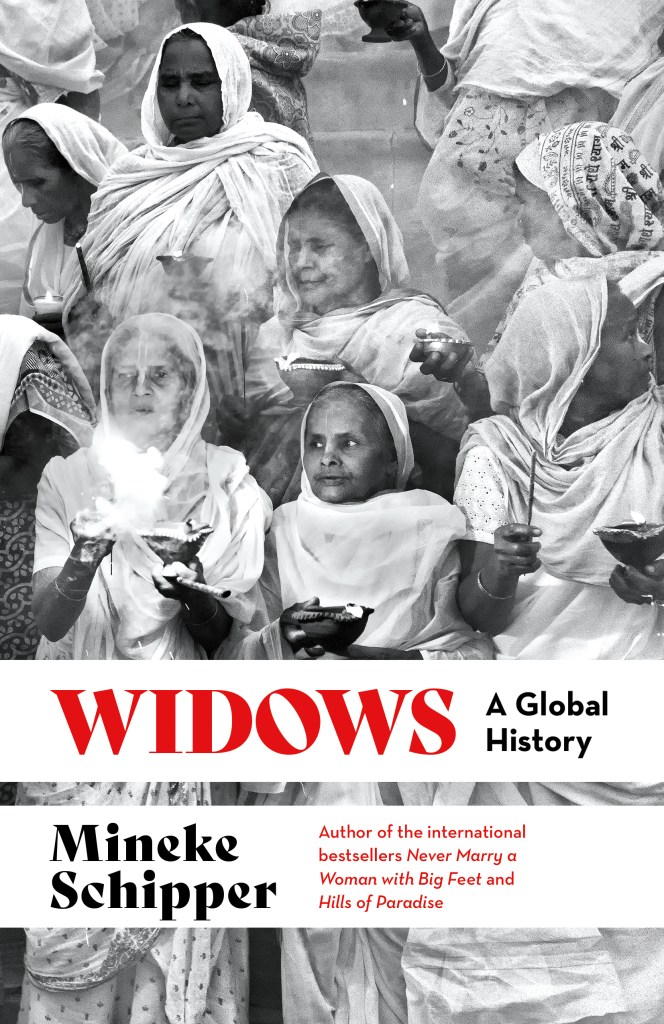
(Extracted from Widows: A Global History by Mineke Schipper. Published by Speaking Tiger Books, 2024)
About the Book
Widows have always far outnumbered widowers (who quickly remarry, usually younger women). War, hunting and the uncertainties of long travel ensured that most husbands died before their wives did. Mineke Schipper’s cultural history of widows examines how these husband-less women have, throughout history and mythology, been portrayed as helpless damsels, easy pickings for men outside the family or clan, or as cunning witches who are suspected of murder. In every case, the motive has been to exclude them and control them. Schipper traverses the world, travelling across time, to collect and analyse stories about widows and their treatment—the loss of status they face after their husband’s death; the harsh rituals of mourning they are forced to perform; the often brutal controls on attire, mobility and sexuality that they must submit to. It is a global legacy of cruelty and shame—as also, occasionally, of resilience and defiance—that has rarely been studied as deeply and thoroughly as in this extraordinary work. Widows draws upon sources from Ancient Egypt and Greece, medieval India and modern-day Europe, Africa and the Americas—examining folk and real-life stories of communities in Fiji, Papua New Guinea, Ghana, China, France, and several other countries and regions, as also stories and images from comics and fashion magazines.
Impressively researched and entertainingly narrated, this book—its information made distinctive by Schipper’s sharp insight and her humour—is an important document that helps us understand our past and, through it, our present.
About the Author
Mineke Schipper is Emeritus Professor of Intercultural Literary Studies at the University of Leiden, The Netherlands, with visiting professorships in Nigeria, Kenya, Zimbabwe, Burkina Faso and China. She is the author of NeverMarry a Woman with Big Feet (Eureka Prize for Non-fiction), Naked or Covered and Hills of Paradise.
.
PLEASE NOTE: ARTICLES CAN ONLY BE REPRODUCED IN OTHER SITES WITH DUE ACKNOWLEDGEMENT TO BORDERLESS JOURNAL.
The fudge boat
stays afloat
thanks
to the towering
willpower
of sailors
who love fudge.

The anchor is weighed
every day
and brings up sludge
on its flukes
that looks disgusting
but tastes
robustly nourishing.

This is the fudge
in question.

And the fudge in answer?

Well, that’s as
smooth as an exotic dancer
who undulates
her degenerate limbs
for the benefit
of the salty whims
of the shore leave crew,
captain, navigator and mate,
all of whom
love to chew
the hardest fudge that you
might ever imagine:
it sticks their
jaws together
as if their gums are tethered
to each other
by mooring ropes.

But the fudge boat remains.

Once I took a trip
as a passenger on that vessel.
I nestled in the hold
among the tubs of fudge
and I refused to budge
when we finally
reached our destination.
I loved that fudge too much!

The captain kicked me off
his ship
and I was reduced
to begging in the port city
for cheap toffee
because of fudge withdrawal.

It’s a terrible curse
to love fudge that much
and even worse
to be forced to give it up
but I was a poor man,
not a toff,
and couldn’t afford
to overindulge until I bulged.
Woe is me!

But I am resourceful
and never abandon hope
and now
I'm designing
my own strange boat:
a tiramisu submarine.

If it works, it’ll be a dream,
and if it doesn’t
I will drift with the currents
under the waves
towards those flooded caves
where mermaids
act as envoys for
the rulers of fudge enclaves.

I’ll be brave
and attempt to claim asylum
by denying my
species, class and phylum
and fudging
the figures to the best of my
affable ability.

Fudge paradise, here I come!
Rhys Hughes has lived in many countries. He graduated as an engineer but currently works as a tutor of mathematics. Since his first book was published in 1995 he has had fifty other books published and his work has been translated into ten languages.
.
PLEASE NOTE: ARTICLES CAN ONLY BE REPRODUCED IN OTHER SITES WITH DUE ACKNOWLEDGEMENT TO BORDERLESS JOURNAL
Anthony Sattin, an award winning journalist and travel writer in conversation about Nomads: The Wanderers Who Shaped our World, his recent book published by Hachette, India.
A breath-taking narrative that travels with the freedom of nomads, drawing from folklore, history and modern movements to give voice to an idea that might help move towards a more progressive and hopeful future — Anthony Sattin has achieved all this in a single book called Nomads: The Wanderers Who Shaped our World, a non-fiction that touches the heart with the concept of unifying humanity beyond the borders of ‘isms’ drawn over time. It explores the history of people who often have not been chronicled in conventional texts.
We are living in times where floods, forest fires, wars and divides are ravaging humanity as it wakes up from the coils of a pandemic that had almost stilled all normal interactions and economic activities for more than two years. The unrests and the changes attributed to “climate change” call for “continued solidarity” and a united front from all humanity as indicated by UN Secretary-General Antonio Gueterres and global guru Harari. In times such as these, an attempt to revive the concept of asabiyya, or bonds based on felt interests, is laudable and a necessity for the world to move forward. And that is exactly what Sattin has done in his recent book.
He has travelled with nomads; folklores, starting with Cain and Abel, Gilgamesh and Enkidu; history, Gobelki Tepe or Potbelly Hill, the place where he locates what might have been Eden, Achaemenid kings, Persian nomads, Mongols, Mughals to global nomads — spanning 12, 000 years of history.
In his book, Sattin tells us: “We are living at a time when the world — our world — shaped by the age of Reason and Enlightenment, powered by industrial and technological revolutions is faltering. Social contracts are fraying and communications are breaking down. The raw materials and natural resources are becoming scarce, and the consequence of our actions … are written large across landscapes, the climate, the fabric of our lives…Change is needed.”
Sattin “traces the shifting relationships between people who move and those who were settled” to find the concept of asabiyya or the sense of bonding popularised by an Arab philosopher called Ibn Khaldun (1332-1406). Perhaps, this is an ideal that could benefit humankind if we were all to see ourselves as one tribe. He has mentioned modern attempts at asabiyya, like the call given by ‘Black Lives Matter’, to contextualise the concept for us and to show how a movement born from within the hearts of people could touch and change attitudes.
The book is divided into three parts after an initial introduction from Mount Zagros, where Sattin was rescued from a bout of sunstroke by nomads: the first part is called ‘The Balancing Act’, where he explores ancient folklore and history, Huns, Hyksos, Scythians, Xiongnu and more: the second part is called ‘The Imperial Act’, from ‘The rise of the Arabs to the Fall of Mongols’ where kingdoms and world history is brought into play and the importance of asabiyya is introduced with historic instances and the last part is called ‘The Act of Recovery’, where changes towards redefining the world in terms of ideals aligned with asabiyya are explored.
The scope of the non-fiction is clarified at the start of the book from Mount Zagros. He starts the first section interestingly in a locale, termed by him as “Paradise” in 10,000 BC with a global population of ‘Perhaps 5 million’, of which he lists the nomad population as ‘Most of the number’. As he unfolds the history of mankind, from the past we find echoes of what could be called mobile or nomadic bonds that embrace to expand and heal civilisations. Sattin has been exploring such bonds for the last forty years.
Described as “a cross between Indiana Jones and a John Buchan hero” and “one of the key influences on travel writing today”, Sattin started his interactions with bedouins at age nineteen and found them nurturing. He elucidates: “After I left school, I went travelling in the Middle East. In the Sinai Peninsula, at that time, there were no hotels or other facilities outside of Sharm el Sheikh. So, I and the friend I was travelling with relied on the Bedouins for many things — they brought us fish and other food, they told us stories about the magical places in the desert mountains and although we had been told that they would rob us, they looked after us.”
Anthony Sattin. Photo Courtesy. John Murray/Hachette India.
Sattin has several non-fictions under his belt and is an award-winning journalist, who writes in a number of well-known journals, like the Sunday Times, the Conde Nast Traveller and the Financial Times. An editorial advisor to the Geographical magazine, he is also a fellow of the Royal Geographical Society and a founder-member of Travel Intelligence and ASTENE (the Association for the Study of Travel in Egypt and the Near East). He was the director of the Principal Film Company, has written, advised and presented on television and radio productions, including the BBC.
In this exclusive conversation, Sattin discusses Nomads, and tells us how the book came to be.
What made you think of writing a book on nomads, who — you have stated in your book — now constitute only 40 million in a world of 7.8 billion humans?
Every book has its moment, and this is the right time for Nomads. It came out of a lifelong interest in people who live on the move and on the problems of settled society, especially with cities – some of the first thoughts in Nomads occurred decades back when I read Lewis Mumford’s The City in History[1]. But I also have many ideas for books in my head at any one time and they don’t all get written! And some of them sit around for ages and then it seems to me to be the right moment to write. The way our world has changed in the past decade helped shape my sense that this is the moment to write about open borders and freedom of movement. I also wanted to write something that would stretch me more than anything else I had written. Twelve thousand years of history seemed like a big enough challenge…
How long did it take you to research and write the book? What kind of research did you do?
I began shaping the idea nine years ago, after I finished my previous book, Young Lawrence[2], about how the second son of an anonymous, middle class Oxford family became Lawrence of Arabia. The proposal took more than a year to get right – as my editor at WW Norton in New York pointed out, a subject this big can be about everything and nothing. Then there were years of research, particularly in the Bodleian Library at Oxford and the London Library, which is a wonderful place, the largest private library in the world and which serves as my home from home. I had many conversations over the years with scholars, people in publishing, fellow writers, travellers and nomads. And then there was the travelling with nomads, the writing and rewriting.
You travelled and lived among nomads for some time? How many years? Were your travels affected by the pandemic? If so, how did you bypass that?
I have been meeting nomads for more than forty years, particularly in North Africa and the Middle East, where I have travelled extensively. When I was 19, I was looked after by Bedouin in the Sinai Desert. In 2010, I was back there on a camel trek with a guide who impressed me because he knew every mountain, every watering place and every cave, including one which he pointed out as the place where he was born.
In Mali, I spent time with Touareg nomads, who came together each year at a place in the desert beyond Timbuktu – these tribes used to be at war with central government (and are again), but a treaty had been brokered and one of the terms was that tribal and government leaders would meet once a year to sort out grievances. They also played music, danced, raced camels… How could one not be swept away?
Specifically for Nomads, I went to Iran to spend some time with the Bakhtiari, a large nomad tribe who I had chosen in part because they claim lineage that goes back millennia, because they had played a part in the making of modern Iran but also because in the 1920s, a movie[3] was made of their annual migration into the Zagros Mountains, amazingly by the director and producer[4] whose next movie was the original King Kong! The Bakhtiari taught me much about the challenges facing nomads today.
Can you tell us of a few interesting experiences while moving with nomads which are not part of the book?
When I first went into the Zagros Mountains to meet the Bakhtiari, I was taken by a guide (being British, I had to have a guide for my entire stay in Iran) and he could not understand why I would waste my money and my time going into the mountains. He was from the city and exhibited age-old prejudices against people who lived on the move, whom he called ‘primitives”. But I am not a nomad and although I don’t find them primitive, I do find some aspects of their lives very challenging: years ago, on a camel trek in the Thar Desert, I caught what I now assume was sunstroke and thought I was going to pass out. My guide – there were just the two of us travelling – got me out of the desert. At the first village we reached, he had someone bring a bed out of a house and placed in the shade of a tree. I lay down and remember no more until about four hours later when I woke to find myself surrounded by the whole village. They had been angry with the guide for bringing me to them – think of all the trouble they would face if I died! When I woke, in the middle of this scene, the whole crowd burst into cheers like a scene out of a Bollywood movie.
You have spoken of ‘asabiyya’ taught by Ibn Khaldun. Can you explain the concept briefly and tell us if this can be of relevance in the current global situation?
Asabiyya is a sense of group feeling, something that binds people together. Ibn Khaldun thought it had shaped the world and found that it was most powerful among nomads and people who lived in the desert, in part because they must rely absolutely on each other. When this group feeling is channelled by a leader – the Prophet Muhammed, for instance – it can lead the group towards extraordinary achievements, as when the first Arabs overcame the might of the better-trained and armed Byzantine and Persian armies. It might all sound like something from long ago but I think there is a sense, in our own time, of someone like Greta Thurnberg having channelled that same feeling to force our leaders to pay attention to the climate emergency.
At a point you tell us that “…cities posed existentialist risks, and their temptations could overwhelm the asabiyya and nomads would lose their identity.” Why was maintaining their identity for the nomads so essential? Do you think this is something that needs revival in the present?
The existential risks I mention are the ones that rob nomads of their asabiyya and therefore of their power. Ibn Khaldun had seen this first hand: in North Africa, several small reformist movements had come out of the harsh desert or mountains to the south and overwhelmed the courts and kingdoms along the north coast. But each of those movements had fallen apart within a few generations as the pure people of the desert found themselves corrupted by living in cities. As for identity, it is important for all of us to know who we are and where we have come from — that was one reason to write the book, because very little is taught about nomads in western schools.
Your book touches upon number of issues — including faith. Given the fact that the great Khan had a Nestorian church, a mosque and a Buddhist temple in his capital city despite following the Shamanistic faith, would you say that an openness or tolerance in beliefs and faiths led to a more strongly tethered kingdom, as they did not really seem to have concepts of permanent national boundaries then? Is this not a dichotomy that you create a strongly tethered kingdom and yet are open to move on, leaving the old capital behind? And is it not wasteful?
I think there are two things going on here. On the one hand, a belief in freedom of conscience, the right to follow any or no religion. This was certainly something the great Mongol khans believed in. They were mostly animists, believing in the Sky Father and reliant on signs and omens, but they were not adverse to being prayed for and blessed by an imam or priest. Even the Ottomans, who came out of a nomadic tradition and were clearly Muslims, thought it important to allow freedom of conscience in their empire. What mattered was not who you prayed to, but whether you were prepared to acknowledge the sovereignty of the khan or the sultan. Some of the most successful periods in human history have flourished because of this idea.
A strongly tethered kingdom is another issue. For nomads, cities and capitals were not as important as lands, particularly hunting and grazing lands. The Mongol khans, like ancient Persian emperors and many other nomad leaders, recognised the need for a pivotal meeting place, a capital, but they were mostly more interested in spending time elsewhere and on the move. A leader such as Attila, the Hun ruler, had no interest in the cities he conquered.
You mention British author,Bruce Chatwin(1940-1989), as having said “we are born to move, that we must move or die.” Can you explain what that would mean? In the current context, people talk of roots and homeland. If they keep moving what happens to their firm conviction in homeland?
It depends what sort of ‘moving’ we are talking about. On a mundane and personal level, research now tells us that we are less likely to get ill and more likely to live longer if we walk 10,000 steps a day. On a national and global scale, we need interaction, we need to live lighter, we need to be nimble on our feet and in our thoughts.
You have divided the world into two groups — nomads and settlers — and said we need a bit of both. Can you tell us how and why?
Humans began to settle and cultivate some 12,000 years ago and since then, like Cain and Abel, humans have broadly been divided into those who stay in one place, usually either cultivating the land or living in towns/cities, and those who live on the move. For most of history they have lived in a state of mutual dependence and often even in harmony. A world without nomads, with everyone fixed in one place – which seems to be where we are heading – is a smaller, less rich, less fertile world.
In a post-pandemic world, would the nomadic lifestyle you have written of be feasible, especially with all the governmental issues creeping in?
The word nomad comes from a very old Indo-European word meaning pasture or a fixed area, which suggest the right to graze. But if you take a broad view of what it means to be a nomad in the 21st century, you might also include digital nomads and others who move to work or just because that is how they want to or have to live. That might not have been possible during the pandemic, when we were all locked down, but the number of people on the move now in many parts of the world is right back up and that can only be a good thing – we need to mix and meet, to exchange experiences and opinions.
If we opt for a mobile lifestyle, would we need to redefine borders as of old? Would that take us back to a pre-nationalistic era? Do you think we should be redefining our mindsets and our isms? Do you suggest we all go back to an intermittent nomadic lifestyle?
We should always be questioning mindsets and isms! Happily, we are living through a golden age of revisionist history shaped by a number of forces, decolonialism, Black Lives Matter and #MeToo among them. We also live in an age of misinformation on a massive scale. Nomads has come out of a need I had to shine some light on a way of life that is either entirely missing, or misrepresented in our histories.
Are you planning to write more on this issue or move on to something else? Would you share with us your next project?
There is much more to be written about this issue, but after spending most of the past eight years working on Nomads, it is time for me to look elsewhere. I hope I have stimulated a debate about nomads that will encourage others to look further. Meanwhile my thoughts are turning to Egypt — and to Italy, from where I am writing today.
Thanks for giving us your time during your travels.



 Borderless