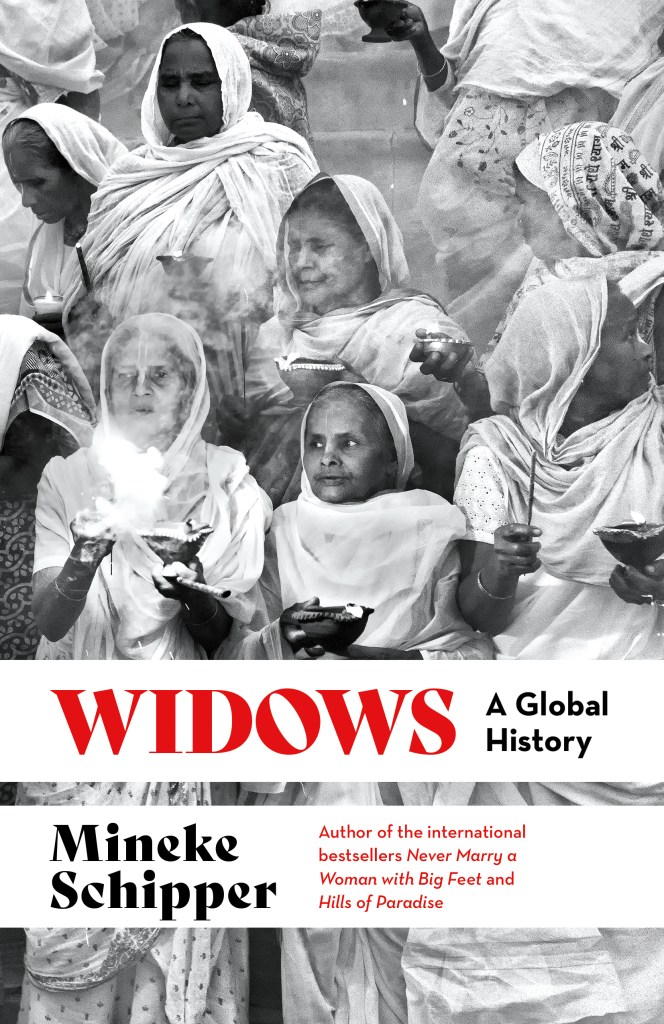
Title: Widows: A Global History
Author: Mineke Schipper
Publisher: Speaking Tiger Books
Lovingly together until the end
Long, long ago, Zeus descended to the place where two trees are wrapped in a loving embrace: an oak and a linden tree amid an undulating landscape, their entwined branches a testimony to undying love. ‘I have seen them with my very eyes’ is how the narrator begins the story about how the gods can decide our fate, which was recorded by Ovid in his Metamorphoses.
The story goes as follows: one day Zeus, king of the gods, disguised himself as a mortal and descended to Earth, accompanied by his son, Hermes. They knocked at every door they found in search of a place to rest, but none of the homes they visited welcomed them in. They finally reached the tumble-down cottage belonging to Baucis and Philemon, an old couple who, in spite of their poverty, were perfectly content with their lot, and welcomed the pair with open arms, generously providing them with all the fruit, nuts, figs and dates they had to hand. They were even prepared to kill their goose, but the bird escaped its fate and found safety between the two gods. Hermes and Zeus explained to the couple who they were and why they were going to destroy this godless part of the world: ‘Only the two of you will be allowed to escape this disaster’.
Leaning on their staffs, the old couple followed the gods to the top of a hill, from which they looked back to see all the land in the valley flooded and sinking into a muddy bog, apart from their own cottage, which had been turned into a glistening temple with marble floors and columns. Zeus granted the couple a wish, and they did not need too long to think about their reply: they wished to become priest and priestess of the new temple and, most beautifully of all, they both wanted to die at the same time at the end of their lives. Both wishes were granted.
One day, after a long and fortunate life, the pair stood at the bottom of the marble steps leading up to the temple. All of a sudden bark began to cover their bodies and legs and their arms began to sprout leaves. They shared one final word of farewell as the leafy canopy started to engulf their faces. In an act of tenderness, they stretched out their branches longingly towards one another, and to this day continue to whisper to each other through the rustle of the leaves.
Living on together in human form after death is another comforting solution in stories the world over. No surprise therefore that storytellers have always wondered how Adam and Eve, the first humans according to Judaism, Christianity and Islam, met their end. The holy books of these three religious traditions all begin with the pair living in Paradise, with the Bible even stating that Adam was 930 years old when he died, but the details of their deaths are conspicuous by their absence.
Eve’s widowhood is not dealt with at all in the Bible, yet oral traditions do discuss it, as storytellers tend to have free rein. In one early Christian story, on his deathbed Adam confronts Eve with the most wicked accusation; during that emotional moment, he forces her to once again explain to their children and grandchildren (and all of his progeny) that it is through her that death came into the world. No surprise therefore that, after Adam’s death, Eve wallows in the mud, grief-stricken and despondent, imploring God’s mercy for her unending guilt, until she dares to gaze upwards, where the most incredible spectacle unfolds before her eyes: angels float in the sky, obscuring the vaults of heaven with their swinging incense burners, as the body of Adam is brought to Heaven on a chariot of light drawn by four shining eagles.
Further details about the now widowed Eve are absent, but in one optimistic Islamic story from Yemen, upon their deaths the angel Gabriel comes to Earth to collect both Adam and Eve to take them back to the Garden of Eden. As they arrive, the gates of Heaven swing open, and they are greeted with ‘Peace be with you and welcome back’. These words are spoken by Ridwan, the same gatekeeper who at the start of their earthly lives had slammed the gates of heaven behind the pair as they left. Upon their return they must undergo a ritual purification: first they are handed a golden cup with water from the well of purity, followed by another golden cup filled with water from the fountain of eternal youth.3 Together till the end, from their expulsion from Paradise to their return.
One goes, the other remains
In the harsh reality of life, this narrative works slightly differently, the question being ‘which of the two of us will be the first to go?’ This pressing question inevitably arises among people who are in love and happy with one another. In fairy tales, couples live long and happy lives, and at weddings you will often hear a variant of the adage ‘may you live long and well’. At weddings in India’s eastern state of Assam, you will hear the words ‘may the kinowari (bindi) never disappear from your forehead’. This symbol of marital bliss is used to wish brides a marriage that lasts a lifetime, with those who become widows no longer being permitted to wear it.
‘May a God-blessed wife go with her husband to his grave’ is a popular Arabic wish for women, as what could be more beautiful than dying together on the same day?
(Extracted from Widows: A Global History by Mineke Schipper. Published by Speaking Tiger Books, 2024)
About the Book
Widows have always far outnumbered widowers (who quickly remarry, usually younger women). War, hunting and the uncertainties of long travel ensured that most husbands died before their wives did. Mineke Schipper’s cultural history of widows examines how these husband-less women have, throughout history and mythology, been portrayed as helpless damsels, easy pickings for men outside the family or clan, or as cunning witches who are suspected of murder. In every case, the motive has been to exclude them and control them. Schipper traverses the world, travelling across time, to collect and analyse stories about widows and their treatment—the loss of status they face after their husband’s death; the harsh rituals of mourning they are forced to perform; the often brutal controls on attire, mobility and sexuality that they must submit to. It is a global legacy of cruelty and shame—as also, occasionally, of resilience and defiance—that has rarely been studied as deeply and thoroughly as in this extraordinary work. Widows draws upon sources from Ancient Egypt and Greece, medieval India and modern-day Europe, Africa and the Americas—examining folk and real-life stories of communities in Fiji, Papua New Guinea, Ghana, China, France, and several other countries and regions, as also stories and images from comics and fashion magazines.
Impressively researched and entertainingly narrated, this book—its information made distinctive by Schipper’s sharp insight and her humour—is an important document that helps us understand our past and, through it, our present.
About the Author
Mineke Schipper is Emeritus Professor of Intercultural Literary Studies at the University of Leiden, The Netherlands, with visiting professorships in Nigeria, Kenya, Zimbabwe, Burkina Faso and China. She is the author of Never Marry a Woman with Big Feet (Eureka Prize for Non-fiction), Naked or Covered and Hills of Paradise.
.
PLEASE NOTE: ARTICLES CAN ONLY BE REPRODUCED IN OTHER SITES WITH DUE ACKNOWLEDGEMENT TO BORDERLESS JOURNAL.
Click here to access the Borderless anthology, Monalisa No Longer Smiles
Click here to access Monalisa No Longer Smiles on Kindle Amazon International



 Borderless