The wind blowing across the Long Island Sound chilled his bones. The day was cloudless and the sky blue, but the sun lacked warmth. New York. Dr Ram Bahadur had called the big apple home for over three decades. Winters were cold and snowy. There were cold snaps and the dreaded northeaster brought snow and freezing temperatures. Summers could be surprisingly warm. February in New York was the depth of winter.
Long Island was blanketed in snow. He had spent the morning clearing snow from the driveway of his home. The suburb of Woodbury was quiet and peaceful. The trees had lost their foliage and were waiting for the warmth of spring to put on a new coat of green. He had a large house with floor to ceiling picture windows. The house was two storied with an attic. There were two bedrooms on the ground and three on the first floor. He had done well in life and was now prosperous.
He still recalled his first days in the big apple. He had just come to the United States from Nepal after completing his postgraduation in Internal Medicine. The first years were tough. He had some seniors doing their residency in New York city. The state of New York offered the largest number of residencies in the country. He did his residency again in internal medicine and then a fellowship in endocrinology.
All his training was completed in New York. He worked for over two decades in large hospital systems. But, for the last five years he started his own private practice. Compared to most other countries medicine in the States paid well. Private practice was certainly lucrative, though the cost of living in New York was high.
He did sometimes think about his home country of Nepal. The Kathmandu valley was still a beautiful place. His visits were few and far in between. Unplanned urbanisation had made the valley dusty and dirty. Winters in Kathmandu were cold but milder compared to New York. The Institute of Medicine (IOM) was the first medical school established in the country. The original intention was to create doctors for rural Nepal. The selection was tough and competitive. He still remembered his joy on learning that he had been selected for the medical course. During the closing decades of the twentieth century Nepal was in turmoil. The insurgency was ongoing, and blockades were the order of the day. Violence was rife and a lot of blood was spilled.
Most doctors from IOM migrated in search of greener pastures. The others mostly practiced in the valley, the historic heartland of the country. Ram was originally from Gorkha, in the centre of the country but his family had migrated to the capital when he was a few years old. His father was a civil servant while his mother was a housewife. Civil servants did not make much and money was always in short supply. His father was a man of principle and never accepted bribes or tolerated corruption. He still remembered the argument he had with his father when he put forward the plan to migrate to the United States (US) to pursue his residency.
His parents had both passed away and his siblings were also settled in North America. He rarely visited Nepal these days. The insurgency was followed by the overthrow of the monarchy and then a new constitution was promulgated. A federal structure was set up and while this did have benefits, the expenditures also increased. Each state had to set up an entirely new administrative machinery. He married an American academician who taught Spanish literature at the City University of New York. His wife’s family hailed from the country of Colombia.
New York had a substantial Hispanic population these days. He was now fluent in several languages: Nepali, his mother tongue; English, Spanish and Hindi. He also understood Newari, the language of the Newars, the original inhabitants of the Kathmandu valley. He did think on and off about his motherland. Many Nepali doctors left the country. Working conditions were hard and the pay was poor. To advance, you required political patronage. The frequent changes in government required you to be on good terms with several political parties.
He still missed the food of his childhood. New York was a very cosmopolitan place. There were several Indian restaurants and even a few Nepali ones. He was very fond of bara (a spiced lentil patty) and chatamari (Newari pizza), traditional Newari foods. These had earlier not been available in New York. Luckily for him, two years ago a Newari restaurant had opened in Queens. He was also particular to Thakali food. The Thakalis were an ethnic group who lived in the Kali Gandaki valley north of Pokhara. He particularly fancied green dal, sukuti (dried meat), kanchemba (buckwheat fries) and achar (pickle). Anil was a decent cook and had learned to cook a decent Nepali thali[1]and dhido (thick paste usually made from buckwheat or corn). He also made tasty momos (filled dumplings that are either steamed or fried) and these were much in demand among his companions.
Ram loved the professional opportunities that his adopted homeland provided. He had become a US citizen. Working in the US was more rewarding though the paperwork associated with medical care had steadily increased. Many of his batchmates and seniors lived and worked in New York state and across the state border in New Jersey.
Many of them did miss their homeland and had a vague feeling of guilt for not contributing their share to their original homeland. A few of them were working on a proposal of developing a hospital at the outskirts of Mahendranagar in the far west of Nepal. The Sudurpashchim province had a great need for quality medical care. The details were still being worked out. There were about twenty IOM graduates involved and they decided on an initial contribution of a million dollars each. Despite inflation twenty million dollars was still a substantial sum in Nepal.
This group of friends collaborated on different social projects. They were also active in promoting a more liberal America where each citizen and resident had access to quality healthcare. The hospital would be their first project outside the US. A strong community outreach component was also emphasised in their project.
The US had made him wealthy. He was a proud American. However, he also owed a deep debt to his home country for educating him and creating a doctor. Now was the time for him to repay that debt, not wholly or in full measure but substantially to the best of his abilities!
[1] Plate made of a few courses, completing the meal
.
Dr. P Ravi Shankar is a faculty member at the IMU Centre for Education (ICE), International Medical University, Kuala Lumpur, Malaysia. He enjoys traveling and is a creative writer and photographer.
.
PLEASE NOTE: ARTICLES CAN ONLY BE REPRODUCED IN OTHER SITES WITH DUE ACKNOWLEDGEMENT TO BORDERLESS JOURNAL
Jim Goodman, an American traveler, author, ethnologist and photographer who has spent the last half-century in Asia, converses with Keith Lyons.
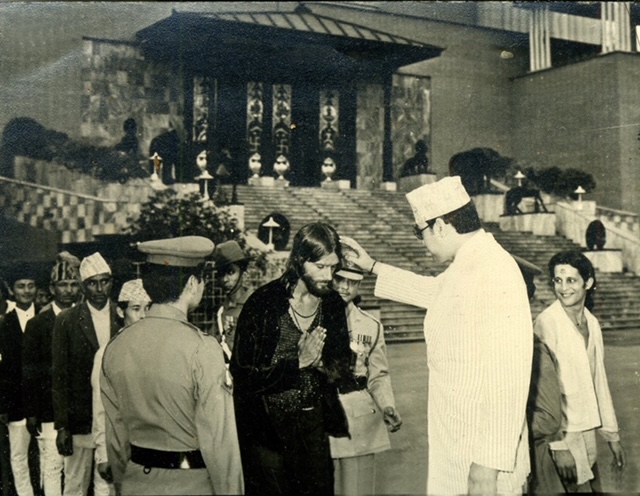
Jim Goodman in Nepal at Dasain being blessed by King Birendra, October 1978.
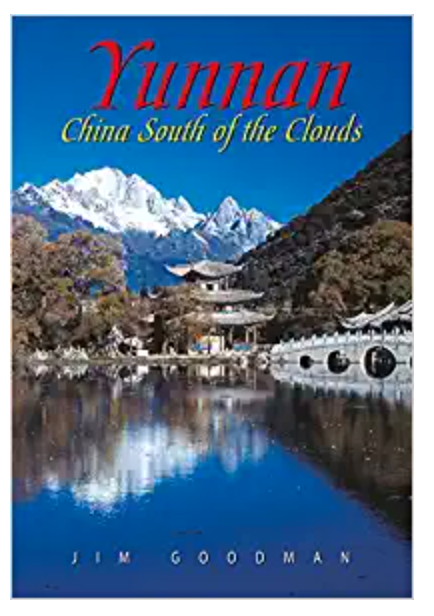
Jim Goodman is something of a legend in Southeast Asia and Eastern South Asia. His definitive guide to southwest China’s Yunnan province was the most sought-after travel book for any intrepid backpacker wanting to get off-the-beaten-track in the ethnically-diverse province bordering Vietnam, Laos, Myanmar and Tibet. That’s how I first came across Jim, through the well-thumbed pages of his The Exploration of Yunnan. Back then, I marvelled at his ability to venture into areas that were only just opening up to foreign travellers, and the breadth and depth of his knowledge of different ethnic minorities. It was almost 20 years later that I finally met Jim in person in a cafe inside the old city gates of northern Thailand’s Chiang Mai, where he has been based since 1988. Later, on a media trip to the Golden Triangle’s eastern Shan state hill-tribe villages, I saw how Jim’s interactions, appearance (and conversation in ethnic language) endeared him to local minorities.
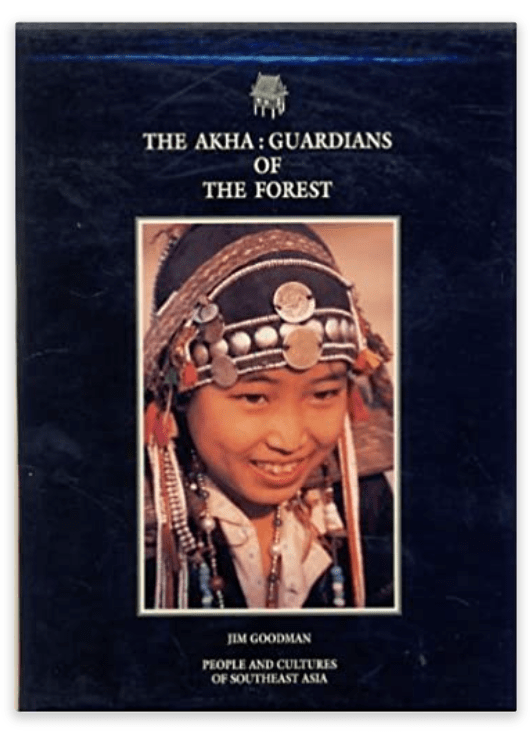
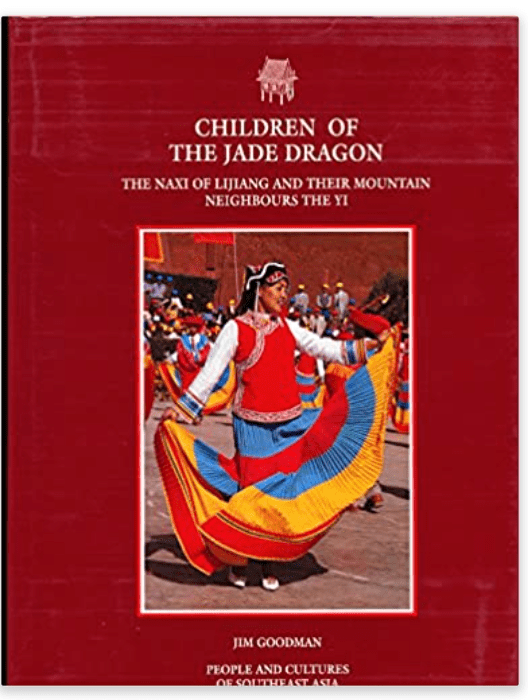
He has published books in Nepal, Singapore, Thailand, China and Vietnam, and also worked with ethnic minorities, including on textiles with Newars in Nepal and northern east Indian Mizos, and on traditional handicrafts with Akha in northern Thailand. “Besides acquiring new labour skills—I was the dyer and designer—the work gave me valuable insights into the different cultural norms and ways of thinking of traditional societies in this region,” he once wrote. “My writing, research and photography reflect my fascination with history, traditional cultures and ethnic minorities, not just in the ethnologies, cultural studies and histories I’ve published, but in my fiction and poetry as well.”
You were born in the US capital Washington D.C. and raised in the Midwest in Cincinnati, Ohio. Growing up in the US, what do you think contributed to your interest in different countries and cultures?
As a kid I was fascinated by American Indians, especially those from the western plains and the southeast. My father taught Latin American history at Xavier University in Cincinnati. He and my mother were members, later chairmen, of the Foreign Students Welcoming Committee. Every American holiday — 4th of July, Thanksgiving, Christmas, etc — we had foreign guests. They were from India, Nepal, Tunisia, Thailand, Colombia and Nigeria. They aroused my natural curiosity.
How were your first experiences of ‘foreignness’ in the US and then overseas?
I stopped believing in my parents’ Catholicism by the time I was in high school and for the next few years felt like a foreigner in my own family and neighbourhood. In later years, when I was living in Europe or Asia I was always conscious of being foreign, especially in things like double pricing, but I integrated socially enough not to let it bother me. Occasionally, that worked in my favour. In Korea in the 70s, males were forbidden by law to grow their hair over their ears or past the collar. Every four or five months the police carried out widely publicised roundups. But foreigners were exempt.
What was it like growing up in the 1960’s in the US?
It was very exciting. Thanks to the civil rights and anti-war movements it was easy to challenge the system intellectually and practically. The drugs and music, a very new kind of music, also contributed to this sense of the times are changing everywhere and lots of options were possible. It was an amazingly optimistic decade.
How did you come to be in the army, and what was your experience as a soldier in Germany and later South Korea?
I got my draft notice in the summer of 1967, at the peak of the Vietnam War, when 80% of those drafted were sent off to Vietnam after training. So I took the enlistment option, signing up for an extra two years, with one year at the language school studying Arabic. War might be over by the time I finish the course, I thought, and anyway they wouldn’t need an Arabic translator in Vietnam. But the Army inserted a little clause in every contract, “subject to needs of the Army,” that let them do what they liked. When I arrived at the language school, after basic training I was told my orders had been changed. I had to go back and wait for new ones. Eventually they put me in a tank training unit, but by the luck of the draw I was in the company sent after training to Germany, while the other three were dispatched to Vietnam.
In Germany, I served in an armoured unit which was very often in the field. However, this was 1968 and I managed to get a pass to go to Paris in early June and marched down the avenues with the students and workers singing L’internationale over and over. I still know the first stanza, in French. I also met Arab officers from Jordan and Libya and took a month’s leave in the autumn to have my 21st birthday in Beirut. On my first night in Beirut, a South Yemeni staying in the same hotel told me there were three good reasons to travel. The first was to meet the different kinds of people living in this world. Second, was to try the various local foods and drinks. And third, was to appreciate the scenery and historical monuments. I never forgot the order in which he listed those attractions: people first. Throughout my trip, I wore a button on my shirt that said Restore Palestine to the Arab People, which guaranteed a good reception everywhere in Lebanon and Jordan. I was very active politically by then and the following spring published the first anti-war newspaper by a soldier in Europe. That later got me transferred to Korea, the only place there was no organised anti-war soldier activity. In Korea, I was in charge of the Photo Lab, where I learned the basic principles of photography. Also joined rock bands as a singer, so I wasn’t very political in Korea, except for some of the song lyrics.
After your time in the army, how did you get back to Asia?
I was discharged in Seattle in January 1972, went to San Francisco to live and later got a clerk-typist job with General Services Administration. Then my boss recommended me for a low-ranking administrative position. I would have been in charge of the installation of furniture in the California offices of the state’s two senators. Not exactly exciting work, but anyway I had to get a security clearance, starting with answering a questionnaire with things like ‘are you now or have you ever been a member of the Communist Party’ and ‘do you advocate the overthrow of the US government by force or violence’.
I answered no to everything, but within 24 hours the office got back a disapproval of my application “for security reasons”. After that news got out, everybody in the building thought I was a terrorist, and that was before terrorist was a household word. It was doubtless my activity as an anti-war soldier but it meant I would really have no future in my country. I went to Korea that autumn on a one-way ticket without enough money for a round-trip. (I don’t think that’s even possible anymore.) I met other ex-GI’s in Seoul who gave private English lessons, so I did, too. In the second year, I got hired by Language Teaching Research Center, which didn’t use textbooks and so I made up my own lessons. I spent free time among soldiers on the army base and in off-base bars and would listen carefully to their conversations. Whatever they said that I thought my students wouldn’t understand, I wrote down and worked it into my lessons. It was a wonderfully creative job and made me especially conscious of my own language.
What happened for you to leave Korea and ending up almost dying and in jail in Nepal?
My last summer (1976) in Korea, I met travellers who had been to India, Nepal and Southeast Asia. Later that year I got busted for a small amount of grass and, near the end of the year, was expelled from Korea. India and Nepal seemed a natural place to go next. It wasn’t easy in the beginning and once in Calcutta, I got robbed of everything and went over three weeks without eating. I was kind of resigned to dying by starvation but a Muslim street merchant recognised the situation, paid my bills and lent me enough money to get back to Kathmandu. Everything seemed fine but when I finally ate a meal I vomited it all a few minutes later. Body won’t take food, eh? Guess I’m going to die after all. He said don’t worry, wait a little and try again. He had witnessed the same thing with starving Bengali refugees during the break-up of Pakistan. He was right. The next meal was fine and ever since then, I’ve not worried about, for one reason or another, missing a meal or two. I missed meals three and a half weeks and got by.
And you spent some time in jail, not just in Kathmandu but in Korea?
I was three weeks in Korean solitary confinement until my girlfriend bailed me out. Longer, about four months, in the holding centre in Kathmandu, where those arrested awaited trial. I was busted for a lot of hash but charged with both possession, 10,000 rupees fine, and exporting, 100,000 rupees fine (about 70 to a dollar then). I pleaded guilty to possession only. The judge dismissed the exporting charge because the hash was found in my home, not at any border. However, to save face, the prosecutor appealed the acquittal for exporting. The appeal had to go to the special court, which only met once a week, so cases piled up. In Nepal, you don’t bribe the judge. You bribe the clerk to put your case before a sympathetic judge. I wasn’t going to hurry up the case because then I would have to leave the country afterwards. The prosecutor wasn’t going to speed up the proceedings because he still would have no evidence and would lose again. Meanwhile, I was free to continue my Nepal life. For over a year the government’s attitude to me was like a joke. They thought I had figured out how to beat the system. The following year, I became an embarrassment and the year after that, with a new government, it became an issue and I finally got a new passport and left Nepal for a month’s holiday in Thailand.
What took you to Assam, and what made you later leave?
It was one of the few places in India I hadn’t visited yet. It had an interesting separate history from the rest of the country and was surrounded by many fascinating ethnic minorities. My first trip was in the autumn of 1979, when I was paid to take an American woman and her daughter, whose tutor I was, to Darjeeling, Sikkim and Kaziranga, the rhinoceros park in Assam. The Assamese anti-immigrant demonstrations had already begun, so I kept up on news then and afterwards. In 1980, I made two trips to cover the movement for newspaper articles. I only got to visit hill people (Khasi) in Meghalaya, as the other states, and parts of Assam were closed to foreigners. I bought a lot of books about them, anticipating freer travel sometime soon. Instead, I got blamed on my third trip in May by the Delhi government for organising the Assam movement (as if they couldn’t organise themselves) and banned from re-entry.
After moving to Chiang Mai Thailand, what did you concentrate on?
Jim Goodman with a Akha girl in Thailand, 1988
The skills I learned in Nepal were those involving weaving and dyeing. I used natural dyes and designed the patterns for the looms. I had worked with both Mizos from Northeast India, who used a back-strap loom, and Newars, who used a stand-up frame loom, like that of the Thai. I began working with the Karen, who used back-strap looms. But after meeting the Akha, I conceived the idea of making Akha jackets, which were cut like Western jackets, using my colours from natural dyes and bigger to fit Western bodies. I soon dropped the work with the Karen and found enough customers for Akha jackets and shoulder bags to cover the expenses of a modest lifestyle and my research on them.
What made you decide to go to Yunnan and southwest China? When did you go, and what was the experience as the region just opened up to travel by foreigners?
One of the sub-groups I worked with in Thailand, the Pamee Akha, came directly down from Yunnan. I met a relative on one of my trips who was in Pamee to make money picking lychees for a season. He invited me to his village in Xishuangbanna, if I could ever come to China. Not long afterwards a flight opened from Chiang Mai to Kunming. I booked one for July 1992. After a few days around Kunming and Lunan County, I flew to Xishuangbanna and found out from Akha in Jinghong how to find my friend I met in Pamee. After some time there, I returned to Kunming and embarked for the northwest for a quick look that did include the Torch Festival in Ninglang. I couldn’t speak much Chinese then, but in Xishuangbanna, the Akha enjoyed the fact that the first foreigner they ever met could speak their language. People were friendly everywhere and once I started repeating visits for research, I got introduced to English-speaking locals who could assist me.
When you first went to southwest China, did you feel you might be documenting some people whose culture would be wiped out by modernisation, and if so, has this happened?
From the very beginning I felt ethnic cultures were having a true revival but wondered how long that could last, not because of politics, as in the past, but because of the greater exposure to outside modern influences, including mass tourism. Certainly, that has happened, but not to the same extent everywhere. And mass tourism has been more disruptive. Lijiang and Lugu Lake are two obvious examples. I was lucky to have chosen those places to fully research before they completely transformed into tourist traps. In other places, like Ailaoshan, parts of Lincang and Pu’er prefectures and even much of Xishuangbanna, modernisation has been less noticeable and the traditional culture and lifestyles still strong.
What have been some of your most memorable experiences in Yunnan?
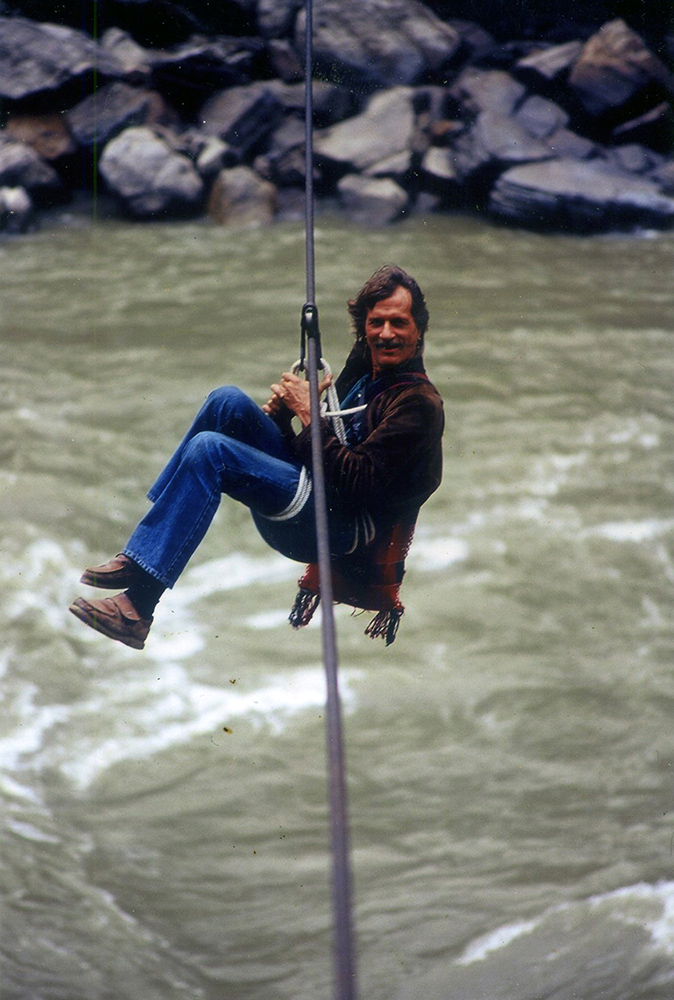
After watching two little Lisu girls at Lishadi cross the Nu River on the rope-bridge several times, for their own amusement, without adult supervision, I concluded:
1. It can’t be dangerous.
2. It must be fun.
Next trip to Nujiang I had a Lisu friend in Fugong get me the harness and cable hook. Made my first crossing, just for the fun of it, at Damedi south of Fugong and over the next few years carried my cable hook and rope harness to Nujiang for more rides at more locations.
Jim Goodman making the crossingJim Goodman with a crossbow
The other unique, to me anyway, research experience was my repeated visits to Lige village, Lugu Lake. Mosuo culture is matrilineal, the children belong to the mother, but also Tibetan Buddhist and each family has a resident monk. Women were definitely in charge of domestic affairs. At Lugu Lake, my friends, the folks I hung out with, got high and drunk with and had the most experiences with, were mainly women. Many of them introduced themselves to me. I only knew a few men. With every other minority, I only met women because they were my friend’s wives, daughters or sisters, whom he introduced to me. The Mosuo were really special.
From your experiences across Southeast Asia and eastern Southern Asia, what are some of the most interesting things you’ve learnt about hill tribes, their customs, societies, and beliefs?
They are very attuned to nature, with a cultural sense of ecological balance. Most of their festivals are concerned with important junctures in the agricultural work cycle. Their societies are very collective-oriented. Everyone has relationships with everyone else. No one ever has to feel alone.
How has learning languages and assisting local craftspeople enabled you to get inside like an anthropologist?
Learning an ethnic minority language is a clear indication of special interest in them. And they respond very favourably to that. Involving them in handicrafts production shows appreciation of their traditional arts and crafts, like a form of flattery. It also means getting to know them more personally and becoming an accepted part of their existence, making research easy.
What’s your personal approach to meeting new people, and why do you think it works?
As that pertains to my research work I always made clear to the people what my interest in them was and that I was going to write about them. Always had a positive response and when I indulged in their hospitality I followed four rules I set for myself: eat whatever they give me, drink whatever they give me, smoke whatever they give me, and sleep wherever they put me. As a result, I’ve had some really spicy food, very powerful liquor, pretty raunchy cigarettes and even opium and some pretty uncomfortable sleeping conditions. But I figured nothing can hurt me much for a day or so and the effect on them was that they thought I was a great guest. Everything they did for me seemed to work. They didn’t have to make any adjustments.
What’s it like to be the first outsider or ‘white person’ that some groups have seen?
That happened mostly in Yunnan and was never a negative experience. I remember once about to enter a Yunnan village that was definitely off the beaten track and when children spotted me they ran back to the village shouting, “Weiguo pengyou lai!” (“Foreign friend comes.”) And then the adults came out to welcome me. I never found any animosity or impolite, intrusive curiosity anywhere I went. The local attitude seemed to be ‘here’s a chance to make a foreign friend’. Minorities were as curious about me as I was about them. And being American in China or Vietnam, in their context I was a fellow minority person.
For many of the groups you’ve studied and spent time with, they are spread across countries and borders. Are there differences on different sides of the borders, or does close contact mean the groups retain their traditions?
I made my first trip to Vietnam precisely to answer that question. I was researching the terrace builders in Honghe between the Red River and the Vietnam border. Many ethnic groups lived on both sides, so I travelled through the border areas in Vietnam to meet sub-groups I knew in Yunnan. Lifestyles and cultural traits were very similar. The minorities in Vietnam seemed more conservative, more resistant to modern influence, while the same minorities on the Yunnan side seemed better off economically.
Your other interest is Vietnam. What fascinates you about Vietnam?
I was already familiar with Chinese culture when I first visited Vietnam, as well as Southeast Asian culture. It didn’t seem like such a strange place and I was able to discover what was unique about Vietnam, its separate cultural characteristics. The people were uniformly friendly, even though I came from a country that bombed the hell out of it. Yet the Vietnamese I met regarded all that as the past and now it’s different so no time for resentment. I made close friendships there easily (eventually married one) and found new topics to write books about—what was unique about Vietnamese culture, the special history of Hanoi, and how the country became one entity.
Why do you have a fascination and affinity with ethnic minorities, particularly hill tribes?
Hard to really say, but I suppose it was because I like their very different kind of living environment, the way they look and the way they act. Always felt comfortable with them.
How do you feel about the changes that have happened to minorities, such as becoming tourist attractions, or having to move to towns for economic opportunities?
It was probably inevitable. Traditional agriculture, the shifting cultivation type, was no longer sustainable due to population density growth. Roads are better and more numerous, too, so those who do move to cities can still maintain links with their villages. Becoming tourist attractions can be more of a lifestyle change. Everything cultural seems to become a commodity, something to be paid to do. In some places, the culture on display is not even their own. For example, in Sapa Vietnam, many Hmong girls dress up in fancy clothing of the Flowery Hmong because their own Black Hmong outfits are not as colourful or photogenic for tourists, who pay them to take photographs.
When did you know that you wanted to be a writer?
When I first started reading world literature as an early teenager and started fantasizing about one day becoming one of the literary giants.
How do you go about your writing process?
I begin by thinking about it for many sessions, then, when it’s a book or a lengthy article, make an outline and start adding details before I actually write anything. When I do get going I often inspire myself by fantasising what a positive review might say, then add or revise something to justify the imaginary praise.
How has photography integrated with your writing?
Most of what I write requires illustration and some of it was because I had a set of photographs that sort of made a story. When doing cultural research, I photographed anything I thought might be relevant, whether it was photogenic or not, because then I would have a reference. I wouldn’t have to write down or have to remember what I saw. The photo was the record.
Yes. It was set up by a young friend many years ago. I don’t make any money from it. It would have been nice to have sold all the site’s articles, but I continue it because it represents my self-image of contributing to the sum of human knowledge concerning the topics I write about. Regarding books, I have had publishers in several cities: Kathmandu, Bangkok, Singapore, Kunming, Hong Kong and Hanoi.
What projects do you have on the go currently?
This year’s project was Peoples of the Mekong River Basin: The Ethnic Minorities. It covers 23 ethnic minorities and over 100 photos, 90% mine. The publisher is World Scientific Press, Singapore and it should come out in or maybe before October. I would like to do one more book, on Lamphun and its first ruler Queen Chamadevi, the most interesting and accomplished woman in all of Thai history. But I have to find a publisher interested before I start work on it.
*Photographs provided by Jim Goodman
Keith Lyons (keithlyons.net) is an award-winning writer, author and creative writing mentor, who gave up learning to play bagpipes in a Scottish pipe band to focus on after-dark tabs of dark chocolate, early morning slow-lane swimming, and the perfect cup of masala chai tea. Find him@KeithLyonsNZor blogging at Wandering in the World (http://wanderingintheworld.com).
PLEASE NOTE: ARTICLES CAN ONLY BE REPRODUCED IN OTHER SITES WITH DUE ACKNOWLEDGEMENT TO BORDERLESS JOURNAL



 Borderless