Categories
Excerpt

Tales of a Curious Land

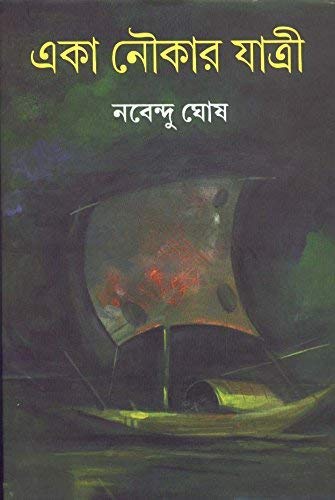
Journey of a Lonesome Boat by Nabendu Ghosh

Title: Eka Naukar Jatri/ Journey of a Lonesome Boat

Author: Nabendu Ghosh, translated by Ratnottama Sengupta

Publisher: Dey’s Publishing

Nabendu Ghosh writes of the time when two directors had wanted to film his novel – but why it was not made… 

Putul Nacher Itikatha[1] did not prove to be a hit but those with any understanding of screenplay all said, “Nabendu Ghosh did a great job.” 

I got the proof of this soon enough. One morning, around 11, Jahar Roy showed up on the first floor of my rented flat on Mahanirban Road.

“Nabenduda, Udayer Pathe[2]beckons.” 

Who?” 

Jahar sang out, “Bimal Roy, the Director of Udayer Pathey! He was all praises for one of your writings. So I offered to escort you — and introduce you if he so wished. He said, ‘He is a creative talent, I’d surely likely to meet him.’  Forthwith I set out on this venture.”

I was stunned. Overwhelmed. My experience of the craze in Rajsahi – when the police had to lathi charge on the crowds that thronged the theatre where Udayer Pathey had released — flashed through my mind. I recalled my deep seated desire to work with him. 

At this point Kanaklata stepped into the room. Jahar sprung forward and despite her vehement protest he bowed to the ground and touched her feet. “Boudi,” he spoke to her, “renowned director Bimal Roy has expressed his wish to meet Nabenduda. I’m here to escort him.”

“Sure, after you’ve tasted some sweetmeat and had a drink of water. The fish curry rice can wait for you to come back for lunch.”

“Thy wished is my command Boudi!” Jahar bowed again. 

*

Bimal Roy lived on Sardar Shankar Road in South Calcutta. Tall, fair complexioned, attractive looking with a commanding presence, Bimal Roy was a heavy smoker.  

After a while of polite conversation he said, “I’ve read your Daak Diye Jaai [3]and Phears Lane. As an admirer of your writing I can say that it has all the essentials of a screenplay.”

This observation brought me alive to a latent aspect of my writing. I kind of rediscovered myself. Gratefully I thanked him. 

“Why don’t you narrate a story that can be made into a film?” he said. “Something new, different, and arresting,” he added.

So I narrated the storyline of my new novel, Ajab Nagarer Kahini (Tales of a Curious Land). It was an allegorical story about contemporary civilisation, about the state, and about love too. His face lit up as he listened to the story. He sat still for a couple of minutes. When I stopped, I waited eagerly for his response. Tense. 

“I liked the story very much,” Bimal Roy pronounced. “It’s a peerless but relatable and captivating emblematic story. But there’s a slight problem. Mr B N Sircar, the proprietor of New Theatres must hear the story. I firmly believe he will also like it. But right now he is not in Calcutta. Just a few days ago he left for Europe. He will be back after two months. So you will have to wait this while.”

“I will wait,” I replied, earnestly.

*

Two months went by. 

One day Mrinal Sen came over. 

“Welcome Mrinal Babu, do come in.” Soon as he sat down Mrinal excitedly said, “I’ve got a producer. I’ll direct a film – so I need a good story.” 

I narrated two stories, of which Mrinal liked one. Then, after some random conversation I spilled out that “Bimal Roy of Udayer Pathe fame has selected a story of mine.” Mrinal was naturally curious and I had to narrate the storyline to him as well. 

The minute I stopped the narration Mrinal clasped my hand, “Give this story to me.”

“But Bimal Roy…” I started out but before I could finish the sentence Mrinal said,“Ritwik [Ghatak] and Hrishikesh [Mukherjee] will both be working with me.”

“Who’s Hrishikesh?” 

“He is a well-known assistant in the Editing department of New Theatres. Very intelligent.” 

“I cannot give you the story without having a word with Bimal Roy,” I told Mrinal. Mr Sircar will be back in a matter of days.”

Mrinal left for the day.

*

I met Bimal Roy the very next day. He informed me that Mr Sircar’s return had been delayed, it will be some more weeks before he returns.

But more than a fortnight went by and I did not hear from Bimal Roy. Besides, I was facing financial hardship. I needed money to keep the kitchen fire going.

Suddenly Mrinal showed up again. “I must have that story Nabendu Babu,” he said and shoved 500/- rupees in my hand. 

I ended up saying ‘Yes’ to Mrinal Sen. 

Two days later we signed an agreement.

On the third day a postcard landed in my flat. Bimal Roy was writing to say that, “Mr Sircar is back from Europe. He has also liked the story idea of Ajab Nagarer Kahini. Come over right away, we must meet Mr Sircar to sign the contract with him.”

The next morning I went to his house and told Bimal Roy about Mrinal Sen. The solemn gentleman turned grave.

I sat still with bowed head. 

The Shubh Mahurat, two months later spelt the ‘auspicious commencement’ of the film. The lead character of Arindam was to be played by Sambhu Mitra, the famous theatre personality who is still revered as an actor, director, playwright, and reciter. In Technicians Studio, the clapstick was sounded on a shot of him by the eminent actor of Bengali theatre and screen ‘Maharshi’, whose name was Monoranjan Bhattacharya. But why was he called ‘Maharshi’? Because the very first role he essayed was of Maharshi Balmiki in Sita produced and acted by Sisir Kumar Bhaduri[4]. His Ramchandra was an amazing portrayal of Lord Rama. So long back he had portrayed the author of Ramayan, yet that remained his calling card in popular imagination, for decades. Why? Because he was a stalwart as far as his wisdom and character was concerned too.

Mahurat, yes, but that initial instalment of Rs 501 was not followed up by another. So what if an agreement was drawn up and signed!

“Oh sir!” I complained to Mrinal Sen, “I need…”

“Yes, he will give,” Mrinal assured me, “in a few days you will get the second instalment. I have spoken with him.”

Six months later Mrinal himself told me, “This producer does not have any fund. You better send him a notice.” 

So I sent him a notice – to the effect that unless you clear all my dues within 15 days, then the agreement will stand cancelled. Null and void. The producer did not bother to grace me with a reply. So legally the rights to the story was now mine again.

Forthwith I visited Bimal Roy again.

“Come, come Nabendu Babu…”

His gracious welcome was encouraging. I said, “It’s been a while since I was here. So, what’s keeping you busy?”

Bimal Roy smiled, “Your story was not available, so I am currently shooting a film about Netaji’s INA.”

“Who is the author?”

” Nazir Hussain, a gentleman who was formerly with INA.”

“Excellent,” I said. Then I murmured in a low voice, “Necessity obfuscates clarity of thought. That’s what happened with me Mr Roy. But my story is back with me now. Those who had acquired the right did not have the wherewithal to film it.”

“Let me complete this film,” Bimal Roy said, “I will speak with Mr Sircar after that. I’ll be happy if we can film your story.”

I drank up the tea, greeted him with folded hands and came away.

*

Then I went through a difficult phase. To put it bluntly, I was in dire need of money. Here’s why.

Literature was my main occupation. However, writing the scripts for Putul Nacher Itikatha and Swarna Sita[5]had spelt a certain prosperity and made life easier. But both literature and cinema was dealt a blow by the political development of 1947.

I think of the Partition as a national curse. I still think so. The direct impact of that was I was alienated from my birthplace, Dhaka, which had become East Pakistan. I still had a link – Bengali Literature and Bengali Cinema. But Pakistan was Pakistan, be it East or West. So the Pak mind thinks differently – rather, quite the opposite. Iconic dramatist Dwijendralal Roy’s classic play Shahjahan had a scene revolving around Danishmand, a celebrated figure from Persia who came to India and was the court jester during Aurangzeb’s rule. Then, he went by the name of Dildar. In the aforementioned scene he discussed the Hindus and Muslims and commented that “These two communities will remain opposites. One prays facing East, the other faces West; one writes from left to right, the other from right to left. One wears a pleated dhoti, the other wears the unpleated lungi. One has a pig tail at the back of his head; the other nurses nur, a tuft of hair on his chin.”

I recalled the scene in the fading days of 1948 when the government of East Pakistan dealt a blow to Bengali language and films by declaring Urdu as the national language of Pakistan at the cost of Bengali, the language of the people’s heart.

In fact, those deciding the fate of the people from distant Islamabad mandated that Bengali too should be written in the Arabic script. What is more, to destroy every emotive link between Bengalis on either side of the divide, Bengali books and Bengali movies were banned in East Pakistan. As a result, once again the middle class and upper class Hindus started deserting their home and hearth and crossing the borders even to live as refugees in West Bengal. 

This dealt a massive blow to the commerce of publishing and cinema.

I had just completed a short novel; I started doing the rounds of publishers to try my luck with it. My household was crying out for money to keep the kitchen fire alive.

I went over to Bengal Publishers. Manoj Da said, “I will definitely publish this Nabendu but after two-three months. The market is stymied right now.”

Sachin Babu of Baak Sahitya also said the same thing in polite words.

I walked over to Cornwallis Street and into the office of D M Library. Gopal Das Majumdar warmly welcomed me and treated me to tea and sandesh[6]. Then he said, “You leave the manuscript with me. I will most certainly publish it but not right away. The market is reeling under this attack by Pakistan. Just wait for a couple of months. Meanwhile here’s an advance for you.”

That’s what I did eventually. That novel was titled Nahe Phoolhaar[7]

Meanwhile, since Gana Natya Sangha, the radical theatre group or People’s Theatre Association that attempted to bring social and political theatre to rural villages in the 1930s and 1940s, was banned by the West Bengal government. Bijon Bhattacharya, the famed dramatist of the classic Nabanna (1944), and other major members founded another organisation named Natyachakra. On its very first night of performance Neel Darpan[8]written by Dinabandhu Mitra in 1858-1859 and pivotal to the Indigo Revolt of 1859, raised a storm amongst the theatre lovers. We the members of Natyachakra were inspired by that.

*

Almost a year had passed by. One day I was visiting my friend Santosh Kumar Ghosh in Bhowanipore. One of the majors in the editorial department of the newspaper, Ananda Bazar Patrika, who was acclaimed as the author of Kinu Gowalar Gali, this friend of mine lived on the first floor of a house opposite Bijoli Cinema. On this visit I noticed that Bijoli was showing Pahela Aadmi[9]

I glanced at my wrist watch — 5.30 pm. “I feel like watching a movie,” I told Santosh Babu. “Care to join me?” 

“Which film?”  

“That one playing in Bijoli – Bimal Roy’s latest creation. The evening show starts at 6 pm.” 

“I’m game for it,” Santosh Kumar said in English. “Let’s go.”

Right away the two of us friends made our way to the balcony of Bijoli Cinema. 

Some of the scenes of Azad Hind Fauj [10] excited us and made us feel proud. The structuring of the story and direction made me salute Bimal Roy once more.  “Jai Hind[11],” I said to myself in his honour. Santosh Ghosh also highly praised the film. ‘’This gentleman Bimal Roy is a rare talent – and this film once again proves that. Well done.” 

As soon as I reached home I told Kanaklata about Pahela Aadmi. She was happy and unhappy, “Such a nice film but I didn’t get to see it.”

“I will take you to watch the film – it is worth a second viewing.”

Next morning at 9 am, I told Kanaklata, “I need to buy some writing paper, I’ll just be back from the market.” But I did not go to the market. I headed straight for Sardar Sankar Road, to Bimal Roy’s residence.

“Come Nabendu Babu, step inside.” Bimal Roy was, as before, holding a cigarette between his fore fingers. 

“I watched Pahela Admi yesterday,” I started the conversation. 

“In which theatre?” he asked, smiling. “Bijoli. And with me was Santosh Kumar Ghosh of Ananda Bazaar Patrika.” 

Kinu Gowalar Gali[12]?”

“Yes Sir. Both of us liked the film very much. It’s very courageous. To make a film concerning INA[13] calls for a lot of courage. We congratulate both New Theatres and you Sir.”

“Thank you,” he replied with a smile. Then he called out, directing his voice inward, “Two cups of tea here, please.”

“Yes, I will send…” a lady’s voice replied. Then he puffed his cigarette in silence. After a few seconds I mumbled what I had actually come for, “Now that Pahela Aadmi has released, will you consider my story?”

“No,” Bimal Roy looked straight at me and shook his head. “And I am sorry to say this. Because I am leaving New Theatres to go to Bombay. There, no one will value your story the way Bengali cinema would. Besides, I am going to Bombay to make a Hindi film for Bombay Talkies.”

He fell silent. And I felt darkness descend around me.

Bimal Roy had not finished. He took a puff off his cigarette and then spoke again, “Himangshu Rai’s wife Devika Rani has sold all the rights over Bombay Talkies and left.  At present thespian Ashok Kumar is the owner of the Bombay Talkies. He has invited me to make a film.” 

Waah!” I was overwhelmed on hearing the name, Ashok Kumar.

Bimal Roy went on speaking, “Bombay is at the other end of India. The demands of the Hindi film world are quite different, so there is a risk involved in this. Besides, the financial condition of Bombay Talkies is not robust at the moment. If I cannot make a film that is both good and successful, then…” his voice trailed off. 

Silently I started pondering over what options I had before me. 

A maid brought tea and biscuits for us. “Have the tea,” Bimal Roy’s voice cut into my thoughts. I kept thinking even as I downed the tea, “What now? Pakistan has as good as killed the markets for both, books and films. Everything was uncertain at the moment. I had no option but to send off Kanaklata and our four year old son to live with her parents in Malda.”

“Nabendu Babu,” Bimal Roy’s voice floated into my ears. I looked at him. He smiled a bit as he said, “My chief assistant Asit Sen is going with me and so is Hrishikesh Mukherjee as the editor in my team. Can you join us as our screenplay writer?”

‘Ayn!’ Surprised, I looked at him with renewed attention. “Are you asking me to go to Bombay with you?” I sought to clarify my own thoughts perhaps. “Yes. Screenplay writing is a very serious part of filmmaking. Not everybody can become a screenplay writer. Along with the ability to wield the pen the person must also possess a sound sense of drama. You have that.”

Am I dreaming! Was I dreaming?! After watching Udayer Pathe in Rajsahi I had secretly desired to work with that film’s director. God seemed to have heard me then and was all set to fulfil that desire.

“I will be happy to do so, Mr Roy,” I replied, gratitude overflowing in my voice. 

“Our future is uncertain, let me caution you Nabendu Babu. You will have to treat it as an adventure. And, another thing: Asit, Hrishi, all these guys will go alone for now, leaving their families here.”

“So will I Mr Roy,” I stressed. “I will go with you to Bombay — ”

[1] Bengali movie, translation: The Puppet’s Tale

[3] The Clarion Call

[2] 1944 Bengali movie, translation: Towards the Light

[4] Pioneer of Bengali theatre, 1889-1959

[5] Golden Sita

[6] Sweet

[7] Not a Garland of Flowers

[8] Indigo Mirror

[9] Bollywood movie, The First Man

[10] Netaji Subhash Chandra Bose’s army, Indian National Army

[11] Hail India

[12] A novel by Santosh Ghosh published in 1950, Translation: Kinu Milkman’s Lane

[13] Indian National Army

About the Book: Published in 2008, this is the autobiography of the legendary screenplay writer and Bengali litterateur, Nabendu Ghosh. Spanning through Pre-Partition India to the modern times, it is both a political and an artistic commentary of his times.

About the author: Nabendu Ghosh was born 27 March 1917 in Dhaka (now in Bangladesh). At the age of 12 he became a popular actor on stage. As an acclaimed dancer in Uday Shankar style, he won several medals between 1939 and 1945. Ghosh lost a government job in 1944 for writing Dak Diye Jaai, set against the Quit India Movement launched by Indian National Congress. The novel catapulted him to fame and he moved to Calcutta in 1945. He soon ranked among the most progressive young writers in Bengali literature.

Nabendu Ghosh has written on all historical upheavals of 1940s – famine, riots, partition – as well as love. His oeuvre bears the distinct stamp of his outlook towards life. His literary efforts are ‘pointing fingers.’ There is a multi-coloured variety, a deep empathy for human emotions, mysterious layers of meaning, subtle symbolism, description of unbearable life. Love for humanity is also reflected in his writings. He has to his credit 26 novels and 14 collections of short story. He directed the film Trishagni (1988), based on Saradindu Bandopadhyay‘s historical short story Maru O Sangha.

He died on 15 December 2007. 

About the Translator: Ratnottama Sengupta, formerly Arts Editor of The Times of India, teaches mass communication and film appreciation, curates film festivals and art exhibitions, and translates and write books. She has been a member of CBFC, served on the National Film Awards jury and has herself won a National Award. 

.

PLEASE NOTE: ARTICLES CAN ONLY BE REPRODUCED IN OTHER SITES WITH DUE ACKNOWLEDGEMENT TO BORDERLESS JOURNAL

Click here to access the Borderless anthology, Monalisa No Longer Smiles

Click here to access Monalisa No Longer Smiles on Amazon International

Categories
A Special Tribute Essay

Gandhi in Cinema by Shantanu Ray Chaudhuri

An innovative rap contest between Gandhi and Martin Luther King, Gandhi as a stand-up comedian, his life as a musical, and at least seventeen actors portraying him across numerous films. No other political and spiritual leader has influenced our cultural discourse as much as M.K. Gandhi. This despite Gandhi’s deep-rooted aversion to cinema and theatre. Shantanu Ray Chaudhuri looks at the legacy of Gandhi in films, plays, songs and TV shows.

“Slim be a combination of an actual kamikaze and Gandhi.” This is Eminem, seventy years after the Mahatma was assassinated, in a song from his 2018 album Kamikaze, that also became the theme song of the Marvel film Venom. It is interesting to conjecture what the bhajan-loving apostle of peace and non-violence would have to say about being referenced by the hip-hop rapper in a song whose very next lines talk of killing and use the F-word.

Probably no other political leader anywhere in the world has been part of popular culture – films, songs, music videos, animation shows, graphic novels – as much as Mohandas Karamchand Gandhi. Newsreels on him run into hundreds of hours. A China-based journalist, A.K. Chattier, put together one of the first celluloid versions of the Mahatma’s life and times from archival material available, sourcing rare footage. Unfortunately, both the print and the negative have been lost.

Beginning with the American feature documentary Mahatma Gandhi: Twentieth-century Prophet in 1953, to The Gandhi Murder, a conspiracy theory film on the assassination, in 2019, he has been part of at least thirty films. Even the Marvel film Age of Ultron has his footage. As many as seventeen actors have played him onscreen: J.S. Casshyap, Ben Kingsley, Sam Dastor, Jay Levey, Yashwant Satvik, Annu Kapur, Rajit Kapur, Mohan Gokhale, Naseeruddin Shah, Surendra Rajan, Mohan Jhangiani (voiced by Zul Vilani), Dilip Prabhavalkar, Dr Shikaripura Krishnamurthy, Avijit Datta, S. Kanagaraj, Neeraj Kabi and Jesus Sans.

Of these, Sam Dastor featured as the Mahatma in Lord Mountbatten: The Last Viceroy (1986) and Jinnah (1998), while Surendra Rajan has donned Gandhi’s garb as many as six times, in Veer Savarkar (2001), The Legend of Bhagat Singh (2002), Netaji Subhash Chandra Bose: The Forgotten Hero (2005), the TV movie The Last Days of the Raj (2007), the short film Gandhi: The Silent Gun (2012) and Srijit Mukherji’s Gumnaami (2019).

Gandhi and Early Indian Cinema

It was common in the 1930s and 1940s for film hoardings to have life-size pictures of Gandhi over the photographs of the stars. The protagonist of Kanjibhai Rathod’s mythological Bhakta Vidura (1921), the first film to be banned in India, resembled Gandhi, cap and all. Ajanta Cinetone’s Mazdoor (1934), written by Munshi Premchand, too was banned, and promoted as ‘the banned film’, as it dealt with Gandhian principles. Produced by Imperial Film Company and directed by R.S. Chaudhary, Wrath (1931) had a character called Garibdas who fights untouchability. The censors cut out many of its scenes and renamed it Khuda Ki Shaan. Vinayak Damodar Karnataki’s Brandy Ki Botal (1939) took up Bapu’s campaign against liquor and referred to Gandhi as ‘azadi ka devta’.

The Feature Biopics

The most well-known of these is Richard Attenborough’s 1982 film. In the making for over twenty years, it remains, warts and all, the definitive film on Gandhi. And though Attenborough made the cardinal error of falling prey to what Nehru had warned him against at the outset when the director had met him with the proposal in 1963 – “Whatever you do, do not deify him … that is what we have done in India … and he was too great a man to be deified” – there is no doubt that this is an epic labour of love that delivers a series of spectacular set-pieces of great emotional heft.

As the filmmaker himself observed, “It took me 20 years to get the money to get that movie made. I remember my pitch to 20th Century Fox. The guy said: ‘Dickie, it’s sweet of you to come here. You’re obviously obsessed. But who the f***ing hell will be interested in a little brown man wrapped in a sheet carrying a beanpole?’” As it turned out, the whole world was, as was the Oscar committee. And Ben Kingsley set a benchmark for the onscreen Gandhi that has been impossible to top over forty years later. So complete was the identification that a few years later a popular Hindi film, Peechha Karro (d: Pankaj Parashar, 1986), had a character swear by Ben Kingsley instead of Gandhi.

Ben Kingsley

Surprisingly, despite the many incarnations of the Mahatma on cinema, Gandhi is only one of two full-length feature films to deal with his life. The other one being Shyam Benegal’s The Making of the Mahatma (with Rajit Kapoor essaying the role), which as its Hindi title, Gandhi Se Mahatma Tak, suggests, deals primarily with his experiences as a barrister and in South Africa. Several biopics on national leaders of the freedom movement feature Gandhi in important cameos. These include Sardar (d: Ketan Mehta, 1993, Annu Kapoor as Gandhi) and Jabbar Patel’s Dr B.R. Ambedkar (2000, with Mohan Gokhale as Gandhi), probably the first time the Mahatma was shown in a negative light. There was also the 2011 film Dear Friend Hitler, based on his correspondences with Adolf Hitler (played by Raghubir Yadav).

These biographical films include Gandhi, My Father, which deals with his tortured and tumultuous relationship with his son, Harilal Gandhi. Based on the latter’s biography Harilal Gandhi: A Life by Chandulal Bhagubhai Dalal, the film was directed by Feroz Abbas Khan, who had earlier helmed a stage version, Mahatma Vs Gandhi (based on Dinkar Joshi’s Gujarati novel Prakashno Padchhayo), starring Naseeruddin Shah and Kay Kay Menon as Gandhi and Hiralal respectively. The film version starred Darshan Jariwala and Akshaye Khanna as father and son respectively.

The Adversarial Gaze

Existing with the eulogies are a handful of films that portray the world of his adversaries – people like Nathuram Godse and Veer Savarkar, in particular. Unfortunately, none of these have the rigour of the works of Richard Attenborough and Shyam Benegal and have been rightly dismissed as sensationalist. Ashok Tyagi’s 2017 short film Why I Killed Gandhi, which released in early 2022, became controversial for allegedly showing Godse as a hero, forcing its lead actor to apologise for playing the role of Godse. In the same vein is Ved Rahi’s Veer Savarkar (2001). Kamal Haasan’s Hey Ram (2000), a fictional tale of the moral dilemmas facing a would-be assassin of Gandhi, is in comparison a more nuanced take, though Naseeruddin Shah is probably the healthiest Gandhi onscreen ever.

Naseeruddin Shah as Gandhi

But by far the more interesting fiction came close to sixty years ago. In 1963, around the time that Attenborough was talking to Pandit Nehru about his film on Gandhi, Nine Hours to Rama created quite a flutter for its purportedly ‘sympathetic’ take on Nathuram Godse. Narrating the last nine hours of the life of Gandhi’s assassin, this one is a strange beast. Dismissed by academic Ravinder Singh as “a heady concoction of a little history and too much fiction”, the film shows Godse involved in an affair with a married woman and even an encounter with a prostitute. Godse tries to lure the former into sharing a room with him, describing the sexual encounter likely to follow as ‘dessert’ after a meal. No wonder, the film, as well as the novel of the same name by Stanley Wolpert on which it was based, faced protests from both Congress and Godse’s supporters, and an eventual ban.

A laughable enterprise in all respects – the only thing it probably gets right are the three bullets, and even that scene is followed by a ridiculous one where Gandhi forgives Godse who is shown as repenting his act immediately afterwards – what is surprising about it are the credentials of the people involved with the project. The director Mark Robson is well known for Hollywood blockbusters like The Bridges of Toko Ri, The Harder They Hall, Peyton Place and Von Ryan’s Express. The screenwriter Nelson Gidding scripted critically acclaimed ones like The Haunting and Andromeda Strain. And among the cast, we have respected actors such as Jose Ferrer (who essayed the definitive Cyrano de Bergerac on stage and screen) and Robert Morley. 

What makes this somewhat of a curio are the smattering of Indian actors in cameos, including David as a policeman, Achala Sachdeva (as Godse’s mother) and P. Jairaj as G.D. Birla. By far the most interesting and innovative aspect of the film is its credit titles – comprising the ticking of an old-fashioned pocket watch – designed by Saul Bass, which is deserving of a full-length article.

The Shadow of Gandhi: Gandhigiri

Gandhi’s life and philosophy have cast long shadows, particularly in Hindi cinema. Almost all films that show a police station invariably have his photograph up there on the wall as part of the background décor. However, it is in the subtle messaging of Hindi cinema that his influence is most strongly felt, particularly the way our films have for the longest time made a virtue of being poor, equating money with all evil.

Possibly the one film that epitomises the enduring legacy of the Mahatma and was instrumental in reintroducing him in popular discourse is Raju Hirani’s Lage Raho Munna Bhai (2006). In a stroke of genius, the filmmakers have a goonda hallucinating about the Mahatma, who inspires him to ‘Gandhigiri’ (the term caught on in a big way, leading to a 2016 film starring Om Puri titled Gandhigiri) instead of gundagiri as a tool to get your way

Munnabhai and Gandhi

Though not as influential as the Munna Bhai film, Jahnu Barua’s Maine Gandhi Ko Nahin Mara (2005) is as important. The film, about a retired professor whose dementia-wasted mind begins to believe that he was accused of killing Gandhi, is a metaphoric exposition of what Gandhi and the values he espoused mean today, how he has been reduced to a statute, a road and a stamp. If Munna Bhai has the two goondas recalling Gandhi only from his photo on currency notes and on account of 2 October being a dry day, Barua’s film highlights how we remember the man only on two days – 2 October and 30 January

Gandhi’s influence on the national psyche has been part of many other films tangentially. The 2009 film Road to Sangam is the story of a Muslim mechanic entrusted the job of repairing an old V8 ford engine, little knowing that the car had once carried Gandhi’s ashes to the sangam for immersion. While Shah Rukh Khan’s character in Swades is named Mohan, and the film, according to Mahatma Gandhi’s grandson Tushar Gandhi, “epitomises Gandhi’s values”, A. Balakrishnan’s Welcome Back Gandhi (2012) imagines the leader returning to contemporary India and dealing with a country he barely recognises.

Girish Kasaravalli’s Koormavatara (2011) tells the story of a government employee who is selected to portray Gandhi in a TV series, owing to his strong resemblance to the leader. Having never acted before and not a believer in Gandhian principles, he resists before reluctantly taking up the assignment. Reading on Gandhi and his philosophies transforms his life as people start flocking to him and he must negotiate the tricky terrain of being regarded as a modern-day Gandhi.

Different Strokes

Imagine Gandhi and and civil rights champion Martin Luther King Jr engaged in a battle of rap! That is exactly what Keegan Michael Key and Jordan Peele did in the popular web series Key and Peele, which has Gandhi and King going the hip-hop way to decide who is the better pacifist.

While the inspiration behind the name of the Canadian punk rock band, Propagandhi, is not hard to ascertain, the animated TV series Clone High, made by Phil Lord, Christopher Miller and Bill Lawrence, imagined teenage versions of legends, among them Gandhi, who is shown as a ‘fun-loving, hyperactive teenage slacker’. An episode in the popular TV show Seinfeld has a character claiming to have met Gandhi and having an affair with him. In the TV series Family Guy, Gandhi shows up as a stand-up comedian while South Park has a character meeting Gandhi in hell. 

Following in the footsteps of Mahatma Vs Gandhi and Lillete Dubey’s Sammy, from Pratap Sharma’s play (the title derived from the word ‘swami’ which was used by South African whites as a demeaning term for Indian workers), Danesh Khambata went the Broadway-style musical way with his theatrical production, Gandhi: The Musical. The play covers the leader’s life through sixteen songs, a dozen dances, featuring a cast of over forty dancers, incredibly introducing song-and-dance routines into the Mahatma’s life.

The impact that playing Gandhi has on an actor and the process that it involves also need to be explored at greater length as it provides insights on how influential he continues to be. Joy Sengupta, who portrayed Gandhi in Sammy, says, “It changed my perspective in life. I was all revolutionary and fashionably loathing Gandhi. I had even directed a play on Bhagat Singh, taking pot-shots at Gandhi. Sohail Hashmi told me not to do that, as Gandhi was the only and the most powerful secular symbol surviving in India. That kind of opened a few clogs in my head regarding what secularism is, whether it could coexist with spiritualism, etc. Ten years later, Sammy happened. I gave up all mainstream work for four months to focus on the play. I went to every Gandhi institution I could, pored over every photograph to imbibe the body language. Every films division reel to get his body rhythm. Recording of his speeches gave me his intonation and pitch. I switched to a Gandhian diet and lost 12 kg. I travelled by local transport. I took in all the hardships and drew strength from the Gandhian perspective of using your negatives by turning them into your strengths. This is something I had read when I was a kid in a school textbook, and it had remained with me. Now it became my full-blown philosophy – hardships and punishment can go on to make you a better man. I did not go for any complicated process – Gandhi believed in simplicity and executed everything in its simple organic form (something the intellectual Nehru found difficult to understand). It was simple. Be transparent, rely on truth, accept faults and do penance, forgive others, do it yourself, and always look at the poorest and most vulnerable as a consequence of your actions. Most importantly, listen to your inner voice for guidance. If you really mix all that, you get a simple childlike man who was always busy doing simple things to improve his inner being. I aimed for his essence, focussing on catching his spirit on stage and not mimicking him.”

Songs eulogising Gandhi are dime a dozen in India, of course. These include the reverential non-film ‘Suno-suno ae duniya waalon Bapu ki ye amar kahani’(Mohammad Rafi) and ‘Gundham hamare Gandhiji’ (S.D Burman).

While the celebrated ‘De di hamme azadi bina khadag bina dhal, Sabarmati ke sant tune kar diya kamal’ (Jagriti, 1953) spoke of Gandhi as someone to look up to, to emulate, Lage Raho Munna Bhai’s sensational ‘Bande mein tha dum’ made Gandhi cool, a buddy you can count on when in trouble, giving us a Gandhi for Generation Z.

For someone who has been such an integral part of popular culture, and for someone almost deified for his pacifism, Gandhi’s views on cinema are stridently illiberal. In fact, some of his pronouncements almost echo those of the bigoted ‘right’ that keeps calling for bans and boycotts. Describing cinema as a ‘sinful technology’ and a ‘corrupting influence [as bad as] a drinking bout, he said, “If I was made prime minister, I would close all the cinemas and theatres…” and “if I had my way, I would see to it that all cinemas and theatres in this country were converted into spinning halls”.

He watched just two films in his life, and hated both. The first one was Mission to Moscow (1943), which Miraben insisted he watch. The film, based on the memoirs of Joseph Davies, the US ambassador to Russia, featured scantily clad women in a few dancing scene. Horrified, Gandhi admonished the people there ‘for showing such nude dances’ to him. Soon after, he happened to watch Vijay Bhatt’s production Ram Rajya, at the insistence of the film’s art director, Kanti Desai. Extremely reluctant, Gandhi agreed only because, as he said, “I will have to see an Indian film as I have made the mistake of watching an English one.” And contrary to popular opinion, as industrialist Shanti Kumar Morarje mentioned, he disliked it ‘especially because of the shouting and uproar in the film’.

Such was his abhorrence for cinema – “The cinema, the stage, the race-course, the drink-booth and the opium-den – all these [are] enemies of society …” – that industry stalwarts like Khwaja Ahmad Abbas and Baburao Patel wrote open letters and editorials to Gandhi, articulating “the positive contribution of cinema to entertainment and its utility as a tool to further the cause of Indian freedom movement.” Patel wrote: “Let this champion of Daridra Narayan come down and meet us and we shall try to convince him, or be convinced. Surely as workers in the film field, we are not worse than the poor untouchables for whom the old Mahatma’s heart so often bleeds. And if he thinks we are, the more reason why he should come to our rescue.”

But to no avail. Gandhi remained unmoved. As he said, “I refuse to be enthused about [cinema] and waste God-given time [on it] … in Ahmedabad children get headaches, lose power of thinking, get fever and die … The disease is caused by going to cinemas.”

The dislike defied all logic and was so deep-rooted that it probably needs a psychiatric assessment. Or better still, a film that addresses the great man’s aversion to cinema.

(Parts of this essay was first published in The Telegraph)

Shantanu Ray Chaudhuri is a film buff, editor, publisher, film critic and writer. Books commissioned and edited by him have won the National Award for Best Book on Cinema twice and the inaugural MAMI (Mumbai Academy of Moving Images) Award for Best Writing on Cinema. In 2017, he was named Editor of the Year by the apex publishing body, Publishing Next. He has contributed to a number of magazines and websites like The Daily Eye, Cinemaazi, Film Companion, The Wire, Outlook, The Taj, and others. He is the author of two books: Whims – A Book of Poems(published by Writers Workshop) and Icons from Bollywood (published by Penguin/Puffin).

PLEASE NOTE: ARTICLES CAN ONLY BE REPRODUCED IN OTHER SITES WITH DUE ACKNOWLEDGEMENT TO BORDERLESS JOURNAL

Click here to access the Borderless anthology, Monalisa No Longer Smiles

Categories
Essay

When Needles Became Canons…

Ratnottama Sengupta, who has edited an encyclopaedia on culture and is a renowned arts journalist, gives us the role ‘kanthas’ (hand-embroidered mats, made of old rags) played in India’s freedom struggle

“Chhenra kanthay shuey, sinhasaner swapna?!”

(Sleeping on a rag, and dreaming of the throne?!)

Sarcasm dripped from every word when the Bengali proverb was missiled at a person who might have ignored his limited means when planning a revolution. But revolution indeed was wrought by the womenfolk of Bengal in the late 1890s and early 1900s when they discarded the brightly coloured drapes from factories across the seas and opted for the desi taant or handloom cotton saris that were less vibrant, even coarse. They were rising in response to Chaaran Kavi Mukunda Das, the itinerant singer who appealed to them through ballads such as “Chhere dao reshmi churi, aar poro na Banga nari (Leave behind silken threads, do not wear these on Bengali women)”. On the streets, in response to Gandhi’s call for Non-cooperation, men were burning clothes from the mills of Britain. The womenfolk, though confined to the inner courtyard, were not to be left behind in the struggle for the dignity that is freedom.  

Subarnalata by Ashapurna Devi

Jnanpith winner Ashapurna Devi, in Subarnalata – the second part of her timeless trilogy on women’s struggle for empowerment which begins with Pratham Pratishruti (The First Undertaking) — records Haridasi, the housemaid who washed dishes round the clock in the wealthy joint family, bring back the expensive vilaiyati (foreign) sari she’d been given for the Durga Pujas. “Here, even if you can’t replace it, please take this back as this is an absolute no-no in our basti (colony) now,” she tells the karta, head of the tradition-bound family. Muktakeshi is stung by this insolence and threatens to sack Haridasi. But her daughter-in-law Subarnalata uses the incident as an excuse to make a bonfire on the terrace, with all the foreign made clothes the family elders and children had been gifted. If she’s chastised for this, so be it! When even little boys were submitting to police atrocities and men were sacrificing their all to sing Vande Mataram (Salute Motherland, authored by Bankim), how could the walls lock out the liberation cry?

Subarnalata, born and raised in the City of Palaces, is not alone in the silent war. Phuleswari, an elderly aunt-in-law she visits in the countryside, asks her if she has the borders of discarded saris. She needs two colours, black and red, to complete a kantha she has worked on. “But make sure these are not from vilaiyati saris,” she tells Subarna. “Those are far more attractive. The desi (Indian) ones are not half as shiny. But if I fall for the shine, my son Ambika will be offended. He told me, ‘It’s only because you have embroidered Yashoda-Krishna, else I would have fed this half-done kantha to fire!’” Subarna, who has not come armed with worn out saris, takes out her newly acquired hand-woven saris, tears off the desi borders and gives them to Phuleswari.

*

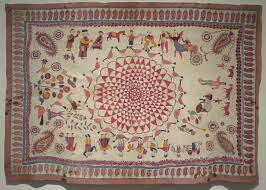
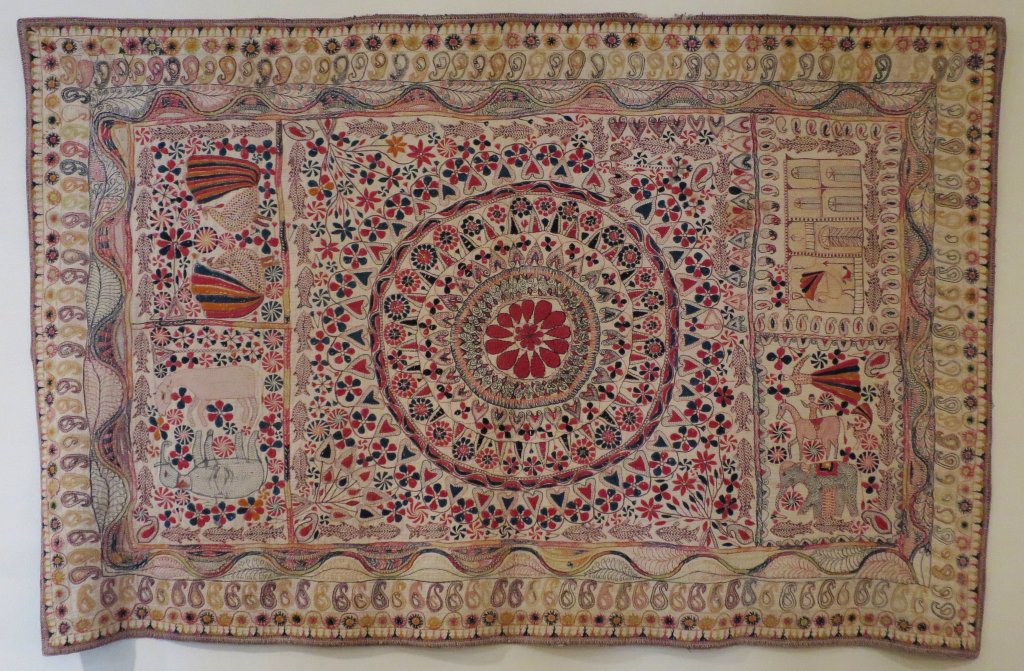
Yashoda chastising Krishna, gopinis (women friends or the milkmaids) pleading for their clothes, or dancing the Raas with Krishna, Duryodhan disrobing Draupadi, Durga slaying Mahishasura, Jagannath on the Rath with brother Balaram and sister Subhadra, Dasarath in a forest, Rama hunting the golden deer, Royal Bengal tiger, alligator, rows of elephants, horses, peacocks… Legends and icons were the major themes tackled by the ladies who inherited the evolved art of the needle from their mothers and aunts and grand aunts in the Hindu families. But these intricate lores were for the especially worked ‘lepkathas or sujnis – bedspreads primarily meant to be quilts or perhaps light wraps. Since these were given at marriages or at childbirth, soon ‘secular’ motifs such as boats and palanquins too entered the rectangular ‘playfield’, as did jewellery and ornaments like bajubandh which lent itself to the snake motif, and paati-haar or mat-patterned necklace.

But what kept the womenfolk busy round the year was the khoka (baby) kanthas used in the days when diapers were unknown, and every branch of the family tree became proud parents several times over. These small sized kanthas widely used the central motif of lotus and water lilies that were seen all around in the land of rivers, ponds, jheels or lakes. Surrounding the flora would be vines, the betel leaf, hand fans, fish, parrots, sparrows or some other small birds.

Then, there were the Aasan or carpet-like spreads meant for sitting on the floor. If they were to be used at mealtime, they would be patterned with kitchen utensils like ladle, kadhai, boti – the Bengali all-purpose knife, sickle or kaita, coconut dessicator, and fish that spells prosperity. The ones meant for daily pujas in the prayer room were adorned with floral motifs, leafs from nature, the paisley off a mango or recurrent curvilinear swastikas to ward off the evil eye. Such kanthas also served as covers for the mirror, on pillows, or even as rumal (kerchiefs).  

In households that would spread out the jainamaza (prayer rug), dastarkhan (for mealtime spread) or gilaf to cover the Quran, the running stitch — mostly in red and black or green and blue thread drawn from worn out clothes — would conjure the tree of life, the pond laden with lotus, or simply abstract the rippling effect of water and of chatai, the mat in every Bengal home. In short, the craftsperson’s aesthetics built upon utilitarian objects of every shape from the landscape of everyday life. In this respect, kantha shared a kinship with Alpana, the art of drawing patterns on the earthen floor with rice powder.

*

The coming of the British changed the age-old tradition that is believed to have originated with the famished Buddha lying in the open, covered by patchwork rags or quilted cloth. Until, roughly, the 1800s the rag and the needle accounted for only the material half of the kantha: the hand that stitched and the imagination that determined the pattern to be embroidered spelt the other half.  Both, the material and the motif were altered, subtly and gradually, by the historical and social metamorphosis that set in with the advent of the Europeans. For, with the imperialists came the tapestry inspired art and the needlework on matte cloth that relied upon the cross-stitch for its staple.

Now, this form of crafting spreads – be it for the bed, the table, or the floor – used designs that were published in books that came from England, France, Germany, and depicted European floral bouquets, pups and kittens, girls in bonnet or with umbrella, fairytale cottages, Greek warriors, even Zodiac signs. These mirrored the social reality of the landscape in which the rulers had grown up and left behind when they set out to conquer and rule. So, for the ‘natives’ this was as remote geographically as it was historically or in terms of tradition.

When the British rulers set up schools for girls and colleges for ladies, the students naturally took to crafting cross-stitch tablecloths and napkins, hand towels, tray cloth and tea cozy that were a part of the colonial lifestyle. The more enterprising ones even stitched the yardage together to make bedspreads and wraps but the amount of labour that went into it was immense. More importantly, the kantha was a unique, creative way of recycling that simultaneously conveyed the love of the elders who would make them in their minimal spare hours. Their kanthas may not have been autographed – though some were, but they certainly were ‘Stay Happy’ blessings even when the words ‘Sukhey Thako’ were not embroidered in by the unlettered grand aunts when the monsoon showers forced them to cut down on the outdoor rituals of preparing vadi, papad, achaar(pickle), kashundi(sauce) and sundry items for consumption round the year, or by widowed aunts with little wherewithal.

In later years, the creatively endowed craftswomen who could stitch layers of cloth without using a single knot, would also start stitching Radha Krishna, Shiv Parvati or Ram Sita on the matte. But by this time the Kantha had also come to grips with the social upheaval and had started depicting guns and cannons on the quilt! By this time, the Bengal Partition of 1905 had been reversed and the Nationalist movement had surged. Durga slaying the Bull Demon had acquired a renewed meaning as Sarbajanin Durgotsab – people’s celebration – took on a nationalist fervour. At the same time Khudiram, Netaji and Tagore gained wide popularity as icons to be mounted on the wall or even to be gifted as swaddle cloth for newborn to signify such blessings as “May you be like them!” or “May you live in a Free Country”.  Gandhi’s charkha (spinning wheel) also gained popularity as a motif along the border of the kantha – this was another quiet way of joining the bandwagon of khadi that was spreading the unarmed war against the rulers into the interiors of the land.

As collections in some Museums of Folk Art such as Gurusaday Dutta’s show, the change in motif also saw the head to toe ‘Gora Sahib’ – a white-skinned European, as Bengal had also gone through periods of French domination – make his appearance in kanthas. This was not unique to the needlework art, though. The coveted Balucharis of Bishnupur and Murshidabad that were conventionally identified by their depiction of battle scenes from Kurukshetra or nawab-begums smoking hookahs or driving horse carriages were now sporting Europeans – suited booted and donning hat, and sometimes along with their automobiles!

This change carried itself into the terracotta tiles too: the terracotta temples of Bankura and Birbhum that stand to this day, singing paeans to the heroism of the Devatas who vanquished the Asuras, or of Radha Krishna, Shiv Parvati and Sri Chaitanya, now showed Bengali Babus wearing ‘chapkan’ like the ones we see on social reformer Raja Rammohan Roy or litterateur Bankim Chandra.

There is another, more subversive side to the use of motifs on kanthas. At the peak of the Nationalist movement, when almost every house in Bengal Province was proud to see their youngsters follow Shahid Khudiram’s way, when Master-Da Surya Sen and Binoy-Badal-Dinesh were inspiring the curbs to join organisations like the Bengal Volunteers, and when women like Bina Das, Kalpana Dutta and Pritilata Wadedar too were picking up guns and bhojalis (daggers), the preteen girls played messengers and couriers. Often, when they could not openly send out a message, the revolutionaries would code it through the motifs on the innocuous kanthas that would be draped on babies in arm.

*

This last bit of history comes from my personal family. My father-in-law Kshiti Prasanna Sengupta, first cousin of Shahid Dinesh Gupta and active member of Bengal Volunteers, was jailed in 1933 right after his Matriculation Examination to be released only at the crack of 1947. His incarceration followed the bombing of three consecutive District Magistrates in Midnapore – of James Peddie in 1931, Robert Douglas in 1932, and B E J Burge in 1933. His sister Rama, then in her pre-teens, was often one such unaware courier as she was asked to reach innocuous objects to one or the other household – among them, baby kanthas.

Kantha, as mentioned before, were crafted by women in their moments of leisure carved out of a daily household routine that enjoyed little assistance from mechanical tools and kitchen gadgets. Stitching together three, five or seven layers of saris or dhotis was an arduous pastime to say the least. Yet they took pride in this pastime as the result was their very own creation, not only putting to good use what would otherwise be considered waste but also adding to the wellness of family members, many of whom would not even have the comfort of sleeping on a charpoy. Away from any thought of carrying forward a heritage, our grandmas were not even doing it for economic benefit or ‘self-help.’

Then came the generation of my mother Kanaklata, mother-in-law Aparna and aunt Smritikana, who had gone to schools where they mastered the art of cross-stitch on matte and knitting woolens that would then be sent off to British soldiers on the Burma border of 1944. They were game for the simple art of running stitch; they were adept at crotchet and could weave silken laces by using the hook that interlocked yarns or thread. No longer were they confined to the inner courtyard although they did not have the compulsion to go out to earn their bread. Neither did they crave for an identity in the world out there save by preparing their offspring to usher a brave new world. For these mothers and aunts, the needlework creations were a matter of self-dignity alone: they took pride in preparing the trousseau of their daughters and daughters-in-law with the labour of their own nimble fingers.

The turbulences in the outer world are the stuff of history. The luminescence and crevices, the glories and betrayals of those events mould the rock bed of idealism for the generations that follow. But do we realise how the hand that rocked the cradle helped us rule our own nation? Until recent times we failed to take note of the demolitions and reinventions witnessed within the inner courtyard. The turmoils our mothers and aunts lived through changed the complexion of society, of their age, of the way people of their times thought. So much has changed since, too. But women like Ashapurna Devi started relating the story of Subarnalatas, we too were indifferent to the significance of such restructuring. It is time to celebrate those brave women who fought with bare needles and midwifed liberation in the dark quarters where maids would lose their jobs for refusing to wear foreign clothes.

Ratnottama Sengupta, formerly Arts Editor of The Times of India, teaches mass communication and film appreciation, curates film festivals and art exhibitions, and translates and write books. She has been a member of CBFC, served on the National Film Awards jury and has herself won a National Award. 

(This essay will be published in Traditional & Contemporary Kantha, edited by Jasleen Dhamija, made possible by the effort of Siddharth Tagore. It has been shared by the author with permission of the editor and publisher.)

.

PLEASE NOTE: ARTICLES CAN ONLY BE REPRODUCED IN OTHER SITES WITH DUE ACKNOWLEDGEMENT TO BORDERLESS JOURNAL