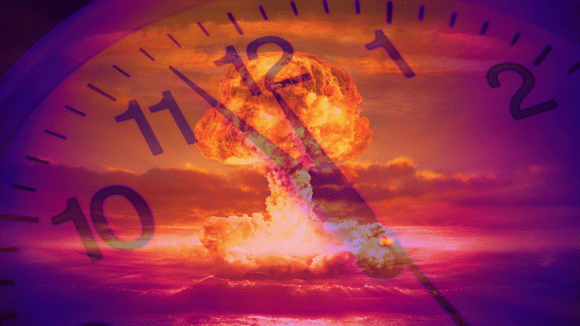
Last month the Doomsday Clock had moved closer to midnight than at any point since it was created in 1947. Maintained by the Bulletin of the Atomic Scientists, the clock is meant to signal how close humanity stands to destroying itself, whether through nuclear conflict, climate breakdown or new technologies. Its latest shift suggests that we are living through a particularly dangerous moment.
That is one way to look at the year ahead.
Another comes from a friend of mine who follows astrology. “2026 will be intense,” she told me after we had worked out the time difference to talk. “There are major planetary shifts happening. But that also means there is potential for growth.”
Between scientific warning and planetary symbolism sits a familiar question. Are we heading towards catastrophe, or simply moving through another period of change?
It is difficult to judge the scale of events while we are inside them. Perspective usually comes later. At the time, everything feels amplified. The media leans towards urgency. Our own thoughts do the same. The expectation of upheaval can sometimes be more overwhelming than the experience itself.
In recent weeks there have been many reminders of transition: the turning of the calendar year; the Lunar New Year observed across China, parts of Southeast Asia, Korea and the Himalayan region; the beginning of Ramadan for Muslims around the world. These moments draw people together in ritual and reflection. They offer continuity, even when the wider world feels unstable.
At the same time, global leaders speak in stark terms. The Secretary-General of the United Nations recently described a world marked by conflict, inequality and unpredictability. Climate scientists warn that we have entered uncharted territory. Heat records continue to fall. Rain arrives in sudden deluges. Winters in some places are no longer as cold as they once were.
For centuries, seasonal rhythms have provided reassurance. Spring follows winter. Festivals return at roughly the same time each year. Even the Gregorian calendar, introduced in 1582, was an attempt to bring order to time.
The Greek philosopher, Heraclitus, wrote that no person steps into the same river twice. The water flows on, and so do we. It is a simple image, but it captures something steady and true about human life.
What feels different now is the speed. Changes that once unfolded across generations now seem compressed into years. Climate patterns shift within decades. Technology reshapes industries almost overnight. Artificial intelligence systems are altering the nature of work, leaving some people optimistic and others uncertain. I know people who are struggling to find employment, both those nearing the end of long careers and those only just starting out.
My friend attributes the turbulence to a conjunction of Saturn and Neptune. She links economic instability and political upheaval to movements in the sky. When she mentioned the recent increase in visible auroras, I thought of astronomers pointing out that the Sun is nearing the peak of its eleven-year solar cycle. Different explanations, same phenomena.
Whether we turn to science, philosophy or astrology, the underlying experience is similar. Things feel unsettled. Time feels faster. The future feels closer than it used to.
It is tempting either to tune out the warnings or to become consumed by them. Neither response changes what is happening. Ignoring risk does not reduce it. Constant alarm does not resolve it either.
We cannot return to a previous version of stability. The seasons will continue to shift, though perhaps less predictably. Technologies will continue to develop. Political arrangements will evolve. Some changes are small and gradual. Others are abrupt and disorienting.
The real question is how we live through them.
After our conversation, my friend sent a message: “Changes aren’t endings, but thresholds.” It is a hopeful way to think about uncertainty. Crossing a threshold suggests movement rather than collapse.
Perhaps this year calls for small, steady practices. Paying attention to what we consume, digitally and otherwise. Slowing down our thinking when everything pushes us to react. Staying connected to the people around us. These are modest responses, but they are within reach.
We step into the river again. The water is different. So are we.
.
Keith Lyons (keithlyons.net) is an award-winning writer and creative writing mentor originally from New Zealand who has spent a quarter of his existence living and working in Asia including southwest China, Myanmar and Bali. His Venn diagram of happiness features the aroma of freshly-roasted coffee, the negative ions of the natural world including moving water, and connecting with others in meaningful ways. A Contributing Editor on Borderless journal’sEditorial Board, his work has appeared in Borderless since its early days, and his writing featured in the anthology Monalisa No Longer Smiles.
.
PLEASE NOTE: ARTICLES CAN ONLY BE REPRODUCED IN OTHER SITES WITH DUE ACKNOWLEDGEMENT TO BORDERLESS JOURNAL.
Winter, together with the northern gales, reached the shores of Hydra, an island belonging to the group of Saronic islands in the Aegean Sea. On the north-eastern side of Hydra, save a few monks in two monasteries, few human beings had built their homes. Hoary pines and cypresses intertwined with other plants, providing shelter and shade for the gangs of dangerous feral cats that roamed amongst enormous, solitary rocks and deep precipices hunting for food. Weird, colourful birds built their nests in the crevices of the towering cliffs whose plateaus were carpeted with red poppies and violet cyclamen. It was a desolate landscape unfavourable to human existence, although it was told that certain ‘wild’ islanders did dwell in the porous caves of the cliffs sculptured by the winds and rains overhanging the foamy waters far below …
It was in the south where the islanders enjoyed a relatively decent living, when of course the fish and tourists were plentiful. Now, however, the bathing areas lay silent and the villas, lifeless. Winter was the time for fishing. The sailing dinghies, catamarans and rowboats that had been hauled in for repairs were once again seen bobbing up and down upon the choppy waves. Seabass abound, as well as sea bream and sardines. Brightly painted sailing dinghies brought fish uninterruptedly to the market. But deep in this particular winter, the fishermens’ nets held little catch, and the islanders had to resort to eating vegetables that survived the cold from their gardens, the bread from their ovens, and now and then a partridge or a quail shot by those who owned rifles. Fish could be purchased from other fishermen in the neighbouring islands. But they sold their catch at a dear price.
Old Vasiliki was preparing his multi-pronged fishhooks. The nets that he had mended long ago had snapped and ripped again. Up till then, winter’s catch proved hopeless. He had scarcely earned fifty drachma. Vasiliki still had earnings from renting the second floor of his house to summer tourists, but those savings were slipping away on fishing material, goods from the shops or fish bought from the fishermen of the other islands, where apparently the catch was abundant. Nico, his grandson, had fallen ill that winter and medicine was dear. The poor boy had not been to school for over two weeks …
School and notebooks cost money, too. So be it. Tonight, Vasiliki would go out fishing, so he carried on straightening out his turkey-feathered multi-pronged fishing-hooks, mending the rotten fishing lines, changing the rusting hooks. If he could catch a lot of fish, he could buy a petrol lamp and more candles for the house, a pair of shoes and a woollen vest for Nico. He would buy Nico a book of sailors’ tales that his curious-minded grandson longed to read. He would also buy him a huge picture of a Spanish galleon that he could pin up on to the yellow painted wall of his tiny room.
Vasiliki went out fishing in the evenings. Nico never knew when his grandfather would return …
Every night the boy dreamed the same enigmatic dream in the absence of his grandfather. He stood at the helm of a beautiful boat whose name was written in bold black letters but which he could never read. Enormous waves continuously surged and battered the solid vessel. Then a sudden volley of rocks or missiles assailed him from all sides out of a rising mist, accompanied by a deafening din of hysterical screams and raucous shouts. From above, a huge white-crested wave was about to engulf him … Nico would be startled out of this recurrent dream, never understanding how he escaped the missiles, the monstrous wave and screams because at that very instant he was startled out of sleep by the flapping of the curtains against the paneless window and the slow, heavy footsteps of his grandfather returning from fishing. Vasiliki, smelling of the briny sea, stepped into Nico’s room.
The boy sat up in bed: “Did you catch any fish, grandpa?”
“No, the sea was empty of fish tonight.”
“Empty?”
“A sea monster has surfaced, Nico. It is eating all the fish in the sea.” Nico blinked his eyes in mistrustful wonder.
“Have you seen the sea monster, grandpa?” The exhausted Vasiliki offered no answer. He shuffled out of his grandson’s room and retired to his own.
Whether Vasiliki really saw a monster always remained a mystery to Nico. He had read about weird sea creatures with lamps on their heads in the inky darkness of the deep; read about shoals of huge fish that swallowed dinghies and rowboats whole. His father, Constantine, had been swallowed up along with his crew by those horrible creatures … so his grandfather narrated, sadly. His mother, Myrto, died a few months later of tuberculosis … or of a broken heart. Or both. They were in their early thirties …
Vasiliki and his wife, Nefeli, took their grandson in. They did their best to bring up the lonely, melancholic boy. Then Nefeli fell ill with fever and died soon after. Vasiliki buried his beloved wife at the neighbouring cemetery. All that the old man cherished now was Nico, his taciturn grandson.
Vasiliki owned a small, green, two-storey wooden house, a house that belonged to his father. Summer was not far off so he could again rent out the second floor to tourists and earn a few lepta or drachma.
In the small sitting-room where the flower-dotted wall-paper was peeling off the badly cut boards, he had nailed photos of his wife and daughter, now yellowing due to the humidity. Vasiliki’s home was hardly furnished, although he had made an effort to provide low sofas, wicker chairs and sturdy tables for his guests upstairs. He even built a shower for them, a luxury that he and Nico dispensed with. They washed either in the sea or directly from the wash-basins in the garden behind the house. But since no one occupied the two rooms upstairs, ever so often they would shower upstairs and from the windows look out at the sea. Presently, Vasiliki climbed the five steps to one of the rooms, parted the laced curtains of the recently washed window and looked out towards the sea, whilst he mended his net, sang songs, thought of Nico’s future. His warm eyes slipped from his mending to the brilliant blue waters of the Argolic Gulf. That boy was all he had. His treasure. When he thought of Nico he awoke from his day-dreaming and smiled. He had promised him long ago that they would build a small boat and send it navigating on the high seas, like a bottle thrown amid the waves, and whose destination would be known to no one, a horizonless destiny for that little boat.
Vasiliki sighed: “I have to keep an eye on Nico. Those nasty children from town always take the thump him at school. He’s not big enough to fight on his own.” Vasiliki took up a needle and began stitching Nico’s torn trousers. “I have to walk him home after school so he won’t go sleeping under the olive trees or on the beach where the schoolboys could knock him up.” Vasiliki wondered where his grandson had gone …
Nico stood under a plane tree in front of his grandfather’s house. He was busy making a boat. It wouldn’t be his first boat. But this one would be the boat of all boats ! A long-voyage boat, built for the broad, open seas … the remote and unchartered seas, a boat that would weather stormy waves, glide over placid rolls, sail alongside monstrous creatures of the deep, a boat without a flag, a nationless boat, yet unmanned by pirates or corsairs, a boat completely independent. Nico put his whole heart into this project, his whole imagination of what such a boat should be made of, and how it should be navigated.
“Nico?” cried down Vasiliki from the upstairs window.
“Yes, I’m here, grandpa.”
“What are you doing?”
“Making a new boat.”
“Another one?”
“The biggest and the best, grandpa. It’ll sail to the other side of the world … to China …”
“Tomorrow you must go to school, don’t forget. You can work on your boat after school.”
“Yes, grandpa. I’ll work hard in school.”
“By the way, what will you name your boat?” Nico thought for a moment. At first ‘Neptune’ came to mind, but he quickly changed it as his grandfather’s eyes swelled with pride and joy at his grandson’s aspirations and imagination.
“I’ll call her Nefeli, grandpa.”
Vasiliki gave Nico an odd look. He didn’t know whether to smile or cry. He murmured the name several times on his lips, slowly, intimately. The old man burst out laughing: “Nefeli! Nefeli!” he shouted. “Your grandmother would have been proud to know that her name will navigate the four oceans of the earth, my boy. Don’t forget to prepare your things for school tomorrow. We’ll be having sardines tonight that I bought from Dimitri. He sold more than a dozen at half price.” And Vasiliki returned to his mending and stitching since the yellowish light of late afternoon allowed his eyes to do so …
Nico went to school the following morning, shuffling along the dirt-packed road. What a burden to acquire knowledge that he would never use in ‘real life’. Neither Nico’s classmates nor his teachers held any interest for him. His two weeks’ absence afforded him time to dream … to concentrate on his boat-building. The boys who crossed paths with him on the way to school never wished him a good morning, nor did they enquire about his health. He was ostensibly shunned by all and sundry, even several of his teachers took a dislike to him.
Nico shrugged his shoulders, sitting in the back of the stuffy classroom, heated by a pot-bellied stove, gazing out over the bungalows to the wide sea. He envisioned the decks of galleons gleaming white from a good scrub, their sails bellowing in the refreshing breeze. Nico filled his lungs with the fresh, clean, ocean air. Yes, only the sea afforded the boy a pleasure in life, along with, of course, the voice and affectionate gestures of his grandpa. All other things to him seemed dull, lifeless … empty.
The children in his class thought only of the tediousness and boredom of their school work and the silly games they played with or against each other to compensate for that tediousness and boredom. None had any project to impassion their lives. None envisioned a future further than the next day at school or in the market. Few went swimming in the bay, where he swam too. They shrank away from his boyish laughter splashing about in the water, avoiding his company completely.
When Nico was not day-dreaming in school he was busy reading or making boats — all kinds of boats. Cutter in hand, he whittled small sailboats and rowboats … even catamarans! Everyday he whittled a raft as he contemplated the steamers’ coming and going in the glimmering Aegean. But his next boat would be huge. A huge boat with a bridge, lower and upper decks, a hold for cargo, masts, sails, portholes and a crow’s nest. This boat would be the largest, the loveliest … and the sturdiest of them all. A boat which had never been built before by a fourteen year old boy. And that day came. Nico, the fourteen year old boat-builder had completed his dream boat. For him this boat meant the world. He felt his heart swell with pride and satisfaction. Vasiliki inspected his grandson’s remarkable vessel. It was painted marine-blue. At the bow he had painted the head of Neptune. He had even cut a hole in the starboard for the anchor to be weighed or dropped using a big fish-hook tied to a long, thin rusty chain. The deck had been sand-papered to a dazzling gloss. He equipped her with a four-cornered small jibe[1], as white as the flesh of a sea bream. He had taken great pains to whiten that piece of cloth of a sail, rubbing and scrubbing away with aqua fortis. It took him days to attain that candid sheen …
All the rigging on the bridge was fixed solidly to the wide deck by thin copper wires rising high above all the rest, held securely with copper wires screwed into the thick wood of the deck and reinforced with English twine. Portholes had been carved out on both the portside and starboard for the cabins, for although Nico’s boat would be captainless — unless he himself exercised this task– his imaginary crew would be like the Lilliputians that he had read of in Gulliver’s Travels. How he had enjoyed reading those stories of sea and island adventures … Nico had even cut and inserted pieces of broken glass he found scattered about the streets to window the portholes, which he polished to a shiny, brassy gleam.
When all had been fitted out properly, he painted the endearing name Nefeli in bold, black letters on her portside. Vasiliki stood in quiet admiration of his grandson’s months of hard labour. It was indeed a work of art. He embraced him. His grandson may not be the best of pupils, but he worked wonders with his hands. Someday he would be a great boat-builder, and not just a poor fisherman like his father and grandfather …
The rising sun peeked over the watery orb of the sea. It was Saturday. That day Nico launched his boat into the placid waters of the Argolic Gulf. Vasiliki accompanied him on this long-awaited day, eager to witness her maiden voyage. The Nefeli once launched, slid with ease. At first, the boat floated unsteadily on her portside. But when the wind picked up, she rose to her full splendour and ploughed through the clammy waters with amazing ease, all sails aswell. Nico let the spool of English twine slide quicker and quicker from its spool. It unravelled rapidly, but the boy had full control of the situation. The spool held hundreds of metres of twine.
The Nefeli skimmed over the wavelets like a shark racing towards its prey. Vasiliki stretched out on the pebbly shore to mend a torn net, eyeing both the Nefeli and his mending in mute jubilation. He thought of his daughter and how proud she would have been to see her son manœuvre his own hand-made boat. His grandson, too, jubilated, running to and fro along the shore to manœuvre the cruising vessel as she swayed to the rhythm of the breeze. Suddenly an easterly gale drove her towards the shore. Nico slackened the twine. At the same time, though, he pulled her away from some dangerous rocks and uprooted pines. Any collision might have caused great damage to the Nefeli. After all, it was only a little boat and the sea a powerful force that no one should underestimate. Two hours or so later, Nico pulled her in, and he and his grandfather returned triumphantly homeward to eat.
News of Nico’s remarkable boat reached every ear on that small island. People from the big town would come to the shore to watch this young boy of fourteen manoeuvre his vessel. As promised, Nico launched his boat only after school as soon as he had finished his homework. For weeks now, the Nefeli had withstood the brunt of several white-crested waves and a slight collision against the rocky part of the shore. All in all, Nico’s boat proved robust and his manoeuvring worthy of any captain of the sea.
One fine, sunny Saturday Nico, as always, launched the Nefeli near a large grove of pine trees. A slight south-easterly wind was blowing. The twine unravelled rather quickly, the boat lying on her side, her stern twisting and turning in the foamy waters like a fish’s tail. He pulled at the twine and managed to steady her route. Nico sighed in relief … Suddenly he heard shouts, cries and screams from behind him. A gaggle of children were racing along the shore targeting his boat with huge stones, one of which, incredibly enough, after hitting its target, propelled her further away from the volley of projectiles. Two or three boys, whom he recognised from his class, had sling-shots and were letting fly stones with great rapidity but not necessarily with great accuracy. Nico ran faster, pulled at the twine, quickening the speed of his boat. But there were too many boys, many of them running faster than him. More and more stones were slung or thrown, luckily off their mark. Nico thought to haul the boat back to shore near the rocky cliffs in the hope that the scoundrels’ pockets would be emptied of stones by then.
The poor boy, however, stopped in his tracks. The Nefeli seemed to navigate on her own, wind filling her sails, skimming high and mighty over the angered waves in spite of the deluge of catapulted missiles. Then in one tremendous volley four or five of the bigger boys hurled dozens and dozens of stones at the speeding Nefeli, some of which broke through portside, others splintered the bridge and still others burst into the jibe and crow’s nest.
Nico’s wonderful workmanship managed to stay afloat for a half hour before sinking to the bottom of the sea. The last thing that Nico saw of his boat were the bold, black letters of his grandmother’s name: Nefeli.
The children vanished into the pine groves as quickly as they had appeared …
Nico turned his back to the dramatic sinking of his vessel. Opening the gate to his grandfather’s front garden, he strolled up to him.
Vasiliki, cleaning several fish and shrimp that he had caught the previous night smiled at the approach of his grandson: “So, how did she sail …?” He suddenly noticed that Nico hadn’t the boat in his arms. He frowned and lowered his eyes.
“She set sail for the other side of the world, grandpa. She’s in route to China. The English twine snapped and off she sped out of the gulf towards the open seas disappearing over the edge of the waters …”
“Well, like a bottle thrown into the sea, right? You never know where she’ll land. I just hope the sea monster won’t swallow her up like it does all the fish.”
“No, grandpa. Monsters don’t swallow boats only fish. Did you see the monster last night?”
Vasiliki shook his head. “Can’t say that I did.” He put down his knife and scratched his white beard: “I caught some prawns last night Nico, what the Spanish call gambas. We’ll have a marvellous meal just you and me tonight.”
“It’s always just you and me that eat, grandpa,” Nico reminded his grandfather.
Vasiliki pursed his lips: “How right you are, my boy.” The old man paused for an instant taking up his knife: “Will you build another boat?”
The boy kicked up the yellowing grass in the garden with his torn sandals. “Yes, grandpa, I’ll build another one.”
“Bigger than the one that just sailed to China?”
“Yes, much bigger.”
“What will you name her?”
Nico furrowed his brow. He looked sadly into his grandfather’s eyes: “I’ll name her Myrto.”
Vasiliki eyed his grandson affectionately. “I like that name Nico. It’s a beautiful name …”
“I like it too, grandpa.” And the boy shuffled off to his room …
Paul Mirabile is a retired professor of philology now living in France. He has published mostly academic works centred on philology, history, pedagogy and religion. He has also published stories of his travels throughout Asia, where he spent thirty years.
.
PLEASE NOTE: ARTICLES CAN ONLY BE REPRODUCED IN OTHER SITES WITH DUE ACKNOWLEDGEMENT TO BORDERLESS JOURNAL
PIRATE BLACKTARN MEETS NEPTUNE


Pirate Blacktarn, Terror of the Lemon Seas
Swung in his hammock, taking his ease.
The sea was calm and the day was hazy,
The pirate ship’s crew were feeling lazy.

“But look,” said Fay, “what’s happening there?”
She pointed her finger and the crew turned to stare.
All except Blacktarn, whose eyes began to close.
His head began to nod and he fell into a doze.

“WOW!” cried the crew, “look, look, LOOK!”
“What can be happening?” asked Big Bob the Cook.
“Don’t make a noise when you know I’m having a nap,
I must get my rest,” said Blacktarn with a snap.

“But the sea’s gone purple and now it’s turning gold,
Oh come on Captain, don’t wait to be told.
Look how now the sea’s bright orange
It’s so mysterious and strange.”
“Oh do stop bothering me,” said Blacktarn, very cross.

“But the seabirds have gathered, even the albatross.
And the dolphins are dancing and the flying fish are leaping.
Oh Captain Blacktarn, do stop sleeping.
Hey, do you hear all that wonderful singing?
The sea nymphs are chanting and the Mer bells are ringing.
See all that spray? It’s the great whales blowing.
And look, now watch, how the whole sea is glowing.”

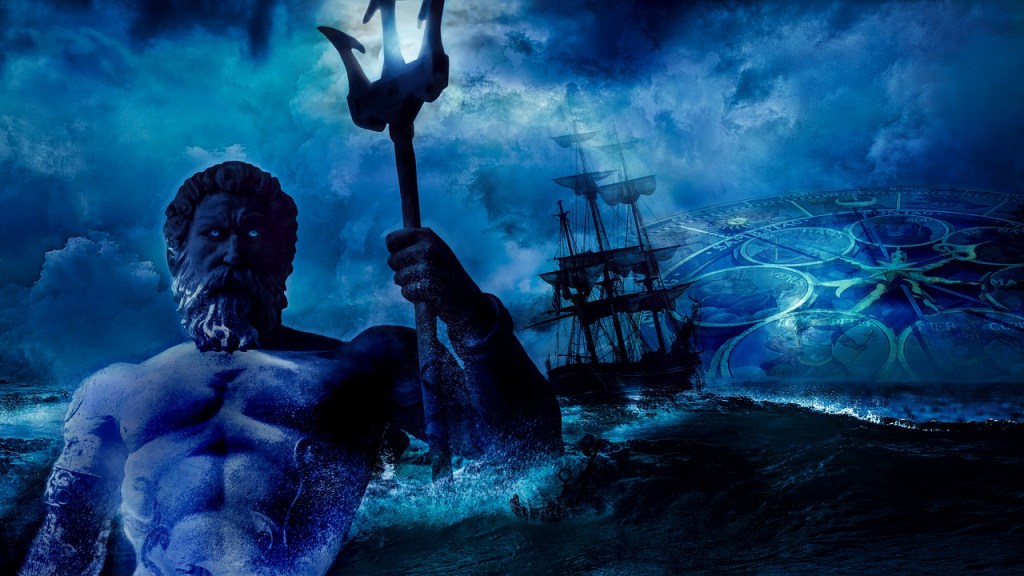
Rising from the ocean, a figure started to appear
Waving a trident, a huge three-pronged spear.
His hair was green as seaweed and he wore a starfish crown
And he rode a giant seahorse which danced up and down.

“I know who it is,” squawked Tim Parrot, all excited.
It’s Neptune, the sea god,” cried Bosun Mick, delighted.
And all Blacktarn’s crew roared out a great big cheer.
For every creature of the Lemon Sea was here,
All waiting to greet Neptune, the sea’s great Lord,
All except Blacktarn, who just snored and snored and snored.

“I think he’s coming here,” gasped Stowaway Fay
For the great god Neptune was riding their way.
“Captain Blacktarn, you must be ready to meet him.
Neptune is here, quick, wake up and greet him.”

“Neptune,” muttered Blacktarn, “don’t be ridiculous.
Neptune’s just a fairy tale, rather like St Nicholas.”

“No, no, he’s here Captain,” cried Mick in alarm.
Come on, wake up now, it’s no time for calm.”

But Blacktarn closed his eyes again and sank into a slumber
And Neptune gave a grin, for he’d got Blacktarn’s number.
He borrowed a big feather from a seagull’s long grey wing
And tickled Blacktarn’s nose, till soon he started blinking.

“Go away,” huffed the Pirate, pushing the feather aside.
Then all of a sudden, he opened his eyes wide.

“NNN Neptune!
I thought you were a fairy tale but now I see I’m wrong.
PPP please don’t prod me with that scary prong.”
But Neptune hooked his trident fast on Blacktarn’s braces.
“Now you pirate, let’s have no more airs and graces”
He told the dangling captain in a very firm way.
“This is a poor welcome, I’m very sorry to say.
But as I’m in a good mood, you have a chance to please me.
For the reason I’m visiting this lovely Lemon Sea
Is most of all because I want a special cup of tea.
I’ve heard from the mermaids that the finest brew to savour
Is made from water with that special lemon flavour.
So now if you make me a special cup of tea
I might just forgive your lack of courtesy.”

“Of course,” stuttered Blacktarn, “if you’ll just put me down.”
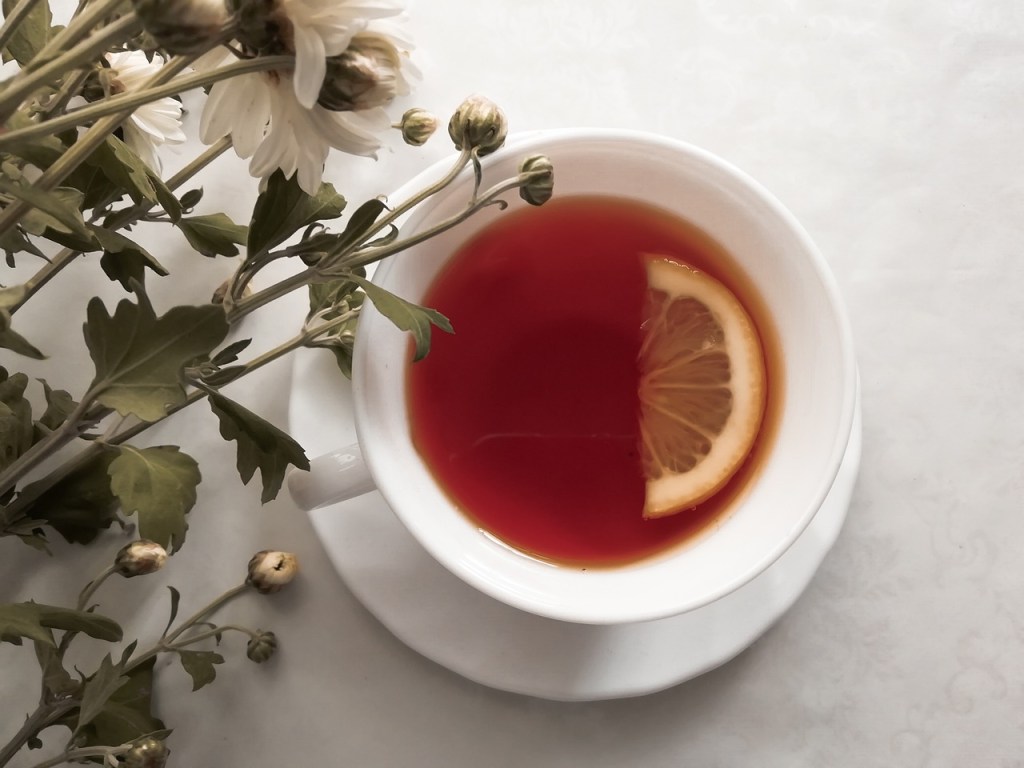
So Big Bob brewed the tea, all hot and strong and brown.
“This is what I’ve been wanting,” said Blacktarn with glee
And now I think it’s time we had a tea party.”

So they had the best of parties, right there on the ship.
There was lemon tea and grog, rock buns and seaweed dip.
Stowaway Fay did daring acrobatics
And Rakesh the mate did magic tricks.
Mick danced a jig and Tim Parrot squawked a solo
Which shivered the timbers, above and below.
Blacktarn cheered up and played the perfect host
Even though the sea horse ate all his toast.

And Neptune beamed a lot and enjoyed himself no end
“Well I’ve had such a good time, I could happily spend
Many days on your good ship but sadly I must go.
I have important business in the deep ocean below.”
And lifting his trident high, he left them with a sigh.
Back into the sea he plunged, waving them goodbye.

“Goodbye,” called the seabirds, the dolphins and the whales,
“Goodbye,” called the Mermaids, swishing their tails.
“Well I’m glad I invited him,” said Blacktarn looking smug.
Now it’s time to sail again – oh Neptune’s gone off with my mug!”
Note: The ‘Pirate Blacktarn’ poems were written in the early 1990s but were never submitted anywhere or shown to anyone. By lucky chance they were recently rescued from a floppy disc that had lain in the bottom of a box for almost thirty years. There are twelve poems in the series but no indication as to what order they were written in and the author no longer remembers. However, they seem to work well when read in any order. They all feature the same cast of characters, the eponymous pirate and his crew, including a stowaway and an intelligent parrot. The stories told by the poems are set on a fictional body of water named the Lemon Sea. (Dug up by Rhys Hughes from the bottom of an abandoned treasure chest).
Jay Nicholls was born in England and graduated with a degree in English Literature. She has worked in academia for many years in various student support roles, including counselling and careers. She has written poetry most of her life but has rarely submitted it for publication.
.
PLEASE NOTE: ARTICLES CAN ONLY BE REPRODUCED IN OTHER SITES WITH DUE ACKNOWLEDGEMENT TO BORDERLESS JOURNAL
 Borderless