Categories
Aeons of Art

Art is Alive

By Ratnottama Sengupta

The Gregorian calendar was still showing 1998.

I was in Oxford on a Charles Wallace fellowship to study John Ruskin’s influence on M K Gandhi and R N Tagore. Like any other student I lived in a hostel, walked up to the Ruskin School of Art and Ashmolean Museum, to the High Street and the flea market, to the Bodleian Library, and – of course – the book stores that continue to make that ancient city of academic excellence such a delight for a person like me who started crawling in the midst of books.

What caught my fancy on the book-lined shelves in the hometown of a ‘legal deposit’ library? The screenplays of Quentin Tarantino. Countless books on Elizabeth 1 – perhaps because Shekhar Kapur’s Elizabeth had just released worldwide. And the volumes on art. The gorgeous reproductions halved the tedium of walking miles of museums and galleries. And the history of art rekindled my love for paintings from our collective past.

But what I didn’t take kindly to was the neglect of – if not bias against — art from my homeland. There were books on Greek, Chinese, Japanese , African, Egyptian, Mayan, Roman art, on Russian Icons and Stained Glass windows, on French Impressionists and German Expressionists, Cubists and Moderns… But Indian art? For crying out loud, where was Ajanta-Ellora? The glass paintings and Miniatures? Pichwai and Patachitra, Nathdwara and Kalighat Pat, Warli and Madhubani, Santiniketan and Baroda?

That’s when I told myself, “Put the journey of Indian paintings between covers.” For, which other country has a continuity that I can boast, of a tradition that has continued unchequered for three thousand years and more?

Once I was back home, my friend Reeta Dutta Gupta approached me to edit an Encyclopedia of Culture for the India Series she was nursing. And Dr Jain of Ratna Sagar entrusted me to author a Notebook that would recount for school-going children the story of Indian art from Bhimbetka to the present millennia. What luck!

*

Be it the hunters and the hunted of Bhimbetka, the rock art now on the UNESCO list of World Heritage, or Kolam and Alpana and Rangoli, the decorative designs of Kerala and Bengal and Maharashtra. Be it the Buddha of Ajanta Frescoes or the ploughmen and blacksmith of the Haripura Congress panels painted by the Bengal master Nandalal Bose, be it the illuminations in the Jain manuscripts or the Mughal manners immortalised by the kalams: art in India has grown out of everyday life. These art expressions have been an integral part of the people’s existence, regardless of the style or the period in which they were painted. Yes, down centuries Indian art has withstood change of regiments, religions, philosophy, social content, historical setbacks. And, aesthetic excellence has found an outlet in forms and lines, strokes and colours, whether these were obtained by crushing gems or pounded rice.

This has helped India enjoy a continuity that is rare even in the developed societies. From the sketches of Bhimbetka to those of the tribal artists of Warli, from the murals of ancient India to the art of contemporary masters, from the miniaturised figures to the Tantric patterns – art in India has reinvented itself again and again. And each time it has emerged with renewed vigour and vitality. Because, every age has related to art in an intimate way. By painting on the wall. Decorating the floor. Placing it on the altar. Or simply by keeping an account of the times.
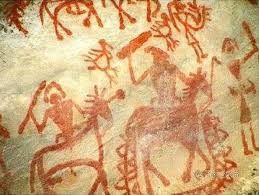
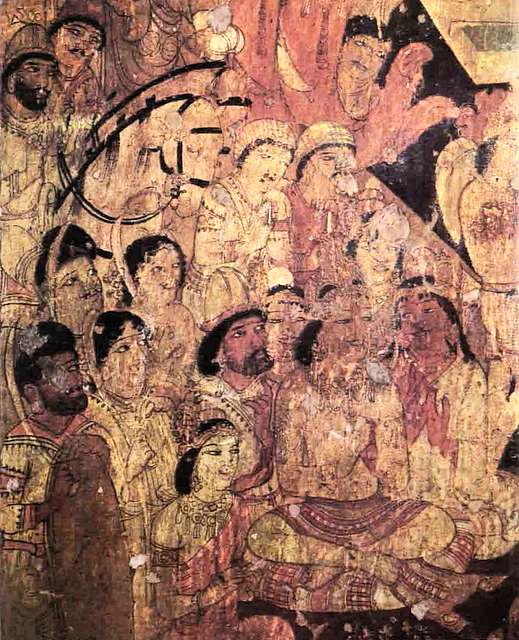
As A Ramachandran – then professor of art at Jamia Millia Islamia in Delhi – had said to me, “Even when our ancient language that was deemed the language of the gods, fell into oblivion, art transcended centuries because it was communicating through a universal language – the visual language of colours and hues.” The lines defined the form, and also created a unitary area for the use of colour, he had further explained. “No matter what the subject, comprehension was never a problem for the Indian – until he was confronted by the art that was imposed by the colonialists.”

The Western overemphasis on realism played havoc, with the native sensibility that allowed for imagination and stylization, Nair Sir had pointed out. That sensibility had no problem accepting a ten-armed goddess, Dasabhuja Durga, or Dasanan, the ten-headed Ravan. “Lifestyle changes too have led to the dilution of Indian aesthetics that once enveloped our workaday lives. The only living art today is the visual art traditions in the villages, but that too might not last as villagers now want to ‘rise’ to the level of the urbans!” he had lamented.

In such a situation, art becomes doubly significant in the life of a child. When she or he is exposed to it, the child can not only access the history and the continuity of a culture but also nurture it with love that can ensure it lives in the days to come… With this in mind, I will write to focus on the high points of Indian art.

Ratnottama Sengupta, formerly Arts Editor of  The Times of India, teaches mass communication and film appreciation, curates film festivals and art exhibitions, and translates and writes books. She has been a member of CBFC, served on the National Film Awards jury and has herself won a National Award. 

.

PLEASE NOTE: ARTICLES CAN ONLY BE REPRODUCED IN OTHER SITES WITH DUE ACKNOWLEDGEMENT TO BORDERLESS JOURNAL

Click here to access the Borderless anthology, Monalisa No Longer Smiles

Click here to access Monalisa No Longer Smiles on Amazon International
Categories
Slices from Life

An Alien on the Altar?

By Snigdha Agrawal

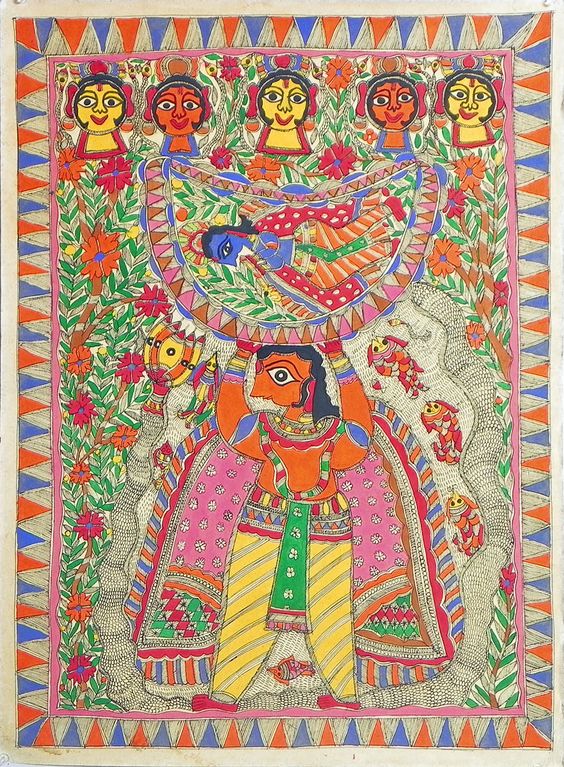
Birth Of Krishna: Madhubani Art. From Public Domain

Throwback to the early 60s.  Janmashtami[1] was a highly anticipated event for us kids, back then.  In our community of expats, the Sharma household outdid others in celebrating the festival with great fanfare.  Aunty Sharma would start the preparations days ahead of the festival, instructing the gardener to collect loose soft soil from the periphery of her kitchen garden.  Plying the soft soil between her fingers, a miniature model village scene was crafted, closely resembling Mathura, where Lord Krishna was born.  Single gauge railway track winding through the plains, midway a station master’s cabin, cows grazing in the green fields at the foot of the grassy sloped conical hills, built into the scene.  Village belles dressed in colourful clothes poised to fill their urns from the lake, (formerly an empty biscuit tin overlaid with mud), made it more picturesque. Thatched roofed huts, and a post office with a red-letter box, made it complete.   Picture perfect in every respect identical to villages depicted in Bollywood movies with heroines dancing around trees.  Placed right in the centre was the crib with the bronze idol of Baby Krishna, looking indolently at worshippers.  The entire scene rested against the living room wall, covered with Auntie’s gold brocaded wedding saree, the two edges tied to the door hinges on either side.

The highlight of the evening was not in the rituals but in the eating of the prasad and the special ‘shudh shakahari[2] dinner that followed. It was a once-in-a-year dinner that we relished and hogged till our tummies could take no more.  Apart from the binge-eating of homemade besan[3] and coconut laddoos[4], soaked in ghee, offered to the idol, it was the ‘panjiri[5]prasad[6], our eyes were fixed on for reasons, other than holy. Made of roasted wheat flour, dry fruits, powdered sugar, spices and a generous helping of ghee added to give it a unique taste and texture, this offering had special significance for us. Of powdery consistency that could go in any direction; swallowed or blown in faces for the heck of it.  The latter was always on our minds, the fun part of the festivities.  Never begrudged by the seniors, who were tickled pink seeing our ‘panjiri’ covered ghostly faces, with pieces of dried fruit stuck in the hair, hanging from eyelashes, stuck at the corners of the mouth.  And always ended in a contest of who could blow the most. Who looked the weirdest?  Thus, acquiring the name ‘phoo phaa’.  The ‘phoo’ sound from the funnel-shaped mouth in the act of blowing, followed by the ‘phaa’ from the mouth muscles stretched sideways.  Those amongst us with missing frontal teeth struggled to get it right as the powdery ‘panjiri’ got moistened by saliva a bit too soon, the ‘phoo’ producing zero results.

One year, the contest was struck off.  For no fault of anyone.  Nor any shortcomings in the puja[7] arrangement.  The scene was up like every year, with a little modification here and there.  Bronze plates were laid out with homemade laddoos, whole fruits, the steel dekchi filled with ‘panchamrit[8]’, a sweet drink made by mixing five ingredients — milk, yoghurt, crushed basil leaves, honey and Ganga Jal [9]to which sugar, ghee, chironji[10] and makhana[11] are added for the crunch part and flavouring.  A drink commonly had to break the day-long fast. This fast was observed by Uncle and Aunty Sharma only.  A cupful of the delicious drink had us craving for more.  It was rationed to pass around to all the attendees. No one left without partaking of this prasad spooned out on open palms.  We were treated to a second helping of the leftovers, if any.

The puja rituals progressed as usual with the offering of flowers, prasad, and singing of hymns, to be followed by the aarti.  Aunty was about to light the ghee lamp for the aarti[12] when our attention was diverted to the sound of a splash in the biscuit tin lake. 

An unexpected visitor had landed from outer space! Uninvited, it dropped from the ceiling above.  We jumped in fright and disgust at the sight of an ugly lizard amid the holy scenery. The creepy-looking reptile stared at us, unblinking, flicked its tongue, cocked its head to one side, then to the other and slithered up to the railway track, making clear its intention of lingering. 

That was not to happen. Baxter the two-year-old Alsatian, otherwise a well-disciplined pet, sitting on his haunches, guarding the inmates and watching the puja with full devotion, bounded across the room barking at the invader, ready to crush the creature under his paws. After all, it was his job to protect the family. In his view, this intruder certainly did not qualify as a worshipper.  

Uncle and Aunty tried to calm him.  That was out of the question.  He went straight into the village scene, bringing it down, chasing the half-tailed lizard, looking at him tauntingly as if to say ‘Catch me if you can’.  The laddoos went flying into the air, the fruit platter upturned, and the ‘panjiri’ mixture floated up like a cloud over the village. ‘Baxter stop…stop’ from Uncle and Aunty went unheeded. Baxter was not in a mood to give up the chase.  Just as he was about to paw swipe, the lizard darted between the folds of the brocaded saree and vanished in the blink of an eye.  Baxter barking furiously spun around, nose to the ground, desperately searching for the invader.  Chintu the cook, busy in the kitchen preparing dinner, heard the commotion and came running, grabbed Baxter by his collar, deftly clipped on the chain, tying him to the balcony railing. Peace was restored. 

Wasn’t this a bad omen, Aunty questioned with concern.  “No…no…Lord Krishna had visited in the avatar of the lizard and blessed us all” comforted Uncle.  Baby Krishna was lifted out of the crib and placed in the alcove on the wall, which served as the mandir for all Gods and Goddesses.  Aarti was resumed, to the ringing of the heavy brass bell and singing of “Om Jai Jagdish Hare[13]”, a hymn sung when concluding the puja.

Baxter sat in the balcony corner with his ears drooped, tail tucked between his legs, a soulful look in his eyes, fixed on Uncle, seeking forgiveness for his misdemeanor.  “It’s okay, Baxter,” Uncle whispered, patting him on the head, and unchaining him. He lifted his head slightly, his tail beginning to wag again slowly.  The reprimand was over and forgiveness had arrived.  He joined us at the dining table, crouching underneath and parking himself near Auntie’s feet.  The grand ‘shudh shakahari’ dinner commenced with deep-fried kachoris[14], an assortment of cooked vegetables, both dry and with gravy, lachha — ginger juliennes soaked in lemon juice, ending with the thick and creamy kheer[15].  With the arrival of the last, the missed ‘phoo phaa’ contest that year, receded into the far corners of our minds. 

.

[1] A festival celebrating the birth of Krishna held in mid-August in India

[2] Pure vegetarian

[3] Gram flour

[4] Dry sweets

[5] A sweet made during this occasion

[6] An offering to Gods that is later consumed by the devotees

[7] Prayer

[8] A sacred mixture of five ingredients used in Hindu Puja

[9] Water from the Ganges – considered holy and therefore, potable

[10] Chironji, grows in India – refers to the fruit,  a nutty seed, sweet and salty in taste.

[11] Lotus seed

[12] Offering of lights, candles or lamps

[13] O Lord of the Universe

[14] Deep-fried Indian bread, stuffed with spiced lentils

[15] Indian dessert made of milk

Snigdha Agrawal (nee Banerjee) is a spontaneous writer, writing in all genres, covering poetry, prose, short stories and travelogues.  A non-conformist septuagenarian, she took up writing as a hobby post-retirement and continues to learn and experiment with the out-of-the-box style.

.

PLEASE NOTE: ARTICLES CAN ONLY BE REPRODUCED IN OTHER SITES WITH DUE ACKNOWLEDGEMENT TO BORDERLESS JOURNAL

Click here to access the Borderless anthology, Monalisa No Longer Smiles

Click here to access Monalisa No Longer Smiles on Kindle Amazon International