Narrative and photographs by Farouk Gulsara
They said they were going to be rough-and-tumble countries, not for the faint-hearted. We said, “bring them on!” Initially, four from the cycling team opted in, but in due course, two withdrew due to medical maladies and other assorted issues, two withdrew. Rather than seeing it as a cue to call the whole thing off, we stood firm.
“It could be our only chance to do it”, we thought. After all, the master organiser extraordinaire, JS, staying true to the grit of his profession, had planned an elaborate itinerary, complete with plans A through C and beyond in case of obstacles. And I did not want to let him down, so there we were, just JS and I to do the course as a duo, cycling through the wild countries that could only be tamed by the Khans themselves, the Mongols, not the Bollywood Khans.
Day 1: Arrival at Almaty
Now everyone can fly to all kinds of spots, and they can also fly directly from Kuala Lumpur to Almaty, Kazakhstan. Almaty is the country’s largest city and was the capital of a struggling post-Soviet economy until 1997, when an economic boom followed. Oil and mineral discoveries snowballed the economy to dizzying heights. Astana became a gaudy display of its wealth, dubbed the ‘Dubai of the Steppes’, and became the capital afterwards.
Call it bias, but because of their leaders’ association with Malaysia’s disgraced PM, Najib, my initial impression of Kazakhstan, even before going there, was dismal. To prove me right, my first contact with a Kazakh was unpleasant. The airport taxi driver tried to fleece us by concocting a story to charge six times the usual fare. We managed to talk ourselves out of it, but this kind of trickery seems to be a common pastime in Kazakhstan. On the last leg back to Almaty, another cab driver tried the same trick.
Before the end of the day, we managed to pick up our pre-booked mountain bikes for hire with minimal fanfare.
Day 2: Almaty to Saty
The day began light and easy, travelling in a hired car to Saty and stopping to admire the many beauties of Kazakhstan’s natural landscapes. Charyn State National Nature Park features striking rock formations in an arid, sandy expanse that resemble ancient, abandoned fortresses, earning it the nickname ‘Valley of Castles’. Nearby, the Black Canyon offered a splendid view of a deep gorge of black volcanic rocks, with the Charyn River rushing below.


Day 3: Saty
Saty is a small village about 200 km from Almaty. Still immersed in the outdoors, we set out on our short 15 km ride to Kolsai Lake. After securing our cycles, we set off on a hike to see the nearby eerie-looking Kaindy Lake with its submerged forest. Apparently, an earthquake in 1911 displaced the trees, but they still stand as projections of dead poles, not rotting after all these years. Funny, this area was so lush with greenery, unlike the rest of Saty. We continued our journey with a 15 km gruelling hike to explore a hidden second Kolsai Lake. We overestimated our abilities, and by the time we returned to our bikes, we realised two things. First, it was already dark, and we had not brought our bicycle lights; second, someone had thought it would be funny to release the air out of one of the tyres.
When the going gets tough, the tough get going, they say. We finally had to hitch a ride on a 10-tonne lorry, packing our bikes on it.
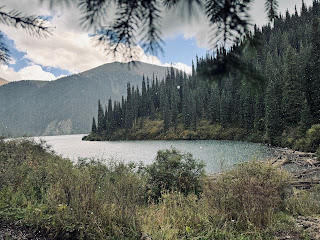

Day 4: Saty to the Kyrgyzstan border
This stretch proved to be the hardest throughout our ride. There is a stark difference between the terrain of Kazakhstan and that of Kyrgyzstan, which we realised much later. The comparison is like night and day. The former is situated in a mountainous region with roads that perpetually ascend, sometimes with gradients of 12% for miles and miles, whilst the latter is mostly boring, flat as a pancake, mainly on steppe land.
We spent almost 3.5 hours trying to cover 28 km, but it proved impossible to complete our planned journey to Kegen, a border town. The midday sun was already scorching, and with the hills relentlessly closing in, we threw in the towel and, after lunch, ‘teleported’ ourselves to the Kyrgyzstan border, some 70 km away, in an SUV.
The entrance to Kyrgyzstan revealed a new set of landscapes and a different set of people with distinct characteristics. If the Kazakhstanis gave the impression of having their noses in the air, probably due to a sudden rise in their wealth, the Kyrgyz were warm and accommodating. The officer at the border patiently explained where we could get food and accommodation. We later experienced genuine Kyrgyz hospitality.
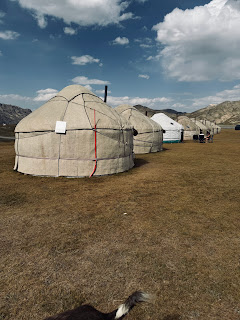
In the border town of Karkara, we realised there were no guest houses available. The only place with yurts [1]was being refurbished and closed to business. After much discussion, aided by hand signals and Google Translate, the workers on the property let us stay there overnight. To top it off, they even let us share their warm, freshly cooked traditional Kyrgyz dinner and breakfast the next morning.
It was that time of year when the World Nomad Games, a UNESCO-sanctioned Central Asian Intangible Cultural Heritage, were in full swing. We managed to catch a glimpse of a group of young people practising ‘Kok-boru‘, in which riders on horseback compete in an open space for a goat carcass.

Day 5: Karkara to Karakol
Unlike our rides in Kazakhstan, this ride was more pleasant in terms of gradient. The state of the roads, however, was far from ideal. In the beginning, we shared the road with herds of cows, sheep, and horses heading towards wherever they were to graze. It was not easy manoeuvring, trying to guide the two-pannier-loaded mountain bikes away from the unpredictable animals. To make it scarier, some of the bulls were obviously in heat, mounting six receptive cows as they sauntered along the highway. And we know how lust blurs the mind.
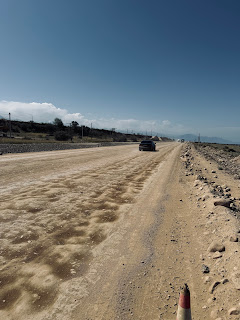
Later we encountered whatever remained as a semblance of a road that was probably laid down when the Soviet Union launched its first Soyuz mission. The edge of the road appeared like a flattened aloo paratha[2] with its fillings sticking out. The Kyrgyz, on a mission to wriggle out of the post-Soviet economic malaise, had struck major deals with China to develop their infrastructure. The new Chinese road contractors must have a peculiar way of road building. They seem to dig out kilometres after kilometres of highway before laying gravel and tar to complete their project. What was left for road users (and cyclists like us) on most of the 91 km journey was a choice between an unpaved road and a gravel-spiked, filled shoulder to ride on. Perhaps it was the contractor’s strategy to complete everything at one go, collect the remuneration and scram before defects show up!
Karakol is a well-planned, modern town with many fascinating structures, and it is home to a Russian Orthodox Church and a mosque.
The Kyrgyz and the Kazakhs mostly identify themselves as Muslims, but do not wear their beliefs on their sleeves. We hardly heard the daily call to prayer. During a visit to the local mosque, we were sceptical about whether we would be allowed in, as we were not exactly dressed for the occasion. Surprisingly, they cordially ushered us in to take pictures. Interestingly, they were happy to know that we were from Malaysia, a Muslim-majority country. Assuming we were Muslims too, they embraced us in reverence, wishing us a hearty ‘Assalamualaikum, Musalman brother!’ We obliged. Most mosques in smaller towns are modest, with their ancient architecture preserved. Mammoth domed mosques are being seen rising in larger towns.


Day 6: Day Trip to Altyn-Arashan
Taking a break from cycling, we took a day trip to Altyn-Arashan, a picturesque alpine valley situated about 2,400 metres above sea level. It boasts a hot spring, eye-pleasing scenery, accommodation, and a passageway for hikers to explore other peaks.
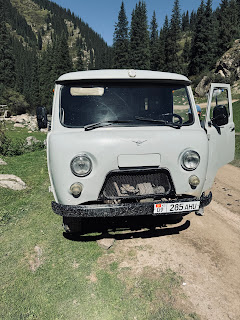
Instead of spending 5 hours hiking along the dusty path shared by 4WD vehicles, we decided to get into one of those mean-looking Russian 4WD vehicles called UAZ. The way up to Altyn-Arashan was treacherous, to say the least. The road was paved not with gravel pebbles but with medium-sized, sharp granite stones jutting from the ground. In my opinion, the UAZ is the only machine in the world suited for this rollercoaster mission. The irony of it all is that there was not a single rattle of the chassis or a single squeak from the vehicle’s parts.
Day 7: Karachol to Barskoon
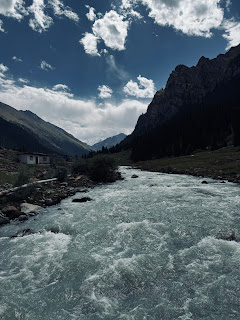
We were back on the saddle for another rollercoaster ride with lots of shaking and rattling going on. The Chinese road construction firms were at it again. Instead of upgrading roads in small stretches, they found it in their wisdom to dig up the entire stretch before resurfacing it. We were fighting between the devil and the deep blue sea, keeping to the edge of the road or pulling over to the shoulder of the road. On the edge, the road is uneven; on the shoulder, there were sharp granite stones. The bikes took a lot of beating. Luckily, they were mountain bikes with broad tyres to match. Yet, on this 79 km journey, we encountered a couple of tyre punctures, and about 4km before our destination, my derailleur broke. We had to push our bikes to our pre-designated guest house in Barskoon. The landlord was gracious enough to arrange for a handyman, whom we fondly referred to as Mr MacGyver, who sorted out everything, patched the punctures, repaired the derailleur and made the cycles good to go.
Communication with the locals remained a major problem for us in both countries. By being behind the Iron Curtain for such a long time and being anglophobes, to avert decadent capitalist values from the mainstream for such a long time, the average Kazakh and Kyrgyz were not proficient in English. Google Translate went a long way to help us express our thoughts. There was an instance when we had an amusing moment. We were trying to order ‘fried rice’ from a restaurant. We thought the message came across well when we typed it into Google Translate, and the Russian Cyrillic script displayed everything.
The waitress returned with a single scoop of white rice and a few slices of tomato and cucumber. Amused, we tried to mimic how chefs usually stir a wok. She then returned with the same preparation but placed it in a plastic container! We then ordered a random item from the menu.

Day 8: Barskoon to Bököbaev
We skirted Isskyl-Kul Lake along the day’s 65km journey. The Isskyl-Kul Lake is the world’s second-highest mountain lake, after Lake Titicaca in South America. Somewhere along the way, we stopped at Tosso Beach, a long sandy beach with captivating turquoise-blue water that had obviously seen better times. The bins were overflowing with garbage. The flies were having a field day. I guess Kyrgyzstan is still trying to get its act together to showcase its natural beauty and attract tourist dollars. Most of the public toilet facilities outside towns are archaic, at least 50 years behind those in Malaysia. On highways and at many tourist-attracting venues, we saw pit latrines for the first time in a long time.
At a distance from the beach lay the orangey sandstone ridges that looked like a scene from a sci-fi movie set on Mars. This is Skaza Valley/Canyon, also called Fairy Tale Canyon, because its natural ridges resemble castles, animals, dragons, and whatever our imagination can conjure.
This turned out to be another eventful cycling day as we encountered flat tyre after flat tyre. In no time, we had perfected the art of changing bicycle tubes without removing the tyre from the bicycle. In every new town we reached, we somehow found a mechanic, not necessarily a bicycle technician, who could get us back on our wheels. Our guardian angels must be kind.

Day 9: Bököbaev to Balykchy
Still riding around Issyk-Kul Lake, we made headway to Balykchy. One problem we often encountered was the mind-bending names of towns. With frequent use of B’s and K’s in their names, and further complicated by their old Soviet names, remembering them became a Herculean task. For a start, don’t Kochkor, Korday, Korkara and Karakol sound strikingly similar?
Free enterprise in Kyrgyzstan must still be in its infancy. Most of the little towns and villages did not have hotels. Online third-party platforms like Booking.com may show scores of available accommodations in the smallest of towns. In reality, they are merely private homes with no signage, and transactions are handled in cash only, without the issuance of receipts.
For the first time, we noticed a railway line traversing a town. With increasing mining activity in the region, Balchyky earned its reputation as a transportation hub. We parked our cycles at Balchyky and took a taxi to Kochkor. Our plan was to visit Kochkor and the Narynn Hills, a popular tourist spot which safely guards its jewel in the crown, Kel-Suu Lake, an enchanting glacial lake bordering China.
Due to the high security of the place, we were to visit, a mandatory permit needed to be issued by the CBT (Community-based Tourism) office. The local populace benefited too by organising travel and accommodation within the community.
Our guest house landlord suggested a popular travel agent to sort out our travel arrangements to Naryn Hills and beyond. Hence, we sought the help of the local travel agents to handle logistics.
The office was actually the living room of somebody’s residence. We were ushered in by a teenage girl who told us to have a seat and wait, saying, “My mother is coming!” A couple of young men were already seated before us. A few moments later, the mother did appear. The young men saw her and said, “Oh, it is you,” and left. Left wondering, we discussed our plans and were thrown a fat quotation. We declined and sought another travel agent. We repeated our plan. Our antennas went up when we heard a familiar sentence: “Wait, my mother is coming!”
“Is your mother also running Shephard Life?” Yes, was her reply. Then we knew there was a corporate mafia controlling Kochkor’s tourism industry.
Day 10: Kochkor to Naryn
We decided to take our chance and rent a taxi to Naryn and see what develops there. By a twist of fate, we found two other young German students who were toying with the same idea of going up to Kok-Kiya Valley, staying the night in a yurt, and hiking up to Kel-Suu Lake. Talk about synchronicity! We ended up paying only a third of what the travel agent quoted. It took a 3.5-hour journey in a 4-wheel-drive vehicle up from Naryn to Kok-Kiya Valley, which lies above 3000 metres above sea level. The valley had collections of yurts, each owned by different families or companies, offering food and warmth to passing travellers and hikers.
A worker was seen clearing horse dung lying across the flatland. I was impressed by their level of cleanliness, I thought, until the same person later came to our yurt to fuel our traditional heater with the same dung. The amenities were basic. Water was stored in a tanker lorry, and the toilets were simple pit latrines. Still, the hospitality was warm, and so was the food that they provided for dinner and breakfast.
Day 11: Hike up to Kel Suu Lake
We started the day trembling. Outside temperatures were in the single-digit C range. After a hearty Kyrgyz breakfast of flatbread, vegetable soup, eggs, oats, cucumber, and tomatoes, we set out to seek the hidden jewel, Kel-Soo Lake. Generally, the guest houses we stayed in offered the same variety of food, just presented differently. We had two ways to get to the lake: on foot or on horseback. Of course, we chose the former. 2.5 hours of climbing and puffing finally unfolded the lake in its full glory.
Then it was time to return and head down to Balychky, where our cycles were. Our newly found German mates and we had a cordial exchange of ideas about social and political situations in each other’s countries.

Day12: Balykchy to Kemin
After a good, full two days’ rest, away from our cycling routine, we continued our journey. We intended to do 60km before retiring for the day. We were slowly getting away from the vicinity of Issyl-Kul Lake. Unfortunately, the Universe had other plans for us. We could not find any guest houses, so we continued to a certain point. The villages were all tiny settlements. At Kemin, at about the 78 km mark, we took a break at a tyre shop to patch our bicycle tubes. As we started chatting with the owner and some curious onlookers via Google Translate, as would a hen and a duck communicate, who were wondering what these two foreign faces were up to, we found out that his friend had a minivan and could take us to the next nearest town. We jumped on the suggestion. Cycles, panniers and all, we swiftly sped off to Tokmok.
Day 13: Tokmok to Bishkek
By a twist of fate, we landed in a town which holds Kyrgyzstan’s most important historical site, Burana Tower. It showcases the remains of the medieval city of Balasagan, an important pre-Islamic Silk Road Settlement. Tokmok itself is an up-and-coming residential city with numerous apartment complexes emerging.
Time to go again, this time to the capital city of Bishkek. Our ride was slowly coming to an end. This 58km journey was flat, but as we got closer to the municipality of Bishkek, we were inundated with too many T-junctions and traffic lights. Bishkek and Almaty are both well-planned cities. Roads are well paved, and paths are wide, providing ample space for cyclists and pedestrians to move around. The trouble is that, as in any part of the world, pedestrians here too display zombie-like behaviour. They walk, staring at their devices, oblivious to who or what is around them. We had to politely alert them.
As if to felicitate us on our safe passage through the country, the Universe blessed us with light showers as we entered Bishkek.

Days 14 &15: Laze around Bishkek
Time to unwind in the city, experience its local culture, food, and sights, and walk in its National Park. Like any country behind the Iron Curtain, Kyrgyzstan (and Kazakhstan) has many statues, plaques, and squares commemorating the numerous fallen heroes of the World Wars.
On a side note, I wonder how many of these statues were erected by North Koreans. For the record, in the 1970s and 80’s, statue building was an important source of foreign funds from socialist countries, non-aligned African countries, and surprisingly, Germany. It dwindled with the collapse of the Berlin Wall.
After days of savouring local cuisines, we were yearning for something Indian. A quick Google search led us to a ‘Gandhi Restaurant’. Assuming it was a vegetarian restaurant, as Gandhi was a vegetarian to the core, we were taken aback to discover that ‘Gandhi Restaurant’ served meat and wine. I guess Gandhi’s kin must not have heard of this restaurant. Otherwise, they would sue the restaurant for tainting the Mahatma’s pristine image of ahimsa[3]. Even Gandhi Jayanti is a dry day (alcohol-free) across India.
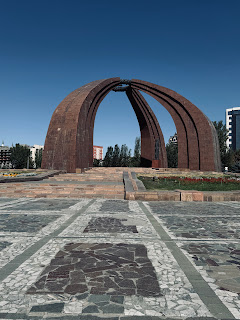
Day 16 &17: Bishkek to Almaty
We were approaching the tail end of our tour. A 23 km ride from Bishkek, and we were at Korday, at the Kazakhstan border. Another taxi ride and 2.5 hours later, we were back at Almaty, where we started.
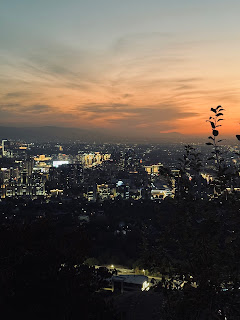
The next day was spent lazing around, wandering about Almaty. A trip up Kok Tobe Hills on the gondola gave a great view of the city’s rapid development.
A ride on the newly commissioned single Metro line has made travelling within the city easier, though it is not quite a breeze yet, as one still has to walk a lot. The Metro stations are quite impressive, each with a distinct motif that highlights different aspects of their history and flaunts their newfound prosperity. Attractive tourist spots include Ascension Cathedral, a Russian Orthodox Church, various parks that form the city’s green lung, and the Green Bazaar. A view that stirred our curiosity was the sale of horse meat. Once stripped to the elements, every meat looked the same — beef, mutton or pork. In fact, they were all sold side by side in the meat section. Interesting.
Next, back to life, back to reality.
The two countries, having a somewhat similar past and even names, are different in so many ways. Firstly, the terrains were different: Kazakhstan was hilly and unforgiving in its inclines, while Kyrgyzstan was as flat as can be. Unlike their cold nouveau riche cousins across the border, the Kyrgyz are warm in their interactions. As far as riding conditions go, perhaps if we had ridden here a year later, the roads would have been in better condition. But then, I wonder if the road users would have shown more etiquette.
All in all, over the span of 17 days, we cycled over 530 km and hiked about 38kms and live to tell the tale that we survived the wild countries.
[1] A yurt is a portable, round tent with a wooden frame covered in felt or skins, traditionally used as a home by nomadic groups in Central Asia
[2] Alloo Paratha is a flatbread stuffed with potatoes.
[3] Ahimsa – Sanskrit for non-violence.
.
Farouk Gulsara is a daytime healer and a writer by night. After developing his left side of his brain almost half his lifetime, this johnny-come-lately decided to stimulate the non-dominant part of his remaining half. An author of two non-fiction books, Inside the twisted mind of Rifle Range Boy and Real Lessons from Reel Life, he writes regularly in his blog, Rifle Range Boy.
PLEASE NOTE: ARTICLES CAN ONLY BE REPRODUCED IN OTHER SITES WITH DUE ACKNOWLEDGEMENT TO BORDERLESS JOURNAL
Click here to access Wild Winds: The Borderless Anthology of Poems
Click here to access the Borderless anthology, Monalisa No Longer Smiles