Categories
Essay

Somdatta Mandal on ‘Mother Mary Comes to Me’

Let me begin by saying that like most readers enamoured by her works, I really enjoyed reading Arundhati Roy’s first work of memoir Mother Mary Comes to Me published in 2025. It is a soaring account, both intimate and inspiring, of how the author became the person and the writer she is, shaped by circumstance, but above all by her complex relationship to the extraordinary, singular mother she describes as a gangster, as ‘my shelter and my storm’. In the meantime, many reviews of the book have already been published, some full of praise and some quite critical, but it can be undoubtedly said that the book created a literary storm that one hadn’t experienced for quite a long time. And to add to that, social media is now flooded with her interviews, readings etc., some very recent and some as old as fifteen years. This essay delves into several issues pertaining to it that have struck me as unique.


Born out of the onrush of memories and feelings provoked by her mother Mary’s death in 2022, this is the astonishing, often disturbing and surprisingly funny memoir of the Arundhati Roy’s life, from childhood to the present, from her movement from Kerala to Delhi. There are forty-two chapters in this book, not numbered, but the titles themselves are self-explanatory. By following their interesting nomenclature, one can get an inkling of how Roy has laid out her narrative strategy, by talking not only about her own life but how it has been intertwined with her mother in a peculiar love-hate relationship. In the very first chapter titled ‘Gangster’, (which Roy has been reading in many gatherings till now), she tells us about her peculiar relationship with her mother. In her excellent and unique narrative style, she says:

“As a child I loved her irrationally, helplessly, fearfully, completely, as children do. As an adult I tried to love her cooly, rationally, and from a safe distance. I often failed. Sometimes miserably. I wrote versions of her in my books, but I never wrote her.”

She then advices her reader: “Most of us are a living, breathing soup of memory and imagination – and that we may not be the best arbiters of which is which. So read this book as you would a novel. It makes no larger claim.”

The narration of the incidents always does not follow a strict chronological order. Some of the stories are already quite well-known. This tells us how the young Syrian Christian Mary Roy married a Bengali tea planter in Assam and had to soon leave her husband because of his drunkenness and lack of responsibility towards his family. Having no support except for a bachelor’s degree in Education, she takes the bold decision of walking out of the marriage and lands in Ooty along with her two young children to live in her father’s cottage. A few months into her fugitive life, her estranged mother and elder brother arrived from Kerala to evict her. They told her that under the Travancore Christian Succession Act, daughter had no right to their father’s property and that they were to leave the house immediately. Years later Mary would challenge the act in the Supreme Court and demand an equal share of her father’s property, and luckily by winning the case in 1986 she became a sort of celebrity overnight.

The story then moves on to Kottayam and then to Ayemenem in Kerala (some of the details of which are beautifully narrated in The God of Small Things too) where Mary Roy struggles to find a foothold for herself and the children and open a school. That story of how that school began in a rudimentary form and how it gradually grew into the well-known residential institution called Pallikoodam designed by the famous architect Laurie Baker, how it remained a top priority in Mary Roy’s life ( the school children prioritised over her own)  along with her own eccentricities, her uncompromising nature and peculiar behaviour ( her refusal to be accepted as the mother of the famous writer Arundhati Roy, being one of them), till her death remains one major strand of the narrative.

The other major narrative strand pertains to Roy’s own life. Arundhati’s version of the story tells us how in the summer of 1976 she finished her high school at sixteen and leaving Kottayam (and of course her mother whom she wanted to dissociate forever), arrived alone without any contact in a completely alien territory in Delhi to take the entrance exam for the School of Architecture. Not having any contact with her mother for several years, she led a bohemian life, lived together with different people, saw partly the underbelly of life and did odd jobs to sustain herself. In the architectural school, she met Pradip Kishen and eventually married him (who was then the husband of the boss under whom she was working for a while). She scripted a screenplay for a movie called In Which Annie Gives It Those Ones about the college life and though it was once telecast in Doordarshan decades ago, it had been lost till recently the footage has been recovered, restored and set as an official entry in the Berlin Film festival this year but one which Roy refused to attend citing the cause of Palestine.

She was involved in another movie script Electric Moon and acted in minor roles in some off beat films like Massey Sahib till she changed her mission of life. After the publication of The God of Small Things, Roy stopped writing novels and got involved in political and social causes and got involved with social activists like Medha Patkar and the Maoists in the Chhattisgarh region and even faced jail for a day for her protests. The writing she produced for a couple of decades were all powerful political manifestos supporting leftist politics (“The Algebra of Infinite Justice” being one of the well- known texts and My Seditious Heart, published in 2019, is a collection of her non-fiction) till she came up with her second novel The Ministry of Utmost Happiness.

In the meantime, the handsome royalty she received from her first novel changed her living style and for the first time Arundhati Roy managed to eke out a comfortable lifestyle and even buy a house of her own. Her narration is interspersed with several interesting anecdotes, relating to her relationship with her brother whom she mentions throughout as LKC, and their chance meeting with Micky Roy, their father in pathetic condition in Delhi. The chapter titled ‘Mama Bear, Papa Bear’ is very interesting to read. It begins with the following lines: “Seven years had gone by since I’d last seen Mrs Roy. The strangest thing is that I cannot remember how she and I came to be in contact with each other again”. Then the joy of seeing her brother after so many years was exacerbated with their meeting of their father Micky Roy, who had totally disappeared from their lives when they were kids. The pathetic state of the man almost dying out of liquor addiction, we are told about how he was “as frail as a small bird, lame and hunched over …he was severely malnourished, like people in UN pamphlets.” This is how Roy narrates the incident:

‘You would never have believed I was your father. You look so much more like me than your mother. Doesn’t she, Kapil Dev? Same nose. Same eyes…sorry eye.’(Giggle.) ‘I say Orundhuti, do you hit the bottle?’

He pronounced my name the Bengali way.

‘Me? No.’

‘Oh, go on. Tell the truth. All good Roys hit the bottle. Whaddyou say, Kapil Dev?’

(Giggle. Slap.)

After going through all the ups and downs of life, especially in relation to her mother (too many to be narrated here), the story end in the last chapter aptly titled ‘A Declaration of Love’ when in January 2022 she got a message from her mother saying that she loved her. Despite everything that had happened between them, somehow, she knew that to be true. “My lifelong refusal to stop loving her, no matter what, had finally breached her barriers.” The story ends with her death, the details of her cremating process, the performance of the Kottayam Police Band, the 21-gun salute she received and ultimately the memorial they built for her in the bamboo grove where the headstone mentioned Mary Roy as ‘Dreamer Warrior Teacher’ and ‘Founder Pallikoodam.’  The strange love-hate relationship that persisted between Arundhati and her mother comes out beautifully in the end when she writes:

“The first night in a Mrs Roy-less world, I spun unanchored in space with no coordinates. I had constructed myself around her. I had grown into the peculiar shape that I am to accommodate her. I had never wanted to defeat her, never wanted to win. I had always wanted her to go out like a queen. And now that she had, I didn’t make sense to myself any more.”

Another interesting piece of information is revealed in this concluding chapter is about how Arundhati casually decided to get divorced from Pradip Kishen with the same lack of seriousness with which she had got married, so that he and the girls (and their property) had no legal connection to her. The order granting them the divorce had been delivered to her the previous morning, at the very moment Mrs Roy died. ‘So, I, free woman, free falling, was heir to nothing at all. But I was curious about our great will-making mother’s will.’ Later she gets to know that her brother had marked off Mrs Roy’s house and its compound from the rest of the school and had it registered in her name. So, she decided to renovate the house and build the Grove simultaneously in it.

The Cover Design

Before concluding, I want to draw the reader’s attention to the special care that has been taken to make and market this book. The cover design is a highly skilled piece of production. On the stark red cover of the book with the title embossed artistically, we have half a dust jacket in white with two different pictures of Roy on the front and the back cover– one a current photograph of the author with her head full of pepper and salt curls and with a discreet smile on her face. The other photograph is of a much younger and radical Arundhati with a distinct far-away look in her eyes and with a burning cigarette on her lips. Though the publisher gives the statutory warning that cigarette smoking is injurious to health and it does not support it in any way, a very stark visual statement about the unnatural bohemian nature of the author gets revealed through this photograph.

Incidentally, this selling of a book through its stark and attractive cover reminded me of a similar strategy undertaken in 1997 when Roy’s debut novel The God of Small Things won the Booker Prize and took the literary world by storm. The book came out in what was essentially the pre-internet and social media era and the maximum number of reviews and essays that came out during that time were in print. In an essay which I had authored then, calling it “The Making and Marketing of Arundhati Roy” I had shown that the contents of the dust jacket of the book differed radically from region to region and it was done through a deliberate and effectively thought-out strategy. So, in the Indian edition we had a different story outline giving us a gist of what to expect inside, especially the love of a paravan, an untouchable man with an upper-caste woman, along with the local setting in Kerala, Ayenemem to be exact.

In the Random House edition published from New York, the story outline was completely different, not only telling us about untouchability and the love between Radha and Krishna that would lure the western reader to pick up the book about a unique place in India defined as ‘God’s Own Country’ in tourist brochures.  Also, the photographs of Roy (both taken by her then husband Pradip Kishen) differed radically. With this new book, of course, such strategies didn’t work anymore. With innumerable book launches, readings by the author everywhere (a search on Youtube will even land you with interviews that are more than a decade old) we now come upon other ways and means through which the book has been popularised. But all said and done, I must conclude by saying that whether you agree or disagree with the extreme left wing political views that Arundhati Roy professes, those who still haven’t read this memoir have really missed reading a wonderfully written book with its 372 pages that is really unputdownable, with its lyrical as well as down to earth style of narration, full of new metaphors, new word coinages that are the USP of Arundhati Roy.

Somdatta Mandal, critic and translator, is former Professor of English at Visva-Bharati University, Santiniketan, India.

.

PLEASE NOTE: ARTICLES CAN ONLY BE REPRODUCED IN OTHER SITES WITH DUE ACKNOWLEDGEMENT TO BORDERLESS JOURNAL

Click here to access the Borderless anthology, Monalisa No Longer Smiles

Click here to access Monalisa No Longer Smiles on Kindle Amazon International
Categories
Stories

Hope is the Dream of a Waking Man

By Shevlin Sebastian

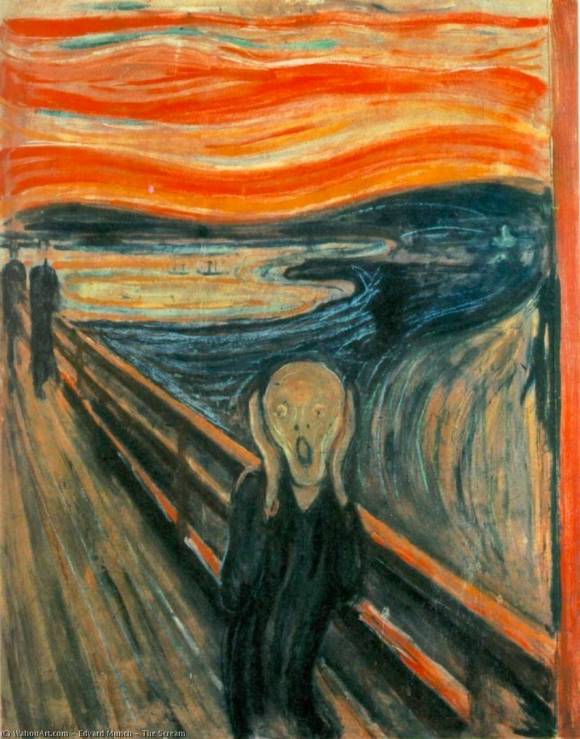
The Scream by Edvard Munch (1863-1944)

There is a large grey wave painted in the middle of the canvas. It is falling over a large group of people standing on the edge of a seashore. Many men wear skullcaps. The women have black burkas. The group has widened eyes and open mouths. Some have turned their backs to flee. Others have raised their arms and clenched their fists, as if they are about to break into a run.  

At the bottom of the canvas, on the left, there is another group of people. They are also standing on another seashore, with windswept hair. There is a woman with a large sindoor in the middle parting of her hair. A young man, in jeans, has a necklace with a gold crucifix. A boy stands with a placard showing a dove with a leaf in its beak. The words, ‘Let’s all live in peace,’ are written in bold, red letters. Others raise placards with slogans like ‘Say No to communalism’, ‘Syncretism is in our DNA’, and ‘We are all brothers and sisters in this great nation’.  

Painter Ashraf Mahmood steps back and stares at the image. A slight smile plays on his lips. He had woken up that morning and this image had come floating into his mental screen. Ashraf kept staring at it, eyes closed, lying on his back. His wife had got up and gone to the kitchen. Alia liked to make her tea using Tata Gold. He preferred Brooke Bond Red Label. So they made separate cups. 

When he entered his studio on Mira Road, in Mumbai, at 9 am, he got down to work, using an easel and grey paint. 

He worked steadily. It was silent inside. But Ashraf did register the outside sounds of a typical Mumbai street. The horns blowing. Tendrils of smoke from exhaust pipes floated in through the window. His nose twitched as he noticed a foul smell. It seemed as if somebody had thrown garbage on the street. Ashraf closed his nose with the tip of his fingers for a few seconds. “The crazy smells of Mumbai,” he thought. 

He grew up near Mandvi Beach in Ratnagiri (343 kms from Mumbai). The air was fresh, and the wind blew constantly. The only sound was the roar of the waves and the beautiful sight of seagulls making circles as they flew above the sea. Ashraf’s father, Mohammed, was a government school teacher. His mother was a homemaker. He had two elder brothers and three sisters. Ashraf was the youngest. He displayed artistic talent from his school days.

Unlike most fathers, Mohammed encouraged his son. His father took him to an art teacher, who taught him how to draw and paint. Ashraf’s major breakthrough happened when he got admitted to the JJ School of Art in Mumbai. After that, there was no looking back…  

It was evening when he finished the work. His soles ached. Ashraf had been standing for hours. 

This image reflected all that he felt. The grey resembled the growing intolerance towards Muslims. This seemed to be overwhelming especially in places like Uttar Pradesh and Madhya Pradesh. There was the rise of majoritarianism. And the fracturing of relations between people of different communities. And yet, Ashraf felt that the DNA of the people over centuries was syncretic. A ready acceptance of people of all faiths. 

It was only the hate campaigns, through speeches, social media, and songs, that had swayed the people. He was sure the fever would die one day. Syncretism would rise again. “After all,” he thought, “throughout human history, love always conquered hate. But it took time.” 

Ashraf wanted to tell the viewers of his work not to lose hope. And hence the pigeon and the symbol of peace. For the title, he used a quote by the Greek philosopher, Aristotle, “Hope is the dream of a waking man.”

Ashraf rubbed his chin a few times and walked to a table on one side. A packet of fresh buns lay on the table. Ashraf opened a fridge. He took out a container which contained butter and a bottle of strawberry jam. He sliced the bun into half with a stainless steel knife, placed butter and jam in between, and began eating it. These were fresh buns from a nearby bakery. Ashraf had bought them when he had stepped out for lunch. He made tea on the gas stove. Then he sat on a stool near the table and sipped it. 

This was his 35th year as a painter. Now, at 55, he could look back with reasonable pride. He took part in regular exhibitions and won a few awards and grants. Profiles of him appeared in the newspapers and on social media. His paintings sold, thanks to his realistic and simple style. An art sensibility was only gradually building up among the people. Ashraf knew that images drawn from his unconscious mind had a pulling power. Why this was so, he did not know. He remembered how one art critic described a David Hockney painting as having a ‘psychological charge’. Hockney was a renowned English painter. Ashraf realised that art needed to have a psychological charge if it had to have an impact.  

But Alia had already made an impact on him. He met her when she came to view his exhibition one day at the Jehangir Art Gallery. She was slim and tall, with curves that were accentuated by the chiffon saree she wore. Like Ashraf, she came from a small town. Through grit and perseverance, she passed competitive exams and got a government job. They went for dates. Ashraf was smitten. Within a year, he proposed and they got married. 

Alia was a superintendent in the sales tax department. She would earn a pension once her career got over. She had another ten years to go. Their two daughters had married and settled down in Aligarh and Delhi. Both had two children each, a boy and a girl. 

Alia wanted Ashraf to earn more money. But he was not a hustler or a man who liked to build a network. If a buyer came and offered a decent price, he sold it. Most of the time, he remained isolated. Sometimes, he met other artists at exhibitions and art seminars. He would chat with them. But that was all. 

He was not keen on extramarital flings or experimenting with drugs or drinking too much. Ashraf led a steady life. In many ways, he was happy with the way his life had turned out. 

He washed the cup and the pans. Ashraf placed the cup on a hook which hung on a wall. He had yet to finish the bun. 

He made his way back to the painting. It was 5.30 p.m. In half an hour, he would close his studio and walk back to his house, fifteen minutes away. The couple owned their apartment. Alia, with help from Ashraf, had cleared the bank loan over 15 years. 

At this moment, he heard a murmur of voices from outside the door. Ashraf wondered what it was. The sound arose. “Was there an emergency?” he thought. “Is the building on fire?” 

He came to the door. Ashraf saw that the lock was coming under strain. It seemed to be bulging backwards towards him. Somebody gave a violent kick and the door sprang open. Ashraf moved to one side.  

A group of young men rushed in. Some wore red bandanas. Many were in T-shirts and trousers. Some had thick, muscular arms. They were shouting. It seemed like slogans. In his shocked state, Ashraf could not register the words. They rushed to the canvas on the easel. One man, using a long knife, sliced the canvas into two. He pushed the easel.  It fell with a clattering sound to the floor.

There were a bunch of finished canvases placed on one side. Ashraf had been doing work to showcase in an upcoming solo exhibition. The group spotted it. They rushed there, pushed the canvases to the floor, and began ripping them one by one with their knives. Within a few minutes, the work of several months lay ripped out. Ashraf remained by the side of the door. He had not moved. 

“Hey you Muslim kutta (dog),” one of them said. “We will come again if you carry on working. No art for Muslims. Clean the sewers. That’s the only job you are good at.” 

Ashraf half-expected one of them to stab him. But they didn’t. They left as quickly as they came. 

Ashraf felt as if a large, round ball had settled at the base of his throat. He could not swallow it nor could he spit it out. 

He blinked many times. Ashraf wasn’t sure whether this event had actually happened. It took place so fast. But there was no doubt about the ripped canvases lying all over the floor.

He felt a pain in his heart. Ashraf rubbed the area. “I hope I am not having a heart attack,” he thought to himself, as he took in lungfuls of air to calm himself down. Employees from other offices on the same floor came to the door. They entered. Most had goggle-eyes. 

“Sir, what happened?” one young man said.

Ashraf shook his head. 

“I don’t know,” he said. 

“Who were these people?” a woman said. 

“No idea,” Ashraf said, as he surveyed the damage. 

“Sir, you will have to call the police,” another man said. 

“Yes, I will,” said Ashraf. 

A couple of men shook his hand. 

All of them surveyed the damage silently. Work was calling them. “All chained to their desks,” thought Ashraf. “At least, that way, I am free. No boss on top of me. No attendance marking every day. No targets to meet. No one shouting at me. But then, no steady income. And no camaraderie. Large amounts of time spent alone.”  

Then he returned to the stool, returned to the present, and placed his head in his hands. 

‘What’s happening to this country?’ he thought. ‘‘There seems to be a collective madness. Indians attacking Indians. And these young people were ruining their lives by working for political leaders. They will be used and discarded.”

He had not seen them before in the locality. They might have come from some other area. Was it a deliberate ploy to send a shock wave through him and the community? Who knew how they thought?  

What should he do now? 

Ashraf realised he had to think rationally. He stood up and went to the door. He realised immediately, he could not do anything immediately. A carpenter would have to be called tomorrow. 

He called Alia and informed her about what had happened. She said she would come directly to the studio from the office. Ashraf called up his media contacts, both in the print and visual media. They said they would arrive with their photographers and cameramen. Ashraf took several photos and videos on his mobile phone, documenting the damage. 

He would have to report the attack at the police station and file an FIR.     

Ashraf realised his work had been ruined, but he would recreate it. He had photos of all the canvases. 

To prove to himself, he had returned to normality, he went back to the table and finished the rest of the bun. He put the butter and the jam back into the fridge. He washed the plate and the knife. 

Fifteen minutes later, Alia arrived. 

In silence, she stared at the canvases lying on the floor. Ashraf saw her press her hand against her open mouth. He realised it was a silent scream. 

In the end, she came up to Ashraf and said, “They have tried to violate your dignity as an artist and a person.” 

The couple hugged. 

After a while they broke away. 

“Don’t keep the canvases here anymore,” she said. 

Ashraf rubbed his chin with his fingers. 

Finally, he nodded. 

“There was something strange about the attack,” he said. “They didn’t overturn the table or the fridge. And for some reason, they did not assault me. It seemed to me they had to leave in a hurry. So I got saved.”  

Alia said, “They are keeping a watch on everybody.” 

“Yes, I read online there is a pervasive deep state,” said Ashraf. “In every neighbourhood there are spies who report about all that is happening.” 

“What is the next step?” she said. 

“I am waiting for the media to come. After that, I will file the FIR,” he said. 

At that moment, a few print and TV journalists arrived. 

Ashraf spoke to the reporters. The photographers and cameramen began recording all that had happened. 

They left after half an hour. 

The couple then shut the door, as best as they could. But there was a small gap at one side. They went to the police station. The police allowed an FIR to be filed against ‘unknown persons’. He faced no hindrances because, as Ashraf surmised, the police were aware of his reputation as an artist. 

The couple took an autorickshaw and returned to their apartment.  

Alia changed into a nightgown. She washed her face, and informed their daughters about what had happened on her mobile phone. 

Ashraf changed into a T-shirt and shorts. He made a glass of whisky mixed with water for himself. Every night he had one peg. 

As he sat on the sofa, nursing his drink and staring at the TV screen, he felt the pain arise in him. It was an ache in the middle of the chest. To see his work treated in such a callous manner was a calamity. He wondered whether he would ever overcome this fear that had come into him. Work on a piece the whole day and in the evening, somebody could come in and rip it up. 

Closed doors did not offer any protection. It was a time of lawlessness. People with criminal behaviour could operate with impunity. Leaders wanted to instil fear in people. 

And would he be able to recreate these ripped-up paintings with the same intensity? He was not sure.  

On the screen, some leader was having his say. His eyes enlarged, he made violent movements with his hand, and spoke with a loud voice. “Horrific,” thought Ashraf. “How do you create art in this environment?”

Yes, indeed, how do you? 

But it did not take long for him to tell himself, “But we must, whatever be the cost. Art is the candle that brings light to the darkness.”

.

Shevlin Sebastian has worked for magazines like Sportsworld, belonging to the Ananda Bazar Patrika Group in Kolkata,​ The Week, belonging to the Malayala Manorama Group, ​in Kochi, the Hindustan Times ​in Mumbai, and the New Indian Express in Kochi. He has also briefly worked in DC Books at Kottayam. He has published about 4500 articles on subjects as varied as films, crime, humour, art, human interest, psychology, literature, politics, sports and personalities. Shevlin has also published four novels for children.

.

PLEASE NOTE: ARTICLES CAN ONLY BE REPRODUCED IN OTHER SITES WITH DUE ACKNOWLEDGEMENT TO BORDERLESS JOURNAL. 

Click here to access the Borderless anthology, Monalisa No Longer Smiles

Click here to access Monalisa No Longer Smiles on Kindle Amazon International