Narratives and photographs by Suzanne Kamata
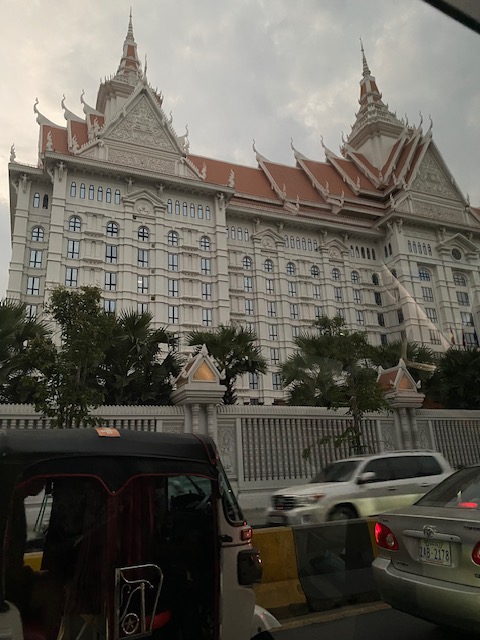
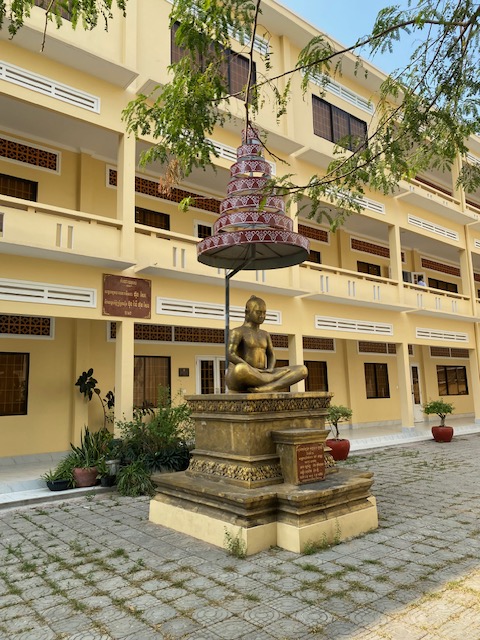
When my research partner Yoko proposed that the two of us attend a conference in Cambodia, I said “Yes, but I want to stay in a nice hotel.” Knowing her, she’d book us into a youth hostel, where we’d bunk with strangers, or the cheapest Air BNB available. In Japan, due to the massive influx of foreign tourists and the weak yen, hotel prices had been jacked up significantly. I could barely afford to stay in a capsule hotel on a trip to Tokyo. In Cambodia, I figured we would be able to pay for a decent room.
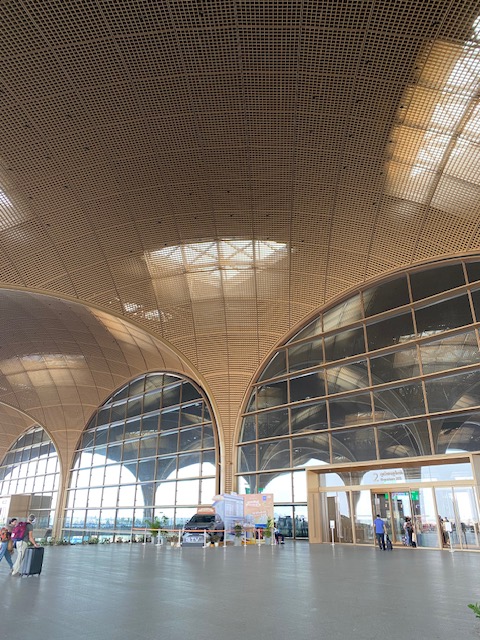
We flew from Osaka to Ho Chi Minh City to Krong Ta Khmau, landing in Cambodia’s newest airport. Modern, cavernous, and clean, it had opened only a few months before. We picked up our luggage from the carousel in baggage claim and proceeded to the exit.
“I’ll let you handle this part,” I told Yoko, as we emerged into fresh air and a phalanx of taxi drivers vying for our services.
This was Yoko’s third or fourth trip to Cambodia, and she had assured me that she knew how to arrange transportation. She’d already figured out how much we could expect to pay. She wasn’t about to get ripped off.
“Thirty dollars to Phnom Penh,” one guy offered.
“That’s too much,” Yoko said. “I’ll give you twenty.”
A deal was made, and we were ushered to a white Alphard Toyota, and introduced to the driver, a young guy, maybe around thirty, in sunglasses. He spoke English.
“To the Harmony Phnom Penh Hotel, please.” I showed him the address on my phone app.
On the hour-long drive, I gazed out the window, eager to soak up new sights. Various construction projects were underway. I spotted a Lexus dealer, and an Aeon Mall. Although much of the signage was in curlicue Khmer, some businesses were labeled in Chinese, Japanese, and English. Shiny new transnational banks rose above structures with traditional architecture. As we entered the city, the traffic became worse. Motorbikes, tuk-tuks, trucks, and cars jostled for space. Many of the cars were apparently Chinese imports. I’d never heard of the brands.
I tried not to distract our driver, whose name was Paekdy, from the business of driving, but we managed to have a conversation. He asked how long we’d be staying and offered his services for our journey back to the airport three days later. I added him to my What’s App contacts. He seemed nice.
“Can you pick me up tomorrow?” I asked.
I would be going on a tour to visit a teacher’s college and a language school. Yoko was planning on spending the day in and around the hotel’s infinity pool. The university where she worked, which was run by elderly nuns, was on the verge of shutting down. Yoko was under a bit of stress.
“What time?” Paekdy asked.
“Early.” I was supposed to be at the university where the conference would be held by 8:30. I asked him to be at the hotel an hour before that.
Yoko helpfully negotiated the fare.
The next morning, I got up, readied myself, and went out in front of the hotel to wait. A man out front was sweeping the pavement. Across the street, vendors were setting up piles of fruit. One woman was hacking at raw chickens. Further down, several tuk-tuks were lined up, awaiting passengers.
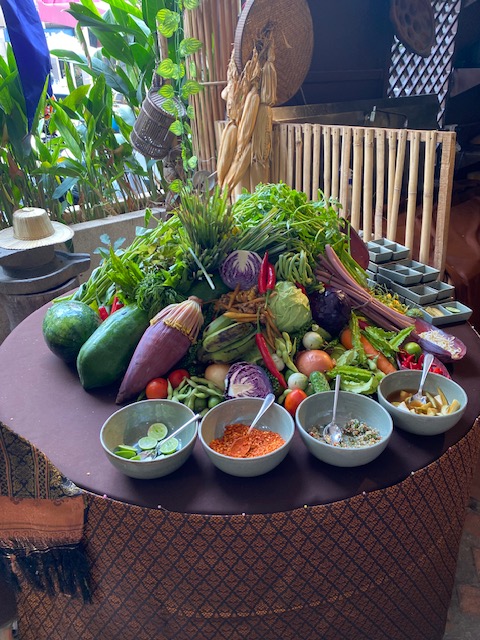
My driver was late. I had allowed extra time, so I would probably not be late for the tour, but I was a bit irritated. If I were him, I would have arrived early. After all, he’d had plenty of advance notice, and I had promised him a decent fare. I checked my What’s App messages. Nothing. I texted Paekdy: “Are you coming?” He responded with a voice message. Due to traffic, he was running late.
He finally arrived, and we set off for the university. I asked him questions about his life, and his family. He told me that he had gone to university and studied marketing. He said that it was hard to find a good job in Cambodia if one couldn’t speak a foreign language. In addition to English, he knew some Chinese. He told me that his daughter was learning English.
After our pleasant conversation, my irritation evaporated. When he dropped me off, I asked him to pick me up at 2:30 in the afternoon to take me back to the hotel. He agreed.
I registered for the conference at one of the long tables set up on the verandah, and picked up the sack containing my breakfast, which consisted of sandwiches and bananas. When it was time for the tour, I got on the bus with the other participants. Over the next few hours, we visited Phnom Penh Teacher Education College, and a private English school. Afterwards, we had a sumptuous lunch at a nearby restaurant. Back at our starting point, I looked for my driver. He was nowhere to be found. Late, again.
This time he sent a message: I am sorry maybe I am late. (prayer emoji) Can you wait for me please?
I sighed, considered hopping onto a tuk-tuk, and then texted, “Okay.” The devil you know, right? I would have a seat in one of the wicker chairs on the university’s verandah and enjoy the slight breeze.
He finally arrived and apologized profusely. The traffic was so bad, he said. Wasn’t it always? I wondered. Wouldn’t he have prepared for that?
“Did you have a lot of fares today?” I asked, in a bid to make conversation.
“Just one,” he said.
Me.
Back at the hotel, Yoko and I discovered that we could get use the Tada app, which was similar to Uber or Grab, to get to and from the conference venue for about $5. My driver was ripping me off, Yoko said, and he was always late. If I called him again, I would only be rewarding his bad behavior, I reasoned aloud. He didn’t deserve my business. If he wanted repeat customers, he would have to learn to come on time.
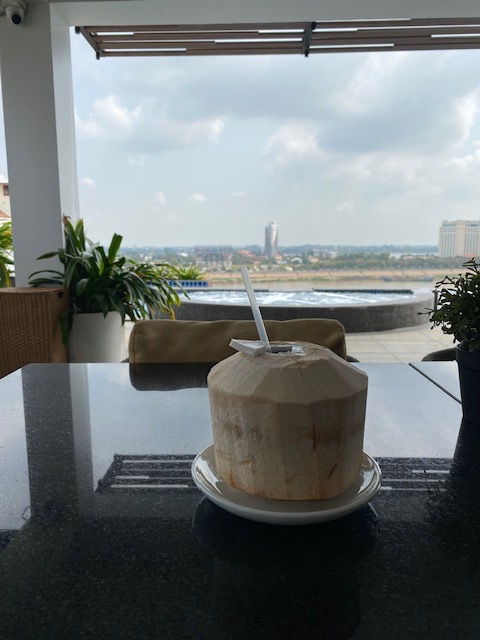
We went to the rooftop where Yoko had spent most of the day and indulged in coconut milk and slices of fresh mango while gazing at boats floating along the Tonle Sap River. European tourists splashed in the pool nearby.
That evening, we called a car via the Tada app and went to the university where the conference began with a ceremony. Cambodian dancing was followed by a display of martial arts, several speeches by invited dignitaries, and a symposium on AI in language teaching. Afterwards, we filled up paper plates at the buffet and mingled with the other conference participants. When it was time to leave, Yoko called for another driver – not Paekdy – with the app.
On the way back to our hotel, it was dark and the traffic was severely congested, as usual. The car crawled along amidst a crush of vehicles of various kinds when…Bam! Suddenly we were side-swiped by a truck. My first thought was, I should have gotten travel insurance! My second was, now we will pull over and everyone will exchange insurance information and call the police. Except we didn’t. The truck surged ahead. The driver did not respond.
“Are you okay?” Yoko asked him.
He laughed it off. “Okay, okay.” His English was limited.
We could still see the truck’s license plate. We could write it down and report it. But maybe things didn’t work that way in this country.
“It’s a good thing that we are in a Toyota,” Yoko said.
Yes, there was something to be said for a sturdy, well-made car. I was happy that we hadn’t taken a tuk-tuk, or that we weren’t on the back of a motorbike.
Still a bit shaken, Yoko overtipped the driver when he dropped us off, hoping he would be able to use the extra funds to fix his car.
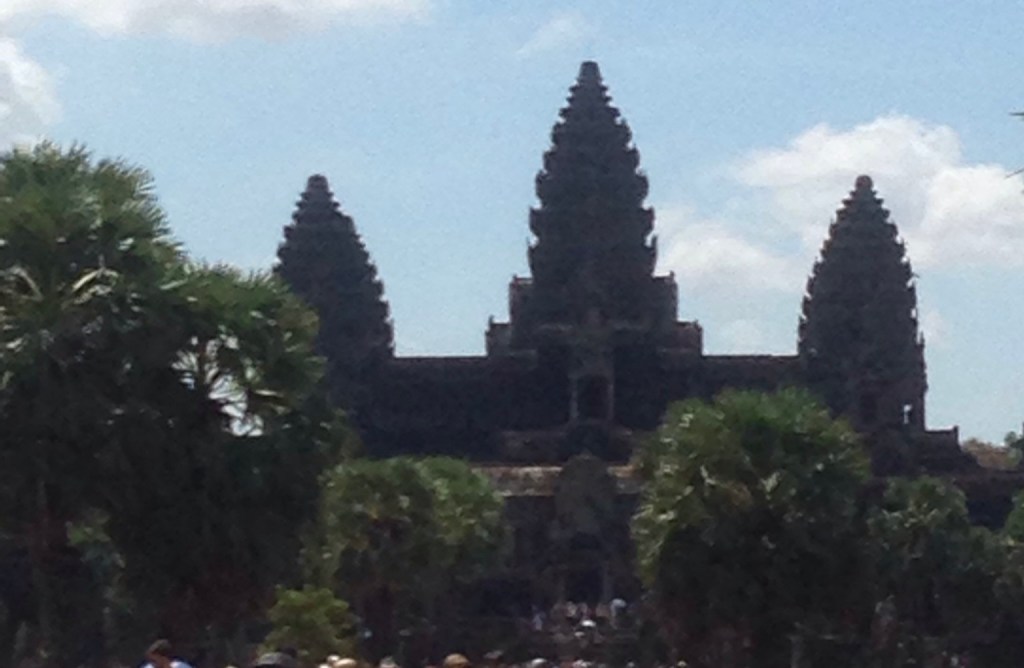
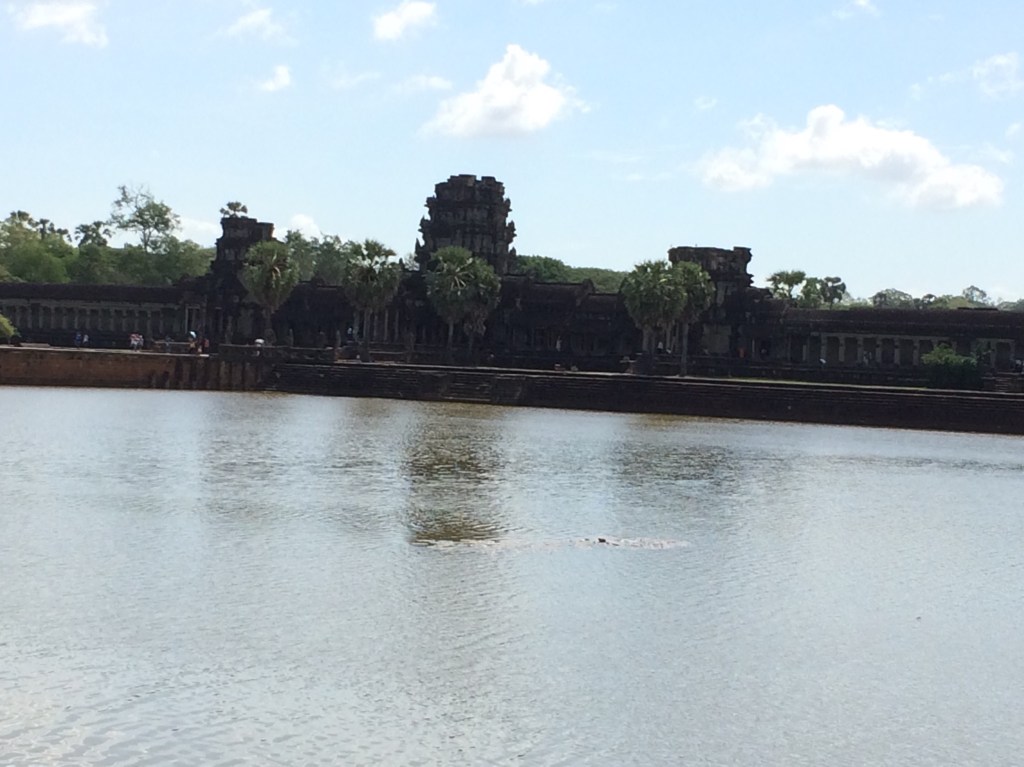
After the conference, Yoko and I debated how we would spend our last day in Cambodia. Before my trip, many people had said that I should to Angkor Wat, but Siam Reap was too far away. I felt that I should pay my respects to the victims of Pol Pot by visiting one of the genocide memorials. Since Yoko had already been to the country a few times before, she had been to the Killing Fields and the torture museum. She didn’t really want to go again, and I didn’t blame her. I decided that I would go by myself and meet up with her at the airport.
I wasn’t going to call Paekdy, but he sent me a message the night before, asking if I needed a ride to the airport. Oh, why not? I could ask him to take me to the Choeung Ek Genocidal Center on the way. Maybe he would wait for an hour or so while I toured the site. That way I could leave my suitcase in the car with him. Okay, so he was a little late sometimes, but I trusted him. I sent a text: Please pick me up at 2:00 PM.
The next afternoon, he was on time.
On the way to the memorial, we talked some more. He told me that his grandparents had perished while fleeing Pol Pot. Many people had died of starvation while in hiding. I remarked upon the many construction sites along the way. Paekdy mused that if not for the 1975-79 genocide under the Khmer Rouge, his country would have been further along. Indeed, had it not been for the vicious slaughter of an estimated 1.2-2.8 million people, comprising a quarter of the population, Cambodia might be right up there with Singapore or Thailand. I thought it was just a matter of time before the country caught up. I thought of the new airport I’d be flying out of, which was undoubtedly destined to become a hub.
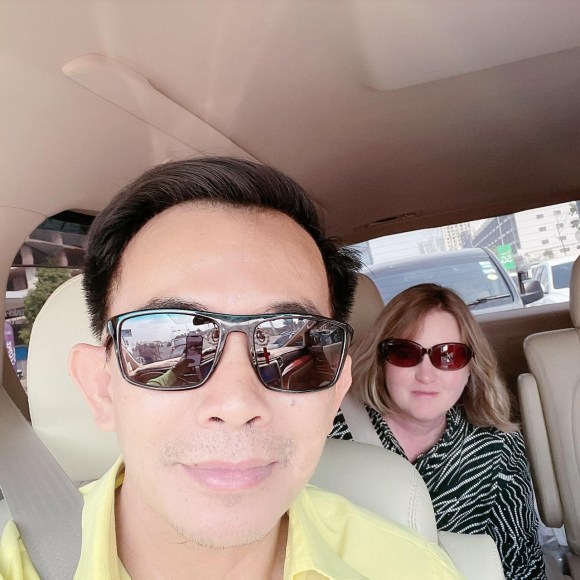
Before we parted, my driver suggested that we take a selfie together. We both put on our sunglasses and smiled for the camera. He sent me the photo the next day, when I was back home in Japan. I realised that although I had enjoyed visiting schools, wandering the palace grounds, and snacking on fresh mangoes by the pool, the most interesting part of my trip had been meeting this taxi driver from Phnom Penh. I still have his contact information on my phone.
.
Suzanne Kamata was born and raised in Grand Haven, Michigan. She now lives in Japan with her husband and two children. Her short stories, essays, articles and book reviews have appeared in over 100 publications. Her work has been nominated for the Pushcart Prize five times, and received a Special Mention in 2006. She is also a two-time winner of the All Nippon Airways/Wingspan Fiction Contest, winner of the Paris Book Festival, and winner of a SCBWI Magazine Merit Award.
PLEASE NOTE: ARTICLES CAN ONLY BE REPRODUCED IN OTHER SITES WITH DUE ACKNOWLEDGEMENT TO BORDERLESS JOURNAL
Click here to access the Borderless anthology, Monalisa No Longer Smiles
Click here to access Monalisa No Longer Smiles on Amazon International



 Borderless