
Title: The Great Himalayan Ascents
Author: Frank S Smythe
Publisher: Speaking Tiger Books
The Himalaya
TWO HUNDRED YEARS ago mountains were regarded as useless and terrible masses of inert matter where dragons had their lairs and the spirits of the damned lay in wait to claim the unwary. But as man emerged from the superstitions and materialisms of the Middle Ages he began to realise that mountains were beautiful and their summits worthy of attainment. The nineteenth century saw the conquest of the Alps. Unknown difficulties and dangers had to be faced by the pioneers of mountaineering. Disasters occurred, lives were lost, and mountaineering thrown into disrepute. The mountaineer was not dismayed. He knew that beauty was his for the seeking; he rejoiced in a newfound comradeship and in the acquirement and exercise of a new craft.
The great alpine summits fell one by one; traditions were established; a technique was evolved; a literature was born. The ripples of alpine mountaineering radiated outwards, bearing with them mountaineers to other ranges: the Caucasus, the Rockies, the Andes, the New Zealand Alps. On their highest peaks the skill acquired in the Alps was sufficient to ensure success. But there remained one great range that defied invasion of its strongholds – the Himalaya. There, the technique acquired in the Alps was not sufficient. Height alone was a physical deterrent, and coupled to height was steepness and danger. Expeditions had to be organised to reach even the foot of the great peaks; time and money had to be found. Yet, despite these disadvantages, Himalayan mountaineering and exploration progressed steadily. Pioneers such as the Schlagintweit Brothers, Sir Joseph Hooker, The Duke of the Abruzzi, Mr W.W. Graham, Lord Conway, Sir Francis Younghusband, Mr D.W. Freshfield, Doctor T.G. Longstaff, Doctor A.M. Kellas, General Bruce, Mr C.F. Meade, Doctor and Mrs Bullock Workman, Messrs. Rubenson and Monrad Aas, and many other pre-war pioneers opened up a region unsurpassed for its beauty and grandeur, and by their experiences pointed the way to the highest summits.
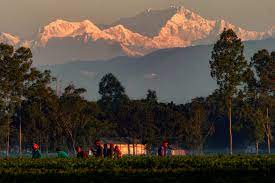
Many people refer to the Himalaya as though their limitations in scenery and climate were similar to those of the Alps. The tourist who gazes upon Kangchenjunga, 28,226 feet, from Darjeeling returns home saying that he has seen the Himalaya. So he has, but how much of two thousand miles of mountains stretching from the Pamirs to the borders of Indo-China, and beyond these limits, in terms of mountains? A lifetime might be spent wandering about the Himalaya, yet the knowledge acquired would embrace but an infinitesimal portion of that vast labyrinth of peaks, valleys and plateaux scrawled across the map of Asia.
In climate alone there is an extraordinary variety. From hot steamy tropical valleys, filled with luxuriant vegetation, it is but a few horizontal miles to zero temperatures and the highest snows in the world. Between these two extremes is an immense range of climate, the common despot of which is a fierce sun. Added to the complexities of climate due to height alone is the added complexity of seasonal weather fluctuations, due directly or indirectly to the influence of the monsoons and weather conditions emanating from the plateaux of Central Asia.
Racial characteristics are as diversified as the climate. From the people of Hunza and Chitral to the Sherpas and Bhotias of Northern Nepal, the almost extinct Lepchas of Sikkim and the wild races of Bhutan, the Himalaya can show many different types, for they form a natural frontier between India and Tibet, and a pudding-bowl wherein is stirred a mixture of Mongolian and Indian blood.
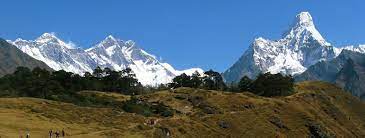
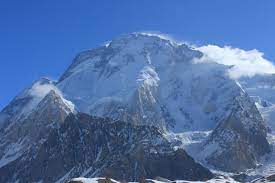
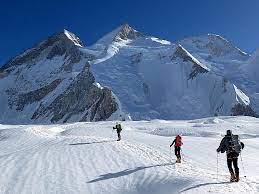
Politically, only a comparatively small portion of the Himalaya is accessible to the mountaineer and explorer. Democracy is unknown in Tibet and Nepal, and both these countries have closed their frontiers to Europeans and resolutely set themselves against infiltration of European thought and ideas. Some of the finest peaks of the Himalaya lie within the borders of Nepal, including the southern side of Everest, 29,140 feet, Dhaulagiri, 26,795 feet, Gosainthan (Shisha Pangma), 26,305 feet, and many other great peaks. In addition there are other districts where the mountaineer is not always welcomed, owing to political and other objections. The three most interesting districts accessible to mountaineers and explorers are the Karakorams, the Kumaun and Garhwal Himalaya and the Sikkim Himalaya, including the eastern side of Kangchenjunga, and it is in these three districts that the most notable mountaineering expeditions have been carried out, with the exception of Everest (now barred politically) and the northern side of Nanga Parba (forbidden territory to expeditions at present). Each of these districts is magnificent in its own way. In the Karakoram there is no glacier to rival in grandeur the Baltoro, and no peaks surpassing in ferocity the terrific ice- armoured spires dominated by K2 (Mount Godwin Austin), 28,187 feet. From the Kumaun Himalaya rises Nanda Devi, 25,645 feet; the highest peak entirely within the confines of the British Empire, a mountain so difficult to approach that no one has yet succeeded in treading the glaciers at the foot of it, whilst Kamet, 25,447 feet, dominates the ranges of Northern Garhwal. In Sikkim, Kangchenjunga boasts the most wonderful snow and ice scenery in the Himalaya, owing to its exposure to the moisture-laden airs of the monsoon. It has defeated three determined attempts to climb it, in 1929, 1930 and 1931 by mountaineers well versed in the technique of high-altitude mountaineering. The highest point reached was 26,000 feet, by the gallant Bavarian expedition in 1931 and that only after incredible difficulty.*
Geologically, the Himalaya are a young mountain range, due to an uplift of the ancient seabed covering Central Asia. This uplift took place so slowly that rivers such as the Indus and the Brahmaputra, which have their sources to the north of the Himalaya, have been able to carve their way through the range as it rose. This is the only explanation that can account for the deep valleys cutting through from Tibet to India.
.
(Extracted from The Great Himalayan Ascents by Frank S. Smythe. Published by Speaking Tiger Books, 2025.)
About the Book
Frank S. Smythe (1900-1949) was one of the greatest mountaineers of the twentieth century, and a celebrated memoirist and adventure writer. This collection brings together three accounts of Smythe’s most thrilling ascents in the Himalayas—The Kangchenjunga Adventure, Kamet Conquered and Camp Six.
The Kangchenjunga Adventure narrates in detail the 1930 expedition to climb the third-highest mountain in the world: how Smythe, as part of an international team of mountaineers, attempts to reach the summit of Kangchenjunga, before a deadly avalanche—which kills one of the Sherpas— forces them to change course and scale the Jonsong Peak instead. In Kamet Conquered, Smythe makes a successful bid at ascending Mount Kamet in 1931, which was at that time still unscaled. On their way back, Smythe and his team chance upon the spectacular and colourful Bhyundar Valley, which they christen the ‘Valley of Flowers’, and which is now a National Park. Camp Six recounts a gripping adventure on the world’s highest mountain—the 1933 Everest Expedition, in which Smythe, climbing alone, ascends to a point higher than any human had reached before. Made without ropes or oxygen to support him, and in terrible snow conditions, the climb is regarded as one of the greatest endeavours in the history of mountaineering.
This majestic omnibus edition offers a fascinating window into early mountain climbing and Himalayan exploration. It is also a rare treat for every lover of fine, entertaining writing.
About the Author
Frank Sydney Smythe was a British mountaineer, botanist and adventurer. Smythe, who began his mountaineering career in the Alps, joined the international Kangchenjunga expedition of 1930 which ended in failure. In 1936, he led the expedition which successfully ascended Mount Kamet, then the highest peak ever to have been climbed. Subsequently, in the 1930s, Smythe was thrice part of teams which attempted to climb Mount Everest. An accomplished photographer and a prolific writer, Smythe wrote twenty-seven books in all, the best known among which are The Kangchenjunga Adventure, Kamet Conquered and Adventures of a Mountaineer. Smythe died in 1949.
.
PLEASE NOTE: ARTICLES CAN ONLY BE REPRODUCED IN OTHER SITES WITH DUE ACKNOWLEDGEMENT TO BORDERLESS JOURNAL







 Borderless