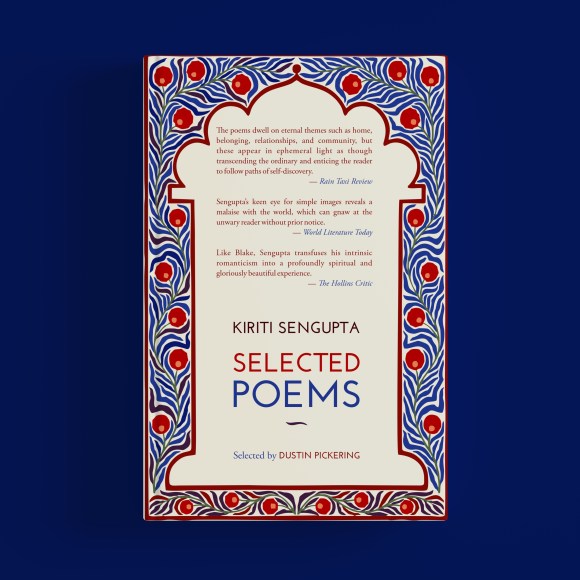
Sir Philip Sidney, in his AnApology for Poetry, argues that the primary purpose of poetry is to “teach” and “delight”. Kiriti’s Sengupta’s Selected Poems serves both purposes though the poems do not preach at any point but leave the readers mulling over the ideas with the play of words. The book contains more than 125 poems, selected by Dustin Pickering, a writer and the founding editor of Transcedent Zero Press. The content covers an eclectic range of subjects—from personal musings to ecology, memory to myths and more — mostly republications from his earlier collections and some from journals.
An award-winning poet, publisher, editor, translator and critic, Sengupta believes himself twice-born as he states in his poem of the same name — ‘Twice Born’, written specially for this collection. He has embraced the calling of a poet, forsaking the lucrative profession of a doctor. It’s not that he doesn’t vacillate: “The ink has dried on the paper; the pot can’t be refilled with scribbles. Do I now surrender my pen?” But poetry is his vocation; it would sound ludicrous if someone could ask a noted poet, “What if you weren’t a poet?”(“Intrinsic’)
There is a sense of flow in the poems despite his stylistic terseness. Water permeates his poetry. The poet believes: “…water is achromatic and otherwise called life.” As the poet is a deep observer of nature and its surroundings, he observes that water carries out its own duty: “Water has no call, no décor either; it floats the bone and/ the ash free.” In ‘Evening in Varanasi’, the poet assigns the water of the Ganges with exceptional qualities: “The water here is not/a fire extinguisher. /Flames rise through the water.” He connects the water to the Sun: “O Sun, I remember/I’ve bathed your feet/with the water of the Ganges”. ‘River of Tears and Mother’ airs the deep concern about the recalcitrance of those who ignore ecological issues: “Ganga has her stories to tell;/wish she had someone to listen to her.”
Ecological strains seep through Sengupta’s poems. In ‘The Pillars of Soil’, he draws a fine connection between human beings and trees through the image of the roots. The poet invokes a supreme spirit: “the world would need another maestro/who could sing for the seasoned flesh—/those who walked the earth—/whose roots ran deep into the ground”. In ‘Hibiscus’, he evocatively draws a curious connection between the colour of hibiscus flower and human blood: “…I’ll bloom/like a hibiscus:/the blush will endorse/my bloodline.” The epigraph of the poem, translated by Sengupta from a poem by the noted ‘rebellious’ Bengali poet, Sukanta Bhattacharya, re-enforces his stance.
Concern for extreme air pollution in cities yields sardonic poetry: “Nature made the nasal frame fragile. /How do they breathe the vain air?” He also highlights pollution caused by plastics: “The earth has grown plastic. Water takes eons to seep”.
Some of Sengupta’s poems convey a sense of domesticity. “Clarity”deals with gastronomy as the poet succinctly invites the reader to succor ghee with all their five senses. In this piece, the poet reminisces about the aroma of ghee that his mother used to prepare. The poet here compares his mother’s organic ghee with his organic memory: “So organic is my memory—/the granular residue lifted us to heaven. /Ah! Pious Ghee, and incorrigible.”
In poems such as ‘Experience Personified’, the poet records his experience of the commonplace things: “Tiny droplets envelop my feet/and permeate the toes. /I don’t call it a feeling, I will name it/my experience”. It reminds a me of lines by Tagore: “But I haven’t beholden/what lies two steps away from my home/on a blade of paddy grain, a dazzling drop of dew”. Sengupta also doesn’t shy away from the recent happenings in India. In ‘The Untold Saga’, the poet recalls the abominable “Nirbhaya episode” and rues that, unlike Durga, Nirbhaya could not create an epic due to her untimely death.
The poet turns metaphysical – almost like John Donne[1]— when he asserts, “I now look beyond the flesh, bone and keratin, /I’ve been told/the finer body dwells undressed.” Though most of the poems are contemplative, the book offers some light-hearted ones too: “To my complete bewilderment, if the ghost appears, I’ve decided to offer it a chair first, and then I’ll plead, ‘Take a seat and relax! Let us share our stories.’” In ‘Gravity’, the poet offers a lighter note for the turbulence caused in the aircraft due to the inclement weather. He gives solace to his terrified son: “Relax, Bumps help us/ realize the earth.” In a haiku, punning on the word ‘wisdom’, the poet realises that it’s a test of a surgeon’s wisdom to pluck out a wisdom tooth (biologically called ‘the third molar’) of a patient.
Sengupta’s Selected Poems is a fabulous collection. These poems are like chosen seeds that contain intrinsic vigour to sprout through the age-old concrete floor, giving a message of hope in the face of all odds. Sengupta’s penetrating observations, coupled with his poetic prowess, can be vividly experienced by delving into the rich treasures hidden in between the covers.
Pradip Mondal teaches at L. B. S. Govt. P. G. College Halduchaur, Nainital (India). He has been published in journals like Suburban Witchcraft (Serbia), Muse India (India), and Indi@logs (Spain).
.
PLEASE NOTE: ARTICLES CAN ONLY BE REPRODUCED IN OTHER SITES WITH DUE ACKNOWLEDGEMENT TO BORDERLESS JOURNAL
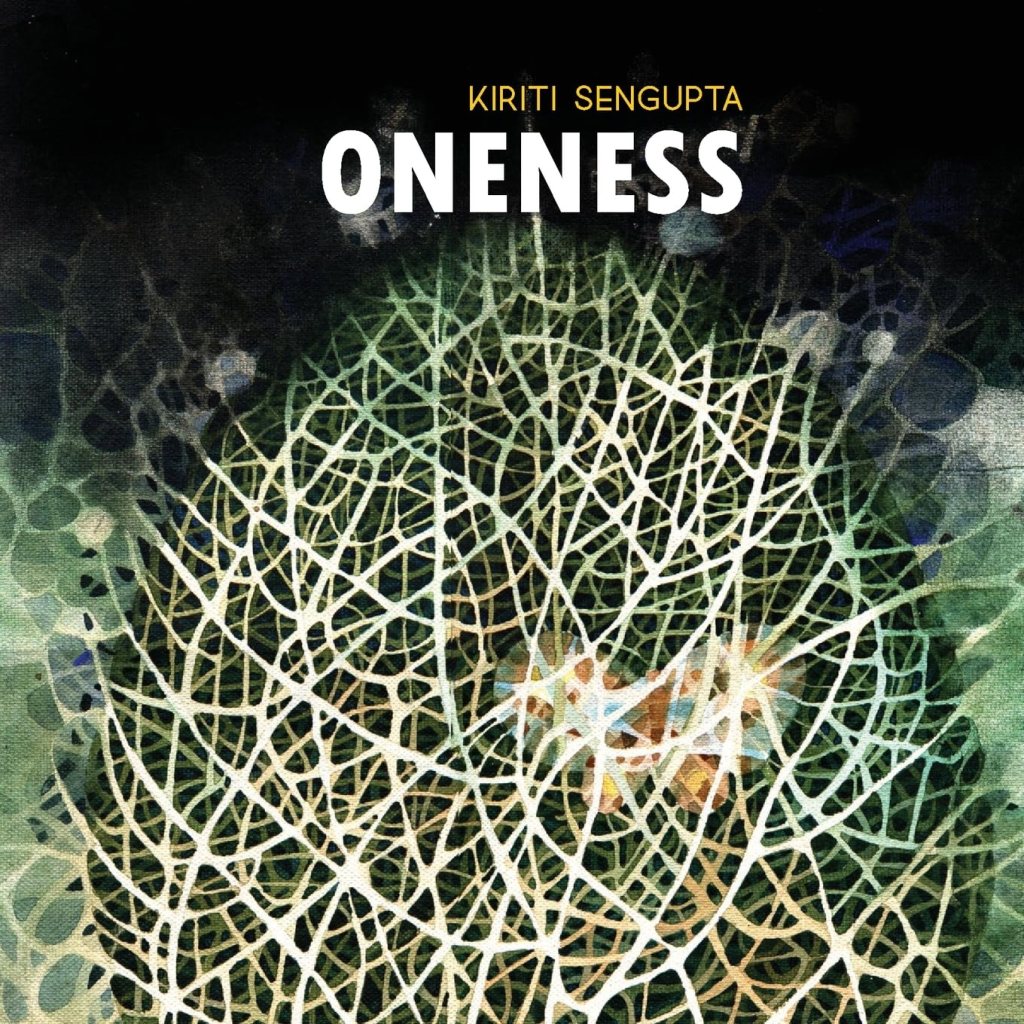
Oneness by Kiriti Sengupta, an established writer and publisher, is the paean of a poet in love with life. This thin volume has the gorgeousness of a Rajasthani miniature: The poems are accompanied by colourful paintings by Pintu Biswas and Samir Mondal. The artwork adds to the magic of the experience that is Oneness. Exploring the pieces, the reader, too, is drawn by the poet into embracing life like an affectionate lover who accepts the highs and lows of our existence or a relationship. The bright tapestry (literal and metaphorical) presented in the little tableau of a book entrances us to appreciate the romance of oneness in the midst of our teeming variety of happenings over time.
The title “Oneness” recalls to mind John Donne’s[1] immortal sermon, delivered after he healed from a prolonged bout of illness, titled ‘No Man is an Island’. Donne’s illness was so severe that he was considered to be on his deathbed, but defying all odds, he survived. And, then, he wrote:
No man is an island,
Entire of itself;
Every man is a piece of the continent,
A part of the main.
Oneness is a celebration of life as much as the start of ‘No Man is an Island’. It expresses an all-encompassing love for other human beings, the realisation that the hues of blood, joys and griefs are same for everyone, that death and sorrow are common to all. Oneness is an eternal feeling captured well in this collection.
Oneness homes haikus, short verses and prose poems. The haikus reflect profoundness with the brevity of words, typical of Sengupta’s style. For instance:
full moon
across the landscape
fireflies.
One would imagine a dark night sky and a full, flowery golden moon, illuminating the black landscape and the pinpricks of lights from the insects. Instead, the accompanying artwork surprises with a canvas awash in swirling cobalt blues a large blazing red moon, and fireflies like bright flames. It forms an interesting contrast.
Some haikus are beautiful and poignant with subtle decadent sadness:
the post box
recedes to rust
the lost art
A post box is part of the past in the twenty-first century with the advent of online communication. The painting shows a cherry-red post box, with two crows frequenting the scene. The crows, presumably, communicate with each other at the site of the letterbox. The visual and the art bring to mind Donne’s lines, “Any man’s death diminishes me / Because I am involved in mankind”. Perhaps there is a need to mourn the metaphorical death of letter writing, a form of genuine, soulful exchange which would wean away from loneliness and the impersonality of online interactions.
Taking other poems into consideration, it is difficult to choose favourites. In ‘Primordial Leaning’, Sengupta begins with an assertive statement, compelling the reader to accept that they define women as Durga or Kali. The rest of the poem intersperses questions and one more statement. The poet questions the attitude adopted by ‘pop feminists’ to ask whether it is ‘kind’ to compare women to these warrior goddesses, and should men, in turn, behave like Shiva, who is the Destroyer in the Hindu Trinity. It is an interesting take that would be of great value to scholars of Gender and Masculinity Studies. There are no easy answers to this interrogative, but Sengupta packs in a punch in his fiery inimitable style.
You define women as Durga
or Kali. Are you a believer? Are you
being kind? You could have convinced
them to fight the evil.
Instead, when you imply the goddess,
do you illustrate
sisterhood with many limbs? Would you
like men to act as Shiva—the destroyer?
The poem ‘Tenure: Early Years’ asserts that one never outgrows one’s early life when he or she is around a parent. Even when the child becomes an adult, a guardian keeps the memories of their wards’ childhood alive through stories and reminiscences. Thus, for a parent, juvenescence lasts forever.
What role do guardians play
when their wards grow up?
They feed lived experiences,
keep childhood alive.
Juvenescence spans the length
of the parent’s life.
In ‘Separation’, man and nature experience alienation, a state prevalent in postmodern times. However, in the artwork facing the poem, the “worn-out tree” is the reflection of the narrator. Perhaps it is a case of pathetic fallacy where nature echoes the loneliness faced by twenty-first century man. Yet, one can always ask: are trees and men, thus, not united in their separation from the rest of the kaleidoscope?
Only a little needs to be invested
in sketching the worn-out tree.
A charcoal or two, canvas, and span.
I place myself amid the landscape
to explain the prevailing isolation.
John Donne’s sermon ends with the idea of the inevitability of Death: “And therefore never send to know for whom the bell tolls;/ It tolls for thee.” The poems in Oneness, on the other hand, create an eternal algorithm of the unity and universality of human existence. Each written piece, with its companion artwork, form an unforgettable vignette; each is a resplendent unveiling of the beauty and truth of life.
.
[1] John Donne (1572-1631), major poet of metaphysical school
.
Jagari Mukherjee is the Editor-in-chief of Narrow Road Literary Journal and the Chief Executive Editor of EKL Review. Jagari has three full-length poetry collections and two chapbooks and a bestselling ebook to her credit.
PLEASE NOTE: ARTICLES CAN ONLY BE REPRODUCED IN OTHER SITES WITH DUE ACKNOWLEDGEMENT TO BORDERLESS JOURNAL
Shesher Kobita(1928-29)Translation of Shesher Kobita by Radha Chakravarty (2011)
Romance and reality inevitably clash. While Tagore is not unconvinced about the existence of conjugal love in some of his stories, conjugality and romance make uneasy bedfellows inFarewell Song. Marriage is rooted in the humdrum, quotidian, everyday but romantic love dwells on another astral plane. It is the realisation of the gap between the two that informs the novel/la, a realisation that never the twain shall truly meet, manifesting itself in the pages of this complex narrative that folds into itself a romantic love story, social satire and literary criticism. The multiple strands are brilliantly woven into the plot of this novel, which could be classified as a prose-poem. Its very title, “Shesher Kobita”, literally meaning last poem and translated by Professor Radha Chakravarty as Farewell Song, is evocative of its lyricality.
Shesher Kobita is primarily a love story between two young people, Amit Raye and Labanyalata, both of whom express their love in the most lyrical vein imaginable. Labanya, like many of Amit’s compatriots in Calcutta, is an avid reader and staunch admirer of Rabindranath Tagore’s writing, and her familiarity with Tagore’s work is evident in much of her conversation and in many of her perceptions. Amit, on the other hand, persists in citing the words of a ‘modern’ poet, Nibaran Chakrabarti, who is a persona created by Amit himself, to express his views about poetry. Readers see through this ruse quickly enough, and the third person narrative , often allows space for narrative commentary. As the translator, Radha Chakravarty points out, “Two schools of Bengali poetry, pro and anti-Tagore, are pitted against each other through the dialectic of the Amit-Labanya encounter.” Tagore cleverly plays out and into the literary /poetic debates of his later decades (1920s onwards) in order to prove his contemporary relevance and above all, the modernity of his work.
Amit, the protagonist, is from an elite and rich family, privileged enough to have gone to Oxford and wealthy enough to be under no compulsion to earn immediately. He’s a dilettante who is interested in the vagaries of style, which is seen as being a notch higher than fashion. Brilliant but restless, mercurial as quicksilver, he cannot commit himself to any one thing or relationship. Yet, getting away from the highly artificial social life of Kolkata, to the relatively pristine and pastoral world of Shillong, he falls deeply, unequivocally in love, with the quiet, studious but unassuming young girl, Labanyalata and establishes a soul-connection, as it were, with her. Yet this deep commitment pales and collapses in the face of the demands of the everyday social world. It is this space–“habitus”– which is occupied by Amit’s sister’s friend, Ketaki (Katy) Mitra. To quote from Radha Chakravarty’s introduction to her translation of the book, “Two forms of love are presented through Amit’s involvements with Katy Mitter and Labanya-one rooted in the material and the social, the other, embedded deep within the soul”
The expression of this soulful love dips into and is expressed through not only Bangla literature and poetry but is steeped in the idioms of English poetry, from Shakespeare to the metaphysical poets. Seeing a book of John Donne’s poems on Labanya’s table, Amit quotes, “for God’s sake, hold your tongue and let me love.” And yet, his intense love seems doomed as an idealistic ephemeral bliss, to be swept away by the ‘real’. Not a keen observer of nature, Amit seems to indulge frequently in “pathetic fallacy”, appropriating aspects of the landscape in order to express his moods and feelings. The landscape is often symbolic with Amit and Labanya meeting for their trysts at the site of a waterfall, always a significant feature of Tagore’s landscapes. Mita (meaning friend) and Banya (of the forest) –the lovers’ names for each other– create a world of their own, full of poetry and lyricality. And yet, inevitably, inexorably, the social, material, everyday world presses upon them and the lovers part. And yet, as the novel draws to a close, we do not experience this parting/ estrangement as a tragedy but almost as much of a resolution and closure that the novel could offer.
For Amit Ray/e is an embodiment of the modern split subject, the divided self. He has made up a world of words, and it is in this world that his heart and mind dwell. It is this inner space-the still centre of the turning world (to quote from another modern poet) that Labanya inhabits. And this is what Labanya, intelligent and perceptive, realises. Labanya, in her own way, is the new woman- independent and emotionally self-reliant, reminding one of Kalyani in ‘Aparichita‘, translated by Aruna Chakravarti as ‘The Stranger‘. They are women who dream of a life beyond domesticity and conjugal felicity. For them marriage would be a slippery slope, not a nesting ground. In these versions of ‘modern’ love, each person, especially the women, are complete and self-assured in themselves. This is particularly true of Kalyani, where we get a sense that she towers over the suitors in her life.
Labanya is able to connect to connect with Amit as a friend. to Amit, the friendship acts as an anchor, a stay against the vacuousness of his urban existence. Such a soulful connection belongs to the realm of dreams and these connects are what dreams are made of. However, dreams often shatter, or worse, fester. When Amit is asked whether in marriage, partnership and companionship cannot combine, his reply is illuminating. Marriage is the finite to the infinity of love and romance. He compares his relationship to the westernised Ketaki/Katy, his girlfriend in England who later becomes his wife, after the interlude with Labanya. “My initial relationship with Katy was indeed based on love but it was like water in a pitcher, to be collected daily, and used up everyday.” In contrast, his love for Labanya “remains a lake, its waters not be carried home but meant for” his “consciousness to swim in”. This realisation creates no inner conflict because he also glimpses that Labanya is someone who lives in his dreams, “in the twilight of gleams and of glimpses” (Tagore’s lines from Gitanjali, a basket of song-offerings). In a serendipitious resolution, Labanya also finds her companion in domesticity, her father’s brilliant student Shobhanlal, who has yearned for her for years, only to be spurned. Thus the story becomes not a tragedy of betrayal, but an extended musing and discussion on love, romance and marriage of the modern subject, in a world where the ground beneath the feet of the characters is constantly shifting.
It is this sense of a world in flux and its nuances that Radha Chakravarty’s translation deftly captures. Translating a novel of discussion requires a constant awareness of key concepts and multiple contexts — literary, social, cultural and philosophical. As a skilled translator and litterateur with an extensive repertoire and many years of experience, the editor-translator has brought her many accomplishments to the task of translation. Translating poetry and its nuances is challenging; here, the translation conveys immense wealth of meaning and richness of detail. The novel, in a sense, is a plea for romantic yearning and aspiration, for reaching out to those “unheard melodies” that are far sweeter than those which are available for the asking.
Unlike Bankim, who had depicted the new woman in an unflattering light a few decades earlier, Rabindranath was essentially sympathetic to women. Women were often among his closest associates and companions, and his friendship with women like the Argentinian Victoria Ocampo not only spurred him into song , but made him rethink the contours of modern cosmopolitan womanhood. Well-read and accomplished, women like Labanya not only challenge traditional ideas of womanhood, but is reflexive and aware enough not to judge Katy Mitra. Torn between the pull of intellectual independence and the desire for surrender, Labanya also represents the emergence of the female subject in modern Bangla literature.
.
Dr Meenakshi Malhotra is Associate Professor of English Literature at Hansraj College, University of Delhi, and has been involved in teaching and curriculum development in several universities. She has edited two books on Women and Lifewriting, Representing the Self and Claiming the I, in addition to numerous published articles on gender, literature and feminist theory.
.
PLEASE NOTE: ARTICLES CAN ONLY BE REPRODUCED IN OTHER SITES WITH DUE ACKNOWLEDGEMENT TO BORDERLESS JOURNAL
Rakibul Hasan Khandiscusses Sofiul Azam’s poetry collection Persecutionfrom a postcolonial perspective
Soiful Azam
Sofiul Azam is one of the most important English language poets from Bangladesh. Persecution (2021) is his fourth poetry collection, which has recently been published by Salmon Poetry (Ireland). His poetry has already appeared in some of the leading poetry or literary journals across the globe, including Prairie Schooner, North Dakota Quarterly, The Ibis Head Review, and Postcolonial Text, to name a few. In Persecution, Azam shows an astonishing poetic talent, offering some wonderful poems on the themes of love, war, and politics, among others. If we read the poems of this volume purely from an artistic viewpoint, we will find most of them as what might be called “perfect” poems, but we may find the same poems somewhat problematic if we read them from certain political perspectives.
The volume has recently come to me travelling a long distance from its publishing house in Ireland to my present residence in New Zealand. This journey, which began in Bangladesh where Azam lives, has covered three different countries of three continents. Such a transnational breadth is the main motivation for writing in English for many South Asians today, who have internalised English as a language of their own for their creative expression, inherited from their colonial past.
These poets capture the complexity and multiplicity of South Asian life with the common thread that binds them all — the language, English. Their expressions are somehow distinctly South Asian. This fact makes Azam stand apart from many of his counterparts in Bangladesh. Very few English language poets from Bangladesh, especially those who were born and brought up there, write such “perfect” poems in English. But Azam’s perfectly written poems in “native” like English with somewhat Western outlook and a poetic expression deriving from Western literary canon make some poems of Persecution incongruous in the South Asian context. In this essay, I will shed light on this incongruity while exploring some other features of his poetry.
The most obvious influences on Azam in this collection are Eliot (1888-1965), Auden (1907-1973), and Walcott (1930-2017). Perhaps, among them his true poetic inspiration is Walcott, who is sometimes alleged to be more an English poet than a Caribbean. This is somewhat true about Azam as well, but his situation is, of course, unlike Walcott. Azam is a self-made poet who has mastered his art of writing poetry in English through reading, overcoming his spatial “limitation” of living his whole life in a Bangla dominant country like Bangladesh where English is no more than a foreign language. Therefore, it would be an injustice not to recognise his extraordinary achievement in mastering the language to write like a ‘native’. But his poetry is not all about language. Azam’s success in Persecution lies in the fact that almost each poem is neatly written, maintaining outstanding poetic and artistic expressions. If the poems were decontextualised from their social, political, cultural, and historical backgrounds, this would be a collection of “perfect” poems. Azam in Persecution is like Walcott – more an English poet than a Bangladeshi! It is, of course, an overstatement, but there are some truths behind this assertion. To illustrate my point, I quote some lines from his poetry:
I tell myself that I can afford to be happy
like a grizzly bear only having to feast on salmon
moving upstream through shallow creeks to lay eggs and die.
I need to act like a hiker does, getting all he needs
On the wild shrubbery dense paths in Yellowstone.

(“The Capitoline Wolf,” 14-18, pp. 15)
In the quoted lines, no one can doubt the mastery of Azam’s versification. If one is not informed of who is the writer of these lines, it would be hard to imagine these were written by a Bengali (English) poet. Objects and images like “grizzly bear”, “salmon fish”, “hiking” and “Yellowstone” are so foreign in the Bangladeshi or even in South Asian context that they seem to be incongruous in an otherwise perfect poem.
But Bangladesh is not untraceable in Persecution, particularly in the part entitled “Heat of Interrogations”, where Bangladeshi landscapes reappear time and again through the poet’s nostalgic recollection of his childhood life in his hometown near the Garo Hill. The hill and a backyard pond in his grandparents’ house are the two most frequented places for the poet to escape from the complexities of metropolitan life of Dhaka where he lives. There is a clear undertone of English romantic poetry in the poems of this section. The quoted lines below may clarify my point:
I grew up picnicking in the Garo Hills.
In summer, I saw trees and clustered vines
dance in the wind and get covered with red dust.

One day we will go there, to see together
the rain falling and washing the dust
off their green foliage.

(“Rain,” 28-33, pp. 17)
This superb poem somehow reminds me of Yeats, especially the early Yeats of romantic phase. I quote some lines from “Coming of Age,” another poem from this part, which casts a shadow over a nostalgic recollection of childhood event through the experienced poet’s realisation of its innocent cruelty:
Even as a child, I did atrocities like floating rat pups
in a coconut shell on a pond’s calm water.
I hear their sqeaks though I’m not degaussed
to such evils yet, drifting far from atonement.

(11-14, pp. 12)
Such memories are the backbone of his poetry. In retrospect, he offers a profound insight into his life, which has a general appeal: “What am I but an accumulation of memories, / each of which is surmounted with unsuccess?” (16-17). It is true that every individual is an accumulation of memories.
This is a prominent feature of Azam’s poetry to attempt to give vent to some sad truths of human lives in general terms, especially in this part of the volume. The following lines from “The Pond at Grandpa’s House” may support my claim:
                       But I
Remain tensed like a hyacinth
Worrying about the lowering water.

(17-19. pp. 19)
This “lowering water” perhaps makes all of us tense, humans whose existence is as uncertain as that of a hyacinth and threatened by the drying up of water – the most vital source of existence. It is more so for Azam who does not want to strike his root in any particular place:
                              I don’t ever relish
the singular idea of being rooted in just one spot;
I rather feel like a rhizome branching out new roots
from its nodes, trying out its various potential climates
for the plurality is itself a self-renewing adventure.
Losing faith in those too preachy about the singular,
I prefer to be an unpaired jerk lusting for the plural.
If I say this planet is where I began and my windows
open into the universe, would I be allowed to belong?

(“Earth and Windows”, 22-30, pp. 30)
This is an unequivocal statement of Azam’s internationalism or transnationalism, renouncing any specific national identity.
Azam’s preference for a transnational identity is a common choice among many poets and writers of the so-called postcolonial world. It makes them different from the traditional postcolonial poets who usually express their deep desires to be rooted in their lands and cultures. Therefore, Azam’s choice of a transnational identity, against the backdrop of his ancestral home that he often revisits, can be interpreted as the conscious choice of a poet whose writing in an adopted language opens up before him an outstanding opportunity to explore other horizons. But there are scopes for raising questions about the intention of such transnationalism. Is it an opportunity for the poet to make his poetry more presentable to an international audience, since creative writers in English from Bangladesh and South Asia in general inevitably sense the shadow of an international as well as an unknown readership at the back of their minds?
I am aware that I am making a clichéd and contentious claim, and I may even be charged for being a nativist for raising such questions. Therefore, I must clarify my discomfort in coming to terms with the idea of transnationalism, which I think is largely confined to privileged people who can afford to assume multiple identities. This is perhaps a narrow and simplistic view of transnationalism, but it cannot be denied that those who adopt transnational or multinational identities are generally from privileged social positions. However, one particular feature that intrigues me the most is Azam’s romantic recollection of the past often with a profound attachment to nature. It makes him, to me, the last romantic of the post-postmodern age!
Part two of the book, “The Flames of Desire,” also exemplifies his romanticism. It is the spiciest part of this volume, but some of the poems in this part slightly disappoint because they do not fulfil my expectation of capturing the complexities of human relationship that I expect from the twenty-first century love poems. I am quite sure that many readers will differ and I admit that what makes me critical of Azam in this volume is essentially because of our ideological differences; his poetry as a form of art has mostly nothing to do with it. However, an exciting feature of this part is Azam’s experiments with metaphysics. This part brings out the influence of English canonical literature in shaping his poetic sensibility and artistry. On the one hand, the erotic and sensual images that he creates with an abundant use of conceits may remind one of John Donne, on the other, the rendering of the metaphysical elements in a modernist vein will remind one of T.S. Eliot who rejuvenated metaphysics in modernist poetry. The following lines from “Krishna’s Return Home” show evidence of his use of metaphysics:
As I reluctantly walk out of your woolen warmth
far worthier than the promise of a kingship
in heaven, I see washing on the line under the sky
with a few stars peeping like pot-bellied spies
through the curtains of dark clouds. (1-5, pp. 37)
These lines, once again, reflect the impressive craftsmanship of Azam who succeeds in matching the poetic talents of the English poets who influence his poetry.
The extramarital sexual trysts that Azam accumulates in this part may titillate readers. But while emulating the erotic art of a seventeenth century poet like Donne who is notorious for his misogyny, Azam also falls into the same trap of presenting women as an object of men’s sexual pleasure, without any agency. The poem “Who Doesn’t Want to Make Love to Someone’s Wife?” is a case in point, from which I quote the following lines:
Could I borrow you?
I promise you will be returned unhurt to him
who’ll know nothing of rain’s work on a taro leaf.

(10-12, pp. 47)
This wonderful poetic expression is problematic for its gendered undertone. Although it may sound like making a gross interpretation of a love poem, I cannot overlook the fact that the quoted lines’ that show women are men’s possessions and they can be borrowed like any other objects. It sounds like a very offensive idea to me. Similarly, in some other poems, he compares different parts of a female body with fruits to be consumed by men.
The third part of Persecution, “Embers of Disappearance,” contains the most politically conscious and powerful poems. I enjoyed the poems of this part the most, but some of those are, unfortunately, problematic for being Eurocentric in outlook. One example of Azam’s Eurocentrism or a Western attitude is his treatment of wars, which is a recurring theme of this part. Surprisingly, Azam does not look beyond the world wars of the twentieth century to reincarnate the horror of war, assumably because of his politically apolitical and liberal humanistic Western outlook. Here lies the main incongruity of his poetry, at least from my ideological perspective. I think it is incongruous of a twenty-first century Bangladeshi poet to rely so heavily and uncritically on the World Wars to reflect on the horrors of wars, whereas there are so many ongoing and past wars in his part of the world, so many struggles of the oppressed.
Even his so-called transnationalism and lack of belonging to any particular place perhaps do not justify his stand because there are also many poems in this volume that reflect his awareness of place and time. Therefore, his position is curiously ambivalent in relation to his homeland. This kind of ambivalence is often considered to be a quintessential characteristic of the so-called postcolonial poets, but the paradox is that Azam does not seem to be very keen to identify himself as a postcolonial poet.
Azam’s treatment of wars also indicates the influence of modern English poets on him. The following lines from “Requiem for the Undead” reflect his reminiscence of Eliot’s rendition of the horror of the First World War in “The Wasteland”: “A desert greens with corpses planted as seedlings. / Did dry sands wish to be washed out with blood?” (11-12, pp. 76). In the same poem, Auden’s account of his devastating experience of the Second World War in “The Shield of Achilles” is echoed:
Weary footfalls, the oars knifing the watery flesh.
The dreams that linger are burst-out bubbles
or hollowed-out conches washed on alien shores.
Batons, barbed wares, and the cold greet the future.

(21-24, pp. 76)
Similarly, in another poem, he echoes the final line of Walcott’s famous poem “A Far Cry from Africa.” Walcott writes “How can I turn from Africa and live?” and Azam writes “How can I write poems and think of beauty alone?” (“Worries at a Hilltop Resort”, 27, pp. 89). Such kind of “intertextualities” are often intentional. They are undoubtably very artistic and evocative expressions, but the problem is neither the intertextuality nor the art, rather the context of the time and place when he wrote these poems. Do I sound like a nationalist now? I would rather call myself a postcolonialist. However, the influence of classic English war poets like Wilfred Owen or Keith Douglas, or the Cold War period’s poet Boris Pasternak, or the holocaust theme of Auschwitz in his poems indicates not only his inclination to present twentieth century modernist themes but also his Western point of view of meditating on his own experiences and perspectives. In this sense, he is a twenty-first century modernist poet from a postcolonial location, although it is not unusual among the Anglophone postcolonial poets to embrace Western modernism as Jahan Ramzani explains in his comprehensive study on such poets in A Transnational Poetics (2009). The irony is that Azam and many others seem to reject the identity of the “postcolonial,” but that identity persists to hang stubbornly around their necks like the dead albatross.
The most ambitious poem of this volume is “Prayers to the God of Jihadists.” In this poem, Azam deals with the issue of Islamic radicalism, which is a pressing concern for the contemporary world, particularly for the West. Azam also writes the poem largely from a Western perspective, which is evident in his use of the word “jihadist” – a popular Western coinage to describe the radical Muslims, and it is sometimes indiscriminately used to label Muslims in general. For many in the West, Islamophobia has ominously led to suspect every Muslim as a potential jihadist, and by writing this poem from their perspective, Azam seems to simplify a complex issue. The poem thus turns out to be a problematic one despite having enormous potentialities to become a great poem.
Nonetheless, there are many poems or short expressions in Persecution which save Azam from doing injustice to his poetic merit. “Persecution” and “The Photographer” are two such poems. In these poems, Azam offers exemplary political consciousness, being fully aware of his time and place. I quote some lines from “Persecution”:
In the wake of the Confederate flags flying
o’er the land of the free and the home of the brave!
I know brown won’t ever be de-browned to white.

I’m a genealogist, cracking the encryption codes
of all those suspicions under my critical lenses.
Oh, don’t let colour and culture make distance between us.

Elsewhere lines of sanity are now increasingly blurred.
Erich said Hear, O Israel! A new Holocaust is raging on.
So between an anvil and a hammer I stammer:

For Jews in Hitler’s war my sad tears drip,
Also for kids bombed out in the Gaza Strip.
Not anti-Semitic but you know Zionists never get it.

(43-54, pp. 93)
Whereas the above lines from “Persecution” express Azam’s consciousness of international politics, the “The Photographer” represents his awareness of national politics. In the latter poem, Azam makes a bold statement about political persecutions in Bangladesh. The photographer in the title of the poem alludes to a renowned photographer and political activist in Bangladesh named Shahidul Alam, who was arrested on the ground of sedition during a time of political unrest in 2018. In the following lines from the poem, Azam asserts his support for the photographer, protesting the repressive political regime that restricts freedom of speech:
                         I want caged birds
to sing their dreams out loud so that captors

feel the horror of wings being of no use.
Palmyra palm trees, though rooted,
make wings of their fronds. And only freedom

gets us on the wing. But in this country,
rules from their laboratory rain down on us
clay subjects and wash away what we made

solid with labour. I wonder if they’ll wise up
to the light brewing under darkness.
Those mute photographs will be vocal soon.

(“The Photographer”, 17-27, pp. 104)
Thus, Azam expresses his solidarity with an artist who fights for freedom of thoughts and expressions through photography. This poem of a national subject matter has an international significance, for nowadays persecutions for dissents are very common everywhere around the world. It also justifies the titling of the volume.
In fine, I repeat that Persecution is a collection of “perfect” poems. There are some problematic areas in this volume, but those are hardly because of any artistic weakness of the poems; rather, Azam’s ideological position sometimes weakens his political stance. His over cautiousness with form and expression is probably another reason of his political compromise. There is hardly any contemporary issue that he does not deal with in this relatively thin volume. Though I have not mentioned it in my discussion, his ecological consciousness is another highlight of this book. Therefore, I warmly accept this collection, keeping in mind the way the speaker of one of his poems asks his beloved to accept him with all his imperfections:
                        I am not

requesting you to accept me as a gem
you might have lost by mistake on the way,
rather as one humanly rife with imperfections.

(“Who the Hell Benefit from Denials?,” 51-54, pp. 60)
Rakibul Hasan Khan is a PhD Candidate in English at the University of Otago, New Zealand. He can be reached at rakib.hasan82@gmail.com.
.
PLEASE NOTE: ARTICLES CAN ONLY BE REPRODUCED IN OTHER SITES WITH DUE ACKNOWLEDGEMENT TO BORDERLESS JOURNAL


 Borderless