Categories
Excerpt

The Stopped Clock

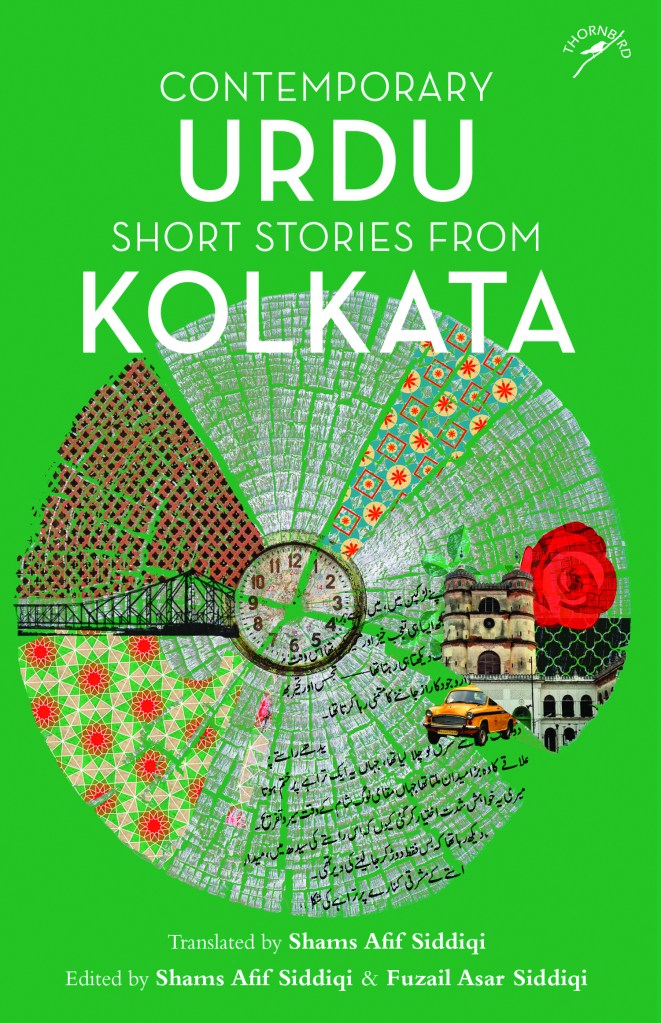
Title: Contemporary Urdu Stories from Kolkata

Authors: Sayeed Premi, Firoz Abid, Anis Rafi Siddique Alam, Mahmoud Yasien, Shahira Masroor Anisun Nabi, Reyaz Danish

Translated by Shams Afif Siddiqi, edited by Shams Afif Siddiqi and Fuzail Asar Siddiqi

Publisher: Niyogi Books

The Stopped Clock

By Siddique Alam

The hands of the clock had stopped permanently at 13 past two and two seconds. Sitting on the bench under the shed, I am trying to understand the oval dial of the clock, the Roman letters of which had become dimmed and its edges covered with spider webs. I wonder when the clock might have stopped. I am 35 years old. Is there apparently any difference between us? Just like the clock, I have also stopped for a while because there was no announcement about the arrival of my train, its departure time being four hours ago.

I am trying to survey the place with wide open eyes. It is a usual day and an ordinary station that we are accustomed to see.

I have bid farewell to the city of my birth. I am leaving the city like a failure. But it seems after relinquishing me, the city, with a feeling of guilt, now wants to take me back. Its first step in this direction is to delay my train for an indefinite amount of time.

Despite being in the midst of a city, a station is free from its clutches. I am enjoying that freedom with a one-way ticket in my pocket. A bit of patience, I tell myself, and I would be far away. Nobody can stop me, neither by erecting obstacles in the way of the railway tracks nor by stopping the hands of the clock. Maybe I am a loser, but the journey of my life is yet to end. I am only 35 years old. I have to go far away from this place. The most important thing is that I am satisfied that the address I am carrying in my pocket is not my last destination.

It is a temporary waiting place that can help me make a new beginning. After all man is born free. The sun does not select a particular spot to shine, nor is every wave that dashes against the shore the last one, losing which the boatman would have to wait all his life for another wave.

An old coolie, wringing khaini[1] in the palms of his hands, passes by me. He is clad in a white banian and dhoti, his red flannel shirt thrown on his left shoulder.

‘Since when has the clock stopped?’ My question stops him in his stride. He turns around, his tired, thoughtful eyes staring at me. A sense of shame overpowers me. He may be an illiterate coolie, not a station employee who is answerable for such a question. ‘I am sorry,’ I quickly add, ‘I should not have put the question to you. I take back my words.’

‘Why sir?’ he stands by the side of the bench, and looks at me with a sense of intimacy. ‘People will be asking questions about a stopped clock, isn’t it? They cannot to be blamed. The story of the stopped clock is well known but only the signal man Gocharan Ray has the right to tell its tale. He had spent all his life showing green and red flags to trains and has retired today.’

‘Who has replaced him?’ my question betrays my foolishness. My imprudence had always entangled me in thoughtless acts.

‘Why don’t you ask the station master?’ The coolie moves away. ‘It’s a question that requires an answer; otherwise, you will regret it all your life.’

I was not ready for such an unexpected turn of events. I thought that my relationship with the city had been cut off forever. What do I make of a station that has ignored me, as if the ticket in my pocket is of no worth? Once again, I look at the dial of the clock hanging from the shed. It had stopped at 13 past two and two seconds. What might have happened when it stopped? Did an accident take place at the station? Had any incident of murder taken place? Was it at the time of the departure or arrival of an important leader? An attack by Naxalites? Or was the place the site of a communal incident?

The coolie returned again. This time he was wearing his shirt. ‘Unless you hear the story,’ he says, ‘your train will not arrive. This is the rule here. It may take weeks, months, or even years and you have to move from one platform to another with your suitcase. Once, a passenger alighted here to board another train. He faced a similar dilemma. He asked the same question about the clock but I do not know what happened and why he refused to listen to the story. Do you know what happened to him?’

‘How can I?’ I replied impatiently. ‘The city hardly gave me any time so that I could listen to stories.’

‘You are becoming irritated unnecessarily, Sir,’ he said. ‘I want to tell you about the man. The fact is nobody knows much about him. Some say he went to the city and did not return. Others say he took another train that never reached its destination. Some may even tell you that a prostitute took him to her house by the railway tracks where he developed leprosy and is slowly dying there. There is also no dearth of people who say he is still moving, suitcase in hand, amidst platforms, difficult to spot in the teeming crowd of passengers.’

‘You mean to say he can be anyone, even me?’

‘Did I say that, sir?’ He was on the verge of leaving. ‘It seems you have tasted bitter gourd.’

I was staring at the departing coolie’s back. The constant use of the flannel shirt had not only exposed its fibres, it had also thinned the material exposing the bones of the man’s neck. I have no hesitation in saying that I did not believe him. Since the time when suitcases developed wheels, the number of coolies has dwindled in stations. The last nail was the introduction of the backpack. Either passengers drag their suitcases on wheels, or carry luggage in their backpacks, leaving the coolies with little work. So, this may be their way of passing time.

About the Book

Dealing with love and loss, dreams and reality, as well as history and violence, this is a collection of best 19 short stories that encompasses the whole gamut of human experience, seen through the eyes of current Urdu writers from Kolkata.

Stories from Kolkata are often assumed to be about bhadralok culture and the Bengali way of life. But Kolkata is a city with amultiplicity of stories to share. Contemporary Urdu Short Stories from Kolkata highlights the diversity of recent Urdu short stories fromthe city. In one of these stories, a writer trying to escape the city wants to find the reason why the railway clock has stopped working, in another, a new friendship sours as soon as it blossoms, while some other stories show how the complexity of human relationships is explored. There is an experiment in abstraction, and legend and reality are brought together when three sleepers of an earlier civilization wake up in the modern world.

About the Editor and Translator

Shams Afif Siddiqi, former Associate Professor of English (WBES), author, short story writer, and literary critic, was born in 1955 in Kolkata. He taught in government colleges of West Bengal for 35 years and was a faculty member at MDI, Murshidabad. Khushwant Singh selected his short story for publication in The Telegraph in the 1980s. His publications include The Language of Love and other Stories (2001), a critical look at Graham Greene’s novels, Graham Greene: The Serious Entertainer (2008), and an annotated edition of G.B. Shaw’s Arms and the Man (2009).

Fuzail Asar Siddiqi is currently a PhD candidate at CES, JNU, New Delhi, researching on the modernist Urdu short story, in general, and short stories of Naiyer Masud in particular. The founder/editor-in-chief of an academic editorial services company, he has been an Assistant Professor of English at Gargi College, New Delhi.

[1] Khaini: Tobacco

.

PLEASE NOTE: ARTICLES CAN ONLY BE REPRODUCED IN OTHER SITES WITH DUE ACKNOWLEDGEMENT TO BORDERLESS JOURNAL

Categories
Poets, Poetry & Rhys Hughes

My Love for R.K. Narayan

R.K. Narayan gives me a ‘warmer’ feeling than any other novelist. This doesn’t mean that his books make life seem easy. On the contrary, his work is absolutely committed to dealing with the travails of existence, but there is a deep humanity about his style that strongly appeals to my better nature, and I love immersing myself in his world. I feel that no more genuine and sincere guide can be found to our common reality than this author.

He was an author I was aware of for a long time before I actually read him. I planned to read his books one day, but most things that are postponed until that magical ‘one day’ seem never to happen. Finally, I dipped into a very small book of his short stories when I had a bout of flu. This was a sampler volume, pocket sized and easy to race through, but I paced myself at one story a day. They were a gift to an unwell man. I loved them. Nearly all of them had a twist at the end, but the twists didn’t feel at all contrived.

There was some other quality about them that intrigued me. They seemed to display not the slightest trace of self-consciousness. They reminded me of the authors I had most enjoyed when I first discovered the joys of literature, Robert Louis Stevenson, the early H.G. Wells, some Dickens. They allowed me to be a pure reader again, rather than an aspiring writer who was always on the lookout for ways to improve his own technique.

Hot lemon tea and short stories just like these are what a man needs when the flu takes hold of him. I finished the slim volume and recovered my health. I now knew that Narayan was an author who strongly appealed to me. Therefore, it was necessary to seek out his other books. I went to the local library, a library that happens to be one of the best I have ever visited, but all the Narayan books were already on loan. However, there was another author with an Indian name on the shelf very near where Narayan should be. I decided that he might act as a temporary substitute and I took out a volume at random. It turned out to be the very first book of V.S. Naipaul, certainly an Indian writer, but one who was also a writer from Trinidad, on the opposite side of the world to India. I read it, loved it, found it very different from Narayan.

Miguel Street is a brilliant collection of linked stories. These tales are set in one street in Port of Spain, the capital of Trinidad, and written in a deceptively simple style that Naipaul claims was inspired by the author of the old picaresque novel Lazarillo de Tormes, published in 1554 and probably written by Diego Hurtado de Mendoza, a book I read a few years ago with great enjoyment. But there is a rhythmic music to Miguel Street that clearly has little to do with that earlier work. It is a funny book, but behind the comedy is a certain measure of pain, and behind that pain is more comedy, and so on. The stories are therefore multi-layered, and this concealed complexity of form works as a very satisfying contrast to the singsong language of the telling. But these tales are hard. They aren’t as warmly embracing as Narayan’s.

I came to the conclusion, one I think I still hold, that Naipaul and Narayan are opposites, that they represent two poles on one spectrum of literature, that the first is hard and cynical, the other yielding and benevolent. Naipaul always seems to be a pessimist, and even in optimistic passages he is pessimistic about the worth of optimism. Narayan always seems to be an optimist, and even when things go wrong for his characters, he is optimistic about their pessimism. More to the point, their pessimism doesn’t endure, it dissipates rapidly. I admire both authors immensely, but I would much prefer to meet Narayan and drink coffee with him than meet Naipaul over any drink.

After I finished Miguel Street I returned it to the library, and now Narayan was back on the shelves, so I helped myself to The Bachelor of Arts, a novel that flows with incredible smoothness. It tells of Chandran, who graduates from college and falls in love with Malathi, a girl he sees on the river bank one fateful evening. His yearnings for her lead to the most dramatic adventure of his youth, as he impulsively but bravely decides to reject the world when he is unable to have her as his wife. But that is only one extended incident among many. The story is delightful, charming, innocent, but it also has elements of melancholy. It is humorous and yet serious. Reading it, I fully understood why Graham Greene said that Narayan was his favourite writer in the English language. Greene also claimed that Narayan had metaphorically offered him a second home in India, and that was exactly the way I felt too.

Then I learned that The Bachelor of Arts was one volume in a loose trilogy, and I obtained the other two books linked to it. Swami and Friends turned out to be almost as engrossing and fascinating, though a little simpler in structure. The English Teacher, on the other hand, was much more sombre in tone, with a plot concerning an English teacher who loses his new wife to typhoid. Narayan lost his own wife to the same disease. The sadness and poignancy of certain scenes in this novel are thus intense, yet the author never allows his narrator to become self-indulgent and the ending of this novel is beautiful. This is a trilogy that can be regarded as authentic, and what I mean by this is that there is no sense that the truth is being operated on by the tools of the writer’s trade for effect. Truth here is unadorned and more effective as a result. It takes gentle courage to write this way and succeed so admirably.

I do feel with Narayan that he is befriending the reader as well as relating a narrative. As I have already said, Narayan gives me a warm feeling that no other writers do to the same degree. His style is perfect for the needs of readers who wish to forget about the technical aspects of literature and feel exactly the same way they did when they were young and launching themselves into the mighty universe of literature for the first time.

Narayan is able to do two contradictory things simultaneously, namely (1) show that we are all the same throughout the world, and (2) show how cultures and people around the world differ from each other. And although other authors can pull off this trick, with Narayan it doesn’t feel like a trick at all but a natural expression of his being. It is true that I have enjoyed some of his books less than others, he is far from being the perfect writer. Talkative Man, for example is one of the weaker works, a short novel, more of a novella really, set in the fictional town of Malgudi as are most of his books, and it is charming and humorous and a little bit haphazard, a semi-picaresque in which the action always seems to be episodic and wide-ranging but in fact is firmly grounded in that one small town in a sleepy backwater of Southern India.

But it lacks bite, for although Narayan’s novelistic bite is gentle, unlike the bite of Naipaul, it is a bite all the same. The Painter of Signs bites, and although there are some slapdash passages in this novel (as there are in Talkative Man) they are easy to forgive, thanks to the compelling soft force of the poignant story about two individuals who despite being on different life-paths, meet and become deeply involved with each other.

Yet there is one Narayan book that is supreme above all his others, at least in my opinion, and it is a collection of stories I took with me when I travelled to East Africa and wanted a companion light enough to carry in my small rucksack and amusing enough to make each mosquito-filled night pass smoothly. The one quality possessed by Narayan that makes him such an agreeable companion on a long journey is that he never lectures or talks down to the reader but invites him to share his world, his vision. His fictional town of Malgudi feels absolutely real to me, so much so that it is my favourite invented location in all literature, and I always accept the invitation to stroll its dusty streets.

Malgudi Days is the title of this wondrous volume. I read it in Mombasa. It is a collection that displays enormous variety within the compass of its fictional setting, the remarkable town of Malgudi, only occasionally venturing outside it, into the countryside or the jungle where tigers and angry gods cause difficulties for the people who stray into their domain. Most of the time, the people settled in Malgudi, or just passing through it, devise deeply human strategies for coping with the difficulties thrown at them by circumstance and fate, often making their own difficulties through the accretion of actions over years. Despite the warmth of Narayan’s prose style, the gentle mood he evokes, the benign ambience of the setting, there is suffering and guilt here too.

Characters are not infrequently criminals who have fled the scene of their misdoings and have relocated to Malgudi in order to start afresh. Not always can they leave behind their pasts. And yet there are no simple morality lessons here, the resolutions are often chaotic, ambiguous, the stories of some lives are left hanging. Narayan is in control of his material but not of life and life bowls balls that his characters can’t always bat…

It is difficult for me to enthuse too precisely about this collection without ending up saying things I have no wish to say. The individual stories are superb, but the sum is greater than its parts. To choose individual tales to praise seems a mild insult to the integrity of the whole, though I am aware that it is perfectly acceptable to pick out particular pieces and talk about them. The collection was not designed as a whole anyway but amalgamated from two existing collections and updated with a handful of new stories.

I am merely delighted that I discovered R.K. Narayan and I fully intend to read everything he published. And there are districts of Bangalore and Mysore that evoke some aspects of Malgudi and are there to be explored without having any specific ‘sights’ to seek out. Ambience is everything. Friendship within that ambience is a blessing. Narayan is a friend on a shelf, a genuine friend, and the black ink of his words on the white pages of his books are like reversed stars on a night sky that is as radiant as daylight.

.

Rhys Hughes has lived in many countries. He graduated as an engineer but currently works as a tutor of mathematics. Since his first book was published in 1995 he has had fifty other books published and his work has been translated into ten languages.

.

PLEASE NOTE: ARTICLES CAN ONLY BE REPRODUCED IN OTHER SITES WITH DUE ACKNOWLEDGEMENT TO BORDERLESS JOURNAL

Click here to access the Borderless anthology, Monalisa No Longer Smiles

Click here to access Monalisa No Longer Smiles on Kindle Amazon International

Categories
Poetry

Christmas Poem

By Rhys Hughes

Courtesy: Creative Commons
Christmas is coming,
the goose is getting fat,
the moose is getting fatter
(he has eaten all your hats).
Your baldness is appalling
under the midnight sun,
the polar bears are warming
their thumbs around a drum.
Who set the drum on fire?
It wasn’t me or even you,
I think it must have been
that cold mutineering crew
from the good ship Caribou
that sailed to Arctic latitudes
simply to enjoy the view.

Christmas is coming,
the serpent is rather thin,
the stick is getting thinner
(it never poked your dinner).
Your moustache is atrocious
under the northern lights,
the penguins are out of place
after their long-haul flight.
What agent gave them tickets?
It wasn’t me or even you,
I think it must have been
Rubadub Gimp, the limping
chimp or maybe London Zoo.
And as for the walrus: his
bigger moustache appals us.

Christmas is coming,
the rain remains the same,
but now it is frozen hard
(shards bombard the yard).
Your elbows are despicable
under my critical gaze,
the narwhals are practising
seasonal songs of praise.
Who made them so devout?
It wasn’t me or even you,
I think it must have been
Graham Greene in a dream
researching a future theme.
Now regarding the festivities,
I’ll have more pudding, please.

Rhys Hughes has lived in many countries. He graduated as an engineer but currently works as a tutor of mathematics. Since his first book was published in 1995 he has had fifty other books published and his work has been translated into ten languages.

.

PLEASE NOTE: ARTICLES CAN ONLY BE REPRODUCED IN OTHER SITES WITH DUE ACKNOWLEDGEMENT TO BORDERLESS JOURNAL

Click here to access the Borderless anthology, Monalisa No Longer Smiles

Categories
Bhaskar's Corner

Manoj Das – The Master Storyteller

Bhaskar Parichha pays a tribute to one of the greatest storytellers from the state of Odisha, India, Manoj Das( 1934-2021), who lived to be 87 and passed on from normal causes this April

“I have now read the stories of Manoj Das, with very great pleasure. He will certainly take a place on my shelves beside the stories of Narayan (R K Narayan). I imagine Odisha is far from Malgudi but there is the same quality in his stories with perhaps an added mystery.”

Graham Greene.

“Whenever people praise Paulo Coelho and the like, I always think of Manoj Das. What a great prolific writer we have. He could have easily reached the heights and beyond of the one Coelho reached. But he preferred the silence, simplicity and serenity to fame and glory. In this, he has lived the very values he gave us through his stories.”

— Aravindan Neelakandan, Indian Journalist

With the passing away of Manoj Das, Indian literature has lost a master storyteller who wrote bilingually — in English and his mother tongue Odia — with equal affluence. Novelist, short story writer, poet, essayist, editor, columnist and a sadhaka, Manoj Das will be remembered by generations of Odias for his literary outpouring for over half a century. Odisha-born (in a village called Sankhari in Balasore district bordering West Bengal), his fame went far beyond terrestrial limits.

Manoj Das began   writing quite early. His first work — a book of poetry in Odia — Satavdira Artanada (Cries of a Time) was published in 1949 when he was barely in high school. In 1950, he launched a literary magazine, Diganta (Horizon). His first collection of short stories Samudrara Kshudha (Hungry Sea) was published the following year. Manoj Das often cited Vyasa, and Valmiki and Fakir Mohan Senapati, as his early influences.  

He took active interest in student politics while studying for his bachelor’s degree in Cuttack’s prestigious Ravenshaw College. A youth leader with radical views, he even spent a year in jail for his revolutionary undertakings. After graduating from Puri’s SCS (Samanta Chandra Sekhara)

College, he received a postgraduate degree in English literature from Ravenshaw College. He was also a delegate to the Afro-Asian students’ conference at Bandung, Indonesia in 1959.

After a short stint as a lecturer in Cuttack’s Christ College, Manoj Das came away to Sri Aurobindo Ashram in Pondicherry in 1963, where he had been professor of English Literature at the Ashram’s International Center of Education. Pondicherry (modern Puducherry) became his ‘Karma Bhoomi’ and his abode of sadhana. His quest for devoutness motivated him to become an inmate of Sri Aurobindo Ashram of which he was an integral part till his end.

Manoj Das wrote expansively and in various genres. Poetry, novel, short story   travelogue and books on India’s history and culture dominated his works. Shesha Basantara Chithi (Spring’s Last Epistle ),Tuma Gam o Anyanya Kabita (Your Village and Other Poems) Dhumabha Diganta ( Dusky Horizon), Manojpancabimsati (Twenty-five short stories) and the most recent one, Shesha Tantrikara Sandhanare (In Quest of  the Last Tantric), are among the Odia works he is best known for. His writings in Odia have mesmerized readers for decades. 

Manoj Das has often been known as the Vishnu Sharma of modern Odia literature —   for his magnificent style and effective use of words. His   oeuvre displayed many dimensions of human nature. He was a truth-seeker, a thinker-writer whose works are defined ‘as a quest for finding the eternal truth in everyday circumstances’.

He began his English writing in 1967 with the publication of the short story collection A Song for Sunday and Other Stories. It was followed by Short Stories of Manoj Das. Both attracted commendation from literary doyens like Mulk Raj Anand, K P S Menon and K. R. Srinivasa Iyengar. Some of his other notable works in English are ‘ The Escapist’, ‘A Tiger at Twilight’, ‘The submerged Valley and Other Stories’, ‘The Bridge in the moonlit Night’, ‘Cyclones’, ‘Mystery of the Missing Cap’, ‘Myths’, ‘Legends’, ‘Concepts and Literary Antiquities of India’. He wrote his memoir ‘Chasing the Rainbow: Growing up in an Indian Village (2004.) 

After the publication of ‘The Submerged Valley’, Graham Greene, whose appreciation of contemporary Indian fiction was limited to R K Narayan, wrote to Dick Batstone, publisher of the book, expressing happiness at his discovery of Das. “I imagine Odisha is far from Malgudi, but there is the same quality in his stories with perhaps an added mystery.” 

Manoj Das is best known for his dramatic expression as well as satire. His writings dealt with various social and psychological issues: displacement, natural calamities such as floods, people’s belief in ghosts and spirits, duplicitous politicians, et cetera. While his writings were social commentaries on post-Independence times, the short stories, novels, essays and poems blended physical experiences with fantasy and left an indelible impression on Indian literature.

An exponent of the philosophy of ‘Sri Aurobindo and The Mother’, Manoj Das wrote weekly columns in almost all national dailies: The Times of India, The Hindustan Times, The Hindu and The Statesman. A whole generation of readers grew up reading his columns, which were contemporaneous and dealt with emergent issues. His newspaper writings — revealing the subterranean truth — are treasured by many.

He wrote for academic journals and periodicals too; and his international appeal grew most in the 1970s and 1980s when The Illustrated Weekly of India and The Imprint published his numerous stories. He also edited a cultural magazine, The Heritage, published by Chennai’s Chandamama group.

Awards came to Manoj Das effortlessly:  the topmost being the Saraswati Samman, Padma Shri and Padma Bhushan for his lasting contribution in the field of Literature and Education. Kendriya Sahitya Akademi conferred its highest award on Manoj Das. He was Member, General Council of Sahitya Akademi, and the Author-consultant, Ministry of Education, Government of Singapore in the early eighties besides leading an Indian delegation of writers to China.

In 1971, his research in the archives of London and Edinburgh brought to light some of the little-known facts of India’s freedom struggle in the first decade of the twentieth century led by Sri Aurobindo for which he received the first Sri Aurobindo Puraskar (Kolkata).

Being a bilingual writer, when someone asked about the language he envisaged before writing a piece, he answer back:  “In the language of silence — if I do not sound presumptuous, the creative process ought to be allowed some mystery. Inspiration surely precedes articulation through any language. This is absolutely true in regard to good poetry and substantially true in regard to good fiction. Without this element of inspiration, which is beyond language to begin with, literature can hardly have a throbbing soul.”

From a disenchanted Marxist to an ardent humanist, Manoj Das was an ingenious author. His creative works – running into a thousand and more — dealt with the Indian psyche and were so spontaneous that it impressed both the Indian and the Western reader — for the authenticity and the diversity.

Manoj Das had an uncanny capacity for presenting the serious and the serene in a way that was amusing, often arousing a lasting humor. Elements of fantasy as metaphor have a domineering presence in his fictions.

 P Raja, author of Many Worlds of Manoj Das, has a deeper insight into his works: ‘Mystery in a wide and subtle sense, mystery of life, indeed, is the core of Manoj Das’s appeal. Born before Independence, he has thoroughly used in his fiction. His experiences, gathered at an impressionable age, of the epoch-making transitions through which the country was passing. Thus we meet in his works lively characters caught up in the vortex of India’s passage from the colonial era to freedom, the impact of the end of the princely states and the feudal system, and the mutation of several patches of rural India into clumsy bazaars.’

For thousands of men, women, and children of the past three generations, Manoj Das has been the very synonym of courtesy and bliss. His words have inspired countless readers and have instilled a faith in the purpose of life.

Glossary

Sadhaka – Someone who pursues a certain discipline with devotion.

Sadhana — Meditation

.

Bhaskar Parichha is a journalist and author of No Strings Attached: Writings on Odisha and Biju Patnaik – A Political Biography. He lives in Bhubaneswar and writes bilingually. Besides writing for newspapers, he also reviews books on various media platforms.

.

PLEASE NOTE: ARTICLES CAN ONLY BE REPRODUCED IN OTHER SITES WITH DUE ACKNOWLEDGEMENT TO BORDERLESS JOURNAL