Categories
Interview Review

Telekinesis, Armadillos and Why Not Squonks? Rhys Hughes at His Serious Best

A brief introduction to Rhys Hughes’ Sunset Suite, published by Gibbon Moon Books this year, and a discussion with the author on this ‘Weird Western’ and more…

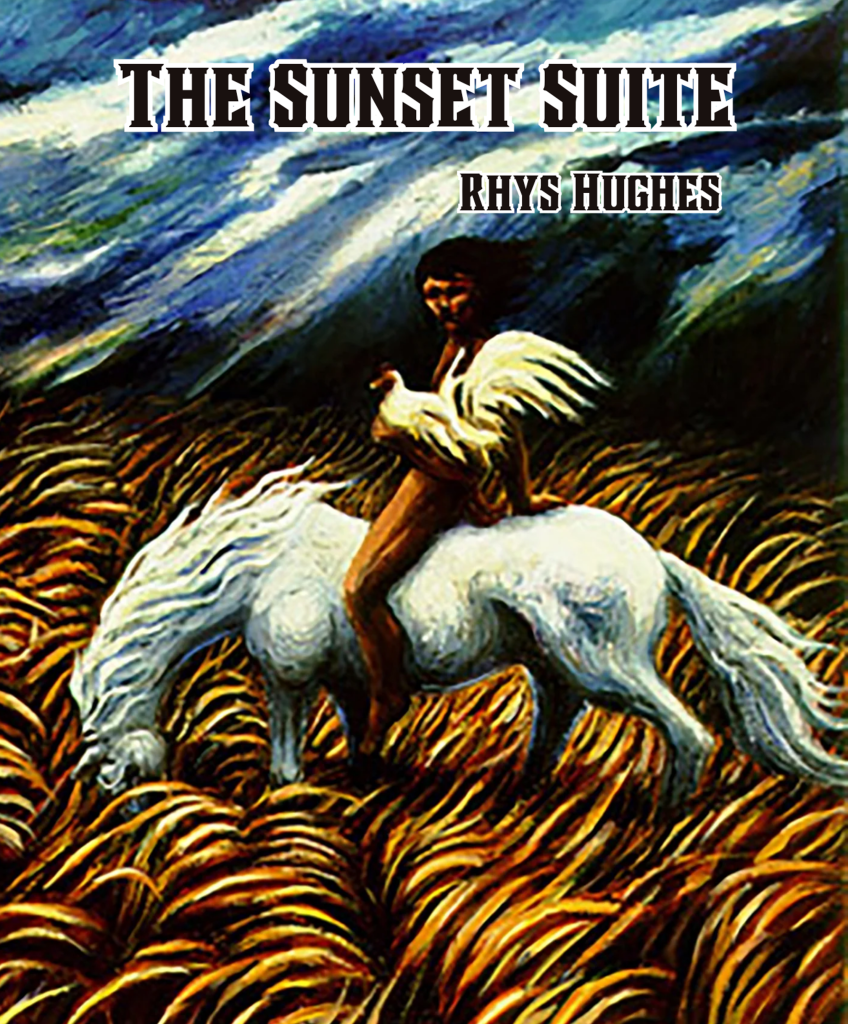
Perhaps — that’s the wrong way to start a review or any article— but given that this is a book that offers immeasurable possibilities, like sunsets or stars, one could still start with a ‘perhaps’… You might start with another word of course!

Perhaps, Rhys Hughes’ The Sunset Suite is a novel? Or, is it not? It seems to be a group of short, tall tales tied neatly into coffee lore, coming closest structurally to The Arabian Nights — stories told by the Scheherazade, originating around Middle Ages, much after coffee was discovered in Ethiopia by a goatherd in 800 CE.  The book departs in various shades from the One Thousand and One Nights, even though magic creeps in every now and then.

Hughes also seems to have a fascination for coffee lores for he redid The Rubaiyat of Omar Khayyam (1048-1131), translated from Persian by Edward Fitzgerald, substituting the wine with coffee a year ago. And here you have two men in the Wild West, telling tall tales, inspired by 26 mugs of coffee.

In The Empire Podcast by William Dalrymple and Anita Anand, there are a couple of episodes on coffee. Coffee houses sprouted around the fifteenth century in the Middle East and flourished during the Ottoman Empire, spreading over time to Europe, and even to America… if we are to believe Hughes! In those times, soldiers, among others, gathered in coffee houses, much to the dismay of kings. The warriors started turning to tall tales, philosophy and gossip instead of training all the time. The rulers were unhappy at the turn of events. Germany went so far as to ban coffee. An article on food history tells us: “One of the most curious of these events happened in Prussia, a precursor to modern-day Germany, where it’s leader Frederick the Great banned coffee by decree in 1777. And he did it for a reason that is almost baffling to modern notions of health and what’s good for society: He wanted people to drink more beer.” In the podcast, they do tell us Germany produced beer. In those days, coffee was seen as a suspicious drink, an aphrodisiac with magical qualities. It is these magical qualities that are invoked in The Sunset Suite.

Brand and Thorn are two coffee drinkers under the stars, sitting over a bubbling pot — and each cup from the pot has a tale in it, professes the author. That the tales are part of a dreamscape of darker hues verging on the absurd, bringing out the strangeness of the illusion we call life and its endless possibilities, comes as a surprise.

People turn into corn cobs, biscuits, musical notes, sombreros and are resurrected in paintings of nightmares at the end, tying the characters loosely into a frame. Phoenixes swim underwater and horses turn into boats and ‘a hill of beans’ becomes a ‘mountain of beans’.  The transformations seem to be reminiscent of Kafka’s Metamorphosis (1915) or Pinter’s The Room (1957) … but we are left wondering, are they?

The settings are often realistic at the start but head for the absurd as they end. Each story has a punch and leaves the reader open mouthed in amazement. They are imaginative, clever — sometimes playing on words — like the story of a genie who was told by a robber to make money ‘no object’ — a turn of a phrase which should mean that money is so plentiful that anything is affordable. But the genie, trapped in time and traveling over centuries, misunderstands the grave robber. He makes money into a literal ‘no object’— ‘abstractions, vague colours, mental scents and other intangible things’.

Hughes expands the literary world to a frog, a dog and even an armadillo who are yet to publish their books. This seems almost like an inversion of Luigi Pirandello’s play Six Characters in Search of an author (1921), where the characters left incomplete by a deceased author are looking for a resolution. Hughes’ reader, who talks of these authors from the animal kingdom, waits patiently for the books to turn up. In another story, evocative of the same play by Pirandello, the characters from his earlier tales are trapped in a painting and talk to the artist, ‘the keeper of Lore’, who paints his own nightmares peopled by the creations of Hughes. One of the last narratives, this one ties the stories into a loosely structured unit.

“I am Grampsylvania. That wasn’t my original name, but it’s my name for the foreseeable future. He changed me, you see, from a man into a gigantic but sapient corncob pipe. I don’t mind.”

“And he changed me into a biscuit,” said another voice. “I was just George Lewis once but now I’m The Biscuit Kid.”

A third voice added, “Turned me into a hat, a sombrero. I was Max Grizzly originally. Not that I dislike being a hat.”

“Wonder what he’ll turn you into?” they said to Henry [the artist inside the painting].

“I don’t want to change.”

“Well, you don’t have a say in the matter.”

The idea of the writer as the ultimate creator stretches through tall tales to experimental forms. ‘The Biscuit Kid’ is a one-and-a-half-page story written in one sentence — is it an attempt at what is known as the stream of consciousness technique (as in James Joyce’s Ulysees, 1918) or just a quirky experiment? A strange tale about a man turning into a biscuit in a sulphurous pond with tea dunked into it with an allusion to the Boston Tea Party has the victim floating in infinite circles … is it a comment on history repeating itself? The narrative of ‘Reintarnation Smith’ maps the history of the world rather randomly through the many reincarnations of the protagonist, from a palaeolithic shaman (were there shamans in that time frame?) to a Napoleonic soldier and a First World War trooper to an intelligent tree in a world where humanity has become extinct! The alternatives offered and suggested are mind boggling…

Each story sees itself as a possibility expressed in a light gripping vein, characteristic of the author, who has ostensibly been seen as a cult writer… though I am not sure what that term means or how Hughes, who has authored more than fifty books and writes up storms of stories and poems, feels about it — Let’s ask him. We start with the most pressing question —

This is on something that has me perplexed after reading Sunset Suite. How do you think a frog, a dog or an armadillo would hold a pen? Can we read frog/ dog/ armadillo — or would one need to download a special app from Google to read their books? Or is it better to have a frogman/ dogman/ armadilloman translate these? Please enlighten us.

Armadillo: Image from Public Domain

I hadn’t really thought about it until you asked the question. They would have to use telekinesis to hold a pen. The power of their minds. Maybe they have bigger minds than we think. Having said that, I don’t know why we always assume that if you have a bigger mind, you will be able to move physical objects just by thinking. When I was young, I often tested my own telekinetic powers. They never worked, of course. Except for once, when I made a cardboard box cover a daisy during a storm. I was staring out the window and willing the box to fall on the daisy and protect it from the wind, and that is what actually happened! All of a sudden, the box rose in the air and came down over the flower. Certainly it was the wind that did the trick, rather than my mental powers, but at the time I wondered if perhaps I had found the secret of telekinesis. Frogs, dogs and armadillos would write books using telekinesis. The real question is how much we would understand of what they had written. I don’t suppose we have much in common with frogs or armadillos. The dog’s books might be more accessible. I guess most of the descriptive writing in a dog’s novel would be smell-based because that’s how dogs map the world. But while reading a dog’s novel, should we dog-ear the pages to keep our places? Or human-ear them?

That’s an astute observation… Maybe we can dino-ear them! Did all dinosaurs have ears…? Let’s leave that discussion for another time. Next, I need to know what is a cult writer? Are you one? Please explain.

I don’t really know, to be honest, and I’m not sure if I am one or not. Many years ago, I was told that I was one. I think it’s another way of saying, “Your books aren’t very popular,” but softening that blow by implying that, “At least some people read and enjoy them.” I embraced the definition for want of any better label. We do like labels, that’s the problem. When I write, I write just for myself. Not quite. I do try to write in a similar mode to the writers I most enjoy, and they have audiences. If they didn’t, I wouldn’t know about them. I adore the books of Italo Calvino [1923-1985], but I don’t know many other readers who read him. Does that make him a cult writer? I don’t think so. I think it’s just more likely that I am a little isolated and simply don’t know the readers who do read that kind of fiction. And yet I am in contact with some people on the internet who seem to share my taste in fiction. In fact, they give me recommendations of authors I’d never heard of, who turn out to be wonderfully in tune with my taste. Apparently, if you are a writer who is more loved by other writers than by readers who don’t write, you are a writer’s writer, and that’s a form of cult writer. Last year, I read the nine novels of the almost forgotten Henry Green [1905-1973], who was described as a writer’s writer’s writer, in other words a cult writer cubed. I suppose that to be a cult writer is simply a stage for some writers as they work their way up to greater popularity. It’s probably possible for writers who were once hugely popular but who are no longer appreciated by a sufficiently wide readership to turn into cult writers on the way down.

Why did you not write of a squonk in this book since it is your favourite fantasy animal? Will you be writing on a squonk soon?
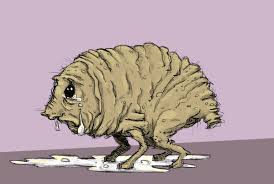
A squonk: A mythical creature in American Folklore. Image from Public Domain.

There are no squonks in The Sunset Suite because I have written too much about them elsewhere. I don’t want to oversquonk myself. I first learned about squonks from Jorge Luis Borges’ Book of Imaginary Beings [1957] I think. And then I noticed references to the creature in all sorts of places. Years ago, I wrote a short story called ‘The Squonk Laughed’ because squonks are the saddest of all entities. I wanted to write about one that cheers up. And one of my longest ever poems is about a squonk ragtime pianist who works in a Wild West saloon, ‘Honky Tonk Squonk’. The very word is funny. It sounds round but also squelchy, rather like a cream-filled pastry. There is an excellent song by the band Genesis about squonks called simply ‘Squonk’ and it’s a song that will tell you absolutely everything you need to know about squonks if you listen carefully to the lyrics. In my book, it seemed to me that it was time to show some restraint when it came to squonks. You can have too much of a good, weepy thing.

How long did this book take to germinate into a full blown one and how did it come about?

Not long at all. Some of my projects proceed very slowly, they take years or even decades to be completed. But most of my projects are done fast. This is because if I take too much time over them, I worry that I will lose the thread or threads of the plot or plots, or that the mood and atmosphere of the work will change and be lost. That’s not always a disadvantage. I might begin work on a book thinking it is going in a certain direction. Then I put the project aside for a long time. When I return to it, I have often forgotten the direction I had intended to take the book. So I make it go in a different direction, and it seems to me that sometimes this other direction is a superior journey to the original intended direction. Who knows? But that has no relevance to The Sunset Suite because I wrote it in just a few weeks. I can’t recall exactly how long it took, but it wasn’t a drawn-out process. It happened to be one of those projects that flowed easily. Many do, and I am always grateful to them. It is almost as if I am not doing the work but simply acting as a channel for a set of stories that exist in some cosmic cloud. This is probably a fanciful delusion, but it is one that many writers have had over many centuries. We are conduits as well as creators. We are pipelines as well as pipers.

Have you actually been to the Wild West? Why have you set your book against this backdrop?

I have never been to the Wild West. I have never even been to the West. Even the most easterly part of the American continent is west to me. The furthest west I have been is Ireland. Yet I love Westerns, especially so-called ‘weird’ Westerns. Having said that, I have been to Almeria in Spain, the only desert in Europe, where many ‘Spaghetti Westerns’ were filmed. It looks the way I imagine Mexico or Arizona might look, but I can’t know that for sure because I haven’t been there. Maybe one day I will. I have written quite a few Westerns, all of them weird and unusual. The first was a novella called The Gargantuan Legion. I had the idea for that when I was very young. Much later I wrote a novel called The Honeymoon Gorillas [2018], and then a collection of stories, poems and short plays called Weirdly Out West [2021]. Shortly after finishing The Sunset Suite, I wrote a Western novel
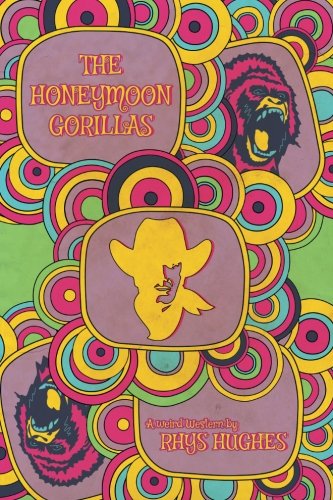
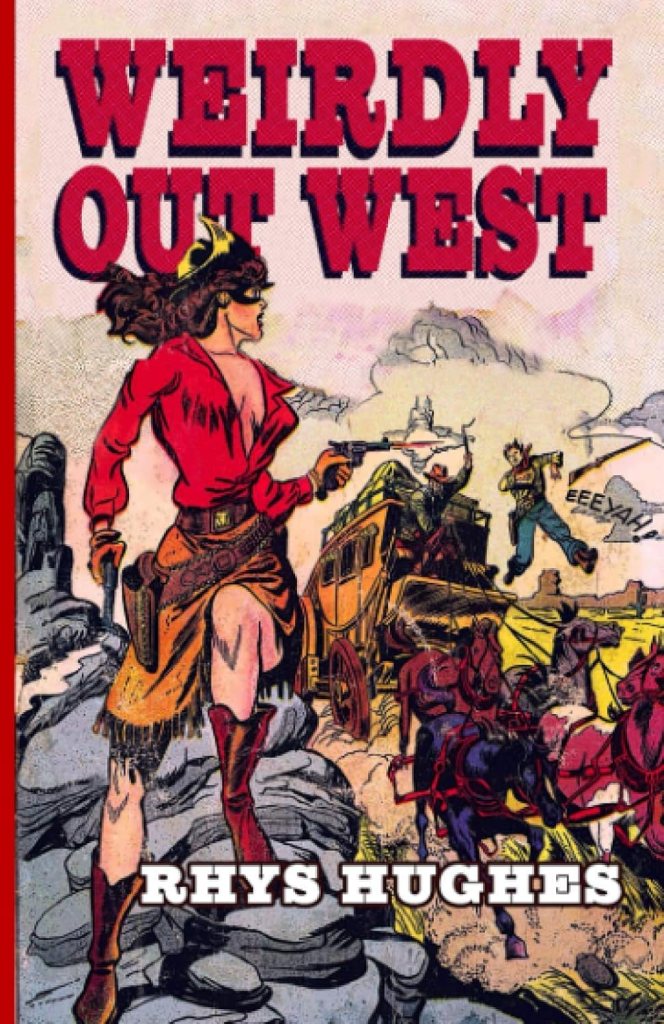
called Growl at the Moon that has been accepted for publication. I am currently working on a novel titled The Boomerang Gang. I find writing weird Westerns to be great fun, relaxing too, yet they apply a strong stimulus to my imagination. Next year I hope to write a novel called Fists of Fleece, which will combine Welsh folklore with Wild West tall tales, creating an especially offbeat hybrid.

You have strange names given to characters peopling The Sunset Suite. Why? Please elaborate.

I enjoy giving my characters strange names. I also think it’s safer. Suppose I have a character in a story named Tim Jones and something absurdly odd happens to him. There might be a real Tim Jones out there in the world who will start thinking that I am referring to him and maybe even mocking him. It is better to give the character a name that surely no real person will ever have. Argosy Elbows, for example, or Crawly Custard. Readers can regard these as nicknames, if they wish. I often make lists of offbeat names for characters that I will use in future stories. Some of these names have been waiting decades to be used. Other names I invent on the spur of the moment while writing. Invention on the spur of the moment is an appropriate thing to do when writing a Western. But in fact the names in The Sunset Suite are still fairly conventional. Jake Bones, Shorty Potter, Killy the Bid, Grampsylvania, Max Grizzly, Cowboy Bunions, Dan Flyblown, Lanky Ranter. It’s not beyond the bounds of plausibility that real people out there do have such names.

Why do you keep obsessing over coffee? Please explain.

I hope it’s not quite an obsession. I like coffee, that’s all. I guess it’s my favourite drink. No offence to water, tea or beer! I am in the process of cutting down on my coffee consumption. I have been reducing my intake for the past twenty years, but it’s still not at zero. I am reducing it very slowly indeed, that’s why. Mind you, the reason why there is so much coffee in The Sunset Suite is simply because cowboy films always show the characters drinking coffee around a campfire. They surely told stories to each other at night while drinking the coffee. It occurred to me that I could use this as a frame for my book. A sequence of strange stories set in the Wild West linked together by the fact that each tale was generated by a cup of coffee. At the end of the book, the two tale tellers have drunk too much coffee. The book is a warning that will be heeded too late. But we are all adults. We don’t really need to be warned about such perils as coffee consumption.

Since classification is an important aspect of human existence, how would you classify your book?

It’s a ‘Weird Western’. That’s what I have been calling it. This is a real sub-genre, and I think my book can be labelled as such without any objections. I might also call it a comedy, a picaresque or portmanteau farce, a speculative whimsy. But it remains a Western, that’s undeniable. It makes substantial use of parody, pastiche, paradox and probably other things beginning with the letter ‘p’. At the same time, I don’t mind if the book is classified just as a fantasy or even only as fiction.

What have been the influences on this book? On your writing?

The main influences on this particular book of mine were other weird Westerns by writers I admire, in particular The Hawkline Monster [1974] by Richard Brautigan, which was marketed as a Gothic Western. Brautigan was especially good at writing short but thoughtful passages that are often at tangents to each other but nonetheless do combine with each other satisfyingly. Another influence was probably a collection of stories I read when I was young, The Illustrated Man [1951] by Ray Bradbury, in which a sleeping man’s tattoos come alive one at a time and tell stories as they do so. But in my book, it is the cups of coffee that come alive in a fictional sense. I also think that the pulp Western author Max Brand was an influence on my book, especially his stranger works, such as The Untamed [1918], which seem to blend echoes of ancient mythology with the more conventional cowboy motifs and clichés.

Would you call these stories humorous? They do linger with absurdity and a certain cheekiness.

I like to think they are humorous. I like to think that The Sunset Suite is a comedy among other things. Most of my fiction has some comedic elements, even if the general tone of the story is serious. Real life is a mishmash of tragedy, comedy, indifference, absurdity, beauty, and who knows what else, so it’s only right and proper for fiction to be such a mishmash too. Obviously, in a short story there’s not much room in which to throw everything, so one has to be more careful when it comes to constructing the piece. The mode of the book, which features a framing device in which is found a set of individual tales that echo each other’s themes, is one I especially enjoy using. I am planning other books that follow this structure.

What books are you whipping up now?

I always work on several projects at the same time. I am currently working on two novels. One of them is a satirical thriller called Average Assassins, and the other is another weird Western called The Boomerang Gang, which is about an Australian immigrant to the Wild West in the late 19th Century and it features an experimental aeroplane with boomerangs for wings. I am also working on a large project called Dabbler in Drabbles, which consists of four volumes of drabbles. A drabble, as I’m sure you know, is a flash fiction exactly 100 words in length. There will be one thousand drabbles in total when the project is finished. The first three volumes have already been published and I am pushing ahead with the fourth. Yet another project I’m working on is a collection of short meditations called City Life. These meditations are supposedly written by the cities themselves and there will be sixty of them in total. I am working on other projects too, but I won’t mention those yet.

Thank you Rhys for your fantastic writing and your time.

(This interview has been conducted through emails and the review written by Mitali Chakravarty.)

Click here to read an excerpt from The Sunset Suite

Image from Public Domain.

PLEASE NOTE: ARTICLES CAN ONLY BE REPRODUCED IN OTHER SITES WITH DUE ACKNOWLEDGEMENT TO BORDERLESS JOURNAL. 

Click here to access the Borderless anthology, Monalisa No Longer Smiles

Click here to access Monalisa No Longer Smiles on Kindle Amazon Internation

Categories
Review

Is Time Future Contained in Time Past?

A Book Review by Rakhi Dalal

Title: A Handful of Sesame

Author: Shrinivas Vaidya

Translator: Maithreyi Karnoor

Publisher: Gibbon Moon Books

Originally written and published in Kannada as Halla Bantu Halla by Shrinivas Vaidya, this book won the Karnataka Sahitya Academy Award in 2004 and Central Sahitya Akademi Award in 2008. The author of many critically acclaimed literary collections, Vaidya is also the recipient of Karnataka Rajyotsava Award.

The English translation A Handful of Sesame by Maithreyi Karnoor was shortlisted for the Lucien Stryk Asian Translation Prize. Karnoor is the recipient of the Charles Wallace India Trust Fellowship for creative writing and translation. She has also won the Kuvempu Bhasha Bharati prize for translation.

Written with the backdrop of India’s struggle for independence, spanning a time period of almost a hundred years from the mutiny of 1857 to Mahatma Gandhi’s assassination, this book chronicles the life of a Hindu Brahmin family over a century in a town called Navalgund in Karnataka. It is the narrative of a family, whose seed originated in Kanpur in Northern India but which took roots in the small Southern Indian town of Navalgund during a period of political upheaval and then made it a home for generations to come. This story, as Tabish Khair notes in the foreword, thus also becomes a story of internal migration, recording the adoption and assimilation of cultural and religious practices in everyday living. More than that, it offers us a window into the socio-cultural mores of a family affected and shaped by changing times. 

Vasudevaachar is the son of Kamalanabh-panth of Kanpur who marries the daughter of a Brahmin from Navalgund and stays back during the chaotic times brought about after the suppression of 1857 mutiny. Like his father, he practiced medicine and takes on the responsibility of the entire household after Kamalanabh’s demise. The narrative deals with a detailed account of the struggles of running of the household with regular events like birth, death, marriages and so on in the big joint family with Vasudevaachar at the centre even as various occurrences like natural calamities, fight for freedom, world war and political turmoil keep altering the contours of their daily life.

Vaidya essentially creates a Brahmin household, suffusing the narrative with a rich language, idioms and slangs and vivid description of rituals, food and daily practices which are rendered in a delightful manner to the non-native reader through a fine translation by Maithreyi Karnoor. It palpitates with both rhyme and rhythm, of language and everydayness, concocting a gripping tale that captivates imagination.

The major characters that inhabit the world of A Handful of Sesame are diverse and non uni-dimensional. They evolve with the progressing narrative, forging the complex web of relationships within a large family that change as the time moves. Vaidya’s skilful portrayal brings forth the nuances in their interactions and connections which tie them as a family.  

Vasanna or Vasudevaachar, the head of the family, a religious and orthodox Brahmin is shown to be burdened by perpetual looming financial burdens of the family. Tulsakka, his wife, is a quiet yet determined woman. Ambakka, sister of Vasanna, is a shaven widow who lives with them. Impatient and irritable, she however assumes bigger role in caring for the newborns of the family. Venkanna, younger brother of Vasanna and a widower too, instead of marrying again keeps a relationship with a Muslim woman. A firm and resolute man, he shares the financial burden of his brother. Rukkuma, an orphan adopted by Panth family and belonging to a lower caste, lives as a house-help while Narayana, another orphan adopted by the family and son of a distant relative lives with them too.

As the world around them keeps changing, family dynamics change too. When English schools open up in Dharwad, the young sons of the family are sent for an education there. With opening of newer avenues for livelihood, the next generation keeps moving onto newer and bigger places, adopting new ways of life but remaining connected with their roots.  

Struggle for freedom, which remains a constant in the background, is employed to portray the rising collective consciousness across the nation which influenced the lives of ordinary people. We are offered glimpses into how the events like Salt Satyagraha or Congress meetings had an effect on the routine life of people of a small town like Navalgund.  The author also offers a peek into the larger social construct surrounding the Panth family, which though fragmented by caste and religion, lived in harmony with each other. An orthodox Brahmin like Vasanna goes to a dargah to offer sugar to ward off evil eye. In the present context, this might appear contradictory to the very definition of an orthodox, but it simply means that a rigidness in following one’s own rituals did not translate to a dislike of others’ and the minds were more open to accepting the customs believed to bring a greater good. 

Such times did exist. How wonderful it would be able to have access to more such works written in regional languages — works which open up bridges to the past of distant lands, connecting to our present, making the present improbable possible and bridging the divide; works which bring to us the account of lived lives of a people separated only by language. Perhaps this is why it becomes important that these works be made available to varied readers through translation.   

For an English reader, Maithreyi Karnoor’s perceptive translation presents a view of the ‘most underrepresented region in Kannada literature’, thereby offering us not only the linguistic nuances neglected by mainstream Kannada but also a compassionate insight into the regional life which is critical for a better understanding of the period.

Rakhi Dalal is an educator by profession. When not working, she can usually be found reading books or writing about reading them. She writes at https://rakhidalal.blogspot.com/ .

.

PLEASE NOTE: ARTICLES CAN ONLY BE REPRODUCED IN OTHER SITES WITH DUE ACKNOWLEDGEMENT TO BORDERLESS JOURNAL. 

Click here to access the first Borderless anthology, Monalisa No Longer Smiles

Categories
Excerpt

A Handful of Sesame

Title: A Handful of Sesame

Author: Shrinivas Vaidya

Translator: Maithreyi Karnoor

Publisher: Gibbon Moon Books

Although Navalgund had been roused from its slumber by the Mainavati elopement episode, in a few days after the eloping couple returned, going by the saying, ‘she becomes of this earth when she starts lighting the hearth’ the scandal lost steam and the town went back to sleep again.

The people returned to their busy routines of asking each other in the mornings if they were up, and turning their faces to the skies in the afternoon and saying “What do you know? There’s not a hint of rain yet.” They went back to sitting on the knoll near the Lalgade temple until darkness stepped in and until the concluding strains of the raag Bhairavi  of the Magdum’s band rehearsal became thin air, they discussed such pressing matters as the ghost in the tamarind tree beside the Sankawwa pond, or the yard-long wheat-hued cobra that had slithered into the rock cluster before the Taluk office, or the Halladmatha’s Sire’s persistent cough, or Mamlatdar’s minor wife Mandakini, or the plague mice falling dead in Hubballi, or Bal Gangadhar Tilak. After ruminating over these never-ending topics, they would hasten home to eat their evening meals and shut their doors upon the darkness outside and turn in before the wicks in the kerosene lamps in their respective homes went off with a phtt.  The womenfolk kept themselves busy with hearth, childbirth, and a little mirth of water’s worth on their way to the pond. Once in a while, they created their own entertainment with gossip and slander and quarrels – scold this one, taunt that one or mock another one. 

Navalgund has grown considerably in the thirty or forty years since the mutiny. Fleeing the Company’s oppression, many families from Nargund are now settled in Navalgund. With the increase in population, more merchants have set up shops. Earlier, Adoni’s was the only trading family in all of Navalgund. Now, with the addition of Mhantshetty, Mhankali, and Yirapakshimath, there are four merchant families. The Queen’s government had laid down with great care gravel roads because of which trade and businesses are growing. Open-topped and covered bullock carts and even horse-drawn carts are now plying from town to town on these roads. The municipality that has been there for a while has now started a school, a library and — can you believe it — even an English hospital! But no one goes to that hospital because it is rumoured that they put the flesh of chickens, sheep, and donkeys in their medicines. Hence, Vasudevaachar’s patients are constantly growing in number. Bullock carts crowd at the Panths’ door every morning. Moaning, groaning and coughing patients covered in woollen blankets wait in their veranda. Vasudevaachar walks among them bare-chested, stroking his sacred thread with both hands and advising the patients on their medication, treatment and diet, offering soothing words of courage or stern reprimands as the occasion demanded.

“Ningawwa, if give up garlic chutney for two days the sky won’t fall on your head”

“Krishtya, I’ll give you a Shankhvati. Powder it, mix it with lemon juice and lick it. Your stomach will be alright. You won’t die if you cut down on your food for a couple of days”

“Bharmya, I’m giving you this bottle of Balantsyrup. Give it to your wife and don’t drink it yourself, you whoreson…”

“Basangauda, you have the sugar disease. Fire two of your farmhands and do their work yourself. You must also eat less…”

“Subbi, I told you that feeding your daughter-in-law the red figs of the Banyan tree will beget her children. But I don’t remember promising they would be male children!”

“Do not eat or drink undrinkable and uneatable things, you sons of unwed mothers!”

“Goudra, your lady is showing signs of consumption. See if her spittle is red-tinted. It’s a terribly infectious disease. Stay away for a few days – it’s good for you and also for her.”

“It’s not just medicines that will cure you, Shambhu. You must also have faith in god. Here, repeat after me, medicine is the waters of the Ganges, the doctor is a manifestation of god’. Now, once more…”

Such medical jargon could be heard in the halls of the Panth house every day. 

From early morning to the ripening afternoon, Vasudevaachar sits in the outer hall attending to his patients. He then heads to the backyard, draws seven or eight pots of water from the well and pours it over himself completing his bath before heading to the altar and sitting down for a two-hour long, uninterrupted prayers. Sometimes the municipality’s three o’clock bell would have rung before his prayers are complete. Then, after a meal and a short siesta, with only a thin shawl covering his bare chest, he heads to the Lalgade Hanamappa temple for prayers in the late afternoon. Sometimes, if there is a sermon or sacred storyrecitation on, he sits down to listen to it. If not, he sits a while on the stone bench that’s open to the skies outside and lets himself afloat in Magdum’s melodies before slowly heading back home.

On one such rippleless evening, Tulsakka and Vasudevaachar sat chatting on the porch outside the house. The children who had gone out to play hadn’t returned yet and Ambakka was at Antambhatta’s corner house, when suddenly Rukuma rushed from the backyard to the main-door looking excited and coughed a couple of times to draw Tulsakka’s attention. She then called out to her sotto voce, “Tulsakka… tssst… come here… come quickly…” Sensing her excitement and strange expression, Tulsakka left Vasudevaachar behind and walked over looking quizzically at Rukuma who began gushing and flailing her arms animatedly.

“She’s here!” she said.

“Who ay Rukuma? Who is here?” Tulsakka asked in her normal calm voice.

“She… she!” Rukuma insisted.

“She who?” asked Tulsakka as calm as before.

Rukuma came close to Tulsakka and said with wide eyes, “She! The one from Annigeri”

Taken aback by her words, “What’s this new drama now” Tulsakka exclaimed and followed her to the backyard.

Covering the child in her lap with the loose end of her sari, she sat by the stack of cotton twigs in the backyard, her poignant face both nervous and hopeful. As soon as Tulsakka and Rukuma came close, she stood up and held the child out and her eyes filled with tears.

“Please don’t be angry, my lady… it’s three days since he’s burning with a fever. Even the master of my home hasn’t visited in a while. Do what it takes but please save my child. I heard the master of your home is a great doctor with healing hands. So I came running here. Please don’t tell my master that I was here… he will be very angry. This is my only son please save him for me…” she implored them.

Tulsakka hesitated for a moment and then said, “Come, sit here…” and showed her to the holy basil pedestal. The Annigeri woman sat down where she was asked to. Then spotting someone else, she suddenly covered her face with her sari, handed the baby to Rukuma and stood back in fright. Even Rukuma and Tulsakka were a little scared as they turned around and saw that it was Vasudevaachar. He fixed a dark gaze upon them for a moment before looking at Rukuma and saying “Bring the child in, I’ll take a look.” He walked back to his desk in the outer hall and Rukuma followed with the baby.

The Annigeri baby’s fever was owing to a knot in the stomach. Vasudevaachar gave a handful of small sachets to Rukuma and said, “Tell her to mix this in thin, watered-down milk to make a paste and feed it to the baby four times a day. Children often get fevers. Tell her not to worry. The baby will be well in a couple of hours. Open one of the sachets and give it to the baby yourself so she can learn how it’s done. Also, tell the mother to drink boiled water and to feed the baby a little less for the next four days.” He sent Rukuma away and went back to sit on the porch outside.

As Vasudevaachar’s instructions were being carried out, Rukuma and Tulsakka had formed an easy friendship with the Annigeri woman as only women could with one another. ‘Where are you from? How many years since you came to Annigeri? What did you say your name was? Mhaashaabi? What does it mean? Where did you meet Venkanna? Is this your only child?’ they were asking her. ‘How many grandchildren? I hear you haven’t seen your own lands in Annigeri… why don’t you visit once? If the baby gets well soon, I will go to the annual fairat the mausoleumof the Yamanoor saint…’ she was saying to them when suddenly Ambakka walked in through the backyard door straightening the parting in her sari. Upon finding out who the stranger was, Ambakka sprung back as if stung by a scorpion. “Ayya may her pyre be lit!” she started shrieking, “That thing may have no sense, but what about you? You have let it in like this! Hey, you! Get up… you have polluted the holy basil with your touch… pick your child up…” Rukuma and Tulsakka were saddened to see the Annigeri woman’s plight. Tulsakka spoke with her usual calm and dignified voice.

“Ambakka, please be quiet. Is this how you treat a guest?” At this Ambakka suddenly came into her wild avatar and started yelling in a shrill, sarcastic tone.

“Ayya… who’s stopping you, my lady? It’s your home… do what you like in it. Who am I to tell you anything? Venkanna mistress is your sister-in-law after all, isn’t she? She’s brought her son home moreover… it’s the procession of the family’s heir. Get the cradle out. Welcome him in, bestow gifts into her lap, give her a new sari– you haven’t given her one on her wedding, have you? Who am I to stop you…?”

“I don’t understand what she’s saying” exclaimed Mhaashaabi alarmed by the scene Ambakka was making. She said a hasty “I’ll take your leave, madam” to Tulsakka and left quickly.

The next day, after the atmosphere had cleared a bit, Rukuma went up to Tulsakka and said in a low voice, “Did you notice the baby’s nose, Tulsakka? Wasn’t it exactly like Venkanna’s?” and smiled knowingly.

A few days since then, Venkanna cornered Ambakka in the backyard. “Ambi, this is the last time. If you stick your nose in my affairs again, I’ll erase all traces of you. Be warned” he said menacingly.

ABOUT THE BOOK

A sweeping historical novel. Shortlisted for the Lucien Stryk Asian Translation Prize, 2019. The original work Halla Bantu Halla won the Central Sahitya Akademi Award.

It is the year 1857. A great uprising — what would come to be known as the first war of Indian independence — has broken out. Two brothers, emissaries of a northern king, on a mission to garner the support of the southern rulers, wander lost and hungry in a forest not far from their destination. They are captured and one of them is hung by the British. Caught in the rough and tumble of the mutiny, the other brother settles down in a place that was never meant to be more than a temporary refuge. He spends his life far away from home among people who do not speak his language. The novel spans the story of three generations of his family living under the burden of inherited nostalgia, a story that unfolds with all its flying fancies and stumbling follies on the threshold between tradition and modernity. Set against the backdrop of the freedom movement, the novel explores the lives of the people of the Dharwad region of Karnataka; their acts of faith and the realpolitik of ritual. Masterfully and sensitively translated from the Kannada, A Handful of Sesame is funny, tragic, ironic, satirical, lyrical and deeply allegorical of a young, modern nation. 

ABOUT THE AUTHOR

Shrinivas Vaidya was born in the Dharwad district of Karnataka. He conceived of the plot of Halla Bantu Halla — inspired in part by the history of his own family — a long time ago, but it wasn’t until he retired from his four-decade long career in banking that he managed to sit down and write it. The novel won the Sahitya Akademi award – the highest honour by India’s National Academy of Letters. He has written several collections of short fiction since then.  

ABOUT THE TRANSLATOR

Maithreyi Karnoor is the recipient of the Charles Wallace India Trust Fellowship for creative writing and translation at Literature Across Frontiers, University of Wales Trinity Saint David. She has won the Kuvempu Bhasha Bharati prize for translation and has been shortlisted for the Lucien Stryk Asian Translation Prize and is a two-time finalist of the Montreal International Poetry Prize. Sylvia: Distant Avuncular Ends is her debut novel.

PLEASE NOTE: ARTICLES CAN ONLY BE REPRODUCED IN OTHER SITES WITH DUE ACKNOWLEDGEMENT TO BORDERLESS JOURNAL

Categories
Excerpt

When I Discovered Laziness…

Title: Comfy Rascals: Short Fictions

Author: Rhys Hughes

Publisher: Raphus Press, Gibbon Moon Books

DON’T SHOOT THE MESSENGER

He who was King in the land of Booshooba ordered his most trusted messenger to deliver a sealed envelope to another ruler, the King of far distant Zazkhaban. The messenger set off on the dangerous journey and was never tempted to open the envelope and read the message within. He knew he would face terrible dangers on the path, diversions, bandits, doom pits. One diversion might lead him into a dimension of woe. Another might not. As for bandits, there were a great many of those. For countless ages they had been terrorising the lonely passes of the mountain ranges that lie between Booshooba and Zazkhaban. The messenger had to be agile and astute to avoid their clubs, spears and nets. He crawled past their sentries and soon was up and hastening again. He never tired, this most trusted messenger. Little wonder that the King of Booshooba had favoured him!

But the doom pits are worse than the bandits. No one who has fallen into them has returned, nor have even their screams risen out of those grim holes in the gruesome ground. Will the messenger be fit enough and light enough to leap them all in mighty bounds? They fall still, those unfortunates who fell into them, and now they are loose bones tumbling like jugglers’ clubs down and down through phosphorescent infinity.

But the messenger is safe beyond them. After months of hard travelling, he finally reaches the palace of the King of Zazkhaban, who takes the envelope from him and opens it. The King reads the letter with a frown that grows deeper. Finally he reaches for a loaded musket and points it at the messenger‟s head.

“Clearly you have received some bad news,” the messenger says, “but I am not responsible for what has happened. Don’t shoot the messenger! For I have simply completed my assigned task.”

Silently, but with a stern expression, the King of Zazkhaban offers the letter to the messenger. It says simply, “My dear brother, I have one favour to ask of you. Please shoot the messenger who delivers this letter.” The king pulls the trigger of the musket. There is noise and smoke and the most trusted messenger slumps to the ground and his blood flows quickly.

BALDNESS

Baldness in men is not natural but a result of civilization. It probably comes from wearing tight hats or eating processed foods. In our original condition evolution would never choose baldness because the moonlight reflecting off the shiny scalp would give away our position to predators in the jungle. Men with thick heads of hair are less likely to be pounced on by tigers. They are more likely to be used as a paintbrush by gorillas, yes, but pounced on by tigers, no! And yet, maybe we need more light at night. Could it be that bald men are necessary? The reflections of the male heads of an entire tribe might provide sufficient illumination for late sessions of applied mathematics to take place. Or for the continuance of guitar lessons.

WHEN I DISCOVERED LAZINESS

When I was young I was full of energy. I read in a book that if every man, woman and child in China jumped up and down at the same time, a tidal wave would be created by the vibrations that would engulf the United States of America. I remember thinking: so why don‟t they do that? If it’s possible, why not make the attempt? Later, I read in a different book that every man, woman and child could fit onto the Isle of Wight standing up straight like skittles, tightly packed together, and that the island would sink. Once again I asked myself: so why don’t we do it?

Even later I was told by a teacher at my school that if every man, woman and child in the world stood on the equator facing east in a long line and took one step forwards, pushing back with their foot, the globe would stop spinning. So why aren’t we lining up and stepping forward, I demanded to know? Then the answer occurred to me. Laziness! That was why there were no human-generated tidal waves, sinking islands or planetary brakes. It was because people were too lazy to make them happen. That was the precise moment when I discovered laziness and what it really meant and its importance to the daily workings and evolving history of the human race.

IDENTITY

Our identities can never survive death because they barely even exist while we are alive. They are not constants but variables. Our identities are constantly changing but so gradually that we do not perceive the changes and thus assume we are a single entity all our lives. In fact we are so far removed from the way we were, and the way we will be, that if our past or future selves were suddenly killed, we (the present “we‟) would feel nothing at all. And we do die sometime in the future without feeling a thing now, which would hardly be the case if all our selves through time were connected and merged into one unit. This is what I think and I thought it.

About the Book:

Many rascals are too tense to be comfortable. Real life rascals have much to worry about. But rascals in fiction can afford to relax a little in the waves of prose that surround them, gently swirling on the wit and wisdom, bobbing on the contrivance, floating on the syntax. It is nice to be a comfy rascal. The language and its ambiguity are the territory where Rhys produces his best in fiction. In the flash fiction format, the stories by Rhys at Comfy gets a full language ambiguity game, in the words of the superb author Brian Evenson: 

“Each of these stories is a shimmering whimsical fleck which not only satisfies in and of itself but, taken with its compatriots, builds an image of life and language that is pure play and discovery. Like Kafka’s parables, if Kafka’s sense of humour was less dark and had more puns.” 

About the Author: 

Rhys Hughes has been writing fiction from an early age. His first book was published in 1995 and since that time he has published fifty other books, nine hundred short stories and many articles and poems, and his work has been translated into ten languages. He graduated as an engineer but currently works as a tutor of mathematics. Having lived in Britain, Spain and Kenya, he is now planning to move to India. His poetry tends to be humorous light verse and offbeat lyrical fantasy, influenced mainly by Don Marquis, Ogden Nash, Edward Lear, Richard Brautigan, Ivor Cutler and Spike Milligan.

.

PLEASE NOTE: ARTICLES CAN ONLY BE REPRODUCED IN OTHER SITES WITH DUE ACKNOWLEDGEMENT TO BORDERLESS JOURNAL

Categories
Review

Books in Rebellion?

Book Review by Rakhi Dalal

Title: Comfy Rascals

Author: Rhys Hughes

Publishers: Raphus Press, Gibbon Moon Books

“The moon was a tomato in the sky, then it was an orange, then a grapefruit, then a metaphor, then it was exactly like a simile, then like some other comparison, then finally it was itself, the moon. The comfy rascals reclined on loungers on the beach and watched it change and pretended it was a weak sun they had tricked out of sunbeams…..”

Thus begins the title story of the collection, which with its brilliant wordplay, focuses on the imagination of things, on moon and Baudelaire, thus first transferring awareness to the realm of uncanny and then almost quietly turning it back to the real world. It is peculiar and subtle, the way it happens. A tale of palpable human helplessness in a cold and dark world as the comfy rascals first laugh and “then shiver at night in their own last desperate resort, an abandoned seaside town”.

Comfy Rascals is Rhys Hughes’ recent collection of experimental short fiction where the stories constantly shift/ permeate to the realm of fantasy from real world and vice-versa, blurring the binary categories of human/nonhuman and natural/material world. Hughes was born in Wales. His first book, Worming the Harpy, was published in 1995. Since that time he has published fifty other books, more than nine hundred short stories, and innumerable articles. He graduated as an engineer but now works as a tutor of mathematics.

Hughes, who sees himself as a comedic writer, uses fantasy and humour to explore unusual concepts which compel readers to re-visualise the accepted ideas of reality, challenging their understanding of the certainties this world offers and the possibilities it may, when seen in a manner unaccustomed to the mind. While some of the stories may unsettle –

“I have destroyed the world, but what of that? Light a candle in my memory and that will be more than enough.” (‘A Deep Breath’)

Some bring a vivid element of the fantastic, like —

It is so cold that the candle flame just froze solid and I was able to snap it off and put it in my pocket for later. When it thaws out I will use it as a hand warmer and then put it back on the wick. In fact it is so cold that the flames of the fire have frozen solid and can be snapped off and used to cut butter, if cutting butter is something you need to do.” (‘How Cold is It?’)

And some others just amuse by virtue of their humour/satire:

“One Socrates in the market square is not a heap of philosophers. What happens if we add another Socrates? Still, this is not a heap. It is two philosophers, that is all. Add another Socrates and keep adding them.” (‘Sorites Speculation’)

Hughes works with human anatomy, sometimes in tandem with non-human forms, and challenges the anthropocentric worldview where everything human has more value over others. The elements of grotesque that he thus makes use of, subvert the notions of ‘real world’ and ‘materiality’ while being playful. He also makes use of spaces inhabited by humans, like homes to question the extent of boundaries we willing create.

One important space that is difficult to overlook in this collection is author’s use of the concept of libraries (Four stories in all), especially in the wake of a tyrannical rule. He employs it to drive home the point that tyrannies succeed when people become subservient to the rule. We witness books being burned but not always.  

“Tyrants burn books, but sometimes the books fight back and vanquish the inferno.” (‘The Library’)

Science fiction and mythology are brought into play by Hughes. His stories swerve socio-political understanding and narratives to the realms of the uncanny, the grotesque and the fantastic while displaying a vibrant play on words, thereby alluring with unconventional reads and hence, unimagined revelations.

In the author’s own words –

“Many rascals are too tense to be comfortable. Real life rascals have much to worry about. But rascals in fiction can afford to relax a little in the waves of prose that surround them, gently swirling on the wit and wisdom, bobbing on the contrivance, floating on the syntax. It is nice to be a comfy rascal.”

Rakhi Dalal is an educator by profession. When not working, she can usually be found reading books or writing about reading them. She writes at https://rakhidalal.blogspot.com/ .

.

PLEASE NOTE: ARTICLES CAN ONLY BE REPRODUCED IN OTHER SITES WITH DUE ACKNOWLEDGEMENT TO BORDERLESS JOURNAL.