Categories
Tagore Translations

Happiness by Rabindranath

Shukh (Happiness) by Rabindranath Tagore was published in his collection called Chitra (Picture, 1895).
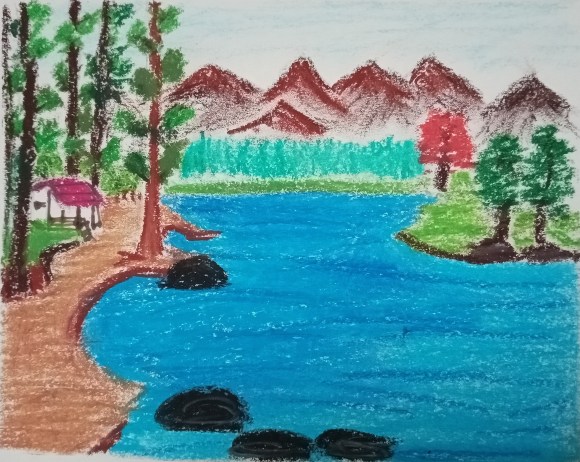
Painting by Sohana Manzoor
Today, it’s a cloudless day. Happy skies 
Smile like friends. The breeze flits, flies
Embracing the face, chest, eyes —
Like an invisible aanchol billows high
Only to descend on a sleeping deity.
Peacefully on Padma’s waves, the ferry
Sails swishing joy. Relaxed sandbanks
Lie sunbathing at a distance.
The high sloping sides are interrupted
By tall shady trees, a hidden hut.
A narrow, curved path from a distant village
Crosses the farms and nears the water’s edge
Like a thirsty tongue. Rural brides
Wash their clothes, chatter awhile,
Joke. Their loud sweet laughter
Mingle with the sounds of water
To waft to me. A fisherman, aged,
Sits on a bent boat, weaves a net
While sunning his back. A naked child
Laughs merrily while he dives
Again and again into the water. Patient,
Padma gazes like an indulgent parent.
From the ferry, I see two shores —
The clearest lucid blue expands galore.
Amidst a flood of light, exotic lines are seen
In the water, land, forests. On a warm breeze,
The ferry sails past shores with groves, sometimes,
Scent of mango buds waft, only at times,
Faint sounds of bird calls.

My mind
Is filled with peace — I feel
Happiness is simple. It spreads like
Flowers in bowers, like the smile
On the face of a child — expectant lips
Holding the nectar of a kiss,
Gaze silently forever laced
With artless innocence.
The sky is immersed and stilled
with the harmony of music in sync.
How will I sing in tune with those notes?
How will I sound? How will I compose
The lyrics in simple words to gift
To my beloved so that they bring
A smile to her eyes, her lips?
How will I help unfold this to my love?
How will I convey the joy from above?
It’s tough to hold on, to clasp.
I chase it but it eludes my grasp.
I look for it. I walk fast—
Like a blind man, I stumble afar.
But it’s now lost.
I gaze
All around, fascinated, focussing
On this still, blue water, so calm.
And I had thought it was easy to clasp.

*Aanchol is the loose end of a sari

This poem has been translated from Bengali by Mitali Chakravarty with editorial input by Sohana Manzoor

.

PLEASE NOTE: ARTICLES CAN ONLY BE REPRODUCED IN OTHER SITES WITH DUE ACKNOWLEDGEMENT TO BORDERLESS JOURNAL

Click here to access the Borderless anthology, Monalisa No Longer Smiles

Click here to access Monalisa No Longer Smiles on Kindle Amazon International

Categories
Tagore Translations

A Hundred Years Later by Rabindranath

Just as George Orwell (1903-1950) envisioned a bleak future in his novel, 1984, Tagore left his optimistic vision filled with hope for posterity – a vision which has also been borne true. Written in the Phalgun or spring of the Bengali year 1302 (1895), ‘1400 Saal or ‘The Year 1993’, was first published in Tagore’s collection called Chitra (Picture) in 1895. 

Art by Sohana Manzoor
   1400 SAAL or The YEAR 1993 

A hundred years from today…
Who are you reading my poetry
With eager curiosity?
A hundred years from today.
I won’t be able to give you
Even a small fragment of the
Exuberance of this spring morning —
A blossom or a birdsong,
The passions that
Drench us.
A hundred years from today…

Still, once, open your Southern door,
Sit by the window,
Gaze at the distant horizon,
And imagine —
One day, a hundred years before,
A lively, euphoric cluster wafted from
Heaven into the heart of the universe,
Like a new-born Phalgun day —
Free of ties, ecstatic and restless,
Adrift with the scent of flowers.
The Southern breeze
Rushed to colour the Earth
With a youthful glow,
One hundred years before you.
On that day, the soul of a poet soared
With a song-soaked heart —
To find words which bloom
With an abundance of love,
One hundred years ago.

A hundred years from today
Which new poet will strum
Lyrics in your hearths?
I felicitate the poet with delight
In your joyous spring —
But let my vernal songs,
Find echoes in your hearts for a while,
Like the buzz of bees,
Like the murmur of leaves...
One hundred years from today...

About 32 years down the line, Nazrul responded to this poem of Tagore’s with a rejoinder, which is from the standpoint of a young poet and depicts his adulation for the older one and his poetry. Nazrul’s poem in Bengali is also called 1400 Saal and has been translated by Professor Fakrul Alam. The translation can be read by clicking here.

This poem was also discussed and translations read in 1993, the Gregorian calendar year for 1400 in the Bengali calendar, in a function jointly organised by the Nehru Centre of the High Commission of India in London and the Tagore Centre of London and held in the premises of the Nehru Centre. The translations included a rendition of Tagore’s own rather brief and ‘loosely translated’ version, according to the keynote speaker and scholar, Brian A. Hatcher, published in the poet’s collection called, The Gardener and reprinted in The Collected Poems and Plays of Rabindranath Tagore (New York, 1966).

Tagore’s own vision of his songs being remembered after one hundred years has been not only borne true but also his hope that poets and poetry will continue to impact our lives, stirring hope and love in our hearts. The role of a poet as seen by Tagore, perhaps, is what Uma Dasgupta’s research on Sriniketan reinforces — as that of a visionary and not merely a recorder of events. 

Tagore reciting his ‘1400 Saal‘ in Bangla

This poem has been translated by Mitali Chakravarty with editorial input by Sohana Manzoor and research by Sohana and Mitali on behalf of Borderless Journal

.

PLEASE NOTE: ARTICLES CAN ONLY BE REPRODUCED IN OTHER SITES WITH DUE ACKNOWLEDGEMENT TO BORDERLESS JOURNAL

Click here to access the Borderless anthology, Monalisa No Longer Smiles

Click here to access Monalisa No Longer Smiles on Kindle Amazon International
Categories
Tagore Translations

Nobo Borshe or on New Year by Rabindranath

Written in April 1894 for the Bengali New Year, Tagore’s poem, Nobo Borshe, was part of his poetry collection called Chitra, published in 1896.

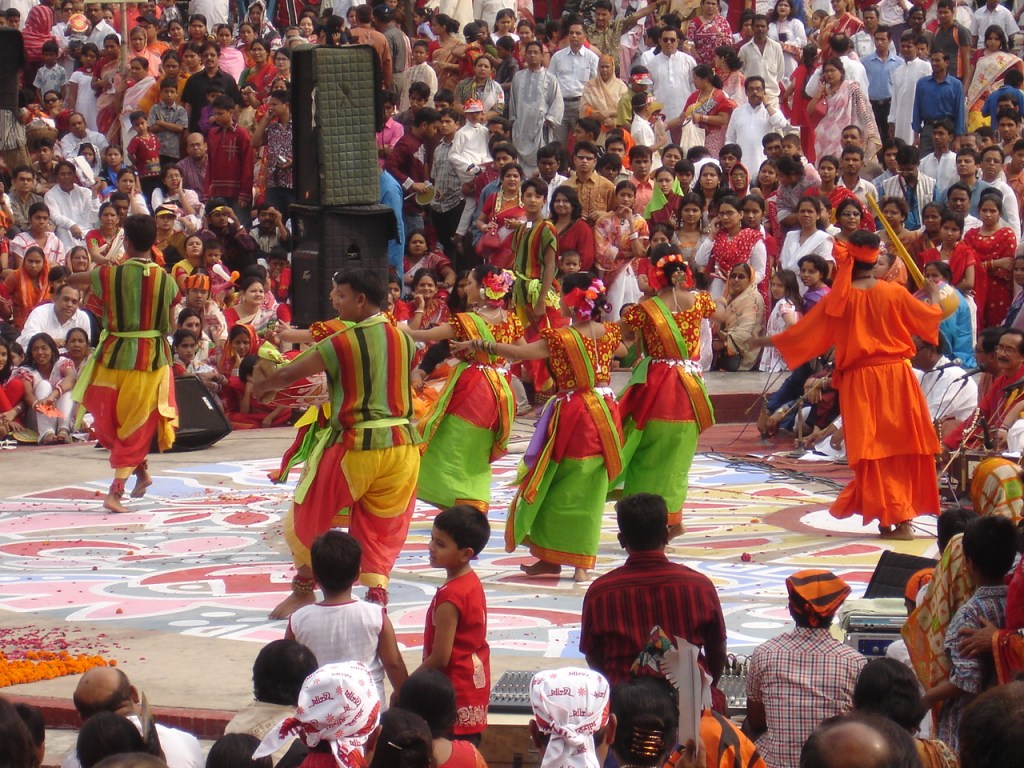
Bengali New Year Celebrations in Dhaka. Courtesy: Creative Commons. Poila Boisakh or Bengali New Year is celebrated in West Bengal, India and Bangladesh. Huge festivities are held in Santiniketan, the University started by Tagore. Multiple Asian New Years across Thailand, Nepal, India and more countries are celebrated mid-April.
The night has nearly come to an end.
The old year is almost past.
Under this dust, it will lay down
Its worn-out life at last.
Whether friend or foe,    wherever you go,
Old wrongs cast
Away. On this auspicious day,
Old grievances shed as the old year departs.

Today, I make new resolutions
Within my heart.
But, when I am reborn, maybe,
I will not recollect this part.
My judgement, perchance,    might be harsh.
Another’s tearful pleas thwart.
On this new-year’s morn,
I beg for clemency from the start.

As today blends into the morrow,
the future continues, unfathomable.
Will the current love and happiness
Still persist, be stable?
The flickering light     may stop tomorrow night.
Our home may be steeped with sable.
Come, this New Year’s Day,
Give what you are able.

Vast and limitless is this world.
There are so many countries.
Where will we find the confluence of 
All these people and their synergies?
Spread good cheer,    with a smile appear,
Like flowers on the same trees.
If you cannot do this daily,
At least come close once please.

The time to meet will pass.
We do not know where we will go.
In the middle of eternity, we may
Never find friend or foe.
Joys and sorrows     will leave no furrows,
They will disappear like bubbles. So,
Glance at your beloved’s
Face forevermore.

For our own personal petty gains,
We raise a ruckus.
For self-conceit and blind beliefs,
We become unjust.
Today I give my best,     I dedicate
My life thus —
I will be content with what you give,
And not expect too much.

I will embrace with daily patience,
All burdens and sorrows.
I will tread the difficult path, my
Life’s mission follow.
If I break my vow,    weakened by this tired brow,
With humility, I will my head bow.
I will accept the burden
Of all my flaws.

If life seems meaningless, if there are sorrows —
They are all in transience.
It will all be wiped away in life’s
Futile insipience.
Are you alone on this earth?    Beauty, pain, hurts,
Can be found in all ambience.
You are but a tiny speck in the
Endlessness of human existence.

As long as you exist, shine
Like a star.
If you do not find happiness,
Let there be peace in your heart.
If you cannot survive,     timeless conflicts outlive,
If defeats bar,
Then learn to die with
Sincerity on your part.

In this life’s journey, who can say how
Far we need to go
While stepping on the razor’s edge of
Heartrending sorrow?
Again, in the dark,     we walk the fiery path.
At least on this day, please pardon.
With the old year
Let all the old grudges go.

There goes, there goes the time,
My past departs.
On this dawn, with tears express
Your indebtedness, O heart.
Fill the cup of life    with joys and strife.
Tell her, her memories will stay past
All times, forever.
I dedicate to you my past.

This dawn heralds new life in the
New Year.
I want to tie all lives with love,
But I hesitate, I fear.
Do not send away     visitors on this day.
Welcome the New Year,
Filling the pitcher with
Virtuous tears.


This poem has been translated by Mitali Chakravarty with editorial support from Sohana Manzoor and Anasuya Bhar

PLEASE NOTE: ARTICLES CAN ONLY BE REPRODUCED IN OTHER SITES WITH DUE ACKNOWLEDGEMENT TO BORDERLESS JOURNAL

Click here to access the Borderless anthology, Monalisa No Longer Smiles

Click here to access Monalisa No Longer Smiles on Kindle Amazon International