Narrative by Meredith Stephens & Photographs by Alan Noble
I have read about overtourism in Spain and Greece. Locals have been overwhelmed with the visitors, and some even displayed signs for tourists to go home. According to Fortune magazine (17 July 2024), some locals in Barcelona turned on tourists with water pistols, and others in the Canary Islands embarked on a hunger strike in response to the numbers of tourists. Images of overtourism in Santorini, Greece prompted me to search for an unpopulated area, and I didn’t have to look much further than our own state of South Australia. We hoped to visit deserted towns, dotted with ruins, where there are more sheep than people.
Alex, Verity and I headed out of Adelaide on a bleak wintery day, caravan in tow, to the outback. First stop was Burra, a former mining town where copper was mined from 1845 until 1877. Copper brought prosperity to the state of South Australia saving it from bankruptcy. The small town centre featured a proudly-standing rotunda. Businesses were open, and there were grand buildings and churches which overwhelmed this small town, standing testament to a thriving past.
The caravan was too big for a parking spot, so we parked it parallel to the kerb straddling several spots. We entered the tourist bureau, and as there was no-one in line, headed straight to the desk. We were greeted warmly by the assistant, who handed us a map and explained the various places where we could stay overnight in a caravan. There were free sites, a caravan park, and if you bought a meal at the pub you could camp in their grounds.
Then she pointed out the many historic sites on the map, fixing her eyes on me with a wide smile. I could sense Alex pulling away ever so slightly, as he was anxious to secure a caravan site and do some sightseeing before nightfall, but I was captivated by the enthusiasm of the guide and tried to remember as much as I could of what she was telling us. We headed to one of the recommended sites for the night and investigated the former mining sites with original equipment that had been shipped out from Cornwall, England, in the1800s. We were the only tourists at the site.
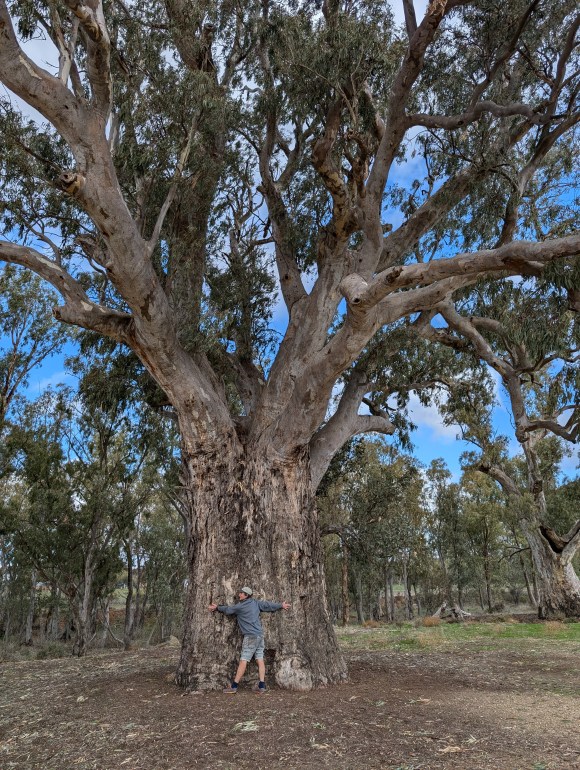
The next day we drove through Peterborough and Orroroo. We entered the cafe in Orroroo for lunch and asked the assistant what there was to see there. She gave us a map and explained that we absolutely had to see a spectacularly large 500-year-old tree on the outskirts of town.
Tree outside Orroroo
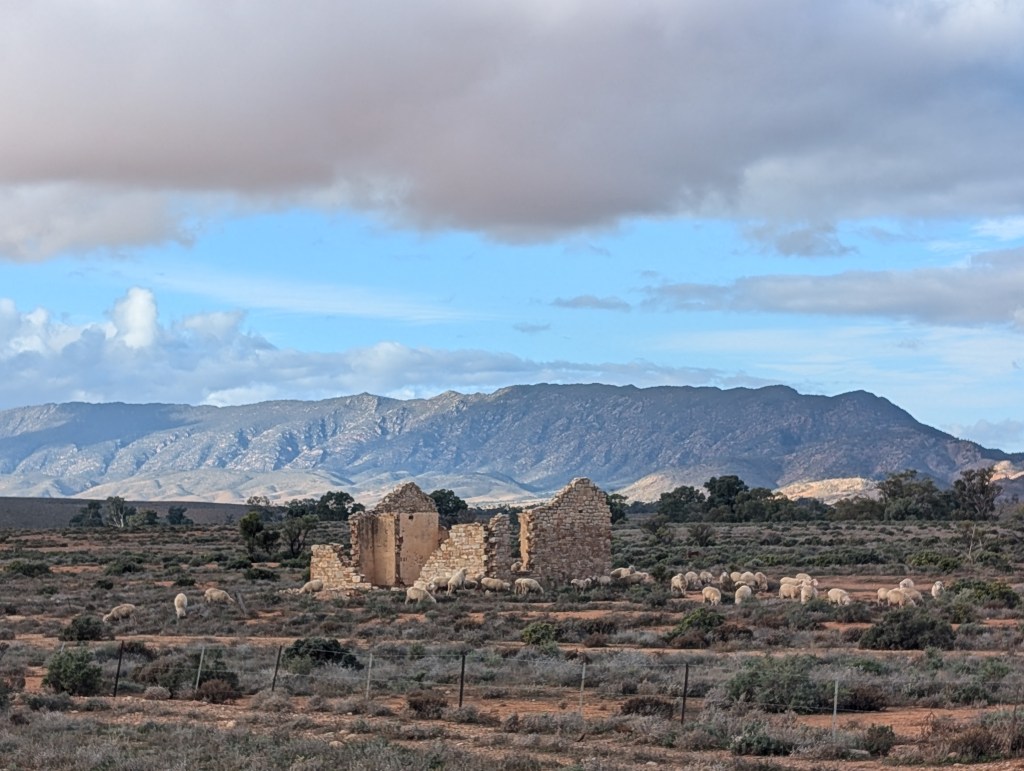
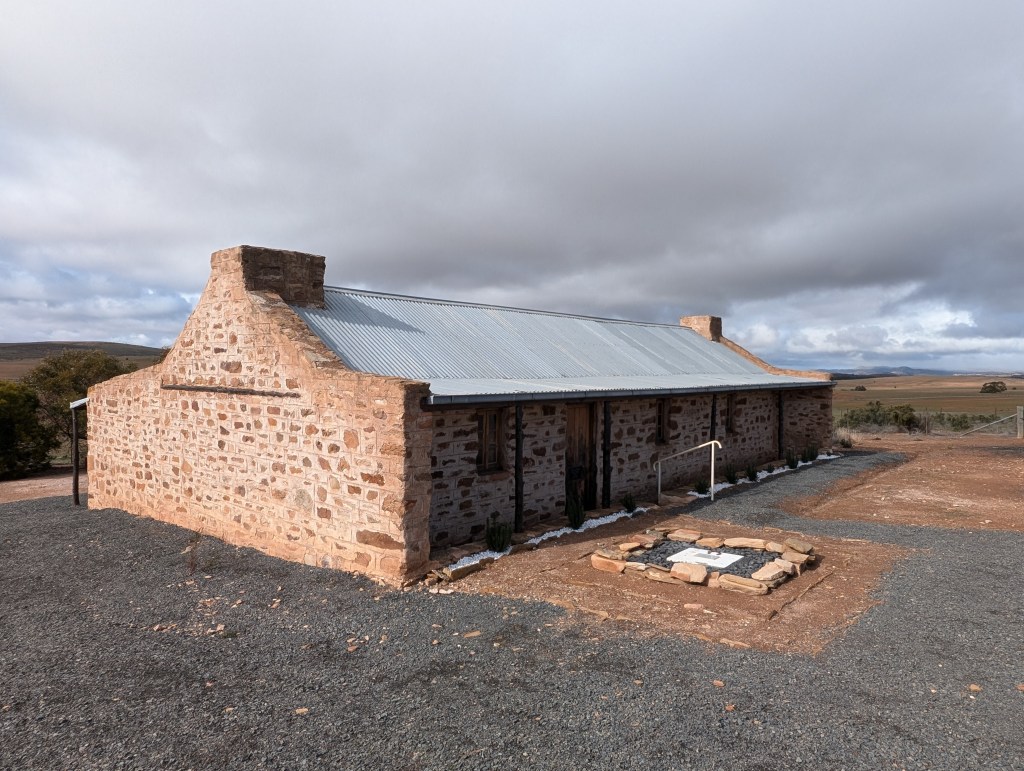
Next, we headed to the very small town of Hallet. There at the general store we asked for a key which would open the door to the now deserted birthplace of the polar explorer and aviator, Sir Hubert Wilkins. It was the first time we had been given a key to let ourselves into a tourist attraction, and we felt very privileged. We drove twenty kilometres to the home along dirt roads. Again, we were the only visitors. We made our way to the front door and unlocked it. This home, formerly rubble, had been lovingly restored by the Australian Geographic Society as a tribute to the explorer.
Ruins in the OutbackRestored home
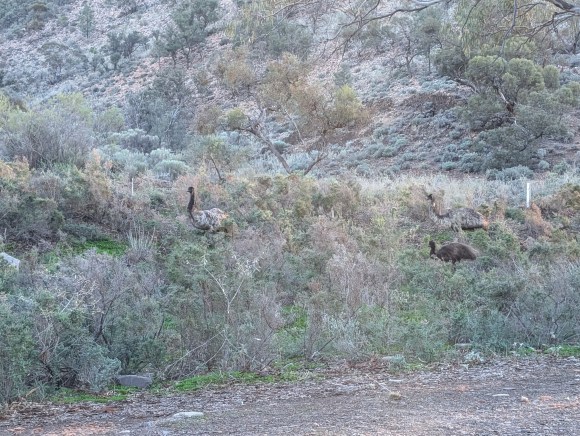
We continued to the Parachilna Gorge in the Flinders Ranges where we spent the night. Alex made a campfire, and we dined outside. Again, we were surrounded by ancient trees with generous girths in a dry riverbed. In the morning Alex woke to spot families of emus passing by, camouflaged by the foliage.
Emu family in Parchina Gorge
We continued onto the deserted nineteenth-century town of Farina that day. People started to abandon the town in the late 1800s, and the last of the inhabitants had left by the 1960s. Fortunately volunteers are keen to preserve the history and the ruins and manage the town during the school holidays. We were given a hearty welcome by a volunteer at the entrance to the bakery and received a map of the town.
Finally, on the 700kilometre drive back to Adelaide, we were low on diesel and made a brief detour to a small town off the highway. After putting the diesel in the car, I went inside to pay.
“Thanks, darling!” the cashier gushed.
“I like your dog! Is he a kelpie?” I asked.
Then I was given an enthusiastic account of how the kelpie had been rescued from a shelter. I think the owners may have been deprived of human company and were glad to see a new face. Alex came in because he was wondering what had become of me, engrossed in conversation. We had the impression that we were their only clients for the day. Eventually, I managed to extricate myself.
On this trip we had no experience of overtourism. Rather we visited sites where few tourists could be seen. Guides were so enthusiastic that they fawned over us. One reason that there were so few tourists is that it was the middle of winter and there was intermittent rain. Another was the geographical isolation of the outback. Australia is distant from countries with large populations. South Australia is distant from the large Australian cities on the east and west coasts and the outback further still—although closer to Adelaide than any other Australian capital city.
The landscape of the outback feels as different as another country. Our city, Adelaide, has a multitude of houses and new freeways, but the outback has few houses and many ruins. These ruins attest to a time of optimism when settlers believed the rains would be consistent. We enjoy hitching up the caravan and driving to the outback, where there are so few tourists that the sight of another human being results in an effusive welcome.
.
Meredith Stephens is an applied linguist from South Australia. Her recent work has appeared in Syncopation Literary Journal, Continue the Voice, Micking Owl Roost blog, The Font – A Literary Journal for Language Teachers, and Mind, Brain & Education Think Tank. In 2024, her story Safari was chosen as the Editor’s Choice for the June edition of All Your Stories.
PLEASE NOTE: ARTICLES CAN ONLY BE REPRODUCED IN OTHER SITES WITH DUE ACKNOWLEDGEMENT TO BORDERLESS JOURNAL
Christopher Columbus (1451-1506)From Public Domain
I, Roberto Mendoza, in this year 1550, ship’s boy on Christopher Columbus’ first and second voyages to the West Indies before my promotion to sailor on his third and fourth voyages, testify to the veracity of the eye witness events that I record for posterity. And in spite of their devastating raw truth, it is my troubled conscious that has conducted my hand, goaded my intelligence to write down these sorrowful facts. For facts they are, regardless of the prestige and boons that Columbus received from his protectors and admirers.
Where shall I begin? How do I burrow through the layers of unquestionable fame that has marked that name to reverberate with the clanking of the slave chains, the death rattles in the gold and silver mines, the gnashing of teeth, the hangings and dismemberments … the insensible apathy of the subjugation or submission of the Indian masses?
It has always appeared to my young eyes that Columbus’ achievements were enveloped in an aura of mystery or incomprehension. I may even add an aura of fantastic falsifications, mainly initiated and authorised by Columbus himself and his unquestioning gallants.
I knew him well, too well to be duped by those seductive charms of his, that subtle cunning, a mask donned whenever a fruitful occasion arose, yet under which lay a brutal, tyrannical individual bent on attaining his greatest ambition: wealth and glory, and this at any price. What was the little ditty that some fool invented for innocent children and naive adults to recite: “In fourteen ninety-two Columbus sailed the ocean blue?” A ridiculous rime to recall that wretched year. Yes, I say that wretched year for it celebrated the Genoan hero’s glorious voyage.
During that fatal year of 1492, two other major events occurred in Spain which I believe to be in relation to Columbus’ conniving his way into Isabella’s confidence: the expulsion of the Jews to North Africa, Italy and Constantinople, and the capitulation of Granada, the last stronghold of the Muslims in Spain, to the Christian kings. Henceforth, Spain rid herself of those ‘impure’, centuries-laden ‘foreign’ plunderers. Did not Columbus write in his logbook (if we are to believe Bartolomé de Las Casas’s transcribed copy of it) that he was overjoyed by those two events: ”thus you (the Monarchs) have turned out all the Jews from your kingdoms and lordships”, and ”the royal banners have been placed on the towers of Alhambra”[1].
This being said, because of the expulsion and the reconquest, Columbus’ true birthplace had to be concealed, for any negotiation with Isabella or Ferdinand. This hero was not born in the city of spaghetti and banks, Genova, as commonly known. The darling of the Spanish monarchy was born in the land of the corsairs, in Calvi, a lovely port town in Northern Corsica, indeed conquered by the Genovans and governed by them during five centuries, but none the less born and bred far from the banks of Italy. Corsica, where for centuries Vandals, Ostrogoths, Greeks and Lombards, and ill-bred Aragonese and Genovans vied for domination, intermingling, integrating and assimilating.
Why would Columbus lie about his place of birth? Was it out of fear of a possible ‘corsair descent’? One that connoted piratry, pillage and other misdeeds [2]? Be that as it may, the rogue managed to cajole Queen Isabella into giving him enough maravedis[3]to undertake a voyage that would heighten the glory of the conquering Spanish Monarchy and the new-founded kingdom.
And that was how Admiral Don Christopher Columbus frayed his way to fame and fortune!
With the Queen’s glittering maravedis he commissioned three caravels : the Nina, the Pinta and the Santa Maria, the third of which he navigated himself, the other two by the Pinzón brothers. How I happened to be aboard the Santa Maria is a long story with which I shall not bore my readers.
So there he stood at the prow, mantled in a vaporous circle of pride and arrogance whilst we, his sea-faring companions, sweated away on deck or in the hold, were fed rotten food, furled and unfurled the sails without respite, hunted out the innumerable rats that ran amok below, withered under the insufferable heat of September. I myself almost fainted under the long, long hours of tedious work, boredom and especially fear; fear that we and our tiny caravel, surrounded by thousands of leagues of far from blue waters, would be food for the horrible undersea monsters that had swallowed many a brave crew and their vessels with yawning jaws and leathery tentacles. All of us were terrified, and the five weeks we spent crossing a swelling ocean towards the East, or so we all thought, triggered a feeling of panic, alienness and remorse. The admiral described the ocean like a river; I myself felt like a cork in a rainswept pond, jostled and jolted, no land in sight, our water and meat, taken aboard at the Canary Islands, foul-tasting, half-eaten by the enormous black rats.
Did the great Admiral not consult the stars? Eastward? There was nothing — only rolls and rolls of higher and higher walls of water battering the fragile sides of our vessels. And I, so young, asked myself time and time again, how did an incompetent sea-faring fellow like Columbus ever win the confidence of Isabella and Ferdinand ? Oh how I recall his bulky figure at the prow, oftentimes behind the helm, screaming orders or simply staring out into the watery vastitude, dreaming no doubt of gold … gold … and more gold … He had written the word ‘gold’ seventy-five times in his logbook during the first two weeks of our crossing!
How many of our poor sailors had been beaten for insubordination, had suffered the excruciating trial of keelhauling[4], one or two even hanged for attempting mutiny, so fearful were they of being devoured by sea monsters, dying of thirst or hunger or being bitten by the furry rats that thrived below in our beds of straw?
At long last I heard the cry “Land ahoy!” coming from the crow’s nest. Yes, we finally reached a cluster of islands that would be named Guanahani[5], Cuba, Haiti and the Dominican Republic on the maps of future cartographers. It was on these islands that my first glimpses of a barbaric and despotic Columbus would not only be corroborated, but magnified to the heights of psychopathic insanity. For it became more and more evident to me that the Admiral, whom I considered in my youthful age as a hero, had no intentions of treating the indigenous peoples of these islands either as equals or with a soupçon of humane sympathy. He indeed judged them somewhat higher than animals, yet whose only human value was how much they would bring him as slaves sold in Spain, or how much gold and silver they would extract for him from the mines and rivers. All he saw in these peaceful peoples was the glitter of gold fastened to their noses and the rings of equal glitter hanging off their ears and arms. He saw gold everywhere, even gold stones shining in the rivers! He wrote in his logbook that gold grew in clusters and could be plucked off trees like fruit!
The way in which he ferreted information out of the Indians about gold deposits turned my stomach. His obsession with gold drove him into periodical frenzies during which time he would beat, even torture the poor indigenous man or woman who failed to locate the deposits. He spent his sweltering nights tossing and turning in bed, totally possessed by this maniacal craving.
But his brutality was not limited in this direction: The Spaniards or other Europeans who disobeyed him or sought to outmanoeuvre him in the pursuit of power or riches were tracked down and hanged, accused of criminal acts. His barbarity knew no bounds, nor his slave-selling which began to enrich him immensely.
On our second and third voyages, which led us to the islands of Granada and Tobago, the abundance of gold extracted was tantamount to the number of Indians he enslaved for his own ‘household’ purposes, and those he sold into a slavery which by then had become a thriving, lucrative business. We navigated from island to island sowing the seeds of destruction as the stoic Admiral described their beauty, the exotic animals and birds, and especially the immense, awaiting riches buried under that beauty. How many of the indigenous he had killed when several tribes revolted against him, and how many committed suicide cannot be accurately tallied. I would learn much later that Las Casas put that tally at 1,500 Taion Arawaks.
Indeed, as time went by Columbus’ wrath found merciless outlets against Indians and Europeans alike as the settlements grew in economic and political importance. Indians who failed to extract enough gold from the mines had one of their arms cut off[6]. On many occasions he had rebellious Spaniards dismembered in public much to the outrage of the governors appointed to the settlements by the Spanish Monarchy.
The governors of these settlements began sending reports to the King and Queen relating the horrendous behaviour of Columbus, his obsession for power and riches, his masquerading as a ruling god-like figure over the ignorant natives. Testimonies piled higher and higher on the Queen’s pearl-inlaid writing-table, relating cases of rape, murder and mutilation.
On his return trip to Spain she immediately had him seized, chained and thrown into prison. She also expropriated all his extorted possessions, be they gold or land. There he rotted away for six weeks, so enraged was the Queen, betrayed by this ‘foreigner’. However, his brother Bartholomew, on his knees, pleaded tearfully in favour of his brother’s heart of gold, his innocence in all matters of governance, having been slandered by the governors and their lackeys who wrote defamatory reports to wreak vengeance upon a man whose glory and greatness surpassed theirs. The Queen hesitated. It was King Ferdinand who decided to have him released.
His release from prison had puffed up his ego, unlocked his megalomania.
Columbus’ fourth and last voyage, between 1502 and 1504 with four caravels, took us to Martinique, Honduras, Jamaica, Costa Rica and Nicaragua. I had been appointed a full-fledged sailor by then and relished the idea of accompanying the Admiral, jotting down all his actions, prudently of course, so that I would not to be arrested for bearing witness to his ruthlessness, perhaps even hanged as a traitor. The ‘civilising’ process undertaken by him included plundering, murdering, enslaving and mutilation. Amidst the unbridled violence and sadism, he posed as an evangelist, a disinterested zealot deeply desirous to convert the ‘savages’ into God-fearing Christians, into ‘civilised’ beings like himself.
Columbus returned to Spain a hero of piety, magnanimity, sanctity. The impostor even wrote two books : the Book of Privileges[7] in 1502, an indecent mass of statistics which enumerate all his accumulated rewards wrested from the Crown under which lay the beaten and mutilated bodies of the indigenous, and the Book of Prophecies[8] in 1505, a shameful scream of smut comprising hundreds of citations from the Bible, all of which spell out in his vapid style his Christian ‘mission’ in the New World, ever so charitable and lenient towards the ignorant, child-like ‘natives’ ; a mission, indeed, pure in spirit, rightful in act.
With Columbus’ death the unwarrantable fervour that he had kindled slowly shrivelled into ashes. I retired from sea-life and found work in the Custom’s Bureau, a most comfortable employment. Besides, I was disgusted by all the tales told about him by the sailors, especially their bawdy narratives about the native women in the New World. I wished to leave my sea-legs behind and tread more earthy paths. Furthermore, my new tasks gave me ample time to read the posthumous reports about Columbus[9], many of which belied the benignant deeds and bountiful achievements of the monarchial and New World idol. It was after these important readings that I decided to begin my memoirs …
The rogue’s Book of Prophecies created quite a stir amongst the aristocratic castes : Columbus’ fantasies of promoting Isabella and Ferdinand as heads of a new crusade to the Holy Lands to defeat the Muslims, and there spread Christianity kindled many a nostalgic and gun-ho heart. The monarchs, wary of the old Admiral’s apocalyptic inaccuracies and religious bigotry, never took him seriously. I wonder if they had even read his book …
None the less, Columbus certainly provided an excellent example for other freebooters to follow in the wake of his doughty adventures. The slave trade between the Old and the New World thrived as well as the gold and silver that flooded the Spanish markets. It is no mere metaphor that this period in Spain was called as El Siglo de Oro (The Golden Century).
.
[1] Bartolome de Las Casas (1484-1566) a Dominicain priest who spent forty years in Hispaniola (Haiti and the Domican Republic) transcribed an abstract of Columbus’ lost logbook. How accurate or truthful is this copy is difficult to assess. Journal of the First Voyage of Christopher Columbus (1492-1493), translated by Clements R. Markhma : London, Hakluyt Society, 1893, pp. 15-93
[2] Corsica : Columbus’ Isle, Joseph Chiari, edition Barrie and Rockcliff, 1960.
[3] Gold coins used in mediaeval Spain during the 11th and 14th centuries.
[4] A maritime punishment by which the sailor is ‘hauled’ under the ‘keel’ of the ship with ropes.
[5] As called by the Indians. Columbus called this island San Salvador. Today it is called Watling.
[6] On this point see Howard Zinn, Christopher Columbus and Western Civilization, Open Magazine Pamphlet Series, 1992.
[7]El Libro de Privilegios. The English edition : Book of Privileges, The Claiming of the New World, John W. Hessler, 2014.
[8]El Libro de Profesías. The English edition : Book of Prophecies, Repertorium Columbianum, Blair Sullivan, 2004.
[9] Columbus and Las Casas : Two Readings on the Legacy of Columbus(1542 (The Devastation of the Indians. A brief Account) and 1550 (In Defense of the Indians).
Paul Mirabile is a retired professor of philology now living in France. He has published mostly academic works centred on philology, history, pedagogy and religion. He has also published stories of his travels throughout Asia, where he spent thirty years.
PLEASE NOTE: ARTICLES CAN ONLY BE REPRODUCED IN OTHER SITES WITH DUE ACKNOWLEDGEMENT TO BORDERLESS JOURNAL


 Borderless