Categories
Essay

The Comet’s Trail: Remembering Kazi Nazrul Islam

By Radha Chakravarty    
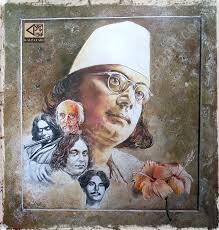
 

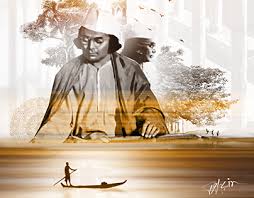
The abiding image of Kazi Nazrul Islam (1899-1976) is that of the “Rebel Poet,” who defines himself as a fiery comet streaking across the firmament, emblazoning in the sky a message of revolutionary change. Unlike Rabindranath Tagore, Nazrul was not born into social and intellectual privilege. He has been described, in fact, as “the ‘other’ of the elite Kolkata bhadralok”.[1] Born in Churulia village in the Bardhaman district of Bengal, Nazrul was the son of the head of a mosque, studied in an Islamic school, and during his youth, joined a Leto group, a travelling band of local performers. When in high school, he was recruited into the British army, and served in Karachi. Even after he returned to Bengal as a young poet who had already acquired fame and repute, he remained something of an outsider to the intellectually sophisticated world of the literati. It was from this position of an outsider that he fashioned his own image as the bidrohi or ‘Rebel poet’ who challenged the structures of the political, social, cultural and literary establishment with the sheer force of his iconoclastic writings.

Though best known as a poet, composer and revolutionary, Nazrul’s oeuvre also includes novels, essays, stories, editorials and journalistic pieces on a remarkable variety of topics. He was also a lyricist and composer, creator of the iconic genre called “Nazrulgeeti”. Nazrul’s brilliant literary career lasted from 1919 to 1942, when illness brought it to a sudden end. During this short span of time, he wrote on an amazing range of subjects, including politics, nationalism, social change, religion, communalism, education, philosophy, nature, love, aesthetics, literature and music. He saw it as his mission to arouse public awareness about pressing issues, and to jolt them out of their complacency and general apathy. Remembering Nazrul on the 48th anniversary of his death, it is daunting to think about his extraordinary legacy, but also a timely moment to reflect upon his significance for our own times.

In his political stance, Nazrul argued passionately in favour of armed struggle for total independence from colonial rule, rejecting the Gandhian path to advocate a freedom won via armed resistance. The trope of violence recurs in his writings. Yet his apparent espousal of the principle of destruction springs from a utopian dream of constructive change. “Reform can be brought about, not through evolution, but through an outright bloody revolution,” he says in the essay ‘World Literature Today’. “We shall transform the world completely, in form and substance, and remake it, from scratch. Through our endeavours, we shall produce new creation, as well as new creators”.[2]

Nazrul’s ideas on education counter the colonial pattern, advocating instead a curriculum that draws on indigenous contexts and models. He feels that the new education policy should emphasise empathy, inclusiveness and heterogeneity, with a special focus on psychological and emotional development. “It is our desire that our system of education should be such that it progressively makes our life-spirit awakened and alive,” he says in ‘A National Education’, adding: “… We would rather produce daredevils than spineless young men.” [3]

Inclusiveness and acceptance of heterogeneities are central to Nazrul’s vision. During his stint as a soldier in Karachi in his young days, he became interested in Marxist thought. The influence of this line of thinking can be felt in his emphasis on economic egalitarianism, and his passionate support of the cause of the downtrodden peasantry, particularly in his journal Langal. Following the 1926 riots in Kolkata, he expresses his anguish at the communal antagonism between Hindus and Muslims, critiquing different forms of orthodoxy in both religions. In the poem ‘Samyabadi (Egalitarian)’ [4], he declares:

I sing the song of equality—
Where all divisions vanish and barriers dissolve,
Where Hindu-Buddhist-Muslim-Christian
merge and become one …

Nazrul was also a supporter of women’s rights. In his poetry, he speaks of equality between men and women. In ‘Nari (Woman)’ he argues: “If man keeps woman captive, then in ages to come, / He will languish in a prison of his own making”.[5]

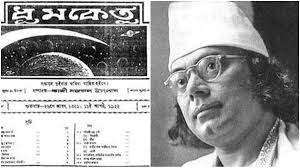
Not surprisingly, Nazrul’s fearless, unconventional attitude aroused hostility in many quarters. His bold, outspoken magazine Dhumketu enraged the British. The journal was banned, and Nazrul condemned to rigorous imprisonment. At his trial in 1923, he delivered a resounding rejoinder in his speech ‘Rajbandir Jabanbandi (Deposition of a Political Prisoner)’.  He remained a thorn in the flesh for the British administration because of his revolutionary views. Nazrul’s religious views also raised many hackles. He married Ashalata Sengupta, or Pramila, who belonged to the Brahmo Samaj. This antagonised conservative Hindus as well as orthodox Muslims.

Nazrul’s success as a writer, especially Rabindranath Tagore’s appreciation of his work, also caused jealousy among contemporary writers. For Tagore had dedicated his play Basanta to Nazrul, and also sent a telegram to him when he was in prison, exhorting him to give up his hunger strike. In 1922, Tagore had written a poem addressed to Nazrul, which appeared in successive issues of the journal Dhumketu[6]:

Come, O shining comet! Blaze
Across the darkness, with your fiery trail.
Upon the fortress-top of evil days,
Let your victory-pennant sail.
What if the forehead of the night
Bear misfortune’s sinister sign?
Awaken, with your flashing light,
All who lie comatose, supine.

Rabindranath Tagore’s recognition of Nazrul’s talent created a lot of envy in literary circles. In 1926-27, parodies of Nazrul’s poetry started appearing in Shanibarer Chithi, a journal published by the Tagore circle. It came to be rumoured that Tagore had not liked Nazrul’s use of the Persianate word khoon (blood) instead of the Sanskritised word rakta, in his composition ‘Kandari Hushiar’. This gave rise to a controversy that became known as khooner mamla (the bloody affair), which drew a strong reaction from a deeply perturbed Nazrul, in the shape of an essay ‘Boror Piriti Balir Baandh” (A Great Man’s Love is a Sandbank)’, in which he blamed Tagore’s followers for the entire misunderstanding. The situation was resolved through the mediation of friends, and relations between Tagore and Nazrul remained cordial. When Tagore died in 1941, Nazrul broadcast a moving elegy, “Robi-Hara”, on Calcutta Radio.

In some ways, Nazrul was ahead of his time. Not many people know that he was aware of environmental issues and the threat of climate change, pressing problems in our own times. In ‘The Day of Annihilation’, he writes in a prophetic vein, of global warming, dissolving ice-caps and a changing ecology, cautioning his readers that if humans exploit the planet, we will eventually be responsible for the destruction of life on earth.

In Nazrul’s life and writings, we encounter the constant pull of contraries. His consciousness was simultaneously rooted in local culture, and infused with a broad transnational spirit. He felt inspired by movements in other parts of the world, such as the Turkish Revolution, the Irish Revolution and the Russian Revolution. In the essay ‘Bartaman Viswasahitya (World Literature Today)’, we discover his awareness about literary developments across the globe. In his political writings he espouses the path of violence, but he also composes exquisitely tender love songs, devotional songs drawing on both Hindu and Muslim imagery, and songs about the beauty of nature.

Nazrul’s style is a volatile mix of colloquial, idiomatic expressions, formal Bengali, Sanskrit and Persianate vocabulary, a smattering of English, and multiple registers of language. His polyglot sensibility also surfaces in his practice as a translator. He translated Omar Khayyam and Hafez from Persian into Bengali. His translations from Arabic into Bengali include 38 verses of the Qu’ran, part of the Mirasun Nagmat (a treatise on Hindustani classical music) and some poems. He translated Whitman’s ‘O Pioneer’ from English into Bengali. He is also known for his innovative ghazals in Bengali.

In 1942, Nazrul suddenly lost his speech. His illness brought his literary life to an abrupt end. All the same, the impact of his writings continued to be felt. In the Bangladesh Liberation War of 1971, the freedom fighters adopted Nazrul’s music as a source of inspiration. He was later declared the National Poet of Bangladesh. Today, while Nazrul’s poems and songs continue to delight and inspire, the true extent of his achievement remains in shadow. It is time for a comprehensive reappraisal of this much underestimated literary genius, because his writings have so much to offer us in our present world.

[1] The Collected Short Stories of Kazi Nazrul Islam, ed. Syed Manzoorul Islam and Kaustav Chakraborty (Hyderabad: Orient Blackswan, 2024), p. xviii. Bhadralok translates to gentleman

[2] Kazi Nazrul Islam, Selected Essays, translated by Radha Chakravarty (New Delhi: Penguin Random House, 2024), p. 137.

[3]  Kazi Nazrul Islam, Selected Essays, trans. Radha Chakravarty (2024), p. 60.

[4] Translation by Radha Chakravarty

[5] Translation by Radha Chakravarty

[6] The Essential Tagore, ed. Fakrul Alam and Radha Chakravarty. Cambridge, Massachusetts: Harvard University Press, 2011, pp. 115-116; Translation mine.

Radha Chakravarty is a writer, critic, and translator. She has published 23 books, including poetry, translations of major Bengali writers, anthologies of South Asian literature, and critical writings on Tagore, translation and contemporary women’s writing. She was nominated for the Crossword Translation Award 2004.

.

PLEASE NOTE: ARTICLES CAN ONLY BE REPRODUCED IN OTHER SITES WITH DUE ACKNOWLEDGEMENT TO BORDERLESS JOURNAL

Click here to access the Borderless anthology, Monalisa No Longer Smiles

Click here to access Monalisa No Longer Smiles on Kindle Amazon International
Categories
Essay

When the Feminist and the Revolutionary Met

By Niaz Zaman

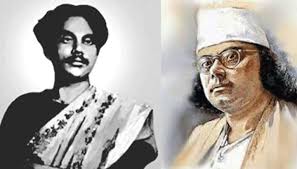
Nazrul (1899-1976)

Roquiah Sakhawat Hossein was born in 1880, Kazi Nazrul Islam in 1899. Apart from their difference in gender, there could not have been more differences in the circumstances of their class and upbringing. Roquiah was born and brought up in an affluent Muslim family of Pairaband. Her brothers went to elite schools in Kolkata. Though she was forbidden to read and write Bangla or English as a child, her brother Ibrahim Saber helped her to learn both languages so that she could write fluently in both. Later, her husband, Sakhawat Hossein, encouraged her to read and write, both Bangla and English.

Kazi Nazrul Islam was born in an impoverished family in the village of Churulia in the district of Bardhaman in West Bengal. Nazrul’s father was the khadim or caretaker of a mosque next to his small mud hut. The death of several earlier children led to Nazrul’s being given the nickname “Dukhu Miah,” the sorrowful one, perhaps also to cast off the evil eye. Initially, Nazrul studied in a maktab, an Islamic elementary school. When Nazrul was about nine, his father passed away, and the young boy was obliged to support his family. This might have meant teaching the children at the maktab, cleaning the mosque, and participating in religious rituals which entailed reciting the Quran

Sometime in 1915, Nazrul got admitted to Searsole Raj High School, and studied there till 1917. This was the longest time he had spent in one place and in one school. However, he did not sit for the matriculation examination, but went off to join the British Indian Army which had started recruiting Bengalis.  Posted to Karachi, Nazrul started subscribing to Kolkata papers and also writing for them.

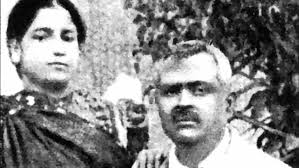
Begum Roquiah (1880-1932) with her husband, Sakhawat Hossein, in 1898

In 1898 – a year before Nazrul was born – Roqiuah Khatun was married to Sakhawat Hossein, an Urdu-speaking widower from Bhagalpur. A civil servant under the British Raj, Sakhawat Hossein, not only encouraged his wife to read and write but was so amazed at her piece of English writing that he showed it to Mr. Macpherson, Commissioner, Bhagalpur.  Mr. Macpherson commended the quality and content of the writing.  We do not know whether Roquiah sent the story herself to Indian Ladies Magazine (Madras) or whether her husband did so. Nevertheless, Roquiah’s first published writing appeared in the magazine in 1905. Three years later, her Bangla translation of the story – with some changes – was published as a small book by S. K. Lahiri and Co, Kolkata.

Sakhawat Hossein passed away on May 3, 1909, leaving a large sum to his widow to start a school. Roquiah initially started the school in Bhagalpur but was unable to continue there and moved to Kolkata. It was there that, onMarch 16, 1911, she re-started Sakhawat Memorial School at 13 Wellesley Lane. Besides persuading Muslim parents to let their daughters enrol in her school and running it, she also had to write letters explaining why certain things were being done or not being done in her school. In addition to these activities, she started writing for local Kolkata newspapers and journals.

Perhaps the earliest Bangla essay of hers that was published was “Pipasha.” This piece about Muharram was published in Nabaprabha in Falgun 1308 [1](Bangla) corresponding to mid-February to mid-March 1912.  She also wrote in other journals such as Mahila, Nabanur, Bharat Mahila, Al-Eslam, Bangiya Mussulman Sahitya Patrika, Saogat, Sadhana, Naoroz, Mohammadi, Sahityik, Sabujpatra, Muezzin, Bangalakshmi, Gulistan, and Mah-e-Nau. News about her school was published in The Mussulman under her initials, Mrs. R. S. Hossein.

During his deployment in Karachi, Nazrul subscribed to Bangla journals from Kolkata and also sent them some of his writings. His first publication was a short story “Baundeler Atmakahini” [The Autobiography of a Vagabond], which was published in Saogat in May 1919. The short stories “Hena” and “Byathar Dan” [The Gift of Sorrow] were published in Bangiya Mussalman Sahitya Patrika in November 1919 and January 1920 respectively. Roquiah’s writings too were being published in Saogat and Bangiya Mussulman Sahitya Patrika.  Though it is not known whether Nazrul and Roquiah actually met, it is impossible that they did not know about each other’s writings.

A few years ago, I asked Majeda Saber, Roquiah’s grandniece who has written considerably on her grandaunt, whether Nazrul and Roquiah had ever met. Majeda Saber did not know. However, even if they did not meet, it is quite evident that Nazrul and Roquiah did meet in print and that they shared some common ideas. Nazrul reveals a deep empathy for women in both his poetry and his fiction. The short story “Rakshushi[2],” about a woman who has killed her husband and gone to jail for her crime, is a sympathetic portrayal of a murderess in her own voice. Nazrul’s poem “Nari[3]” demands equality for women.

I sing of equality. 
In my eyes, there is no difference
Between a man and a woman.
Whatever is great and blessed in this world,
Has come equally from both, man and woman.

(Translated by Selina Hasib)

His song, “Jaago Nari Jaago” [Rise Up, Women], gives a clarion call to all women to rise.

Rise up women – rise up like the flaming fire! 
Rise up, O wife of the Sun god,
with the mark of blood on your forehead!!
...

Like the fire blazing out of a smouldering heap,
rise up – all you mothers, daughters, wives, sisters!
(Translated by Sajed Kamal)

In his epistolary novel, Bandhon Hara [4] which began to be serialized in Moslem Bharat from mid-April 1920 and was published as a book in 1927 the feelings of the women letter writers reflect Roquiah’s ideas.

The narrative of Bandhon Hara seems to focus on the soldier-protagonist Nuru. However, the letters of the women not only contribute to the narrative of the triangular love story but also reflect on the condition of Muslim women in seclusion. For example, Mahbuba writes to Sophie – her friend, who, like her, is also in love with Nuru about the claustrophobic nature of the inner quarters where women reside. It is a place where even the sun may not enter. But women are not criminals, Mahbuba says. “We are entitled to some freedom, for are we not human beings? Are we not made of flesh and blood, don’t we have feelings? Do we not possess a soul?”

After Mahbuba gets married, she writes to Shahoshika, a Brahmo teacher and a family friend,  that women are supposed to be self-sacrificing. She tells Shahoshika that she has no wish to be renowned for self-sacrifice. She would like to die but refuses to die locked up in the inner quarters. “If I have to die, I would wish to have all the doors and windows around me open wide . . .  I want to die looking straight at Mother Earth”.

In her essay “Subeh Sadek” [Dawn], published in Muezzin between mid-July-mid-August 1930, Roquiah asked women to proclaim aloud that they were human beings, not possessions. “Buk thukiya bolo ma! Amra poshu noi. Bolo bhogini! Amra asbab noi. Bolo konye! Amra jarau olonkar rupe lohar sinduke aboddha thakibar bostu noi. Sokole somoswore bolo, Amra manush. Mother, proclaim aloud, we are not animals. Proclaim, sister, we are not inanimate objects. Proclaim daughter, we are not ornaments set with precious gems to be locked up in iron trunks. Proclaim together, we are human beings.” In Aborodhbashini [The Secluded Ones], published in 1931, several years after Bandhon Hara, she described the claustrophobic, unhealthy, and often fatal conditions of extreme purdah.

Dhumketu edited by Nazrul

These similarities might simply be coincidences. However, it is clear that Nazrul thought highly of Roquiah and that she too reciprocated that feeling.  Roquiah had been contributing to several Kolkata journals.  In 1922, she contributed two pieces to the newly founded bi-weekly paper, Dhumketu[5], edited by Nazrul. The paper started publication from 26 Sravan 1329 BS/11 August 1922. A month later, a large extract from Roquiah’s essay “Pipasha”[Thirst] was published in the Muharram issue of 16 Bhadra 1329/ September 2, 1922.

Thanks to Selina Bahar Zaman[6], we have facsimiles of Dhumketu. From this valuable collection we realise that, from the very beginning, the paper not only voiced Nazrul’s anti-British views but also displayed his non-communal and non-gendered outlook. Many of the contributors to the paper included Hindu writers as well as women. There were at least ten women who wrote at least once. One of these included a ten- or eleven-year-old girl as well as a thirteen-year-old girl, the former Hindu, the latter Muslim.  Mrs. M. Rahman, to whom Nazrul dedicated his book Bisher Banshi[7], wrote several times. Roquiah – as Mrs R. S. Hossein – was published twice in Dhumketu.

We do not know whether Roquiah sent the extract from “Pipasha” herself or whether Nazrul asked her for the piece for the special issue of twenty pages. The extract published in Dhumketu reflects on the plight of Hazrat Imam Hossain and the group of warriors, women and children, who accompanied him on his tragic journey to Karbala. 

The only other piece by Roquiah to appear in Dhumketu was a poem, “Nirupam Bir” [The Dauntless Warrior], published on 5 Ashwin 1329 BS / September 22, 1922. Unlike “Pipasha”, the poem does not seem to have been published before. This time, Roquiah might herself have sent the poem to Dhumketu. She would not have had to go in person to the office of Dhumketu. With a good postal service, contributions were mailed to journals.

 “Nirupam Bir” is a remarkable poem from a woman who has been called an “Islamic Feminist.”   The 18 August issue of Dhumketu had published a photograph of Kanailal Dutt (1888-1908). Did this inspire Roquiah to write the poem?  Kanailal was a revolutionary belonging to the Jugantor Group[8]. Arrested with a number of other revolutionaries, he was imprisoned in Alipore Jail.  There, along with another revolutionary, he succeeded in assassinating Narendranth Goswami, a government approver. Kanailal was hanged on 31 August, 1908. He was the second revolutionary to be hanged by the British after Khudiram Bose – whose picture also appeared in Dhumketu.

In the poem, Roquiah eulogises Kanai as the dauntless warrior. The poem begins with the magistrate telling Kanai that he will be hanged. But Kanai – addressed here as Shyam, another name of Krishna – laughs. The one who willingly sacrifices his life does not fear hanging.  “Moriya kanai hobe omor/ Shadhyo ki bodhe tarey? By dying Kanai will become immortal. Who can slay him?” The poem ends with a strident call hailing Kanailal: “Bolo bolo ‘Bande Shyam[9].’” It is a brave poem by a woman who was the widow of a government servant, a woman who ran a school for Muslim girls and promised their parents that purdah would be observed.

There were no Muslim revolutionaries at the time – though Nazrul’s friend Muzaffar Ahmad was a communist – and in Mrityukshudha Nazrul would describe a Muslim Bolshevik and in Kuhelika[10] he would portray a Muslim revolutionary. In his two poems on Durga, “Agamoni[11]” and “Anandamoyeer Agamone”, published in the Puja issue of Dhumketu on 9 Ashwin 1329 BS /September 26, 1922, Nazrul used the legend of the goddess to call for the overthrow of the British. In his editorial in the thirteenth issue of Dhumketu, 26 Ashwin 1329 BS / October 13,1922, Nazrul called for complete independence from the British: “‘Dhumketu bharater purno swadhinata chay.[Dhumketu wants India’s complete independence]” He quoted a line from his poem “Bidrohi”: “Ami aponare chhara kori na kahare kurnish [I bow to no one but myself].” Unlike Khudiram and Kanai, Nazrul did not resort to bombs or pistols, but to soul-stirring words. Just as in some of his writings, Nazrul revealed the feminist perspectives of Roquiah; in “Nirupam Bir”, Roquiah approached the revolutionary spirit of Nazrul.

Selected Bibliography

Hossein, Roquiah Sakhawat, “Subeh Sadek.” Rokeya Rachanabali ed. Abdul Mannan Syed et al,   revised edition. Bangla Academy: 1999.

Islam, Kazi Nazrul. Unfettered (translation of Bandhon Hara).Translated by The Reading Circle Nymphea Publication: 2015.

Zaman, Selina Bahar, ed. Nazruler Dhumketu, Nazrul Institute: 2013.

[1] 1902 February

[2] Demoness

[3] Woman

[4] Without Bondage

[5] Comet

[6] Selina Bahar Zaman (1940 – 2004) Bangladeshi academician and writer

[7] The Poisoned Flute

[8] A revolutionary group started in 1906

[9] Translates to — I bow to thee, Shyam/Hail to thee, Shyam

[10] Enigma, first published as a serial in 1927

[11] Advent

Niaz Zaman is an academic, writer and translator from Bangladesh. She has published a selection of Kazi Nazrul Islam’s work in the two-volume Kazi Nazrul Islam: Selections. In 2016, she received the Bangla Academy Award for Translation. This essay was first published in In Focus, the Daily Star,  December 12, 2022.

.

PLEASE NOTE: ARTICLES CAN ONLY BE REPRODUCED IN OTHER SITES WITH DUE ACKNOWLEDGEMENT TO BORDERLESS JOURNAL

Click here to access the Borderless anthology, Monalisa No Longer Smiles

Click here to access Monalisa No Longer Smiles on Kindle Amazon International
Categories
Slices from Life

Dhaka Book Fair: A Mansion and a Movement

Ratnottama Sengupta writes of a time when a language freed itself and a palace called Bardhaman House became the centre of a unique tryst against cultural hegemony. The Language Movement of 1952 that started in Dhaka led to the birth of Bangladesh in 1971. In 1999, UNESCO recognised February 21 as the Mother Language Day.

The window at Bardhaman House. Courtesy: Kamrul Mithon

All through the day Kamrul Mithon was standing in front of this window, waiting. He was waiting to be allotted a stall in Ekushey Book Fair 2022. This year the annual book fair in Dhaka is being hosted by the Bangla Academy from February 15 to 28. 

This window is a part of the Bardhaman House. The first boimela or book fair had started under the banyan tree facing this very window. Kamrul Mithon, who earns his bread and butter by the click of his camera, is a book publisher by passion. The freelancer for National Crafts Council of Bangladesh is the Associate Visual Editor at Nymphea Publication who have just published titles like Cannes Diary and When the Mango Tree Blossomed, in the ongoing book fair. The day he spent facing the window was the day the lottery was held – so the best way to while his time was by clicking away, capturing all that captivated his fancy. 

Later it occurred to him that he could post the pictures on Facebook to announce the forthcoming boimela. And when he did so, he captured my attention. “Is this a painting? A poster? A book cover?” My curiosity was piqued. “Neither,” Kamrul replied. He went on to give me a brief history of ‘Burdwan House’ – the architecture from the British Raj when Dhaka, the second biggest city of Bengal Presidency, housed estates of many erstwhile royalties including the Raja of Burdwan.

Maharajadhiraj Bahadur Sir Bijay Chand Mahtab (1881-1941) was the first in the Burdwan family to obtain formal education qualification, tour England and Europe, write his memoirs. Adopted at the age of six, he was bestowed the title of Rajadhiraj at the coronation in the Delhi Durbar. Though only eighteen then, he had the savvy to build a Gothic style gate to welcome Lord Curzon when the Governor General visited Bardhaman. That gate continues to be a historical landmark in the Indian state of West Bengal. 

In 1908, when Bijoy Chand Mahtab risked his life to save that of Sir Andrew Fraser from a Nationalist bullet, Lord Minto elevated him to the title of Maharajadhiraj. He represented the Bengal zamindars in the Bengal Legislative Council and in the Imperial legislative Council for years. President of the British Indian Association, this philanthropist in education and health welfare was part of the committee that recommended replacement of Zamindari by the Ryotdari or tenancy system. After all this, though, he extended hospitality to Gandhi in 1925 and to Subhash Chandra Bose in 1928. Did he sense that the sun was soon to set on the British Empire?

The mansion in Dhaka was one of the many palaces of His Highness of Burdwan: the one in Darjeeling was his Summer Palace. Through the year he resided in the Burdwan House in Kolkata’s Alipore area. That stately home is now rented out for weddings and other occasions. So, I was especially happy to learn that Dhaka has transformed the classical architecture into a centre for research and preservation of Bangla. “Indeed this was where the Bangla Bhasha Andolan spread out from,” Mithon cues me in, “since this was where the instruction went out on the evening of February 21, to fire on the students of Dhaka University.”

Mithon further leads me through the various chapters of the Movement. “In 1952, being the residence of Nurul Amin, the Chief Minister of East Pakistan, Bardhaman House witnessed the escalation in our demand that Bengali be accorded equal status with Urdu as State Language of Pakistan.”

I remember hearing the backstory of the movement from my father, writer Nabendu Ghosh: he was forced to leave Kolkata, the home ground of Bengali literature, theatre, cinema, art – indeed, of Bengali culture – and live in Bombay after the Partition of the Indian subcontinent. Because? The readership of Bangla literature had been halved as had the viewership of Bengali films. Keen to build upon its Islamic genes, the government of the newly formed Pakistan decided that Urdu would be the state language. And to impose that decision even in East Pakistan, its eastern wing separated by 2000 miles of land and rivers, language and culture, it decreed that even Bengali, its lingua franca, must be written in the Arabic script!

Mithon encapsulates the story of rebellion against the firman – the decree — that took the masses unaware. 

“1947, December 5. The working Committee of the Muslim League was meeting in Bardhaman House. The students and teachers of Dhaka University were stunned by the unfair decision that would impact the lives of the 44 million Bangla-speaking citizens who formed roughly 2/3rd of the 69 million population. They took out a procession to demand that Bengali be made the language of education and administration in the state — and at the Centre, it should be accorded the same dignity as Urdu, adopted by the Western wing of the divided India that encompassed large part of Punjab and Sindh, where the lingua franca was Pubjabi and Sindhi.

“1948, January 8. Evening at Bardhaman House. Leaders of the Language Movement met Prime Minister Najimuddin. The purpose? To protest the arrest and torture of the Bhasha Andolan (language revolution) activists — under section 144 — for demanding that they be allowed to freely read write and speak Bangla.

“1948, March 15. On the eve of signing the State Language Agreement, the then Governor Khwaja Najimuddin met the students involved in the Andolan. The next day a procession set out for Bardhaman House to demand the cancelation of the draft agreement. The police were let loose on them, for disobeying the orders under section 144, and the students and teachers were severely wounded. 

“February 21, 1952, was Phalgun 8, 1358 on the Bengali calendar. Governor General Nurul Amin sent out the order that took the lives of Rafiq, Salam, Barkat, Abdul Jabbar, Shafiur Rahman, teenaged Aliullah, 17 other students, teachers, progressive intelligentsia and non-communal individuals, rickshawallahs and labourers… The tower that came up overnight in the University campus was not the only direct fallout of the inhuman firing: The symbol of Power, Bardhaman House became the target of people’s anger. 

“After the heinous bloodbath, the demand to turn it into a Centre for Language Studies gathered momentum. And four years later, in 1954 it gained formal sanction prior to the elections. The 21-point Charter of Demands put forth by the Jukta (United) Front spelled out that the Prime Minister move into a less luxurious residence, leaving the mansion to be used as a Student’s Hostel and, subsequently, to be turned into a Research Centre for the language.

“Eventually the Pakistan government had to bow to the unrest: On May 7, 1954, Bengali was adopted as one of the state languages in the Constituent Assembly of Pakistan. And on December 3, 1954, the Chief Minister of East Pakistan, Abu Hosain, inaugurated the Bangla Academy in the Burdwan House.” 

Quite naturally, along with research and nurturing of the language, Bangla Academy has taken care to perpetuate the memory of the Amar Ekush (eternal 21st) martyrs. The first floor of the Bardhaman House is home to the Bhasha Andolan Museum. Inaugurated on February 1, 2010, it preserves historical photographs, newspapers, memorial documents, cartoon, letters, publicity leaflets, manuscripts, book covers and memorabilia of the language martyrs. And in the ongoing Boimela, Nymphea has brought to the reading public volumes like Ekush: A Photographic History of the Language Movement (1947-1956) and Kaaler Kheya (The Boat of Time) about passing on Bangla from generation to generation. 

The events of February 21, 1952, shed a long shadow that culminated in the emergence of the sovereign nation of Bangladesh which sings, Moder garab moder asha – Aa mori Bangla bhasha (Our pride, our inspiration, O sonorous Bangla!)… The love for its language has seen the nation adopt Tagore’s creation as its national anthem, Aamar Sonar Bangla. And even before that, Renaissance personality Satyajit Ray saluted the language by penning Moder nijer bhasha bhinna aar bhasha jaana nai … O maharaja, we speak no language other than our own, and we celebrate through that very language, Mora sei bhashatei kori gaan

Indeed, the world salutes the struggle and sacrifices of the people of Bangladesh to be able to sing their songs. In November 1999, UNESCO paid tribute to Amar Ekush, the movement for safeguarding Bangla – with all its proverbs and poetry, myths and songs — by declaring February 21 as the International Mother Language Day.

.

Ratnottama Sengupta, formerly Arts Editor of The Times of India, teaches mass communication and film appreciation, curates film festivals and art exhibitions, and translates and write books. She has been a member of CBFC, served on the National Film Awards jury and has herself won a National Award. 

.

PLEASE NOTE: ARTICLES CAN ONLY BE REPRODUCED IN OTHER SITES WITH DUE ACKNOWLEDGEMENT TO BORDERLESS JOURNAL