Categories
Excerpt

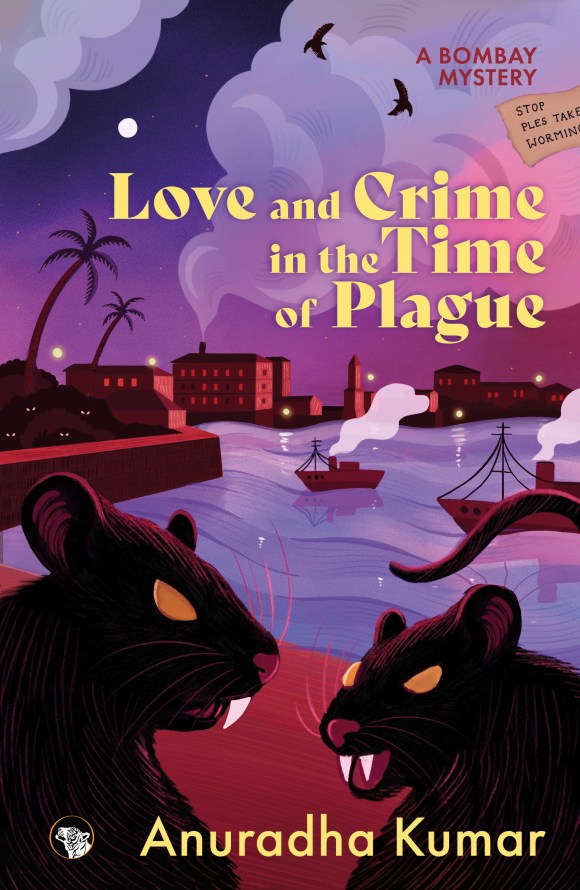
Love and Crime in the Time of Plague

Title: Love and Crime in the Time of Plague: A Bombay Mystery

Author: Anuradha Kumar

Publisher: Speaking Tiger Books

Maya is Discomfited

What shall we talk about?’ Maya asked in her irrepressible way, a lilt in her voice. That afternoon she was out cycling with Henry when the rain came down, turning heavy in moments. It was August and the middle of the monsoon season.

‘Tell me more about what you found. More about those…mysterious sketches. You have two minutes,’ Henry rolled his eyes playfully as he pulled out his watch.

Dark, thick clouds loomed over the sea and gathered by the palm trees and rocks lining the shore. Leaving their bicycles against the tall, old Ashoka tree, they had run, like many times before, toward the old Prong’s lighthouse to their right. Its white walls were damp-streaked and moss-stained, and the grey rocks huddled by it were dotted by foamy flecks. The sea swirled in noisily with an insistent rhythm.

They stood on the low stoop, looking out at the gravestones across the road. The door behind, blue paint flaking in places, creaked in the wind. The room in the old lighthouse always smelt musty. It was sparsely furnished with wooden chairs, a table, and a cupboard. Faded red curtains fluttered on the windows. A part of the roof near the fireplace leaked, and rainwater often dripped down into a large wooden tub. Soon, Henry always joked, it would fill up with fish. The keeper, an old Eurasian, waved to them from an upstairs window, his beard flailing through its rusting iron bars.

They were right at the tip of the city on the island of Colaba, and the new bicycles—shipped to Henry only that summer—were safe to ride on, with their evenly spaced wheels, pneumatic tyres, and a chain system. Henry was pleased with these new ‘Rover’ cycles, made by a company in Chicago, Henry’s home town. The wind left a mist on their faces, the gulls were noisy on the rafters, and they waited for the rain to ease.

The Causeway, its white stones grey in the wan light, stretched to the mainland. Built some fifty years ago, it now connected what had been the separate islands of Colaba, and the Old Woman’s Island to the bigger island of Bombay. If they craned their necks and looked to the left, through the palm trees, the stone walls of the old fort were clearly visible.

Henry took his cap off, twirled it with his fingers then placed it back on his head. Maya scraped the soles of her muddy boots against the stoop, and leaned against the door. They heard a sharp clear call, two eagles were majestically scouring the skies, their wings spotted white, and lighting up when the sun momentarily breathed through the clouds.

‘You’ve been thinking about the sketches, haven’t you?’

Maya nodded, her eyes the colours of the stormy sea. The eagles, she was thinking, maybe they were the White-bellied Sea Eagles familiar to these parts.

‘Tell me about it,’ Henry encouraged, stealing a look upstairs, and noting the open window. The keeper was probably all ears. They were always the subject of gossip, and Henry ruefully accepted this, always with a turmoil in his heart. He enjoyed Maya’s company and tried not to think too much of the future; most times he failed. Sometimes he thought Maya felt the same way.

~

Maya had found the sketches only a fortnight ago. In a room, dark, mysterious and unused, at the very back of the grey-stone ‘doctors’ house’ where Maya lived. She had wanted to use the room as a study. The doctors’ house stood on a narrow lane leading off the Colaba Causeway, on the sliver of land where Bombay stretched into the sea in a crab-like way. One walked through the house’s main hallway, and the study appeared after a series of small steps. Next to the study was the covered courtyard and on the left, its lone window faced the garden, with its wooden latticed fence, the bougainvillea and oleander creepers, and tall palm trees. Farther beyond, closer to the sea, lay the asylum and a part of the lighthouse, always visible from the upper floor windows of the doctors’ house. Sounds of the horse-drawn tramcars, the bells of the Afghan Church, the train coming in every morning and in the late afternoon, and the constant rolling of the sea, shaped a pleasing backdrop to everyday life in the house.

Once owned by Hormuzji Dorabji, a merchant whose business interests spread across Bombay, Surat, East Africa and Natal, the doctor Edith Pechey had first rented it when she came to Bombay to manage the city’s first women’s hospital. Soon there were two of them, when Charlotte Ellaby responded to Edith’s invitation, and that was how the bungalow got its name. Then about two years ago, though Maya felt it was much longer, the doctors’ house had a new resident when Maya joined them, a few weeks after reaching Bombay as part of a travelling theatre troupe from Lahore. The troupe soon moved on to another city, but Maya had stayed back. For a while only, she had thought at first, but months had flown by and the ‘doctors’ house’ was her home now. Edith had moved out when she married Herbert Phipson, an American businessman with offices in Bombay, and Maya still stayed on with Charlotte. Finding her feet in a city, warm and lively. Finding her heart too, but with that Maya wanted to take more time.

~

For Maya, the string-bound folder with the sketches was an unexpected find. It lay in the old wooden almirah, lost among dusty old account ledgers, old books, in old Pali and Persian, and crinkled maps brown with age.

‘They look so old, and so skilfully done.’ Henry still remembered the awed expression on Maya’s face the afternoon she told Charlotte and him about it. They had shared Maya’s delight, looking at the sketches—lifelike depictions of birds, drawn mainly in black ink, with distinct colours on some.

(Excerpted from Love and Crime in the Time of Plague: A Bombay Mystery by Anuradha Kumar. Published by Speaking Tiger Books, 2025)

ABOUT THE BOOK

It is 1896. A ship docks in Bombay Harbour, and as the workers rush to unload the cargo, a scream rings out. A large black rat, frothing at the mouth, has bitten one of the men.

Within weeks, a miasma of fear engulfs the city as ship-borne rats overrun its nooks and crannies, and more and more of its inhabitants fall sick—and die. Dr Acacio Viegas is the first to ring the alarm—it is the plague. The only way to control it is to sanitize the city’s slums, clean its drains, report any fever, and stay at home. The British Administration embarks on these measures on a war footing—until warning notes begin to turn up at Doctors’ House, where Maya Barton lives with Dr Charlotte Ellaby, and at the Women’s and Children’s Hospital—notes that threaten those who are ‘interfering’ with people’s religion and customs with dire consequences—all signed by the ‘Native Society’.

Maya and her friend Henry Baker, the American trade counsel, are soon hot on the trail of the Society, which leads them to the formidable Rangnekar Bhau, the Society’s founder, and its Secretary, the treacherous Satarkar, who hates everything new and ‘modern’, whether the British and the brown sahibs, and their so-called anti-plague drive, or women like Maya, who think too much of themselves.

As Maya and Henry unravel the mystery, they draw closer to each other and to what could be a future together. And Maya learns more about Reverend Barton, who could have been her father, and the Kashmiri woman who might have been her mother.

Anuradha Kumar once again uses her talent for recreating a period setting and engaging characters to brilliant effect in this sequel to the acclaimed The Kidnapping of Mark Twain, her first Bombay Mystery.

ABOUT THE AUTHOR

Anuradha Kumar has worked for the Economic & Political Weekly. She has an MFA in Writing from the Vermont College of Fine Arts (VCFA). Her stories have won awards from the Commonwealth Foundation, UK, and The Little Magazine, India. She writes regularly for Scroll.in. Her stories and essays have appeared in publications like Fiftytwo.in, The India Forum, The Missouri Review, among others. Two of her essays received notable mention in ‘Best American Essays’ editions of 2023 and 2024. Her essay collection, The Sound of Lost Memories, was recently a finalist for the Gournay Prize (University of Iowa) and will be published (2027) by Cornerstone Press (University of Wisconsin, Stevens-Point).

PLEASE NOTE: ARTICLES CAN ONLY BE REPRODUCED IN OTHER SITES WITH DUE ACKNOWLEDGEMENT TO BORDERLESS JOURNAL

Categories
Review

…My Heart Wanders Wailing with the Restless Wind…

Book Review by Meenakshi Malhotra

Title: Shabnam

Author: Syed Mujtaba Ali

Translator from Bengali: Nazes Afroz

Publisher: Speaking Tiger Books

Shabnam (1960) by Syed Mujtaba Ali is a love story that is set in the third decade of the 20th century. ‘Shabnam’ in Persian means a ‘dewdrop’. The polyglot scholar Mujtaba Ali’s love story becomes a vehicle for articulating the profundities of life which extends beyond the plot and the telling just like that of his teacher, Rabindranath Tagore. To quote the words of another reviewer: “His novel can be compared to a dewdrop which assumes rainbow hues during sunrise as it encompasses not only the passionate cross-cultural romance of Shabnam and the young Bengali lecturer, Majnun, but also shades of humanity, love, compassion set against the uncertainties generated by ruthless political upheavals.” Sweeping in scope, set against the backdrop of the Afghan Civil War (1928-29) and beyond, the novel narrates an epic love story. That this has recently been translated by a former BBC editor stationed in Afghanistan, Nazes Afroz, and published for a wider readership, emphasises its relevance in the current context, where regressive curtailment of human rights and liberties are evident on a daily basis.

Shabnam is a young, upper class and educated Afghan woman, fluent in French and Persian. As we learn in the course of the narrative, she is daring and apparently fearless. She is proud of her Turkish heritage as she invokes it while introducing herself: “You know I’m a Turkish woman. Even Badshah Amanullah has Turkish blood. Amanullah’s father, the martyred Habibullah, realised how much power a Turkish woman—his wife, Amanullah’s mother—held. She checkmated him with her tricks. Amanullah wasn’t even supposed to be the king, but he became one because of his mother.” Given the current context, with its attack on womens’ freedom, it is perhaps difficult to imagine that a woman like Shabnam or anyone with a similar persona or voice could be found at all. She seems at times to inhabit the rarefied realms of her author’s imagination, beyond the earthly realm.

Shabnam’s knowledge of history and the world is extensive. She actively chooses and decides about her surroundings and her own life, which is more than what many women can do in today’s Afghanistan. Characters like Shabnam are also the result of the varied travels of the author Mujitaba Ali, who traveled and taught in five countries. On the power wielded by women, Shabnam offers a rejoinder to her lover/narrator: “In your own country, did Noor Jahan not control Jahangir? Mumtaz—so many others. How much knowledge do people have of the power of Turkish women inside a harem?”

The novel has a tripartite structure. In the first part, is the dramatic meeting of the narrator, Majnun, with the striking and unconventional Shabnam at a ball given by Amanullah Khan, the sovereign of Afghanistan from 1919 to 1929. The novel’s narrative is dialogic in nature and the introduction and subsequent exchanges of the protagonists  are peppered with wit and poetry. The first part concludes with the two of them acknowledging their love for each other.

In the second part of this novel,we witness more developments in their relationship. Shabnam assumes an agential role and makes a decision to marry Majnun secretly with only their attendants looking on. And then later, this decision receives a legitimate sanction since a wedding is organised for them by her father, who does not know they are already married. Despite the xenophobic approach in those times of many Afghans (and other South Asian communities) against marrying their daughters to foreigners, her family decides to marry Shabnam to Majnun as they wanted her out of conflict-ridden Afghanistan and in a safer zone. Her father hopes she will go off to India with her husband. This seems unexpectedly progressive in the Afghanistan of  almost a century ago. But instead, in the third part, she is abducted by the marauding hordes while her beloved attempts to organise their return from Afghanistan.

The last part continues with Majnun’s quest for his beloved. His endeavour leads him to travel, hallucinate and drives him almost insane, reminiscent of the Majnun of Laila-Majnun fame, a doomed union that resonates in and forms a motif in the narrator/lover’s repeated conversations with Shabnam. At the end of the novel, Majnun ascends the physical realm of love. He says: “Now after losing all my senses, I turn into a single being free of all impurities. This being is beyond all senses—yet all the senses converge there… There is Shabnam, there is Shabnam, there is Shabnam.”

The novel concludes with the realisation that “there is no end” (tamam na shud). This feeling seems to echo the idea of  “na hanyate hanyamane sarire”(“It does not die”) in Sanskrit signifying that love is eternal, even beyond the material realm. Both the luminosity and fragility of love is represented in the novel.

Mujtaba Ali’s wide and varied experience is in evidence at several points in the novel, as is his wit and satiric sense, some of which filters through to his created characters.   This can be experienced in the dialogues and descriptions even in its translated form. In order to conceal her identity from the marching and rustic hordes, Shabnam comes to visit her beloved in a burqa. She argues that it is not a symbol of oppression but a self-chosen disguise: “Because I can go about in it without any trouble. The ignorant Europeans think it was an imposition by men to keep women hidden. But it was an invention by women—for their own benefit. I sometimes wear it as the men in this land still haven’t learned how to look at women. How much can I hide behind the net in the hat?”

A valuable addition to the rich corpus of travel writing in Bangla Literature, the book remained unknown to the world outside Bengal despite its excellence as there were no translations. In 2015, Afroz had translated and published this book as In a Land Far from Home: A Bengali in Afghanistan. It was subsequently shortlisted for the Crossword Book Award. That translations can provide a bridge across cultures is eminently clear from this work, which gives us a tantalising glimpse of a culture beyond our own and encourages us, the readers, to recognise that true love transcends borders or boundaries and that the language of true love is the same everywhere.

The novel’s title, Shabnam, is a natural choice, as the intelligent, courageous and beautiful Shabnam is the emotional centre of the novel. To describe her ineffable charm, we could draw upon Mujtaba’s teacher’s words, in Gitanjali (Song Offerings by Tagore):

She who ever had remained in the 
depth of my being, in the twilight of
gleams and of glimpses…

… Words have wooed yet failed to win
her; persuasion has stretched to her its
eager arms in vain.

Song 66, Gitanjali by Tagore

Majnun, the narrator lover is left, in Tagore’s words: “gazing on the faraway gloom of the sky, and my heart wanders wailing with the restless wind.” Romance by its very nature, is fleeting and  transient and romantic love in its literary avatars/depictions acquires a bitter-sweetness when its founded on loss and longing. So it is with Shabnam.

.

Dr Meenakshi Malhotra is an Associate Professor of English Literature at Hansraj College, University of Delhi, and has been involved in teaching and curriculum development in several universities. She has edited two books on Women and Lifewriting, Representing the Self and Claiming the I, in addition  to numerous published articles on gender, literature and feminist theory.  Her most recent publication is The Gendered Body: Negotiation, Resistance, Struggle.

.

PLEASE NOTE: ARTICLES CAN ONLY BE REPRODUCED IN OTHER SITES WITH DUE ACKNOWLEDGEMENT TO BORDERLESS JOURNAL
Click here to access the Borderless anthology, Monalisa No Longer Smiles

Click here to access Monalisa No Longer Smiles on Amazon International

Categories
Excerpt

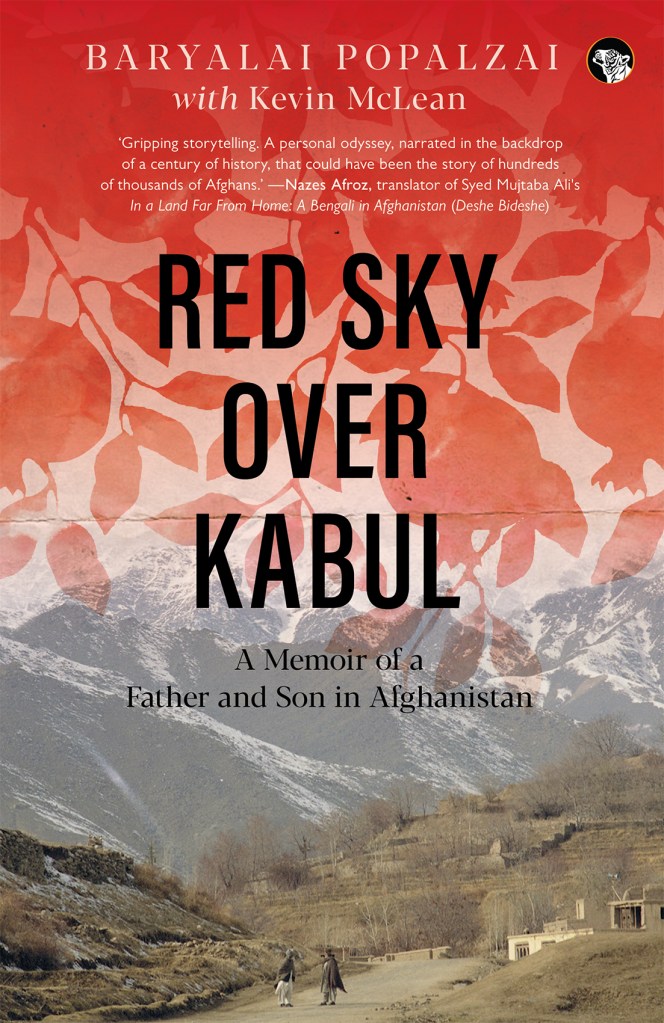
Red Sky Over Kabul

Title: Red Sky Over Kabul: A Memoir of a Father and Son in Afghanistan

Authors: Baryalai Popalzai and Kevin McLean

Publisher: Speaking Tiger Books

One
Kabul, Afghanistan, 4 October 1980

On a breezy October day, a kite-flying day, my cousin Kader surprised me with a visit. He looked much older than I remembered, his hair thinner, his once smooth face now lined with worry. He was a well-known political writer who had worked for the Ministry of Education before the Spring Revolution. He was also known for his short stories.

For generations, his family had been one of the most important families in Kabul. Kader looked at me with his deep-set black eyes and spoke in a frantic voice, ‘Bar, you must leave immediately. The National Security and Russian soldiers are now searching house to house. They’ve already searched half of your neighbourhood and they won’t stop. You must come to my house immediately. It’s the only place that will be safe for you now.’

I did not know what to think. Things were so bad now, I wondered if I could trust my own cousin. He could have given in to the Communists; or he could be telling me this because they were holding someone in his family hostage.

I hated the Russians for making me doubt him, and I hated myself for doubting him.

Tashakor (Thank you). I’ll be okay,’ I assured him. ‘I have a hiding place that the National Security will never find.’

But he was adamant. ‘You must come to my house. It’s the only place that will be safe for you now.’

‘I need time to think,’ I said, deflecting his request.

‘There’s no time!’ he said.

I told him, ‘I have to think of my wife and children, my father and mother. I’m the only one who can take care of them.’

‘You won’t be much use to them dead,’ he said.

‘That is true, Kader. But before I leave my family and go to your house, I must speak with my father.’

Kader just sighed. ‘God be with you.’

That night I lay on the floor, unable to sleep. I could hear the National Security guards in the street outside my house shouting at people, ‘What is the password for tonight?’ If there was no response, there would be the sound of gunfire and I would flinch as if the bullet had ripped through me.

As soon as the sun appeared, I went up to my father’s bedroom where he spent most of his time since losing his leg years before. I told him about Kader’s visit. ‘Things have changed,’ I said. ‘Every house is being searched now. They will even search the general’s house. I can no longer hide from these crazy people.’

‘So, you think you should go stay with Kader?’ Baba asked.

‘We don’t know who’s honest anymore,’ I replied. Then the words I had dreaded saying for so long escaped my lips.

‘The time has come for me to leave.’

Baba didn’t say anything at first. This unsettled me because my father was never at a loss for words. When he finally did speak, his voice was weak. ‘I was afraid it might come to this,’ he said. ‘I’ve spoken with Abbas. He agreed that when the time comes, he would go with you. I will get word to him. You can leave tomorrow at first light.’

When I told my mother, who I called Babu, her body shuddered, but her lips were silent. My mother had a habit of never sitting still when she was nervous. First, she paced back and forth in the room. Then she walked from one room to the other. Then from one house in our compound to another.

She returned to our living room and continued pacing back and forth until I could take it no longer.

‘Sit!’ I told her. But she never sat. My wife Afsana was asleep in another room with our two children. I couldn’t find the tongue to tell her. But I knew I must.

‘Afsana?’ I called, waking her.

Baleh? (Yes?)’

‘It’s not safe for me here anymore…I must leave tomorrow.’

‘What do you mean?’ she asked, panic rising in her voice.

‘Kader came to see me. Things have become too dangerous now. Abbas is coming for me in the morning. He’ll make sure I get out safely. I’ll send for you and the children as soon as I can.’

A painful silence followed. Afsana started to speak, but stopped. She knew there was nothing she could say or do now. We both lay awake all night.

As dawn approached, I went to say goodbye to my father.

He was sitting up in bed staring at nothing, his books and newspaper lying next to him, unread.

‘Ah, the time has come,’ he said. He seemed to be searching for something else to say; some last words of wisdom, some final advice from father to son. When he finally spoke, he spoke slowly, the words sticking in his throat, ‘Take care of yourself.’

I could not do this. ‘I won’t leave without taking you and Babu. I can’t leave without Afsana and the children,’ I said.

‘We’ll all go together!’

He was silent for a moment, his eyes never leaving my face. ‘Nay, you know that’s not possible,’ he said.

‘I can get friends to help us. They can take all your things. We’ll go to Jalalabad. Everything will be all right.’

‘Nay, Bar. It is not practical. I’m too old and weak to be moved. The Russians won’t bother Babu, or Afsana, or the children. We’ll be safe here. If we try to leave, none of us will survive. Things are very bad, but I still have my house and my writings. But it is true, you are no longer safe here, so you must leave to save yourself. Let’s pray that in a few months, things will change.’

‘If that is your wish,’ I gave in.

‘Say goodbye to me now,’ Baba said. ‘I’m afraid you won’t see me again.’

‘How can you say that?’ I protested, feeling the pain of those words as though he were already dead.

Extracted from Red Sky Over Kabul: A Memoir of a Father and Son in Afghanistan by Baryalai Popalzai and Kevin McLean. Published by Speaking Tiger Books, 2023.

ABOUT THE BOOK

 Red Sky Over Kabul is the deeply personal, moving and dramatic story of a royal Pashtun family—the Popalzais—intimately connected with Afghanistan’s history from the 1800s. After the Soviet invasion in 1980, the narrator, Baryalai—Bar—is forced to leave his beloved country as National Security guards carry out a house-to-house search for young men who refuse to fight for the Russians against their fellow Afghans. He flees to Pakistan, where he is imprisoned as a spy, eventually making his way to the US, to make a new life for himself. He returns twenty years later, to reclaim his family homes in Kabul and Jalalabad, only to find them occupied by drug dealers and warlords.

This memoir is as much a story of Bar as it is a story of Afghanistan: Bar’s father, Rahman, was tutor to Zahir Shah, who would become the last king of the country after the assassination of his father in 1933; Rahman Popalzai continued to serve Zahir as his advisor and confidant for 40 years. At the heart of this book is the relationship between a father and son—Rahman and Bar— who share a fierce love for their homeland, but whose paths diverge.

Red Sky Over Kabul is also a vivid portrait of a vanished Afghanistan—a world of kite flying, duck hunting and sitar lessons; a world lost to unending, horrific violence. But even in loss and tragedy, the human spirit finds hope and resilience—which is Afghanistan’s triumph, as it is Bar’s.

ABOUT THE AUTHORS

 Baryalai Popalzai was born in Kabul, Afghanistan in 1952. After the Russian invasion in 1980, he fled the country and eventually settled in San Diego. When the Taliban were ousted in 2002, Bar returned to Kabul for the first time in twenty years and has been returning a few times every year since then.

Kevin McLean received his JD from Boston University School of Law and practised law for many years in Boston and San Diego. He is the author of Crossing the River Kabul (2017).

PLEASE NOTE: ARTICLES CAN ONLY BE REPRODUCED IN OTHER SITES WITH DUE ACKNOWLEDGEMENT TO BORDERLESS JOURNAL

Categories
Poetry Tribute

For Danish Siddiqui

A tribute by Sutputra Radheye for Pulitzer Prize winning photojournalist, Danish Siddiqui, who died while covering a clash between Pakistan, Afghan security forces and Taliban on 16th July 2021. He is known to have said :”I shoot for the common man…”

Danish Siddiqui. Courtesy: Creative commons
For Danish Siddiqui

“I shoot for the common
 man” 

in the future
when no one will remember 
the crows anchoring
inside the small boxes
we call televisions
Danish and his photographs
will be discussed --
appreciated far beyond 
the boundaries
of classrooms and exhibitions
in streets, in protests
in the songs of humanity
and in the voices of people

the streets will never forget
the smile, the eyes
and the camera that could speak
write stories
and shake the city
inside every human
where humanity lives

Click here to see photographs by Danish Siddiqui.

Sutputra Radheye is a young poet from India. He has published two poetry collections — Worshipping Bodies(Notion Press) and Inqalaab on the Walls (Delhi Poetry Slam). His works are reflective of the society he lives in and tries to capture the marginalized side of the story.

.

PLEASE NOTE: ARTICLES CAN ONLY BE REPRODUCED IN OTHER SITES WITH DUE ACKNOWLEDGEMENT TO BORDERLESS JOURNAL.