Categories
Review

Finding Hope in Despair

Book review by Candice Louisa Daquin

Title: The First Cell and the Human Costs of Pursuing Cancer to the last

Author: Azra Raza

Unless you are an oncologist, what would possess you to read a book on cancer?

Azra Raza’s unexpectedly well written book gives you the only reason you’ll need. Because it’s necessary.

Why? We go through life without thinking of death very much. Maybe this is a good thing. However, all of us shall die. And many of us shall develop or die of cancer. Whilst we may not wish to think about this during life, that she tells us is precisely why the progression of cancer treatment has been stymied. It’s not the only reason of course. There is more money in treatment than cures. But as long as we are all too busy to read on these subjects, we can be assured nothing will change and it really does need to change.

If you read the news, you’d be forgiven for believing cancer treatments have progressed and improved. After all we want to believe that don’t, we? But like any statistic, it can be inaccurate and miss the larger picture. Unfortunately, much as we want to be positive, we need to be realistic. The truth is cancer deaths have only lessened because of social change (less smoking, healthier lifestyles) and early detection (screening programs) and not because of the actual treatment.

The actual treatment (cut, poison, burn — surgery, chemotherapy, radiation) remains the most popular of choice for battling majority forms of cancer. We can all point to the notable exceptions but they make up a relatively small percentage. The vast percentage of cancer patients are given these options in varying forms.

Those cancers that do not necessarily kill, may not terminate lives. But it isn’t because of the treatment so much as the cutting out of, or sheer luck, that the cancer was caught in time. The treatment itself, if you are unlucky enough to have an advanced cancer, hasn’t changed much (with the exception of gene therapies that have been advancing but are not applicable for all cancers) since the 1950’s. Yes, that’s right, the 1950’s.

So, while doctors want to offer hope, they do so more out of a stubborn desire to ‘try anything’ rather than because the six months they may give a dying person, is really beneficial when you consider the sheer backbreaking cost (bankruptcy from medical costs being the number one reason) and very small gains (six months more of life and you have spent all your money on a treatment which only benefits Big Pharma). The unwillingness of doctors to give up, is admirable and very human (who wants to tell someone there is no hope?) but it brings with it, a false promise.

What’s the solution? Azra Raza’s solution is very simple but mostly overlooked. She believes from her own experience of watching her husband die of cancer despite her being an oncologist and researcher that we have to stop looking for the ‘magic pill’ and go back to basics. Let’s find out what causes cancer. Let’s intervene before cancer gets a foothold. Why are we only looking at how to treat the incurable? Why aren’t we looking at how to prevent it in the first place?

Raza points to a Westernized, masculinized perspectives in the medical world that makes true research very prohibitive, that research being done is drowned out by the lack of people who will be willing to take it to the next step, and a lack of funding. Without this, we cannot hope to change a decades old ‘tradition’ and yet, this tradition is causes enormous suffering. Every time Raza sees a new advertisement on TV for a ‘platinum-based treatment’ or something that offers ‘real hope’ to cancer survivors, she is acutely aware of the enormous price tag and literal months or weeks these treatments really offer patients. She asks; ‘Is throwing up every day in agony really worth spending your life savings on for a scant six weeks more of life?’

Of course, there are miracles. But Raza says, rather than looking at the outliers, we need to be honest about how many people with cancer have horrible odds and suffer hideously at the hands of an unchanging system that doesn’t really address the problem at its root.

“We have seen that the current cancer landscape is worse than it was in the 1970s. Even today 95 percent of experimental trials continue to fail…. By law the FDA can only take safety and efficacy data into account when reviewing a drug for approval, not its price-tag.”

So, if we were to do that, what would it look like? When someone is treated for cancer, doctors reverse engineer the tumour to see if the cancer is returning in the body, that way they can ‘detect’ returning cancer and treat it. What if we could do this before cancer exists in the body, by looking at biomarkers and other evidence that pre-dates the actual development of cancer, so that along with improved screening measures, we can stop cancer before it starts?

Once a cancer has metastasized, we are chasing our tails in many ways and while this can give a patient many years of life, just as often it does not. And rather than slashing and burning and causing more cancers, if traced prior to the onset, the ‘first cell’ can be a less invasive and less catastrophic method of treating or avoiding cancer where no ‘work-up’ costs a million dollars. The concept of ‘prolonging survival’ needs to be re-examined against the invariable suffering of those who are terminal.  

As Raza says: “The very terms meant to empower end up detracting from the profound human experience of an individual facing mortality head-on in all its chaotic savagery, the physical suffering, anxiety, the grief…. The terminology of positive thinking also stigmatizes by indirectly blaming the victim.”

Additionally, we test on the wrong thing, by testing on animals we cannot hope to reproduce the effect a medication has on a human body. “I’m not saying all scientific research on animal models should be abandoned. What I am saying is that animal models are misleading and harmful for cancer drug development, because the disease cannot be reproduced in such simplistic, artificial systems.”

Using poetry from India and the Middle East, interspersed with recounting of real lives affected by cancer, Raza makes the unpalatable subject, readable. I cannot say this is easy reading, or that it will be a book many lay people read, but I’d hope more than cancer sufferers pick this up, because there is a real answer here, and it’s written with such compassion and intelligence, it’s as evocative and vital as the very treatments it considers.

I was so impressed with the bright star that is Azra Raza and her courage, compassion and bright mind. If more were like Raza, maybe we’d already be further along the road in offering long lives to those with cancer. We may instinctively wish to turn away from this subject and thus, this book. But if we do one thing for ourselves, we should read The First Cell and consider, if not for ourselves, for someone we love, if we are mindlessly ignoring the problem and thus, letting it perpetuate. We need to have this conversation and we have needed to have had it since the 1950s. Let’s be brave enough now. As Raza says:

“There is no activism without despair, no despair without hope. Despair can be as powerful an engine for change as hope.”

.

Candice Louisa Daquin is a Sephardi immigrant from France who lives in the American Southwest. Formerly in publishing, Daquin is now a Psychotherapist and Editor, having worked in Europe, Canada and the USA. Daquins own work is also published widely, she has written five books of poetry, the last published by Finishing Line Press called Pinch the Lock. Her website is www thefeatheredsleep.com

.

PLEASE NOTE: ARTICLES CAN ONLY BE REPRODUCED IN OTHER SITES WITH DUE ACKNOWLEDGEMENT TO BORDERLESS JOURNAL
Categories
Review

Reconciling Difference

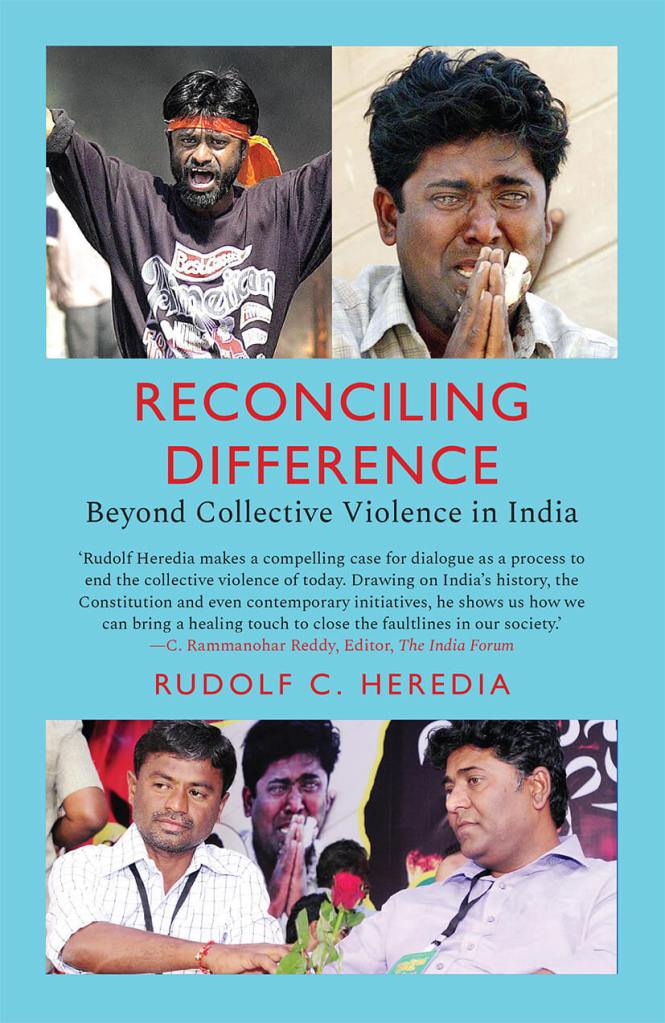
Title: Reconciling Difference — Beyond Collective Violence in India

Author: Rudolf C. Heredia

Publisher: Speaking Tiger Books, 2021

“When the British Imperialists left the Indian subcontinent in 1947, they left behind a legacy of governance based on communal and ethnic polarization. Since then, India has been engulfed by religious and ethnic violence—from the Partition to the more recent Gujarat riots of 2002 and Delhi riots of 2020. This trajectory is in direct opposition to the ideals of ‘justice, liberty, equality and fraternity’ enshrined in the Indian Constitution. Our increasingly polarized society is now faced with the question: Will India follow the ethnic nationalist route that seems to be becoming a global phenomenon?” enquires the blurb of this remarkable book.

Reconciling Difference — Beyond Collective Violence in India by Rudolf C. Heredia is an attempt by an anxious citizen and academic to understand the nature of hate and violence prevalent in India. It is also an effort to find practical ways to restore peace and harmony–so essential to present turbulent times.

A leading sociologist and thinker, Heredia is an independent writer and researcher. Based in Mumbai, he taught sociology at St Xavier’s College, where he was the founder director of the Social Science Centre. With a keen interest on issues related to religion, education and globalization, Heredia has authored Changing Gods: Rethinking Conversion in India andTaking Sides: Reservation Quotas and Minority Rights.

In the preface to the book, Heredia writes: “Violence has no borders. It is like a forest fire which once lit, even if by an accidental spark, in a dry, hot summer drought burns out of control, fanned by the wind until the entire forest is gone. It must then wait for the next rains to restore it. If the rain fails, desertification will inevitably follow.”  

He continues: “But first the crisis must be recognized before it can be addressed, the problem understood, before a resolution can be attempted. The urgency of the present emphatically suggests that collective violence in India, with its brutalizing horrors, is now becoming the new normal.”

In this in-depth study, Heredia urges citizens to seek contexts beyond punitive justice. What he suggests is returning to the Gandhian ideas of ahimsa — non-violence and compassion — in order to heal the fraying fabric of the society. While doing so, he recalls Nehru’s ideas of a pluralist and inclusive India, as well as Ambedkar’s idea of the republic.

With eight reasonable and coherent chapters, Heredia inspires the readers to undertake a politico-historical journey — the way promises were broken and hopes betrayed, the cultural/psychic/political roots of the “spiraling violence”. In this quest, he feels the need to understand Gandhi as “a new hermeneutic is needed to dialogue with Gandhi’s counter-culture and its basic themes of swaraj, swadeshi and satya”.

Relying heavily on pedagogy, Heredia is unfaltering in his conviction. He feels intensely about restoring the country’s damaged polity. Drawing inspiration from the Truth and Justice Commission set up in post-Apartheid South Africa, he urges steady and thoughtful discourses between polarized citizens in order to heal the past wounds of collective violence. Drawing on India’s history, the Constitution and even contemporary initiatives, he shows us how we can bring a healing touch to close the fault lines in our society.

Sample this: “If this dream of peace is to become a reality, we must divest ourselves of a great deal of the presumptions and pre-options we have been, and still are being socialized into by exclusive communal identities and religious fundamentalisms, national extremists and radical rationalism.”

What distinguishes this volume from other such works is its ability to persuade the reader to see the disgruntlements of the times we are living in, comprehend the pathology of the limiting identities, cultivate the art of dialogue, understand plurality and differences, and move towards peace.

Heredia concludes the book by saying: “We need to deconstruct this ideology of exclusion and the politics of hate. We need a struggle, a jihad, a crusade, a padayatra for the idea of a sovereign, democratic secular socialist India. We need to sow the good seed of meaningful, relevant, liberating humane cultural and religious traditions for a hundredfold harvest of a harmonious peace, premised on tolerance and justice, forgiveness and reconciliation. For if we stop dreaming peace, we will stop dreaming India.”

Written in a florid yet graspable language, the argument put forward is persuasive and convincing. Far from being a hypothetical one, the 300 plus paged book is observant, dialogic and meticulously researched and with a touch of contemporariness. Heredia offers solutions to every problem and every delinquent behavior. Coming as it is from a renowned sociologist-activist, this book is an essential read, especially for those who are concerned about preserving the secular and democratic ideals of India.

.

Bhaskar Parichha is a journalist and author of No Strings Attached: Writings on Odisha and Biju Patnaik – A Political Biography. He lives in Bhubaneswar and writes bilingually. Besides writing for newspapers, he also reviews books on various media platforms.

.

PLEASE NOTE: ARTICLES CAN ONLY BE REPRODUCED IN OTHER SITES WITH DUE ACKNOWLEDGEMENT TO BORDERLESS JOURNAL
Categories
Review

Whose Land is it Anyway?

Book Review by Nivedita Sen

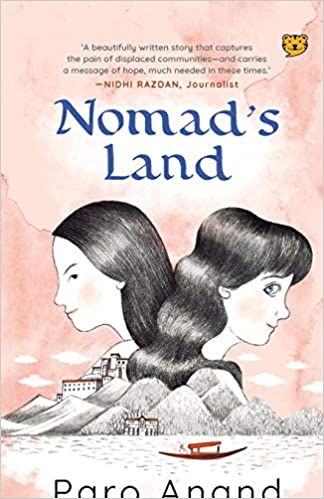
Title: Nomad’s Land.

Author: Paro Anand.

Publisher: Talking Cub (an imprint of Speaking Tiger Books), 2020

We live in times when the business of children’s literature increasingly turns towards desanitising the world around child readers to expose them to real life accounts of hatred, violence, othering and numerous other ills that are perpetuated around them in a way that they can decide for themselves who or what they want to be amidst all this. In a universe torn by war and the hostile drawing of lines, Paro Anand’s writings are sentient, sensitive and sensible exemplars of portraying the child reader’s realm as one that can subsume the world within it if s/he wants it to. In her book of stories Like Smoke, or her novels No Guns at my Son’s Funeral and now Nomad’s Land, she has let her child protagonists tread on and explore many of the concerns in the lives of adults.

Anand has talked about two ethnic groups – the Kashmiri Pandit community that had fled the valley in the eighties due to terrorist violence that often targeted them, and the imagined Qhushvaha people in the higher plateaus who had got dislodged from their homeland due to the political upheaval in which they had been ostracized by their own kinsmen, a combination of many such marginalized groups of children that the author has been interacting with. The Qhushvahans have come and resettled in what can perhaps be recognised as Majnu ka Tila, the Tibetan resettlement colony of Delhi, although Delhi has been named in the entire novel only once in relation to the Kashmiri Pandit girl Shanna’s grandparents’ residence.

The refugees have made it their camp, their home away from home, by severing their link with their own ancestral territories, reinventing the colony’s open sewer lines as the river that flowed in the lap of Mother nature back home, and reinforcing their disconnect with their own land of not so long ago. Anand claims that this group is based on a combination of children from Tibet, the North East, the Rohingyas, the Syrian child who had been left to die between shifting sands, decriminalised tribes like the Pardhis, and finally the children of the migrant labour who had to flee the cities to walk back to their villages immediately after the declaration of the lockdown with no sense of belonging to any definite region. When Anand mentioned the last group in an interview, one could sense a goosebump-raising contemporaneity about the story. The Qhushvahans represent what Anand calls the ‘Everyman of Nomad’s land’.

Amidst all messages of acrimony that children receive from their parents, Anand, who works with children of various backgrounds, says that they do not necessarily internalise those abrasions, fissures and fractures. She uses a beautiful metaphor when she says in an interview that she wants to spread the message of love and peace by teaching children addition and multiplication rather than subtraction and division. Shanna the Kashmiri girl is one such child who overcomes her diffidence in the subtle manner in which she connects with the other children of her school when Pema her friend is away and suggests to them that we could all be trees. What she means is that even if we have lost our own roots, we could grow not only branches but new roots, a message of inclusiveness that makes them rethink their inherited prejudices about the Nagas. It suggests a review of inbuilt bad blood passed on by our parents.

Pema, the Qhushvaha girl in the refugee colony, is preoccupied with something else — liberating her old grandmother or mola from her racking cough and releasing her into death through an ancient practice of ‘breathtaking’ that is performed on those who are leading vegetable lives in the twilight of their lives. It has, of course, been banned by the government because it is a kind of mercy killing. Anand points out that when laws and policies are framed in a country with a multicultural canvas like that of India, we do not take into account that one size cannot fit all. Interestingly, Shanna is included in this project. She is entrusted with the task of enabling Pema’s mola cross the bridge to death because a kinsman is not supposed to do it.

The cough becomes a motif that unites the frail and elderly across the book — Debek Dan, the only man who can teach Shanna how to perform the breathtaking ritual, Shanna’s grandfather who significantly learnt indigenous medication from a Muslim hakim friend, and Pema’s grandmother. Shanna realises that the cough that links these three people has to do with the pollution in a big city, which is where they had had to resettle after having been natives of “forever skies and endless horizons”. 

An ecological concern over the abuse of the environment comes through in the images of the open drain choked with plastic wrappers that acts as a surrogate for a river or the respiratory distress that affects the elderly across communities that were inhabitants of the mountains. That is when Shanna and Pema hit upon the idea of going back to Kashmir to procure some ingredients like roots and herbs for Nanaji’s medicines from the higher reaches of the Himalayas.

Both of them want to become doctors of indigenous medicine when they grow up, and Debek Dan’s daughter, Doyang, is willing to be an accomplice in their enterprise. The starting point of the fantasized venture would involve a reconnaissance trip to Kashmir themselves to stay with Huma and her family.  And the novel ends with Shanna and Pema undertaking a  mission that seamlessly and happily weaves together so many disparate strands in the novel — Shanna’s mother’s stops mourning to start a new life by accompanying the two girls, the reunion with Huma on whom Shanna had perpetrated communal hatred without any provocation, the understanding that Huma’s family has also been the victim of terrorist violence, the fusing together of Ayurvedic, Unani and Qhushvaha medicinal practices to solve a medical crisis in which the elderly in the novel suffer due to the hazardous air quality index in the urban pockets of the plains, and the children’s environment-friendly command over the ambience we live in. As Anand admitted herself, despite her effort to expose her child readers to sordid truths about the life around them, she ends her stories on a hopeful note so as not to leave them feeling stressed, anxious or depressed. Pema is a doer to begin with, and both the girls go up and about towards the end, therefore, to act positively on something that needs to be done to make the world a better place to live and breathe in.

Anand’s invention of the race of Qhushvahans involves not only creating a history and a geography about them, representing a protagonist, Pema as the ‘Everyman of Nomad’s Land’, but constructing a language that expresses itself in the quaint Qhushvaha deathbed rituals and chants, and making up nomenclatures (like Mola for grandmother) and facets of their culture like clothes. The English language is used by the possibly pre-teen protagonists in a way that shows real children imitate their peer group and improvise. Shanna, it is shown, feels progressively proud of being included in a group that uses adolescent colloquialisms like dude, swag, grandmom, wanna, whack, lezzies – what she calls “real TV language”.

The book deploys an anachronistic time scheme in which internet and cellphones exist in the early eighties in which the story is set. She says that this is to enable the children of the here and now to identify and feel more at home with its setting.

Paro Anand’s themes and portrayals have been such that a lot of censorship has been imposed on them by the adult gatekeepers of children’s morality. One of her books was banned from school curriculums because two adolescents of different communities share a fleeting kiss in it, and Anand justifiably calls such censorship the banning of books “for the love of hate.”

It is a work for children that is not only food for thought for children who are trying to find their feet around in a big, bad world but also makes adults pause and revisit the biases with which we inadvertently indoctrinate our children. 

Nivedita Sen is an Associate Professor in English at Hansraj College, University of Delhi. She works on Bangla children’s literature, and has translated authors like Tagore, Sukumar Ray, Asha Purna Devi, Leela Majumdar and others for Harvard University Press, Vishwabharati Press, Sahitya Akademi, Katha, Tulika and more. 

.

PLEASE NOTE: ARTICLES CAN ONLY BE REPRODUCED IN OTHER SITES WITH DUE ACKNOWLEDGEMENT TO BORDERLESS JOURNAL
Categories
Review

Socio-political Thought of Rabindranath Tagore

Book Review by Bhaskar Parichha

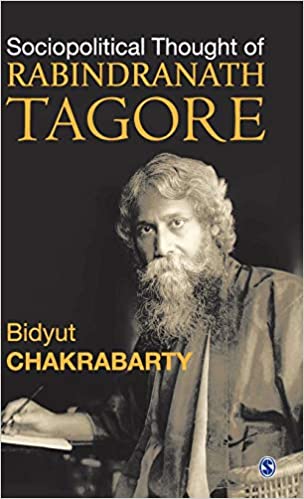
Title: Socio-political Thought of Rabindranath Tagore

Author: Bidyut Chakrabarty

Publisher: SAGE Publications India, 2021

Eighty years after his death, Rabindranath Tagore continues to be written about. Any biographical or critical account of Tagore’s life and works — whether it is in Bengali, English or any other language — is noticeable and is received with reverence and respect. Rabindranath Tagore’s poem, ‘Where the Mind is Without Fear’, demonstrates the continuing universal appeal of the poet’s signature composition.

For the bard whose immortal lines reverberate even today — “If no one answers to your call, walk alone, walk alone” — no number of books can be enough to have another look at this great mind.

Tagore’s vision of transcending time, place, space and national boundary continues to resonate with people’s dreams and hopes all over the world. To read and understand Tagore, it is also necessary to understand the various national and global events of the late nineteenth and early twentieth century which critically shaped the poet’s language, incorporating distinct narratives.

The Socio-political Thought of Rabindranath Tagore by Bidyut Chakrabarty presents a comprehensive and detailed analysis of the socio-political, socio-economic and ideological preference of Tagore, with emphasis on nationalistic, inclusive and gender development ideas. It shows that Tagore’s socio-political ideas remain relevant not merely as a package for intellectual rejuvenation but also as a meaningful device for socio-economic transformation for the world.

Vice-Chancellor of Visva-Bharati, West Bengal, and former professor in the Department of Political Science, Delhi University, Bidyut Chakrabarty is a reputed academician having taught in prestigious universities across counties. Chakrabarty has also authored Public Administration: From Government to Governance, Winning the Mandate: The Indian ExperienceCommunism in India: Events, Processes and IdeologiesIndian Politics, Society since Independence: Events, Processes and Ideology and The Governance Discourse: A Reader. His new book, Socio-political Thought of Rabindranath Tagore — all of 400 pages — is a venerable account of Tagore’s mental universe, his idea of nationalism, his thoughts on socio-economic reconstruction, his understanding of gender issues, his approach to education and, finally, his comprehension of universal humanism.

Says the blurb: “Rabindranath Tagore, an icon of humanism and universalism who always privileged India’s argumentative traditions, remains a source of inspiration for humanity. However, Tagore’s social and political ideas appear to have received inadequate attention presumably because of the hegemonic influence of derivative Western ideas and thoughts. This is where Tagore stands out, not only as a poet but also a visionary who charted a course of action in tune with human betterment, cutting across all kinds of man-made barriers and customary restrictive social, economic and political practices.” 

Chakrabarty sets out to understand Tagore’s political and social philosophy of universalism, humanism and cosmopolitanism, which the poet, to a large extent, inherited from his distinguished family lineage. As Tagore himself wrote, “It was as if we lived close to the age of pre-Puranic India through our commitment to the Upanishads. Along with that, there was a genuinely deep love of English literature among my elders.”

Writes Chakrabarty in the introduction: “An icon of humanism and universalism who always privileged India’s argumentative traditions, Rabindranath Tagore, popularly known as Gurudev, remains a source of inspiration for humanity. Born in a wealthy family with serious concerns for India’s cultural heritage, Gurudev designed, through his creative writings, a uniquely structured tapestry for India and the globe.

“Based on his own understanding of India’s cultural past, Tagore revived the lost socio-cultural traditions and ideological inclinations of the past just to develop a repertoire of knowledge that he thought was one of the effective means of rejuvenating a moribund nation reeling under colonialism.”

Chakrabarty writes in the prefacing remark  : “The book is a historical document in the sense that it was written at a critical time in India’s recent history when the entire nation voluntarily accepted home quarantine  to defeat the invisible  enemy in the form of COVID-19 virus that led to a pandemic in 2020.This was a testing time for humanity and the exemplary  steadfastness shown by everybody cutting across spatial boundaries  once again  proved that we win if we are united  and fail when divided.”

The book offers insights into Tagore’s political viewpoint developed through his interaction with leading personalities and ordinary people in India and abroad. There are several contradictory layers in his political vision. Tagore admired Ram Mohan Roy, but differed from his ideological outlook and disdained Bengali elites for imitating their colonial masters. He disagreed with Bankim Chandra’s ‘aggressive nationalism’. Though he appreciated the Western ideas of scientific progress, he made a trenchant critique of imperialism. He attended meetings of the Indian National Congress (INC), but disapproved of its policies and scorned its leaders for mimicking the West in their language and attire.

Then, how different was Tagore’s universal humanism? Writes Chakrabarty: “A firm believer in the notion, Tagore stayed away from the hurly-burly of national politics. Despite sharing the nationalistic condemnation of the colonizer, Tagore never allowed this restrictive vision to cloud his concern for human emancipation.”

What makes the book noteworthy is the logicality, lucidity of the language and its wholesome approach. Engaging and informative, the book is an essential read to know Tagore’s belief in social cohesion and the all-inclusive approach articulated in his political ideas.

.

Bhaskar Parichha is a journalist and author of No Strings Attached: Writings on Odisha and Biju Patnaik – A Political Biography. He lives in Bhubaneswar and writes bilingually. Besides writing for newspapers, he also reviews books on various media platforms.

.

PLEASE NOTE: ARTICLES CAN ONLY BE REPRODUCED IN OTHER SITES WITH DUE ACKNOWLEDGEMENT TO BORDERLESS JOURNAL
Categories
Review

“Talkin’ About A Revolution”

Book review by Rakhi Dalal

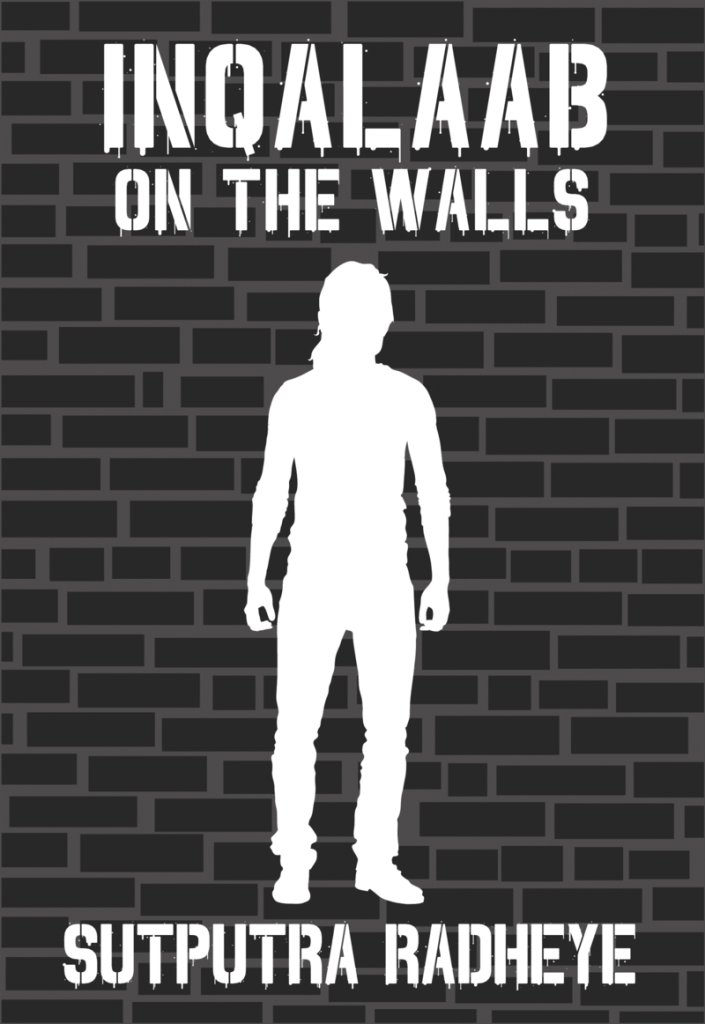
Title: Inqallab on the Walls

Author: Sutputra Radheye

Publisher: Delhi Poetry Slam, 2020

Sutputra Radheye is an Indian poet. His works have been published in several national and international magazines and journals. This book was published by Delhi Poetry Slam in the year 2020.

Inqallab* on the Walls is a collection of 50 poems. As is reflected by the title, these poems are poems of resistance. In choosing to name it thus the poet, in times disrupted by oppressive forces, seems to be making an attempt to claim a space for his resistance. Walls are spaces which have always become a site of defiance, of resistance of common man against injustices of State in a society. The poet appears to write with the intention of registering his resistance, and the voices of those oppressed, loudly for everyone to notice. 

In his essay, “Resistance and Poetry”, K. Satchidanandan writes:

Resistance in art has a complex relationship with this resistance by the people. It tries to discover parallel aesthetic and emotional structures and create new languages adequate to express the new energy. In one sense art is essentially oppositional as it works against hegemonic ideologies and status-quo structures and ever strives to “make it new”.

The poems in this collection, echoing the voice of common people, reflect an artist’s opposition to the oppressive structures, like state, capitalist system, caste and patriarchy. In the first poem, “Singing like a Crow”, his defiance in the face of accepted structure of poetry comes forth quite forcefully.

You.
Yes you.
I am talking to you.
Look at me.
I too am a poet.
Listen to me.
Though, my feather is burnt
in the fire of corrupt sun,
I carry a bleeding pen.
Ugly, and dangerous,
I fly like the dragonfly.
Cage me. Please try.
My wings won't screech
                            like the tyres 

The poet’s pen is ugly and dangerous because it is bleeding. And though his feather is burnt he knows he can soar like a dragonfly and wouldn’t falter. This poem starts with a promise as the poet appears to challenge the privileged world of Indian English poetry which follows certain aesthetic principles and has long been the domain of a small elite group reading poetry in comfortable spaces. And just as the reader becomes engrossed in the voice, a little sloppiness jerks the attention. Why compare wings with tyres? One wonders if a better simile could perhaps be used, the impact would have been more pronounced.

This is a stanza from next poem “The Dictator”:

There is a hummingbird in my throat, dictator,
Singing the songs of free beckon.
There is a hummingbird in my throat, dictator,
Afraid, who is not, of your weapon.

As much as a reader may wish to admire the intent of poet in giving a voice to resistance, the experience is marred by the evident laxity in choosing words for the sake of rhythm. This happens with many poems in the collection. The choice of similes and metaphors do not add to make the poems impactful which may have been the poet’s aim.

In some poems the poet uses Biblical imagery. For example in following stanzas from two different poems:

When I die-
I shall go to the hell
And meet comrade, Lucifer
To listen to the anecdotes
Of the first rebellion
Of oppressed on oppressors. (When I Die)


I shall light up the torch extracting fire from the sun
To burn the forbidden, puritan trees for freedom
Living hidden from the barbed gates in a corner
Waiting for the comrades with kerosene to reach. (Walk Alone!)

In “When I Die”, Lucifer is referred to as a comrade whom the poet wishes to meet in the hell after death. He doesn’t wish to go to heaven, which might be the place that home his oppressors, but rather to hell so that he may listen to the stories of first ever rebellion. In “Walk Alone”, the poet speaks about burning the ‘Forbidden tree’ for freedom, the reference is to the rigid societal systems which oppresses certain classes of people. However, by making use of such imagery, the poet seems to be drifting away from his notion of reclaiming space in the otherwise established conventions of the art form.

As one moves along in the collection, reading one poem after another, the poems which should speak to you because they seem to be coming right from the heart, the poems seething with anger against oppressors of all kinds, the poems seemingly calling the readers, the fellow people to stand up and take control, somehow fall short on the intended impact because of slack, and sometimes very casual word selection.

.

*Inqallab — Revolution

Rakhi Dalal is an educator by profession. When not working, she can usually be found reading books or writing about reading them. She writes at https://rakhidalal.blogspot.com/ .

.

PLEASE NOTE: ARTICLES CAN ONLY BE REPRODUCED IN OTHER SITES WITH DUE ACKNOWLEDGEMENT TO BORDERLESS JOURNAL. 

Categories
Review

Bridging Cultures

Book Review by Gracy Samjetsabam, commemorating the tenth anniversary of the 2011 tsunami in Japan. Resilience and recovery can be learnt from a survivor of the Tohoku earthquake as the protagonist learns.

Title: Indigo Girl

Author: Suzanne Kamata

Publisher: GemmaMedia

Suzanne Kamata is an American writer, academician and fiction editor based in Tokushima Prefecture, Japan. She has authored or edited 14 books including, award-winners Gadget Girl: The Art of Being Invisible (GemmaMedia, 2013), Squeaky Wheels: Travels with My Daughter by Train, Plane, Metro, Tuk-tuk and Wheelchair (Wyatt-Mackenzie, 2019), Pop Flies, Robo-pets and Other Disasters (One Elm Books, 2020), Indigo Girl (GemmaMedia, 2019); and other novels, travel writings and short stories. Her next novel The Baseball Widow (Wyatt-Mackenzie Publishing) will be published in October 2021.  

Indigo Girl is a story of Aiko Cassidy, an aspiring manga artist and a confident and sensitive 15-year-old bicultural teenager with cerebral Palsy. She is raised in Michigan by a single mother who is a sculptor and for whom, Cassidy is her muse. When her mother marries Raoul, her Hispanic step-father and he moves in with them, there was hope for her adoption and completion of a dream for a perfect family. But when a baby step-sister arrives, she starts feeling tugged at the margins.

In the meantime, she gets invited to spend three months in rural Japan in Tokushima in her biological father’s home, who is an indigo farmer. She sees it as an occasion to explore the hitherto unknown link of her life and root her belonging. She planned well in advance and looked forward to experiencing and fitting in into her role as a half-Japanese. However, her vacation in Japan is filled with shocks and surprises in contrast to her initial excitement and imaginings. She had conjured up images of her stay and even thought of the summer-break in Japan as a means to provide inspiration for her manga story, Gadget Girl, if not anything else.

The meeting of cultures and the clash of expectations and reality sets in, as she travels deeper into lives of people in Japan. Cassidy has her many complaints and concerns as a differently-abled teen stuck in-between the construct of family and relationships. In the conditions rendered by marriage, or in coping with grief and loss of a young one, or in turning homeless, or in living the life of a refugee, she comes across the many complicated truths and realities of people.

She meets Junpei, her Japanese half-brother, who dreams of getting out into the world as a young boy but for his predicament in being the sole heir to the 200-year-old family farm and the indigo farming legacy. Obashan, her grandmother obsessed with the love and loss of Kana, her younger Japanese step-sister to leukaemia, ignored the existence of Cassidy, her other granddaughter. Mariko, her Japanese step-mother, whose silence spoke louder than her words was more like a friend to her. In her Otosan’s (father’s) house, she figured out a lot was left unsaid but decided to speak out her heart and build bridges on the rift between her father, her father’s family and her.

Cassidy confronts her father by juxtaposing their places as characters in fiction and in reality. While they discuss the Italian opera, Madame Butterfly, her father gives his own point of view and she does hers to realise how complicated life’s choices and what we become are. Every small experience through participation in the family trips, visiting people, stories, visits to parks, temples and shrines made her culturally and personally wiser. She realises that “Change is inevitable” and that “life goes on”,

Cassidy’s story is a stand-alone sequel to Kamata’s book Gadget Girl, as it uniquely represents the story of a differently-abled child’s quest for greater clarity on her desires and the reality.

In her brief stay, having come from the West and with cerebral palsy, she attends a bilingual school and is introduced to all as Junpei’s cousin. She falls for Taiga, an upcoming figure skater. He respects her feelings for him, becomes a good friend. From his dedication to his profession, she learns the art of persistence against self-doubt. She tells Taiga that she is not Junpei’s cousin and Taiga says it is not a secret to many at school. She gets conscious of being called “disabled”, “bastard”, and “unwanted”. She draws inspiration from the resilience and learns to hope to “begin again” from Kotara, a refugee of the March 11, 2011 earthquake and tsunami disaster which killed 15,500 people, caused a nuclear power plant meltdown and damaged the economy, making many homeless to this date. Kotara was one of them. Taiga’s understanding, Junpei’s sibling bonding and her friendship with Sora and other manga enthusiast members in the club at school, make  her feel as one with them.

Today’s continuously growing multicultural world needs more diverse stories. Kamata does her share of diversity writing by touching on issues such as biracial upbringing, single motherhood, divorce, re-marriage, step-children relationship, sibling rivalry, sibling bonding, trust, jealousy, parenting, love, death, disaster, refugees, stereotyping, stigmatisation, differently-abled children and inclusion. Kamata beautifully brings up the unconventional and often untouched areas in fiction with warmth and understanding. Family secrets, rituals, traditions, and what is spoken and what is left unspoken, speaks in volumes about the lives of people. The characters voice relevant issues with ease and confirm the importance of writing and speaking out on the many challenges and realities of life.

Kamata’s love for writing blends with the love of a mother in her works to reflect experiences of a multicultural, multilingual, multiracial and multi-abled world.

In the beginning of the story, Cassidy talks about her present self and her trip to her real father’s home in Japan and puts her condition as: “I’m in the sky. Here above the clouds, I’m in limbo: between America and Japan, between the past and the future. It’s weird, but for once I feel as if I’m where I belong.” In the concluding chapter, she again says, “And then I’m in the sky again, above the clouds. Between Japan and America, the past and the future.” The experiences in between, though happy and sad, come as a treat to the reader.

I would call Indigo Girl a heart-warming and compelling coming-of-age novel, a must read.   

.

Gracy Samjetsabam teaches English Literature and Communication Skills at Manipal Institute of Technology, MAHE, Manipal. She is also a freelance writer and copy editor. Her interest is in Indian English Writings, Comparative Literature, Gender Studies, Culture Studies, and World Literature. 

.

PLEASE NOTE: ARTICLES CAN ONLY BE REPRODUCED IN OTHER SITES WITH DUE ACKNOWLEDGEMENT TO BORDERLESS JOURNAL

Categories
Review

Ray’s Goopy Bagha Revisited

Book Review by Nivedita Sen

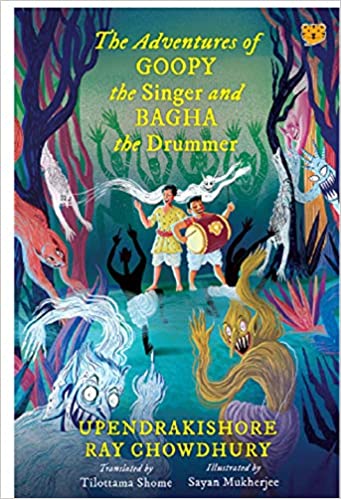
Title: The Adventure of Goopy the Singer and Bagha the Drummer

Author: Upendrakishore Ray Chowdhury, translated from Bengali to English by Tilottama Shome. Illustrations by Sayan Mukherjee.

Publisher: Talking Cub, an Imprint of Speaking Tiger Books, 2020.

Upendra Kishore Ray Chowdhury’s name was well-known as an innovative children’s writer, painter, musician, photographer and a pioneer printer-publisher in the late nineteenth century. His grandson, Satyajit Ray, immortalized his long short story for children ‘Goopy Gyne Bagha Byne’ as a reputed film that deployed a lot of music, dancing and fantasy elements.

This graphic version of the story, particularly its musical score that was penned and directed by Satyajit Ray himself, had almost obliterated the children’s tale that was a household word in Bengal earlier. Since it is a story about two naïve, rustic boys who desperately try to be a singer and a drummer respectively, Satyajit Ray worked on and elaborated the musical potential of the story by writing lyrics for songs that could be sung by Goopy, with Bagha’s drumming as accompaniment. The songs like Dekho re Nayan Mele ( Opening Your Eyes and Look), Bhuter Raja Dilo Bor (The King of Ghosts Grants a Wish) and Maharaja Tomare Selaam (Salute to you Maharaja) have been all time favourites for the last fifty years. The two sequels to the film, Hirak Rajar Deshe (Hirak King’s Kingdom) and Goopy Bagha Phire Elo (Goopy Bagha Return) were written by Satyajit Ray himself, although the latter was directed by Ray’s son Sandip Ray. The innocuous Bengali story therefore surfaced on the celluloid screen, and then extended through sequels to follow the adventures of Goopy and Bagha through time.

The status of an internationally acclaimed film also enabled the story to traverse across space by getting translated in different languages, particularly English. Among recent translations are those by Swagata Deb (Penguin, 2004) and Barnali Saha (Parabaas, 2012). Perhaps in order to communicate a different tone and emphasis, in this one, Tilottama Shome took up another translation. She has stuck to each and every word of the original. Although Upendrakishore’s stories have been translated by well-known scholars, editors and translators like William Radice, Madhuchhanda Karlekar and Arunva Sinha, this translation is also very fluent. The use of casual vocabulary in English that is used on a daily basis, like ‘vocal warm-ups’, ‘country bumpkins’ and ‘spooked’, add to the readability of it. The illustrations by Sayan Mukherjee, which include a lot of the ghosts, is brilliantly evocative of the ghostly fun and frolic in Ray’s film.

The story, which is something between a folk tale, a benign ghost story and a fantasy around a realistic setting with two ingenuous protagonists, has many violent episodes. Most of Bengali children’s folk-fairy tales like those in Dakshina Ranjan Mitra Majumdar’s Thakurmar Jhuli portray such unpleasant interludes, which is not different from Grimms’ or Hans Andersen’s Fairy Tales depicting brutal human behavior and blood and gore. Such violence and deaths go back to the earliest children’s stories, possibly to equip children with the overpowering truth that is an important, if an unsavoury, aspect of life. The violence becomes an indispensable component of children’s stories, since children need to be aware of what they might confront in the real world.

Bruno Bettelheim, a psychologist who tried to read fairy tales in terms of Freudian psychoanalysis, said that children need to be exposed to fairy tales with grim episodes in them. He demonstrated that these dark happenings, fantastic as they may be, expose and initiate the child to real life that is inclusive of the ruthless and the arbitrary and contribute to children’s holistic understanding of life. In this story, when Bagha goes home, he finds that his parents have died in the interim he was away. Goopy’s parents remain alive, perhaps to signify that deaths in real life are ubiquitous, imminent but random. But there is greater cruelty than death in children’s stories.

According to Ernest Jones, Sigmund Freud’s biographer and a psychoanalyst in his own right, the savagery in children’s stories represents expressions of the unconscious mind like the jealousy and hostility inherent within family relationships. He elaborated how abstract moral concepts like anger, fear and guilt are ‘physicalized’ and ‘externalized’ in children’s tales to enable children to conquer them. Also, after acknowledging these harsher primal feelings and instincts, the child gets to make sense of what is happening all around.  Goopy and Bagha’s boat loses balance and capsizes due to their cacophonous singing and drumming, causing the passengers to tremble and roll around. This drowns and kills all the passengers except the two of them who are also terrified but keep afloat by clutching on to Bagha’s drum. But Gidwitz, a twenty first century children’s writer, explains how violence is deployed as a didactic tool to reinforce the moral certainty of good triumphing over evil, which must be punished. For example, in another episode where the garden house of the king is burnt down by the guards in accordance with royal injunctions, everyone who was responsible for proactively setting fire to the house dies but Goopy and Bagha, who are inherently good,  escape with the help of their magic boots.

Goopy Gyne is also a ghost story with a difference. Ghosts appear in such a story within a realistic backdrop, not by invoking them or within a supernatural setting, but out of the blue. They also do not haunt an individual human being, a particular place/ house or a specific object, and are therefore aliens who are removed as suddenly as they appear from the forest in which they are discovered, after they have performed their task. They are not characters who take part in the narrative.

Goopy and Bagha initially get panic-stricken on seeing the glowing eyes of the ghosts that are like burning coal and their radish-like teeth. However, these are not the spirits of the dead that have revived to take revenge or to try to fulfill their unfulfilled desires in life. These ghosts continue to act as external agents who empower the two friends, much like the fairy godmothers in fairytales who grant boons to the protagonists and rescue them from perilous situations.

The terror that these ghosts have the potential to invoke is one that instead becomes a pleasant experience because Goopy and Bagha learn very soon that these spirits are extremely generous. The film is also enlivened with the scene with the ghosts. The narrative describes a curious reversal in which Goopy and Bagha are themselves mistaken as ghosts, thanks to all the miraculous scenes associated with their magical powers.  But their achievement of raining delicacies and sweets, their accoutrements in looking like princes or the magic episodes of the two friends fleeing from any difficult situation with the help of their enchanted boots is actually an outcome of the three wishes granted to Goopy and Bagha by the ghosts. The ghosts are responsible for bestowing melody and rhythm to Goopy and Bagha’s music that used to be tuneless, jarring and noisy before.

The music in the story is wholly their contribution, something that has been underscored by Satyajit Ray in delightful compositions in the film. It might, in fact, be a pioneering enterprise, copyright permitting, to translate the screenplay that includes the songs.

Nivedita Sen is Associate Professor in English at Hansraj College, University of Delhi. She works on Bangla children’s literature, and has translated authors like Tagore, Sukumar Ray, Asha Purna Devi, Leela Majumdar and others for Harvard University Press, Vishwabharati Press, Sahitya Akademi, Katha, Tulika and more.

.

PLEASE NOTE: ARTICLES CAN ONLY BE REPRODUCED IN OTHER SITES WITH DUE ACKNOWLEDGEMENT TO BORDERLESS JOURNAL. 

Categories
Review

Travel Stories Beyond Borders

Book Review of an anthology of travel essays by Gracy Samjetsabam

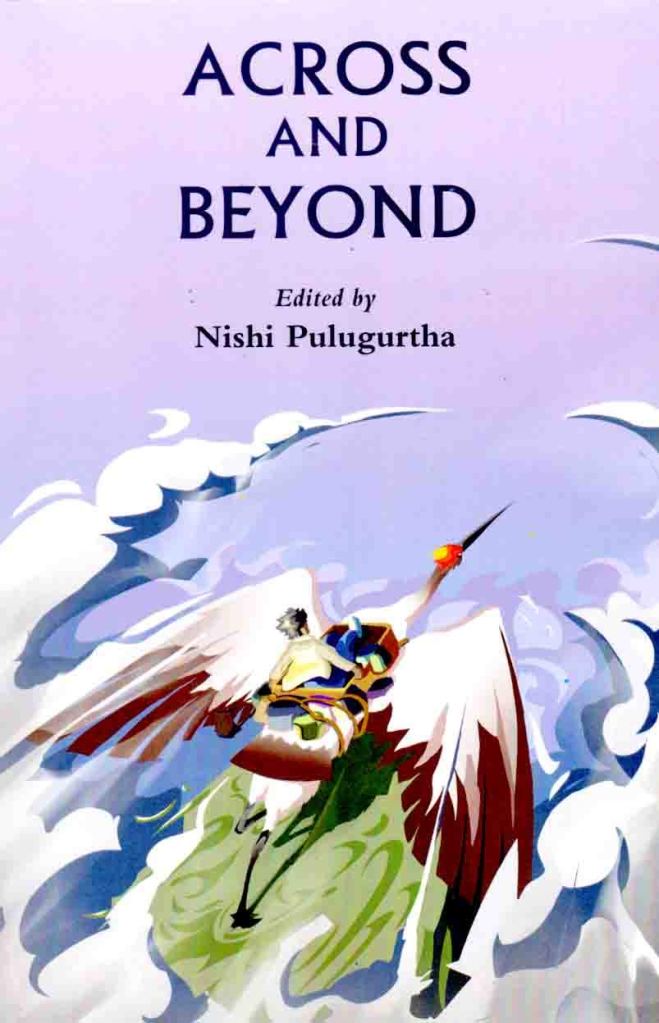
Book: Across and Beyond

Editor: Nishi Pulugurtha

Publisher: Avenel Press, 2020

Across and Beyond edited by Nishi Pulugurtha is an anthology of sixteen essays by multiple writers on travel. Nishi Pulugurtha is an academic and writes on travel, films, short stories, poetry and on Alzheimer’s Disease. Besides Across and Beyond (2020), her works include a monograph on Derozio (2010) and a volume of poems, Real and the Unreal and Other Poems (2020). She has a number of publications in various newspapers, journals and magazines.

Through the essays, the contributors share their travelogues to entertain and enliven our imagination and reason. Pulugurtha opens the introduction by invoking “small little things” from a travel as passages to our journeys taken in which nostalgia, memory, and longing play a significant role in recreating the magical experiences and knowledge gained and shared.

She contends, “Travel is about negotiating with the known and the unknown, the familiar and the unfamiliar.” The essays traverse on these negotiations to humanise the travelling self by pondering on perceptions before and after the travels. Thereby, highlighting how travel writing is not merely about the journey but is more about the experiences of people, places and cultures. And in this, the memory ignites the experiences to a better comprehension on life, politics, history and geography.

The essays are arranged thematically into four sections. Each covers multiplicity of themes on language, identity, gender and culture. In the first section – ‘Music, Textiles, Food and Travel’, Srirupa Dhar’s ‘From the Womb of Wien’ beautifully blends motherhood and music to her travel experiences and takes us on a tour to Vienna, the home of Hayden, Mozart and Strauss. In ‘Here and There: My Experiences with Food’, Usha Banerjee shares her gastronomic travel explorations of places in and around the two places she calls ‘home’ – Roorkee and Calcutta (now Kolkata). Ilakshee Bhuyan Nath’s ‘Celebration of Everywomen’ races her memory of travel to Lyon in France and a nostalgic remembrance of her childhood days in Tipling village in Assam and juxtaposes the two different cultures across time and space to weave new ideas and thoughts. As she ferries across the Brahmaputra, she remembers seeing Le Mur des Canuts, one of the largest murals in Europe, a tribute to silk workers in the city, a celebration of textiles. She thinks of women, weavers and the Muga silk in Assam and hopes for such an “art that celebrate the life of Everywomen”. In “A Journey to Santa Barbara”, Ketaki Datta muses over her trip to Santa Barbara and compares her taking the route Tagore took in 1916, experiencing the Danish culture in the city and visiting the Christian Anderson Museum to getting into portals of history.

In the second section – ‘The Solo Women Traveller’, Sohini Chatterjee’s “Travelling with fear and baggage of vulnerability: Reflections on Gender and Spatial mobility” juxtaposes her travel from Kolkata to Nottingham with the issues faced by women traveling alone, stressing on fear and vulnerability. Amrita Mukherjee’s ‘How Work Travel Taught me a Thing of Two About Life’ recollects her trip to Kashmir to emphasise on how an enriching travel is more about discovering people than places. Debasri Basu in ‘Journey’s Mercies Please – The Female Traveller in Perspective’ recalls her trip to the Himalayan province of Uttarakhand.

In the third section – ‘Literature and Travel’, Nishat Haider’s ‘Travelling Memory: A Study of Qurratulain Hyder’s River of Fire’ critically explores concepts of time, history and memory and examines plurality of culture. Haider notes how the novel evades conventional boundaries of historiography or narratology and is “like time travel across the map of memory”. In Arundhati Sethi’s ‘Re-mapping A Small Place: Examination of the Tourist Gaze and Post-colonial Re-inscription of the Antiguan natural and social landscape in Jamaica Kincaid’s A Small Village’, one can read to find out how Kincaid “uses the Antiguan consciousness to reveal the inerasable tie between the colonial past and the post-colonial present”. Gillian Dooley’s ‘From Timur to Mauritius: Mathew Flinders’ Island Identity’ analyses the travel accounts of the British navigator Captain Mathew Flinders to enlighten us on how the islands inspired him and “never quite lost the aura of romance for him”. Nabanita Sengupta’s ‘A Bibliophile’s Sauntering in and Out of London’ tells us about the joy of actually travelling to re-live familiar places that have earlier featured in books. Sayan Aich’s ‘In Search of the Lost Travellers: Tradition of Travel in the Bengali Milieu’ debates with humour and serious concerns on the label “Bengali tourist”, the community’s passion for travelling and pauses to reflect on how political and social turmoil can dampen the spirit of inclusivity and cultural heterogeneity.

In the fourth Section — ‘History and Travel’, Sheila T. Cavanagh’s ‘“The Sun Shines Bright in Loch Lomond”: Geography Meets Politics in Scottish Highlands’ explores the narratives of the 18th century travellers Dr. Samuel Johnson and James Boswell to point out the power of narratives in shaping political and social agendas of the time. Himanshu Sharma’s ‘The Exotic Tropics of William and Thomas Daniell’ is an interesting take on how one of the earliest travel impressions of the ‘Oriental scenery’ of the two engravers-painters travel to British India from 1786 to 1796 indirectly contributed to coloniality by creating new materiality of India.

Ankita Das’s ‘The Private Lives of Memsahibs: A Study of Emily Eden and Fanny Parkes’ Experiences in India’ discusses multi-layered experiences based on a traveller’s social class or caste and their purpose of travel to relate race, gender and politics in narratives. She explores representation of Otherness, cross-cultural contacts, feminist discourses in Europe and on mental health and travel. Ruskin Bond’s story ‘Susanna’s Seven Husbands’ later made in the Bollywood movie Saat Khoon Maaf was inspired from the life of a Dutch lady Susan Anna Maria who lived in Chinsurah, whose tomb is locally known as “saat saheber bibir kabar” (tomb of the lady with seven husbands). This and many more stories through art, architecture, culture and heritage interlocking history and literature in and around Chinsurah finds life in Nishi Pulugurtha’s ‘By the Ganga-Chinsurah’.                    

Rich and delightful, subjective yet universal, whether you are a citizen of the world of globalisation or a postcolonial scholar, Across and Beyond is a book for everyone. Ranging from personal accounts of travel to critical essays on literary texts, it engages to connect and cater to mindful and meaningful travelling. Passionately written by a group of travel enthusiasts from their own experiences of travel, their shared moments and memory make the set of essays a bumper harvest for anyone looking for ideas or insights to solo travel or group travel, or for those who want to partake in what Jumpa Lahiri wrote in Namesake, “… to travel without moving your feet”.     

.

Gracy Samjetsabam teaches English Literature and Communication Skills at Manipal Institute of Technology, MAHE, Manipal. She is also a freelance writer and copy editor. Her interest is in Indian English Writings, Comparative Literature, Gender Studies, Culture Studies, and World Literature.

.

PLEASE NOTE: ARTICLES CAN ONLY BE REPRODUCED IN OTHER SITES WITH DUE ACKNOWLEDGEMENT TO BORDERLESS JOURNAL
Categories
Review

Beyond Dharma

Book Review by Bhaskar Parichha

Title: Beyond Dharma – Dissent in the Ancient Sciences of Sex and Politics

Author: Wendy Doniger

Publisher: Speaking Tiger Books, 2020

When one of the world’s most acclaimed and charming scholars of Hinduism presents a trailblazing interpretation of ancient Indian texts and their historic influence on subversive resistance, the book ought to be of more than ordinary interest.

Eminent Indologist Wendy Doniger’s book was published by Yale University Press earlier under a slightly different title. It has now been republished in India by Speaking Tiger Books, thus widening the scope of readership.

Their blurb on the book reads: “Ancient Hindu texts speak of the three aims of human life: Dharma, Artha and Kama. Translated, these might be called religion, politics and pleasure, and each is held to be an essential requirement of a full and fulfilling life. Balance among the three is a goal not always met, however, and dharma has historically taken precedence over the other two qualities, or goals, in Hindu life.” 

 Doniger is the author of several acclaimed and bestselling works, among them, The Ring of Truth: Myths of Sex and JewelryHindu Myths; On Hinduism; Siva, the Erotic Ascetic; Dreams, Illusion and Other Realities and Reading the Kamasutra. She is the Mircea Eliade Distinguished Service Professor of the History of Religions at the University of Chicago and has also taught at the School of Oriental and African Studies, University of London, and the University of California, Berkeley. Then, she has also been a controversial historian. Her earlier book The Hindus: An Alternative History was banned in 2009 because of some disruptive exemplifications of Hindu gods. 

In the present book, she offers a spirited and close reading of two ancient Indian writings—Kautilya’s Arthashastra and Vatsyayana’s Kama Sutra. She argues that scientific disciplines have offered animated and continuous criticism of dharma over many centuries. While she chronicles the tradition of veiled subversion, she uncovers connections — to voices of dissent all the way through Indian history. 

The book offers deeper insights into the Indian theocracy’s subversion of science by a limited version of religion these days. In the preface she contends: “Prime Minister Narendra Modi’s attempts to replace genuine science with ludicrous religious science debases not only the work of real scientists working in India today but a strong ancient tradition of scientific opposition to religious dogma, a tradition that we can see at work in the two great texts.”  

The Hindu belief system has always encouraged deliberations, debates and questioning of not only one’s beliefs but also, of all the ancient Indian texts — whether they are religious or impious. Consequently, Doniger’s book offers to the readers an occasion to deliberate on Indian texts in the modern day context. 

The book with its exemplary research is insightful and also somewhat controversial as it attempts to define the elusive word dharma and its overall place in human life. It is not just about the philosophical aspect of dharma, rather it draws parallel between Kautilya’s Arthashastra and Vatsyayana’s Kama Sutra and how both oppose what is mentioned in the Dharmashastras.

The book picks up popular terminologies from Hinduism, such as moksha (freedom from the cycle of birth) and provides different views of the word when mentioned in Arthashastra and Kama Sutra.

While talking about Hinduism and dharma, it is impossible to not talk about Manu. Doniger argues, “There are many other dharma texts, with significantly different ideas on many of the subjects that concern us here; some are older, some later than Manu… But Manu’s text remains the gold standard that later texts either accepted or rebelled against, and it provides a base against which we may measure the other two texts that are our main concern.”

Doniger makes some interesting observations that exists in the two ancient texts. For instance, in the section ‘Spying and Seducing’, the author brings out exhilarating facts. “The paranoid psychology of the political text casts its shadow over the erotic text. Eternal vigilance is the price of tyranny — but also the price of adultery.”

Divided into eight chapters, the book pronounces, “As not only Protestants but Victorian Protestants, the British rejected as filthy paganism the sensuous strain of Hinduism, both the world of kama and much of Hindu theological dharma, with what they saw as kitschy images of gods with far too many arms. It reminded them of Catholicism.”

In the epilogue, Doniger brings forth the colonial impact on these texts. She says, after the British colonized India in the eighteenth century only a sanitized version of the Kamashastra arrived.

As a whole, Doniger’s book must be read with panache. Even though it is a well–researched book with a liberal outlook, her point of view would surely give rise to opposing discourses.

.

Bhaskar Parichha is a journalist and author of No Strings Attached: Writings on Odisha and Biju Patnaik – A Political Biography. He lives in Bhubaneswar and writes bilingually. Besides writing for newspapers, he also reviews books on various media platforms.

.

PLEASE NOTE: ARTICLES CAN ONLY BE REPRODUCED IN OTHER SITES WITH DUE ACKNOWLEDGEMENT TO BORDERLESS JOURNAL
Categories
Review

Tales of conflict along the MacMahon Line

Book review by Bhaskar Parichha

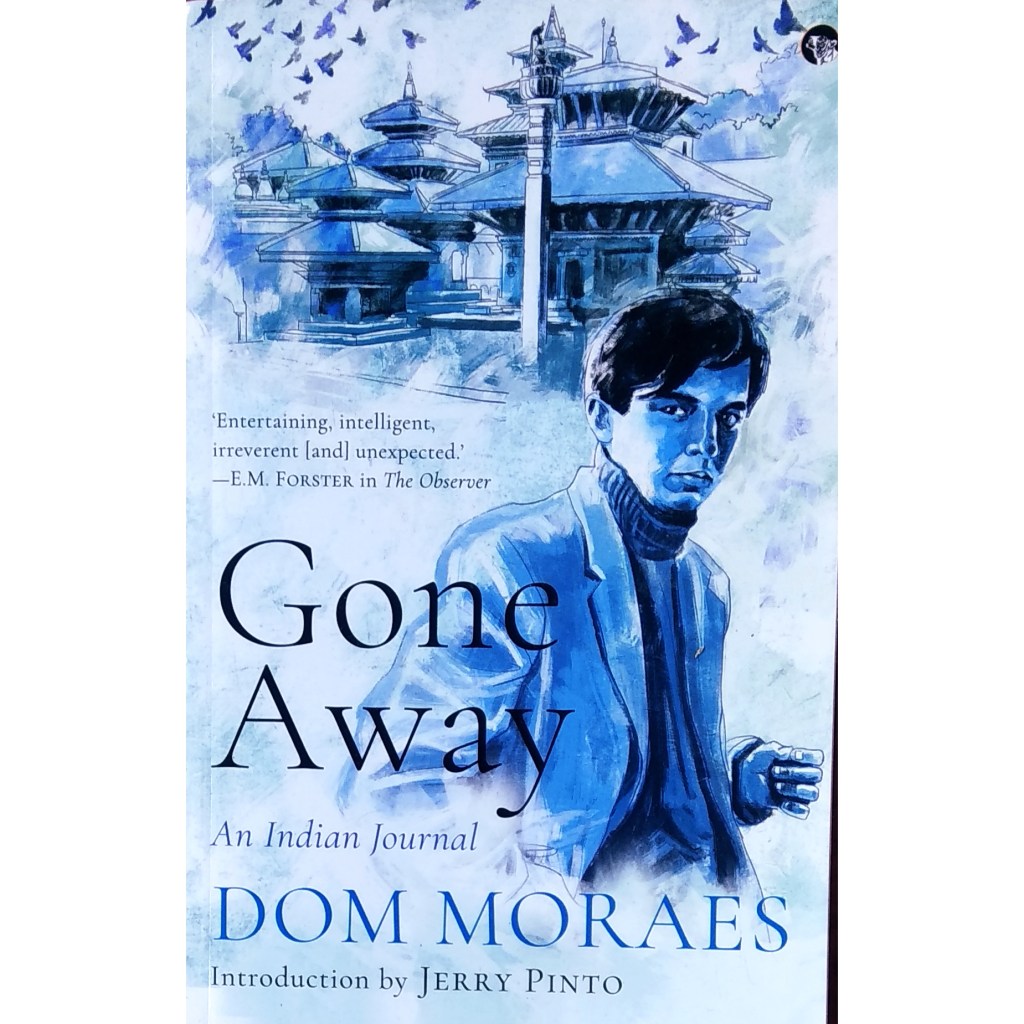
Title: Gone Away — An Indian Journal

Author: Dom Moraes

Publisher: Speaking Tiger, 2020

When a travelogue resurfaces sixty years after it was first printed, that ought to be meaningful. “Gone Away – An Indian Journal” by Dom Moraes was originally published in the UK by William Heinemann. Republished as a paperback edition by Speaking Tiger Books (New Delhi) in 2020, the travelogue carries the same magic for the reader as it was then.

Dom Moraes, a poet, novelist and columnist, is perceived to be a foundational figure in Indian English Literature who published thirty books in his lifetime. In 1958, at the age of twenty, he won the prestigious Hawthornden Prize for poetry. Winner of the Sahitya Akademi Award for English in 1994, Moraes passed away in 2004.

Son of the Editor of the Times of India, Dom had grown up in well-off and generous circumstances. After traveling with his father through Australia to New Zealand and Malaya to the borders of Red China, he watched and wrote poetry. Moraes met Stephen Spender in India, showed him his poems and had some published in “Encounter.” The combined efforts of Spender and his father had gained him admission to Jesus College, Oxford.

Reads the blurb: “One of the most unconventional travelogues ever written, Gone Away covers three months of Dom Moraes’ life spent in the subcontinent at the time of the Chinese incursions on the Tibetan border in 1959. In that short time, a remarkable number of memorable things happened to him, some of them the sort of fantastic situations that could only enmesh a poet, perhaps only a young poet – a visit to a speak-easy in Bombay; an interview with Nehru and an hour spent closeted with the Dalai Lama in Delhi; and a meeting with the great Nepalese poet, Devkota, whom he found already laid out to die by the side of the holy river Basumati.”

After a short stay in Calcutta, where he tried, with limited success, to investigate the lives of prostitutes, he went up to Sikkim, the north-eastern border state into which no visiting writer had been allowed for almost a year. Having made his way by jeep right up to the frontier, he ran into a Chinese detachment and was shot at, but escaped to safety.


Full of comicality, felicity of phrase and oddity of behavior, Gone Away communicates the special excitement of the traveler on every page. Example: Unforgettably funny is the account of the Sikkimese soccer match played in an impenetrable mist and involving the loss of several footballs kicked over an adjoining cliff. Though wit and impertinence prevail through the pages, this is a book which catches and holds the mood of modern India and illuminates as much as it amuses.

This is both a political and a personal voyage of discovery, told simply. Moraes’ travelogue is also significant because it gives us the poet’s eye view: providing details from the Indian cityscape and draws our attention to the zeitgeist of the early decades after Independence.

This memoir is a delightful read and is both modest and polished. Moraes’ account of India’s friction with China and India’s relationship with Nepal at the end of 1950s is convincing, especially in the context of the new tensions on the borders. Recording public disquiet over China’s infractions in 1959, Moraes mentions that General Thimayya had asked that the Indian troops on the NEFA border should be supplied with automatic weapons, as they were inadequately armed in case of Chinese attacks. Krishna Menon is said to have refused the request. Then came Longju, when inadequately equipped and outnumbered Indians were put to flight by the Chinese. Indian foot soldiers, caught in the cross locks of war, continue to be ill equipped, even to date.

There are many more accounts in the book of Dom Moraes meeting prominent diplomats, politicians, writers and artists such as Malcolm MacDonald, Jayaprakash Narayan, Han Suyin, M F Hussain, Nirad Chaudhuri, Kishen Khanna, Buddhadeva Bose, Jamini Roy and many more. Moraes also managed to reach Sikkim when the Chinese were closing in on the border. There is so much of the subcontinent’s socio-cultural history to exude. The historical incidents and famous people are easily recalled from textbooks but reading this firsthand experience is something exceptional.

Moraes travels continue to Calcutta, Gangtok and Sikkim, where the Chinese army’s presence is strongly indicated and the Indian state does not provide enough information. Reporting a readable narrative about independent India’s first decade, Moraes’ love for India anticipates his eventual homecoming.

He captures the occasion with candour, his narrative provides a perspective that tells the whole truth, with little sentimentality or precision, and is peppered with humor that is situational and occasionally self-deprecatory.

With an introduction by Jerry Pinto, “Gone Away” is part of the trilogy of autobiographies written by Moraes. It is a fabulous testimony to India and many of its rarities.

.

Bhaskar Parichha is a journalist and author of No Strings Attached: Writings on Odisha and Biju Patnaik – A Political Biography. He lives in Bhubaneswar and writes bilingually. Besides writing for newspapers, he also reviews books on various media platforms.

.

.

PLEASE NOTE: ARTICLES CAN ONLY BE REPRODUCED IN OTHER SITES WITH DUE ACKNOWLEDGEMENT TO BORDERLESS JOURNAL