Categories
Poetry

Early Winter in Delhi

By Akshada Shrotryia

early winter in delhi

marks a beautiful change. 

the cruel sun of the summer
becomes kind.

so kind that the roads embrace happily - new footwear,
warm, woolen boots - knee high, suede, chelsea.

when the sun shines, full of April’s warmth
people share stories on the grass.

crowds in the metro provide respite from the harsh winds,
desserts become sweeter.

the atmosphere becomes soft too -
warm cashmeres, colourful pashmina, playful jumpers, everywhere.

early winter in delhi,
binds the city with a certain silence

when the hum and whirr of the fans cease,
people listen to each other.

Akshada Shrotryia, a graduate from Delhi University, harbours an intense passion for literature and writing. Her works have been published by The Punch Magazine, Setu Mag, Live Wire, Gulmohur Quarterly, Muse India, among others.

.

PLEASE NOTE: ARTICLES CAN ONLY BE REPRODUCED IN OTHER SITES WITH DUE ACKNOWLEDGEMENT TO BORDERLESS JOURNAL

Click here to access the Borderless anthology, Monalisa No Longer Smiles

Click here to access Monalisa No Longer Smiles on Kindle Amazon International
Categories
Poetry

Chest of Jesters

Poetry by Rhys Hughes

Courtesy: Creative Commons
There is a chest in the cellar
with a broken lock
and a ticking comes from inside it
like a working clock.

So I throw it open
to find out what might be within,
but the noise is made
by little bells
on the caps and slippers
of men who look like elves
with pointed chins
and pointy ears, who have no fear
of me at all but laugh
and jump up like lines on a graph
that charts a sudden
interest in the arts
of the anonymous
populace in a highly cultured town.

They come back down,
those mediaeval clowns,
and land on the floor,
descend the stairs and prance
throughout the expanse
of my living room. What should I do?
My wife is coming home soon
and she has jester-phobia.
I don’t think she can cope
with parti-coloured harlequins
who caper, cavort and grin like loons.
     I don’t blame her!

I must capture them one by one,
I’ll use a butterfly net
and drag them kicking back upstairs,
deposit them in what was
their secret lair for untold generations,
slam the lid, ignore the lock,
weigh down the chest with a heavy rock
and keep them safe forevermore
in that hiding place.

The fact they escaped is a disgrace,
the chest in the attic is an heirloom,
passed down through my family
from father to son for centuries.
And knowing this, it occurs to me
that I can work out the identities
of these pesky pestering fellows.
Yes, it’s true, I’m forced to confess–
those jesters are my ancestors.

Rhys Hughes has lived in many countries. He graduated as an engineer but currently works as a tutor of mathematics. Since his first book was published in 1995 he has had fifty other books published and his work has been translated into ten languages.

.

PLEASE NOTE: ARTICLES CAN ONLY BE REPRODUCED IN OTHER SITES WITH DUE ACKNOWLEDGEMENT TO BORDERLESS JOURNAL

.

Click here to access the Borderless anthology, Monalisa No Longer Smiles

Click here to access Monalisa No Longer Smiles on Kindle Amazon International

Categories
Poetry

The Deed of Separation 

By Malachi Edwin Vethamani

Courtesy: Creative Commons
The husband

The wife 

The children 

The child custody 
The wife gets 

The child support
The husband pays 

The family house 
The wife gets 

The housing loan 
The husband pays

The joint bank accounts 
The wife gets 

The balance supplementary credit card bills
The husband pays 

The lawyers’ bill 
The husband pays

The signatories 

The witnesses 

The dates 

Husband leaves the cheque on the table. 

The husband leaves 
The wife leaves 

Malachi Edwin Vethamani is a Malaysian Indian poet, writer, editor, critic, bibliographer and Emeritus Professor. His poetry publications in 2022 include: ‘Rambutan Kisses’, ‘The Seven O’clock Tree’ and ‘Love and Loss’. His other poetry publications include Life Happens (2017) and Complicated Lives (2016).  He has a collection of short stories titled Coitus Interruptus and Other Stories (2018). His poems and short story have been published in Borderless Journal. He published the second edition of A Bibliography of Malaysian Literature in English in 2015. He has edited five volumes of Malaysian writings in English. He is founding editor of Man Matters Online Journal.

.

PLEASE NOTE: ARTICLES CAN ONLY BE REPRODUCED IN OTHER SITES WITH DUE ACKNOWLEDGEMENT TO BORDERLESS JOURNAL. 

Click here to access the Borderless anthology, Monalisa No Longer Smiles

Click here to access Monalisa No Longer Smiles on Kindle Amazon International

Categories
Poetry

Slowly, but Surely

By Namratha Varadharajan

No
not love at first sight
nor in the first night

But slowly over the years

A walk in the neighbourhood
under monsoon skies 
when you made me laugh so loud 
it must have woken up the sky

A summer of growing tomatoes on the balcony
and harvesting four teeny tiny ones,
cooking rasam* with it and feeling so proud

Holding hands in a distant land
but never stealing even a peck outdoors
to slobbering over our babies 
until they scream “No more!”

Reading and writing 
in a silence that hugs

Slow dancing our way through life
until spooning grows to mean coming home

Slowly, but surely
moments weave us together
to be one in love

Slowly, but surely
till the end.


*Spicy South Indian soup


Namratha Varadharajan writes to explore human emotions and our connection with nature while trying to chip at prejudices that plague us, one syllable at a time. She has been published in The Yearbook of Indian Poetry 2021, The Kali Project, The Gulmohar Quarterly, The Alipore Post, among others.

Categories
Poetry

Musings on Night

Poetry by George Freek

Courtesy: Creative Commons
THE NIGHT MUSIC 

As I sit by the river
clouds soft as pillows
smother the moonlight.
All night I hear waves
beat the shore, as if
it were a door
that refuses to open.
Life is unclear.
I’m nearing sixty,
and I still have no idea
from year to year
who I am,
or why I’m here.


WINTER AT WEST LAKE 

The years pile up
like the snow on the roof.
As I look out my back door,
the moon seems
trapped like an insect
in a web of branches.
They say that Li Po
tried to express the sound
of a rising moon
in words. I don’t care.
I drink wine,
and listen to a dove
calling softly to
his unheeding mate. 
Is there a meaning for me?
The dove in frustration
abandons his tree.
What will be, will be.


A MOON POEM

Fall is as cold as the moon.
Angry clouds tell me
snow is coming.
It will be no surprise.
Monks, seeking comfort,
mutter to themselves incantations
in their selfless occupations.
In their trance-like silence,
they ignore the signs
in the sky. I watch
the moon as it dies.
Where does heaven lie?
I stare at that sky.
I wonder if life is a
terrible mistake for which
one must apologise,
but my answer would be a foolish lie.

George Freek’s poetry has recently appeared in The Ottawa Arts Review, Acumen, The Lake, The Whimsical Poet, Triggerfish and Torrid Literature.

PLEASE NOTE: ARTICLES CAN ONLY BE REPRODUCED IN OTHER SITES WITH DUE ACKNOWLEDGEMENT TO BORDERLESS JOURNAL

Click here to access the Borderless anthology, Monalisa No Longer Smiles

Click here to access Monalisa No Longer Smiles on Kindle Amazon International

Categories
Poetry

Birds are Alive

Written by and translated from Korean by Ihlwha Choi

Courtesy: Creative Commons
When I was young, I chased birds day and night.
I looked up at trees and wandered through fields to find them.
That passion lives fully in a corner of my heart.
Birds were my friends.
They were my lovers for a long time.
They were the faith that breathed blue vitality into my free soul.

I tried to catch a bird that never came to my hand,
Countless times but failed.
That was the bird that built its home and fed its young,
The bird that lived like a king in the middle of the sky and earth.

To the bird, I was a dangerous beast,
But to me, the bird was an immortal soul and a magnificent dream.

Birds have their own personalities.
Each bird flaps its wings differently.
They sing with their unique voices.
They meticulously choose their housing lot and build the house geometrically.
They are experts in raising their young and brave soldiers.
They are faithful fathers and mothers who build their homes with trust and love.
When the time comes, they proudly let their children go.

Birds always live in places higher than humans.
They greet the morning and welcome spring before humans.
They live closer to trees than humans.
Loving birds is like loving stars.
I don't know how to love birds.
But those birds all live in my heart.
My life is a long journey to find birds.
Sometimes I close my eyes and look far away,
Because I want to apologise to the birds.
The birds never entrusted themselves to me.
They were never tamed by my touch.
Like the birds, dreams and love cannot be tamed.
The dream and poems that have never entrusted themselves to me resemble the birds.

Ihlwha Choi is a South Korean poet. He has published multiple poetry collections, such as Until the Time When Our Love will Flourish, The Color of Time, His Song and The Last Rehearsal.

.

PLEASE NOTE: ARTICLES CAN ONLY BE REPRODUCED IN OTHER SITES WITH DUE ACKNOWLEDGEMENT TO BORDERLESS JOURNAL. 

Click here to access the Borderless anthology, Monalisa No Longer Smiles

Click here to access Monalisa No Longer Smiles on Kindle Amazon International
Categories
Poetry

Life of a Poem by Sutputra Radheye

There is a poem that begins abruptly
like the destruction caused by bombs
being thrown from the planes hovering
over the sky in a formation of a triangle

the poem makes its place in the society
word by word like an immigrant family
through the voracity of their cheap labour
and silence while working under exploitation

the poem starts reaching its prime after years
like a person crossing a teenage river
to fall in love, to experience the carnal touch
to reproduce echoes of its own voice

the poem is often misunderstood and ignored
as a utopian dream of equality as it is
thought to be irrational and stupid to waste time
imagining a world where leaves are green for all

the poem dies in a clumsy alley, homeless
starving, its body becomes home of wounds
where microbes live, eating its flesh and bone

there is no one who writes an elegy for a poem

Sutputra Radheye is a young poet from India. He has published two poetry collections — Worshipping Bodies(Notion Press) and Inqalaab on the Walls (Delhi Poetry Slam)His works are reflective of the society he lives in and tries to capture the marginalised side of the story.

.

PLEASE NOTE: ARTICLES CAN ONLY BE REPRODUCED IN OTHER SITES WITH DUE ACKNOWLEDGEMENT TO BORDERLESS JOURNAL

Click here to access the Borderless anthology, Monalisa No Longer Smiles

Click here to access Monalisa No Longer Smiles on Kindle Amazon International

Categories
Poetry

April Love?

Poetry By Michael R Burch

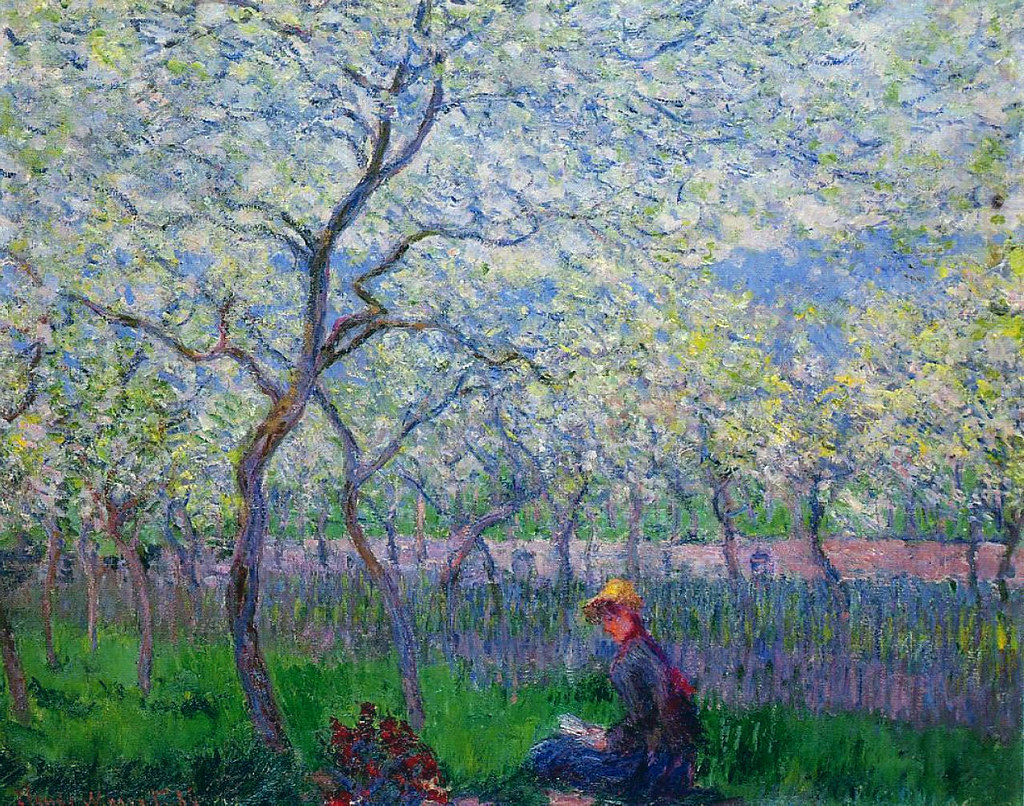
Orchard by Oscar-Claude Monet(1840-1926). Courtesy: Creative Commons
MOMENTS
(for Beth)

There were moments
full of promise,
like the petal-scented rainfall
of early spring,
when to hold you in my arms
and to kiss your willing lips
seemed everything.

There are moments
strangely empty
full of pale unearthly twilight
—how the cold stars stare!—
when to be without you
is a dark enchantment
the night and I share.

(Originally published by Tucumcari Literary Review)


WATER AND GOLD 

You came to me as rain breaks on the desert
when every flower springs to life at once.
But joys are wan illusions to the expert:
the Bedouin has learned how not to want.

You came to me as riches to a miser
when all is gold, or so his heart believes,
until he dies much thinner and much wiser,
his gleaming bones hauled off by chortling thieves.

You gave your heart too soon, too dear, too vastly;
I could not take it in; it was too much.
I pledged to meet your price, but promised rashly.
I died of thirst, of your bright Midas touch.

I dreamed you gave me water of your lips,
then sealed my tomb with golden hieroglyphs.

(Originally published by The Lyric)


LADY’S FAVOUR 

May 
spring
fling
her riotous petals
devil-
may-care
into the air,
ignoring the lethal
nettles
and may
May
cry gleeful-
ly Hooray!
as the abundance 
settles,
till a sudden June 
swoon
leave us out of tune,
torn,
when the last rose is left
inconsolably bereft,
rudely shorn
of every device but her thorn.

(Originally published by The Lyric)


ROSES FOR A LOVER, IDEALISED 

When you have become to me
as roses bloom, in memory,
exquisite, each sharp thorn forgot,
will I recall—yours made me bleed?

When winter makes me think of you—
whorls petrified in frozen dew,
bright promises blithe spring forsook,
will I recall your words—barbed, cruel?

(Originally published by The Lyric)

Michael R. Burch’s poems have been published by hundreds of literary journals, taught in high schools and colleges, translated into fourteen languages, incorporated into three plays and two operas, and set to music by seventeen composers.

PLEASE NOTE: ARTICLES CAN ONLY BE REPRODUCED IN OTHER SITES WITH DUE ACKNOWLEDGEMENT TO BORDERLESS JOURNAL

Click here to access the Borderless anthology, Monalisa No Longer Smiles

Click here to access Monalisa No Longer Smiles on Kindle Amazon International

Categories
Poetry

Back to the Future by Amit Parmessur

(On the day slavery was abolished members of the army started to climb Le Morne Brabant with the intention of telling the slaves that they were free [1]but—)

Le Morne Brabant, Mauritius. Courtesy: Creative Commons
Gasping between egg-like boulders on the mountain cliff,
she could hear the rustling in the forest again. Thoughts
of recapture tortured her. Her dreams panicked.

When she heard a stick snap under one officer’s boot,
bondage stabbed at her bosom—bluer, bitterer.
The rustling came closer. Far too close.

She leapt gracefully to meet the other eight
who had showered into The Valley of Bones*
like cold raindrops, wishing to wake up
somewhere else, anywhere else.

Her legs pedalling, her shout
bold and free, blissful and final,
her unborn baby safe under her rugged rags,
she was about to splash on the ground like a rotten pumpkin.

It was a mistake, an aberration. She
boomeranged to the cliff like a rocket
and stopped those who jumped before and after her.
They tasted the news of their freedom together.

She then recovered her husband cocooned in a cave
and they fast-forwarded to Trou Chenille**
where the soil turned into a hut, the hut into
ripples of relief that sank into their scars.

Waking up to the sea changing into the sky,
she watched him build the crab trap,
smiling, straw-hatted, growing younger day by day.

And their evening often hatched into a sega
of unheard agonies, of unfelt pleasures,
their child playing hide and seek with her friends,
ever curious about her mother’s soft, bulging belly.

*   Where slaves who jumped off Le Morne’s western cliff face met their end
** The first village to be inhabited by freed slaves

[1] Slavery was abolished on 1st February, 1835 in Mauritius. More at this link https://howafrica.com/le-morne-brabant-mauritian-peninsula-where-slaves-jumped-to-their-deaths-to-escape-slavery/

Amit Parmessur is from Quatre-Bornes, Mauritius. He spent his adolescence hating poetry before falling in love with its beauty. His poems have appeared in several online magazines, namely The Rye Whiskey Review, Night Garden Journal, Hobo Camp Review, Ann Arbor Review and Ethos Literary Journal.

PLEASE NOTE: ARTICLES CAN ONLY BE REPRODUCED IN OTHER SITES WITH DUE ACKNOWLEDGEMENT TO BORDERLESS JOURNAL. 

Click here to access the Borderless anthology, Monalisa No Longer Smiles

Categories
Poetry

Poetry by Carl Scharwath

Carl Scharwath
TEARS

Lacrimal glands creating
Basal, emotional, and reflex tears 
They say are good for your eyes.

The hypostases of three
In a washtub of emotional water
Overflowing with sad memories.

The misery of life within,
when a memory of you evaporates like
Leaves migrating in the wind.

Your name on my lips, aching
to talk to you again in the 
Quiet moods when I forgot the words.


ABANDONED

I see you everyday
Standing alone, a roadside sentinel
Quiet, lonely and unassuming

In a psychological time
Of lived and remembered
Experiences long ago

Hulking awkwardly and
Out of place
Ravaged by nature and neglect

The sun plunging down
Into empty windows as
Ghosts peer out

In the darkness
Pressed from the 
Inside calling the spectators

Decaying in slow drips
On a cruel timeline marching
Onward to becoming forgotten.

ATARAXIA

Time to enter the Epicurean Garden
A buffer to the Zephyrs blowing of
Obscurantist voices impregnating
The innocents huddled in ignorance.

Tranquil pleasures-
Procreative purpose-

In an atomic swerve
Filling desolate emptiness
Looking for less what’s there
Then what was truly missing.

BLUE HORNS

Georgian avant-garde experimentation
Intricate words constructed
As the great purge continued in
A fire burning rain of hopelessness.

A coterie of youthful hands
Joined at the pens of doom.
Symbolist Revolutions ringing with
Attacks on the flag of Realism.

Sonorous prophet, verses evaporating.
In the Soviet frozen sins evoking
Death sentences, suicides,
Resurrected in a poetic afterlife.

One survived, one for us
Honour his name, in the literary cemetery.
Giorgi Leonidze entered into
His eternal time for rest.

{The Blue Horns was a group of Georgian Symbolist poets and prose-writers which dominated the Georgian literature in the 1920s. It was founded in 1915 and was suppressed under the Soviet rule early in the 1930s.
The only member of the Blue Horns movement who has survived the Great Purge was Giorgi Leonidze.}

Carl Scharwath has appeared globally with 175+ journals selecting his writing or art. Carl has published three poetry books and his latest book “Playground of Destiny.”

PLEASE NOTE: ARTICLES CAN ONLY BE REPRODUCED IN OTHER SITES WITH DUE ACKNOWLEDGEMENT TO BORDERLESS JOURNAL. 

Click here to access the Borderless anthology, Monalisa No Longer Smiles