Categories
Poetry

Every Day

Poetry by Hafeez Rauf, translated by Fazal Baloch

Hafeez Rauf

Hafeez Rauf belongs to the generation of the poets who emerged on the literary landscape in the early 2000s. Homelessness, exile, uprootedness and related agony are the recurrent themes of his poetry.

How far will the last 
sigh of the smoke stretch,
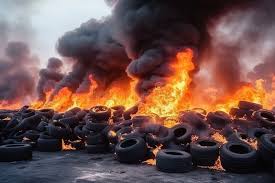
Rising from the tires
Burning in the distance?

The road lies closed --
No longer offers a passage.
Women and children,
Youths and elders --
All surrounded by an
ever-rising wall of helplessness.

How far can their hands,
their voices reach?

Meanwhile,
A crumbling wall,
In the wall, a decayed door,
And the door gazes at the occasional passerby,
Stretching its sight as far as it can see.

It watches the deserted roads
With the frantic eyes of a man
Who, after losing something,
searches his pockets in despair.

Where will this caravan of smoke lead?
The door just gazes.
From Public Domain

Fazal Baloch is a Balochi writer and translator. He has translated many Balochi poems and short stories into English. His translations have been featured in Pakistani Literature published by Pakistan Academy of Letters and in the form of books and anthologies. Fazal Baloch has the translation rights.

PLEASE NOTE: ARTICLES CAN ONLY BE REPRODUCED IN OTHER SITES WITH DUE ACKNOWLEDGEMENT TO BORDERLESS JOURNAL

Click here to access the Borderless anthology, Monalisa No Longer Smiles

Click here to access Monalisa No Longer Smiles on Amazon International
Categories
Poetry

How Not to Want…

Poetry by Michael Burch

CHLOE

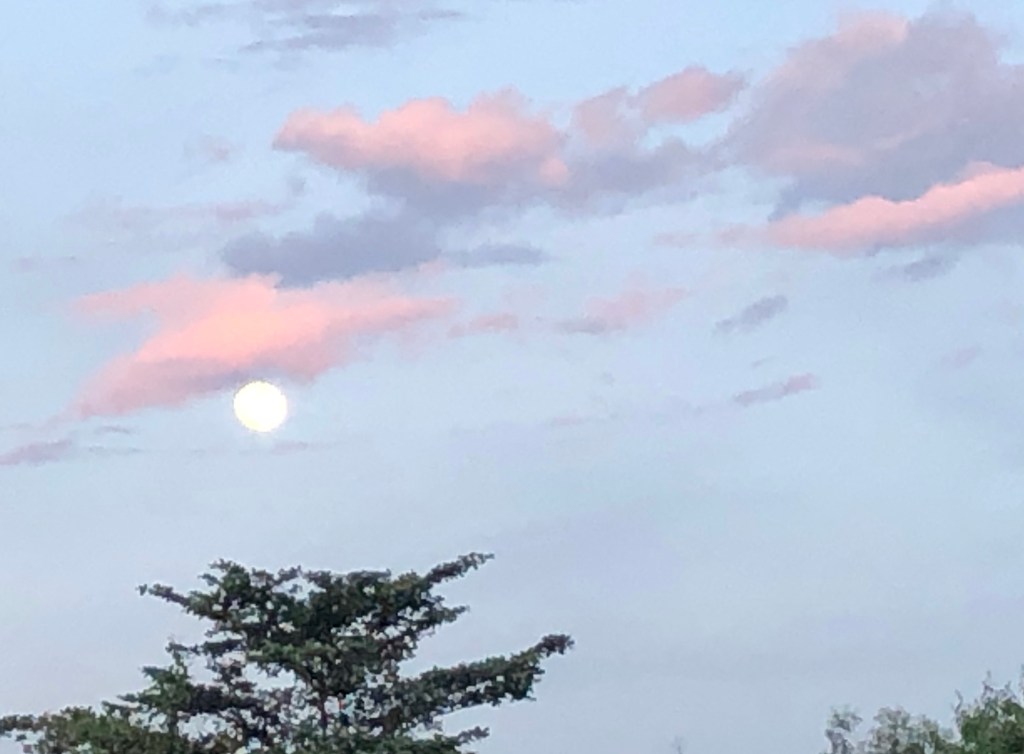
There were skies onyx at night ... moons by day ...
lakes pale as her eyes ... breathless winds
undressing tall elms ... she would say
that we’d loved, but some book said we’d sinned.

Soon impatiens too fiery to stay
sagged; the crocus bells drooped, golden-limned;
things of brightness, rinsed out, ran to grey ...
all the light of that world softly dimmed.

Where our feet were inclined, we would stray;
there were paths where dead weeds stood untrimmed,
distant mountains that loomed in our way,
thunder booming down valleys dark-hymned.

What I found, I found lost in her face
by yielding all my virtue to her grace.

(Originally published by Romantics Quarterly as “A Dying Fall”)


MIRAGE


You came to me as rain breaks on the desert
when every flower springs to life at once.
But joys are wan illusions to the expert:
the Bedouin has learned how not to want.

Michael R. Burch’s poems have been published by hundreds of literary journals, taught in high schools and colleges, translated into fourteen languages, incorporated into three plays and two operas, and set to music by seventeen composers.

PLEASE NOTE: ARTICLES CAN ONLY BE REPRODUCED IN OTHER SITES WITH DUE ACKNOWLEDGEMENT TO BORDERLESS JOURNAL

Click here to access the Borderless anthology, Monalisa No Longer Smiles

Click here to access Monalisa No Longer Smiles on Kindle Amazon International

Categories
Poetry

Textures by Jared Carter

             TEXTURES

At times the fabric shows itself,
as though up close—
A linen swatch, scraps from a shelf
of silk, or those

Long scarves made of the lightest wool,
that with a touch
Can wrap around, yet never pull
or press. For such

Affinity invokes, like wings
against the air,
What elevates but does not cling
to what is there.

Photo from Public Domain

Jared Carter’s most recent collection, The Land Itself, is from Monongahela Books in West Virginia. His Darkened Rooms of Summer: New and Selected Poems, with an introduction by Ted Kooser, was published by the University of Nebraska Press in 2014. A recipient of several literary awards and fellowships, Carter is from the state of Indiana in the U.S.

.

PLEASE NOTE: ARTICLES CAN ONLY BE REPRODUCED IN OTHER SITES WITH DUE ACKNOWLEDGEMENT TO BORDERLESS JOURNAL

Click here to access the Borderless anthology, Monalisa No Longer Smiles

Click here to access Monalisa No Longer Smiles on Kindle Amazon International

Categories
Poetry

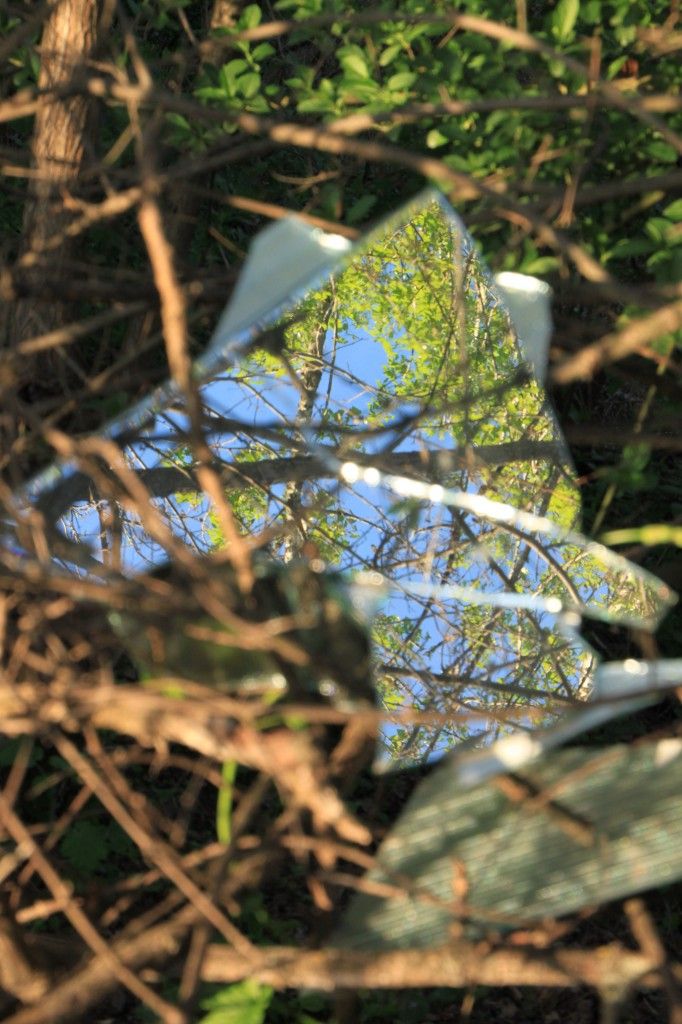
Shattered Mirror

By Tasneem Hossain

SHATTERED MIRROR 

Shattered mirror on the ground sparkles sunlight.
Tears glisten bright.

People shudder and protect their feet,
Lest they cut and start to bleed;
Broken glass… thousands of pieces,
Prick and cut veins,
Bleed but no one sees the pain.

I smile every day, a perfect smile,
You say, ‘You are happy, you own a style.’

Have you seen the pain of my bleeding heart?
Smiling every day is a beautiful art.

This world is a stage.
Here in plots, we play our parts,
I do my best to smile and dance,
Perfect in my role, I am the star.

Shattered mirror of my heart,
No one sees how I bleed and play my part.

Tasneem Hossain, an author of four poetry books, is also an op-ed and fiction writer, translator, educator and trainer from Bangladesh. Her poems are published frequently in literary journals worldwide and have been translated in seven other languages.

.

PLEASE NOTE: ARTICLES CAN ONLY BE REPRODUCED IN OTHER SITES WITH DUE ACKNOWLEDGEMENT TO BORDERLESS JOURNAL

Click here to access the Borderless anthology, Monalisa No Longer Smiles

Click here to access Monalisa No Longer Smiles on Kindle Amazon International

Categories
Poetry

The Village Huckster

By Shamik Banerjee

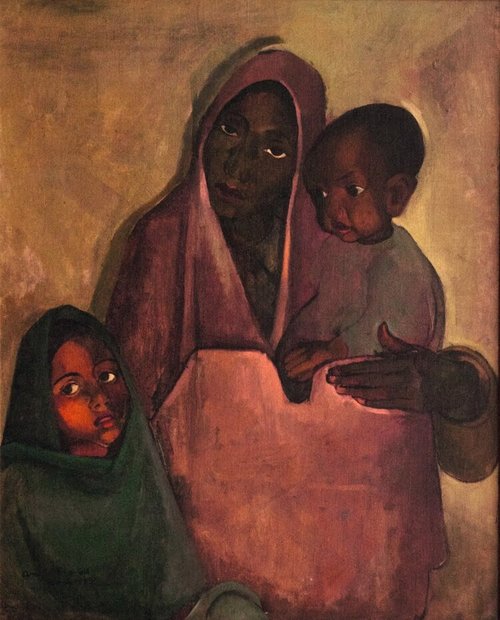
Painting by Amrita Shergill (1913-1941)

THE VILLAGE HUCKSTER

Upon the tracks of Assam's soggy soil,
She peddles from one doorstep to another.
Carrying a sling bag, she begins to toil.
Her scraggy feet -- all varicosed together.
Today, I saw her in a floundering state,
Submerged in sweat, shod in half-tattered shoes,
And haggling for the dairy in her crate --
Enslaved by mugginess -- to earn for two.
She halted at a nearby marsh with trees,
Reposed, and smeared some poultice on a heel,
Then toiled some more until the day's release
To have enough for one full, proper meal
And rest at last when all her tasks were done
While caring for her seven-year-old son.

Shamik Banerjee is a poet from Assam. He lives with his parents. Some of his latest poems have appeared in The Dirigible Balloon, New English Review, The Society of Classical Poets, and The Hypertexts.

.

PLEASE NOTE: ARTICLES CAN ONLY BE REPRODUCED IN OTHER SITES WITH DUE ACKNOWLEDGEMENT TO BORDERLESS JOURNAL

Click here to access the Borderless anthology, Monalisa No Longer Smiles

Click here to access Monalisa No Longer Smiles on Kindle Amazon International

Categories
Poetry

Three Poems by Rakhi Dalal

Rakhi Dalal


LETTING GO

They tell you one must learn
to let go to remain sane.
What they miss out telling
is how much it takes
to forget and let go people
who make a whole city in your life.
A city that is not home
still, the only home you know;
A home that consumes
and yet the only place that sustains you;
A sustenance that holds
but offers no release.
When you have lived
long in such a city,
your hopes are entangled
with the unyielding forces
of knots
difficult to untie.


THE OFFERING

I despair
when things don’t go
as I planned.
I forget
to breathe,
and lament
the spaces around
for smothering me.
I forget
time is as mercurial
as the fancies of my mind.
I forget
it only takes
as much warmth
as that bestowed
by a weak winter sun
to step out
and begin
from the beginning.


RESILIENCE
(after 'Window' by Naomi Shihab Nye)

Resilience makes itself every day
appear from unexpected places.
We are shown in abundance
if we stop to notice
amidst the muddle
beget by ordinary ordeals.
A shoot
emerging from the stem
of a withered plant in your balcony,
long after you thought it had died
because you forgot to water it for months,
tells you life clutches
tightly after all.
And pushes forth with might
through everything it is denied.

Rakhi Dalal writes from a small city in Haryana, India. Her work has appeared in Kitaab, Scroll, Borderless Journal, Nether Quarterly, Aainanagar, Hakara Journal, Bound, Parcham and Usawa Literary Review

.

PLEASE NOTE: ARTICLES CAN ONLY BE REPRODUCED IN OTHER SITES WITH DUE ACKNOWLEDGEMENT TO BORDERLESS JOURNAL

Click here to access the Borderless anthology, Monalisa No Longer Smiles

Click here to access Monalisa No Longer Smiles on Kindle Amazon International

Categories
Poetry

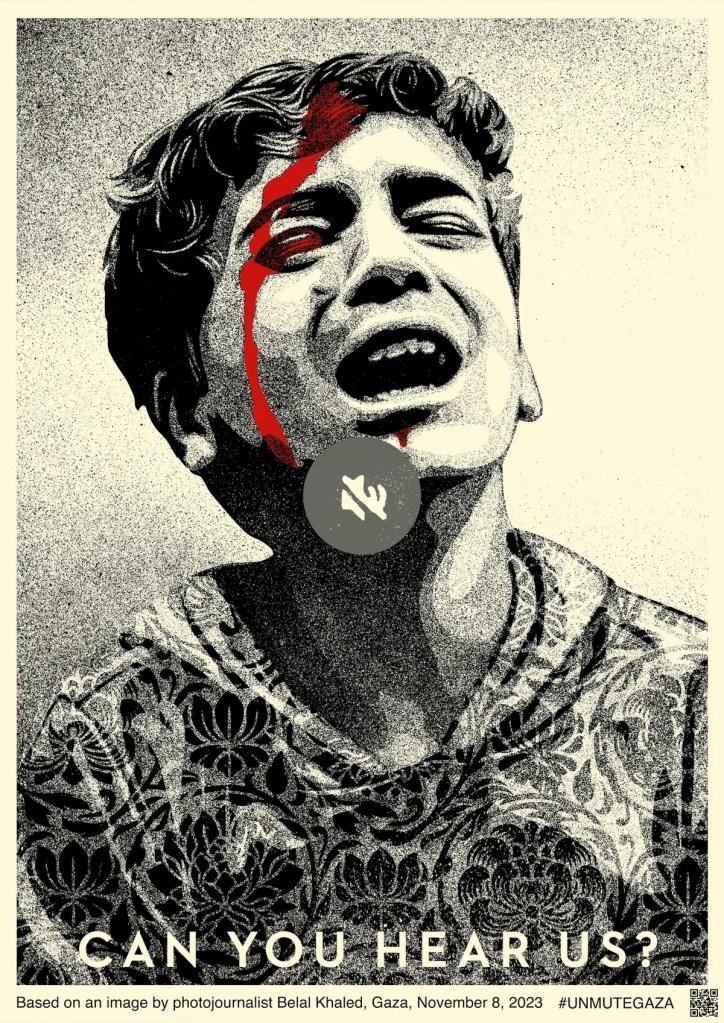
A Child in Gaza

By David Mellor

Dreaming of leaving
This rock above my
Head

Dreaming of leaving
The thought you are dead

Dreaming of leaving

Going back to when I
played here, running up
the path mama mama
kissing your sweet forehead

now motionless and
cold

Dreaming of leaving

Not wishing to go
But there is no one here, just the buzz
Of the drone overhead
And night falling in my soul

Leaving leaving
Dreaming dreaming
of leaving
leaving leaving
leaving…

David Mellor has been published and performed widely from the BBC, The Tate, galleries and pubs and everything in between. Now, resident in Turkey he has continued his literary career with his work appearing in journals including a weekly column in Canakkale Gündem about his observations of Turkish life. His poems and writings are autobiographical, others topical and several his take on life. 

.

PLEASE NOTE: ARTICLES CAN ONLY BE REPRODUCED IN OTHER SITES WITH DUE ACKNOWLEDGEMENT TO BORDERLESS JOURNAL. 

Click here to access the Borderless anthology, Monalisa No Longer Smiles

Click here to access Monalisa No Longer Smiles on Kindle Amazon International

Categories
Poetry

At the turn of the Century

By Stuart MacFarlane

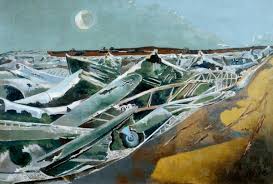
Art by Paul Gnash (1889-1946)
                  I

I wonder what people felt
at the turn of the century,
with Waterloo behind them now;
and the Crimea and the hundred wars
fought by men to prove
I'm not sure what.
I wonder what they felt
as the thick black smoke of industry
cleared now on the skyline;
and there, for the first time, they saw
the blue sky, the sunlight shining through.
I wonder what they felt
when they saw their century slip away,
like a fine ship pushed out to sea.
And there, before them, the great unknown;
mile on mile of endless ocean.
Did they feel hope or fear, I wonder?
Or maybe both?
And, seeing the gravestones in the rain,
perhaps a sense of sadness, too,
for those who had not made it.
For many had lived, but many more had died.


II

We survived the shock of the millennium,
with Passchendaele behind us now;
and Auschwitz, Hiroshima, Korea, Vietnam.
And, I wonder, as the years subside,
what we will feel
at the turn of our century...
With Iraq behind us now,
and Gaza and Ukraine and the hundred wars
yet to be fought by men to prove
I'm not sure what.
I wonder what we'll feel as
the thick clouds of radioactive gas
clear slowly on the skyline.
And there, for the first time, we see
the blue sky, the sunlight shining through.
I wonder what we'll feel
as our century slips away,
like part of a rocket jettisoned
silently in outer space.
And there, before us, the great unknown;
a thousand light years, bright with stars;
yet so very, very far away.
Will we feel hope or fear, I wonder?
Or maybe both?
And, seeing the gravestones in the rain,
perhaps a sense of sadness, too,
for those who did not make it.
For many will live, but many more will die.

Stuart MacFarlane is now semi-retired. He taught English for many years to asylum seekers in London. He has had poems published in a few online journals.                                                                                                                    

.

PLEASE NOTE: ARTICLES CAN ONLY BE REPRODUCED IN OTHER SITES WITH DUE ACKNOWLEDGEMENT TO BORDERLESS JOURNAL

Click here to access the Borderless anthology, Monalisa No Longer Smiles

Click here to access Monalisa No Longer Smiles on Kindle Amazon International

Categories
Poetry

The Boat Park by Rhys Hughes

Photograph by Rhys Hughes

Boat Park only.
No cars or hearts
of dying stars
or interplanetary vessels
originally from Mars.
Just boats please.

No freezing icebergs
from Arctic climes,
no bottled messages,
discarded dresses,
no teasing flotsam,
thank you, ma’am.

Old ships are allowed,
The Flying Dutchman
is especially welcome,
the Marie Celeste too,
but as for the rest: the
sunken ones ought to
remain where they’ve
lain for so many years
on the gloomy seabed.

When all’s said and done,
that is best for everyone,
don’t you think so?
The boats with holes
remaining in the drink
instead of trying to park
in a spot where they
will never sink again.

This is a respectable
boat park: I will tolerate no
scandals in the dark.
Don’t bring your submarines,
hovercrafts, hydrofoils,
zodiac dinghies loaded
with gung-ho marines,
giant rubber ducks or rafts
worth forty bucks or more.
(How much is that, you want
to know? Items priced
in bucks are very deer.)

Let me make myself clear.
Boat park only.
This is no place for planes,
trains, skateboards,
sledges drawn by yetis,
so don’t turn up with any
kind of scooter
or motorbikes seating girls
named Betty.
A boat park, do you hear?

A knight riding a stallion
or a rascal in a rocket
will be denied admittance
no matter how much gold
from their pockets
they are willing to pay.

But a galleon under full sail,
bigger than a blue whale,
will only be charged a pittance
to rest and wait in the park until
other ships arrive from Spain
to escort the poor thing home:
it doesn’t want to sail the dark
remaining seas alone. That’s the
stark truth, I can’t say I blame it.

Boat park only.
Those are the written words.
The issue has been put
to the vote and
the judgement is final.
Only park boats.

No giant squid or octopuses,
no massive clams
or tide-claimed buses,
no mermaids, tritons,
pirate ghosts: no drifting pieces
of charred toast.
Boat park only
and you might
quote me on that, if you like.

Rhys Hughes has lived in many countries. He graduated as an engineer but currently works as a tutor of mathematics. Since his first book was published in 1995 he has had fifty other books published and his work has been translated into ten languages.

.

PLEASE NOTE: ARTICLES CAN ONLY BE REPRODUCED IN OTHER SITES WITH DUE ACKNOWLEDGEMENT TO BORDERLESS JOURNAL

Click here to access the Borderless anthology, Monalisa No Longer Smiles

Click here to access Monalisa No Longer Smiles on Kindle Amazon International

Categories
Poetry

Are We There Yet?

By LaVern Spencer McCarthy

ARE WE THERE YET 

A migrant child who holds his mother's hand
will ask the question many times a day.
"Is this America, the Promised Land?"

An innocent, he does not understand
how long it takes a heart to find its way.
A migrant child who holds his mother's hand

may think all citadels he sees are grand,
but soon perceives that he can never stay.
Is this America, the Promised Land?

He sees a barrier where soldiers stand
with rifles drawn, encroachers kept at bay.
A migrant child who holds his mother's hand

may find that dreams will not come true, as planned.
There comes a time when we can only pray.
Is this America, the Promised Land?

Must we deny asylum, reprimand
with angry words and deeds that cause dismay,
a migrant child who holds his mother’s hand?
Is this America, the Promised Land?

LaVern Spencer McCarthy has published twelve books of short stories and poetry. She is a life member of Poetry Society of Texas and lives in Blair Oklahoma.