Categories
Musings

Write in the way you love to write…

By Devraj Singh Kalsi

I had never felt the need to move out of the city. Let me correct myself here. I had never felt the urge to move out of the city. All my friends were determined to leave the city after completing their studies. They had convinced themselves that there were no opportunities here. A better future, a dream career was only possible elsewhere. I did not buy this sentiment. I was not swept by the tide of majoritarian thinking. I was a loner marooned on the tiny island of my hardcore beliefs that withstood the winds of change.  

I had always felt that a writer does not necessarily need to move out except for commercial compulsions. If he moves out, it does take him away from his roots and the intimate world he belongs to. He writes wistfully of the lost world and tries to draw a connection.

If I wish to write well, I have to read well. This can happen in the small town as well. Why should I leave the city I had grown up in? This was the kind of idealism that restrained me. I was convinced to hear this reassuring voice urging me to lock myself down where I was and just read and write. I listened to it and stayed back. For almost two decades.  

While they moved at a frenzied pace made more furious by their ambition within, I was the one who remained out of this race, to enjoy the simple pleasures of life, finding bliss in buying vegetables from farmers, plucking guavas and mangoes, having long walks to breathe in the fresh air, and listening to birds and their different voices. Something must be terribly lacking in such a person who opts for things nobody cares about. Must be a nervous chap afraid of failing who refuses to participate.

Relatives and family members came down heavily, suspecting the lack of the seeds of ambition. Inspirational stories of success abroad were narrated. When these did not push me hard to go out and compete, they realised the futility of it and dismissed my cowardice and lethargy as a tell-tale sign of impending doom. A person who lives to commit professional blunder. Such abuse came my way. I brushed it all aside. Nothing went deep inside to stir me, to jolt me, to make me feel insulted, to feel challenged, to come out and fight the usual survival wars of middle-class existence.   

Most of the friends became journalists and editors and rose to the eminence of the kind they had visualised. I was still reading and writing and undergoing the angst of creative puberty, waiting for the first novel to burst out of me. When they heard of my long, endless struggle, they advised me to become flexible and practical, move to a cosmopolitan city and build contacts.

I knew from my college days I had chosen a path less travelled. Okay, I was late in meeting them at the thoroughfare of success. But does it mean I have to change my chosen path now? Their words did not persuade me. I still believed in what I had chosen long ago. I was ready to face the consequences. My experiences of failure kept me grounded. I never thought I was desperate to meet success, never pleading for the gates of success to let me in.    

The hectic pace of life never made me change my languid pace. I followed my speed, never rushing into anything. I had the time to stand and absorb the beauty of flowers blooming all around, I had the time to sit by the riverside and watch its languid flow. I had the time to sit under the shady tree and distance myself from the world around me. I had the time to observe hordes of people in the market.

While I did work in advertising as a copywriter for my bread and butter, I stayed away from the stressful world and chose to work from home. It gave me a flexible routine, offered extra time to think and write for myself. I felt I was going to lose this fine balance if I went elsewhere. The ideal state of composure would be lost forever.

A compromise would scuttle my romance with nature. I was convinced even if I had to write for any other medium, I would still do it from my hometown. If the creative output was impressive, the terms and conditions would be made flexible. I was not going to relocate for career gains.  

The world is full of stories of people leaving homes for jobs. In the creative world, such stories of migration and struggle are also common. I was perhaps the uncommon kind who was convinced of the lack of the need to go anywhere else. Perhaps, it was true that the urge to make pots of money was not there. Or maybe I always believed big money was going to come if I wrote big stuff. Location was immaterial. Nobody really cares to know where the writer wrote the story so long as his work was good. When I read about respected authors who were grocers, postal clerks, and ration-shop owners, the entire perspective changed.

If I make it, I will be proved right. Perhaps I am wrong to think so. Sometimes, I wonder why I have this stubborn streak.

Is it because I love the city? Or I am afraid of finding myself fighting the same predictable battles as others do? Is it that I hate to come out of my comfort zone? Hurl any such reasoning. I am unruffled.   

This makes me think hard again. Is it the love of people and places? Why don’t I try once to leave and see how it pans out? As I tell myself to change, something tells me not to get distracted. Stay on the path I have been following. Do not think like others, say no to herd mentality. But when others question my present life, they do not think I chose it. They think I could not secure a better one. It is a defeat when I have nothing to tell them, to show them, to silence them.

The world I live in is relatively small, but it is nurturing my system well. While the city-based people have also suffered a lot, their success hides everything else. My failures strip me of the barest cover to defend myself.  

Take the counterpoint now. If life is so good here, why is your creativity not blooming and booming in the small town? Those city-based ones are writing best-sellers and you make tall claims of being a good writer. When it does not show in terms of success, isn’t it a wasted life?  

More important to find out is whether the writer in me feels exhausted or wasted. I have a word with the writer within every morning. He says he is still connected and happy to be here, not regretting the choice I made long ago.  

Agreed, creativity did not blossom here for me, but what is the guarantee it would have flourished elsewhere? They argue the chaos of survival, the urge to prove would have brought out my creativity. This slow life did not let it happen. They mean creativity comes out under stress. Well, it is an opinion and a possibility. But for me, I never like to write a single sentence under pressure.  

At this stage in life, with nothing worth to showcase as a fancy badge of success, I have no regret for not moving out, of being content with whatever creativity I could muster to tell a few stories. Did I wait too long for creativity to bloom instead of trying to force it? So long as I can create something decent even if it is not conventionally successful, I am happy for myself. Nothing else matters – not even the harshest criticism of my choices.   

The creativity I see around is non-competitive and complete in itself. Only humans want their creativity to become competitive, get acknowledged and recognised. I am happy to blossom the way my world wants me to bloom. Even if I do not, absolutely no regrets. Many creative folks have already gone down this path. I am not the first one to disappear without leaving behind a substantial body of work.

But the belief that brilliant stuff does not always have to come out of a metro-centric environment remains firm. All creative folks are not bound to create great art during their lifetime. Much of their existence is dedicated to the admiration of creative beauty in various forms. Forget the charm and trappings of success. Write in the way you love to write. This harmony is more important for the seeker within.      


Devraj Singh Kalsi works as a senior copywriter in Kolkata. His short fiction and essays have been published in Kitaab, The Bombay Review, Deccan Herald, The Assam Tribune, The Sunday Statesman, Earthen Lamp Journal, and Readomania. Pal Motors is his first novel.
Categories
Musings

People matter more than Money

By Keith Lyons

Some of my best friends on Facebook aren’t my friends anymore

It was the post on Facebook, in the early days, before, you know, before it got really serious. “Does anyone know of anyone actually getting this virus?” The question behind the question was something like ‘this is all fake news, all made up, this is not real’. In the comments section, her FB friends and followers were quick to respond. No. No. Don’t know. No. No. Don’t know anyone. As if to confirm suspicions. So, the poster followed up. Wasn’t it interesting that no one of her hundreds, perhaps thousands of friends, had themselves or knew of anyone with the virus?

When I checked later that week, the denial and dismissal hit some bumps. People, from around the globe, added comments to the list. Yes, they knew of someone who had it. Yes, one of their friends got COVID. Yes, I have it.

So that conspiracy theory in the making was quashed. I selected first unfollow, then unfriend. And thought about blocking or reporting.

But like the arcade game Whac-A-Mole, more so-called Friends were re-posting ‘alternative news’, or penning their own takes on the virus. Sure, we are in a democracy. Sure, information is distributed. Sure, we can be critical of official sources. But when a friend posts, all in upper case, “THIS IS ALL CRAP” I am tempted to turn off the shouting. Because this is a sign that someone has been contaminated, just like in the horror-comedy Shaun of the Dead. Ironically, it is their shouting about all the unnecessary fear and overblown panic that suggests that they themselves are afraid and panicking and have chosen to find comfort in the thin veneer of insight that comes with conspiracy theories. Just that you can’t call them conspiracy theories. Non-mainstream views sounds nicer. Alternative news perhaps.

I’m told not to believe public health officials, political leaders, epidemiologists or scientists. Because, somehow, without educational qualifications, just with a little time using Google and YouTube, my friend is now privy to the real truth, and I am just a mere witless sheep, so naive, so unable to see that this virus hoax is actually a black swan event being used by the powerful elites and clandestine organisations to bring about compulsory micro-chipping, GPS tracking and vaccinations. Or is it really a white swan event, and we could have seen it coming?

So, who will achieve world domination through the pandemic and the recession to follow? The coronavirus itself, isn’t that its goal, aided and abetted by human carriers? All of this is a tad confusing. There’s an invisible virus which is wreaking havoc, it has almost closed down many nations and brought a halt to human activity. We can hear the birds singing, the water is clearer, the air is breathable again, and filled with smells and fragrances. It is an unexpected benefit of lockdown. In such a short amount of time, the Earth has started to heal. We’ve seen how a new world might look, with the kindness of neighbours, a sense of community, time to pause, linger, reflect.

There’s a psychological test, where you imagine yourself in a white room, with no way out. What do you do? Your answer is supposed to indicate your attitude towards death, specifically your own death. In a way, the lockdown has been like a mini-psychology test, to see how we do behave. Are we productive and organised, with full routines and self-care and connecting with others? Or instead, do we mope around, eat too much, binge on Netflix or entertainment as a means of escape, rather than use this time to sort out some things in our lives? Funny how a few months ago many of us were complaining we don’t have enough time with our families or that we are putting off doing things because we are too busy. Yet when the opportunity to spend quality time together or the freedom to do that home decorating task finally arrives, instead we find ourselves wanting to kill those we live with, lamenting over our lack of progress on those rainy day errands, or getting into a cycle of avoidance, regret, and guilt.

In these turbulent times, many things have been put on hold. Not just haircuts, or holidays. But many things have carried on too, though in ways that are not so familiar to us.

The first of my friends to get COVID-19 was in Canada, though she wasn’t able to be tested to confirm her case. One of my best friend’s mother died at the start of the lockdown, not from the virus, but from the kind of natural causes that sees you go out in your late nineties. Travel restrictions and prohibitions on gatherings meant a small service was held via video link.

A comedian and actor from my childhood, Tim Brooke-Taylor, died from COVID-19, on the other side of the world, but because he’d been in the living room when I was young, it seemed like it was close. Then, just a few days ago, a friend calls from China, bearing sad news. One of my friends, a Tibetan in her sixties who founded orphanages and schools across Tibet, had died in Switzerland. The cause of death, I check and re-check the translation on the article in the newspaper: the virus. Tendol was the kindest, big-hearted, loving person I have ever met. She was literally mother to over 300, having welcomed street children, abandoned waifs and orphans into her homes.

As the COVID-19 pandemic spreads, it seems to have separated out those countries that have acted quickly from those who haven’t, or those lacking resources. The daily updates of confirmed cases, patients in hospital, and deaths seems to be too much like the Olympic medal table. We check on how we are doing, how others are doing, how we are doing in relation to our rivals. Self-proclaimed experts ponder exponential curves and possible projections, politicians casually dismiss that it might hurt tens of thousands of people, but they are standing in the way of economic growth.

I would like to go on Facebook and tell others about my friend Tendol, who more than once told me she was ‘the happiest person on Earth’. I would like to let others know that this pandemic is human, not mathematical. I would like others to know people matter more than money, that you can re-start an economy but you can’t bring someone back to life, that if you let go of selfishness and greed you may find your love extends beyond yourself, your family, even your country.

I would like to say this to all my Facebook friends, though the ones I’d really like to reach are now quarantined, unfollowed, unfriended.

Keith Lyons (keithlyons.net) is an award-winning writer, author and creative writing mentor, with a background in psychology and social sciences. He has been published in newspapers, magazines, websites and journals around the world, and his work was nominated for the Pushcart prize. Keith was featured as one of the top 10 travel journalists in Roy Stevenson’s ‘Rock Star Travel Writers’ (2018). He has undertaken writer residencies in Antarctica and on an isolated Australian island, and in 2020 plans to finally work out how to add posts to his site Wandering in the World (http://wanderingintheworld.com).

Categories
Musings

Hobnobbing with Literature

By Ketaki Dutta

A fresh morning with a generous sun awaited me on the balcony outside. It was flooded with birdsongs — the caws of the crows, the chirps of the sparrows and the continual trills of a magpie. As my south-facing balcony door opened on a pond and a meadow that stretched up to the street lining it, leaving at least 90 feet to 100 feet in between, I had no dearth of morning breeze or late afternoon gusts of wind in summer. The time of this corona-scare was quiet and soundless. All these birdsongs, whoosh of a car-engine on the road 70-100 feet off my balcony were soothing to my ears.

As I stay alone, there is no one to talk to me. Sometimes, just to feel companionable, I talk to my nephew, imagining his presence beside me, mostly the ‘little nephew’ who was my constant company almost 10 years ago, when he was just 4-5 years-old, a wisp of a boy. You may regard this as a sign of being an inmate in bedlam, but this conversation refreshes me, keeps me healthy and going. This does not however mean that I crave company. On the contrary, when after my usual hours in the college, I come back to my apartment, I love to enjoy my own company, clicking away on my laptop — a story, a poem, a personal piece or just scholarly writing.

I do not even have the need to call anyone up and while away my private hours by talking my heart out. That I hardly do. I sit with a mug of coffee by my writing desk, a wheeled one, which I love to drag to the balcony, especially on peaceful Sundays. It overlooks the greenery of the open space, facing it and whiffs in the pleasant presence of the feathered beings with whom I have already struck friendship since the last four years. In fact, I chose to buy this home, only because of this south-facing balcony and this open space. A few of my friends objected to my buying this flat, as I would be staying alone and this serenity, they felt, could compromise my security[!] and again, this tranquility would give a fillip to my solitariness. I could not make them understand that I am a private person and I love to commune with the calm nature outside my balcony. My solitariness is not ‘so-called loneliness’ but my aloneness, which I love madly and would never compromise with anything, however precious that may be.

  I am just trying to say that this imposed isolation, during lockdown, is something I love. I feel cocooned in the warmth of my home. In the afternoon, I gave in to an occasional siesta. In the evening, I get up fresh, have a cup of tea and go into meditation for some few minutes.

The glow of the evening outside is really alluring, and hence, I to stand in the balcony for some time. One day as I returned to my bedroom, adjacent to the balcony, I found a gecko-like lizard, hanging from the wooden beam on the balcony door. I was so terrified to see its enormous size that I rushed into my bathroom and came armored with my mosquito-repellent spray. I sprayed it and to my utter surprise, found the creature giving in to its poison. In an hour, it writhed on the floor and breathed its last. I felt so guilty! However, I had a skimpy supper and went to my desk to read a few pages from Literary Occasions by V.S. Naipaul.

   Lockdown is really a blessing in disguise to me! I am getting to read so many books, which I kept aside for reading but could not read as my regular schedule on a work day with all the commuting left me fatigued. I was really disturbed to find Naipaul’s take on R.K. Narayan, one of my favourite authors. I love his narration, his way of describing things, his making inroads into the hearts of his characters. I love him blindly. In my class too, I praise Narayan to the skies. Even some years ago, I taught The English Teacher by him! But times have changed, old three-year-graduation structure has been replaced by semester system. And, UGC (University Grants Commission) is keeping an eye on the ‘quantity’ rather than quality of teaching. Everything said and done, I cannot downplay ‘quality’ of my teaching. Hence, be it Narayan or Lewis Carroll, I try to put forward my best. Anyway, let me stop the digression and give you Naipaul’s observation on Narayan is something I will share with you.

To Naipaul, he (R.K. Narayan) ‘appeared to be writing from within his culture…He truly possessed his world. It was complete and always there, waiting for him.’ But that world proved on closer examination to be static. Narayan’s characters seemed to Naipaul ‘oddly insulated from history’– a history of defeat and subjection that was so oppressively present in India that Narayan’s fictional world could only reveal itself as ‘not, after all, as rooted and complete as it appears.’ As Naipaul saw it, the novel in India, and specifically Narayan, could ‘deal well with the external of things’ but often ‘miss their terrible essence’.

What do you think?

Ketaki Datta is an Associate Professor of English at Bidhannagar Government College, Kolkata, India. She did her Ph.D. on Tennessee Williams’s late plays and later it was published, titled, “ Black and Non-Black Shades of Tennessee Williams”. She has quite a few academic publications along with two novels, two books of poems and quite a few translations. She had been interviewed by Prof. Elisabetta Marino, University of Rome, archived by Flinders University, Australia. She won grants for working at American Studies Research Centre[1993,1995], Hyderabad, India. She presented academic papers at IFTR Conference[Lisbon], University of Oxford and University of California, Santa Barbara. Her debut collection of poems, Across the Blue Horizon, had been published from U.K. with the aid of Arts Council, England. Her latest poetry-book, Urban Reflections: A Dialogue Between Photography and Poetry has been published by KIPU, University of Bielefeld, Germany, with Professor/Photographer Wilfried Raussert [photographs of Street Art of Americas]. She has interviewed American novelist, Prof. Sybil Baker, recently for Compulsive Reader. She is a regular reviewer of poetry volumes with Compulsive Reader, USA. She interviewed poet Lucha Corpi of San Francisco, in 2018. She is the Regional Editor, India, of thetheatertimes.com, headed by Prof. Magda Romanska, Emerson College, Boston, U.S.A.

Categories
Musings

Notes from Singapore: Ordinary inspirations

By Ranjani Rao

“Walking is a pastime rather than an avocation.” Rebecca Solnit

In the weeks since social distancing measures were imposed and circuit breaker measures implemented in Singapore, despite having more time on my hands, my writing output has decreased. Have I been afflicted by the dreaded writer’s block?

By working from home, I save almost two hours of commute time every day. Instead of writing more, I find myself in a slump. Is my well of inspiration drying up?

Topics to write (mostly Covid-19 related) still buzz around in my head but I am surprised to discover just how much I depended on the world outside my home to stimulate not just my senses, but also to rouse my muse.

Unexpected encounters on the train, surprising conversations with colleagues at work, casual lunches with friends, all served as triggers for ideas, inspirations, and epiphanies. Without these avenues to spur creativity, I fret about wasting these precious extra hours that have landed into my packed schedule like a much-needed gift.

All that is left of my pre-pandemic life is the ability to step out of my home for a walk, as long as I wear a mask, walk alone, and avoid crowding. Not a bad idea, since walking is my favorite ‘sport’.

Walking has been my savior for as long as I can remember. Walking has rescued me, given me a respite from life, and a reason to continue with it. It has served as an exercise to maintain physical health, a mindful pause to collect myself emotionally, and as a conduit to receive guidance in turbulent times.

The wonder years

As lanky teenage girls, my friend and I walked hand in hand, two pairs of braids swinging around our shoulders, wearing similar if not identical clothes through busy Bombay streets. Some evenings we walked to the temple, on others we did some errands, or stopped for spicy street food when we had money.

Traffic fumes engulfed us as we navigated streets crowded with vendors pushing cartloads of bananas, people queuing up at bus stops, and beggars lining the pavements. We talked as we walked, trying to make sense of growing up, and understand the world of adults while we contemplated our future. We didn’t know then that she would get married young but remain childless, a lingering regret that she is yet to come to terms with. Neither could we have predicted the marital troubles that would plague me for several years before I took action.

Working mother

As a young working woman, I resumed walking in California during my lunch hour. Stuck in a laboratory all day, mothering a baby in the evenings, and catching up on housework on weekends left few options for exercise. I strolled around the one-mile periphery of the triangular campus in the mild sunshine. A gentle breeze blew around my face as I walked in my comfy Easy Spirit pumps, taking in the pleasant greenery of the beautiful site. Walking helped my body lose some of the pregnancy weight and enabled me to make peace with my decision to be a working mother without letting debilitating mommy guilt weigh me down.

It was an era before cell phones became appendages. Getting away from your desk meant truly stepping away from co-workers, computers, and chores. I made a new friend one afternoon, a young woman who had arrived from China. She seemed excited but bewildered by the world around her. Her lack of fluency in English was no barrier to our connection. We spoke about important things, matters that were hard to articulate to others but easier to say aloud to a relative stranger albeit one you met regularly.

An unexpected life trajectory

The terrace of the duplex house in Hyderabad that I moved into when my child was eight served as my walking track for several years. The large L-shaped structure overlooked a frangipani tree in the front yard. Although too big for just the two of us, the spacious house with a private gate shielded me from inquisitive neighbors and well-intentioned strangers curious about my life.

The moon would hang low on some nights, yellow and heavy with promises of better days. On dark moonless nights that reflected my somber mood, I wondered about the string of circumstances that had now made me a single parent. Managing a full-time job and holding complete responsibility for a growing child were clearly not compatible. Nightly walks along the edges of the small terrace gave me clarity and confidence that I could leave my job and still maintain financial independence. It would mean reconfiguring the career path I had planned, but in the long run, it would enable me to create a more balanced work life.

Lockdown blues

These days, instead of a nightly walk after dinner, I sometimes take another one after lunch, especially if the sky is overcast, or if it has just rained. The gently sloping street is lined with condos, many among them bearing some variation of the word ‘hill’ in its name. Not surprising, since I have a clear view of Bukit Timah Nature Reserve from my balcony. 

Each condo has a personality that is not as evident at night. Used to the seasonal lights that adorn the entryways, each condo trying to outdo the other for every major festival, I now observe subtle differences that I had not previously noticed.

One has an impressive two-level waterfall at the entrance that pours into a pool where koi fish and small turtles swim. A newly-constructed condo has terraced spaces in its outer walls where flowering plants bloom. From the opposite side of the road, they look like tulips, reminding me of a missed opportunity for a trip to Keukenhof, Netherlands for the spring tulip season.

The cemented court, a short distance from the community center that served as a gathering point for the gardening club as well as the tai chi class, is taped off. A lone collared kingfisher sits atop a light pole. Mynas chirp loudly and assemble on a small flowering tree and gobble all the seeds that are yet to flower before rushing off to their next halt.

Joys of walking

As we navigate these unprecedented days of the pandemic, I am grateful that I have the freedom to walk. Much more than mere exercise, walking is my moving meditation. Now walking is my catalyst for creativity. 

Through walking, I have once again learnt to zoom in on the things closest to me, the ones with the most significance. I am hyper-aware that time, like breath, simply slips away if we don’t give it our attention.

Even though the days seem interminable, sooner or later, life will return to normal. Before that happens, I want to make sure I observe and imprint the beauty of these ordinary days, and savor the pleasure found in simple activities like walking,

In the words of John Burroughs –

“I still find each day too short for all the thoughts I want to think, all the walks I want to take, all the books I want to read, and all the friends I want to see.”

.

.

Ranjani Rao, a scientist by training, writer by avocation, originally from Mumbai, and former resident of USA, now lives in Singapore with her family. She is co-founder of Story Artisan Press and her books are available on Amazon. She is presently working on a memoir.  Check out her writing at her website www.ranjanirao.com and receive a free ebook. Connect with her at Medium | Twitter | Facebook | Blog

Categories
Musings

When Corona Becomes a Memory

By Devraj Singh Kalsi

The world of advertising is already getting creative to give a positive spin to the image of corona virus. Digital media is flush with out-of-the-box renditions. These wonderful interpretations indicate we have the rare ability to mutate this symbol into something exciting.  

Despite its malevolent impact on human lives and livelihood, the image does not look threatening in isolation. When we look back a year or so later, we are likely to remember a lot regarding the pandemic including the lockdown. By that time, the image of the corona virus will be present all around us in a myriad of forms, a living memory eliciting a host of conflicting emotional reactions ranging from anger to awe.

The world of art is certainly going to get busy, with a slew of contests and competitions to promote the novel corona virus in various forms of art, to serve as useful reminders to the global community. A framed post-card size photograph of the corona virus on my writing desk – just like a photograph from a memorable holiday – is my idea of remembering the Covid-19 times.   

Amusement parks are going to have a giant, bright-looking corona virus installed right in the middle. With crowds milling around to get clicked against this backdrop and post it on their social media handles. Installation art inspired by the corona virus is likely to be treasured in museums and other exhibition spaces, with connoisseurs and dilettantes standing in front of these majestic creations to eulogize the arty assets. Expect painters to mount something novel about the corona virus for us in art galleries, perhaps something profoundly abstract to wow our imagination. Writers and poets immortalise the virus in their inimitable verses and voices – through engaging stories and soulful poems. Photographers comprise the only disadvantaged cabal of creative honchos fully deprived of the chance to shoot the invisible virus.  

The pitch is perfect for marketing wizards to capitalize on the corona virus. It will be a tasty surprise if bakeries come up with corona-shaped cakes and pastries for gastronomical delight. Corona ice-cream sounds cool to beat the summer heat. Melt away your fears with yummy sticks and cups of frozen flavours. Bite into a corona chocolate to feel like a warrior who survived the pandemic. Relish traditional Indian sweets like corona laddoo or gulab jamun. Gobbling up the virus in its sweetest form infects you with a vicarious sense of invincible power.

Corona stickers and magnets on the fridge door refresh memories every time you pull the door. Keeping it full of essentials had become quite a challenge – how the booze rack looked deserted during those dry days. Corona lamp shades near the bedside remind you of how widely you read during the lockdown phase. Let imagination run wild to think of where and in what form the corona virus can be immortalised.  

Apparel brands are sure to launch a new line of clothing. Winning the big fight against the corona virus creates heroes everywhere and they need visual celebration of their grand conquest. T-shirts emblazoned with corona virus on the back or right in front for chest-thumping. Caps, handkerchiefs, and several other accessories carry the imprint wherever possible. Jewellery makers roll out a corona collection of ear-rings in gold – those dangling pieces remind women how the virus battle kept oscillating between hope and despair. Expect watches to become trendy for youth again. A corona watch shows what times the world has been through – the immense suffering of lovers who could not meet for months during the lockdown. 

Lovers will remember the unbearable pangs of separation just as couples will remember how their marriage plans were stalled. There will be a new term entering the dictionary – coronafied in love. To hint at forced separation due to an extraordinary situation like pandemic.   

Players will kick corona virus-shaped balls in the playground. Workers will have corona virus-shaped punching bags to vent their frustration of losing jobs during the crisis. Building entrances and residential complexes will have a dedicated corner for the corona virus where visitors will offer donation and bow down prior to entering the elevator. A precautionary step to appease the demi-god, to keep people safe. Corona virus-shaped dust-bins in every street corner will remind us of sanitization and hygiene drives. Corona virus-shaped bottles of hand sanitizers or room fresheners inside washrooms will serve as quick reminders of the harrowing past. 

Just like individuals and corporate entities deliver something innovative to keep the memory of the corona virus alive, nations should also come up with something novel – erect memorials where people can go and pray for the peace of departed souls who lost the battle against the corona virus. 


Devraj Singh Kalsi works as a senior copywriter in Kolkata. His short fiction and essays have been published in Kitaab, The Bombay Review, Tehelka, Deccan Herald, The Assam Tribune, The Sunday Statesman, Earthen Lamp Journal, and Readomania. Pal Motors is his first novel.

Categories
Musings

What Ramayan taught me about my parents

By Smitha R

Who knew a repeat telecast of a mythological series based on the life of a man/God would set me on the road to new discovery about my own parents. When Ramayan began to be re-telecast on the national television, I had no intention of being glued to it. I am not a big fan of men who abandon their wives, even if they are the Supreme Being/Leader. So, it was a surprise that I ended up watching a whole episode of the series with my family.

Now, you need to understand that the drawing room, where we have our TV, is the war room of my home. It is where all the wars in the family are fought so as to ensure those passing by our house know every minute details of the bombs being dropped. A stranger can walk into our house and determine how the hierarchy works by looking at who has the remote.

It is also the place everyone in my family rushes to while talking loudly on their mobile. They then proceed to glare at the occupants until the television is meekly muted. It is where we have our breakfast, lunch and dinner and where we perform acrobatics sitting on the sofa to avoid getting up when the maid comes to clean the room. It is where my mother finds it necessary to place a chair bang in front of the television so that 80% of the occupants get to watch her back and not what is on the screen.

Since my parents won’t let us have a slice of television time, I have, like a true scavenger, taken to stealing bits and pieces of their fun time. I do it by pestering my parents with intelligent queries about the dumb soap operas that they like to watch.

So, when I sat down together to watch Ramayan, after losing yet another remote war to my parents, I had every intention of ruining their fun. The over- the-top acting, the poor production and the almost hilarious expressions the actors had in the name of emotions gave me enough ammunition. I began a running commentary that could rival that of Navjot Sidhu, the cricket player turned commentator. But my mom was not pleased and she soon sent me to shell some peas. Yes, my mother, the innovator that she is, has over the years devised better punishment-cum-chores for her adult children when they outgrew their ‘face the wall’ disciplining.

As I sat with the peas, I could not but help notice the delight with which my mom watched the series. Her face mirrored every expression that the characters had. I felt bad for trying to ruin it for her and could not help but ask, “Why are you so excited about watching the re-run of a series you watched three decades ago?”

“I never watched it. We did not have a TV at home then,” she replied, still glued to the television.

“What, then how do I remember watching it?” I asked.

“You kids would go with your dad to the neighbour’s house to watch it on a Sunday. I had to cook for everyone, so I never came,” she said in a matter-of-fact tone.

 Suddenly it occurred to me that watching Ramayan on television was not the only thing my mother had given up. I remember going on trips with my dad on his scooter leaving my mom behind as the vehicle could not ferry all five of us. Everytime we went to do all the fun things, my mom voluntarily stayed back because a taxi was a luxury we could hardly afford. Three decades of living with my mom and there were chapters of her life I was never privy to. I decided to shut up and vowed to ask her more about her life as a young career woman with three kids once the episode came to an end.

Since multi-tasking was never my strength, I ended up ignoring the peas and actually watched Ramayan with my parents. While my parents seemed to follow the series, I felt like I had skipped several important chapters in the story.

So, when the episode came to an end, I had several queries. What forced King Dashrath to grant a boon to his third wife Kayekayi? What is Parsuram’s background? How come two avatars of Vishnu happened to inhabit the earth at the same time during Ramayan?

My dad seemed to know the answer to all the questions I had and that is when I discovered what an amazing story teller he is. As a kid, I don’t remember him ever reading us a bedtime story. A voracious reader himself, he bought us a lot of books but never read to us, maybe because he preferred Malyalam and we deviated towards English. I think it was also because both my parents were caught in the struggle to provide the three of us a decent living and at the end of the day, they did not have much energy to do anything other than order us to go to sleep, bedtime stories be damned.

I soon found out that he had extensive knowledge of Indian mythology and could weave a story that could put the best bards to shame. He had read the Bhagavad Gita and the Bible and could quote couplets from them with ease. When had he learned this? How is it that living in the same house I had missed so much about my own father? Why is it that despite having no pressure, I had not taken out the time to interact with my own parents? How had I taken them for granted to such an extent that so many aspects of their life had remained hidden from me?

As I interacted more with my parents over Ramayan I realised that they had earned the right to hog the remote. It was their attempt at ‘having fun’ at an age where their health limited the avenues for entertainment. For them, it was not mindless television watching. It was their way of relaxing after a life spent giving up on things. The way they saw it, it was time for the kids to return the favour.

Smitha R is a former journalist with a passion for travel that often fails to take into consideration her poor financial health. When she is not whipping up a disaster in the kitchen, she is busy distributing ‘an honest opinion’, unmindful of the perils..

Categories
Musings

If all time was eternally present …

By Ketaki Dutta

After almost fifteen days of this ‘lockdown’, I drew a long breath and took up my laptop to scribble away my thoughts. Know not why! Just a way of keeping myself busy, just a mode of whiling away the ‘time’ which otherwise might lie heavy on my heart, cannot say exactly why. Or maybe, being inspired by the ‘lockdown diaries’ penned and shared on Face Book by my friends! Cannot tell you the reason exactly!

 Last night, I sat up till late. Sleep eluded me. Dreams kept streaming in, whenever I was trying to catch forty winks! I gave up my futile attempts to fall asleep and went on reading! A metallic noise vibrated my cellphone. The noise usually cuts through the stillness of my room, in vacant hours when messages, especially ones on WhatsApp, pour in. I felt lethargic. Did not check the messages, went on going through Italo Calvino’s Six Memos for the Next Millennium instead. A beautiful book. It opened up casements on many unknown terrains, quite interestingly. I read and was being informed subsequently.

However, before dozing off finally for the night, I went to check my incoming messages. There was a video-clip sent by a friend, who used to burn midnight oil during school days. I am sure, the habit of staying up late into the night, talking to the moon and stars, is still very much with her. I ignored it and checked the other messages, navigating off. But somehow, some inadvertent press on some button began playing the clip. I did not stop it. Went on watching instead. It was a short film with not more than three small scenes. But believe me, I found myself in a pool of tears when it ended.

You are wondering… I know. For that, I have to share the story, I am afraid, there’s no well-formed story at all, but just a simple narration. Naturally, how can you expect a story to be told in such a narrow compass of say, some 7 minutes or so? Well, let me tell you what happens there actually… 

A little boy rushes to school to attend his classes. Every day, he finds to his utter dismay, that the teacher has already entered the class before him. As he raps on the closed door of the classroom, the teacher asks him to get in. And each day, he feels irked to find himself late for the class. The teacher daily drubs him loudly with a measure-scale on his right palm and the boy never whimpers nor groans in pain. With pain writ large on his face, he takes his seat instead. Tears glisten at the corner of his eyes, but they do not spurt out or course down his cheeks.

He sits at his desk, driving his pain down his gullet. One afternoon, as the teacher cycled through his neighbourhood, he spotted the boy behind a wheelchair. The young boy was pushing the wheelchair with a man with deformed limbs seated on it. The man looked sad.

The teacher felt sad, cast a glance at his watch and paddled off. He could feel the boy’s pain, it seemed. He sighed aloud. Next day, the boy was late to the school as usual. He found the teacher standing with the scale, calmly. He was just looking at him. The teacher had forgotten to utter the curses with which he used to snub him before. He stuck out his hand to his teacher. The teacher put the scale on the boy’s palm, lightly, knelt before him and took him in an affectionate embrace.

The boy was puzzled. He did not comprehend the reason.

The film ended here. A soft piano went on playing in the background. It was soft, but so evocative of many untold emotions!

I shared this clip on my Facebook page with a note saying, “Cannot say why I loved it so much! This language is Latin and Greek to me. I do not teach little kids. But somewhere, somehow, the inner chord felt a tug. A plaintive note issued. A drop or two coursed down my cheeks, unawares!”

Many comments poured in. Many likes and loves followed. I answered only one from among them, delving into my feelings, rather I tried to justify my emotions, “Pain has its own language, expression of love too has. No langue and parole divide can stand in its way! The message rings loud and clear through it all.”

  After downing a few cups of green tea and coffee down my oesophagus, I sat with Italo Calvino. Read a few pages. Was being charmed by his take on poetry. I was really carried away by his notion ‘lightness in poetry’.

I remembered Kundera’s Unbearable Lightness of Being and was trying to imbibe the thought as propagated by Calvino. On the 6th June 1984, Italo Calvino was welcomed officially by Harvard University to deliver the Charles Eliot Norton Poetry Lectures. He divided his lectures into six talks of which I was going through ‘Lightness’ first. While talking about ‘lightness’ he named Cavalcanti and went to talk in length about his poems, at the first place, ‘lightening of language by which meanings are carried by a verbal fabric that seems weightless, until they take on that same rarefied consistency’, secondly, ‘the narration of a train of thought,’ and ‘a visual image of lightness that takes on symbolic value’. I was trying to fathom deep into these notions of ‘lightness’.

Suddenly, I looked out through my open window and the world was getting ready to usher in evening in myriad hues. I was lost somewhere.

Cutting through the silence of my room, the phone rang. I received and at the other end a voice commanded, “So, when are you going to send your essay on Lawrence?” Oh yes, by this evening… I hate to renege on a promise. Hence, after a frugal supper, I sat with the paper on Women in Love by Lawrence and sent it by 1.40 a.m.

  Dog-tired, on a lockdown night, I lay straight on my bed to get transported to the much-desired realm of dreams…surrendering slowly to the inviting arms of the eiderdown…losing myself…drifting into dreams…

Ketaki Datta is an Associate Professor of English at Bidhannagar Government College, Kolkata, India. She did her Ph.D. on Tennessee Williams’s late plays and later it was published, titled, “ Black and Non-Black Shades of Tennessee Williams”. She has quite a few academic publications along with two novels, two books of poems and quite a few translations. She had been interviewed by Prof. Elisabetta Marino, University of Rome, archived by Flinders University, Australia. She won grants for working at American Studies Research Centre[1993,1995], Hyderabad, India. She presented academic papers at IFTR Conference[Lisbon], University of Oxford and University of California, Santa Barbara. Her debut collection of poems, Across the Blue Horizon, had been published from U.K. with the aid of Arts Council, England. Her latest poetry-book, Urban Reflections: A Dialogue Between Photography and Poetry has been published by KIPU, University of Bielefeld, Germany, with Professor/Photographer Wilfried Raussert [photographs of Street Art of Americas]. She has interviewed American novelist, Prof. Sybil Baker, recently for Compulsive Reader. She is a regular reviewer of poetry volumes with Compulsive Reader, USA. She interviewed poet Lucha Corpi of San Francisco, in 2018. She is the Regional Editor, India, of thetheatertimes.com, headed by Prof. Magda Romanska, Emerson College, Boston, U.S.A.

Categories
Musings

Embracing Imperfections: Kintsugi Hearts


By Laura Saint Martin

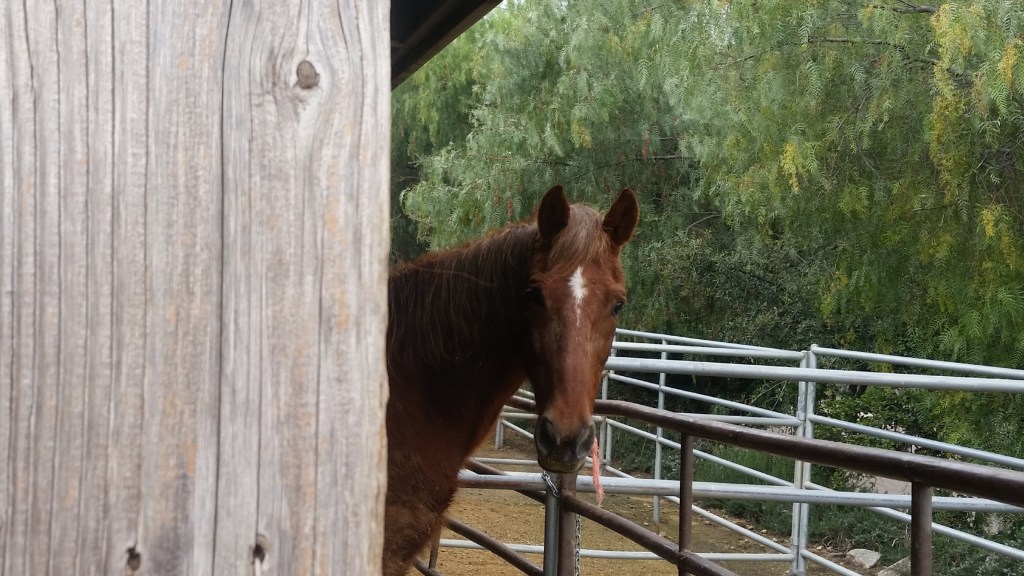
As I wipe the sweat from Pogie’s spotted coat, I think about what horses mean to me. Aside from their centuries of service to mankind, for the work they’ve done and the wars they’ve carried us into, I think horses bring out the best in us. I am especially an advocate of equine interaction for people on the autism spectrum. Horses certainly saved me.

We are not born broken. We are born different. Fear and ignorance break us. Every bad habit broken in schools, hospitals and clinics is a little shard of our crushed spirits. Just as every broke horse is too frightened of consequences to be his true self, we are too frightened to tap out unique creativity. If we excel at something, it is classified as an “intense interest,” a symptom rather than a skill.

My parents shunned applied behaviour analysis. They instead taught me alternatives to my impulsivity. They taught by example. They knew better than to try to bring order to my chaos. so they taught me to give chaos an orderly space to bang around in.

Because my chaos liked to break things.

Broken.

Who isn’t? Good ol’ chaos drops us on our heads all the time, and we break. And we mend. But not perfectly. Like the Japanese art of kintsugi*, we emerge less perfect but more beautiful. Intriguing. We are a story.

When I soothe the seismic skin of my horse, I imagine filling his broken places with trust. This is not easy for him. I’m a predator and he’s prey. I stink of meat and death. But his heart will eventually slow, the surf of his skin becalmed, and he in his turn will flood my cracks with gold.

*Japanese art of mending and philosophy of embracing the flawed or the imperfect.

Laura Saint Martin is a semi-retired psychiatric technician, grandmother, jewelry artist, and poet. She is working on a mystery/women’s fiction series about a mounted equestrian patrol in Southern California. Sha has an Associate of Arts, and uses her home-grown writing skills to influence, agitate, and amuse others. She lives in Rancho Cucamonga, CA with her family and numerous spoiled pets, and has dedicated her golden years to learning what, exactly, a Cucamonga is. She works at Patton State Hospital and for Rover.com. She can be contacted at two.socks@hotmail.com.

Categories
Musings

COVID-19: Days by the Arabian Sea

By Gracy Samjetsabam

COVID-19 lockdown continues. I am stationed in a small modern town, surrounded by rustic villages in coastal Karnataka. From some of the tallest buildings in the locality, you can see the mighty Arabian Sea in the horizon, far and wide like a steamy mirage. It’s dreamy!

As uncertain as the pandemic, the day kicks off with the thoughts of the “what ifs,” “What numbers?” and “What next?” Waking up to birds chirping, calm sunrise, though the sun’s the same — shining bright and ever brilliant — I wondered if today was going to be the same or any different. It was the same. It was a melodious morning with birds chirping and singing, except that I was missing the honking and bonking of the pre-office and office hours rush of children and people moving, waiting, walking, rushing, driving in or away, or embarking on their respective buses to work or school. My mind was not merry but having decided to ceremoniously spend some time in the garden before breakfast, I freshened up and invited my husband to join me. He isn’t always interested in garden stuff but agreed. In disbelief, he uttered, “COVID-19, it’s truly a Black Swan situation.”

I called home to find out their condition. Unsurprisingly, identical stories of the contagion loomed large enmeshed with gloom, grim and grimace. Feeling cynical, I asked my husband what would happen if things would get worse? Would we never go out again till some vaccine or a solution took the form of a saviour, or, if things got out of control, would we all fall sick and die — unable to get back to the old normal?

He just said, “Don’t be silly. It will be over soon. I mean, it has to …” Watering the plant leisurely, I was happy for those moments that I was able to spend tending plants, admiring the blooms and nurturing my garden. I wanted to think that this day was going to be a blessing in disguise.

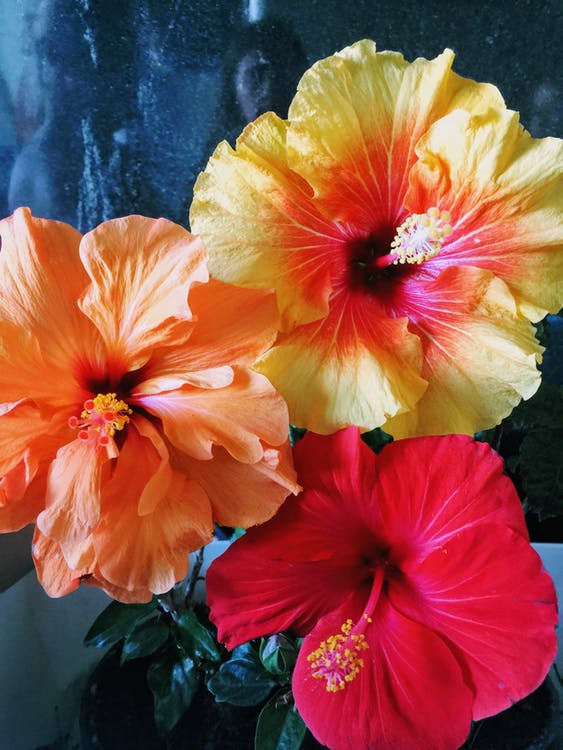
Multi-coloured Hibiscus

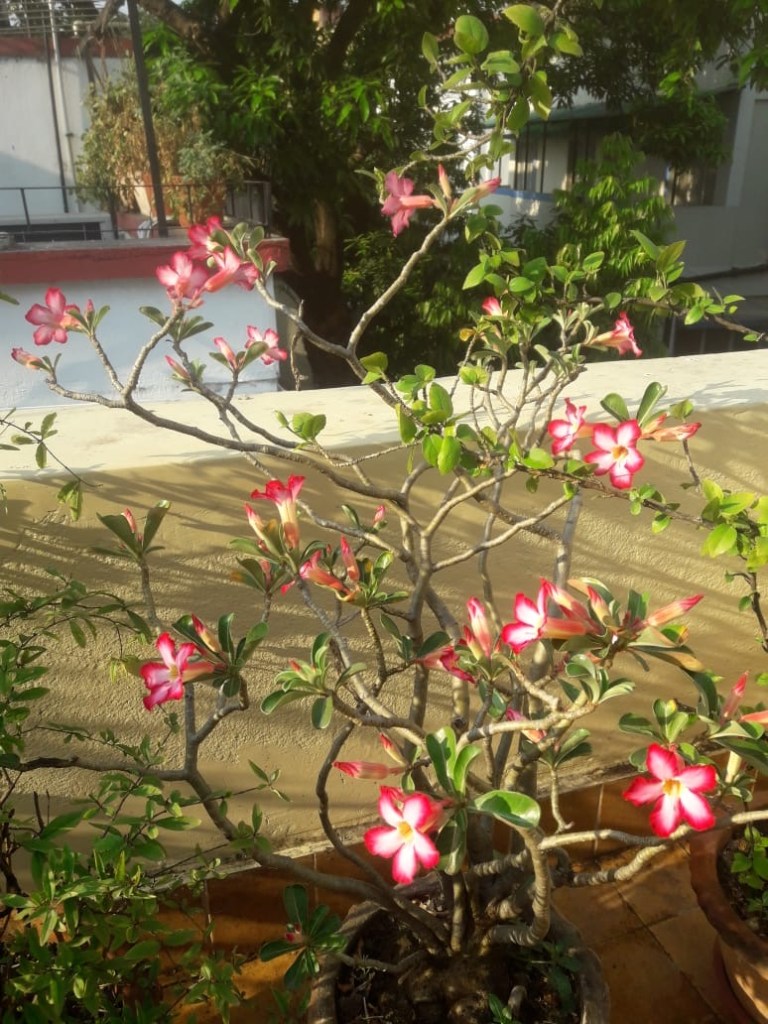
As I watered the plants, I was greeted by a couple of sunbirds sucking the nectar of the multi-coloured variety of hibiscus plants that grew along the fence in a row interrupted by jasmines followed by a parade of Ixora flowers mostly red, a couple of tall jackfruit trees bearing jackfruits big and small, a middle-aged cashew tree, a budding chikoo tree, curry leaf trees with its young ones sprouting around it like little children gathered around to listen to stories and, an alternate of tall coconut palm trees and lanky areca nut trees in each corner.

In one of the corners, was a family of plantains with one out of the two bigger ones that stood out gracefully, bearing tender bananas. They hung like braided hair with a flower at its tip. As I reached the corner, I could look up to the coconuts that hung so bountifully with spiky leaves that stretched out fiercely and proudly against the azure sky. For a moment I felt I was wrapped in a blue bubble.

I thought the sky is the same as the one I had seen from the rooftop of my house in Imphal on certain days when there were no clouds and the sky was exceptionally clear. But as I continued to look up almost breaking my neck, I twisted my head a little and wondered that it was the same sky yet it was different like a picture with filters. Spellbinding both though, in their own ways. 

Coucal

Spotting a greater coucal (crow pheasant) taking a quick-short flight from the cashew tree to the bushes reminded me of the Hume’s pheasant (Nong-in), the state bird of Manipur, which too loves to utilise the early hours of the day for food and fun. It reminded me of the familiar and at the same time made me curious.

Atypically, I missed rava idlis for breakfast, which I relished on certain mornings in the canteen, and so I had made plans to finally try cooking some at home. I always thought that the people of the place made it best, which surely is the case, but I thought of giving myself a chance. I looked up for the recipes and the procedures and made some with the emblematic coconut chutney. As I gave the final touches and made ginger tea, I thought of friends and family in this cosmic crisis. I could not help but feel heavy in my heart. I poured the hot aromatic tea into my favourite cups.

We were supposed to be home at this time of the year. By home, I mean my home in Manipur. A time we always look forward to, as the summer breaks are long and it has become a luxury to spend time at my home with dear and near ones. Along with the idea of longing and belonging, the idea of home too, keeps redefining with the passing time. And each time it gets defined, I get redefined too.

I remember, the first time I saw the Arabian Sea, it breathtakingly blew my mind. At the first glance, I felt like I was on the moon. The sea was calm and teeming blue. On the contrary, during the monsoons, the sea is wild, rough and voluminous. The sea, the waves, the sounds and sights of the beach slowly, becomes more familiar, the more I visit, the feeling is the less of a surprise but more of an endearing one.

Precarious as it may seem, the pandemic injected a moment of retrospection on the accustomed and the unaccustomed.

I continue to hope. I looked out into the garden from my window and smiled contentedly. I picked up my cup, sipped my tea and thought of home and of homes, at home. It captivatingly dawned on me that it was quite the same, yet not the same.

Gracy Samjetsabam teaches English Literature and Communication Skills at Manipal Institute of Technology, MAHE, Manipal. She is also a freelance writer and copyeditor. Her interest is in Indian English Writings, Comparative Literature, Gender Studies, Culture Studies, and World Literature. When not reading or writing, she loves to indulge in Nature.  

Categories
Musings

Creativity and Corona: Responses of Artistes

By Ratnottama Sengupta

Dil dhundta hai phir wohi fursat ke raat din

Baithey rahe tasavvur-e-jaana liye huye…

Garmiyon ki raat jo purvaiyaan chaley

Thandi safed chadaron pe jaagey der tak 

Taaron ko dekhtey rahe chhat par parey huey…

My words for Gulzar’s lyrics taking off from a Ghalib couplet?

Once more, my heart seeks 

Those days and nights of leisure, 

To simply lose them

In thoughts of the beloved!

Or, the balmy summer night 

When the Easterly breezes in,

To stay up till it’s dawn 

Only gazing at the stars…

Lying on cool white sheets 

Spread out on the roof…

Gulzar Sa’ab, how many more stanzas would you add to these lines, now that we have endless fursat ke raat din (days and nights of leisure)? 

A lot of people are seeking — no, not days and nights of leisure but ways to harness the close-door hours that are stretching on and on, yet leading to heated debates the world over whether to end or to extend the lockdown for some more days/weeks/months…

Meanwhile, the students and teachers of FTII — Film and Television Institute of India — have been making short films exhorting us to stay at home. Bollywood stars led by Amitabh Bachchan and including all others, have made a comedic short wherein they’re all searching for Big B’s misplaced chashma or glasses — from the confines of their individual homes.

Celebrated actor-director Aparna Sen has used the distancing hours to translate and audio recite evergreen poems of Tagore and Jibanananda. Members of the Contemporary Dance group Sapphire have been recording their creations conceived and executed in artistic isolation. Nandita Roy and Shiboprasad of Windows have come up with a series beginning with Hing or Asafoetida, a short about how being locked at home is providing new insights into the role of homemakers. Director Debesh Chatterjee has used Nabarun Bhattacharya’s concept of Fyataru – flying humans – to cinematically comment on the plight of people stockpiling food. 

With Tobu Maney Rekho (But Remember),  actor-anchor Aparajita Ghosh has initiated Galpo Toru, an audio series recording stories by contemporary authors from Bengal and Bangladesh. My dancer-actor niece Priyamvada Kant, living in Mumbai away from her Delhi-based parents, has made a short that asserts social distancing does not mean Dil Se Door (Far from the Heart). Documentarist Arindam Saha Sardar has crafted Ghaire Baire (Home and Outdoor), and Manush O Maanchitra (Contours of Human Subsistence), both involving his seven-year-daughter, Rupkatha. But what I’ve been most taken up with is You Can Fly by Kumaar Chowdhury wherein a little boy climbs up to the  roof or chhat and lets loose his imagination… 

Because? It comes closest to my experience of rediscovering the chhat — the key word of Gulzar’s lyric from the feature film, Mausam. Every flagstone of the open terrace on my house in Kolkata is shining like marble. Not one dry leaf in sight, and not just crows but doves and sparrows, bulbuls and mynahs are flocking to drink  from the earthen gamlas (basinets) I fill up for them. Ever since Biplab and Biru — the brothers who water my obsession with plants — bowed down to the lockdown, I have been going up to the terrace sharp at 6 pm, armed with a khurpi (hand trowel) and pruning shears. The hundred-and-more plants have never been so happy. The buds are blossoming into lilies and roses, adenium and petunia, genda and mogra, jaba and sthal padma, birds of paradise and orchids too!

This has prompted my husband to spend an hour in the morning and three every evening on the rooftop. The morning walk up the stairs mitigates his lack of exercise, and he paces the terrace too — a necessary part of the recovery process prescribed by doctors for his recent illness. And in the evenings he lies on a cot looking up at the stars and listening to music and jokes and stories on his handset. 

But bear with me: this piece is not about us. I have been amazed to see how many people have brought their so-far neglected rooftops back to life. Biswanath, CA by profession, finishes his brisk 30-minute walk on the house to our left. And on my right Bubai, my son’s childhood mate — in forced separation from his wife and baby girl stranded in Pune — is watering the plants for his mother. Across the street, Kailash has been putting to good use the cycle his ailing Mama is unable to exercise. As the boys are back from their campuses, the Bagadias next door have added clotheslines to sun-dry the joint family’s washing. One house away, I spot Aalo’s Dada assiduously keeping his mask in place when he alternates with his wife on the rooftop walks! From the adjacent terrace Ramola Di waves back a “Howdy?” in reply to my “Kemon achho (How are you) ?”

Diagonally across, on the rooftop of a multi-storied structure, I see three heads — one salt-n-pepper, one bald, one raven black — bobbing up and down.

“Are they playing badminton?” I wonder to myself. For, the terrace of the stand-alone next to theirs has been converted into a maidan by a lone child who’s scoring run after run with his football!

This brat, away from school, is not wanted downstairs where his mother is juggling with the mopping-chopping-cooking-serving-washing-cleaning as her kaajer mashi (home help) cannot relieve her from the drudgery of chores, while his father gravely sits before his laptop to comply with the ‘work from home’ ruling of his bosses. This child is not allowed to play with the neighbourhood kids, nor is he permitted to fiddle with his parents’ mobile phones. Lonely? He is. Forlorn? He is not. For he has his football, his terrace, and the liberty to let his imagination fly!

It is this liberty to fly, riding on imagination, that has fuelled the aforementioned Creativity in the countdown times of Corona. For, as Vilayat Khan once said to me, “If I don’t play my sitar for 2-3 days, saaz bhi kitne nakhre kartey hain ( even the chords will play up)! I have to put so much effort to appease them before I can tune them.”

A true artist can, then, never sit idle.

Remember Bengali litterateur Manik Bandopadhyay’s Madan Tanti? When the weaver of classy Balucharis grew tired of idling the days of bandh (strike), he sat on his loom all night, weaving the warp and weft — without a single strand of thread!

Ratnottama Sengupta turned director with And They Made Classics, on the unique bonding between screen writer Nabendu Ghosh and director Bimal Roy. A very senior journalist, she has been writing for newspapers and journals, participating in discussions on the electronic media; teaching mass communication students, writing books on cinema and art, programming film festivals and curating art exhibitions. She has written on Hindi films for the Encyclopaedia Britannica; been a member of CBFC, served on the National Film Awards jury and has herself won a National Award. The former Arts Editor of The Times of India is also a member of the NFDC’s script committee. Author of Krishna’s Cosmos and several other volumes, she has recently edited That Bird Called Happiness (2018/ Speaking Tiger), Me And I (2017/ Hachette India), Kadam Kadam (2016/ Bhashalipi), Chuninda Kahaniyaan: Nabendu Ghosh (2009/ Roshnai Prakashan).