Categories
Review

The Reclamation of Wilderness

Review by Basudhara Roy

Title: Wild Women: Seekers, Protagonists and Goddesses in Sacred Indian Poetry

Editor: Arundhathi Subramaniam

Publisher: Penguin Random House

“The path of the heart is at times discredited as a soft option. It is seen as a path of neurotic excess and greasy sentimentality. Yet, what we hear in these songs isn’t prissy obedience but open-throated longing. […] Such longing is not born of an infantile need for a divine paterfamilias. Nor is it the resort of those who lack the intellect to craft their own destinies. This is the way of the razor’s edge. The path of those who have nothing left to protect or prove. This is one of the most courageous journeys back home,” writes Arundhathi Subramaniam in some of the most powerful lines of a very evocative Introduction to this book.

Wild Women: Seekers, Protagonists and Goddesses in Sacred Indian Poetry is a comprehensive anthology of sacred poems that brings together three of Subramaniam’s most cherished interests–spirituality, poetry, and women’s creative lives. Seen within the tradition of Arundhathi’s own consistent and remarkable oeuvre as woman, poet and spiritual traveller, this anthology containing poems by women seekers as well as poems by men and women dedicated to women protagonists and goddesses, is a deep historical and existential search for legacy, for connection, for the otherness of selfhood and the self-ness of the other. The cover of the book, richly symbolic as it is, is also highly attractive, and one that readers will not forget in a hurry. Here is a birth, both cosmic and cataclysmic, a falling and a rebounding, calm and turmoil.

As an anthology of poems, Wild Woman attempts an undertaking not envisaged before – the bringing together of the voices of women within the spiritual fold from across the length and breadth of the country’s geography and history. Here are women from varied historical ages, diverse places, languages, social classes, traditions, and religious cults; women who are both well-known and relatively anonymous; women who choose to live within the family as well as those who seek to renounce it altogether; women who speak in their own voices as well as those who are spoken for by male poets, lovers and devotees; women who stand between history, myth, and divinity; in short, women who have been beckoned by and have responded, in various ways, to the persistent call of the wilderness within their wide, vibrant souls.

Given the intensity of its subject and intention, the book is aptly titled. ‘Wild women’, apart from being alliterative, marks distinct metaphorical connections with the cultural terrain of women’s lives. As the poems in this book powerfully assert, ‘wilderness’ is a location these women existentially inhabit. It is a space that is beyond the governance and influence of society, and though women are native to it, this is where they are forever exiled from. To return to the self is to reclaim this wilderness within, to dismiss societal constructs and make an institution out of faith and intuition. This wilderness, as Subramaniam insists, “is not a cosy hearth. It is a place of peril, a smithy of surprises.”

It is also a space that has the potential to envision a new ontological, epistemological, and social order. Every voice in this anthology is, thus, disruptive in its envisioning of a form of existence that militates against the one offered by contemporary society. In ‘Get Ready to Live like a Pauper’, Gangasati [1]whose songs are an important part of the oral tradition of poetry in Gujarati even today, says:

The world of the divine has no place
For caste, gender or race
Shed this phantom chain,
Be cool and take it easy, man.

Similarly, Amuge Rayamma of the twelfth century CE, says:

If you know the self
why have truck with those who gossip?
If you can move in ways unimagined,
why depend on women?

In every poem, the route taken into this wilderness is that of the spiritual, revealing a desire to merge the self with the essential light of the universe—the formless Divine or the God, loved deeply in some human form.  Here is a total rejection of every established commandment, and a faithful obedience only to the experience of the self – the physical and the spiritual. The Lord is conceived as responding to every form of desire and arrives to the woman seeker in plural shapes of parent, lover, mentor or guide. To Kanhopatra of the fifteenth century CE, the Lord appears as “Mother Krishna” while to Vidya who wrote in Sanskrit sometime between the seventh and ninth century CE, he comes as a lover:

Why expose a lone woman
to such pageant
o season of rain
the torment
the sweet bitter need to be
touched

The poems in this anthology evince a strong dissatisfaction with prescribed moulds of identity and an urgency to experience life and thought first-hand. The constant pull between society and the individual, dogma and will, subjection and agency, and incarceration and liberation constitute the essential conflict in these poems, only to be resolved by the fierce choices of the spirit. Dissatisfaction with caste, gender, family, materialism and injustice lead the poets in this book to experiment with a language that legitimises the use of women’s experiences as yardstick and metaphor for the exploration and exposition of new truths. Keeping the feminine body of woman and nature at the centre of experience and discourse, the syntax of these poems is framed by an irresistible desire to overwhelm the old with the new. In every poem, thus, language becomes a sharp and dextrous tool, both argumentative and aesthetic, to establish new knowledges and new points of view. In ‘A Manifesto for New Poetry’, Muddupalani (eighteenth century CE) writes:

Can your poems stand in the field, girl,
alongside all the great poems of all the great
poets? Absolutely.
Doesn’t the bee gorged on honey
from the great lotus still savour
the humble flower’s nectar?

“The journey of a book, not unlike the journey of the heart, has its own logic—precise but not always schematic,” writes Subramaniam. Operating on its own logic, this book vitally performs for our times four extraordinary tasks—historical, activist, poetic, and feminist. Historically, it liberates women from stereotypes of oppression within patriarchy and domesticity, and by reinstating their positions as thinkers, philosophers, agents, leaders, and role-players within active religious and community life, it lays down empowered annals of womanhood for us to contemplate on. In terms of literary activism, such an extensive attempt at documenting and compiling voices of and for women within the spiritual domain, is largely unprecedented. “The essential impetus behind this project was to invoke the names of women. To turn cameos into protagonists. To invite backstage workers into the spotlight,” remarks Subramaniam. By highlighting women’s names and contributions to Indian spiritual traditions, this book will not only protect these names from oblivion and erasure but also encourage further explorations and deliberations in this field.

“A poem can offer us respite from too much meaning,” states Subramaniam. As poetry, this volume is a distilled collection of some of the finest spiritual doubts, agonies, and ecstasies of the human self in its journey towards the divine. Additionally, by bringing poems in translation from a wide corpus of vernacular languages into English, this anthology opens up Indian English poetry to the most intimate linguistic and creative recesses of the Indian mind. Finally, as a feminist work, this book highlights an ontology of the wild which becomes here, a praxis rather than an anomaly, and helps to establish a shared bond of courageous and self-conscious womanhood. Through each of the three sections of the book where women appear as seekers, protagonists and goddesses, Wild Women steadily performs an ecriture feminine, and sculpts a spiritual biography of Indian womanhood.

There is an elemental power that radiates from Subramaniam’s language, the power of words that have been painstakingly lived through before utterance. Subramaniam is, as much, a disciple of language as she is of the spirit. “This is poetry as power—the power of conscious utterance and the raging power of all that must be left unsaid,” she remarks of the poems in this book. Her own words evince that power to create and to procreate an understanding of womanhood that is steadily expanding to include new experiences and worldviews. She writes, “Since these poets lived lives profoundly wedded to mystery, that mystery is an integral part of this project.” Constantly aware of this mystery, Wild Women is a passionate and compelling thesis for reclaiming women’s essential wilderness and the place of wild women within history, spirituality and poetry.

[1] A medieval saint poet of the Bhakti tradition

Basudhara Roy teaches English at Karim City College affiliated to Kolhan University, Chaibasa. Author of three collections of poems, her latest works have been featured in EPW, The Pine Cone Review, Live Wire, Lucy Writers Platform, Setu and The Aleph Review among others. 

.

PLEASE NOTE: ARTICLES CAN ONLY BE REPRODUCED IN OTHER SITES WITH DUE ACKNOWLEDGEMENT TO BORDERLESS JOURNAL

Click here to access the Borderless anthology, Monalisa No Longer Smiles

Click here to access Monalisa No Longer Smiles on Kindle Amazon International

Categories
Poetry

‘Gossamer Voyage of Praise’?

Poetry by Jim Bellamy

THE PRAYER?

I know the site of that hidden mind
It is sidling and empty, a farcical bent
Sliding up the clock. I ride minds behind
The towers, the towering wheel and flowers
Dropped in a vase of the heroine's smile.

My hypnotic illusion is not cowed.
Aligning my head, the skies, the one
Bay of the evening chorus, above
The serviette of gears I make my single
Shimmering of hand into hand. The
Sun moves below the eye, a
Beautiful rivering
Of a beautiful consternation.

Resentful of the world, the underglassed
Tauntening of jade, the mind
Tightens its grip on the reprobate
And moves sloanes out to sea.
Most beautiful is the singlet, the
Wondrous land of films and spheres;

Next, the spider spinning
Its gossamer voyage of praise.
The eye is unperfected; lies
Days deep beneath the dial. I
Kiss my girl, yet here the sense
is no-one's, nobody's, vile.

Jim Bellamy was born in a storm in 1972. He studied hard and sat entrance exams for Oxford University. Jim has a fine frenzy for poetry and has written in excess of 22,000 poems. Jim adores the art of poetry. He lives for prosody.

.

PLEASE NOTE: ARTICLES CAN ONLY BE REPRODUCED IN OTHER SITES WITH DUE ACKNOWLEDGEMENT TO BORDERLESS JOURNAL

Click here to access the Borderless anthology, Monalisa No Longer Smiles

Click here to access Monalisa No Longer Smiles on Amazon International

Categories
Poetry

Impure

By Surbhi Sharma

In the quiet of dawn, she began her day,
Sweeping, scrubbing, tending each corner,
A dance of broom and cloth, a silent ballet,
Her hands, the maestros of order.

Dusting off shelves, arranging each shelf,
Her heart a temple, her home a shrine,
In the quiet solitude, she found herself,
In the rhythm of chores, a sacred design.

With care she sought, a deity divine,
From the hands of a sculptor, skilled and sure,
An idol of lord, a treasure to enshrine,
In the sanctum of her humble abode, so pure.

But fate’s cruel twist, on that auspicious day,
As she readied to place the lord with grace,
Her body whispered secrets, in crimson array,
A visitor unwelcome, yet she embraced.

Yet voices arose, from the depths of fear,
Whispers of impurity, staining the air,
“Leave, you’re unclean,” they cried, severe,
Her heart shattered, in silent despair.

Alone she stood, in the shadow’s embrace,
Her temple forsaken, her offerings denied,
Yet in her solitude, she found her grace,
A goddess in her own right, undenied.

For purity lies not in a drop of red,
But in the spirit that perseveres and endures,
She, the keeper of hearth, in the dance she led,
A woman, a goddess, forever pure.

Surbhi Sharma is a research scholar at Himachal Pradesh University. She has poetry in The Criterion, Muse India, Literary Voice and Polis magazine and many more platforms.

.

PLEASE NOTE: ARTICLES CAN ONLY BE REPRODUCED IN OTHER SITES WITH DUE ACKNOWLEDGEMENT TO BORDERLESS JOURNAL

Click here to access the Borderless anthology, Monalisa No Longer Smiles

Click here to access Monalisa No Longer Smiles on Kindle Amazon International
Categories
Stories

Alvin and the Curious Case of Spoilt Milk

By Anagha Narasimha

The Bangaloreans will mostly remember the spring of 2024 for bringing on only the heat wave. The Garden City’s temperature reached an unprecedented forty-one degrees Celsius (falling just nine short of a half-century. The summer was terrible for Bangaloreans on two counts – the heat wave and the RCB[1] Men’s team drifting further away from their slogan, hashtag ESCN[2]. But, all of it changed and changed suddenly. The pre-monsoon showers finally brought some relief from the heat wave. Although it initially teased everyone with sprinkles (making the entire city seem like a hot dosa pan, from which steam emanates as soon as the chef sprinkles water). The clouds took pity on the poor souls and became generous eventually. Similarly, RCB Men’s fortunes also changed and changed utterly as they stood with a legitimate chance of qualifying for playoffs after six consecutive wins on the trot.  

Amidst the aforementioned cloudy weather, teasing the Bangaloreans, Alvin, a young advocate in a mid-tier law firm, enjoying his long-sought break from the court, finally decided to make himself a coffee from the coffee brewer. All thanks to the summer that preceded, he had forgotten the setting of the coffee brewer and had to rely on the manual. Finally, he found a way to set the brewer to make a cappuccino with 80 ml of milk and 40 ml of coffee. Just when he was about to press start, his senior colleague interrupted: “What the heck are you doing? Can’t you see that the milk is spoilt?” Alvin did not even bother checking the authenticity of the claim by himself as he knew he would not be able to figure it out. He directly took the matter to the only other colleague who happened to be working even during court vacation, albeit cursing her fate.  

Avni, who was buried inside her file, was suddenly brought back to the office by Alvin.

Avni blurted, “Oh good you are here!”

Alvin showed her the container with the milk and Avni realised she made a big blunder by assuming that Alvin’s presence was a good sign.

Alvin confirmed her fear by asking, “Tell me whether it’s spoilt.”

“Spoilt? It has become curd, you idiot, ” retorted Avni, adding, “And here I was… thinking I would take your advice on my cheque bounce case.”

Accepting Avni’s judgment, Alvin proceeded to throw the milk (or curd) into the wastebin and just then… He noticed the empty aseptic tetra-pack milk sachet lying there craving his attention. He carefully picked it up, went straight to Avni and held it in front of her as a matter of fact. Avni had given up on Alvin’s antics and had decided to finish her work and go home.

Avni: “What?”

Alvin: “It was lying in the dustbin.”

Avni: “Ewwww gross. Throw it away.”

Alvin: “You don’t see?”

Avni: “I see trash but I don’t see why it is outside the dustbin!”

Alvin: “The maid clears the bin every morning around ten thirty…”

Avni: “Mhmm. You are the one to tell. Who’s never in office before 11!”

Alvin: “It is nonetheless. It is twelve forty-eight now. And the packet is still in the bin. Which means it was opened after ten thirty.”

Avni: “Mhmm.”

Alvin: “So processed milk, packed in an aseptic tetra-pack, gets spoiled within two hours?”

Avni, finding all the strength within her, dragged herself out of the file she was covered in and yelled, “What do you want me to do now? Sue them? For fifty rupees?”

Alvin: “No!”

Avni: “Yeah right. Let’s add damages too!”

Alvin: “No!”

Avni: “I must prepare for cross-examination in a Section 138 NI Act case. So why don’t you just blurt out whatever it is?”

Alvin: “How did the milk get spoiled?”

Avni: “Really? I’m asking you for a way to rebut the presumption against the accused in a cheque bounce case and you are worried about spoilt milk?”

Alvin: “Well…”

Avni: “You know what they say? Do not cry over ‘spoilt’ milk!”

Alvin: “What?”

Avni: “Forget it.”

Alvin: “You don’t get it. Cause milk can’t get spoiled for no reason. That would change everything. If you let it go then the very fabric of causality will be ruined and once that’s done… Well, it opens the floodgate and anything can happen.”

Avni stared at him with a dismissive look, “All that’s great but some of us are dealing with real-life problems like preventing a person from going to prison. So can we first focus on that?”

Alvin: “Ah, maybe you’re right. What is it now?”

Alvin sat beside her and cleared the long pile of files that were enjoying their summer break.

Avni: “Good! We’re for the accused. The complainant alleges that the accused issued the cheque in discharge of the amount he lent to the accused in cash on January twenty-seventeen, worth sixteen lakhs[3]. Well, the accused says he received no such cash and the complainant is misusing his signed cheques – but the presumption under Section 118 and Section 139 is against the accused, so…”

Avni was startled when she saw Alvin dozing off in the middle of her narration.

Avni: “Oh come on! For crying out loud! I am not narrating some chanda mama[4] story or singing a lullaby.”

Alvin: “Well you know me. I want my afternoon nap. That’s the reason I wanted to have a cup of coffee in the first place.”

Satisfied with his explanation, he laid his head to rest on the cleared table. Avni could not afford that luxury and she went back to her files. Alvin, who was struggling to stay awake, was now struggling to sleep. Coffee was supposed to help him not fall asleep, and now the thought of missing coffee kept him awake.

The entire event ran in flashes while he tried to sleep.

INT. MID-TIER LAW OFFICE – MID-NOON

Nitin, a middle-aged, office clerk, is running around haphazardly stitching a file. He is cursing somebody – “Even on vacations — these people won’t let me even have a cup of coffee in peace. Keep calling again and again, interrupting. Screw them.” 

Alvin makes sure that the coffee beans are filled. Alvin presses the buttons to make the coffee. Nothing is working. Realises it is switched off. Finds the plug and connects it to the switchboard. The tray on which the coffee cup is supposed to be placed is dusty. Searches for a towel nearby, and finds it on the printer. The towel is also dusty. Ends up wiping the tray with tissues…

BLACKOUT

Alvin woke up suddenly, imagining himself to have exclaimed “Eureka”, except, he had done that only in his sleep. Avni felt she was oblivious to the world of Alvin and continued with her day out with the file.

Alvin ran towards the coffee brewer, completely ignoring Avni’s presence. He had reached the coffee brewer by the time he realised his mistake, and returned to the office cabin to drag reluctant Avni with him.

Alvin: “I got it!”

Avni: “There is no way I can escape this is it?”

Alvin: “So why bother?”

Avni: “I’ll listen to your crazy explanation only if you promise to assist me in preparing for the cross.”

Alvin proclaimed, “Done.”

Alvin: “You see the Bean Hopper? It is recently filled.”

Avni: “So?”

Alvin: “The brewer wasn’t even connected to the power source and I had to dust it before connecting. Obviously, everyone’s on vacation and it wasn’t in use so it was dusty.”

Avni: “Can we cut to your big reveal, where my exhaustion takes the form of beating you up?”

Alvin: “If these are dusty, the milk container must also be dirty.”

Avni: “Ewwww and you were making coffee with that?”

Alvin: “Hell no. The milk was already filled, and I saw Nitin running around, cursing the work that he had been asked to do.”

Avni: “Poor Nitin. Just like me.”

Alvin rushed past Avni to the washbasin where the sponge was lying on the washbasin, completely displaced from its actual position.

Alvin: “You see?”

Avni: “What am I supposed to see?”

Alvin: “Nothing is in order. The sponge is over there, the liquid soap isn’t even closed properly, and you can even find the soap smudges on the washbasin.”

Avni: “Don’t wait for me to react. Just get done with it already.”

Alvin: “Nitin came to the office, earphones plugged, listening to some merry song, thinking of starting his day by making a cup of coffee. He brought out a packet of milk, prepared to clean the milk container, and the office telephone rang – vibrations tearing through the melody of the song being played on his earphones.”

Narrating thus, Alvin walked towards the telephone and pressed a button revealing the call logs.

Alvin continued: “Nitin cursed his fate when they assigned work, but thought he could start with it after having his daily cup of coffee. He went back to cleaning the container and then again – as you can see from the call log – multiple calls didn’t let him have the coffee.”

Avni: “He spoilt the milk so that none can have coffee?”

Alvin: Nah! There is no mens rea[5]whatsoever. If that was the case, he would have made sure none would notice. He was constantly disturbed by the calls. He realised he couldn’t have his coffee so decided to clean it and pour the milk so that he could have it as soon as he was done with the work. While he was cleaning the container – you can see there were a few more calls – he hurried, after cleansing the container with the liquid soap, he forgot to soak it in hot water to remove the soap remnants.”

Avni: “How do you know?”

Alvin points at the water dispenser, which was switched off, which further implied that Nitin had no access to hot water.

Alvin: “Nitin, in that state of mind, added milk to the container which had soap remnants.”

Alvin pointed out the lemon on the liquid soap bottle and with a wide grin exclaimed, “…did the job of spoiling the milk”.

Avni: “That’s artificial lemon, you genius. They don’t add actual lemon.”

Alvin: “Yes indeed. What they add to get that lemon flavour is limonene — a colourless liquid aliphatic hydrocarbon classified as a cyclic monoterpene, which is the major component in the volatile oil of citrus fruit peels. That’s how we were faced with the curious case of spoilt milk.”

Avni: “You. Just you. Don’t you dare include me by saying we. Now, if you’re done playing Sherlock Holmes, can we switch to Perry Mason and find a way to rebut the presumption against the accused in our case?”        

Alvin: “Ah, don’t worry about it.”

Avni: “Why? You have a few more spoilt milk puzzles to solve?”

Alvin: “You can disprove the complainant’s testimony.”

Avni: “How? The complainant says he gave a loan worth sixteen lakhs to the accused. The signature is not disputed. There is no way to prove that the complainant hasn’t given sixteen lakhs because the presumption in his favour.”

Alvin: “How much does the complainant claim to have paid?”

Avni: “Sixteen Lakhs.”

Alvin: “Date of payment?”

Avni: “Sometime during January 2017.”

Alvin: “Mode of payment?”

Avni: “Cash. How convenient?”

Alvin: “Denomination?”

Avni: “I don’t know. Five hundreds and thousands?”

Alvin: “There. You have proved him wrong.”

Avni: “How?”

Alvin: “In January 2017, he paid a sum of sixteen lakhs via cash. November 2016, we had demonetisation — five hundred and thousand notes were discontinued. Moreover, he couldn’t have paid more than two lakhs in cash to the accused as per the guidelines that existed. There. You have proved he is lying on oath.”

Avni ran to her chamber to verify the statements – “He says he paid the entire sixteen lakhs at one stretch” – Her facial expression screamed “Eureka”, while Alvin prepared coffee for both of them.

Avni, sipping her coffee, “So when did you realise this loophole?”

Alvin: “As soon as you told me the case.”

Avni: “And why didn’t you tell me?”

Alvin: “You would have gone home and I had to solve the curious case of spoilt milk alone.”

Avni: “One day… You’ll find poison in your coffee and you’ll die without ever knowing how it got there.”

Alvin sounded baffled, “You’re so mean”.

Finally, the rain made up its mind to show mercy on Bangalore by pouring down as they had their coffee in peace.

.

[1] Royal Challenger’s Bengaluru, a football team.

[2] Ee Sala Cup Namde translates to ‘This time, the cup is ours’

[3] A lakh is an Indian denomination equal to 100,000

[4] Chanda mama or moon uncle in Hindi… here used in lieu of fairy tale

[5] The intention or knowledge of indulging in a crime constitutes a criminal act.

Anagha Narasimha C N, an advocate by profession, is also a poet and writer. His poems in Kannada and English are published in various online journals and he is actively involved in playwriting and theatre production. 

.

PLEASE NOTE: ARTICLES CAN ONLY BE REPRODUCED IN OTHER SITES WITH DUE ACKNOWLEDGEMENT TO BORDERLESS JOURNAL

Click here to access the Borderless anthology, Monalisa No Longer Smiles

Click here to access Monalisa No Longer Smiles on Kindle Amazon International

Categories
Poetry

Cat in the Morning & More Poems

By John Grey

CAT IN THE MORNING

It’s dark out
as the cat takes up residence
on the sill of a wide open window.
The sparrows in the trees outside
don’t notice him
or, more likely, just don’t care
having established that he’s a house cat,
too domesticated,
too set in his ways,
too lazy to chase prey.
But then the cat yawns and the sun rises.
So he’s still powerful in that respect.

POINT REYES


Early May,
the waystation mudflats
are inundated
with sandpipers, godwits
and a squabble of
long-billed dowitchers,
all Arctic bound.

Grebe flocks wheel relentlessly
over the ponds
before settling, as one,
to feast.

Inland, small herds of
deer and tule elk feed.

Cliffs provide a rookery for heron
and their pine-tops
are full of screeching young.

Here,
life is a quirk
of its own clear fate.
Its joy is not to dabble
but sustain.


A GARDEN IN SNOW

Brushing away snow,
she uncovers the stone dog.
And its hare companion,
solid, steadfast, despite
the bitterness of winter.

Only the garden succumbs
to the heartless weather:
sunflowers slaughtered,
dahlias defeated,
tulips trampled,
rose-bushes ripped raw.
If there’s any fight left in them,
it eludes her gloved fingers.

Early March,
and it’s like looking in on children.
Some are still robust.
Most are memories.


John Grey is an Australian poet, US resident, recently published in New World Writing, North Dakota Quarterly and Lost Pilots. His latest books are Between Two Fires, Covert and  Memory Outside The Head are available through Amazon.

.

PLEASE NOTE: ARTICLES CAN ONLY BE REPRODUCED IN OTHER SITES WITH DUE ACKNOWLEDGEMENT TO BORDERLESS JOURNAL

Click here to access the Borderless anthology, Monalisa No Longer Smiles

Click here to access Monalisa No Longer Smiles on Kindle Amazon International

Categories
Excerpt

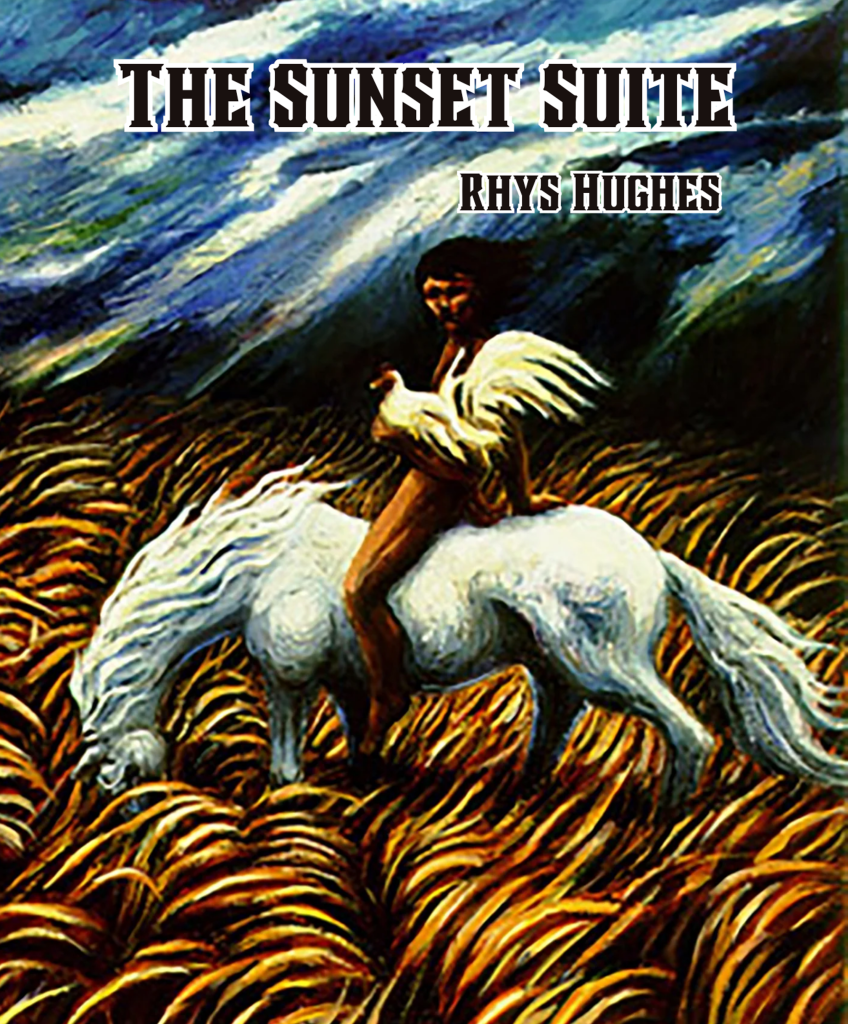
The Sunset Suite

Title: The Sunset Suite (A Weird Western)

Author: Rhys Hughes

Publisher: Gibbon Moon

The two men had made camp beneath a bristlecone pine and they sat with a fire between them. The flames had died down but the embers were glowing and the pot of coffee was resting on the ashes and bubbling. They had tiny cups in their gnarled hands and sipped them as they blinked at each other and the stars over the world burned without twinkling. The first man, who was called Brand, spoke to the second, who was named Thorn, and his words were about the beverage in their cups, and his tone was awestruck.

“You know something, pard? This coffee tastes not just like coffee but also like something else. I think it tastes like a story, a different story with each cup, but a very short story every time because the cups are so small. And that’s not a normal thing for coffee to be like. I won’t say the situation is worrying, no siree, but I might venture the opinion that it’s highly unusual. The cup I drank just now tasted like an anecdote about a mule.”

And Thorn said, “You are right, Brand. What should we do about it? There is a lot of coffee remaining in the pot.”

“I guess we’ll keep drinking it, pard. But maybe we ought to tell it as well as drink it. Get those stories out there. It might be injurious to our health if we swallow them and absorb them all.”

“Agree with you, I do. The cup I just drank tasted like a fable concerning a cactus and a coyote. Should have related it to you, but I didn’t. Maybe I’ll get an attack of indigestion now. Hope not.”

“Listen then, Thorn. Let’s help ourselves to another cup each and I will tell you the story that I’m tasting. You can go second. We’ll take it in turns and keep going until the coffee pot is exhausted.”

“That dented thing looks tired already. But I know what you mean. Alright, I am waiting for you to tell me a tale.”

And the one named Brand opened his mouth.

Into the Sunset

Cowboys are often depicted riding off into the sunset. Jake Bones loved riding off into the sunset more than anything. He refused to ride in any other direction or at any other time. Sunsets don’t really last long, and so Jake rarely rode more than a mile every day. He hung around places until the sun started to turn orange and when it reddened he would mount his horse and canter towards the western horizon until the fiery ball vanished over the edge of the world. Then he would pull on the reins, dismount and look for a place to sleep. In this manner he very slowly crossed the continent. It took years for him to complete his journey and when he started, from a small town on the coast of North Carolina, he hadn’t a plan at all. He just knew he had to follow the sunset. The plan came to him five years later, when he was halfway across the mighty landmass. Jake Bones knew that one day he would finally reach the Pacific Ocean. How would he be able to ride off into the sunset then? His horse would drown if he attempted to make it swim through the rippling light. But there is a solution to every problem and he was riding through a forest of dead trees when inspiration struck. He snapped a branch off, then another, as he went, while the rays of the setting sun slanted at a lower and lower angle and finally were horizontal before they were blocked by the curvature of the Earth. Jake strapped the branches to the sides of his horse with the rope he always carried. In the days, weeks and months that followed, he acquired more branches and other pieces of wood, and the appearance of his horse changed dramatically. Finally, the tang of a salty breeze filled the nostrils of Jake Bones and he knew he had almost reached the ocean. With his knife he cut off the brim of his Stetson and turned the hat into the cap of a sailor. Then he climbed over a rise and found himself gazing down at a seashore lapped by little waves, and the sun was setting into the sea and making a ladder of reddish light towards him. That ladder beckoned and he spurred his horse the short remaining distance into the cool water. His horse was watertight and floated well and he had no anxiety as he slowly paddled towards the west. Why should a lack of land interrupt his progress? Jake Bones had converted his horse into a boat and he had done this on the hoof. He still follows the sunset and has been sighted by the crews of several ships since.

A Model Prisoner

He was guilty of shooting off the ear of a man in a saloon, a man who later died, and that’s why he went to jail. Everyone knew that Shorty Potter was quite an unpleasant individual and that he had tried to place that bullet in the brain of the mad auctioneer, Killy the Bid, but he had been drinking heavily and his aim was amiss and the ear flew off and landed in the middle of an important poker game on a table in the far corner of the saloon.

The bar keeper sent an errand boy to fetch the town sheriff and Shorty was apprehended and locked up and a trial date was set, but Killy the Bid made the incident more complicated than it might have been. The loss of his right ear left him with a ringing in his head, and at first he supposed the ringing was the noise of a train coming through the town, so he tended to stop in his tracks whenever he heard it and wait for the train to pass.

But there never was a train and he soon understood that the ringing was in his mind or maybe some form of tinnitus. He was crossing the railway tracks on a bright morning three weeks after the incident, and when he heard a ringing he just ignored it, and the train struck him and not much of Killy the Bid remained, apart from his left ear, curiously enough.

His demise was deemed wholly, albeit indirectly, a result of Shorty Potter’s discharge of his Colt in that saloon, and the public prosecutor wanted him to be charged with murder, but in the end he was charged with affray and disorder and sentenced to ten years behind bars. Ten years was considered a harsh sentence at a time when men died relatively young and Shorty was appalled at the idea. But he decided to make no trouble henceforth.

He was meek and mild and his reputation as an unpleasant fellow began to erode, at least among the other prisoners and the prison guards. Shorty became, in short, a model prisoner. He volunteered for menial tasks, swept the cells and corridors even when it wasn’t his turn, tended to inmates who fell sick, kept his own cell neat and tidy, was always polite to the guards, no matter how savagely they spoke to him, and in fact they started to soften their tone when telling him something. They eventually trusted him.

The result of all this activity was that he was awarded privileges, nothing a free man might regard as a luxury, but small liberties that any incarcerated felon would certainly appreciate. He was allowed to read books, though the choice he was offered was very limited, but not all of them were religious tracts, and a big volume of Longfellow’s poetry became his favourite. He was also permitted two hours of exercise in the yard instead of one.

Shorty Potter never pushed his luck too far. He scarcely pushed it at all, but one day he approached the most senior guard in the prison and softly asked if he might be allowed some clay. He wanted to construct models for his amusement, a hobby that nobody could surely regard with disapproval, and the guard agreed it was a great idea, an outlet for Shorty’s exuberant creativity that was obviously pent up not only by metallic bars but the rigid routines of prison life. Permission was granted. A bucket of clay was provided.

He moulded it to create little figures of men and women, and as his skills improved he made small houses, churches, even a replica of the prison itself, a model that delighted the senior guard so much he asked for it as a gift. Shorty was happy to give it to him. He produced another, deliberately not as detailed, for himself, and followed this up with ships and saloons, wagons and herds of bison, incredibly lifelike eagles and coyotes. He was especially admired for the hungry bear and a pack of wolves he made.

During this phase of his imprisonment, Shorty Potter often thought about his own surname and wondered if fate was playing a joke, but fate sometimes is kinder than that, and in this case it wanted to help him. Shorty began work on a special piece, the most ambitious of his models. He required more clay than one bucketful and it was given to him after he answered the question, “Why do you need so much?” by saying he was preparing a surprise for the prison guards, an artistic statement that would electrify them.

He worked on this project only at night. The prison guards trusted him now and waited to see what surprise he was preparing for them, and they laid bets on what his masterpiece might turn out to be. A paddlesteamer, said one. A replica of the White House, said another. One guard, pondering the word ‘electrify’ had the unhappy idea that Shorty was making a model of an electric chair, a method of execution introduced the previous year.

One morning, he failed to respond to the wake-up call. A guard rapped on his door with a short iron pole, but there was no answer. The guard peered into the cell and saw Shorty Potter still in bed, and there was something wrong with him. He looked an unhealthy colour. Had he died in his sleep? The guard turned his key in the lock and rushed inside. He shook Shorty and felt the clamminess of his flesh. No, it wasn’t flesh. It was clay!

Shorty had made a model of a man and substituted the model for himself. A decoy! He must have made his escape. But how? There were no holes in the wall and no tunnels under the cell. How had he managed this miracle? With an angry yell, the guard summoned his comrades. They felt betrayed, and it must also be admitted that they felt some respect for Shorty. He really had turned out to be a model prisoner. Then they growled:

“Send out a search party. He can’t have gone far. Shoot on sight! And get that clay model out of here. There will be hell to pay for this. No one has ever escaped from this prison before! Hurry…”

And they hurried. Two of them carried the clay model out of the cell and along the corridors to the main gate and threw it into the dust outside. Then they returned into the prison and slammed the door. One minute later, the clay model stirred, sat up and blinked, then stood. It began hobbling away from the prison until it reached the bushes. It pushed on through the undergrowth, avoiding the paths, until it reached a rapidly flowing river.

It knelt and washed itself in the foamy water and every part of its exposed skin needed a good scrubbing, all apart from the left ear. People would later say that this was a secret message to Killy the Bid about his missing right ear, but in fact the reason was merely that there hadn’t been enough clay to cover it. Shorty Potter cleaned himself and when he looked like a flesh man again, he forded the river with difficulty and reached the far side.

Then he started running for the hills. He reached them too, a sanctuary safe from his pursuers. But on the sixth day of his newly-won freedom, as he walked over a fissured plateau, he slipped down a narrow crevice…

About the Book

Coffee around a camp fire. But every cup tastes like a story. And so the two cowboys, Thorn and Brand, exchange tall tales as they drink. And they will keep telling stories until the pot is empty. They will relate implausible and incredible accounts of outlaws, pioneers, visionaries, musicians, lawmen, warriors, ghosts, mountain men, dreamers and hellfire preachers. They will gradually and inevitably turn into stories themselves as they sit beneath the bristlecone pine tree…

“Rhys Hughes seems almost the sum of our planet’s literature. He toys with convention. He makes the metaphysical political, the personal incredible and the comic hints at subtle pain. Few living fictioneers approach this chef’s sardonic confections, certainly not in English.” — MICHAEL MOORCOCK

“If I said he was a Welsh writer who writes as though he has gone to school with the best writing from all over the world, I wonder if my compliment would just sound provincial. Hughes’ style, with all that means, is among the most beautiful I’ve encountered in several years.” — SAMUEL R. DELANY

About the Author

Rhys Hughes is a writer of Fantastika and Speculative Fiction.

His earliest surviving short story dates from 1989, and since that time he has embarked on an ambitious project of writing a story cycle consisting of exactly 1000 linked tales. Recently, he decided to give this cycle the overall name of PANDORA’S BLUFF. The reference is to the box of troubles in the old myth. Each tale is a trouble, but hope can be found within them all.

His favourite fiction writers are Italo Calvino, Stanislaw Lem, Boris Vian, Flann O’Brien, Alasdair Gray and Donald Barthelme, all of whom have a well-developed sense of irony and a powerful imagination. He particularly enjoys literature that combines humour with seriousness, and that fuses the emotional with the intellectual, the profound with the light-hearted, the spontaneous with the precise.

His first book was published in 1995 and sold slowly but it seemed to strike a chord with some people. His subsequent books sold more strongly as my reputation gradually increased. He is regarded as a “cult author” by some and though pleased with that description, he obviously wants to reach out to a wider audience!

.

PLEASE NOTE: ARTICLES CAN ONLY BE REPRODUCED IN OTHER SITES WITH DUE ACKNOWLEDGEMENT TO BORDERLESS JOURNAL

Click here to access the Borderless anthology, Monalisa No Longer Smiles

Click here to access Monalisa No Longer Smiles on Kindle Amazon International
Categories
Poetry

Culture, History and More… in Verse

By Kirpal Singh

CULTURE REDEFINES HISTORY

Who would have thought it’s possible
To undo centuries of traditions
Trapped and shaped by norms galore?

On New Year Days, we wear black —
Really — it’s the fashion these days!
Even the Communists prefer black —
Ditching the red to history’s dustbins!

Tough lessons History teaches,
So we can make better judgments.
Alas the mind resists and rejects
Revisions which suggest undermining.

How weak our wills and our resolves!


I’M THE GOOD SHEPHERD

I bring you glory and a new life-
History written in the Lamb’s blood
And the Future assured in Love.

We hear and try to fathom meanings
Written in blood — cold and hot,
Alas, no revelations on the horizons
And no blessings either in the making.

And so we toil and wait,
Toil and wait for a new world,
Where waiting will be no more
And promises delivered on call—

Such, such shall be the Arrival
Of a fresh understanding,
Of what it means to be human,
To know flesh and blood and the
Soul’s search for a new heaven,
And a new earth brimming,
Sealing centuries of waiting,
Fulfilling expectations of yore,
Making past and present and future
In a miracle beyond reckoning.
This will come to pass as we sleep…

Kirpal Singh is a poet and a literary critic from Singapore. An internationally recognised scholar,  Singh has won research awards and grants from local and foreign universities. He was one of the founding members of the Centre for Research in New Literatures, Flinders University, Australia in 1977; the first Asian director for the Commonwealth Writers’ Prize in 1993 and 1994, and chairman of the Singapore Writers’ Festival in the 1990s. He retired the Director of the Wee Kim Wee Centre.

PLEASE NOTE: ARTICLES CAN ONLY BE REPRODUCED IN OTHER SITES WITH DUE ACKNOWLEDGEMENT TO BORDERLESS JOURNAL

Click here to access the Borderless anthology, Monalisa No Longer Smiles

Click here to access Monalisa No Longer Smiles on Kindle Amazon International
Categories
Review

Mapping the Mind

Book Review by Navleen Multani

Title: Mapping the Mind, Minding the Map

Editors: Basudhara Roy and Jaydeep Sarangi

Publisher: Sahitya Akademi

Mapping the Mind, Minding the Map edited by Basudhara Roy and Jaydeep Sarangi anthologises twenty contemporary poets. This book unveils a large canvas of poems penned by poets hailing from diverse locations and cultures, evoking thoughts on existential dilemmas of the contemporary world. The 391 pages of the anthology comprise poems by multiple poets: Adil Jussawalla, Arundhati Subramaniam, Ashwani Kumar, Bashabi Fraser, Bibhu Padhi, Jayant Mahapatra, K. Satchidanandan, K.Srilata, Keki N.Daruwalla, Lakshmi Kannan, Mamang Dai, Nabina Das, Robin S. Ngangom, Sanjukta Dasgupta, Tabish Khair, Usha Akella, Yogesh Patel and more

Every poem entails evocative images, visual and syntactic cues that put forth poetics of everyday life. Traversing maps and minds, this engaging collection of two hundred poems unravels different places and persons. The anthology is a poetic narrative and holistic exploration of locating oneself through language. As the book brings together experiences and knowledge of space, it pushes readers to rethink how landscape shape identity.

Memories encompassing reflections on landscapes, ancient history, myth, family, home, towns, cities, countries, music, seasons, elements of nature, disasters, wants, love and wounds of Homo Sapiens, women, mother as well as immigrants abounds the creation of every poet. Memories of special days, seasons, cities and cultures culminate in the compositions of Mamang Dai. Nabina Das’ creations talk about death and else. Sanjukta Dasgupta juxtaposes past and present to celebrate free spirit of Kali, Alakshmi and Millenial Sita.

This compilation, published by Sahitya Akademi, is an itinerary for dreamers and travellers alike. Ten poems by each poet weave a tapestry of emotions, experiences, moments and memories that define persons, places, practices and cultures. Every word, image and syntactical turn in these poems moves readers to discover poet’s emotional state. Events and myriad experiences, memorable and unpleasant, form an intricate reflection on life. The poems are also revelations about the contemporary world. The mosaic of memories present a ceaseless stream of significant moments that mould the minds and the maps. The compositions heighten consciousness, enrich the understanding of readers and deepen their humanity. The poems make the readers encounter hardships, moments of despair, compassion, empathy and resilience to extract invaluable insights. Reflections on difficult and dark times infuse renewed strength to deal with adversity.

Every poet uses different linguistic register to delve into solitude, decay, death and a new force that nurtures mind as well as takes to greater understanding about existence. “When Landscape Becomes Woman” by Arundhati Subramaniam reveals “That a chink in a wall is all you need to tumble into a parallel universe”. Whether it is Bashabi Fraser’s “Mothers All” claiming, “They are the bravest soldiers-marching on”, or Adil Jussawalla’s “Refuge” telling “Mother tells her rosary from six to seven, her one hour refuge,” each poet, irrespective of gender, envisions an independent and autonomous identity. “What’s wrong with us Kali women?”, “Maryada[1] and modern Draupadi”, “Woman in a Landscape” by Adil Jussawalla, “History”, “Draupadi”, “Partition Ghazal”, “The Tribal Goddess” and “Patna to Nalanda-1979” by Keki N.Daruwalla transport readers from past to present and illuminate multi-facets of life. “Somewhere like a shadow in the night like a black mineral in the earth, /Somewhere in a mirror where you can see your dreams a poem awaits deftly angled light,” writes Keki Daruwalla. Ashwani Kumar’s poems dwell on Alzheimer’s, lies emerging from deception, town vanished in the reservoir of waters and the strange ways of the world.

The deftly crafted poems blend imagery, thoughts and experiences. Many of the poems are centred on home, landscape and seasons. Titles of a few poems like “Mitti[2]’, “Bhakti[3]”, “Haldi[4]”, “Mahaprajapati[5]”, “O Boisakh[6]” and “Lopamudra[7]” have not been provided with a translation. Supplementing these titles are poems like “Earthrise”, “Missives of Music”, “The Same Moon from Edinburgh to Calcutta: A Refracted Lens”, “Sunrise at Puri-on-Sea”, “The River” and “Earth Day”.

The poems ranging from prose to typographic and linguistic variations, Mapping the Mind, Minding the Map speaks to larger issues of urban Indian identity, acceptance, adaptation and cultural estrangement. These map the poetics of womanhood, the body, institution, family and love. By doing so, the anthology erases traditional boundaries to develop a new poetic form. The poems are ensembles of words that unite to present verbal, vocal and visual sphere of communication.

This three-dimensional language becomes carrier of aesthetic message of the poet. The reduction of language to a word or fragments in many of the poems is similar to the reduction of landscape to map elements selectively and generally. This gives a distinct charm to the anthology. The poems explode with bird-names, names of cities and countries making these compositions a dialectical map. Very aptly the poems, as Howard McCord contends, can be comprehended as “a map on which articulation of consciousness can be charted, and the serial flow we associate with prose can be gathered into clusters and islands of words which reveal the individual’s voice and vision, even his philosophical stance, more accurately than a line broken by a general rule imposed.” Poems in Mapping the Mind, Minding the Map are maps that offer ways to know simplified, generalised and selective views on the world and human existence.

[1] Dignity

[2] Mud

[3] Devotion

[4] Turmeric

[5] The woman who raised Buddha

[6] The second month in the Bengali calendar which coincides with April-May

[7] A philosopher who lived in the Rigvedic age

Dr Navleen Multani is Associate Professor, Head, School of Languages, and Director, Public Relations at Jagat Guru Nanak Dev Punjab State Open University, Patiala (India). She is Area Editor with Oxford Online Bibliographies: Literary and Critical Theory.

.

PLEASE NOTE: ARTICLES CAN ONLY BE REPRODUCED IN OTHER SITES WITH DUE ACKNOWLEDGEMENT TO BORDERLESS JOURNAL

Click here to access the Borderless anthology, Monalisa No Longer Smiles

Click here to access Monalisa No Longer Smiles on Kindle Amazon International

Categories
Poetry

The Chase

By Thompson Emate

THE CHASE

Chasing a moment in time,
Running against the changing clime,
Pursuit of a desire in life,
On the path of a worthy strife,

Listening to my mother,
Learning how she goes over and moves further,
Searching for a path through the night,
Seeking redemption’s light,

Walking out of each day’s shadow,
Hope tells me to look out of the gloomy window.
Buoyed by the benevolent elements of nature,
I bask in the Creator’s favour.

Every time I see a new way,
Monsters stealthily walk into that day.
I’m a conundrum of light and gloom,
It’s like an eternity in this room.

Thompson Emate spends his leisure time on creative writing. He has a deep love for nature and the arts. He lives in Lagos, Nigeria.

PLEASE NOTE: ARTICLES CAN ONLY BE REPRODUCED IN OTHER SITES WITH DUE ACKNOWLEDGEMENT TO BORDERLESS JOURNAL

Click here to access the Borderless anthology, Monalisa No Longer Smiles

Click here to access Monalisa No Longer Smiles on Amazon International

Categories
Stories

Speech Matters

Story by Naramsetti Umamaheswararao: Translated from Telugu by Johnny Takkedasila

Naramsetti Umamaheswararao

Naramsetti Umamaheswararao has written more than a thousand stories, poems, and novels in children’s literature over the past 42 years. He has 32 books to his credit. He was honoured by the Central Sahitya Akademi Award in Children’s Literature for his novel Anandalokam[1]. Naramshetty founded the Bal Sahitya[2] Organisation and is working for the promotion of children’s literature.

Photo from Public Domain

Parvathipuram’s Siddaiah roams the streets, selling vegetables and green leaves from a cart. He has two sons, Murali and Saradhi. Both are educated but idle, having picked up more bad habits from the street than good ones. Siddaiah also noticed an increase in their arrogance.

He called his sons and said, “We are poor people who need to be satisfied with what we have. I am afraid to see you behaving like this. You must be humble. We should learn to respect our elders.”

“Yours is an old way of thinking. Nowadays, we should be like this only. You should see us and change yourself,” replied the sons.

Siddaiah tried to convince his sons, but they did not listen. So Siddaiah asked Gangadharam, a teacher in their neighbourhood, for suggestions. Gangadharam gave him an idea to convince his sons.

The next morning, Siddaiah said to his sons, “I have brought vegetables, green leaves, and fruits for sale, but I am not feeling well and cannot go to sell them. If kept at home, they will lose their freshness by tomorrow. Can you both sell them?”

“We don’t know business. How can we sell these?” asked the sons.

“The saying goes that, ‘If you speak well, the village will thrive.’ Impress people with your speech and sell them at the prices I tell you,” Siddaiah retorted.

They took the cart and entered the streets, shouting, “Vegetables, green leaves, fruits.” Some women came out and asked their prices. Siddaiah’s sons told them the prices their father had set.

“How can you charge such a high price? If you reduce it by twenty per kg, we will buy one kg each,” said a woman.

“We do not lose if you buy or not, but we will not reduce the price,” Murali said.

“They are not harvested in the backyard. We also bought them. The prices can’t be reduced,” Saradhi said angrily.

She didn’t buy anything. Hearing their words, the other women also went away without buying. They said things like, “In business, there should be give and take,” but Murali and Saradhi went ahead without listening.

A woman stopped the cart on a side street and checked the freshness of the vegetables. “Your price is high… at least, will you weigh it properly?”

“How can we believe that you are giving real money?” Murali said angrily.

Even after asking the price, she did not buy it. She also told others not to buy from them. As the business did not work, they moved to another street.

The women started bargaining there too. This time Saradhi got angry and said, “People will post a WhatsApp status saying ‘Don’t haggle and buy from the small traders who come to the streets’. The true nature comes out only when you buy it.”

Everyone got angry. There was no business. They returned home without selling a single item.

Siddaiah, who saw his sons return in a hurry, said, “You are spoiling the business with your bad attitudes. I have been saying it from the beginning. You did not listen.”

“It’s okay, Dad. Even if you went, you couldn’t have sold it. None of them were ready to buy,” said both the brothers.

“Will you listen to me if I sell all the goods?” asked Siddaiah. Both sons agreed they would. Siddaiah told them to follow him to observe how he sold his goods.

First, Siddaiah went to a street and shouted that he had brought vegetables, green leaves, and fruits. Some women came to buy and asked the price. Siddaiah told them the prices. A woman among them said, “Some guys came earlier, their price is lower than yours. If you also give that price, we will buy it.”

“Buy it with your golden hands, mother. I just came into the street. If you buy first today, my business will be great,” said Siddaiah. She gave the money and bought the vegetables without saying a word.

To the second woman, he said, “Do you see the money, mother? Do you count ten or twenty for someone like me?” She also bought the vegetables without saying a single word.

“I will happily tell all others that Rangamma also buys vegetables from me only. So please don’t bargain and buy, mother,” he said. She bought vegetables with a happy smile.

“If you buy from me, other women in the street will also buy from me only. So please don’t ask me to lower the price. If I lower the price for you, I have to lower it for all,” Siddaiah pleaded. She also bought it.

After talking to each one of them, the sons saw Siddaiah had sold all the goods. “Didn’t you see what happened! Do you still think arrogance is necessary?” Siddaiah asked. Both nodded reluctantly.

“A friendly word we speak makes friends, and a hateful word makes enemies. Harsh words drive people away. Remember this,” said Siddaiah.

Later, Siddaiah noticed a change in his sons’ speech. Siddaiah didn’t forget to thank the teacher who gave him such a good idea.

.

[1] Abode of Happiness

[2] Children’s Literature

Johny Takkedasila is an Telugu poet, writer, novelist, critic, translator and editor from Andhra Pradesh, India. His literary journey, which began as a Telugu poet, has seen the publication of 27 books. He has received numerous awards for his contributions. The Central Sahitya Akademi Yuva Puraskar for 2023 (National Award) was awarded to Vivechani, a critical study book in the Telugu language.

PLEASE NOTE: ARTICLES CAN ONLY BE REPRODUCED IN OTHER SITES WITH DUE ACKNOWLEDGEMENT TO BORDERLESS JOURNAL

Click here to access the Borderless anthology, Monalisa No Longer Smiles

Click here to access Monalisa No Longer Smiles on Amazon International