Categories
Excerpt

Waiting

Title: Waiting

Author: Suzanne Kamata

Publisher: Kelsay Books, 2022

Waiting
 
My brother Benjamin waits
for Gent
our lost cocker spaniel
to come home.
 
Dad waits 
for his boss
to give him a promotion.
 
Mom waits
for portents
and signs.
 
My boyfriend waits
for me to say 
“yes.”
 
I wait 
for the future
far away from
here.
 
The town waits
for a missing girl
to turn up and tell us
it was all just a joke. 


Vigil
 
My little brother Benjamin 
fills the plastic dish
only to later dump

the untouched nuggets
and fill the dish
again, a ritual
a sacrificial offering
to our lost cocker spaniel.
 
He’s gone door to door
promising mown lawns
washed windows
shined cars
in exchange for information.
No one helps.
Everyone is more concerned about
the disappearance of a young woman.
 
Young women disappear
with alarming regularity.
Two dead, in the woods
naked.
A third 
still missing.
Shira Bates.


Shira
 
I was invited to her birthday party
in kindergarten.
I tried to wrap up
my mother’s engagement ring
after snatching it from a crystal saucer
while she washed dishes
a suitable gift for such a princess of a girl
I thought.
 
Mom caught me
spanked my behind
made me give Shira a Barbie
with silky blonde hair
smooth skin

wearing the latest fashions
like the birthday girl herself.
 
I was more Raggedy Ann.
 
Later, Shira and I drifted apart.
She fell in with the cheerleaders
became star of the chorus
girlfriend to Number One Hottie
Greg Shealy
found God.
 
While I faded into
gawkiness
good grades
and hid behind glasses 
and my long stringy hair.
 
Invisible me.


Her Voice
 
On the last day of school
a week before she went missing
Shira Bates sang with the chorus in
the school cafeteria
while I ate my blueberry yogurt.
 
Her voice blended then
soared above, the others went
silent, listening to her solo before
jumping back in again.
 
That girl could sing angels out of
the sky, could get larks to land on
her outstretched hands, I thought with
a kind of wonder instead of the usual
jealousy that I felt around Shira Bates.
  

ABOUT THE BOOK

American Suzanne Kamata attended Lexington High School in South Carolina with Sharon Faye “Shari” Smith, who was kidnapped and murdered by Larry Gene Bell in 1985. This crime compelled the writing of Waiting.

ABOUT THE AUTHOR

Suzanne Kamata was born and raised in Grand Haven, Michigan. She now lives in Japan with her husband and two children. Her short stories, essays, articles and book reviews have appeared in over 100 publications. Her work has been nominated for the Pushcart Prize five times, and received a Special Mention in 2006. She is also a two-time winner of the All Nippon Airways/Wingspan Fiction Contest, winner of the Paris Book Festival, and winner of a SCBWI Magazine Merit Award.

PLEASE NOTE: ARTICLES CAN ONLY BE REPRODUCED IN OTHER SITES WITH DUE ACKNOWLEDGEMENT TO BORDERLESS JOURNAL

Categories
The Observant Immigrant

Seasons in the Sun

By Candice Louisa Daquin

Courtesy: Creative Commons

I was lucky enough to avoid the era of self-help books for the most part, but I remember when I was a kid, many adults joined groups which moved towards such pursuits. At the time it seemed sensible, I mean what’s wrong with helping yourself? Or letting others? By the time I was old enough to work, one of my early student jobs was in a bookstore, unsurprisingly. However, I was surprised at how many self-help books were still selling. Eventually those self-help books all shared the same theme: ‘Be positive. It’s the answer to everything.’

The message didn’t sit well with me once I began working with clients. It seemed the pressure of being positive and having to re-frame everything you thought/felt/said on a daily basis would be exhausting rather than healing.

Yesterday was one such example. In a small group of ten I was talking to a mom who recently had breast cancer. I said: “That’s a shame,” about something said. She immediately turned to me and said: “I try to reframe everything to a positive, so I don’t think it’s a shame, I’m all right with it.” The conversation was shut down as fast as if I had said, “I don’t care.” Fine, I thought, this is her way of handling things post-breast-cancer. Made sense. She’d been through a lot and being positive was working for her. Nobody else in the group said anything other than positive platitudes and I left feeling like I had bathed in honey, but not in a good way.

When we can’t have balanced, adult conversations that include an acceptance that not everything is going to be 100 percent peachy 24/7, then we fall into conversations of platitudes, small talk and falsity. Granted, I’m usually one of the first to be positive, but like anything, balance and a time-and-a-place factor into this. If someone comes to me crying because they lost a parent, I’m not going to say: “I try to reframe everything into a positive.” That would be insensitive. Likewise, sometimes people feel they cannot talk about things because they’re going to be deliberately or inadvertently shut down for saying something that isn’t shining and positive.

The reality, however, is we do suffer. We can be scared. We are exhausted sometimes. We may have fears, or feel overwhelmed, or just depressed for no reason. None of those emotions are ‘wrong’ and by aggressively reframing every perceived ‘negative’ thought we’re cutting out our need to express ourselves. Yes, like everything we need to keep in mind there are definite advantages to thinking positively, but we may have gone too far.

My clients overwhelmingly share with me that they are exhausted and wary of the positivity police. By this they mean, the mothers-in-law who shut them down for saying they’re tired or fed-up or cranky or peri menopausal. They embrace their ‘squad’ of female and male friends whom they can go out with for an evening and talk candidly with. No positivity police around. They are stressed from having to watch what they say, much like others complain that they cannot comment on a girl’s pretty dress for fear of being labeled toxic or inappropriate.

Linguistic change is good. It can help erase some common stereotypes, but if it shuts us all down and prevents candour, then it’s also harmful. When you jump on someone for not being ‘positive enough’ it isn’t very different from telling someone to ‘cheer up’ when they have clinical depression, or ‘get over it.’ And we all know how well that goes.

Granted, sensitivity training has fallen to the wayside since social media, but in some ways, it has reinvented itself as the erasure police. Groups of people who take it upon themselves to pontificate on the right others have to their feelings. If those feelings are racist or sexist, then maybe someone should say something, but if they’re simply about how we’re feeling, does it help to tell someone they should be more positive?

Like anything, it’s how you say it, and when you say it and why you say it. I have a client who is so negative it does harm her and so it behooves me to try to reframe her thinking – but I do so respectfully and in the context of therapy. If we were friends out for lunch, I wouldn’t shame her in front of others by saying she was too negative and she needed to be more grateful and positive. That’s not friendship that’s gaslighting[1].

The other day I was talking to a client whose husband died a few years ago. She was told by relatives, both his and hers, that she was ‘taking too long to grieve and needed to get back to living’. On the surface, she agreed, but later on, she felt bullied by their words, as if she’d fallen short of what was socially acceptable. She told me angrily (and has given me permission to share this) that she didn’t think anyone had the right to dictate how she should feel about losing her husband, or the duration of that grief, nor did it help to be shamed into thinking she wasn’t ‘doing enough’ to get over his death.

Again, clinically if a client is experiencing challenges with grieving beyond the intensity of the experience, they may wish to process this and find ways through it that are more expedient. But that’s a very different thing to being told by those you want to trust, that you’re failing to get over something that you shouldn’t have a subscribed mourning period for. The cult of positivity can be a stranglehold when it goes too far, as anything can.

Is there an alternative?

We agree that positivity tends to benefit the beholder, and others. Whilst negativity can be harmful. We also agree everything must be in the right time, and the right balance for the individual. People are different. Ironically some of my clients and acquaintances, report they feel ‘less pressured’ ‘more relaxed’ and ‘less judged’ when they hang out with sardonic, less positive people. Contrary to popular belief, the most positive person in the room isn’t always the most popular.

I can relate to this because when I feel too much positivity is heaped on my plate, I feel akin to a performing seal, it’s inauthentic, tiring, and doesn’t leave me feeling positive. Sometimes a really hard day, with plenty of negative experiences, can act as a better reminder of the value of life, than someone shouting out positivisms. Likewise, if I watch a film where everyone is radiant and happy, it can seem less authentic, and sometimes it’s the struggle, and the endurance, rather than say, the happy ending, that captures my interest.

Why else do we appreciate dark humour? Or like watching psychological thrillers? A bit like people saying you can only appreciate happiness if you have experienced grief. There is a wise lesson in the necessity for balance and reflection of both. If we police every sentence and dictate every action into what we believe are positive traits, we may be exhausting our natural state. It is possible to be realistic without being negative or positive. It is possible to be reflective without giving up hope or forgetting how challenging life can be. For some, extreme positive thinking appears to work, just like for some working out in a gym for 5 hours a day, works. But not everyone lives in extremes, in fact most of us do not. If I’m hearing from my clients that they are exhausting by having to maintain the appearance of positivity, then we’re doing something very wrong in thinking this is the answer to everything.

There is a time and a place for everything, or a season. And sometimes when the sun shines and it’s a beautiful day, we feel capable of maintaining a positive mood all day, and it seems to radiate from us. Whilst this may be an ideal, it’s not likely to be possible to sustain and if we don’t manage to sustain it, should we feel ashamed of that or believe we have failed?

Ironically, I could sit at a table with a bunch of self-deprecating, sardonic folk and have a real laugh, where we’re not all pretending everything is peachy but we’re pretty happy all things considered, and that’s without a need to reframe each word into a positive. There is something very liberating and freeing about being yourself, not having to watch what you say to such an extreme. When we police ourselves, we’re not doing therapy, or work on ourselves, so much as we’re being self-conscious about what we say, and often inauthentic.

So many times, I talk to people I meet, and they are unremittingly positive, but later on when they know me better, they reveal a totally different side of themselves. A man I have known some time, tends to make a conscious point of being positive 24/7 because he’s in marketing and believes instilling positivity is how he sells efficiently. But when he’s had a glass of wine and it’s the evening, he will reveal to us at the table as we sit talking, a completely different side to himself. I can see why he needs to maintain the positive side for work and I admire that, but I often wonder if he is a little tortured by the pressure he puts on himself to be like this 24/7, when it’s clearly not his ‘natural’ state.

Funnily enough I like the ‘real’ side of him far better. It’s more realistic, less cliched and narrowly focused and I believe, just as content, without the need to put the shine on all the time. Growing up with friends and family who were not afraid to be realistic or even negative, I can see the value and the downside of negativity. Being negative all the time reminds me of the saying ‘nothing comes from nothing’ whilst realism is underrated and underutilized. I wouldn’t want to be as self-defeating as some of those whom I grew up with, I believe in empowering people and supporting them, which involves believing in them and being positive. But I also think too much of a good thing can be insincere.

Sometimes when a client comes to me and says they’re having an awful time, I know they do not want me to reframe that and tell them tomorrow will be better, or if only they could see the positive in the event, things will improve. That would be offensive and inauthentic. Rather, they want me to sit with them, digest their experience, share it and be a friend. Sometimes a friend doesn’t need to make things better, they just need to care and show up.

The extreme end of positivity feels a lot like a cult. It’s unrelenting, it changes language and natural feelings, it acts like a cancel culture on many authentic emotions and shuts them down. One of the best things I ever heard from a therapist was from a colleague who told me: “Sometimes it just stinks and you have to throw your hands up and say I give up! Until something changes, which it might not, for a long time, but eventually it will. If during that time you feel awful, that’s just how you are going to feel and it’s okay to feel that.” That therapist was radically different in their approach. There’s something honest and real about this advice, that I don’t find when I get overdosed on mantras, affirmations, positive sayings and memes.

Too much of anything can be an overdose, that includes positivity. While a teen may get a lot from a positive meme on Instagram, they may also feel less alone by reading a negative meme. The point is to avoid the extremes of embracing darkness or pretending it doesn’t exist. The point is to consider we’re humans not trainable robots. Don’t we already stifle emotions enough by trying to be strong all the time? When did being honest about how you feel, become an anathema? If your heart tells you that you are exhausted by trying too hard, then examine this. Take a step back. Be authentic to yourself. Don’t follow the crowd. Follow your gut instinct. Sometimes the extra slice of really sugary cake isn’t delicious, it’s nauseating. Stay balanced kingfisher!


[1]  A form of emotional abuse and manipulation. https://www.healthline.com/health/gaslighting

.

Candice Louisa Daquin is a Psychotherapist and Editor, having worked in Europe, Canada and the USA. Daquins own work is also published widely, she has written five books of poetry, the last published by Finishing Line Press called Pinch the Lock. Her website is www thefeatheredsleep.com

.

PLEASE NOTE: ARTICLES CAN ONLY BE REPRODUCED IN OTHER SITES WITH DUE ACKNOWLEDGEMENT TO BORDERLESS JOURNAL.

Categories
Musings of a Copywriter

Journey of an Ant

By Devraj Singh Kalsi

Courtesy: Creative Commons

This was the first time I strayed from the caravan. I must admit that the wayward journey was full of adventure and thrill. Nobody could anticipate that the linear path we were following in a disciplined manner like a marching infantry would suddenly be deprived of my august presence. I had no idea what I was going to do the next moment. In a flash, something took over. I decided to break away. But I do not think my absence was conspicuous. Not a single fellow looked back, stopped in the tracks, or tried to persuade me to return to the fold – perhaps least bothered because their mission was bigger and more important to achieve. My derailment did not inspire a minority to stray and follow my anti-establishment path. 

I love to imagine how some inmates would have felt or reacted to my sudden disappearance. When the family does not miss you much after the search proves futile, I should not harbour great expectations from the community. Antagonistic reactions would defame, defile, and write me off, using my example to teach the vagrant and the flagrant some life lessons. 

The fact I went solo along this unexplored path was an affirmation of the fact that losing me did not affect the movement, speed, or the direction of the caravan that was supposed to reach the stainless steel tiffin box of the young schoolboy that was smelling so sweet from so far away and our alert team decided in a jiffy to march forth and gather the taste of the finest sweets brought from the best traditional Mithai shop of the city.    

When I jumped from the carved wooden leg of the antique table, I landed on the hairy thigh of the householder. I think it was the right one. It was tough to navigate the surface as I was constantly getting lost in the hirsute jungle but the urge to find a treasure kept me going. I was driven by the rather unusual smell of something cool, fruity, and refreshing. Variety is the spice of every life and I do not think it was a gaffe to experiment with a myriad of gastronomic delights. Just because I am an ant, it does not mean my short-lived, insignificant life should not have something worth celebrating. Remember, I have the power to kill an elephant. All I need to do is get into the right orifice and make life hell for the giant that never thinks I have this lethal potential. 

Coming to the story, the man had possibly just finished off ice cream with pastry made of exotic fruit like kiwi. Some crumbs and melt-down leftovers were lying somewhere around. The upper thigh retained some tell-tale signs of it. I stopped there and slurped, taking care not to sting the fellow who was offering this feast. I exercised caution or he would have slapped me hard to end my worldly journey on a sweet note. 

Frankly speaking, I do not recollect how long it took me to polish it all off. But the greed to savour more led me in search of creamier pastures just like you guys look for greener pastures. For more such stuff I travelled north, and went right to his back, with tyres of flesh hanging loose on both sides, without any intention to back-bite.

My wonderful trip was over now. After the lovable treat, the stinking smell of perspiration-absorbed innerwear was unbearable. I rushed out of the fold of his vest, away from the darkness of the fold, seeking fresh air and sunshine. I was now desperately looking for a shortcut to the chair. I wanted to reach his hand resting on the arm of the chair for that purpose. I was looking for the best strategic way to save myself, but his hefty hand studded with gold rings landed near me. It was a close shave.

 I did not think I would have luck on my side again. Somehow, I managed to walk away and hide near a shirt button. When he gave up the looking for my corpse and returned to his chore, I emerged out of the hiding spot and travelled slowly to ensure my movement did not give him any sensation. I chose to walk close to the buttons and finally reached his lower back ensconced on the comfy leather chair. He did raise his hand to slap his back repeatedly as he suspected some movement. 

Despite my best efforts, he got to feel the presence of something crawling right there. I waited for his series of assaults to end soon. He did hold the edge of the shirt to pinch me hard between the folds. While I was navigating the escape route, I noticed the caravan I had broken away from was still on its way to the edge of the table.  

This was perhaps the last opportunity to save my inconsequential life. I pored over the idea of making a last-ditch attempt to rejoin the group, but the gap was as wide as a river between us. 

As luck would have it, the householder got up from the seat and used his hands to dust off his behind. I was on the edge of his shirt, and as he came closer to the table, it facilitated my return to the fold. 

When he brushed against the table, I made a swift, calculated move and landed on the inside of the table. From here, it was a short distance walk to my caravan. Finally, I was reunited with my troupe. I felt like recounting my tale of survival and the ordeal I went through. The wholesome treat I enjoyed made my outing memorable. I continued with my slow march and soon mingled with the team. I do not think they would get convinced by the reality of this impossible journey I had made on my own. I gave up the idea of sharing it with others. Also, nobody feels happy to find other people leading a good life.  

.

Devraj Singh Kalsi works as a senior copywriter in Kolkata. His short stories and essays have been published in Deccan Herald, Tehelka, Kitaab, Earthen Lamp Journal, Assam Tribune, and The Statesman. Pal Motors is his first novel.  


PLEASE NOTE: ARTICLES CAN ONLY BE REPRODUCED IN OTHER SITES WITH DUE ACKNOWLEDGEMENT TO BORDERLESS JOURNAL. 

Categories
Poetry

A Third Coming?

By G Venkatesh

KNOW THE ‘WHY’; FORGET THE REST


The ‘When’ and the ‘How’
Stimulate his mind
Towards half-baked theories
On the origin of mankind.
He talks of Crunches and Bangs,
Of black holes and dark matter,
Of infinite space and infinite time,
Endless prattle, idle chatter.

The gift of reasoning,
The power of thought
Which arrogant man
Has from somewhere got,
Is used by him
More often today
To explain the existence
Of its Giver away,
Quite as X
Would use Y’s pen
To pull him down
In the eyes of men.
The gift is taken for granted
The ‘Why’ never interests man,
As that probing would be exacting,
He would rather be Darwin’s fan.
Charlie boy, rise from your grave
And help the world to see wrong from right.
Would you rate a selfless do-gooder,
On par with a selfish and cunning sprite?

Hollow rhetoric, mere verbose
Reams and tapes for no reason
Except to pander to the basest of senses
And proclaim aloud the hegemony of Mammon.
Clamour and clutter,
Confusion and chaos,
A melange of unrest,
Erosion of ethos.
Will there be a Third Coming
Of Jesus the Christ?
Or a rebirth of Lord Vishnu
As man disguised?
For did not they say
That they would come again,
Whenever they would see
Their precepts in vain,
To tell all men around
That the mind is to be employed
To seek and understand
The pure Self, unalloyed?


Turn inward, a little will do,
The Lord is there at close quarters,
Give up your quest for the When and the How
Know the Why, obey His orders.
Shafts dug deep into diamond mines,
Spaceships launched far off into Space
Distract man and lure him away
From the near-at-hand divine grace,
Which serves to Know and not just know
Enables to Be, and not just be
And while Being, serve to launch
A veritable deluge of spirituality,
For black and white and brown and yellow
Rich and poor and fast and slow
To give and take, accept and offer
For eyes to well up at another’s woe.
Sink your shafts and get out the gold
To feed and clothe the millions
Languishing in gut-wrenching misery
Else worthless are your bullions.


The ‘Why’ of muscle and the ‘Por que’ of the brain
Not to be one-up on the less-endowed.
It is rather an unspoken divine command
Do His bidding – silently, untold

.

G Venkatesh  is a Chennai-born, Mumbai-bred ‘global citizen’ who currently serves as Associate Professor at Karlstad University in Sweden. He has published 4 volumes of poetry and 4 e-textbooks, inter alia. 

.

PLEASE NOTE: ARTICLES CAN ONLY BE REPRODUCED IN OTHER SITES WITH DUE ACKNOWLEDGEMENT TO BORDERLESS JOURNAL

Categories
Essay

The Good, the Bad, and the Benign: Back across Bass Strait

Photography and Narrative by Meredith Stephens

“What! A text message at this hour,” exclaimed Alex, reluctantly looking at his phone.

Then his expression turned to concern.

“Gregory, our boat neighbour in George Town, says the boat hatch is open.”

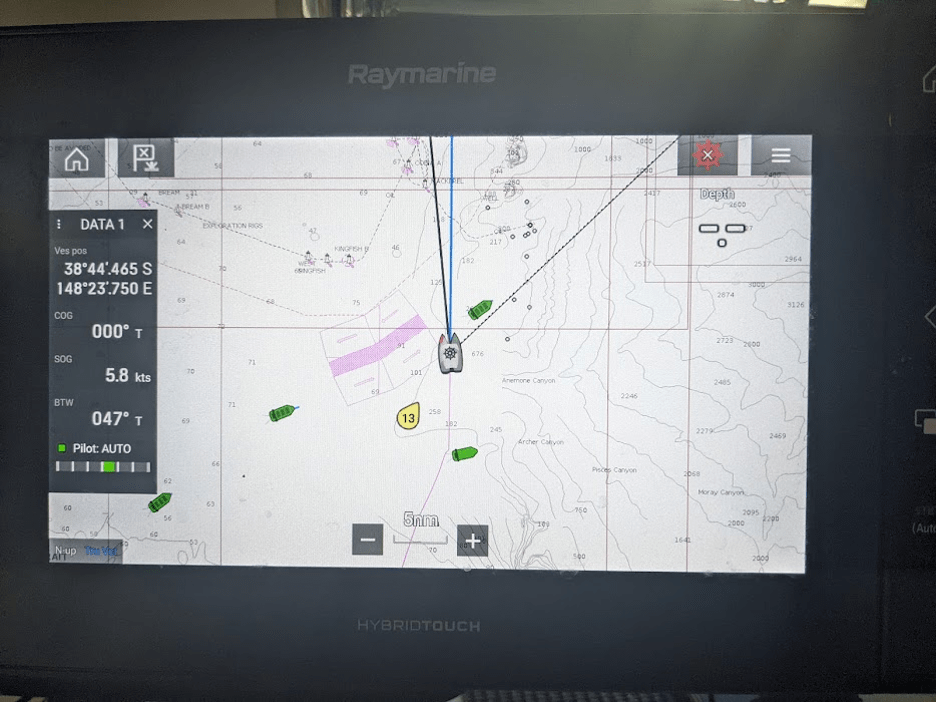
George Town, Tasmania, was a two-hour flight and a one-hour bus ride away from Adelaide. Who could have entered the boat from the hatch? They would have to be both slim and lithe. What could they have taken? Could they have taken the chartplotter – used to navigate, the Emergency Position Indicating Radio Beacon (EPIRB) – used to aid search and rescue or the Automatic Identification System (AIS) – used to track other vessels? We couldn’t sail without them.

“I can’t really bring our flight to Hobart forward because all the seats are gone during the Easter break. We’ll just have to hope for the best.”

Meanwhile, Alex decided to text Gregory back and ask him to take a look through the hatch to determine what might have been stolen. Gregory kindly obliged, and sent Alex a photo of the interior of the boat. The equipment appeared to be in place.

Alex checked the location of the boat on the AIS. It should have been updated daily, but it had been inactive for a few days. That did not bode well.

We spent the next day packing our bags as carefully as possible to avoid excess charges. On Friday Alex, Verity, Katie and I caught the plane from Adelaide to Hobart, and then picked up our rental car. We drove north through the centre of the island to the lush agricultural lands of the Tamar River, passing through towns lined with Georgian buildings constructed with convict labour.

Sculpture at Evandale

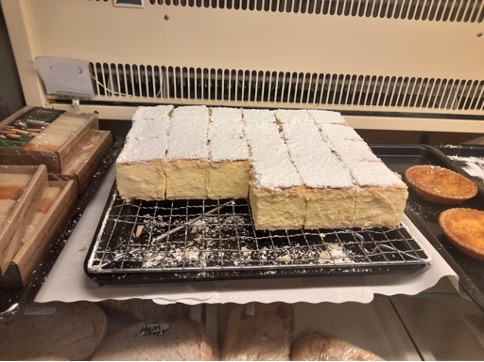
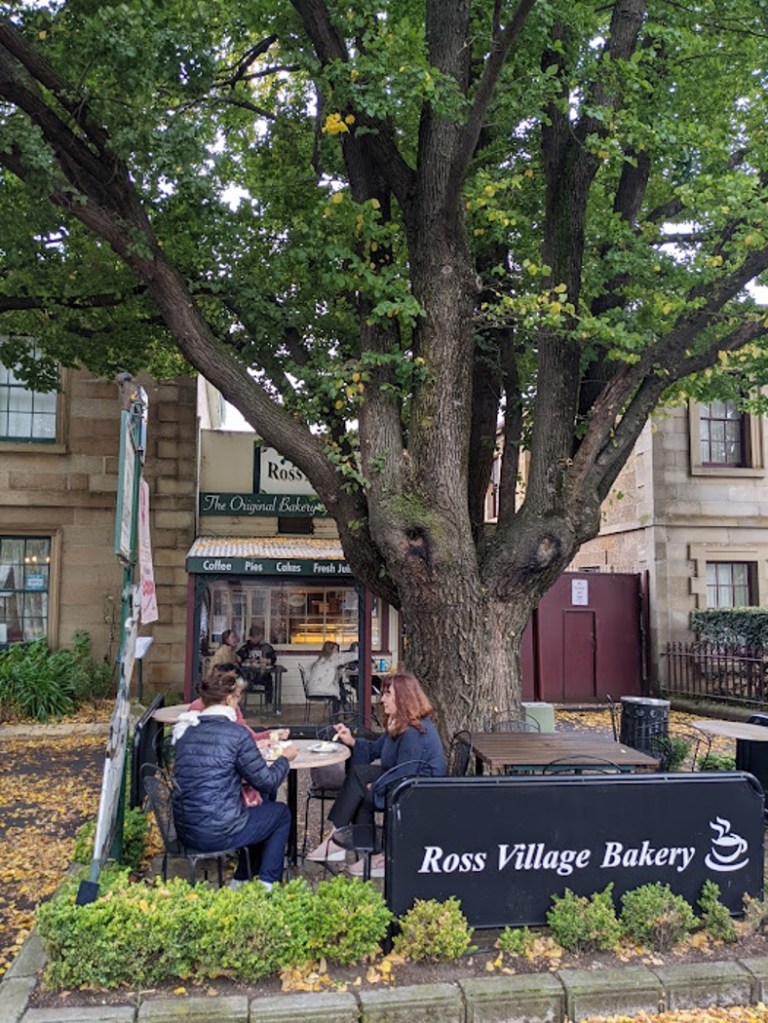
We were particularly looking forward to partaking of the best vanilla slices in the world, located in the township of Ross, and I confess that this distracted us from our concern for the safety of the boat equipment.

We sat outside the bakery savouring the vanilla slices as slowly as possible. Who knew whether we would ever be able to come back to Ross?

Then we continued our drive northward to George Town, Australia’s third-oldest settlement, meandering through other towns lined with Georgian buildings. As night fell, we arrived at George Town to our boat home. My fellow crew members were able to climb on the boat from the wharf unaided but I wasn’t tall enough to do this. Alex positioned an upside-down bucket on the wharf so that I could clamber on board. With trepidation we opened the door, now unlocked, and ventured inside. The equipment was still there but it had been unplugged. The lid of the clear plastic box under the monitor was open.

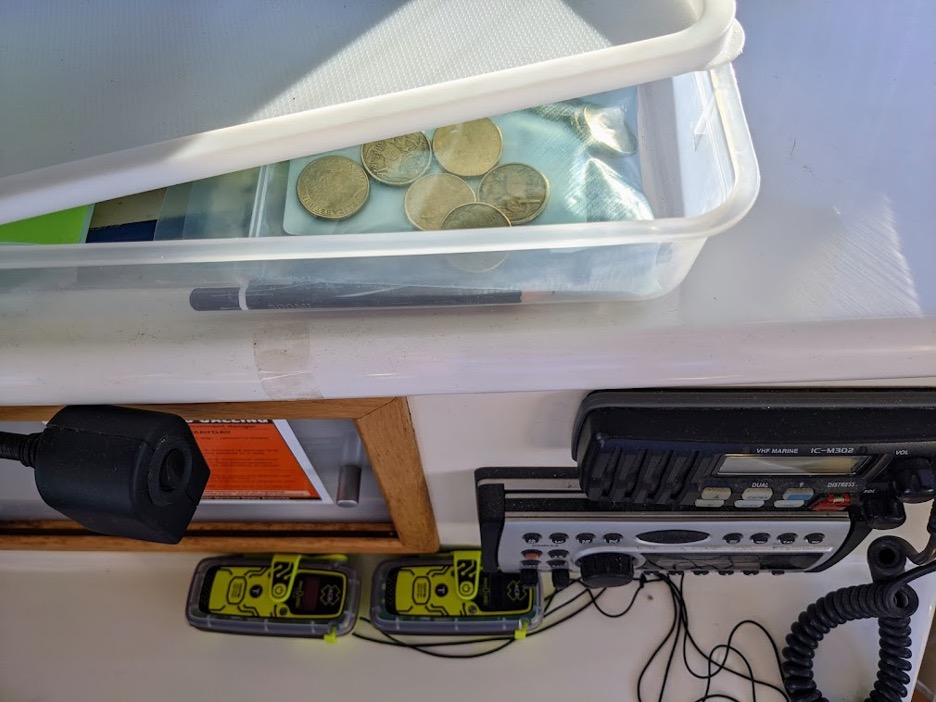
“They’ve taken the spare keys. The gold coins have gone too!” Alex observed.

Alex had prepared a collection of one and two dollar coins in a plastic bag in the clear box to be used for laundromats on shore. So this is what the thieves had been after!

Next Alex checked his wine collection in one of the bilges, “the boat cellar”. This was untouched. The thieves must have entered through the hatch and left through the door. Other than the keys, the only goods that had been stolen were the gold coins for the laundromat – or so we thought. Perhaps they were planning to return, next time through the door.

The theft of gold coins reminded me of advice I had received at the beginning of my teaching career in the 1980s in the city of Whyalla in South Australia. I had been assigned teacher housing by the education department. I was advised by a colleague that when I was away from home, I should leave gold coins in obvious places for youngsters who might break in.

Alex was relieved that they had not taken any navigational or safety equipment, and I was relieved that they had not taken my boat slippers. We were well into autumn and it was cold underfoot.

Despite the break-in we were very fond of George Town, not least due to the camaraderie of our boat neighbours.

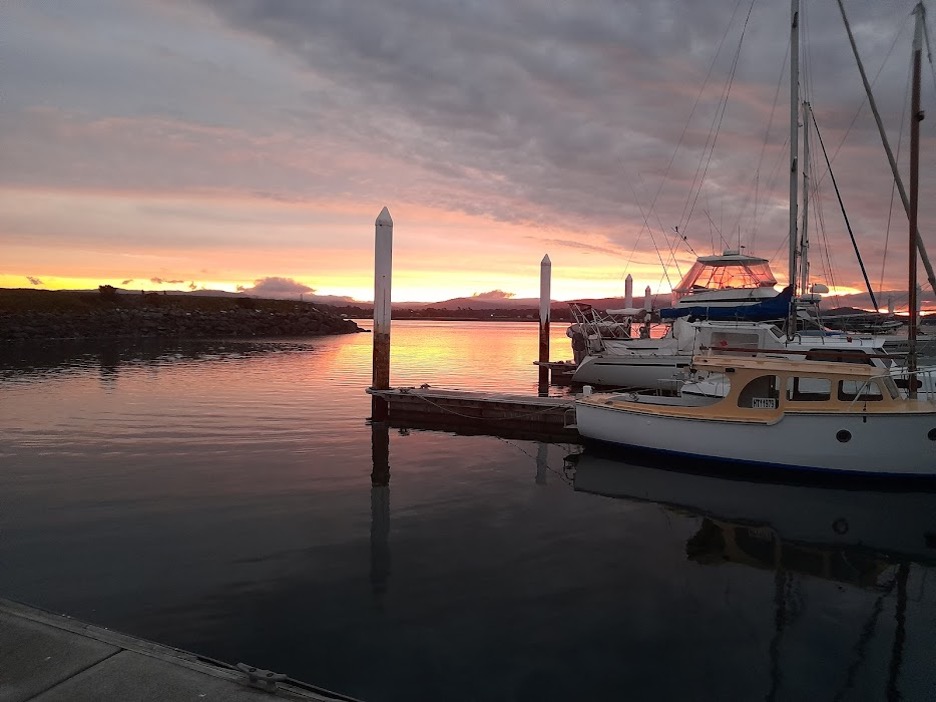
On the day of departure, as always, Alex got up before the rest of us to commence the day’s sailing. We were due to head north across Bass Strait towards the mainland. The harbour was generously lit up by the lights in the supermarket carpark on the other side, facilitating the safe exit to the Tamar River.

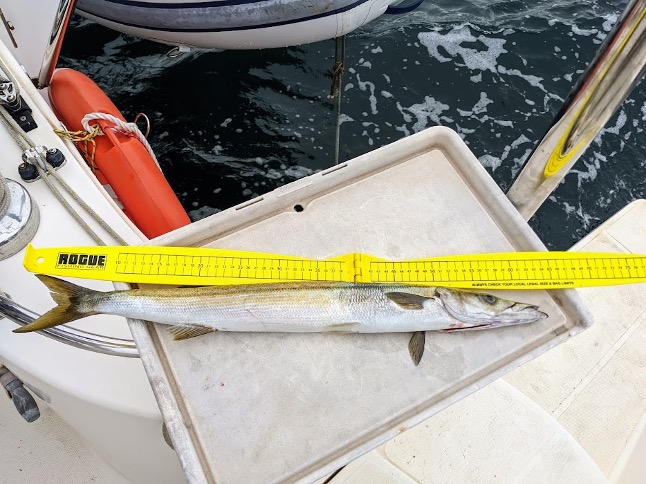
One of our favourite boat meals was freshly caught fish. Only when looking for a rod one evening did we discover yet another item had been stolen — a heavy-duty tuna fishing rod. This time, rather than using the rod we trolled with a hand reel, and had no trouble catching smaller fish.

Meanwhile someone in George Town was enjoying spending our gold coins and fishing with Alex’s special rod. At least we had our technology to guide our decisions as we crossed Bass Strait, where identifying marine traffic and the right weather conditions was critical. We followed the course Alex had plotted, stopping at the offshore island of Badger Island overnight, East Kangaroo Island and Whitemark for a few hours the following day, then anchoring at Settlement Point for our second night. Based on the Predict Wind forecast, we decided to tuck in for shelter at Outer Sister Island for two nights to wait out a front bringing strong winds. The shore looked tantalisingly close. I asked Alex if we could take the dinghy ashore but, pointing to the shore break, he told me that if we did we would likely capsize. We stayed indoors for the day, reading, writing and longingly looking at the forbidden shore. My preferred pastime is writing, but every now and then I had to force myself to stop and fix my eyes on the horizon as the boat danced over the anchor, to recover from bouts of seasickness.

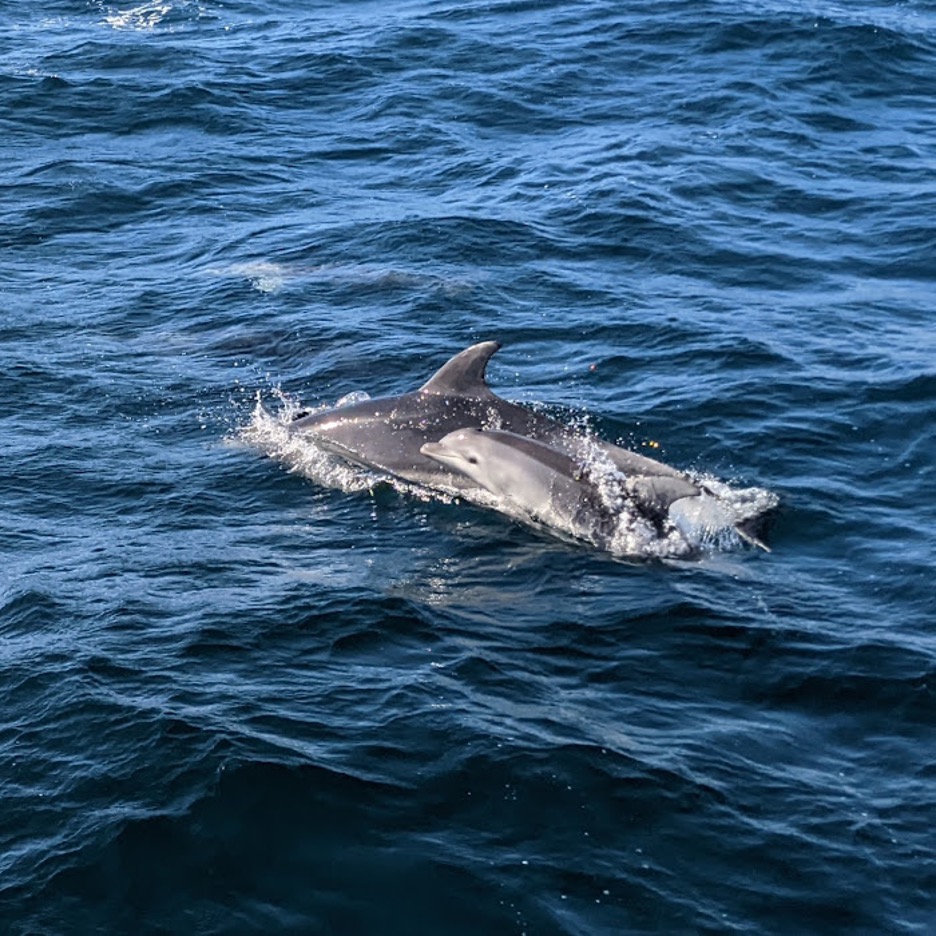
The forecast was for calmer conditions the following morning. We were ready for the long stint to the mainland, during which there would be no more coves in which to shelter. Alex got up first and departed Outer Sister Island at 6.38 am. We persevered sailing through both day and night. During the day we were rewarded by dolphin sightings as they played alongside and in front of us for about ten minutes a time, before suddenly veering away. During the night Alex and I roused ourselves at midnight to take our turn on the three hour shift until 3 am. Well, to be fair, Alex did the night watch while I forced myself to keep my eyes open.

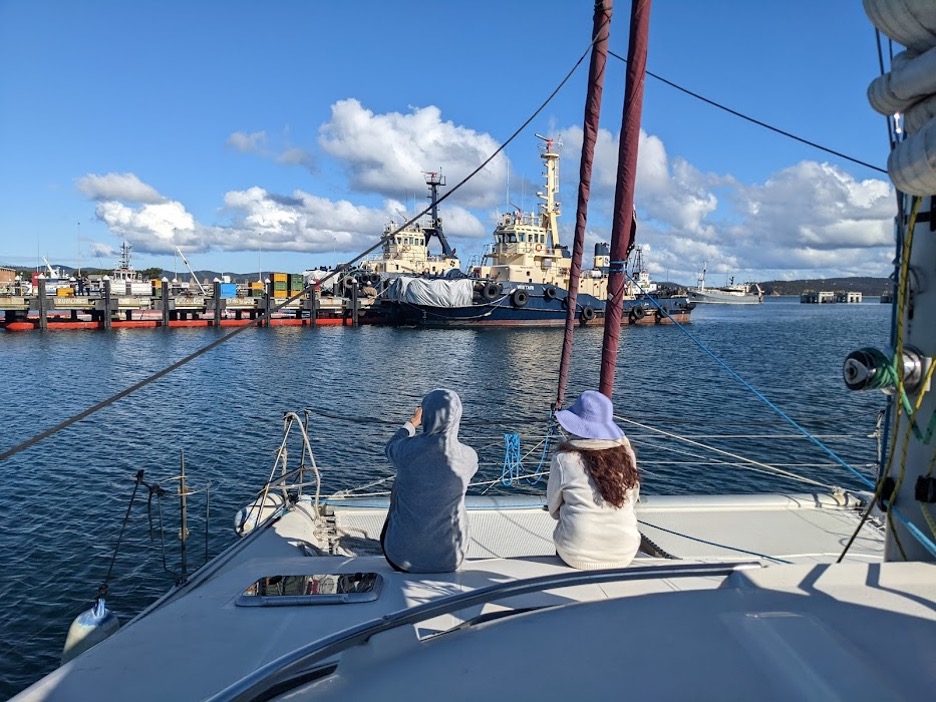
We arrived at Eden, New South Wales, at 4.20 pm, and secured the boat on a public mooring. Too tired to venture ashore that evening, we relaxed on the boat, ready to explore Eden the following morning.

We had crossed Bass Strait availing ourselves of the technological support of the chartplotter and the AIS. Although the equipment did not spare us the trials of the night watch, it did help us avoid commercial trawlers and container ships in the shipping lanes. If it weren’t for our boat neighbour Gregory back in George Town, the thieves may have returned to steal the crucial equipment which made our crossing of Bass Strait safer. No less importantly, the notorious Bass Strait had been kind to us.

Meredith Stephens is an applied linguist from South Australia. Her work has appeared in Transnational Literature, The Muse, The Font – A Literary Journal for Language Teachers, The Journal of Literature in Language Teaching, The Writers’ and Readers’ Magazine, Reading in a Foreign Language, and in chapters in anthologies published by Demeter Press, Canada.

PLEASE NOTE: ARTICLES CAN ONLY BE REPRODUCED IN OTHER SITES WITH DUE ACKNOWLEDGEMENT TO BORDERLESS JOURNAL

Categories
Poetry

The Serene Mornings

By Heather Sager

THE SERENE MORNINGS

During our long walk 
to the school bus, the dappled 
black-and-white cows followed us
slowly toward the road,
mooing behind their fence.
When they paused, if we strayed close,
the cows let our wide-eyed faces
near their steaming nostrils
or wagging tongues.
The music of the bells
round their plump necks
clattered on grey mornings.

Heather Sager’s recent work appears in OtolithsPoetry PacificRedEftMagmaBluepepperPoets’EspressoActiveMuseYgdrasilShabd AawegThe Bosphorus Review of BooksThe Fabulist, The Orchards and more. 

PLEASE NOTE: ARTICLES CAN ONLY BE REPRODUCED IN OTHER SITES WITH DUE ACKNOWLEDGEMENT TO BORDERLESS JOURNAL

Categories
Notes from Japan

Marathon Blues

By Suzanne Kamata

Tokushima. Courtesy: Creative Commons

“Do you want to run the Tokushima Marathon with me?” my husband asked for the third year in a row.

The first time, three years before, I’d given him a flat-out refusal. The previous year, I’d promised to register, but then my brother had died suddenly, and I’d had to fly from our home on the island of Shikoku in Japan back to the United States for the funeral. My husband had run the race for the third time on his own. This year, though, I didn’t have an excuse. “Maybe,” I said.

To be honest, running a marathon has never been one of my life goals. Nor am I interested in bungee jumping, getting a tattoo, climbing Mt. Everest, or anything else that would cause pain or discomfort. I power walk four or five kilometers per day for my health, and I did run on my high school’s cross-country team, but I am not really into long-distance running any more. My New Year’s resolutions tend to be more aligned with pleasure: Try new wines. Read more poetry.

My husband, however, couldn’t understand why I wouldn’t want to run a marathon. He told me how satisfied I would feel afterwards. And we’d get swag – a T-shirt, a medal, a certificate worth framing. Maybe he also thought it was a fun activity that we could do together. He is a high school physical education teacher. He would think that.

The Tokushima Marathon course goes along the embankment of the Yoshino River right past our house. We live at the twelve-kilometer mark. In previous years, I’d used a tracking app to determine when he was about to run by. My daughter and I had then gone up the hill in time to cheer him on. Once, he’d shoved a jacket that he no longer needed into my hands as he’d dashed past us.

“What size T-shirt do you wear?” my husband asked.

I told him. I knew that he was registering me for the marathon, even though I had said, “maybe,” not “yes.” But perhaps I could just walk and run the first twelve kilometers, and then jog down the hill to our house. I could run that little bit as a tribute to my brother who had aspired to run a marathon himself. More than once, on my visits to see him, I’d found myself waiting at the finish line of some fun run or other. He had been such a devoted runner that he had been buried with his running shoes.

I started training. My husband usually didn’t put in any effort until a month in advance, and yet he still managed to complete the whole race. But I needed more time. I walked and ran and walked and ran instead of my usual regime. I did this at night after work. Then it started to get really cold, and my self-imposed training program started to fall apart.

Enter the new coronavirus. In January, we heard news of a deadly virus in Wuhan, and then a cruise ship full of afflicted passengers in Yokohama. Even though we were far away in Shikoku, by February local events were being cancelled. There would be no graduation ceremony at the university where I taught, no farewell party for professors who were leaving to teach elsewhere. Public schools began spring vacation a month early. I wondered if the Tokushima Marathon, which was scheduled for March, would be cancelled as well. I must confess that I secretly hoped it would be because I hadn’t kept up with my training and I didn’t want to disappoint my husband.

Of course, it was cancelled, like the 2020 Tokyo Summer Olympics and the national high school baseball tournament at Koshien Stadium and everything else. We were informed that there would be no refund of our registration fees, but we would get swag. I looked forward to receiving my Tokushima Marathon T-shirt, which I would wear ironically. I waited and waited for the package to arrive.

Finally, two bulky envelopes were delivered. Around this time, my husband and I were stuck together in the house with nothing to do. We’d already gotten rid of all of the stuff that didn’t spark joy. Our clothes were rolled neatly in our drawers. We were driving each other crazy. We opened the envelopes to find the finisher medals – ha! ha! – and no T-shirts, but an indigo-dyed handkerchief each.

“Let’s make these into masks,” my husband said.

At first, I protested. They were such nice handkerchiefs! But I already had a few indigo-dyed handkerchiefs which I never used, but which nevertheless sparked joy. If we cut them up and made them into handkerchiefs, at least they would serve a purpose.

My husband dragged our dining room table in front of the wide-screen TV in the living room. He found a mask-making tutorial on YouTube. He cut up the pieces, and I sewed them together. They turned out well! We wore them every day until the elastic started to lose its spring, and health experts declared that wearing paper masks was actually better than handmade cloth ones. And the medals? Well, maybe we will someday figure out something to do with those.

Masks stitched by Suzanne. Photo Courtesy: Suzanne Kamata

Suzanne Kamata was born and raised in Grand Haven, Michigan. She now lives in Japan with her husband and two children. Her short stories, essays, articles and book reviews have appeared in over 100 publications. Her work has been nominated for the Pushcart Prize five times, and received a Special Mention in 2006. She is also a two-time winner of the All Nippon Airways/Wingspan Fiction Contest, winner of the Paris Book Festival, and winner of a SCBWI Magazine Merit Award.

PLEASE NOTE: ARTICLES CAN ONLY BE REPRODUCED IN OTHER SITES WITH DUE ACKNOWLEDGEMENT TO BORDERLESS JOURNAL

Categories
Poetry

The Maiden and Death

By Elizabeth Ip

THE MAIDEN AND DEATH

These days I tire easily.
When I rise to follow out the light,
Death uncurls slowly in my shadow,
tiger-toeing from his armchair to my bedroom.
Tenderly he hushes the deathbed negotiations of a weakening sun,
and when it is done, he shoulders open the door,
and comes to me where I already rest, framed in white. And that
is when we talk. For three years I have medicated on this,
put myself to sleep with a shadow at my feet.
And I want to tell you,
       did you know I come back from the underworld every night? -
              and find I cannot. No words come to mind
but the painting of your lips I once made,
your mouth modelled the moment it had just taken its pleasure in me;
beautiful, but very blue. If not that,
then the sculpture of my heart, cast in the horrible knowledge
that one day, your brow will cool and not from sweat.
I am so sure you would not have wanted to know. Or
would you? That I have seen your mortality
and moved my hands in it. That this is an unwilling medium
through which you talk to your ghost.
That I told Death about you,
and we agreed that you are beautiful,
just in different colours.

I hope you’ll stay long enough for me to bring a cat home.
He’ll be black. At night, he will stay at our feet.
And this time we won’t say anything
but we’ll know that you’re beautiful.

Elizabeth Ip’s works have been published in the Atelier of Healing and Eye on the World anthologies. When not writing, the pen in her hand is usually replaced by her viola.

.

PLEASE NOTE: ARTICLES CAN ONLY BE REPRODUCED IN OTHER SITES WITH DUE ACKNOWLEDGEMENT TO BORDERLESS JOURNAL

Categories
pandies' corner

Children of the Nithari: Dhaani

Written in Hindustani and translated to English by Kiran Mishra

Kiran Mishra is 22 years old. She was just 7 when she started coming for pandies’ workshops immediately after the Nithari pogrom. A fabulous performer in all senses of the word she has been in all Saksham productions with pandies’, including a lead role in the performance at The American Center, Delhi. She has done her MA in political science. Aspiring to be a teacher, she is currently doing her B.Ed. She also has a senior diploma in Bharatnatyam dance. Central to the teaching programme at Saksham, she started teaching there after high school and currently she is both a teacher and the Co-ordinator at Saksham. She says, “I love to teach these kids specially those who want to get educated but are unable to because of different reasons. I think when we teach one kid, we teach one whole generation.”

Dhaani

I had come to Kota, Rajasthan for some company work but suddenly I had to leave for Delhi for an urgent meeting in office. Train tickets were not available and so I decided to take the inter-state bus to Delhi.

A small box like ticket house had been constructed at the bus stand from where I bought the ticket and boarded the bus to Delhi. The bus was full, people had left their belongings on the seats and not even one seat was without something on it. The next bus was at 4 am, too late. So, I knew there was no choice but to take this one, the last one that night. I entered the driver’s cabin thinking I will ask him where the earliest seat would get vacant. I was surprised that the seat next to the conductor was empty, nobody had noticed it. I quickly occupied that seat.

Settling I realised that the condition of the bus was bad, really bad. But well, I had no choice. Soon the driver started blowing the horn to indicate the bus was ready to leave. Hearing that people rushed to occupy their seats. The bus started moving. It sounded like a bronchitis patient. A girl aged 24-25 came and stood beside me. I started to ignore her, thinking I might be asked to give my seat to her as she was a woman. And as a man, it was only courteous to offer my seat. Without looking at her I could feel her staring at me, she kept doing that for a while and slowly she said, “This seat is mine.” I finally turned to her and raised my head and saw that her face was covered with a dupatta. She repeated, “This seat is mine.”

The bus was moving at a hesitant speed. I kept looking at her, the dupatta slipped a bit and half her face became visible. I could see she was beautiful. Though only her nose and lips were visible, I could estimate her beauty. I was still staring trying to estimate her face when she repeated that that was her seat.

“Now I can’t see how it is your seat when I am sitting in it”? I retorted finally. She continued in a very polite and sweet voice, “Yes this seat is mine since I kept a handkerchief on it and went to the washroom.”

I looked carefully at the seat, and yes there was a hanky, a white hanky, lurking in the corner. Irritated but conceding her point, I took a long breath and stood up to give her the seat. It felt like she grabbed my arm and then she said, “Hey, why are you getting up? Just shift a little and we can both sit together, any way there is no vacant seat in the bus.” And with that, she sat down next to me. I felt slightly embarrassed at the closeness, but she was seated quite comfortably.

The bus was moving slowly, as if protecting itself from the big potholes on the road.

It was November, and the chilly wind was blowing through the broken glass window. But the touch of her body started to thrill me to the core of my being. We sat on the single seat, clinging together lest we fall off the seat. I felt we were merging together. Her dupatta was raised more now, and I could see her whole face. This is what they call an “apsara[1]”. She was unbelievably beautiful, her nose, her eyes and her lips were like rose petals and the teeth like pearls between. Travel with such a beautiful girl was double fun and there I had been cursing the ride and the bus.

Every road bump would propel us in the air and then we would land almost on top of each other. A couple of times we almost fell off but in a second, she would be sitting, fully composed as if nothing had happened. Looking at me, she enquired, “Are you uncomfortable? Are you experiencing any trouble?”

“No, no, not at all,” I said reassuring. She started looking straight into my eyes and asked: “I think you have not recognised me”.

Now it was my turn to be surprised. I looked at her carefully. Her face clicked somewhere. And I was wondering where I had seen this face. She said in a very soft tone, “You have forgotten me.”

She said this in a way that I felt heartbroken and kept staring at her and thinking for some time but could not remember her. Avoiding her, I looked at my wristwatch. It was 10 pm, an hour since we started. She had turned the other way. Angry and upset at my not giving an answer? She was looking outside, and my mind was all in a mess.

Suddenly a word jumped into my mind: “Dhaani.”

I suddenly blurted out: “Dhaani?”

As soon as I said that the glow returned to her face, her eyes were happy, and a beautiful smile floated on her lips. “Too late,” she said, “But at least you have recognised me.”

“Hey, how are you here Dhaani?” I asked.

“Just understand,” she said, “I have come here to this bus only to meet you.”

“So, you have learnt how to joke too,” I remarked. “I still remember how you would get irritated over small things.” She looked at me with imploring eyes. Her eyes were raising questions and the four years she was in my life came across me.

This is about the time I was staying in Delhi to study. I needed money. So, along with studying, I wanted to give tuitions. A friend, who did tuitions, gave me her address and asked me to go to her home. I met Dhaani the first time there. I was giving tuitions to her younger brother in the 8th grade. Both her parents were working and she had done her graduation and was preparing to study further. There was a servant, but he was usually missing. Three of us would be in the house and Dhaani would give me tea and sometimes some breakfast. We became friends and I advised her with her preparations too. I did not realise when Dhaani fell in love with me. Dhaani was not her real name but she wanted me to call her that. Things were going fine but then something happened, and we could not meet again.

Dhaani was from a Rajasthani family. And one day, her maternal uncle arranged a marriage proposal for her and I too reached at the same time. Her family members were talking among themselves, so I went to another room and started teaching her brother. After a while, I was feeling thirsty. As usual I called out to Dhaani by name, and asked her for a glass of water. This created the trouble. Dhaani’s uncle came and glared at me. I could not understand. He roared, “Who did you call Dhaani?”

I pointed at her.

“Do you know the meaning?” he asked.

“No”, I said, “Maybe a nickname.”

Realising I was innocent, her uncle backed off, and the elders explained to me that the word meant “wife” and is used as an intimate address for one’s spouse. I could only stare at Dhaani who had tears in her eyes. Her father told me firmly that my services were not required anymore.

Four years later, I had never thought I would ever meet Dhaani in this rickety old bus in the middle of the dark night. Dhaani was shaking my shoulders, “Where are you lost?”

I blurted a series of questions: “Just remembering the old times. You got married, didn’t you? What does your husband do? Why are you travelling alone?”

She asked me “Did you get married?”

“No,”I answered.

“Why? You should have,” she responded.

We had left the town behind. We were in the jungle. Trees and sand. It was dark, the lights of the bus were weak and the visibility was poor. People were asleep in the bus. Maybe to keep awake, the driver started singing aloud a film song. His voice broke the silence.

I asked her again, “Why are you travelling alone?”

She said with a heavy heart, “I am on a journey that never ends, just one wish to see you and meet you once.”

“What nonsense!” I said, “Please answer my question.”

“You want to know where is my husband? Husband is one a girl like me falls in love with once, I am his Dhaani and never again will anyone settle in my heart. But you will not understand these things.” She took my hand in both her hands, “Swear to me that you will get married and have a family and a home.” With that she got up to leave.

I said, “Where are you going to go in this forest?”

“It’s a forest for you,”she said in a low voice, “For us it is our new home, we’ll never meet again but keep your promise.”

Saying this she got off the moving bus. I was stunned and stopped the driver, “A girl just got off the moving bus and you did not stop for her?”

The driver looked amused, a bit irritated, “Which girl?” he asked.

“The one sitting next to me, the one who I was talking to,” I was almost shouting.

He chuckled, “Near you. You were sitting all by yourself and yes you have been talking loudly to yourself but we get people like you, it doesn’t bother me.”

I craned my neck out of the bus and saw a smiling Dhaani waving to me. I was sweating despite the chill. “Dhaani, why did you do this?” I looked at the handkerchief in the corner, picked it, it had Dhaani written in the corner. Squeezing it tight, I cried. The bumpy potholes could not measure up to the pits in my heart.


[1] nymph

.

PLEASE NOTE: ARTICLES CAN ONLY BE REPRODUCED IN OTHER SITES WITH DUE ACKNOWLEDGEMENT TO BORDERLESS JOURNAL. 

Categories
Poetry

The Self I Adorn

By Alpana

The self I adorn is the self, draped in a saree,
prim and proper.
well pleated,
pinned,
yet flowy.

The self I adorn is the self, carrying a book,
a book about hope
or a book about sunshine.

The self I adorn is the self, tiptoeing,
but with poise.
Why tiptoe, you ask?

Because the baby is in deep slumber,
dreaming of ships, the moon and the barnyard mother tells her about.

The self I adorn is the self, indulged in parenting,
calm and slow,
taxing but full of content.

The self I adorn is the self, living to the full,
not everyday, but trying every moment!

Alpana teaches in a government college of Gurugram, Haryana. If not responding to her babbling toddler and her curious gestures, she finds herself occupied with reading haikus and listening to Urdu poetry.  

PLEASE NOTE: ARTICLES CAN ONLY BE REPRODUCED IN OTHER SITES WITH DUE ACKNOWLEDGEMENT TO BORDERLESS JOURNAL