Categories
Poetry

When the Quotidian Wrote our Notes of Isolation

By Nabina Das 

We were brought up by folks who respected the encrusted time,

wound in their watches every morning, opened windows to days.

They swept the morning breeze with either their prayerful ways

or brisk footprints out about the gardens of mint and marigolds.

 *

We were taught to eat with hands but not lick the fingers too much,

sometimes given spoons to scoop up manners away from the old world.

 *

Also made to brush our shoes black as squeaky bumblebees on the run,

rub wet chalk every Saturday on the white canvaswear like ghost tales.

 *

Visitors in that world arrived often without having to sniff their hands

from stiff alcohol smells. No furtive glances. They kept wearing shoes.


*

We were brought up by a man and a woman who valued hugging

and cracking a silly joke or two, elbows pirouetting at the dining table.

 *

They took us to the movies where women with small breasts got laughs

and even men with clownish big arms were thought to be big bores.

 *

Solitude meant suddenly finding hand holding in unexpected places.

A decade has now gone. Taking away easy tactile closeness with it.

 *

Nothing changed as we spotted snails in the grass; she still cooked

while he got the monthly grocery home counting money with care.

 *

Days of déjà vu-ing didn’t matter and he read the inscrutable Prufrock

in his gong-wide voice; she sang full throated. But it wasn’t called strategy.

 *

Nothing took the rhythm away from books and ink and weekends,

ice cream treats, water color tablets in tin boxes, the neat domestic talk.

 *

It’s not to say we did not hop mad after the moon or swoon in rains

brought mud in our feet, ran amok like twisters on the sleepy town.

 *

He sneezed too hard some days and scared the alley cat and she

scanned the city in her tiny feet, eyes lush gooseberries and face small.

 *

The music was always a rousing breeze through the receptive ceiling,

the food was quite reluctant to let its own vital aroma fade and die

 *

I often read through my story books learning to spell: i-s-o-l-a-t-i-o-n

hidden within the Kamasutra. The neighborhood lay in erotic repose.

 *

What was missing, oh, what was missing, people sometimes asked in jest:

not the doorknobs, not the bloody ancestors, not new birds on chipping beams.

Nabina Das is a poet and writer based in Hyderabad. She has published three books of poetry, one short fiction collection, and one novel. In the age of Corona virus, she tackles here the questions of isolation already experienced while she grew up in Guwahati, Assam, among ginger roots and swamp dragonflies.

Categories
Musings

The Dawning of a New Era

By Mitali Chakravarty

More than a century ago Tagore wrote a song:

Kothao amar hariye java nei mana, mone, mone

Translated it stands, I can get lost anywhere within the infinite of my mind (imagination).

Time has come that we put his suggestion to test.

Though we are all torn by the isolation that battling COVID-19 demands, we still have a huge thing which we did not in the past, a thing that helps us all connect — the internet. While the educated stay connected, using social media and email, there will be many under isolation who will not have the skill sets to reach out, either due to lack of internet or due to the inability to write. There are countries like Singapore, where this is not an issue — but there is still a large population out there who cannot connect, who will be told by their community leaders that they need to remain isolated. Will that be a possibility? What about the homeless? What about those who do not have a clean potable water supply? What happens to them?

One thing that the tiny virus, which we cannot see with our naked eyes, has taught us is that mankind in its suffering cannot be bordered by economic, religious, cultural or political boundaries. As we all stand, in isolation, willing or unwilling to take up cudgels against a virus that has forced us to disturb, break and destroy the tenor of our lives, perhaps the time has come to assess our blessings.

Today, the fact that you are reading this means you are connecting with the internet and can read. You are connecting with my ideas, with my thoughts. We belong to the privileged few who can soar with internet and our imaginations. We have a home and hearth. We are educated and have enough to eat. We can afford to be kind and merciful to others.

The factory smoke has largely got silenced — even if temporarily. That means the air is getting cleaner. I can see more birds fly in the sky, bluer skies and hear bird calls. Perhaps, the Earth will stretch out in languor and awake from COVID19, a healthier and greener planet.

As I see the visa exempt, borderless virus roam the world, I am reminded of  Sir Arthur Conan Doyle’s novel, The Poison Belt (1913), where the whole of mankind loses a day as our planet passes through Ether, and then wakes up as the Earth emerges out of the sleep inducing belt of the ‘poisonous’ gas. Will such a thing happen? Will we wake up and see the corona disappear one day?

Probably not, given that we have already diagnosed the virus. But, when you think of it, mankind has been through so many pandemics and has continued to thrive.

Perhaps, the tiny virus has taken on more than it can digest. Each time, mankind emerged a winner, they had a better life. After the Great Plague that wracked Europe from 1348-1350, came a jubilant Renaissance with Leonardo Da Vinci, Botticelli, Michelangelo, Christopher Columbus and Galileo Galilei celebrating the wealth of human development.

Then there was small pox, which was introduced among Native Indians and Mexicans in the fifteenth century by Conquistadors, and was completely eradicated after two centuries; cholera, which continues to assail some countries and many more such diseases. Mankind battled these and emerged victor into a better equipped world.  

This time, the pandemic is more widespread because we are living in a more connected planet. Is that such a bad thing? We do not really want to live like the hermaphrodite humans in Isaac Asimov’s Solaria, where mankind is served by robots alone on a solitary planet and they never meet other humans. But a temporary and intelligent isolation can teach the little virus that for all its virulence, it cannot destroy mankind. This is just a temporary measure, a temporary gesture to help mankind move into a better world. We will have to reorganise our way of life, our tenor of existence. Given the climate, economic and political issues our planet faces, this may not be such a bad thing!

After all, twentieth century guru, Yuval Noah Harari in his recent article in Financial Times, concludes: “Humanity needs to make a choice. Will we travel down the route of disunity, or will we adopt the path of global solidarity? If we choose disunity, this will not only prolong the crisis, but will probably result in even worse catastrophes in the future. If we choose global solidarity, it will be a victory not only against the coronavirus, but against all future epidemics and crises that might assail humankind in the 21st century.”

And I would like to agree with Harari as he says with conviction: “Yes, the storm will pass, humankind will survive, most of us will still be alive — but we will inhabit a different world.”

Let us look forward to the dawning of that new world.

Mitali Chakravarty is a writer and the founding editor of borderlessjournal.com.

Categories
Poetry

The Contingency of Saying and Eternal Motion

By Desmond Kon Zhicheng–Mingdé

The Contingency of Saying


If I say I love you.
If I say this love we share will be our last.
If I say we should trust our every emotion.

That even at their darkest, they reify the same.

The same culling of past acts of love, of endearment.

That’s what the novel was, haven’t you known all along?

A book of letters, each epistle like a gift of the angels.

If I say you should stay.
If I say this staying will be forever.
If I say every decision arrives at the same decision.

That as you confessed: you are, as I am.

You are, as I am content in this mirror of things.
All things now made for this, to house our love.


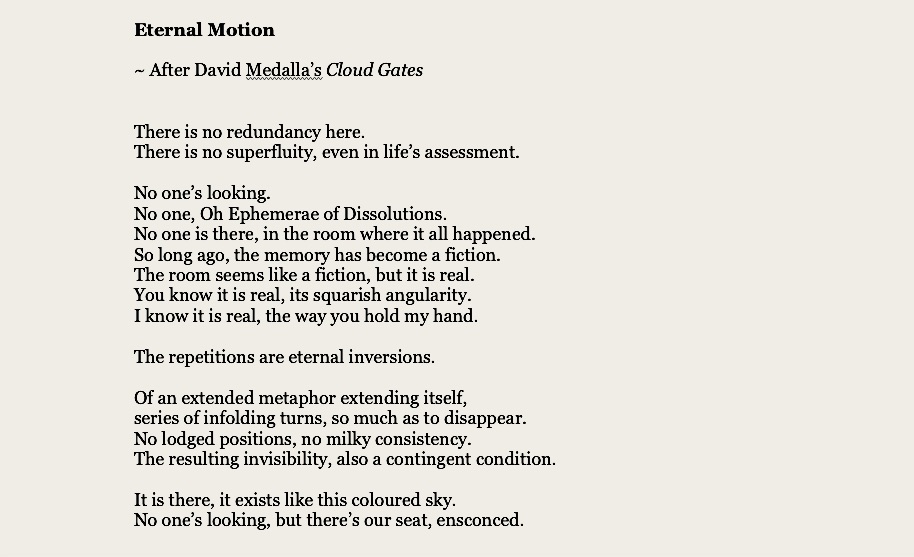
Eternal Motion

~ After David Medalla’s Cloud Gates


There is no redundancy here.
There is no superfluity, even in life’s assessment.

No one’s looking.
No one, Oh Ephemerae of Dissolutions.
No one is there, in the room where it all happened.
So long ago, the memory has become a fiction.
The room seems like a fiction, but it is real.
You know it is real, its squarish angularity.
I know it is real, the way you hold my hand.

The repetitions are eternal inversions.

Of an extended metaphor extending itself,
series of infolding turns, so much as to disappear.
No lodged positions, no milky consistency.
The resulting invisibility, also a contingent condition.

It is there, it exists like this coloured sky.
No one’s looking, but there’s our seat, ensconced.


~ Penned specially for the event, In Stitches, this poem was read at the National Gallery Singapore on 28 January, 2018.

~ Penned specially for the event, In Stitches, this poem was read at the National Gallery Singapore on 28 January, 2018

Desmond Kon Zhicheng-Mingdé is the author of an epistolary novel, a quasi-memoir, five hybrid works, and nine poetry collections. A former journalist, he has edited more than twenty books and co-produced three audiobooks. Among other accolades, Desmond is the recipient of the IBPA Benjamin Franklin Award, Independent Publisher Book Award, National Indie Excellence Book Award, Poetry World Cup, Singapore Literature Prize, two Beverly Hills International Book Awards, and three Living Now Book Awards. He helms Squircle Line Press as its founding editor. He can be found at: desmondkon.com

Categories
Essay

Poetry as Utopia and Apocalypse

By Dustin Pickering

The word “prophet” is rooted in the Greek word prophetes, a word that breaks down etymologically into “to speak before or foretell”. A soothsayer is considered a prophet in the sense that he foretells events. Such is the soothsayer in Julius Caesar who tells Caesar to “beware of the ides of March” when he was doomed to assassination. The Prophetic books of the Old Testament inform the people of Israel what God desires of them and what will happen if they disobey His commands. In Amos 3:7, it is written: “Surely the Lord GOD will do nothing, but he revealeth his secret unto his servants the prophets.” This designates the place of the prophet as one who knows God’s secrets. Amos reveals that the prophets had been instructed to remain silent until the burden became too great. Throughout Scripture, there is a love for justice which maintains the distinct definition of sympathy for the disadvantaged, and upholding God’s Word. A prophet is thus one who speaks on behalf of God Himself. The prophet Amos indicates throughout that the Lord will speak when He is out of patience. God is a God of all nations and will not tolerate disobedience even from Israel.

The Arab poet, Adonis, said, “It is an awful idea that after this one prophet, after this one book, everything would be said and written, isn’t it? If Mohammed would really be the last of the prophets, then no human word can be uttered anymore, and even much more frightening, no divine word either. The holy book is a trap closing in on us. Every monotheistic religion has the same problem. Christianity had the chance to avoid the trap but it didn’t. It identified itself with power and it embraced dogmatics.” Here we have a radical view that prophecy continues in the modern world. Richard Wilbur in “Advice to a Prophet” writes:

Nor shall you scare us with talk of the death of the race.   

How should we dream of this place without us?—

The sun mere fire, the leaves untroubled about us,   

A stone look on the stone’s face?”

Here the poet is a prophet of a particular kind. Bringing God’s message to the people becomes something peculiar— in this, the prophet defines the meaning of humanity. The role of prophet in Wilbur’s poem is one who does not warn of the imminent threats to human life, but rather defines the human role within Nature and Being itself. The modern reflection of God is much more personal and forgiving. As stated by Adonis, Christianity could have unleashed the powers of human language but, instead, gave way to power structures. Language carries the unique gift of uniting disparate things. The power of analogy is that of reconciliation. The poet, with his or her unique gift, invites comparisons between things that have little in common as if to agree with Heraclitus who wrote, “All things contain their opposites.” Perhaps not their opposites, but definitely things of dissimilar nature. The dark contains the light, and the light is contained by the dark. One interiorises the other. This strange capacity of language to reveal what is concealed in the dark is a magic of its own. A word is a form of conjuration, something brought into being by shining a light on it. That light itself is the poem—a unified body of language that conditions the reader to a certain subjectivity, thus causing the reader to recognise some hidden aspect of him or herself.

What is this thing of revelation? “Apocalypse” is from the Greek apokalupsis which means to unveil, uncover. The nightmarish visions portrayed in Revelations are considered to be end of the world prophecies. The opening of the scrolls, the rivers of blood, the hellfire and dragon tossed into the pit: these things are seen as happening at the endtimes. This branch of Biblical study is called eschatology. What is it that eschatology uncovers? What is God unveiling to us in His prophetic writings?

 Is it that true theology, the branch of learning concerned with the study of God, includes a side of God we are less acquainted to receive and understand? In Answer to Job, Carl Jung proposes what he called the Quaternity. According to Frith Luton, “The quaternity is one of the most widespread archetypes and has also proved to be one of the most useful schemata for representing the arrangement of the functions by which the conscious mind takes its bearings.” In Answer to Job, Jung writes of Job himself, “Because of his littleness, puniness, and defencelessness against the Almighty, he possesses, as we have already suggested, a somewhat keener consciousness based on self-reflection: he must, in order to survive, always be mindful of his impotence. God has no need of this circumspection, for nowhere does he come up against an insuperable obstacle that would force him to hesitate and hence make him reflect on himself.” The Quarternity is an extension of the Trinity. Jung believed the traditional conception of God was lacking. He invented the Quarternity to define the evil face of God. Thus, God becomes a holistic vision of the cosmos.

In Answer to Job, Jung portrays a human god who is capable of feeling guilty. In the end, Jesus is sacrificed not to cleanse humankind of sin but to rid God himself of guilt. Why wouldn’t God share the being of that created in His image? However, traditional theology includes a study of theodicy or reconciling divine goodness with the existence of evil. The ultimate question is why God might permit evil. We might even ask what constitutes a definition of evil. C. S. Lewis writes in Defense of Christianity, “God created things which had free will. That means creatures which can go wrong or right. Some people think they can imagine a creature which was free but had no possibility of going wrong, but I can’t. If a thing is free to be good it’s also free to be bad. And free will is what has made evil possible.” However, the definition here has an inevitable fallacy. In using free will to excuse God of wrongdoing, Lewis tells us he cannot imagine a free creature that has no capacity to do wrong. In applying this logic to God Himself, we are left with two possibilities. Either God isn’t a free creature, or God is also capable of wrong. In what capacity could God not be free? God is seen as “omniscient, omnipresent, omnipotent.” He is defined as sui generis, a being that causes itself. How could a self-caused being not maintain perfect autonomy? If God has will, He must have the ability to err if we take Lewis’s definition at face value.

 Continuing along my original line of inquiry concerning the Apocalypse. What does it say about God’s nature? One, it demonstrates that we as fallible creatures are capable of causing great destruction. Why is that quality inherent in us? The Apocalypse, or “unveiling”, is shown to be final — creation is revealed for its full promise. The conclusion of time is the extinction of choice — it is ultimate revelation of true being. All secrets come undone. The lid to Pandora’s box is unclasped and all evil is unleashed. This tells us that something is hidden within Creation itself. Our awareness is incomplete. The Apocalypse completes that awareness and shows us the purpose we missed—complete annihilation. Why should God desire the annihilation of His creation? Why did He command the death of His Son as a sacrifice to the world?

Humankind is bent on forging a utopia, a paradise that lasts eternally. Behaviorist B. F. Skinner invented a utopia based on his model of psychological conditioning where people are entirely robbed of choice. Instead they are conditioned by authorities to fit their chosen roles. This theory is presented in Walden Two. In this novel, Skinner applies his understanding of behaviorist psychology to the creation of a perfect society. Children are conditioned to perform certain roles from the onset. Each person has a role chosen for them. What we don’t consider is who is making the decisions for the roles given to each person. By nature, this model eliminates choice by individuals—yet how is there any order without choice? The authorities are making the ultimate decisions but who chooses that role for them? In this utopian vision, we see a flaw inherent in the system itself. Humankind is robbed of “freedom and dignity” for the sake of a perfect community conditioned to serve the aims of the community as a whole. Yet what criteria is used to sponsor this concept of communal well-being? Again, who decides?

Aldous Huxley presents us with a similar enigma in Brave New World. This is a utopia that is so oblivious to its flaws that it is dystopian to the onlooker. People are robbed of dignity again, but in the process, they become childlike in their understanding. Human misery is alien to them because they take measures to eliminate it and inoculate themselves from it. The results are the same. We are left with a set of social engineers who demonstrate scientific objectivity in their observations. They comment on the community, applying their superior awareness of things. Knowledge is too specialised in such a community. It becomes the risk of those designated to “know” rather than the shared offerings of the community. So much for community.

Lois Lowry’s The Giver is another dystopian vision where knowledge becomes specialized for a few. The Giver is a person who is entrusted with the collective history of humankind, and this person imparts it to another person as the role is relinquished. This arrangement resembles the pagan priesthoods where the Eleusinian mysteries were kept secret exempting those initiated into the sacred cult. What did these secret rites entail? No one knows because they are extinct. However, the parables of Jesus Christ contain a certain mystery to them. They are the prophecy of God in themselves. Jesus was known for his unique gifts of teaching and language. The ancient prophecies concerning him told us that he would not be physically attractive so that his message would be the accent of his coming to the earth. In Matthew 13:11, Jesus answers his disciples who ask why he taught in parables. “He answered and said unto them, Because it is given unto you to know the mysteries of the kingdom of heaven, but to them it is not given.” So, what are the rites of the initiated?

Paul the Apostle writes in 2 Corinthians 4:4, “In their case the god of this world has blinded the minds of the unbelievers, to keep them from seeing the light of the gospel of the glory of Christ, who is the image of God.” Jesus is also described as the unveiling in various verses—thus the Apocalypse is understood as the wedding of the Paschal Lamb. In Exodus 12, the Paschal Lamb is the sacrifice whose blood is put on the doors of the firstborn of Israel so the avenging angel would spare them. Jesus Christ is seen as the Paschal Lamb in the New Testament whose blood protects believers from the avenging angel, or Satan. In Revelations 19:7 it is written, “Let us be glad and rejoice, and give honour to him: for the marriage of the Lamb is come, and his wife hath made herself ready.”

It seems God spares those He decides to spare. The firstborn of Israel were spared by Moses’ prayer and desire for their freedom from Egypt. One man’s strong desire for the justice of his people pleases God. As we know, Israel would later also sin and be condemned. However, the revelations of Israel became the truth of all of the nations and God’s people span the entire world.

The relationship of utopia and apocalypse is nowhere more apparent than in the Holy Bible. God defines Israel’s purpose. History shows they failed in acknowledging God after His power rescued them from Pharaoh. Even Moses came up short of God’s will and was not permitted to see the Kingdom of God. One universal truth of Scripture is that all of us, no matter how holy or chosen, fall short of God’s grace. It is thus we see the emergence of Original Sin. Original Sin is itself a revelation of St. Augustine, early Church father and Christian apologist. He began his journey in truth as a Manichean. In Confessions, he tells us that God showed him the error of his ways. It was then he discovered the power of Original Sin—that darkness cast on the world by Adam’s first disobedience. We are created in God’s image but are not God Himself; Jesus Christ alone is seen as the true image and equal of God in his Passion and innocence.

In short, utopia is the promise we can redeem ourselves with radical changes to our world or relations. Utopians tell us that their vision is superior and if we conform to it, we will all be better off. Politicians are often utopians with realist proclamations. They desire to shape the world in their own image, as God did with us, and grant us our salvation. The poets use utopia as a vision—it becomes a kind of mnemonic device in understanding the nature of the world. Prophecy is a revelation of utopia—which is modeled after God’s being. Our concepts of goodness are even deficient, but we all desire to live in a world of productivity and happiness for all. A poet casts his or her eyes forward to a world known in the imagination. Such visions shape the world as ideas and influence our thinking. The Romantics, for instance, were conservative republicans. They desired freedom from authoritarian righteousness—both political and religious autonomy. William Blake, an Anabaptist, voiced these visions the best in All Religions Are One. He writes, “That the Poetic Genius is the true Man, and that the body or outward form of Man is derived from the Poetic Genius.” He further explains that all nations experience this poetic genius differently. He defines this capacity as prophecy. Our true state of Being is poetic. Our form is a distinct relationship to that poetic being. Poetry, then, is being itself expressed in variety.

I remind the reader again of Heraclitus: “All things contain their opposites.” Therefore, what we see conceals a deeper mystery and faith. Even consciousness withholds certain fundamental values and truths from us. The unveiling of those values and truths has great destructive and restorative power. The Apocalypse is a lifting of the veil of consciousness to bring the powers of wholeness to Being. It is ultimate light and extinction—and therefore it is a vital annihilation. The power of chaos is spoken of in Genesis where we see God wrestling with the deep to create a new world. The creation of a new world from rough matter is the very act from the spirit of utopia. Utopians desire to restructure existence to perfect it. God summons His powers of light to unveil the cloud of unknowing.

Poetry as Being and Knowledge is the truth of God. It declares itself to the world and seeks to order it and restore its original purpose. However, the poet is largely unconscious of this power when he or she writes. Language is the poet’s tool. The poet casts language like a net to gather truth and display it to the world. The poet is a maker, a prophet, a seer, a utopian radical.

The Poet is the sheer image of God and the shadow of Christ’s spirit.

Dustin Pickering is the founder of Transcendent Zero Press and editor-in-chief of Harbinger Asylum. He has authored several poetry collections, a short story collection, and a novella. He is a Pushcart nominee and was a finalist in Adelaide Literary Journal’s short story contest in 2018. He is a former contributor to Huffington Post. 

Disclaimer: The opinions expressed are solely that of the author and not of Borderless Journal.

Categories
Review

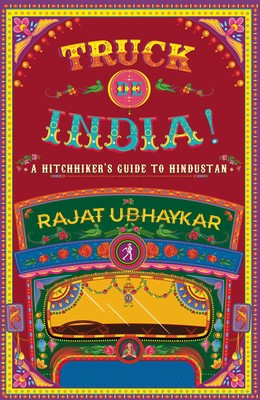
Truck de India: An Epiphanic ride

Book Review by Rakhi Dalal

Title: Truck De India

Author: Rajat Ubhaykar

Publisher: Simon and Schuster, India, 2019

“Gaddi jaandi ae chhalanga mardi

(The truck goes jumping)

  Mainu yaad aaye mere yaar di”

(I remember my beloved)

The one image that I have always associated with the thought of truck/ goods carrier on Indian roads is a boisterous Punjabi driver driving the truck in abandon while singing this song full throttle. Part of the reason lies in my spending my early childhood years in Punjab and part in being enamoured by the bitter sweet song which is as much about love as it is about lamenting the distance between lovers.

But apart from this sweet image, one other image that has been deeply ingrained in my mind about these trucks is that of a formidable giant body on wheels which must never ever be overtaken on a highway.

This was one of the first lessons I was given while learning to drive – “Don’t ever overtake a moving truck or a bus, especially on Haryana Roadways.” So while I have adhered to this rule most of my life, sometimes I have indulged in the guilty pleasure of overtaking the giant on a highway, more specifically whenever I found it trudging painfully slow. It generated a sense of exhilaration when I beat the king of the highway on its own territory.  

But other than this, the sight of a truck never evoked much contemplation. That was not until I came across Truck De India.

Really, I thought? A book on trucks? WOW.

And then I read the subtitle – A hitchhiker’s guide to Hindustan

In the prologue of the book, the author narrates the incident which kind of seeded the idea of discovering the country through road:

Staring outside the window on that trip, the wind tousling my unruly hair, I remember being struck by a sort of epiphany, that India is bigger than the boundaries of my imagination, or anyone’s, for that matter. You didn’t have to go the scale of the cosmos to imagine something vast – India was enough.”

That the author, Rajat Ubhaykar, chose trucks to hitchhike to undertake the journey was at first kind of bewildering to think. But then as I read on, I realised what better way to discover a country if not through the eyes of one of the most vulnerable yet surprisingly one of the most underrated and suspected class in the workforce of the unorganised sector which forms the backbone of logistics across the country.

Another reason might be the mysterious air that hovers around the sight of a truck on a highway. It seems to be destined for discovering vistas unknown to commoners like us and so the experience of its riders may seem much richer than that gained through journeys undertaken by conventional means.  

Ubhaykar started the journey from Mumbai, moving all the way upto Kashmir and then Far East to Nagaland before finally reaching Kanyakumari in the South. A journey across the country hitchhiking thus with truck drivers and their helpers, gave him a first-hand experience of the many tribulations and dangers they face while transferring goods for people like us — the goods we eventually consume unthinkingly.

What I found immensely likeable about his hitchhiking with truck drivers is that he entered their world only when taken kindly in. Throughout, he maintained a respectful distance while asking questions about their lives, their experiences. He found that apart from paying “taxes” on road to braving harsh weathers, the threat of insurgents or evading highway robbers, the drivers also spent long periods away from family only to save a couple of thousands more. But none of the problems that they faced made them hostile as they conversed about these with a total stranger. In fact, as opposed to the commonly held notion, he found most of them very friendly and warm.  

Aap humare mehmaan hain” (you are our guest). How else can one define the gesture of the driver paying for a stranger’s meal where a single penny mattered to him? Or sharing the already cramped space for two to sleep with someone they had barely met? What held them together apart from the commonality of being part of the same journey from one destination to the next? Or was it the inherent human desire for the need to be understood, respected and treated kindly by fellow beings? In the journey of life each of us choose a path, most suitable circumstantially, and so, a comparison materialistically is not only naïve but also degrading.

While on his journey to initially discover the unseen India, Ubhaykar found what really mattered were the transits which characterise life. He has penned his experience to showcase what happens in the lives of the truckers who spend most of their lives behind wheels — away from their loved ones — to ferry goods and materials which not only run our country’s economy but also bring comfort to the lives of millions of strangers. 

It is fascinating to enter Ubhayakar’s world of truckers in India who live with the uncertainties of highways and circumstances to earn their livelihoods. Now, with this book by your side, are you ready to embark on the ride?

Rakhi Dalal is an educator by profession. When not working, she can usually be found reading books or writing about reading them. She writes at https://rakhidalal.blogspot.com/ . She lives with her husband and a teenage son, who being sports lovers themselves are yet, after all these years, left surprised each time a book finds its way to their home.

Categories
Stories

The Wooden Horse

Short Story by Naguman

Translated from Balochi by Fazal Baloch

It was his first flight. The first flight in twenty crawling years. He sat at the Departure Lounge of the Quetta airport waiting for the final boarding announcement. He was delighted but at the same time a bit nervous too. He feared that the plane would crash. He sat impatiently on the sofa.

Afflicted by extreme poverty, where he could hardly bear the expenses of his studies, air travel had seemed a distant dream to him. He always traveled by bus. On the Quetta-Turbat dirt road, he covered a distance of eight hundred miles in forty hours. Amidst the dust from the road, smoke of cigarettes, earsplitting music, cacophonies rattling the old bus, coughing, sneezing and vomiting passengers, the tedious journey was no less than a nightmare. His head would almost explode from a headache, his feet would be swollen, and his bottom would ache from sitting too long in the bus but his destination would remain distant.

Whenever he was on the bus, he felt like a worm crawling ahead. At times when he happened to see plane tags on the bags of his friends, his heart quivered like a caged bird. He wanted to ask them how it felt to fly in the air. But he never mustered up the courage to ask. “Such senseless questions! Everybody would mock me. Poverty does not mean you get yourself ridiculed.”

At such times he would often curse his poverty. After all, for how long was he supposed to crawl like a worm? Was he not destined to soar in the air like an eagle? Voiceless poverty had no answer. Rather silence was its answer.

One day destiny favored him. The government announced scholarships for deserving students. He too was awarded a sum of five thousand rupees. He used half of the money to pay his college fee and, with the other half, he bought an air ticket.

He looked at the clock. There was still some time to left for the flight. He picked up the newspaper and began to read. The headlines read:

‘An American plane crashed killing all passengers on board.’

He froze with fear and couldn’t read a word more. If the planes of the world’s superpower could crash, then how would these old Pakistani planes survive?

He put the paper back on the table.

“Thank you, Holy Lord.” He turned around. A white bearded man clad in white, was telling his rosary on a nearby sofa.

“I reckon, like me, he also fears that the plane may crash.” He felt a little relieved and with sympathetic eyes looked at the old man. But there were no ripples of fear or anxiety on his face. He sat relaxed flicking his rosary. He was not afraid. He thanked the Holy Lord by way of habit. Just to while away the time.

The shades of sympathy he felt for the old man evaporated. For a moment, he wanted to tell him to thank God when He stopped taking lives. In a moment, He could take lives of millions in the world. And yet the old man extended his thanks to Him. And to the One who ceases life in the living. Mullah you are supposed to know that submission before a brute isn’t a sort of worship. Rather it is sycophancy; it is fear.

“Thank you, Holy Lord. You’ve blessed me with everything.” The old man reiterated.

“He is showing too much gratitude! As if God has promised him that He would never take his life. And he affirms you have blessed me with everything. The best of all blessings is life. If He snatches it from you then what would you do with the ‘everything’ you have been blessed with.”

Again, he was alone and anxious. In an attempt to divert his attention, he unintentionally picked up the newspaper but the moment his eyes fell on the headlines he dropped it. Then he took out the ticket from his pocket and began to scan it. When he was done with it, he turned around and glanced at his co-passengers. They were so calm and composed as if they were sure that the plane would never crash. For a moment he decided to read aloud the news about the crashed plane; so that everyone would tremble with fear and panic and resolve not to fly again.

A few minutes later the final announcement was made, and the passengers began to proceed towards the plane. He had his eyes fixed on the plane. What the eyes see, the heart at times refuses to believe! The thing that appears like a bird in the sky looked like a mountain on the ground. If this giant took off, wouldn’t it crash? Again, fear overwhelmed him but now he had set his foot on the stairs. As he stepped into the plane, he heard a woman voice:

“Assalam o Alaikum!”

The beautiful air hostess standing by the door was greeting all passengers smilingly. He was reminded of the untidy and messy conductors and crew members of the bus who never showed any sort of respect towards the passengers. On the other hand, the beautiful air hostess greeted the passengers warmly on board. Even though her smile didn’t spring from her heart and it was just lip-deep, but to steal a look at her lips was something enchanting unto itself. Her voice was a melody. The fake respect he got in the plane was much coveted than the genuine disrespect in the bus.

When the plane was picking up speed on the runway, he felt that he was running to prepare himself to soar in the sky. Suddenly, it dawned on him that once the God of heaven also lived on the Earth. And one day running on the Earth, he soared into the sky and never returned.

The plane was moving away from the Earth. Astounded, he looked at the sky as of it was the first time he was seeing it. It was the first time, it occurred to him that the sky was more beautiful than the Earth. He wondered whether it was due to the distance between the Earth and heaven or was it just an illusion of the eyes? He couldn’t make up his mind, but he assumed that it was beautiful because God lived there. It also had an ambience of eternity. The Earth, despite all its colours and shades, was unbearable because it housed graveyards. He realised why God wouldn’t return to the Earth.

When the plane soared above the clouds, he found them more enchanting from the sky than from the Earth. Patches of clouds lay scattered in the sky and appeared like cracked crusts of soil in a dried out plain. In essence, the heaven and the Earth were no different. It was all just an illusion of the eyes. He knew that his eyes were telling lies. But he was amazed to see how the heart often believed in the lies of the eyes.

Now the plane had soared to the required altitude. The thought that he was flying above the clouds sent ripples of fear in his heart. Caught between belief and incredulity, he fancied he was the prince of the old legends and the plane was the magical wooden horse. When you twisted its right ear, it took off and when you twisted its left ear it landed on the ground.

“Excuse me”!

The voice of the airhostess juggled him out of his thoughts. The beautiful lady with the platter of the food stood smiling beside him. The fairy of the Mount Qaf was kind to the prince and the Wooden Horse was soaring high in the air. He looked at the fairy-like airhostess and smiled over his prince-like-thoughts.

When he put the first morsel in his mouth, it occurred to him that if Earthly foods were taken in the sky, they would taste like the forbidden fruit of the paradise for which Adam and Eve transgressed God’s command and became mortal.

After the meal, the air hostess served him cold drinks. He picked a glass of his favourite drink. It reminded him of the elixir of life. A silent prayer sprung out of his heart. He wished he could forever stay in heaven. The gorgeous lady would remain at his service with ambrosial food. But there shouldn’t be the Forbidden Fruit among them and nor the transgression of Adam and Eve.

After having finished the meal, he took out the booklet from the seat pocket and began to read it. It carried guidelines about emergency situations and about how to put on the life jacket. Again, he was reminded of the plane crash.

Before he took the flight, he had been overwhelmed with such fear and thoughts. But now in those moments of delight and fancy when he was flying in the sky, he thought about the plane crash — the heavenly end of the Earthly life. It was more beautiful than all forms of death. Much desired than illness, bullets, road accident, water, fire, poison and hanging. Better than all.

In the meantime, the plane shook. Something ran down his spine. It was a wave of fear. He looked at the other passengers. Everybody’s face was pale with anxiety. At the very moment, it was announced that the plane was flying over a mountain. There was nothing to worry. Everybody breathed a sigh of relief.

With this single turbulence that shook the plane, his desire for a heavenly death disappeared. He thought that death in any form was frightening — be it in heaven or on Earth. Death was just death. Heavenly end of the Earthly life, these are mere words. Words placed in a beautiful order. Glorification of death wouldn’t make the road easy.

“Thank you, Holy Lord, the Creator.” The voice of the old man jolted him out of his thoughts. He turned back. Seated nearby, the old man was looking for something in his hand bag. He pulled out two strips of pills and took one from each strip with a glass of water. He drew a large breath and wiped out the driblets of water from his beards. Again, he thanked God and began to tell his rosary.

“This old man is afraid of illness.” He felt sympathy towards the old man. Whether it was the fear of illness or plane crash both have the same upshot. Both roads led to the same destination — the destination of death and everybody ran away from it. Everybody sought life. A life that has no end. An eternal life — that is the hallmark of God — but everybody longed for it. They all want to remain eternal like God. They all want to become God.

A sudden thought flashed like lightning on the horizon of his mind. “God is a horse man has carved out of the wood. Yesterday’s wooden horse is today’s plane and today’s God is tomorrow’s man.”

He trembled and quivered. He was so excited as if he had run into a treasure. For a moment he felt like calling out at the top of his voice:

“O, people of the world! I’m very familiar with God. The kind and compassionate God. God is a dream man’s heart has dreamt with its wakeful eyes. One day this dream will come true. How beautiful is this moment of my life. This moment seems eternal. How enchanting it is to understand God! If I cease to exist now, I wouldn’t lament. I’ve discovered my God—my companion.”

He was all excited and delighted. He felt an ocean of delight in his heart where his fear of death had capsized like a shipwreck. Happiness. Absolute heavenly happiness. No fear at all. Only God could experience such happiness because he had no fear of death. He felt the storm of happiness would burst out of his chest and sweep through the entire world.

“Do you know what is God?”

All of a sudden, his voice resonated in the plane. He was standing on his feet. Everybody was looking at him with surprise.

“I’m going to tell you who actually God is,” he touched the zenith of excitement. “God is a horse man has carved out of the wood!”

People were all ears. Wrinkles of their hearts had appeared on their faces. But indifferent to all, he was speaking without a pause.

“Man has made this wooden horse just because he wants to reach out to the Mount Qaf. He desires for the most beautiful fairy of the Qaf. Do you know what does Qaf mean? Qaf means absolute power. Once you reach the Qaf, you would overcome on each and everything in the world. Qaf is the land of miracles. Nothing is impossible there. Whatever you wish for, you can do. Moses’ rod, Solomon’s flying throne, Aladdin’s djin, all are found there. You may not know but this plane is heading for the Mount Qaf.”

The travelling prince was narrating the legend of the Mount Qaf to the bewildered Earthly folks and the wooden horse was flying high in the air.

But it had a big flaw. Its left ear was missing. And neither the excited speaker knew about it nor the bewildered audience.

Naguman is an eminent name in the world of Balochi fiction. So far, he has published one collection of his short stories under the title Dar ay Aps (The Wooden Horse). Most of his short stories are based on human aspirations, their relationship with fellow human beings and various elements of the nature. His lucid and flowing prose stands him out in the realm of Balochi short story.

Fazal Baloch is a Balochi writer and translator. He has translated several Balochi poems and short stories into English. His translations have been featured in Pakistani Literature published by Pakistan Academy of Letters in 2017 and Silence Between the Notes — the first ever anthology of Partition Poetry published by Dhauli Books India in 2018. His upcoming works of translation include Why Does the Moon Look So Beautiful? (Selected Balochi Short Stories by Naguman) and God and the Blind Man (Selected Balochi Short Stories by Minir Ahmed Badini).

Categories
Essay

Corporations are Human Creations. We Can’t Let Them Threaten our Survival

By David Korten

We live in a world in extreme crisis. By the estimates of the Global Footprint Network, the human species currently consumes at a rate 1.7 times what Earth’s regenerative systems can sustain. Yet billions of people face a daily struggle for survival that strips them of happiness and fulfillment of their human potential.

A growing concentration of financial wealth puts ever more political power in the hands of fewer and fewer people. According to Oxfam, twenty-six billionaires now hold personal financial assets greater than those of the poorest half of humanity (3.9 billion people).

This rapidly accelerating environmental and social crisis is a direct and predictable consequence of global rules that facilitate a concentration of economic and political power in corporations — rules that provide minimum accountability for the consequences of how they use that power to monopolize markets, evade taxes, and operate in whatever place offers the cheapest labor and least environmental protections.

As Allen White has correctly noted, appeals to corporations to exercise conscientious self-regulation do not work. The reason is simple. Mentally healthy living humans have a conscience. Corporations are constructs of law. They have no conscience beyond whatever responsibilities the law may require of them — backed by strict enforcement.

Corporations that are under the control of individual humans — rather than the financial markets — may act responsibly when those individuals possess a deep concern for the common good. Such corporations, however, are rare — at least among those of any consequential size.

Most large corporations are captives of financial markets that drive the pursuit of short-term financial gain with no concern for the social or environmental consequences. Not only do they fail to serve the common good, but they are also driving us all toward civilizational collapse. Indeed, they are driving us toward human self-extinction.

These conditions create an imperative for urgent structural change. Fortunately, corporations are entirely human creations. Indeed, there is no equivalent in nature. If they do not serve our needs, humans have both the right and the means to change — even eliminate — them.

Corporate purpose

Allen White notes there was a time in the early United States when corporations were chartered only for a specific length of time to fulfill a designated public purpose, such as to build a bridge or a canal. The former colonies had fought a brutal war to gain their freedom from the abuses of imperial rule, including the state-sanctioned monopoly power of the British East India Company. They were acutely aware of the potentials for abuse of corporate power, and they wanted none of it.

Despite that early public awareness, corporate interests have been able to mount a relentless drive for power that has, over time, reduced US democracy to little more than an aspiration. Indeed, the United States has become a global driver of the processes by which global corporations pursue with impunity the destruction of Earth’s capacity to support life. And ironically, they do so for the primary purpose of growing the fortunes of billionaires.

It is worth remembering that a corporation exists only when a government has issued a charter. There is no legitimate reason for any democratically accountable government to issue a corporate charter other than to serve a public purpose. Similarly, there is no legitimate reason why a corporation chartered by one government jurisdiction has any inherent right thereby to do business in any other jurisdiction unless granted that privilege by the people of that jurisdiction through their government.

That current law contradicts these simple truths is a consequence of corporate interests’ ability to manipulate the legal system.

Current rules governing corporate conduct encourage and reward what should be treated as criminal behavior. Consider the following examples:

1. They allow corporations to reap the rewards of their decisions without bearing the full costs. For example, when they evade paying taxes, they evade paying their fair share of the costs of infrastructure, education, or other essentials of doing business.

2. They allow the corporation to assess value only in terms of financial costs and returns, thus ignoring the need to secure the health of Earth’s regenerative systems on which all life depends.

3. They allow corporations to use their enormous financial resources and centralized decision-making to shape public opinion and pressure politicians to assure that laws favor corporate interests instead of public interests.

Calls for corporate responsibility generally assume that those who work for corporations, especially top management, are free to exercise moral responsibility on behalf of the corporation should they choose to do so. This ignores an important reality. Unless they own the corporation, those who lead a corporation only appear to be in charge. They serve only at the pleasure of financiers who compete for control of any corporation that is not taking full advantage of opportunities to maximize profits – which often means externalizing costs.

Business in service to community

Science is coming to recognize what many indigenous people have long understood: life exists – can only exist – in diverse communities of living beings that self-organize to create and maintain the conditions of their own existence. The concept is captured by the South African term ubuntu, which translates to “I am because we are.”

This basic frame of how life organizes is demonstrated in a very personal way by the human body. For each of us, our body consists of tens of trillions of cells and micro-organisms that self-organize beyond our conscious awareness to create and maintain the vessel of our consciousness and the vehicle of our agency. On a far grander scale, the countless living organisms that comprise Earth’s community of life similarly self-organize to create the conditions on this planet essential to life’s existence.

The purpose of all human institutions—including corporations—must be to serve human well-being and the health of the planet on which we all depend.

Trying to set and enforce rules at a global level to force transnational corporations to serve the people and planet they were created and designed to exploit would be an exercise as futile as a call for voluntary responsibility. Any global institution created to implement such rules will be subject to nearly instant co-option by the very corporations it is created to control.

A better solution is to break up transnational corporations and restructure them in ways that assure community accountability. How this might be done to best serve the well-being of people and Earth is a topic worthy of serious discussion, with implications well beyond the corporation.

With few exceptions, humans have fallen into a pattern of organizing around hierarchical institutions that centralize power. Capitalism vs. socialism is a false choice specifically because both, as currently understood and practiced, centralize rather than distribute power. Thus, they diminish local control and responsibility and suppress essential local adaptation to changing local conditions. Electing the leaders who head those institutions is only a partial corrective.

Our challenge in learning to function as a global society dependent on the health of a living Earth is to learn to organize as life organizes – within holonic structures that self-organize from the bottom up in response to constantly changing local conditions, with the support of higher system levels. It is a frame for which we barely have the language needed for a coherent discussion. Yet it is the way that life has organized since life first emerged. And it is the way we must now learn to organize.

The closest human approximations would probably be the organizational forms common to most indigenous societies. In the business sector of contemporary societies, they might be the varied forms of cooperative organization based on cooperative ownership.

The work of developing creative options would be a fitting challenge for schools of management interested in creating organizational models for the new human civilization we must now create together.

Dr. David Korten is the author of Agenda for a New EconomyThe Great Turning: From Empire to Earth Community, and the international best seller When Corporations Rule the World. He is board chair of YES! Magazine, co-chair of the New Economy Working Group, a founding board member of the Business Alliance for Local Living Economies, president of the Living Economies Forum, and a member of the Club of Rome. He holds MBA and PhD degrees from the Stanford University Graduate School of Business and served on the faculty of the Harvard Business School.

First Published in Countercurrent.org

Categories
Poetry

The Tiniest Man on Earth and more…

By Aditya Shankar

The Tiniest Man on Earth

Was so tiny

he did not belong among humans.

Too big for microbes and fungus to befriend.

Too small for mushrooms

to feel the entitlement of a rain shelter.

Eliot’s practical cats were too practical

to respond to his queries.

Orwell’s Old Major

was busy inspiring a rebellion.

With none to acknowledge,

his happiness bore no relation to happiness.

His grief bore no relation to grief.

He watched the communion of men from afar—

their greets, hugs, smiling eyes.

He was happy.

But with none to share it,

his happiness hurt worse than grief.

He watched the war of men from afar—

their slit throats, longing, silence.

This hurt him.

But with none to relate with,

his grief grew light and comical.

He roamed the lonely world,

depressed and happy at once,

a microcosm of the humanosphere.

On his epitaph, he wrote:

Emotion seeks a watching eye

and lay in his grave.

But death never came for him.

It did not want to devour a breath

that wouldn’t distill into a potion of loss.

Notes:

Old Possum’s Book of Practical Cats by TS Eliot.

Old Major, a character from Animal Farm by George Orwell.

Annapurna// A History of Food

Mouth opens like the door of a shrine.

God, hungry and veiled by gloom is within.

She clutches her children tight.

Sets her men and women to work on barren lands,

pickaxes in their hand.

They plant crops, harvest the yield.

Chases away pigeons and crows.

War, they charge at rats in the granary.

Time is but the rushes of a never ending film on food—

the land our ancestors moved/ oxen ploughed,

earthworm that wiggled/ lizard fish that splashed,

cranes and parakeets that flew.

Not to forget the much more ancient recordings.

Spears that we darted/ meat that we roasted,

forests that thronged the fields once/

hills that we scaled.

No love story, without an episode of meal.

No battlefield, without a thirsty dying throat.

No captivity, as unbreachable as hunger.

Grounded by roots that we assume are severed,

an indoor sapling channels light.

A hand fed parrot pecks from our digital nest.

Concise and edible in its beak,

the epic of Annapurna, my mother’s fond deity.

Note: Annapurna is the Hindu goddess of food and nourishment

Aditya Shankar is an Indian poet, flash fiction author and translator. A Best of the Net and two-time Pushcart Prize nominee, Aditya has his poetry translated into Malayalam and Arabic. His poems have appeared or is forthcoming in The Little Magazine, Chandrabhaga, Asiawrites, Indian Literature, Poetica Review, Columba, Periwinkle Literary Magazine, Reality Break Press, Brasilia Review and so on. Books: After Seeing (2006), Party Poopers (2014), and XXL (Dhauli Books, 2018). He lives in Bangalore, India.

Categories
Review

The Forever Abode

Book Review by Candice Louisa Daquin

Title: The Forever Abode
Author: Dustin Pickering
Publisher: Transcendent Zero Press

I’d not read a lot of Dustin Pickering before reading a draft copy of The Forever Abode. Pickering had mentioned this was a collection of poetry about a long-term relationship and thus, I found the idea intriguing. Poetry and love going so well together.

The first thing you notice reading Pickering is, he’s not a modern poet. His writing style and the emotional emphasis behind it, is very much inspired by, and in the genre of poetry from the 17th and 18th century poets.

For many this may be a little too classical, but I found it refreshing and ironically, original, because of its homage to the poetic form of old. What better genre in which to accomplish this than poetry about love or love in poetry?

Pickering is a huge romantic, that’s clear from the first few lines. Another thing in his favour. When men are romantic, I think they excel at it. It becomes their life blood and bleeds into their words effortlessly. Who better to be romantic about than a woman? She is the object of desire, whether we with our modern principles accept this or not.

The style is distinct. Pickering doesn’t title all his poetry. He has three sections. In 1. Baby, the first poem speaks of:

“because I honor you because love isn’t cheap— / my heart sequestered by phantom desires / and touch what soul?”

I love the use of his question(ing) in the lines, this reminds me of William Blake so much and is very poignant, working so well with the idea of asking (the desired one) whilst at the same time beseeching them.

“when darkness preens our bodies / flight like a whistle birds of stone we cannot eat / I lay quietly in your light.”

If you say this poem out loud, you can hear the skill with which it was wrought. There is a baseline melody and then an upper cadence, rhythmic throughout and the ‘voice’ is extremely predominant, almost begging you to usher it into existence. This accomplishes a sense of: the poet himself, the object of his desire, his emotions. In many ways this is a classical recipe when writing love poems and you either love them or hate them. I fall into the former category.

Beautiful wordplay also dominates almost effortlessly. One such example: the use of “phantom desires” saying so much in two words. And the ending – “I lay quietly in your light” such a brief ending, so perfectly crafted with the flow of words, and overall feeling of gentle love and adoration. The tenderness he is able to evoke using his mastery of language is evident from the first line.

Although it’s harder to navigate the book due to not having titles, I quite like the idea of titleless poems and a reliance instead on the meaning, the emotion, the swell so to speak. In the second poem of 1. Baby, the lines: “by design I am fatal/ horse of sleep / carrying you toward me / where dreams eviscerate the mind” stood out as being stocked with metaphor and glorious imagery. Sometimes when you write obliquely in some ways and at the same time, say so much through your use of image, you set a stage far more vividly than by deliberate illustration. Suffice to say, such lines appear classic in their magnificent deliberation, how Pickering is able to shift our reading by the choice of which line they appear on, is surely the poet at his finest.

Poem 3 in the same series states: “you inhabit this tender world/ with a majesty no one recognizes/ but me.” By using “tender” before world Pickering deliberately and artfully softens the tone. Again using “majesty” he reveres his subject without needing to say more, and so, in three lines, so much is given, and little is lost. Another poetic device few possess, for we are often tempted to spell out what can be self-evident if we know our craft well enough.

As I read on, I find lines like: “the efficacy of dawn / like hammers clutched to the skin—” . These are equal to lines you would recall from taking a poetry course, that’s how tight and well-woven they are, and remain long after reading. Few authors have the ability to bring two lines alive with such dexterity and it is to Pickering’s credit that he is able to do this throughout this collection again and again.

Then suddenly there is a titled poem – “We Are Descending Together (After Marcel Duchamp’s Nude Descending a Staircase, No. 2)” and from this, I learn, how Pickering is able to be the poet I find. He takes a snapshot of something beautiful and speaks on it. As he does here, as he does throughout, and it works with such a crescendo of evocative naturalness, you feel he’s the creator and the subject:

“I admit to my failure at lovemaking. / I don’t make love; I destroy it.”

These lines are shattering. Their purity is staggering and I am reverent in my appreciation of Pickering’s high feeling like I have never been before.
I become aware that maybe I have mis-stepped, that this format is actually more deliberate than I even realised. I think of Duchamp’s staircase and then see the way these poems are arranged, with title or section title it matters not, these are meant to be read as one would fall down or climb up a staircase. You can hear it in the arrangement, as if Pickering were a composer writing music. That is exactly how this collection reads and I have never read a book of poetry that did this, not even Rossetti’s Goblin Market.
Within this, lines stand out like stars: “in empty fear there is an impulse to love—”. A mature and eerie understanding of human beings, emotions, desire, compulsion: “bolt the doors, rinse your wings: / every fear is justified. / nightingale slit throat, stolen honey.” It is a veritable glut of homage to every poet from Keats, the Brontë’s, through to Sappho, but done so naturally that it is in no way pretentious or seeking acclaim on the back of another. No, this is informed writing at its best.

Whether you are fan of poetry en masse or classical poetry, you will sink into lines like: “how do worms canker the flower? / envy’s sweet bud purses its lips in song.” I expect at times you may find this removed from the modern world and that will be a delight, because poetry isn’t of this world and a real poet will not conjure our world but a mirror of it, and reflect it back. Pickering has accomplished this through his breadth of knowledge about the world of literature and his own heart, that lives among those airy lines.

In the second section, ‘II Adult.’, Pickering shows his virtuoso as a philosopher of poetry with lines like; “What is known is not what we are certain of” and “heaven is anonymous and there are raging flags / above us”. And “nothing is senseless. Only the lack of sense.” (‘Intuition and Destiny’). Lines like those make me envy the quiet mind Pickering possesses, how he intuitively gleans beneath surfaces and remains in his imagination in ways that bring redolent colour and depth to his language.

The irony of when Pickering states: “you will be born forever into my tired stanzas.” Is that nothing could be further from the truth. These stanzas are anything but tired, they are fresh with intensity and passion and for those who love poetry, they are a welcome boon from the lackluster world beyond. If you find yourself envying his muse, then you know his work as a true romantic poet is accomplished.

Section Three is called ‘Walking Stick’ and symbolically I felt this line spoke of its meaning: “if I was perfect your stars would engage me.” This is the last part of the journey, where love slips through his hands, as beautifully as tragedy can be:

“if a monster I am, let me galvanize the pretty flux of death. / rapid sleep, dream in agency, I will not forgive.”

As an ardent fan of tragic love as well, I found Pickering’s handling of this delicate grief remarkable. It is far, far too easy as a writer to slip into maudlin self-pity and to retain that flourish of poetry whilst writing such despair is extremely challenging. Pickering succeeds in making tragedy beautiful and this is when you know, yes, he’s got that bittersweet magic in his soul:

“if prayer and fortune are no better than chance, / sublime randomness rules the punch— / we dig in, we live, the banquet of folly.”

It sounds pretentious of me to say this, but I have to because it’s what I thought reading The Forever Abode. Dustin Pickering’s writing reminds me of Shakespeare in his dexterous handling of tragedy especially and John Keats or Gabriel Garcia Marquez, in his wild submergence into love. With lines like:

“I will not forget my love, for she is silver / to gestalt eyes.”

What else can come to mind but those greats, who know how to pick silver from the darkness and make it see? Equally, as a writer of poetry I have learned so much about the importance of line breaks, something so seemingly obvious and yet, Pickering could give seminars on it in his sleep.

Two final points necessary to make mention of. Firstly, that Pickering may use old-world language in such a way we have seen and grown bored of before, but he does it with intelligence. He doesn’t just borrow the words; he inhabits and understands them. Many times, I read words like ‘o-er’ and know the author doesn’t really understand more than the obvious meaning behind them, and not how to employ the rhythm and romance of those old words into song. Pickering is dexterous in his awareness of these words, both then and now, and as such they are not just symbols, he is bringing the past into the future.

Lastly, Pickering has wrought a beautiful creation with The Forever Abode. He has reminded me why I was drawn to poetry way back when I first read it. He has tapped me on the shoulder and let me know it’s okay to be a hopeless romantic. He has let it be okay to love language and wordplay without needing a modern twist. For this I owe him a debt of gratitude. Reading The Forever Abode has been an awakening into my own love affair with poetry and how no matter what, it endures within us, without us and throughout us, in its ability to make us feel … everything.

“Gold chalices are floating in an array of fleecy torpor: / wind puts the candle to its test. Failure is only a game./ It doesn’t matter how or when— / love will sink into you like a raw fruit / seeded by memory. / The thought of you reconciles me to death.”

Candice Louisa Daquin is a Sephardi immigrant from France who lives in the American Southwest. Formerly in publishing, Daquin is now a Psychotherapist and Editor, having worked in Europe, Canada and the USA. Daquins own work is also published widely, she has written five books of poetry, the last published by Finishing Line Press called Pinch the Lock. Her website is www thefeatheredsleep.com

Categories
Poetry

Saturday Morning Musings

By Sheldon John Dias

Gazing into a mirror on a Saturday morning…

As I gaze into the crystal flattened and stretched

I search for meanings – of life and of memories etched.

Who am I?

Where am I?

Why am I?

Here?

I ask myself these questions till I faintly hear :

You are chaos

You are the cosmos

You are light and darkness

Shining brightly through prisms of uncut gems.

Alive in a spectrum of life and death and then life again.

You are the elaichi in kadak chai

The icing on macaroons and

Pani in the hands of the puchkawala.

You are the dal in the khichdi and

every grain of atta in your paratha.

You are the pandal blocking the road on Durga Puja.

You are the magician at the end of his Act saying, “ Ta da”.

You are a drop of rain. You are the ocean.

You are the sun and moon and stars altogether.

You are the highways and by-ways

And dead ends of a one- way street to bedlam.

You are the question and the answer.

You are the lie and the truth.

You are no one and everyone.

You are a mystery of this universe

but not a mystery to you!

Sheldon John Dias is an Educational Supervisor and a teacher of English and Drama at GEMS Modern Academy, Dubai. He has also served on several examination boards and panels. He is passionate about theatre and elocution and is currently working on his first book