the rains will bend their direction to mourn the distance,
the lights will sit heavy on the evening of remembrance,
a lake in Kashmir will abruptly freeze in sorrow,
a mirage in Kutch will waylay a traveler for water,
memory will weave a flower patterned chintz curtain,
the dreams of the curtain will cover the world like a storm,
a poet will squeeze the universe in his palms and say,
“Today when you read your poems and I am far away
I wish the words that escape your lips come all my way.”
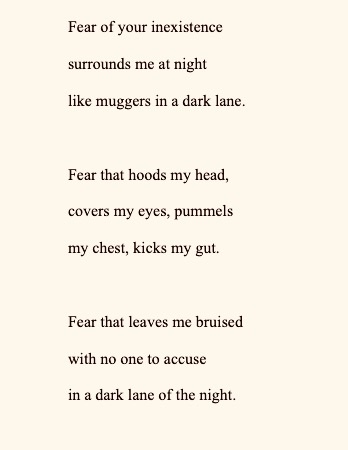
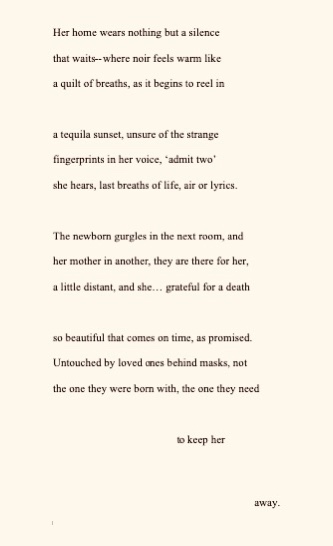
Quarantined Night
Amit Shankar Sahais an award-winning poet and short story writer. He has won the Poiesis Award,, Wordweavers Prize, Nissim International Runner-up Prize. He has been nominated for the Pushcart Prize and the Griffin Poetry Prize. He is the co-founder of Rhythm Divine Poets and Assistant Secretary of Intercultural Poetry and Performance Library. His poems are in Best Indian Poetry Anthology 2018 and he has read at Sahitya Akademi. His collections of poems are titled “Balconies of Time” and “Fugitive Words”. He has a PhD in English from Calcutta University and teaches in the English Department of Seacom Skills University.
Our admiration, interest, and respect spikes for countries where the spread of Covid-19 is flattened or limited with early measures. As we track global statistics on a daily basis, any country with less than 1000 cases makes us react with Wow and How. As we scroll further down the list, those with 500 or less than 100 cases make us feel positive and we conclude: This is the place to live. These may or may not be counted as fantasy lands or ideal destinations in normal times, but when it comes to survival, we salute them for keeping citizens safe in these dark times.
When I discussed this with some friends in an online chat, they are reluctant to bat for developed and advanced nations now. Countries more efficient in the management of crisis and saving human lives, countries more benevolent towards the poor, countries with more nature-friendly policies, countries where a citizen is considered much more than a statistic are weighed against the traditional heavyweights. When the pandemic subsides and people have lesser emotional stress, perhaps the same set of questions will have completely different answers. Or maybe, the magnitude of this crisis enables us to imagine grief more closely and we are compelled to revise our assessment of growth, development, and quality living.
While the recovery phase will take its time, the nations least affected will have having a clear advantage over the severely affected ones. Whether they will be able to leverage on their strengths and give the world the option of a better life with limited but sufficient resources remains to be seen.
Economists and artists will get busy mapping the COVID-19 impact on people once the pandemic is contained. GDP predictions, recession, relief packages and stimulus will form the key discussions. The wealthy of every nation will look for growing economies to park their funds and they will come together to create rich economies — lured by maximum plough back of profits. They will look for economies with double-digit annual growth or for high single-digit economies with enormous potential to double up in the short term itself.
Job losers and fresh job seekers will migrate in search of better and stable options anywhere in the world. The top ten nations for immigrants will be another interesting development. Many new countries will enter this list and many big names will be excluded from the list. Globalisation will become a word of caution for some nations while the rest of the world will begin to harness its potential.
Tragedies inspire artists. The political class that creates global tragedies will be defeated by nature this time. Man-made tragedies kindle the angst in artists far more than the natural ones, even if the extent of damage remains the same or even greater. Being lovers of nature, the community of artists will not be ruthless towards the eco systems. They will blame mankind for being unkind, for the excesses against nature, and treat every natural disaster as the planet’s brave attempt to heal or reclaim what it lost. Artists will remind people and countries to be friendlier towards the Earth as will environmentalists, who have always emphasised harmonious co-existence with nature. This enthusiastic drive will continue with full force.
As soon as the element of greed raises its ugly head and the countries become competitive to provide a ‘better life’ or restore the ‘better’ life, the return towards normal will start. Although we live under greater threat, we have greater confidence that we will survive every kind of threat. The resumption of the predictable cycle will make us return to our lives of consumerism, to flaunt fancy gadgets or something precious to suggest our material abundance. The lessons from COVID-19 will be forgotten and buried.
Rich countries fear the death of their privileged status more than the death of thousands and millions of people. Those who survive will need to live in the same country with pride in its strengths. A country with the highest casualties will continue to say it is far below the expected numbers. If a million die, they will boast of saving many millions more. They will boost the morale of the nation with solidarity drives and keep them upbeat about a quick bounce back. It is a humongous task that brings a battery of opinion makers, public relation strategists and pliant media to play a constructive role in helping governments build – or rebuild – their image.
However, as critical assessment will have lesser tolerance, masses will expect their governments to do what is required. In such times, elected leaders will get the opportunity to showcase their potential. State leaders will grow in stature through their performance. National leaders will find suitable roles other than criticising the government. Social service measures to benefit the poor will help them connect better. Instead of lampooning the governments, people should be seen aligned with the government. These images will linger in the public mind for long. And a new class of leaders will emerge as viable alternatives –some reaching the helm through sacrifice, some reaching it through service.
It will not matter whether democracies deliver the best care or totalitarian regimes perform better. Any kind of governance will find resonance if the citizens conclude their leaders prevented severe loss of human lives. At the end of the day, survival matters. The political class has understood it is not only important to do enough, but it is equally important to be seen you are doing enough. When one game seems lost, the other has to be won.
Global leaders are trying their best to tell their citizens they have a responsive and proactive government. When elected leaders get affected by the virus, they appear vulnerable as individuals. When they get cured faster, they prove their stronger ability to fight and survive. A subtle message that the nation is safe in their hands.
Devraj Singh Kalsi works as a senior copywriter in Kolkata. His short stories and essays have been published in Deccan Herald, Tehelka, Kitaab, Earthen Lamp Journal, Assam Tribune, and The Statesman. Pal Motors is first novel.
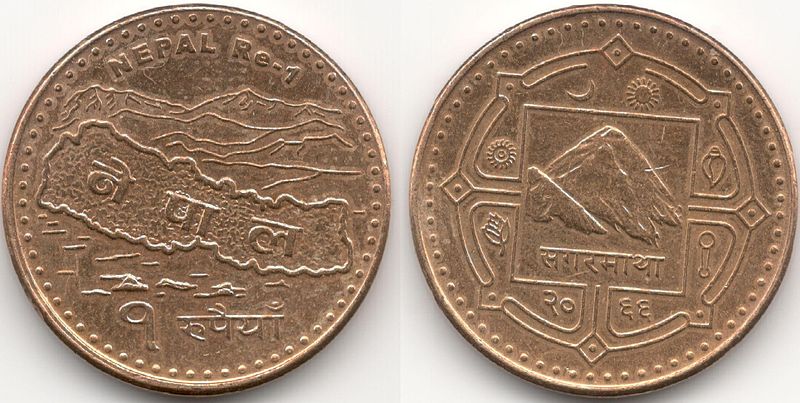
Every day he visits my home and takes only a one-rupee coin. Not more and not less. If I try to give him a two-rupee coin, he asks, “Do you want me to take this coin?” and he won’t take it. He is in the habit of taking a one-rupee coin from my home and perhaps many other homes. I can only see him coming to my home to take a coin. I do not care if he visits other homes and collects coins, for I care about his visit to my home because of his regular habits.
We see him in gatherings and ceremonies at other places. He sits flat on the ground. They serve him well in many social functions. Unconcerned, he sits politely and leaves in a well-mannered way. Yet, his daily habit of taking a one-rupee coin from my home worries me.
“How very forgetful of him!” says my dad if he is late.
His tension is unlike that of a housemaid who lights a single cigarette in the afternoon after finishing her morning chores. A single cigarette puts the maid to relief. But a single coin puts the man to unrest every day.
People say he is loosely wired. Decades have passed. But he has not changed his habit. Everybody in the town has ceased to talk about him now. They are not worried about his activities. He is dressed untidily in dirty clothes often. He is well built, stout and tall. He seems to come from a healthy family. The only thing that concerns him is the daily collection a one-rupee coin from every home. He might have hoarded a vast amount by now.
He used to talk to my grandfather in those days when I was young. He would see my grandfather having lunch at the dinner table through the window, and he’d say, “Well, you are having your lunch, should I not be having my coin?” I used to be young but now I can write his story. I’m a grown-up man now, and I can write things about the one-rupee man.
Many times, I have placed a coin in front of the man myself. I would place it on the windowsill, he would murmur something, and I would say — “It’s there.” Silently, he would feel the coin with his hand and take it. He would say nothing to me.
Once, my little niece gave him a two-rupee coin. The man asked my dad, “Why do you create such confusion? Why do you give me two rupees instead of one?”
Once a day, we see him standing in front of the window of my house, but he is very careful not to visit more than once a day. Perhaps it bothers him, and that’s why he is particular about it.
Some say he was a rich businessman, and that his business partners deceived him and he lost every penny he invested. He got detached from the business world, but he does collect a one-rupee coin from everyone. He continued to have a relationship with the monetary world in as much that he would have his daily dole of a one rupee coin. He makes sure that he comes to collect a one rupee coin from us, and we get bothered about handing him his single one-rupee coin. The give and take process dilutes the tension. Yet, it seems to be a never-ending process that holds the burden for both parties.
Sushant Thapa is a recent post-graduate in English Literature from Jawaharlal Nehru University, New Delhi, India. His short story “The Glass Slate” has been published in Kitaab.org from Singapore. His poems and essays have been published in Republica daily from Kathmandu. His short stories and poems have also been published by The Writers’ Club, New Jersey, United States. He revels in rock music, poetry, books and movies from his home in Biratnagar, Nepal.
The day when his second novel was rejected in the same cold cursory manner the earlier one had been, Pavish Reuk decided to take a stroll across the city. He didn’t have much in his mind then, except a half-bitter tingling that always grew out of his failures. As he stood at the crossing with a crowd of scared masked men waiting for the green that summons pedestrians to march across the throbbing cars, Pavish Reuk realized that his whole life had been a string of failures.
He had been a failure at the crucial points in his student-life, excelling in the unimportant exams. He had been a failure in romance, having lost the only woman he had loved, as he didn’t have enough courage to tell her. He had been a failure professionally, failing in all the career-oreinted competitive exams and ending up as a lowly clerk in a semi-nationalized bank about to go bankrupt. Most importantly to him, he had been a failure as a writer, something he had always wanted to become.
Now, at the age of thirty-nine, with his greasy glasses, shrinking legs, and balding head, Pavish Reuk was in a loveless marriage with a disappointed wife and two children, none particularly fond of him. And yet, Pavish thought, despite having failed in almost all aspects of life, failure still saddened him, it still gave him the feeling of being denied, still, after all these years. This thought surprised him; it touched him with something that felt like happiness. Perhaps it meant, Pavish thought, that he still bore some dream, some debris of optimism that was hurt each time it was not fulfilled. Sensitivity to failures is somewhat a success. Pushed by a restless young man who muffled beneath his mask, Pavish began to cross the street. It had turned green while the last thought crossed his mind.
It had begun to drizzle, and the March Kolkata evening glistened with lights of various shades, strangely silhouetted by the many masked faces that marched slowly down the boulevards on either side of the main street. As the rain swished across the twilight shadows with the gusts of wind, and the cars’ lights mixed with the shafts from the streetlamps on either side, Pavish Reuk began to walk, breathing in the mixed smell of rain, dust, and sweat that spread along the pavement. He was not carrying an umbrella and though his thin hair looked thinner and his small frame smaller in the rain swept crowd, Pavish felt something resembling reverie beginning to fill him in. Suddenly a big black police van with a dirty diesel smell screeched to a halt by the road. Two policemen got off and walked briskly into the by-lanes that flanked the corner of the pavement. The sight of the van made Pavish afraid, though he did not understand why. It seemed to have a sinister message stuck to its dented sides. That, and the sound of a lame dog wailing at a corner of the pavement, took Pavish Reuk to where he did not want to go this evening: the memory of his last, rudely rejected novel.
His last novel was about a shepherd boy who loses his way in a blizzard and discovers a magic stone in the cave he took shelter during the storm. The stone enables him to see the truths out of other people’s lives and create stories out of those. As the boy starts using the stone, he becomes a brilliant storyteller, famous in the taverns, enthralling the people in his valley and even beyond it, till the people realize he makes up his stories from the incidents in their lives, from the carefully hidden secrets that were somehow prized open by the boy’s imagination. In the end, the people gather together and kill the boy through a public execution, but not before he had swallowed the magic stone. The next morning, as they wake up, the people in his valley cannot remember anything that had happened to any of them. The novel ends with the oldest man in the valley breaking down in tears for a reason he did not understand, while the others gathered around him, looking at him wail with a blank expression in their faces. A blizzard with a deadly epidemic was about to set in.
Pavish had drawn the novel with many characters and had named his central protagonist Pratham. There was also a series of subplots that had carried the novel to three hundred pages. But the only publisher Pavish knew and could approach hated the idea of the novel. The editor had clearly stated that his theme was more like an old-fashioned fairy tale and would have no takers in the modern world. Pavish loved the novel as it grew out of the flesh of his imagination. He could particularly relate Pratham to himself and had taken care to give him the attributes of his own younger days. But both he and Pratham had failed and as Pavish entered the staircase that led down on to the metro station, he decided not to write any novel anymore. The raindrops had become fatter by then.
Not knowing exactly where to go, not sure why he entered the metro station either, Pavish Reuk stood in the long snaky queue before the ticket counter. When he reached the counter after what seemed an eternity, Pavish mumbled the name of the next station as he put forth the exact fare through the narrow slit. There was a growing commotion in the metro station. The ticket-punching turnstile had broken down and an increasingly angry crowd swore at the nervous crew that tried to fix it. There was something numbing and scary about the way the people looked now, as if all of them were dreading a disease to break out, a massive infection about to spread like a contagion. Most of them were wearing masks which made them faceless in Pavish’s eyes. The broken turnstile seemed to have triggered some collective claustrophobia of being trapped in a tunnel full of worms. Pavish looked at the group of masked men and women around him.
There was this big burly man in blue shirt with a wart on his forehead who swore the loudest at the incompetence of the crew. There was this very attractive woman dressed in a red top that reminded Pavish of an accident he had seen from close three years back, in which a young girl lay in a pool of blood after being run over by a speeding truck. If the girl had lived, thought Pavish, she would have been as old as this woman. Trying to figure out if the girl looked like this woman as well, Pavish saw the woman staring back at him with a knowing half-smile that scared him. She wasn’t wearing a mask.
There was this absent-minded young man of about twenty-six, already balding, with a brooding look of a jilted lover or a confused philosopher, or both. A group of teenaged schoolgirls chatted away about something funny that had happened in school. Pavish tried to eavesdrop but he was too far away. He had always been too far away, he realised, from the real centers of interest.
Trying to recall with difficulty the content of a long letter he had been asked to type in office the previous day, Pavish fixed his gaze at the wart on the forehead of the big man that seemed to grow in size with his focus. It grew till it was an orange-red haze and would’ve grown bigger had it not been for the sound that rose above the noise of the human voices within the station.
The turnstile handle had given way to the machinations of the metro-crew and people were about to gush in like a flood of insects set free to infect each other. Between the moment when the turnstile broke with a loud crash and the one that saw the long-waiting crowd rush in, something happened inside Pavish Reuk. A loud cacophony of conflicting voices sent Pavish’s mind in a wild disarray even as he tried to figure out where those came from. The breaking of the turnstile, with its loud noise of collapse, had ushered in strange voices that spoke very fast, like a group of jugglers performing simultaneously with colored balls and knives. The many marks from the many wet shoes and slippers spread like a maze across the platform floor, a testimony to the drizzle above, as Pavish closed his eyes to listen…
“That bugger Bobby, he was sleeping with the boss’s wife or else the old hag wouldn’t have favored him so much…kicked the bucket…road-accident…didn’t his sister die in a similar way…three years ago wasn’t it…what the heck…let’s see if I can make some inroads now…” “The new English teacher is cute, and I think he likes me… kept glancing back at me through the entire class… should be fun… I’ll wear my new ear-rings tomorrow…” “How did she come to know where I was last evening? I had told her I was at an office meeting… like I do every time I go out… is she spying on me now?” “The film was crap…had to come along with him and waste so much money and time…as if this is a good time to come to a cinema hall in the first place, with all the scare going around… I should’ve stayed at home and completed the new problems of integral calculus…he’s so stupid sometimes… laughed like a fool at all the corny jokes during the film…don’t think we can stay together for much longer.” “She’s gone insane…bringing her mother over to stay with us…driven out of her son’s house…and bang she arrives in her son-in-law’s house like a pest…” “How am I going to pay back the loan? 50,000 a month…how…how…why did I let them talk me into it? I can’t…can’t…can’t anymore.” “A paper on The Waste Land…we are doomed…it’s so long…and so boring…can’t get anything out of it…Eliot’s personal grouse… why must we suffer…the other group got to do just The Dead…just a short story…it’s so unfair…” “I asked her specifically to take the pill every night…she’s so silly… can’t remember a damn thing…and now…who should I see now to get it done quietly…just before my promotion…the dumb bimbo…and she’s got such a rotting reek in her breath now…” “I think the complete work of Kafka would be a good gift…he’s 17 now…he should love it…it’s on the 16th…can I get a hard cover so fast…paperback would look cheap…” “Ma’s been having the cough for two weeks now…I must take her to the doctor tomorrow…she will never come unless I force her…with the scare now for old people particularly.. I will take a half-day tomorrow and pick her up from home…” “The shares of Safe-Life are crashing down…must sell out and get out of it fast…” “Everything will be shut down soon” … “Bobby is dead…alas…”
It took Pavish Reuk a few seconds to realise that he had, by some long pent-up power that had chosen him now, gained access into the thoughts of the people around him. It was like being struck with a strange virus. He was hearing people speak inside their minds. The voices were criss-crossing the space between his ears like a buzz of busy bugs infecting someplace furiously. The words screamed out of the brains of the dwellers of the metro station, a group of strangers whose lives were now connected by this space-time, by the fear of a common contamination, by the wait for the next train. Pavish Reuk looked around to see if anybody could suspect what he was doing, but nobody in particular was staring at him. Relieved, Pavish walked to the centre of the platform and seated himself on a chair that was surprisingly empty considering the large crowd that had gathered around it. As he sank further deep into the monstrous melting pot of secret thoughts, Pavish remembered the one who could do the same, one he himself had created, and killed: Pratham.
Leaning forward in his chair so as to catch the thoughts better, Pavish looked like a slanted antenna as more and more stories buzzed inside him. Pratham had had a magic stone. For Pavish the sound of a turnstile breaking catapulted him into the belly of a super-sensory universe.
The stories grew out from fear, from secrets, from thoughts never put into words and Pavish Reuk knew right away he was inside the triumph that all artists crave for. He felt like an old typewriter suddenly brought back to life by an incessant clanking away of keys, in this crowded contaminated metro station as a drizzle fell on the floors above. Meanwhile, the two policemen near the signal crossing were walking back to their van. They had been informed of an infected man. One who could spread the disease. And hence had to be captured before it’s too late. Below them Pavish Reuk stood up as he heard the train coming in from a distance. He was full of stories now. He had stolen it all. Triumph, of the purest kind, had finally touched him and he knew he must win this time. Maybe that would redeem Pratham, his death, his failure.
As Pavish Reuk stood up he looked around and saw what he knew he would see. The people around were all looking at him. With sad, infected eyes. Gloomy, masked faces, waiting to slowly die. He was the chosen one now. Despite his unpublished novels, despite his balding head, despite his shrinking frame. The touch of that gaze made him surer of his purpose. He could not go back to failure now. To his loveless home of lack and disappointment. He must win from here. Genius, he had read somewhere a long time ago, lay in the ability to take an infinity of pain. With the smile of a sure man, Pavish Reuk walked to the edge of the platform. The yellow light sped along the rails and became a train. Pavish Reuk jumped into his triumph and disappeared. Outside, it continued to rain.
Avishek Parui (PhD, Durham) is Assistant Professor in English at the Indian Institute of Technology, Madras, and Associate Fellow of the UK Higher Education Academy. He researches on storytelling, embodiment, and memory studies and is the author of Postmodern Literatures (Orient Blackswan).
In the uncertain and unsettling time of the COVID-19 crisis, we may be wise to consider our good fortune and family. We are fortunate, in fact, that our family bonds exist and we have loved ones at all. This testifies to God’s ever shining mercy. However, in the current crisis we should also consider those who are distant from us and less fortunate. A variety of faiths teach mercy to the needy.
The word family originally referred to domestic servants under one roof. It only emerged in its current meaning in the 1600’s. Strangely, the word familiar also has a unique history:
mid-14c., “intimate, very friendly, on a family footing,” from Old French famelier “related; friendly,” from Latin familiaris “domestic, private, belonging to a family, of a household;” also “familiar, intimate, friendly,” a dissimilation of *familialis, from familia (see family).
From late 14c. as “of or pertaining to one’s family.” Of things, “known from long association,” from late 15c. Meaning “ordinary, usual” is from 1590s.
The noun meaning “demon, evil spirit that answers one’s call” is from 1580s (familiar spirit is attested from 1560s); earlier as a noun it meant “a familiar friend” (late 14c.). The Latin plural, used as a noun, meant “the slaves,” also “a friend, intimate acquaintance, companion.”
— Online Etymology Dictionary
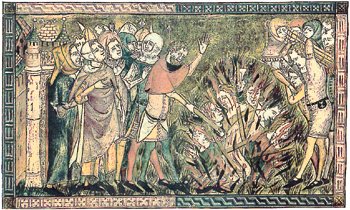
Family and familiar share a common background apparently. Suspected witches, burned in numerous witch trials, had their familiar spirits. Some speculate that the European psyche was traumatised by the Black Death that depopulated the land, and such widespread trauma led to the historic witch hunts. Fear has a way of unraveling the human psyche and creating an atmosphere of unrest. We are facing similar conditions now.
When our social ties loosen, we turn on one another. Strangers are seen in every human face. Yet what is a stranger? What makes a person a stranger? Are strangers only those who cross borders? Is it the distance separating him or her? Is it a transformation of self that makes another person strange?
Recent foreign policy blunders have shaken the world and created a refugee crisis that only time or God could sort through. From Arab Spring and Mubarak, to Assad and Syrian protests, horrific deaths and destabilizing events shook the Middle East as well as Europe. Refugees fled and were welcomed by Germany, Canada, and the United States, but to the dismay of much of those countries’ populace. Quite possibly, these events brought by the Obama administration are a cause for Brexit as well as tightened immigration policies. France, as recently as 2018, imposed tougher immigration policies and included assimilation and learning French in their priorities for accepted refugees.
The question of nationalism is a heated one. However, even the founder of The Huffington Post, Arianna Huffington, once opposed lax immigration policy though she is an immigrant herself. The debate concerning immigration policy revolves around culture, law, human trafficking, employment, and human rights. Why do nations safeguard a certain identity for themselves? Why is “the Other” to be feared, misunderstood, deported?
Is there something integral to nation states that they desire to protect themselves from those outside them?
All across the world we are asked to practice “social distancing”, to quarantine ourselves to protect against the spread of COVID-19. To “flatten the curve”, experts say, we must work at home and venture out only for essential tasks, and then we must keep our distance from others. As can be expected, people are lonely and restless. The virus has generated conspiracy theories, shut down events and outdoor activities, and emptied stores of wares, especially toilet paper.
According to Rene Girard, an anthropological philosopher, the plague was often blamed on those of the Jewish faith. Many Jews practiced medicine, and their ability to heal also made them suspect. They were believed to cause the illness they could treat. They were accused of poisoning community wells. It turns out the plague was actually carried by fleas on rats. Hysteria distorts our perceptions of one another. Where there is no perceived explanation, we invent one from our fears and suspicions.
Does a quality of strangeness arouse suspicion? If so, what defines the quality? Is strangeness something within us, not so much outside? When facing inner transformations, do our surroundings alienate us? In what sense are we even masters of our environment, so heated by political strife?
One thing is certain: President Trump told Mexican President Enrique Peña Nieto that his border wall was at the bottom of the priority list. However, couldn’t he tone down the divisive rhetoric? Or is this the way he befuddles a hostile press?
American Historian Howard Zinn wrote, “Nations are not communities and never have been. The history of any country, presented as the history of a family, conceals the fierce conflicts of interest (sometimes exploding, often repressed) between conquerors and conquered, masters and slaves, capitalists and workers, dominators and dominated in race and sex. And in such a world of conflict, a world of victims and executioners, it is the job of thinking people, as Albert Camus suggested, not to be on the side of the executioners.”
Recall the etymology of family and familiar. The strangeness of the Other is the strangeness of our haunted psyche. We project our fears and naked ambitions onto the Other, or the outsider, who we construe secretly to harbour those same things within. Does the Other become our double? Considering our eusocial nature, Othering may be the psychological stumbling block we put our heads on before the executioner arrives.
President Trump insisted on calling COVID-19 “the Chinese virus” during this crucial period of trade negotiations with the Chinese government. In his briefing, he informs the press and public that his negotiations are going well. In what sense is he, as President, Othering China? Do we Other him in our recoil against his rhetoric? Perhaps he is the doppelgänger of our country’s hideous history coming to bite us back. Perhaps he is the voice of the forgotten, as his adviser Stephen Miller told CNN. In being the voice of the forgotten working class, has he saved the working class at all or only confused things more?
One thing is certain: we are strangers to ourselves if we cannot answer these questions.
Dustin Pickering is the founder of Transcendent Zero Press and editor-in-chief of Harbinger Asylum. He has authored several poetry collections, a short story collection, and a novella. He is a Pushcart nominee and was a finalist in Adelaide Literary Journal’s short story contest in 2018. He is a former contributor to Huffington Post.
Disclaimer: The opinions expressed are solely that of the author and not of Borderless Journal.
(A conversation on ‘hope’ between a mom and her 14-year-old daughter)
By Nidhi Mishra
Yesterday, someone shared with me a video by Serena Williams that went viral last year, where she is emotionally urging her little baby girl to grow up and take to a sport, ANY sport, but some sport. I remembered watching it together with my young daughter — in fact, many times over.
But, somewhere, during the repeats, I wondered what it was about this message from Serena that moved me so much. I have never really played any sport myself. I did inherit the family culture of an impeccable and exhaustive viewing of all Tennis grand slams, but it did not impact me any other way personally.
My daughter loved the video and gathered that I was trying to relay to her Serena’s message about the life lessons from sports. But seeing a tiny tear curl up in the corner of my eye, she figured it meant something more to me.
“Why are you so moved by this video?” she pestered, not happy that she was missing some point. The lack of a response from me made her venture to guess why Serena seemed important to me right now, while our lives seem to have come to a standstill.
Was it the daunting speed of Serena’s aces or the power of her backhand?
Was it the unmatched records of her Grand Slam victories?
Or was it the emotional appeal in the video, Serena trying to pack her life’s wisdom in a two-minute video, for her baby?
The answer I gave seemed terribly simple for all the flush of emotions I had been displaying.
“It is because she is a mom,” I said.
I could see my daughter had a loud “So what?” written all over her face.
“It is just that she is a mom,” I continued. “A returning mom. Doesn’t matter that she is returning to sport. It is the overpowering image of a mom returning to her life, reclaiming her life, the life she always knew before she hit pause. You won’t understand it. But every mom will.”
After some moments, my daughter replied, “You are right Ma. Yes, I get that it is hard. But I may not get HOW hard. I do understand now that when we talk of or watch Serena, it is not just her game.
“I am conscious she is ‘getting back’ to her game, which is very different from ‘getting on’ with her game.
“It mustn’t be easy, after going through the life changing experience of becoming a mom. I don’t claim to know how much it means to young moms out there, but I do understand it means something. Someone to look up to. Someone like you, who pulled through. Some one who gives you hope.
“And I know what you will say now Ma, more than the game and the technique, Serena is sending out a message. As a mom. To another mom like you. And to any young girl like me, who is told there are so many reasons why women can’t take up the demands of a life-long career, sports or not. Well, there is one reason less now.”
There was something reassuring about hearing my daughter talk that way. It doesn’t take an expert to glean through and pick a few drops of hope from someone else’s story, someone else’s experience, however unknown their territory.
Now is not the time to convince our young ones that we have faced hardships. Now is the time to tell them that we lived through hardships and will do so yet again.
For now, I would only like to tell myself and all people out there, moms or not, working or not —
Many of us have hit pause before in our lives. And hard as it was, we always managed to resume.
There is no reason why we wont, this time.
Serena William’s video message for her little girl
Nidhi Mishra is an ex-banker who pivoted from a 10 year banking career to her passion for reading and luring others to read through her startup Bookosmia (smell of books). Bookosmia, a children’s content company has grown at a furious rate in the last two years, building an enviable bank of 270+ Intellectual Property, focused on bringing. She went to Lady Shri Ram College , Delhi University to pick up an Honours in Mathematics and a feminist flair on the side. An MBA from IIM Lucknow took her to a decade long career in the financial sector, finally quitting as VP, HSBC as she suffers from a (misplaced) sense of satisfaction and a drive to do something meaningful with her time. You can write to her at nidhi@bookosmia.com. Nidhi’s first children’s book “I Wish I Were” is retelling of an old Indian folklore in partnership with Parvati Pillai, ex-design Head of Chumbak received much global acclaim and is available on Kindle.
Barnali Ray Shukla is a writer, filmmaker & poet. Her writing has featured in Sunflower Collective, OutOfPrint, Kitaab.org, OUTCAST, Indian Ruminations, Vayavya, Anthology of Contemporary Indian Poetry II, indianculturalforum.in, Madras Courier, Bengaluru Review, Voice& Verse (HK) UCityReview (USA) and A Portrait in Blues (UK). She has a feature film to her credit as writer director, 2 documentaries, 2 short films & a book of poems, Apostrophe. Her short fiction & non fiction feature in print anthologies by Amaryllis, Speaking Tiger Books. She is shooting her third documentary & scripting a movie.She lives in Mumbai with her plants, books & a husband.
Camus’ La Peste has never been out of print. In the wake of pandemic that now sweeps the entire world, its sale has seen a surge quite unlike at any other time since its publication in 1947. What else can be a greater proof of the relevance of a work that seems to be an ageless parable of human condition.
The novel, most of which he wrote in confinement, away from his family due to his acute illness, is the story of a town suffering from bubonic plague. But this novel can also be seen as an allegory of human crisis brought about by moral contagion.
Camus belonged to a generation which was born either before or during the First World War, reached adolescence during the worldwide economic depression and turned twenty the year of Hitler’s rise to power. Next they saw the civil war in Spain, the Munich Agreements, the start of another World War in 1939, the fall of France in 1940 and four years of enemy occupation and underground struggle.
All of this, in his opinion, resulted in a human crisis where most people, disillusioned by religion or nationalism and wary of the traditional morality imposed upon them, lived in contradiction. They accepted war and violence which was given to them, which they had never wanted but from the consequences of which they could not escape. It was as if the entire generation was plagued by an indifference which led people to accept human suffering as a banal reality.
In one of his lyrical essays, The Almond Trees (1940), Camus wrote:
“I do not have enough faith in reason to subscribe to a belief in progress or to any philosophy of history. But I do atleast believe that men have never ceased to grow in the knowledge of their destiny. We have not overcome our condition and yet we know it better. We know that we live in contradiction, but that we must refuse this contradiction and do what is needed to reduce it. Our task as men is to find those few first principles that will calm the infinite anguish of free souls. We must stitch up what has been torn apart, render justice imaginable in a World which is so obviously unjust, make happiness meaningful for nations poisoned by the misery of this century.”
He believed in human kindness and solidarity. He believed that if in the face of a crisis people could rise and act, not out of some heroic courage expected of them, but with reason and optimism, then it would be possible to reduce human suffering.
Written in the given context, the novel quite pertinently, became a tale of a persisting contradiction and subsequent human actions in overcoming the condition.
“What’s true of all the evils in the world is true of plague as well. It helps men to rise above themselves.”
In the novel, after initially rejecting the plague, the people of Oran are forced to go into isolation and quarantine. In fact the whole city is closed down and its borders are sealed. There are people suffering from the disease, people in exile – away from their loved ones, people serving those ridden with disease and also people trying to make more money by smuggling goods. Here the depiction of illness, loneliness and separation is quite vivid – much that we can relate to as well at present?
Dr. Rieux, the one who detects the illness, assumes his responsibility and does what he must. He is an ordinary man doing extraordinary things, not out of a notion of valour but out of simple decency and a sense of moral obligation. His character personifies individual moral responsibility essential to make effective public choices in a society. At one point, he says:
“When you see the suffering it brings, you have to be mad, blind or a coward to resign yourself to the Plague.”
Rambert, a young journalist who is exiled in Oran, tries to escape the city initially but later he realises that he shares a common fate with rest of the people and joins in serving those afflicted.
Then one fine day, the plague disappears as mysteriously as it had appeared but not without playing havoc with the lives of people. Later when the people celebrate in the streets of Oran, Dr. Rieux observes:
“The plague bacillus never dies or vanishes entirely, it can remain dormant for dozens of years in furniture or clothing, it waits patiently in bedrooms, cellars, trunks, handkerchiefs and old papers, and perhaps the day will come when, for the instruction or misfortune of mankind, the plague will rouse its rats and send them to die in some well-contented city.”
Camus knew that even if a contagion, whether biological or moral, ends – one couldn’t be too sure of its absolute extinction. So in the absence of a clear moral lesson from this book, what is it that makes the book still relevant?
In the face of the present pandemic which lurks in the corners of our cities and stares at us from outside the windows of our isolated homes, this book not only brings to our notice the horrors such plagues can inflict but also the human will, solidarity and collective resistance that remain instrumental in overcoming such disasters. It puts our focus back where it should be – on assuming moral responsibility as individuals — on each act of kindness, on goodness which when collective not only helps combat a pandemic but also rouses our alertness lest our laxity make us miss the signs of an impending darkness.
Rakhi Dalal is an educator by profession. When not working, she can usually be found reading books or writing about reading them. She writes at https://rakhidalal.blogspot.com/ . She lives with her husband and a teenage son, who being sports lovers themselves are yet, after all these years, left surprised each time a book finds its way to their home.
Of my territory, nevertheless, the land of my home
I reckon!
I imagine I am a butterfly
Caged by the river, flows up each second and then comes down
In merriness!
For, it owns the feeling
The feeling of sense of belonging
In particular!
The joyful days continued and would have continued
Unless, interrupted by the stormy alarums and excursions
And then chained, indeed, feet by hands
The vociferations would have gone on and on…!
If the stones had not remonstrated
Although they fall, but have learnt to stand back strongly
Accompanied by the rains of the Above Power!
The salvation we made in grievance
The souvenir in future
Entitled with the tears of glory
Of thine…!
Ever since everything sounds so irritating
Wandering on the land of survival
In the streets that are seized entirely
The fighting butterflies, fearlessly, against the burning sun
Shadowed all around, yet in fear
Fear of setting back!
For, the sun has to rise someday
And then begins the journey of thorns and flowers
Of the territorial conflicts of butterflies
Near the mountains, under the sun of shadow
In the land of my home!
And then culminates the mournings
Upon the arrival of the victory
Awaite desperately
Who knows who dies
“In the battle of life of love and war”
When the journey begins all anew…!
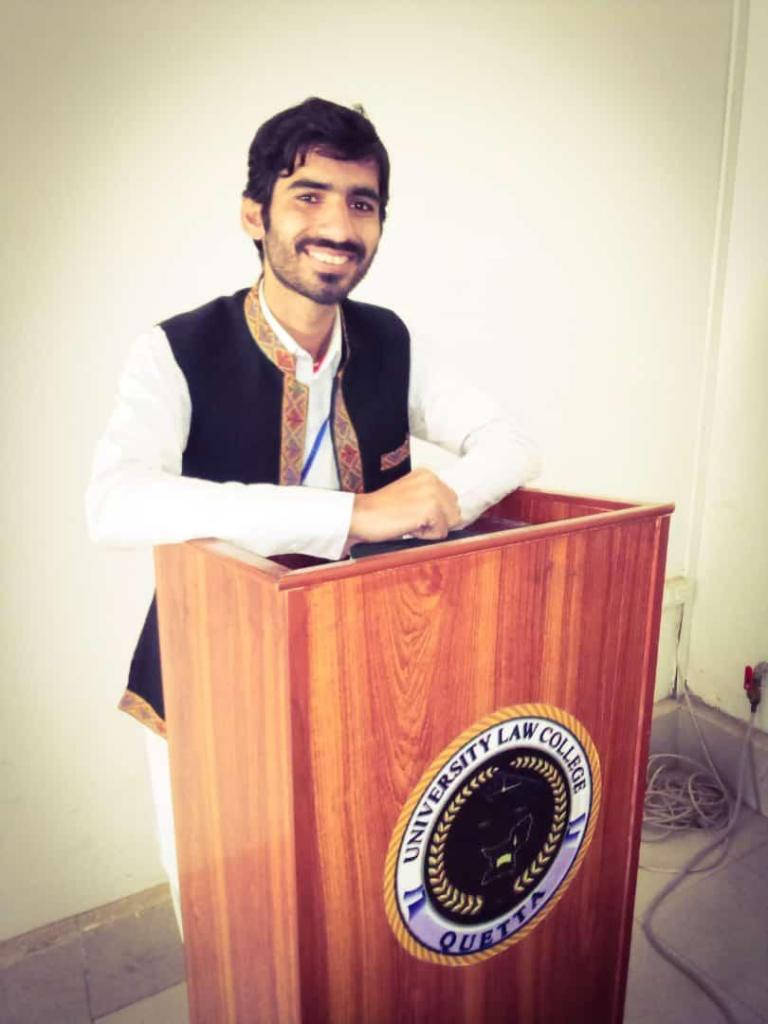
Ali Jan Maqsood is a student of Law at University Law College Quetta and a former guider at Dynamic English Language Teaching Academy (DELTA) in Turbat. He can be reached at alijanmaqsood17@gmail.com and tweets at @Alijanmaqsood12
There’s some wise advice that you should never meet your heroes in person, for fear of destroying their aura of invincibility. But what happens when you meet a childhood hero, the singer of a song which is still on rotate in the back-catalogue jukebox of your mind? This is a tribute to the great, late Julie Felix, a legend in her lifetime, who was more than just a bohemian folk singer who knew no borders.
Julie Felix
It is not easy to classify Julie Felix, who died the week before last, aged 81. Most of the labels don’t fit. Sure, you could tag her as a folk singer, as she had one of the longest careers in folk music, spanning more than half-a-century. The singer-songwriter was also a humanitarian and human rights activist, having been politicised in the 1960s and was active in peace and environmental movements. But to dismiss her just as a protest singer of yesteryear would be to ignore her much larger contribution.
Californian-born and raised Catholic (as a child she wanted to become a nun), Julie started singing at beach parties and coffee bars, then tripped around Europe, where she had a fateful meeting with Leonard Cohen on a Greek island in 1962. Arriving in the UK with just her guitar and duffel bag, the woman in her mid-twenties known for her strong voice and long black hair rose to prominence in 1960s beatnik England as folk music gained in popularity. She ended up spending much of her time on that side of the Atlantic, including a stint in Norway, dying peacefully in her sleep in a village north of London once rated the happiest places to live in the UK.
With Mexican, Welsh and Native American ancestry and heritage, the American, British-based recording artist was very much a global citizen who defied being placed in a box. Her passion for music was instilled by her father, a Mexican mariachi ensemble musician who played guitar and accordion, while her Welsh American mother liked the mournful ballads of Burl Ives — both her parents had Native American blood.
In 1964, even the British record label Decca Records didn’t know whether to place her debut album in the classical category for folk music or take the risk in marketing her music as ‘pop’ and mainstream. It was eventually decided she was a pop singer. That decision was a key moment in her career. She became a household name, TV star and Top Twenty recording artist. In the late sixties, perhaps oblivious to her Californian origins, The Times newspaper described the musician as ‘Britain’s First Lady of Folk’. She had an engaging voice and a charming manner, but never learned to read music. She put it down to being at the right place at the right time. “Fate whisked me along,” she said in an interview last year. And it was fate that led to me meeting Julie almost 30 years ago.
There’s a wise saying that you should never meet your heroes in person. Obviously, I chose to ignore that advice when I met Julie, my childhood hero of sorts.
I knew of her because she sang a song popular at primary school and on the radio, particularly on the New Zealand Sunday morning children’s hour show Small World where ‘Going to the Zoo’ was a popular request along with Spike Milligan’s fairytale ‘Badjelly the Witch’. ‘Daddy’s taking us to the zoo tomorrow . . . And we can stay all day!’ starts out with the catchy chorus: ‘We’re going to the zoo, zoo, zoo, How about you, you, you? You can come too, too, too, We’re going to the zoo, zoo, zoo.’
The action song, complete with onomatopoeic animal noises, was a big hit at Nayland primary school, and it was a soundtrack on constant loop when we made a school trip to the nearby Tahunanui Zoo (now known as Natureland Wildlife Trust and more into wildlife conservation than a petting zoo), back before zoos became places to avoid because of their treatment and captivity of animals.
So, in 1992 I met up with Julie in the South Island of New Zealand and travelled around the Catlins area near Dunedin for almost a week with the legendary folk singer, hosted by Fergus and Mary Sutherland of Catlins Wildlife Trackers. At the time I was a budding writer, fresh out of post-graduate journalism school. As well as tagging along to write some stories for newspapers and magazines, I was quickly identified as the unofficial local guide, the fixer, and the fetcher. I was tasked with taking photos, opening wine bottles, and carrying her prized guitar. We hiked trails to spectacular waterfalls in the lush forest, visited panoramic coastal viewpoints, ventured into limestone cathedral arches, combed beaches looking for petrified tree fossils, and watched dolphins play in the surf.
At night, with no street lights, if the skies were clear, we’d go outside to admire the Southern Hemisphere stars with the Milky Way and its just-visible breakaway of large Magellanic cloud, and the constellations unfamiliar to Julie, such as the Southern Cross, or ones easily recognisable, such as Orion, which were differently oriented compared to night skies in Europe and North America. “This is where I belong,” she declared after a long session of awed gazing, “I am a child of this wonderful universe.”
On that adventure was the glamorous American health and beauty author, Leslie Kenton, daughter of jazz musician Stan Kenton. There was a little bit of tension on our sightseeing trip, as Leslie, former health and beauty editor at Harpers and Queen, and author of Raw Energy and The X Factor Diet was into raw food for vitality and longevity, while Julie was more into living in moment rather than her appearance, the future or order. She didn’t wear make-up, she dressed in comfortable clothes, and she enjoyed the occasional puff on hand rolled cigarettes. It wasn’t quite a reckless rock n’ roll lifestyle, more of a down-to-earth, unpretentious, good-hearted existence.
Julie’s habits were met with a disapproving look from radiant Leslie, who was three years younger — though it was health freak Leslie who died earlier, in 2016, aged 75, near Christchurch, having been charmed enough by New Zealand from that first visit to decide to move permanently.
The slight clash of personalities, Julie later confided to me, was mainly astrological. Fortunately, we got on well, possibly because I didn’t want to change her in any way, had no expectations, and I also shared Julie’s skepticism, about the virtues of coffee enemas. Though I must admit, I did hope that at some stage she would sing THAT song.
Julie would roll her eyes after another plea from Leslie to try a new-fangled supplement, recently-discovered treatment or life-changing product. “Where are we going to tomorrow?” she once asked me to divert Leslie’s attention, so she could go out for some fresh air and a smoke. “To the zoo,” I replied, hoping to subtly remind her of the song I wanted to hear her sing.
During the trip, Julie didn’t feel the need to impress, even though she had an impressive CV and contact list. She had become the first solo folk performer to sign with a major British record label, and in 1965 she was the first folk singer to fill the Royal Albert Hall – that same year she was the first ‘popular’ singer to perform at Westminster Abbey. She even had her own primetime BBC TV programme (the first colour series produced by the BBC), after being a member of David Frost’s satirical ‘Report’ team.
Her own series ‘Once More With Felix’ included guests The Bee Gees, The Kinks, Fleetwood Mac, The Hollies and Spike Milligan. Julie, with her dark, long hair, was often compared to (and sometimes mistaken for) fellow American and Californian resident Joan Baez. Even though she still had an exotic West Coast accent, a US passport, and sang songs penned by American’s Woody Guthrie, Bob Dylan, and Paul Simon, she was once dubbed ‘Britain’s answer to Joan Baez’.
Among her contemporaries and friends were Bob Dylan, Arlo Guthrie (‘This Land is Your Land’), Dusty Springfield, Paul McCartney, Cat Stevens, Jimmy Page, and Leonard Cohen. She once opened for Dylan at the Isle of Wright Festival, later did a cover of his peace song ‘Masters of War’, and so liked the fellow Gemini’s music, she recorded a double-album of his songs. Julie was one of McCartney’s girlfriends, and it is said he sang ‘Strawberry Fields Forever’ to her before it was first performed publicly. She is credited with being the person who taught Cohen how to turn his poems into songs. If you get the chance, there’s a Youtube clip of her singing with Cohen ‘That’s No Way to Say Goodbye’ (https://www.youtube.com/watch?v=f1EJ-ITAcEU). It was Cohen’s British TV debut.
Julie was born in Santa Barbara, but couldn’t get her musical career off the ground in the US, so with savings of US$1000 in her pocket, and inspired by Jack Kerouac’s ‘On The Road’, she hitchhiked across Europe (meeting Cohen in Greece on the bohemian island of Hydra and lending him her guitar), and then found a bigger audience in the UK, where she stayed for decades.
She once got arrested at Heathrow airport for possession of cannabis and carrying more than the allowable amount of cash — that was more than 50 years ago.
She first came to New Zealand in 1971, singing to a record-breaking crowd of 27,000 at Western Springs in Auckland, urging Kiwis to reject conscription for the Vietnam War. But she wasn’t just a singer of protest songs, she had a deep concern for the world, the environment, and its people, particularly those less well off. As well as being a singer, social justice, human rights and peace were important to her, and she was involved in many initiatives, charities and humanitarian causes for women’s rights, refugees, and victims of oppression, including projects to end the military use of landmines in Third World countries, and as an ambassador in the Middle East and Africa for Christian Aid.
One of her most requested songs is ‘Deportee (Plane Wreck at Lost Gatos)’, about the mistreatment of migrant farmers, while her top hit was ‘If I Could’, best known as the Simon & Garfunkel version ‘El Condor Pasa’ which starts off with the ‘I’d rather be a sparrow than a snail . . .’ And of course, among a younger audience, she was the voice behind the ‘Going to the Zoo’ song, which featured in her second album released in 1966 (that song was also sung by Peter, Paul & Mary).
At the end of the week, with Julie rejuvenated from the New Zealand natural scenery and serenity, (and with better access to tobacco, alcohol and spicy, ‘well-cooked’ food), she had a concert in Dunedin, and I got to be her temporary road manager, carrying her guitar, the treasured one from her father. After the soundcheck, one of her devoted fans, who had met her two decades earlier during the anti-Vietnam War era, snuck into the green room, and pressed upon her a tinfoil containing marijuana that he’d especially prepared just for her.
There was a surprisingly large turnout, with an older audience of loyal followers eager to hear her voice again, which had gone a little dusky over the years (she was then in her mid-50s), similar to the vocal trajectory of Joni Mitchell, thanks to the nicotine habit. On some of her songs, everyone sang along. After helping her out (‘Keith, where can I get . . . ‘ she would ask), I thought perhaps she’d do ‘Going to the Zoo’ as one of the encore pieces.
So if you haven’t heard it before, or if you did a long, long time ago, you can still hear Julie sing ‘Going to the Zoo’ (https://www.youtube.com/watch?v=WgCiE_tiyQo). It is quite a good song if you currently are in coronavirus lockdown with children to entertain or care for. It ends with this:
Well we stayed all day and I’m gettin’ sleepy, Sittin’ in the car gettin’ sleep sleep sleepy, Home already gettin’ sleep sleep sleepy, ’Cause we have stayed all day.
Listening to her sing, as I stood backstage, I realised why I liked her, and it was because her voice reminded me of a simpler time, when I was young, when things seemed more black-and-white. “This world goes round and round, green leaves must turn to brown, what goes up must come down, It all comes back to you,” she sang out Tom Paxton’s ‘World Goes Round and Round’. “People knocking at the golden door, they got plenty but they still want more, don’t know what they’re looking for, the world goes round and round.” She has also sung Paxton’s ‘The Last Thing on My Mind’. It was Paxton who wrote ‘Going to the Zoo’. But did I get to hear her sing that zany song? Nope.
The next day, before Julie headed off on her travels (she wanted to go bungy jumping over the Shotover River in Queenstown), she confided that she did sometimes sing ‘Going to the Zoo’, but the performance was usually reserved for a much younger audience. “Keith, I’ve been singing that damn song for more years than you’ve been on this precious earth.”
She took away a few pebbles and shells we’d found on our shore and estuary ramblings, and I made her a booklet of photos from the trip. After our time together, we kept in touch.
A few years ago, she said that when she sings live, she taps into a great energy, and it was her way of praying. “Music is like breathing to me,” she declared. In one of her most recent interviews, she said she missed her youth and the energy she once had but was grateful at being able to make music and share it with others.
She was still touring, recording and performing into this year, with an album released in 2018 of her own songs, and a schedule of concerts planned for 2020. She had even teamed up Mike D’Abo from Manfred Mann to do songs they’d performed together more than half a century ago, including Bob Dylan’s ‘Fare Thee Well’ with the lines ‘So it’s fare-thee-well, my own true love, We’ll meet an-other day, an-other time’ (see this from 1967 https://www.youtube.com/watch?v=BsH0xPFbV0g).
She died on Sunday 22nd March, a couple of days after another 81-year old who had made a contribution in expanding the audience for a music style and making it more mainstream, Kenny Rogers, and on the weekend when the UK went into lockdown.
Julie leaves a deep legacy not just musically, but in her ideals, and how she strived to make a difference. She was both a product of her time, and ahead of her time, in wanting to make the world a better place, and being prepared to speak up, particularly for those without a voice. In a divided world, she saw no divisions, only an unrealised global consciousness, that we are all one, all children of the universe.
Keith Lyons is an award-winning writer and creative writing mentor, originally from New Zealand, who has lived in Asia for more than a dozen years. His creative non-fiction, short stories, and poetry have been published in journals, magazines and anthologies around the world, and his work has been nominated for the Pushcart Prize. He edited and co-authored ‘Opening up Hidden Burma: journeys with – and without – author Dr Bob Perival’ (2018, Duwon Books), and is currently working on a book about finding Asia’s last island paradise, the Mergui Archipelago.












 Borderless