As the author of Jorasanko and Daughters of Jorasanko, which map the life of the greatest visionaries of the world, Aruna Chakravarti gives us a brief summation of the genius of Rabindranath Tagore.
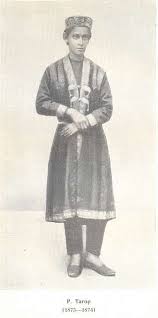
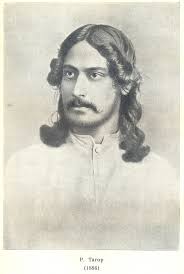
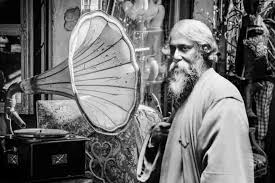
Young Tagore in 1870sTagore in 1886Photos from Public Domain
Rabindranath Tagore was born in 1861 in the throes of the Bengal Renaissance. A unique movement which took place during the latter half of the nineteenth century, it saw the germination and the slow stirring into life of a social and religious consciousness and the emergence of a middle class that idealised British rule and used its support to usher in considerable social change. The revolutionising of values and the social, political and literary awakening that followed gradually came to encompass the whole of India.
The Bengal Renaissance, like its European counterpart, swung precariously for a while, between two worlds. One old, decrepit and dying by degrees — the other struggling to be born. A host of great personalities emerged during this time; household names to this day.
All were protagonists engaged in battle. Some to keep alive and perpetuate the old; some to hasten its death and bring about the birth of the new. Needless to say, it was the latter who prevailed. Bengal saw an upsurge of activity, the like of which had never been seen before, in fields as diverse from each other as politics and religion to literature and the performing arts. In this, Bengal’s close contact with the British served as a catalyst.
Yet the same movement, in its latter years, saw the first stirrings of resentment against British domination. India’s acceptance of English education and her faith in the scientific discoveries of the West was countered by a new revivalism. An assertion of political independence and the growth of a nationalist consciousness. A need for introspection became the call of the hour. Rabindranath was among the first to articulate this need. In an essay, entitled Byadhi-o-pratikar[1]written in the early years of the twentieth century Rabindranath expressed his doubts regarding the changed Indian psyche wrought by the West. Reflecting on the French Revolution, the efforts to abolish slavery and the upsurge of literary activity in Europe he wrote: “Western civilisation seemed to proclaim an inclusiveness for all humanity irrespective of race and colour. We were spell bound by Europe. We contrasted the generosity of that civilisation with the narrow mindedness of our own and applauded the West.” He goes on to say, however, that the scales had fallen from the nation’s eyes. The supposedly Western ideal had failed Indians. European education and adoption of its values hadn’t helped them to achieve equality with the white race.
Thus, the movement came full circle. Rabindranath had not been part of it from its inception. Yet, if one were to look for and identify a single persona in whom the entire Bengal Renaissance may be said to be epitomised, it would, without doubt, be the persona of Rabindranath Tagore.
Poet, playwright, novelist, painter, composer, educationist, nationalist and internationalist, Rabindranath was not only a myriad minded genius but a Renaissance Man in the truest sense of the word. In fact, the dawn or awakening of Rabindranath’s creative inspiration is synonymous with the awakening of a whole nation.
The cultural identity of India and the place in it of religion, caste, class and gender which much of Rabindranath’s prose and poetry explores, continue to retain their relevance even today, a hundred years later, in a post-colonial time frame. His novels offer masterly insights and analyses of the complexities of Indian life with its teeming contradictions; its rootedness in tradition as well its ability to assimilate and accommodate change.
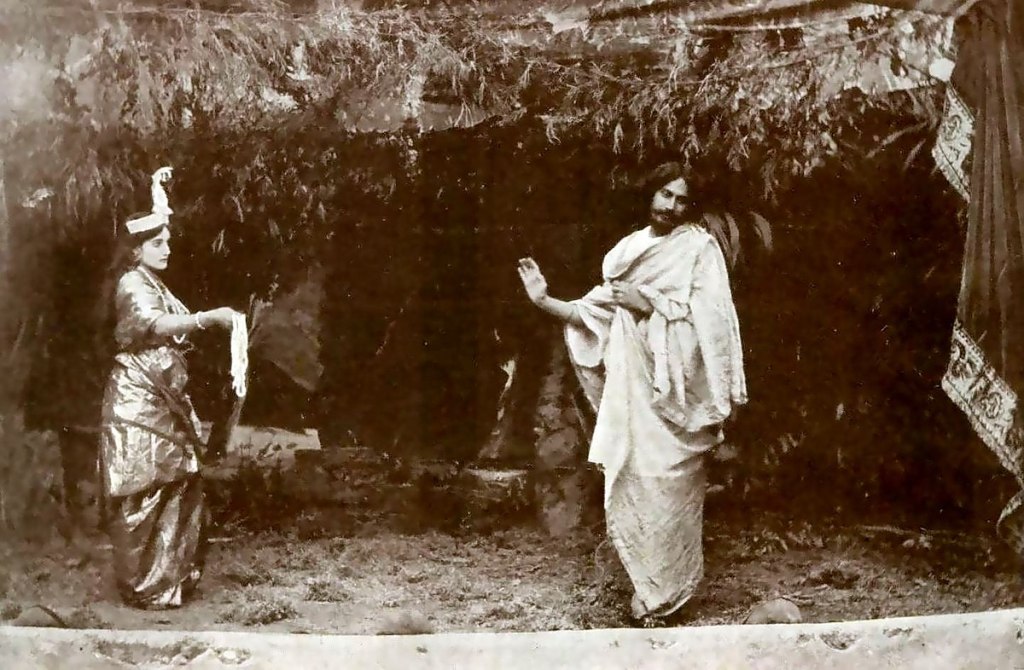
Rabindranath Tagore and Pratibha Devi (his neice) performing in his dance-drama, Valmiki-Pratibha (The Genius of Valmiki) 1881. Photo from Public Domain
Rabindranath, however, is best known as a poet. His poetry, drawn from ancient cultural memory as well as the immediate present, is in a class of its own. For there is a third dimension to it. He not only wrote of what he saw and remembered but what he saw only in his mind — a world that lay a vast space away from reality. ” There are two kinds of reality in the world,” Rabindranath said[2] of his paintings. “One of them is true; the other truer.” He could have said this of his poetry too. The real and surreal quality of his images in the vast span of his poems and lyrics; their indefinable nuances and evocative power are comparable to the works of the great Impressionists.
Interestingly, Rabindranath arrived at the canvas through his poetry. The calligraphic erasures and corrections with which he embellished many of his poems became sketches of a special kind. “I try to make my corrections dance,” he said[3] once, “connect them in a rhythmic relationship and transform accumulation into adornment.”
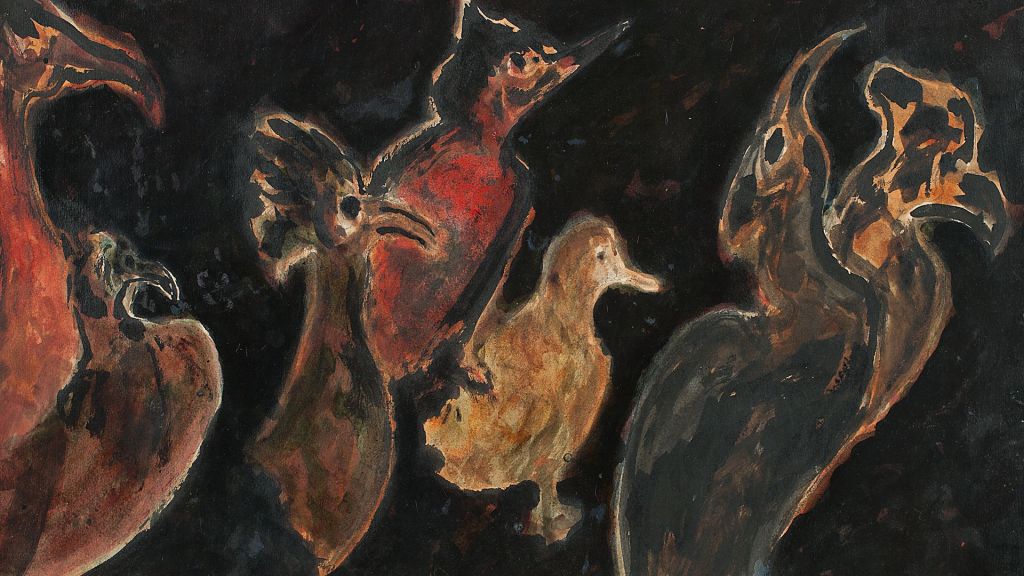
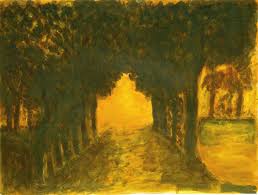
Later, in the last thirteen years of his life he threw himself into frenzied bouts of painting leaving behind more than two thousand and five hundred art works. Strange, haunting faces with eyes that look deep into one’s soul; surreal landscapes the like of which were never seen this side of the horizon; trees and flowers painted in violent colours that erupt from the artist’s palette in volcanic bursts — his paintings, as an artist once said, reflect “emotions recollected more in turmoil than in tranquillity.”
Art of Rabindranath Tagore. Photos from Public Domain
Yet, though famed the world over for his poetry and painting, it is as a music maker that Rabindranath has stayed entrenched in the hearts of his own people. His songs, loved and sung by generations of Bengalis, range in theme from celebrations of nature and yearning for freedom to love of God and Man. They convey the poet’s profound philosophy of life, his deep faith in humanity and his sensitive exploration of the Universe, often touching on the quest of the unattainable. Rabindranath once said that, though he could not predict how future generations would receive the rest of his work, he was confident that his songs would live. The increasing popularity of Rabindra Sangeet, both in India and abroad, bears ample testimony to the fact that his prophecy was based on a certainty born out of self-knowledge. Vast and varied though his genius was — music was its mainspring. He wrote of his songs: “I feel as if music wells up from within some unconscious depth of my mind; that is why it has a certain completeness.”
[2] Quoted from Tagore’s Galpa Salpa (Conversations) by Soumendranath Bandopadhyay in Expressionism and Rabindranath
[3] Quoted in An Artist in Life by Niharranjan Ray
Aruna Chakravartihas been the principal of a prestigious women’s college of Delhi University for ten years. She is also a well-known academic, creative writer and translator with fourteen published books on record. Her novels Jorasanko, Daughters of Jorasanko, The Inheritors, Suralakshmi Villa have sold widely and received rave reviews. The Mendicant Prince and her short story collection, Through a Looking Glass, are her most recent books. She has also received awards such as the Vaitalik Award, Sahitya Akademi Award and Sarat Puraskar for her translations.
.
PLEASE NOTE: ARTICLES CAN ONLY BE REPRODUCED IN OTHER SITES WITH DUE ACKNOWLEDGEMENT TO BORDERLESS JOURNAL
Agomoni (1878–1883), Metropolitan Museum of Art, Kolkata
Bengal — and here I refer to undivided Bengal — with her plurality of religions, cultures and sub-cultures and her numerous linguistic forms and dialects, provides a wonderful kaleidoscope of thoughts and ideas through her oral utterances. Multiple streams of expressions provide a fascinating study for the researcher. This cultural heritage is deeply enmeshed in the life of a Bengali enfolding Hindu and Muslim alike. In the present scenario of divisive identity politics, it is imperative that we draw upon this common heritage constantly and consistently.
In this essay, we will highlight practices in which there was equal participation of Hindus and Muslims, with each community infusing and enriching the traditions of poetry, music, narrative and ritual. What is observed is a readiness to dissolve religious differences in a common cultural pool of assimilated identities.
A large body of the oral literature of Bengal is rooted in the worship of demonic powers. As is to be expected in a tropical region and a primitive, rural society, certain deities are seen as holding human lives in thrall by their control of natural calamities, animal attacks and epidemics. Though Islam sanctions worship of none other than Allah, the Muslims of Bengal are equal participants in the propitiation of these deities. Interestingly, most of these are female deities, indicating that Bengalis have seen the powers of destruction and preservation as vested in women from time immemorial.
Olai Chandi
Let us begin with the Saat Bibir Upakhyan, the legend of the seven sisters who hold in their hands the power to unleash and contain some of the deadly diseases that strike rural Bengal from time to time. The eldest and most feared is Ola Bibi or Bibi Ma –the goddess of cholera or olautha –ola, in the rustic dialect meaning diarheoa and utha –vomiting. When the two symptoms appear together the villagers see it as Ola Bibi’s curse and rush to offer prayers and sacrifices. So great is their awe and terror of this deity that they invest her with the most flattering attributes. Worshipped by both Hindus and Muslims alike, she is represented as a woman of surpassing beauty, striking personality and noble mien. The Hindu version of the idol, Olai Chandi, has a bright yellow complexion and long slanting eyes. She wears a blue sari, has open hair and is adorned with the jewellery wealthy Hindu women wear – bangles, necklaces, armlets and a nose hoop. The Muslims visualize her as a high-born Muslim maiden in Islamic attire – loose pyjamas, shirt, cap, veil and nagras[1] on her feet.
The worship of Ola Bibi continues vibrantly into the present in Nadiya, Bankura, Birbhum, Bardhman and even Kolkata, sometimes singly, sometimes along with her other six sisters –Jhola Bibi, Ajgai Bibi, Chand Bibi, Bahurh Bibi, Jhentuni Bibi and Asan Bibi. Her puja is performed out in the open under the trees or by the river. But some places are earmarked as Saat Bibir thaan or Ola Bibir thaan –thaan being a corruption of the word sthaan meaning place. The rituals, even when the devotees are Brahmins, are performed by Muslims or drawn from the lowest rung of the caste ladder –the Hadis or Doms.
The second sister Jhola is the goddess of pustules – the full range from the harmless measles to the killer smallpox. But at least one of the seven sisters is a benevolent deity. The youngest, Asan Bibi, makes things easy for women who invoke her aid.
Asan Bibir brata katha[2] tells the story of Shireen, the first brati or invoker of the deity’s aid. Shireen’s father Sultan Isa Khan ordered his daughter to be killed at birth to save her from falling into the hands of the pirates of Arakan who descended on his kingdom, periodically, to loot, plunder and rape. But his purpose was foiled by his eldest son Chand, who escaped with his sister into the forest, far away from the civilised world and its cruelties to women. When Chand was forced to go out to seek a livelihood, he gave his sister seven munia[3] birds and charged her solemnly to give them their gram and water everyday and keep them alive, for his life was bound up in theirs. Young Shireen, in a playful mood, forgot her duty one day and was shocked to find that the birds had died. She set up a wail hearing which Asan Bibi appeared before her. Commanding Shireen to find seven married women and make them sit around the birds and listen to her story, Asan Bibi brought the birds and Chand back to life.
This was the first Asan Bibir puja[4]. Isa Khan’s cruelty to his daughter, with all its implications of female infanticide and honour killing being foiled by his rebel son –an enlightened man and champion of women’s rights — is as relevant today as it was then. Asan Bibi is not only a deity. She is the manifestation of woman power. The seven bratis symbolise the bonding and coming together of women in a bid to protect each other from masculine cruelty and domination.
Asan Bibi is a Muslim deity but, as part of an appropriation and assimilation that has gone on for centuries and is typical of Bengalis, the legend of Asan Bibi is enacted, to this day, by Hindu women not only in Bengal but all over India. The offerings are gram and water and the birds are represented by clods of earth
The rituals of this puja display a fascinating blend of Hindu and Muslim practices. The square of red silk on which the pot of water is placed, the silence observed when the tale is being told and the prasad being eaten out of the pallus[5] of the women’s saris, are pure Muslim. But the water in the pot is Gangajal[6], the pot is adorned with a swastika and the clods of earth have to be taken from the base of a tulsi bush[7]. Sindoor, alta and paan[8] with which the chief brati or pledger greets the other six women are the other Hindu elements of the puja.
Another women’s brata[9] is centred around Bhadu — a folk deity worshipped extensively in Rarh and its surrounding districts. Bhadu puja is performed throughout the month of Bhadra, that is the middle of August to the middle of September. The main component of the puja is the community singing by women in which the tale of young Princess Bhadreswari of Manbhum and her tragic, untimely death is told. Bhadu gaan or the ballad of Bhadu expresses the hopes and aspirations of young maidens in ordinary, everyday village life. This puja has no religious basis. No mantras are required and no priests to conduct the rituals. The devotees, like in the Asan Bibir brata, are all women. But despite the non-Aryan nature of the puja and the absence of mantras, there are references to Kali and Krishna in the ballad. The drums announce the coming of Bhadu from Brindaban but, at some point, in her journey she must have stopped at Kailash for her hands are covered with blood red sandal paste, like Kali’s, and a garland of hibiscus hangs around her neck.
Thus, Vaishnav and Shaivaite ideologies are mixed and mingled in the worship of Bhadu, and Shyam and Shyama come together. Yet Bhadu is human – a young girl. She is petted and pampered by her devotees and called Bhadu Rani and Bhadu Dhan[10]. Young girls form eternal friendships with her using the tradition of Soi patano – the exchange of symbolic names with special girl friends. In the song that follows a devotee makes Bhadu her soi picking phul (flower) as a name for her. But what is she to give Bhadu as a gift? Flowers and garlands, of course.
To go back to the deities who hold the key to human suffering and happiness we have Ghentu – the patron deity of skin ailments like sores, itches, scabies and carbuncles. Like Jhola Bibi of the pustular menace, Ghentu appears in spring which, though a season of sweet breezes and mellow sunshine, is particularly conducive to skin afflictions. But Ghentu is not accorded the same respect as Jhola. Though feared, like her, he is also hated and held in contempt. This, perhaps, is owing to the fact that he is only capable of causing minor irritations. He doesn’t have the power to kill or wreak serious damage.
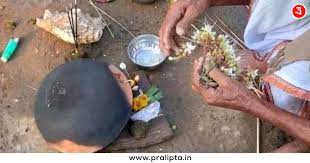
Ghentu Puja is performed by women, mainly mothers, in the twenty-four parganas and the Bardhaman / Bankura belt through the month of Chaitra[11]. There are no temples to Ghentu and no images. A well-worn household pot of black clay is placed on a broken winnowing tray. A pat of cowdung on the pot forms the face and two cowrie shells the eyes of the god. He is made to look bizarre and ugly because Ghentu, though a Deb Kumar[12], had to take birth among the ghouls following a curse by Vishnu. The offerings denote the contempt the idol is held in. Ghentu phul (a foul-smelling flower) parboiled rice (also foul-smelling) and masur dal[13] which is considered unholy for some reason (caste Hindu widows are not allowed to eat it) are placed before the pot with the left hand and not the right. There are no mantras but some verses, insulting and derogatory, and meant to drive him away, are chanted.
Ghentu puja
On the last day of the puja the clay pot is beaten with sticks and kicked to pieces by an excited crowd. This extraordinary humanising of deities and the concept of irreverence as a form of worship is admissible only in Hinduism and never better expressed than in Ghentu puja.
Agrarian societies are almost totally dependent on the whims of nature. Droughts, floods, storms and pests might bring to naught months of hard labour in the fields. Thus, fear and uncertainty dog the lives of peasants and they can breathe easy only after the harvest is reaped and safely stowed away in their paddy bins.
The harvest festival of Bengal starts on Makar Sankranti or the Winter Solstice when the crops begin to ripen. In some districts this festival is known as Tush Tushulir Brata and in others Tushu. Tushu is neither a goddess nor a human like Bhadu. Tush or the husk that protects the precious grain for the whole period of ripening is the object of worship here.
The puja is performed by women irrespective of age or status. Young girls, married women, matrons and widows are all allowed to participate in the rituals which go on for three days. An earthen plate filled with husk is placed in a room where the women of the household assemble chanting verses in praise of Tushu. On the third day one of them carries the plate on her head to the pond and sets it afloat. The rituals vary from region to region but the practice of bauri bandha is prevalent in most parts of Bengal. The outer surface of a clay saucer is smeared with rice paste then filled with water and placed on the fire. As the rice paste bakes and hardens and gets stuck to the pot women chant and sing for joy, for the ritual of bauri bandha symbolises the binding of the grain. It is now firmly in the household and cannot escape. It is only on the conclusion of this ritual that the preparing of peethe puli – an array of sweets made from new rice, coconut and mollases –can commence.
The emotions that spark off the festival of Tushu are relief and gratitude for being spared the prospect of starvation for another season. What better way to express these feelings than in song? Song which liberates the mind and relieves fears and anxieties? Tushu gaan[14]is similar to Bhadu gaan in many ways but whereas the latter focuses on the dreams and aspirations of young maidens Tushu expresses the hopes and fears of an entire community and is represented as a rustic lass celebrating a bountiful harvest with her friends –boys as well as girls.
The literature of rural Bengal is studded with references to these deities. Brata katha and katha katha, stories with a moral lesson at the end, were told by professional narrators or kathak thakurs at religious gatherings from as early as the 5th or 6th century AD. The practice continues vibrantly into the present. At some point down the years they were given a structured form called panchali, a story chanted in verses. Still later, they were textualised by erudite versifiers or pada kartas in a form called Mangal Kabya[15].
The worship of Satyanarayan or Satyapir is performed by both Hindus and Muslims. The rituals are identical, but the deity is called by different names –Satyanarayan by Hindus and Satyapir by Muslims. The offering is identical too – a thick gruel like substance made of flour, milk, mashed bananas and mollases called shirni, which seems to be a corrupted form of the Persian word phirni. Satyanarayan puja in Hindu households is performed by Brahmin priests learned in the Shastras. A Shalagram Shila[16](symbol of Vishnu) is placed on a square of carpet called an asan. Five small plates surround it each containing a betel leaf, a supari[17], a banana, a batasha[18] and a coin. These are called mokams. A metal object, usually a knife or blade, is placed next to the Shalagram Shila.
There is some debate on what came first – the Islamisation of Satyanarayan or the Sanskritising of Satyapir. The latter seems to come nearest to the truth for the following reasons:
The presence of a metal object on the asan of the Shalagram Shila is totally alien to any form of worship sanctioned by the Shastras.
2. The words Satya and mokam are Arabic in origin.
3 Shirni, as an offering, is not seen in the worship of any other Hindu deity.
The truth probably is that someone called Satyapir actually existed at some point of time and was subsequently raised to the status of a deity by his followers. Since Islamic shariat does not sanction worship of any other than Allah, Satyapir remained on the fringes till caste Hindus, ever eager to swell the ranks of their pantheon, appropriated him and made him their own. The rituals remained the same. The only thing they added was the concept that Satyapir was an incarnation of Vishnu in Kaliyug[19]. Hence the Shalagram Shila.
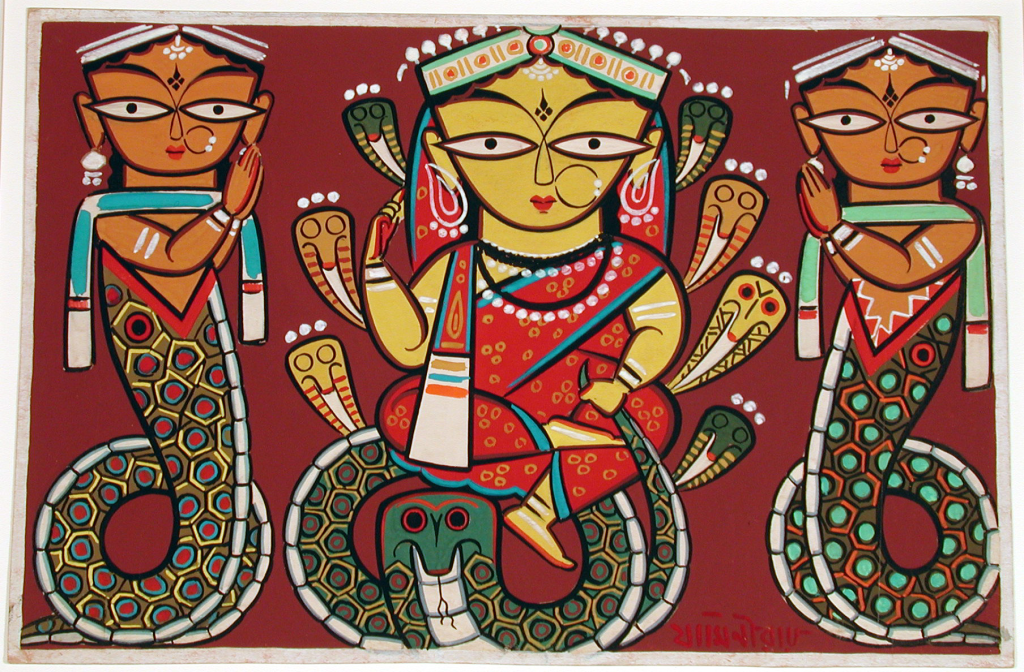
Several eminent pada kartas have written of the exploits of Manasa, the daughter of Shiva and Ganga, another name for whom is Bishhari (conqueror of poison). Of these the most popular version is the one by Ketakadas Khemananda and is still performed by theatrical troupes in the small towns and villages of Bengal.
Manasa Devi (1920) by Jamini Ray (1887-1972)
Manasa worship is said to have emanated from that of the goddess of snakes Manacha Amma of Karnataka — the ch sound having changed to sh in provincial Bengali. There are several versions of how the concept arrived from South India to Bengal of which the most reliable one is that it was brought by bands of Bedeys –nomadic snake charmers who wandered from place to place exhibiting their skills in taming snakes and making them dance to the trilling of their pipes. Bedeys — a community that still exists in Bengal, though Muslim, are fervent worshippers of Manasa.
Manasa puja is traditionally performed at the base of a phani manasa bush – a wild plant with thick, spiky leaves edged with thorns. The bush is supposed to be the protector of snakes and hence their favourite haunt. Though a pre-Aryan deity, Manasa puja is performed by Brahmin priests in accordance with Vedic rites. The goddess is offered flowers, paddy, incense and sindoor. But the bhog – a meal of rice, dal and vegetables– has to be cooked the previous night and offered stale. Manasa puja is also performed in Bangladesh, often by Namazi Muslims who see no contradiction between their worship of Allah and this indigenous deity.
ManasaMangal or Manasar Bhashan is a long-drawn-out narrative set to music. The versification is rudimentary – composed of octosyllabic couplets interspersed with occasional quatrains. The story line is simple and the tunes primary and repetitive. The ballad tells the story of the complete humiliation and defeat of the merchant Chand Saudagar at the hands of the snake goddess Manasa. Puffed up with pride at his wealth, his seven sons and his fleet of ships that carry expensive cargo from one port to another Chand Saudagar refuses to pay Manasa the homage due to her. Manasa decides to teach him a lesson. His seven sons die of snake bite. Seven of his ships, in some versions it is fourteen, are lost at sea. But the youngest son Lakhinder’s wife, the great sati[20], Behula, saves her father-in-law from Manasa’s wrath. She refuses to cremate her husband or don widow’s weeds. Making a raft of banana trunks, she sets herself afloat on the Ganga with her husband’s head on her lap. The river takes her to the abode of the gods where she wins Manasa over with her devotion and humility. Manasa forgives Chand Saudagar and all ends well with Chand acknowledging Manasa’s divinity and Manasa returning to him all she had taken.
The story of Behula predates Brahminical Hinduism and established caste structures. The names—Behula, Sonoka and Lakhinder serve as evidence to the fact. Yet the moral is rooted in patriarchy. A woman’s chastity and steadfast loyalty to her husband, as integral to the welfare of family and community, has been valorised in ‘Manasa Mangal‘ and to this day Behula’s chastity is seen to be on par with that of the great satis of the epics, Sita and Savitri.
Agomoni, verses sung in preparation for Durga’s coming by itinerant minstrels, both Hindu and Muslim, got its first structured form in the songs of the sage Ramprasad who, along with Horu Thakur, Ramnidhi Gupta and other pada kartas from the Twenty-four parganas, Bardhaman, Bankura and Murshidabad, imbued the form with extraordinary sensitivity and human feelings.
At the end of the monsoons when the first clear light of Autumn suffuses the skies, when the lotus blooms and the waving kaash is reflected in the waters of ponds and rivers, Bengal villages come alive with the singing of Agomoni, the legend dear to Bengali hearts, of the coming of Uma. For the great goddess, the ten-armed Mahashakti and the vanquisher of Mahishasur, comes to her earth mother’s lap in the form of her little Uma. The emotional Bengalis, ever ready to humanise their deities and form relationships with them, rejoice at her coming.
Agomoni song by former folk artiste, Amar Pal (1922-2019)Giri Ebar Uma Ele… Kaaro Katha Manbo Na (Giri, when Uma comes, I will not listen to anyone), A song composed by Ramprasad Sen (1718 or 1723 -1775)
Agomoni is an expression, pure and simple, of the everyday life of women in a rural community –their joys and sorrows; hopes and fears. Agomoni opens with Menaka’s grief at the plight of her daughter Uma married, by a careless, indifferent father, to the wayward, half crazed beggar Shiva who covers his nakedness with ash, gets stoned with bhang and consorts with ghosts and spirits. Maneka’s impassioned plea to her husband Giri Raj to bring her darling to her, if only for a few days, echo the yearning of all mothers for a daughter married far away from home.
Giri Raj, like most men, likes to believe what suits him. Convinced that his daughter is perfectly happy in her husband’s home, he dismisses his wife’s fears and tries to placate her with vague promises. But Menaka won’t let him off so lightly. She tells him that she won’t send Uma back to her husband’s house when she comes next. She’ll turn a deaf ear to what people say and, if Shiva insists on taking her back, she and her daughter together will give her son-in-law the tongue lashing he deserves. This song, composed by Ramprasad Sen in the eighteenth century, touches a chord in every mother’s heart for all women, including Menaka, know that this show of rebellion is worth nothing and will be quelled by Giri Raj before he has even heard her out.
Uma comes but Menaka has to reckon not only with her husband but with a daughter whose other name is Sati and who smiles away her mother’s suggestion of keeping her permanently with her. The three days of Uma’s visit pass quickly, too quickly. A desperate Menaka changes her tune. She appeals to her daughter to persuade her husband to come to his father-in-law’s house and stay a few days. Dropping her aggressive stance, she promises to pamper him and give him everything he wants including his favourite bhang.
But that, of course, is not to be. Shiva, incensed with Giri Raj for past insults, won’t even step across the threshold. Nabami[21] night comes. Only a few hours to dawn and Uma will go back. Menaka breaks down and weeps. Alas, her desperate plea to the night of the ninth moon to embrace eternity and never see the face of dawn remains unheard and unanswered.
From the complex compound of anxiety, nostalgia and hope that is Agomoni, we move to another area of cultural memory—the legend of Kerbela. Through the month of Muharrum the Muslims of rural Bengal enact the legend of the battle of Kerbela and the massacre of the prophet’s grandsons Hassan and Hussain. The tale is sung in verse known as jaari gaan—the word jaari, derived from Persian, denoting mourning. It is accompanied by the playing of musical instruments like drums and cymbals and body movements like leaping and dancing. About twenty young men, with gamchhas[22] on their shoulders and ghungroos[23] on their feet, make up a jaari troupe. They go from door to door, the lead singer telling the tale—the others singing the refrain.
Jaari is presumed to have originated in the 16th century with its roots in the Muharrum legend. But the form evolved and came to incorporate other tragic legends—not all of them Muslim. For instance, a very popular Jaari theme is that of Chandidas and his ill-fated love for the washer woman Rami. And, over the years, Jaari has moved on bringing every form of human suffering within its ambit. While retaining old myths and legends in its repertoire, present day Jaari explores and foregrounds the adversities and afflictions of common folk – the fears and terrors that make up their day-to-day existence – poverty, sickness, failed harvests and natural disasters. A famous Jaari gaan reflects this transition. It begins with a heart-rending account of the trials and tribulations suffered by the adherents of Allah after losing the battle of Kerbela—the miles of walking in the desert under a white-hot sun, feet on fire against the burning sand, chests crackling with thirst.
Allah Megh De: Pani De (God give cloud, give water): Jaari song by legendary folk singer Abbasuddin Ahmed (1901-1959)
But soon the focus moves from the plight of the faithful in distant Arabia to the plight of the ryot in rural Bengal. From a song of worship it becomes a song of livelihood. Peasants, who live by the soil, in the grip of the whims of Nature, look up at a drought hit sky and call upon to Allah to send rain.
Music runs in the Bengali blood, particularly in that of the rural masses. Work and song are so closely inter-woven that every livelihood is expressed in song. All working people whether potters or weavers, cowherds or blacksmiths, peasants or palanquin bearers sing as they work. But being a land of many rivers and waterways and sailing being a way of life here, perhaps some of the most poignant forms of folk music are to be found in the songs sung by the boatmen of Bengal.
Bhatiyali is the song of the lone boatman as he drifts down the river, wide as the sea from monsoon rains, far away from his loved ones, braving storms and tempests, the fear of never reaching his destination in his heart. The boatman pours out his love and longing, dreams and hopes in a melody that is as slow and tranquil as the flow of the water. Of all the folk songs of Bengal, nothing matches the subtle and sensitive blending of word and image, tune and rhythm that characterises Bhatiyali. The boatmen are both Hindu and Muslim and their songs, though reflecting their distinctive lifestyles, throb with the same emotions of nostalgia and despair.
Like Bhatiyali, Saari Gaan is essentially a collection of river songs. But these are sung during regattas when rows of boatmen need to ply their oars in synchrony to attain maximum speed. In fact, whenever a group of men or women try to accomplish a physically demanding task – be it weeding a field, threshing paddy, washing jute or rowing a boat — they tend to chant or sing to give a rhythm to their movements and to relieve the tedium of the work. In that sense all the songs sung collectively by the labouring class comes under the category of Saari Gaan – saari meaning row or line. But Saari Gaan, like Bhatiyali, is linked in the minds of Bengalis primarily with the movement of a boat – quick and rhythmic in Saari; slow and languorous in Bhatiyali. The other, more fundamental difference between the two is that Bhatiyali is sung in a single voice—Saari in a chorus of voices.
Boat races are organised, and Saari Gaan sung, extensively in Rajshahi, Dinajpur, Dhaka, Mymensingh and Barisal, on both Hindu and Muslim festivals such as Sravan Sankranti, Bijoya Doushami, Eid ul fitr and Eid ul zuha. They have a wide range of themes. The songs sung before the starting of the race are usually paens of praise to the deities with the idea of invoking their blessings. After the boats set sail, the singing becomes loud and clamorous and is accompanied by the beating of drums and the clanging of metal plates. These songs are loaded with comic jibes, contempt and invective for the rival group. Sometimes the main singer is seen dancing on the boat to the rhythm of the oars.
On the return journey, the mood changes. The singing becomes somber and pensive; the language thoughtful and imbued with philosophy.
Bhavaiyya is essentially a wonderfully lyrical love song expressing the full range of emotions that sway the heart of a woman in love. Sung mainly in Rangpur, Cooch Bihar Assam and Jalpaiguri, Bhavaiyya describes the rapture of union and surrender and the anguish of parting and loss. But, somewhere down the line, the fate of the abandoned woman is fused with the tragic destiny of the mahout—the dangers he faces as he guides his elephant through impenetrable forests. These songs are also known as Goalparar gaan—after a forest of Assam where, presumably they had their origin.
Jhumur is the name given to a style of folk music common to many parts of India such as Bengal, Bihar, Madhya Pradesh and Gujarat. The language differs from region to region, but the tune and style of singing is more or less similar. The bordering areas of all these states, being hilly terrain covered with forests, are inhabited by adivasis of whom the ones in Bengal and Bihar are santhal. Santhali Jhumur having come under the influence of Bengali folk and classical traditions, has evolved into something different in terms of form, tune, language and expression.
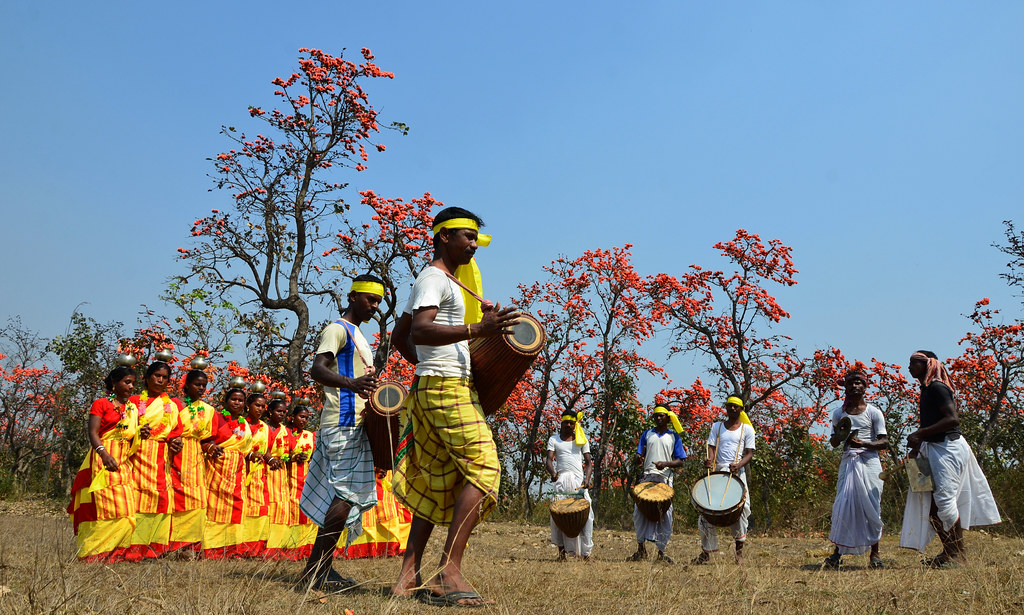
Santhali performance in spring
Santhali Jhumur is made up of three-line verses. The singing is accompanied by dancing and the playing of musical instruments like the madol (a kind of drum) and banshi (flute) The themes are mostly those that pertain to everyday adivasi life – such as the agony of a girl whose father, lured by a large bride price, marries her off to a man from a distant village or the aspirations of a vivacious lass who wishes to dress and walk as gracefully and elegantly as the women of the city.
But soon the girl’s flirtatious charm is revealed for what it really is– a thin veneer. Her real self is laid bare in the heart broken lament that follows; of a woman for whom poverty and deprivation are constant companions; whose children die because she cannot feed them.
We now come to the two universally acclaimed traditions of music in Bengal.Keertan and Baul, which while transcending the traditionally religious, and social and community needs and concerns, yet absorb and assimilate them all in the rich fabric of their complex plurality.
Cultural movements such as Bhakti and Sufi, spanning time and territory, entered Bengal in successive waves creating a syncretic culture in which music, poetry and other fine arts were amalgamated. Bhakti and Sufi found their creative expression in several parallel musical forms in Bengal. These forms, though distinct from one another, have some attributes in common. The presence of a mystical fervour which celebrates the unity of God and man and a philosophy of humanism which rejects rigid and stifling religious orthodoxies and stresses the equality of all human beings irrespective of caste, class, race, gender or religion is common inKeertan and Baul.
Keertan, derived from the word keerti or deed, is a form that showcases the attributes and exploits of the gods, humanising them to an extent that makes them part of the everyday lives of ordinary men and women. Keertan is said to have emanated from Sri Chaitanya Mahaprabhu. Vaishnavas believe him to be the eleventh incarnation of Krishna. It is said that Radha wept a hundred years after Krishna’s desertion –- that is his departure from Brindavan to assume the kingship at Mathura. But, as the legend goes, Radha didn’t stop at tears. Her grief and yearning were transmuted into a burning rage in the throes of which she cursed Krishna with another incarnation. He would be born among the common people, she said, bearing his own form but her heart, mind and senses. He would experience for himself the breathless rapture and the excruciating agony of Krishna love. Great God though he was, Krishna could not shake off Radha’s curse. He came down to earth as Nimai of Nadiya. But he didn’t come in his own aspect. The cloud complexioned god took on the hue of a golden lotus, Radha’s hue, becoming Gouranga or He of the Fair Form. The itinerant minstrel sings…
Nimai was Krishna’s natural incarnation in infancy – playfull and mischievous, the bane of his mother Sachi’s life. Then gradually she, whose heart, mind and senses he bore within his body, began asserting herself and he was drawn towards Krishna as a moth is to a flame. In the grip of a divine frenzy that could only be matched by Radha’s for her Madanmohan, Nimai found himself drowning in a sea of Krishna consciousness. He would stop in his tracks whenever he heard the God’s name then, lifting his arms above his head, he would close his eyes and start swaying and pirouetting, chanting …hare Krishna hare Krishna[24]…
This was the origin of Keertan. Naam Keertan (reciting the names of the god) swelled as villagers, both Hindu and Muslim, started veering around Nimai in twos and threes. Then, with the passing years, a large band of devotees was formed and Nimai the wayward and incorrigible was metamorphosed into the great saint and sage Sri Chaitanya Mahaprabhu who preached a religion of humanism and founded the Vaishnava cult.
As the numbers grew, Naam Keertan changed in form and content. Sang Keertan (sang meaning together or in a chorus) added adjectives and descriptive phrases to the names and used drums and cymbals to liven up the singing which became loud and clamorous. The Mahaprabhu often took the lead himself and the rest took up the refrain. Sang Keertan parties moved from village to village in the manner of troubadours disseminating the Mahaprabhu’s message.
From these humble beginnings Keertan passed, by degrees, into the hands of skilled versifiers and came to be known as Padabali Keertan – pad meaning verse. Haridas Thakur, Narottam Thakur, Jnandas Thakur and Raghunandan Thakur were some of the padakartas[25] from whose creative genius Keertan evolved into the intricate, meticulously structured musical form it is today. But though it had its genesis in the Radha Krishna legend, Keertan moved, over the years, towards the Shaivaite tradition imbuing it with its philosophy of humanism and love. Down the river from Nadiya was Halishahar where the great Kali sadhak[26], Ramprasad sang Kali Keertan which humanised the goddess of terror and turned her into a mother whose eyes held oceans of mercy.
Concentrated mostly in Kushthia, Shilaidaha and Sajadpur in East Bengal (now Bangladesh) and Murshidabad and Birbhum in West Bengal, Baul is a folk tradition rooted in the lives of the rural people. Though traces of other influences are seen in Baul gaan its main flow is from two strong sources—Muslim Sufi and Hindu Vaishnav. Hence the equal presence of Hindu and Muslim bauls in the villages of Bengal. Though they dress differently –Muslims wear robes of motley-coloured rags and carry a hookah and chimta[27]and Hindus don saffron and have sandalwood markings on their brows and ektaras[28] in their hands – their message is one and the same. Nurtured by great composers like Lalan Fakir, Duddu Shah, Madan Baul, Gagan Harkara and Fikir chand, Baul songs disseminate a message of harmony between man and man rejecting religious codes like Shariat and Shastras, caste differences, and social conventions and taboos as barriers to a true union with God. But where is one to find God? Gagan Harkara, an unlettered rustic whose livelihood was carrying the post from village to village sang as he went: “Ami kothai pabo tar amar moner manush je re…”[29]
And how does man find this moner manush—the being within himself. Only by freeing himself of all external forms of worship and trusting the flow of his own spirit.
The Baul (the word is derived from bayu –air) moves spontaneously towards God the way air flows in and out of all created things. The term could also be derived from the Arabic bawal meaning mad –in this case, mad with love of God.
Since God is believed to reside within man, the human body is looked upon as the site of the ultimate truth; that which encompasses the entire universe. This tenet of Baul philosophy is known as dehatatwabad—the belief that the soul being pure the body that houses it, together with all its functions, is pure and true. Lalan Fakir expresses this philosophy in a song so complex in idea and image as to be almost abstruse. The body is likened to a cage from which the godhead flits to and fro. The Baul spends a lifetime trying to capture it but the bird remains elusive.
Khachar Bhitor Ochin Pakhi( An unknown Bird in a Cage) Song by Lalan (1772-1890) sung by Kartik Das Baul, a contemporary Baul singer
In such a philosophy there is, one would think, no place for Guruvad[30]. If the godhead you seek resides within you, where is the need for a middleman? Yet, strangely enough, guru, peer, murshid and sain are extolled in Baul lyrics and often take the place of God. Baul philosophy, like a gigantic honeycomb, seems to have a slot for all human needs.
I would like to end this piece, with an account of the life of the greatest of Baul composers Lalan Fakir. Not much is known of him except what has come down to us in the form of anecdotes. Lalan was born in the year 1774 in the village of Bhadara in Nadiya district, to a kayastha family with the surname Kar or, as some academics maintain, Das. He lost his father in infancy and was married while still in his teens. As a young man he went on a pilgrimage to Puri and on the way back was stricken with small-pox. His fellow travellers abandoned him or, as per another account, set his body adrift on the Ganga thinking him dead. He was found, alive but badly pitted and blinded in one eye, by a Muslim woman who nursed him back to health. In this village, he met an itinerant Baul singer named Siraj Sain who became his murshid or mentor. There are frequent references to Siraj Sain in Lalan’s compositions.
Lalon by Jyotindranth Tagore. The poet Tagore and his family brought Lalon’s music to limelight… as much as they could.
At some point Lalan went back to his native village but was not accepted by his family and community because, having lived among Muslims and eaten with them, he had lost caste and was no longer acceptable as a Hindu. Many of Lalan’s songs question this aspect of Hinduism. But Lalan’s rejection is not only of the discriminations practiced by the Hindus. He questions the very basis of the divisive walls created by religion between man and man.
Shocked and hurt by his rejection Lalan renounced his family, community and religion and started keeping company with Siraj Sain. On the latter’s death, Lalan set up an akhra[31]in Chheuria village on the banks of the Gorai River and gradually a band of followers gathered around him. Lalan was an inspired singer and could only sing when the Muse was on him. But being totally illiterate, he could not record what he sang. Thus, many of his songs are lost to us. Later a disciple started writing them down the moment they issued from his lips. And his collection is what we have today. Though he didn’t go through any formal process of conversion or adopt Islamic religious practices, Lalan lived like a Muslim and among Muslims till his death in 1890 at the age of 116. In Lalan’s life and art is seen the confluence of the two greatest religions of this world in its truest and most humane form. He lies buried in Chheuria —a place of pilgrimage for all Bauls of Bengal, Hindu and Muslim.
[21] The fourth day of the five day festival of Durga Puja, the last day of Uma’s stay with her parents and the ninth day of Navratri, the Hindu festival.
[30] A guru is seen as a middleman who will help you reach out to God.
[31] An enclosure where they would live and practice their beliefs
Aruna Chakravartihas been the principal of a prestigious women’s college of Delhi University for ten years. She is also a well-known academic, creative writer and translator with fourteen published books on record. Her novels Jorasanko, Daughters of Jorasanko, The Inheritors, Suralakshmi Villa have sold widely and received rave reviews. The Mendicant Prince and her short story collection, Through a Looking Glass, are her most recent books. She has also received awards such as the Vaitalik Award, Sahitya Akademi Award and Sarat Puraskar for her translations.
.
PLEASE NOTE: ARTICLES CAN ONLY BE REPRODUCED IN OTHER SITES WITH DUE ACKNOWLEDGEMENT TO BORDERLESS JOURNAL
The twenty-fifth day of Baisakh dawned. A hot airless day when not a leaf stirred in the trees and the red earth burned like smouldering coals. Rabindranath was taken to the southern veranda in the morning as usual but he lay in his armchair so listless, so drained of energy, Nandita realized that something was wrong. ‘Let me take you back to bed, Dadamoshai,’ she said. ‘You had better rest the whole day and reserve your strength for the evening. The students have organized a programme for your birthday.’
‘I know.’ Rabindranath nodded. ‘I mustn’t disappoint the children. But I would like to give them something in return. Fetch a pen and paper. Closing his eyes, he sang slowly in an old man’s quavering voice. He nutan/dekha dek aar baar janmer pratham shubhokshan:
Oh ever new!
Let my eyes behold once more
the first blessed moment of birth.

Reveal yourself like the sun
melting the mists that shroud it.

Reveal yourself
tearing in two the arid empty breast.
Proclaim the victory of life.

Give voice to the voiceless that dwells within you;
the eternal wonder of the Infinite.

From emerging horizons conches blow;
resonating in my heart.
Oh callout to the ever new!
Twenty-fifth of Baisakh!
Rabindranath lay on his bed all day breathing heavily, the heat sapping his strength. He felt so exhausted that even to lift an arm or keep his eyes open was an effort. He could sense the activity that was going on around him. People were coming from far and near with gifts of flowers and fruit. They begged for a glimpse of him but he, who had never refused to meet anybody in his life, now lacked the energy to do so.
He felt a little better towards the evening when the heat of the day had dissipated and a cool breeze started to blow from the khowai. Then at dusk, Nandita came in. ‘Get up, Dadamoshai,’ she ‘ said brusquely. ‘You’ve rested long enough. Time to get dressed.’
Rabindranath sat up meekly and allowed her to put on him his birthday garments of silk dhuti and chador. He didn’t object even when she adorned his brow with sandal paste and hung a garland of fragrant juin flowers around his neck. But when Protima came in with a bowl of fruit he couldn’t stand the smell. ‘Not now, Bouma.’ He shook his head, ‘I’m not hungry.’
Protima wouldn’t go away. ‘You’ve hardly eaten anything today,’ she said firmly. Have a few pieces of mango. It’s your favourite himsagar. Prashanta brought a basketful.’
Lacking the strength to protest, he put a small piece in his mouth and shuddered with distaste. ‘The good days are gone, Bouma,’ he said sadly. ‘Else why does the king of fruits taste bitter in my mouth?’
‘But even last season you were eating five or six a day!’
‘I know.’ He smiled. ‘That is why I say the good days are gone.’
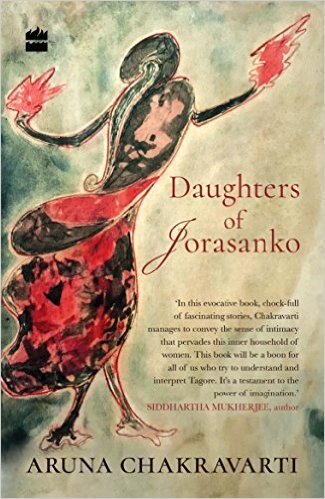
(Excerpted from Daughters of Jorasanko by Aruna Chakravarti, published by HarperCollins India)
About the Book:
The Tagore household is falling apart. Rabindranath cannot shake off the disquiet in his heart after the death of his wife Mrinalini. Happiness and well-being elude him. His daughters and daughter-in-law struggle hard to cope with incompatible marriages, ill health and the stigma of childlessness. The extended family of Jorasanko is steeped in debt and there is talk of mortgaging one of the houses. Even as Rabindranath deals with his own financial problems and strives hard to keep his dream of Santiniketan alive, news reaches him that he has been awarded the Nobel Prize for literature. Will this be a turning point for the man, his family and their much-celebrated home? Daughters of Jorasanko, sequel to the bestselling novel, Jorasanko, explores Rabindranath Tagore’s engagement with the freedom movement and his vision for holistic education, brings alive his latter-day muses Ranu Adhikari and Victoria Ocampo and maps the histories of the Tagore women, even as it describes the twilight years in the life of one of the greatest luminaries of our times and the end of an epoch in the history of Bengal.
About the author:
Aruna Chakravarti has been Principal of a prestigious Women’s College of Delhi University for ten years. She is also a well-known academic, creative writer and translator with seventeen published books on record. They comprise five novels, two books of short stories, two academic works and eight volumes of translation. Her first novel The Inheritors (published by Penguin Random House) was shortlisted for the Commonwealth Writers’ Prize and her second, Jorasanko (published by HarperCollins India)received critical acclaim and also became a best seller. Daughters of Jorasanko, a sequel to Jorasanko, (HarperCollins India) has sold widely and received rave reviews.Her novel Suralakshmi Villa, published by Pan Macmillan Ltd under the Picador imprint, has been adjudged “Novel of the year (India 2020)” by Indian Bibliography published in The Journal of Commonwealth Literature U.K. Her latest work, The Mendicant Prince, a semi-fictional account of the Bhawal legal case, was released by Pan Macmillan Ltd, in July this year to widespread media coverage and acclaim. Her second book of short stories Through a Looking Glass: Stories has just been released by Om International Ltd.
Her translated works include an anthology of songs from Rabindranath Tagore’s Gitabitaan, Sarat Chandra Chattopadhyay’s Srikanta and Sunil Gangopadhyay’s Those Days, First Light and Primal Woman: Stories. Among the various awards she has received are Vaitalik Award, Sahitya Akademi Award and Sarat Puraskar.
She is also a script writer and producer of seven multi- media presentations based on her novels. Comprising dramatised readings interspersed with songs and accompanied by a visual presentation by professional artists and singers, these programmes have been widely acclaimed and performed in many parts of India and abroad.
.
PLEASE NOTE: ARTICLES CAN ONLY BE REPRODUCED IN OTHER SITES WITH DUE ACKNOWLEDGEMENT TO BORDERLESS JOURNAL
The author of In a Better Place is a highly respected medical practitioner with a long and distinguished career in U.K. and India. Given the vast knowledge and wide-ranging experience that have gone into the writing of this book, it is surprising to note that it is not an academic work. It is a novel, written with effortless ease, that proves to be as informative as it is readable and interesting. Bornali’s language is simple and has a gentle mellowness and her style, though lively, isn’t racy or trendy. It has a leisurely flow but demands close attention. She gives her reason for writing this book in her ‘Author’s Note’:
“While reams of clinical history and medical notes are written arduously every day in every hospital by its diligent doctors and nurses, there is hardly anyone to document the human stories that unfold continuously in the long corridors and lonely wards of hospitals.”
The book, as per her own admission then, is not an account or analysis of medical research and clinical practice. It is a story of human lives caught in the cusp of aspiration and reality. Of sickness and suffering entwined with the pressures and frailties of care givers. It draws from detailed and extensive research into the lives of Indian doctors during the last thirty years of our history. A momentous period which saw globalization and the waking up to a Many countries; One world, concept in a big way.
The writer shows a comprehensive understanding of her subject. Her characters are a group of idealistic young doctors, who are genuinely eager to use their medical education to treat the sick in the best way possible. They inhabit two worlds, India and England, sometimes physically; sometimes in spirit. They are confronted with two choices to begin with. Adherence to convention and traditional ways. Or carrying out their aspirations for what they think will be a better life, in defiance of social and parental pressure. Those who are unhappily trapped in India’s heat and dust, poverty and primitive systems, crowds and chaos yearn for foreign shores. Those who have made it to the West are ill at ease in the strange new life they have embraced. A sense of not fitting in, of somehow being reduced to the other despite all their education and proficiency in English, dogs them. Swamped in nostalgia and exile they are confused and bewildered.
Both sets of lives are seen as fragmented. Places define people and relationships. The book provides a fascinating kaleidoscope of yearning and aspirations in a direct, not always complimentary way. The value of the book lies in its creation of complex emotions, use of empirical data and honest telling.
The chief protagonist of the novel, Sudha, undergoes post graduate training in a government hospital in Delhi before moving to England with her husband, another young doctor called Girish. Their friends, Jai and Sanjay, also make it to their dreamland. All four are overwhelmed, initially, by the difference in the two systems and take a jingoistic delight in having reached where they wanted to be. The dirt and squalor in Indian hospitals, the rusted equipment and callous attitude to suffering by overworked doctors and nurses, is a shameful contrast to what they see in English hospitals. At first the picturesque buildings, manicured lawns, spotless beds and hushed corridors win their total admiration and respect. But, gradually, they get a sense that all is not as it appears on the surface. They, who only wish to do their best, encounter hurdles, injustice and racism and the cold, hard superiority of people who will never forget or let them forget they were once their rulers. An immigrant angst overtakes them. Some make a desperate bid to overcome it and manage to carve a groove for themselves in the land of their exile through unequal, often loveless, marriages with British citizens. Some begin to consider going back to India. But the choice, either way, is equally hard.
Dr. Chatterjee, a senior doctor in the hospital Jai works in, has made two attempts to return to India. Both proved abortive and he was forced to return. His wife and children, having lived too long in the West, could not adjust to India. He has become the proverbial nowhere man, unable to find a comfort zone anywhere. Though an excellent doctor and an intelligent, cultured gentleman, he knows that he will never reach the top of his profession or be accepted socially by his colleagues.
“’The Whites…,’ he tells Jai, ‘don’t want to socialize with you. Take Dr Smith and Dr Weldon. I’ve called both of them for dinner to my house, their entire families, not once but two times. But there is no reciprocation from their side. Not once have they invited me over, although they get together quite often.’”
Aspirations die but hope continues. People suffer but they also find solutions. The author is non-judgmental.
“There is never right or wrong, she says in conclusion to her story. Just what works for one and what works for another. Life goes on regardless, both inside and outside of the hospital, through the trepidation of change, of migration, of loss and adoption of a foreign land.”
But what, in the end, is a better place? Though Bornali doesn’t provide the answer I am tempted to do so. I quote from a poem I used to recite as a child:
Mid pleasures and palaces though we may roam
Be it ever so humble there’s no place like home.
Aruna Chakravarti was the principal of a prestigious women’s college of Delhi University for ten years. She is also a well-known academic, creative writer and translator with a number of published books on record. Her novels, The Inheritors,Jorasanko, Daughters of Jorasanko, have sold widely and received rave reviews. The Mendicant Prince is her last novel and Through a Looking Glass, her latest short story collection. She has also received awards such as the Vaitalik Award, Sahitya Akademi Award and Sarat Puraskar for her translations.
PLEASE NOTE: ARTICLES CAN ONLY BE REPRODUCED IN OTHER SITES WITH DUE ACKNOWLEDGEMENT TO BORDERLESS JOURNAL.




 Borderless