Categories
Excerpt

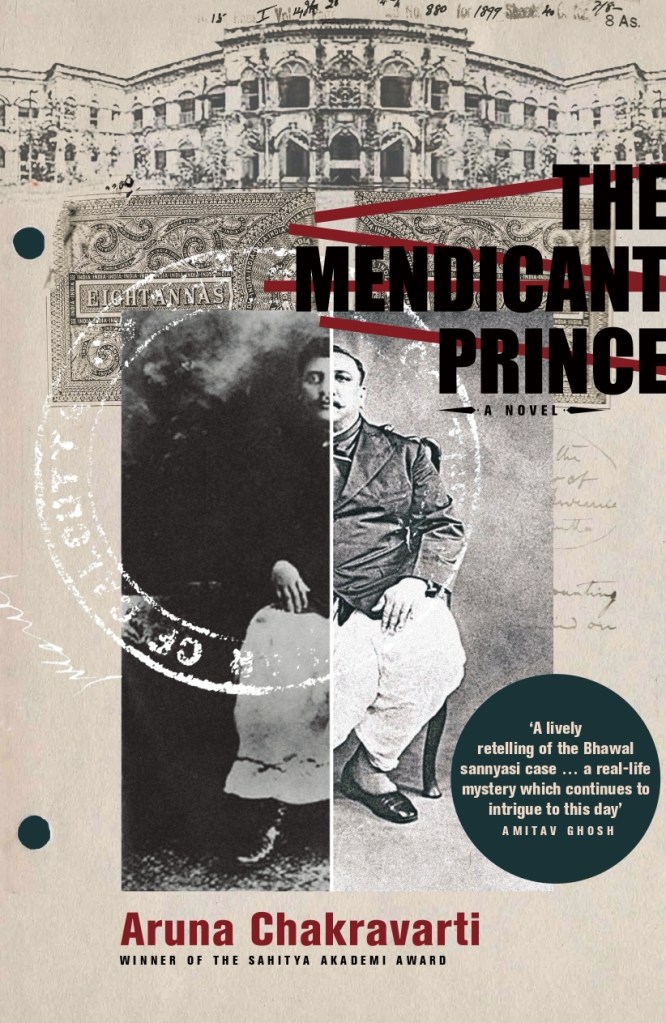
Aruna Chakravarti’s The Mendicant Prince

Title: The Prince Mendicant

Author: Aruna Chakravarti

Publisher: Picador India

January 1921

1

The Sannyasi

It was a raw, blustery morning in late January. A small knot of people could be seen standing near the Buckland Bund, an embankment on the Buriganga river. The river, which swirled and foamed along the edges of the city of Dhaka, was especially turbulent this winter.

All eyes were fixed on a man, a stranger to these parts. He had been sitting cross-legged on the Bund, gazing into the distance day and night, for the past three months, impervious to the cold gusts of wind and spray that rose from the agitated waters below. There was something odd about his appearance. He could be a Bengali, the locals surmised, judging by the shape of his face with its somewhat square jawline, wide nose and high cheekbones. His body was covered with ash but the patches that were visible were as fair as a European’s and his eyes, hooded by dark, heavy lids, a greenish brown. Masses of tawny hair fell in dreadlocks down his sturdy back and shoulders and a matted beard almost touched his navel. A tattoo—a word in some strange language—could be seen on his right arm. He was naked except for the strip of coarse orange cloth that covered his genitals. The men standing around stared at him with unabashed curiosity and exchanged glances. Once in a while someone would fling a question at him. They had been doing so from the first day they saw him sitting on the Bund.

‘Who are you? Why are you here?’ A middle-aged man in a silk lungi and woollen vest asked in a stern voice.

‘Main Bangla nahin jaanta.’ [1]The stranger’s lower lip twisted to the right as he answered in Hindi.

A barrage of questions followed in a Hindi thickly accented with Bengali.

‘Where have you come from?’ ‘Bahut door se.[2]

‘What are you doing here?’ ‘Nothing. Just sitting.’

‘That we can see. But why here?’

‘No reason. I just … just came here …’

‘Are you a sannyasi?’

‘Yes. I’m a roaming sadhu.’

‘You look quite young. Must be in your mid-thirties. Am I right?’ The stranger shrugged his heavy shoulders and turned his eyes northwards on a massive structure looming in the distance. It was the zamindar’s mansion locally known as the Rajbari. The zamindars of Bhawal were rich and powerful beyond ordinary landowners and had been dignified by the title of Raja. Their sons were addressed as Kumar, each according to his position in the hierarchy.

The man in the lungi moved aside. Another, an elderly gentleman in a dhuti[3] and shawl, took his place.

‘You are too young to abandon the world. When did you become a sannyasi?’ The old man leaned forward and examined the stranger’s face and head closely. There was a puzzled look in his eyes.

‘I ran away from home in my youth and joined a group of holy men.’

‘How long ago was that?’

‘I don’t remember.’

 ‘Where did they take you?’

‘To the mountains. I spent many years there.’

The old man nodded. But the answer didn’t seem to satisfy him.

The crowd ebbed, melted and swelled once more. Others took up the interrogation.

‘Do you have parents?’

‘No.’

‘Are you married?’

The man, calm and unruffled all this while, stiffened at this question. As though alerted to some hidden hostility. He had a prominent Adam’s apple which jumped up and down his throat.

‘Um …’ he hesitated, ‘yes … n-no. Yes. I had a wife … once.’

‘You left her too?

‘Yes.’

‘Why do you keep looking at the Rajbari?’

‘No reason.’ The answer came pat as though he had prepared for the question. ‘There’s nothing else to see …’

The men walked away and stood a little apart. They exchanged meaningful looks and nudged and whispered. Snatches of their conversation came floating through the air.

‘Exactly like the mejo kumar[4]. The same height and build. The same small hands and feet. Even the tiny wart on the lower lid of the right eye. What do you think, Taufique?’ The elderly gentleman turned to the man in the lungi.

‘Yes, indeed, Kashi kaka. I never did believe the story.’

‘You think anyone does?’

‘I don’t know about the family. The subjects certainly don’t. Not one.’

‘The man seems to be about thirty-five or thirty-six. Exactly the age the mejo kumar would have been today. Have you noticed the way he sits? Hunched forward like a bull.’

‘And his complexion! What man other than a royal could be that fair? His body is covered with ashes but I noticed his hands and feet. Particularly the feet. Rough and scaly but shell pink. Like new milk with a drop of vermilion mixed in it.’

‘The colour of his eyes? And the tiny angles sticking out from the tops of his ears? The resemblance is uncanny. The mejo kumar too had …’

‘There are marks on his back and legs. And tiny patches on the scalp in between the dreadlocks. I looked at them closely …’

‘Yes, I noticed them too. The mejo kumar’s body was ridden with syphilis when he was sent to Darjeeling. These must be the scars.’

‘He seemed a bit rattled when I asked if he was married.’

‘He did indeed. He couldn’t decide what to say.’

‘He is the mejo kumar,’ a chorus of voices joined in. ‘The story we have been told is bunkum.’

‘Concocted by the mejo rani[5] and her brother.’

‘Without a doubt. Without a doubt.’

‘Why do you think they did it?’

‘Who knows? They must have had their reasons.’

‘Mark my words, brothers,’ an old man wearing a skull cap observed darkly, ‘this man is pretending to be a sadhu, when he is in fact the mejo kumar – the second prince of the royal family. Now that both his brothers are dead, he is the sole heir of the estate. The real ruler. If I’m proved wrong, I’ll never venture another opinion as long as I live.’ He moved his head solemnly from side to side.

About the Book:

In the winter of 1909, Ramendranarayan Roy, the ailing second prince of the Bhawal zamindari, proceeds to Darjeeling with his wife Bibhavati, brother-in- law Satyendranath and a retinue of officials and servants, after being advised a change of air by his physicians. Three weeks later, a telegram from Satyendranath arrives at the Bhawal estate, carrying news of the prince’s demise and subsequent cremation.

Soon peculiar rumours start circulating around Bhawal and the surrounding town. Some say that the prince was poisoned, while others suspect that his body was taken to the burning ghat but not actually cremated. There are also whispers about an incestuous relationship between Bibhavati and her brother. The story takes a bewildering turn when, twelve years later, a mendicant comes to Bhawal, claiming to be the long-lost prince and the heir to the estate.

With no resolution in sight, matters reach the court, where the so-called prince and some family members face off against Bibhavati and her brother, aided by the British Court of Wards who are keen on maintaining ownership of the zamindari. The breathless legal drama that ensues will culminate in an incredible series of events, permanently altering the course of the estate’s history.

Inspired by the legendary Bhawal sannyasi case and evocative in its recreation of pre-Partition Bengal, The Mendicant Prince is an intriguing tale of dual identity and the inexplicable quirks of fate.

About the Author:

Aruna Chakravarti has been Principal of a prestigious women’s college of Delhi University for ten years. She is also a well-known academic, creative writer and translator with fifteen published books to her name. Her novels, The Inheritors, Jorasanko, Daughters of Jorasanko and Suralakhsmi Villa, have sold widely and received rave reviews. She is the recipient of the Vaitalik Award, the Sahitya Akademi Award and the Sarat Puraskar.


[1] I do not know Bengali – translated from Hindi

[2] From very far – translated from Hindi

[3] A cloth wrap that is a substitute for trousers

[4] The second prince

[5] The second queen or the prince’s wife

Amazon pre-order link: https://amzn.to/3uZgjCy

.

PLEASE NOTE: ARTICLES CAN ONLY BE REPRODUCED IN OTHER SITES WITH DUE ACKNOWLEDGEMENT TO BORDERLESS JOURNAL

Categories
Review

Beyond the Veil: A Book Review by Aruna Chakravarti


Title: Beyond the Veil

Author: Devika Khanna Narula

An important task for those committed to tracking the path of women’s Issues, past and present, is to embark on a study of the academic discourses on gender sparked off by feminist scholars and activists — an area that is fast gaining ground all over the world. Yet there is another dimension to the effort. It also involves an exploration of creative writing generated by sensitive, imaginative feminism. It is important to understand that concepts such as Patriarchy, Agency and Resistance are not limited to feminist debate and discourse. They are equally and dynamically present in poetry and fiction. In India, the field of feminist creative writing is growing rich with promise every day.

One such endeavour is Devika Khanna Narula’s novel Beyond the Veil.  A work of epical dimensions it operates on a vast canvas. Vast both in terms of space and time, it spans half a century, between 1900 and 1950. It offers interesting insights into life as lived by upper class and middle-class women during a momentous period of Indian history. A time when a mass resistance against British rule was spreading all over the country culminating in the independence of India. A movement in which some women also participated.

Spatially the narrative shuttles between two families from two different parts of India linked by marriage. They belong to different cultures though they come from a common stock. They are the Punjabis of Lahore and the Punjabi Khatris of Bandhugarh, a fictional name for Bardhaman, in West Bengal. The founder of the Kapoor family in Bandhugarh, came from Punjab in the sixteenth century and, by sheer dint of merit and hard work, amassed lands and wealth. His progeny followed in his footsteps, established themselves as zamindars and, at some point, were dignified by the title of Rajah by the British.

The Khannas of Punjab and the Kapoors of Bandhugarh seem very different in externals. The first belongs to the ‘small business’ class. The other is related to royalty. One is of pure Punjabi extraction. The other, though from the same genetic type, is highly Bengalised having lived in Bengal over many generations. They speak Bengali, eat Bengali food, dress like Bengalis, worship in Bengali temples and use idioms and expressions that serve to accentuate the effects of defamiliarization and alienness among the daughters-in-law who, in an effort to keep the bloodline pure, are brought from the old pristine stock.

These women face the challenges their upheaval brings in its wake. They are required to come to terms with another kind of life, learn to adapt to a new environment, cope with taunts about their dissimilarities and conquer their fears and insecurities. It works both ways. Roopmati, coming from Punjab has to turn herself into a Bengali in her marital home. Her daughter, brought up as a Bengali in Bandhugarh, is wed to a young man in Lahore and has to adapt to a different set of priorities and values for which she is totally unprepared.

Yet, scratch the surface and the fates of women, whether in Punjab or Bengal, are identical. Denial of education, economic dependence on the male, social conditioning over generations and the suppression of individual identity by an oppressive ‘joint family’ ideology are present across the spectrum. Humiliation and desertion by husbands, violence—physical and mental, molestation and rape both marital and by other males of the family are normalized and hidden from view. Adherence to tradition have rendered other horrors acceptable and inevitable. The custom of Sati and Purdah, female infanticide and neglect of the girl child are part of a patriarchal system that exists in both communities.

The strange thing is that the women who suffer these indignities, day in and day out, are the very ones who are entrusted with perpetuating the system. Males set the rules but females are expected to implement them. And many do. Mindlessly like automatons. Some even enjoy the process. Because this is the only area of dominance men have relegated to women. Women like Bebe of Bandhugarh and Rukmini of Lahore enjoy power through a determined subjugation of the younger women of the family, particularly the daughters-in-law. They also see it is as their duty to break the clay of the other and force it into the patriarchal family mould. 

The world in which the young women of Beyond the Veil live is cold and dark. But occasionally a shaft of sunlight pierces through the clouds. Some women upset the status quo from time to time. These are rebels who expect consideration and fair play. They demand change. The mother and daughter duo Roopmati and Maina are two such women. It is heartening to see that, under their influence, their husbands too develop sensitivity and compassion for the women in their households. Other males follow suit. The curtain falls on a world slowly waking from slumber.

The ambience of both worlds is created with great sensitivity and detail. Descriptions of food eaten, clothes worn, journeys undertaken and the joys and sorrows of day-to-day living are totally credible. The narrative flows smoothly unmarred by jolts and jars. The topography of Lahore, Karachi and Bandhugarh of those days is authentic and accurate. Life as it is lived in, whether it is the Khanna family or the Kapoor, the cultural differences come through with clarity and precision. Events and locales are rooted in history and dates are adhered to. Names of streets, restaurants, railway stations, cinema halls… even the films that were shown in them a century ago… can be put to the test and will not fail. Best of all are the local legends and myths that have grown around communities and families, rivers and lakes, temples and mansions. The book is a storehouse of information of a bye gone era.

.

Aruna Chakravarti has been the principal of a prestigious women’s college of Delhi University for ten years. She is also a well-known academic, creative writer and translator with fourteen published books on record. Her novels JorasankoDaughters of JorasankoThe Inheritors have sold widely and received rave reviews. Suralakshmi Villa is her fifteenth book. She has also received awards such as the Vaitalik Award, Sahitya Akademi Award and Sarat Puraskar for her translations.

.

PLEASE NOTE: ARTICLES CAN ONLY BE REPRODUCED IN OTHER SITES WITH DUE ACKNOWLEDGEMENT TO BORDERLESS JOURNAL
Categories
Review

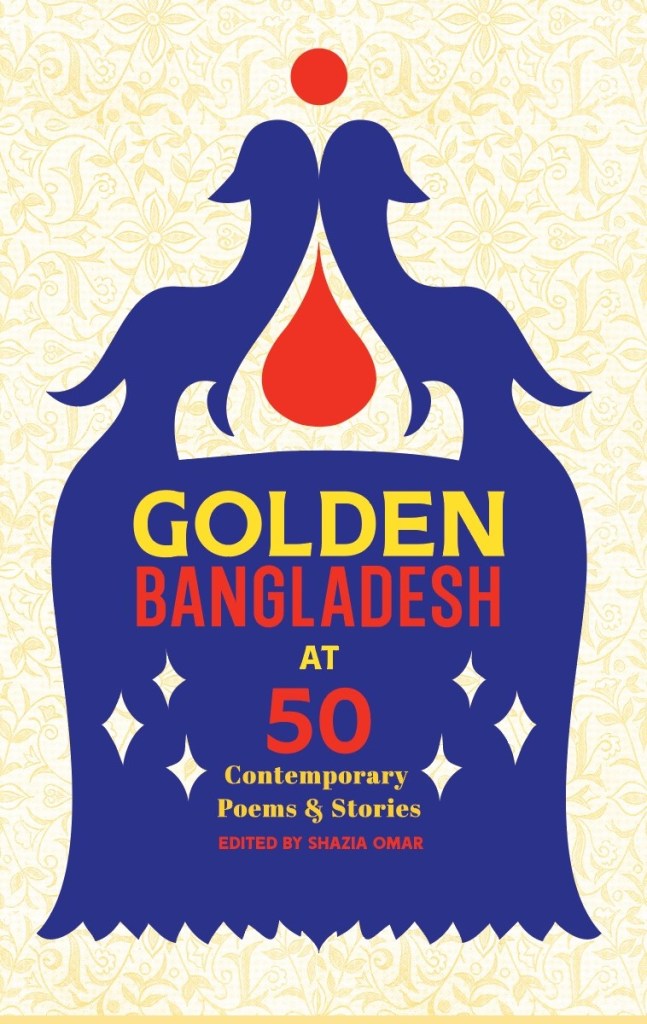
Golden Bangladesh at 50: Book Review by Aruna Chakravarti


Title: Golden Bangladesh at 50, Contemporary Poems & Stories

Editor: Shazia Omar

 Publisher: The University Press Ltd, 2021

The title of the collection of poems and short stories under review is apt for two reasons. First, that it derives from Rabindranath Tagore’s lyric Amaar Shonar Bangla … the national anthem of the country. Second, that the book has been published in 2021, the Golden Jubilee year of the formation of Bangladesh.

The political partition of Pakistan in 1971 caused one of the greatest convulsions in the history of the subcontinent. The Bengalis of Pakistan suffered barbaric violence and bloodshed because they valued their distinctive identity above everything else and refused to submit to a harsh regime’s determination to quell and subdue it. Civil wars have been fought before but never, in the history of mankind, over a language and culture.

Interestingly, Rabindranath’s poem, too, was written as part of movement led by him against Lord Curzon’s infamous Partition of Bengal bill in 1905. The intention of the government was clear. Bengalis were waking up to a sense of nationhood and coming together through the growth and spread of the Bengali language and literature. A blow had to be struck to curb it. And what could be more effective than division based on ethnicity and religion?

The editor Shazia Omar deserves our congratulations for bringing together a vast range of voices. Some are new and unknown, some old and established and some culled from across a wide diaspora. From New York, Chicago and San Francisco. From London, Rome, Toronto and Hongkong. This anthology, to use her own words is, “a way of honouring all that we have learned, yearned for, found and let go. To give our readers a sense of who we are now.” Accordingly, itencapsulates the joys and sorrows, hopes and aspirations, losses and anxieties of two generations of Bangladeshis both from home and abroad.

That partition trauma continues to shape the literature of Bangladesh is apparent from this volume. But the new enquiry has moved away from a nationalistic obsession with the horror of the event to a closer probe into people’s history through recollections of lived experience. Social, familial and personal attempts at restoration of identity seems to be the primary concern in these stories.

The contributions are all in English. The last few decades have been marked by a great deal of discourse about the decolonization of the language. In the past, much colonial creativity has felt throttled by the dominance of English as written and spoken by the ruling class. Today the fragmented pieces of the old empire are striking back with a vengeance. Each erstwhile colony has come up with its own brand of English. This book is a triumphant vindication of Binglish… tried and tested in the literature of West Bengal and Bangladesh. The volume is replete with cultural nuances. Phrases like eta ki, amaar kukoor, or naam, madhur hanshi and names of seasons and festivals phagun, boishakh, agrahayan, eid, nabanno are used freely without footnotes or glossary. The writers have felt no compulsion to translate kinship terms, exclamations and natural phenomena. English has triumphantly broken its original grammatical and syntactical mode and become a hybrid — both a native and a foreign language.

The issues examined in this collection are varied. Class struggle, patriarchy, dogma, superstition, displacement, loss and reclamation of identity. The characters are culled from a wide spectrum of society. From the very rich to the very poor; from the shamelessly privileged to the shockingly deprived. Such yawning gaps, some of the writers seem to imply, are a reality in Bangladesh even in its 50th year of Independence.

 Some stories depict a polarisation of power along the lines of gender. Women are victims of exclusion and varied forms of subjugation. Some are seen as trapped in the iron fist of a feudal order. A few others, westernized and seemingly empowered, share the same fate though the mode of suppression is refined and sophisticated.

Yet, that is not always true. Many of the stories are set in the bustling metropolis of Dhaka where women from all religions, classes and persuasions roam freely. The city is seen as a place of pluralism and diversity. One senses freedom of thought and action as well as a strong sense of belonging to larger whole.

The book is a rich multi-site ethnography that spans continents and traces personal histories and movements of Bangladeshis. It is a notable addition to the literature of the diaspora in that the stories present sensitively nuanced accounts of the East West encounter. In ‘Neighbours’, Nadeem Zaman explores the dilemma of a Bangladeshi woman trying to make a life in Canada during the Liberation war. Struggling against a harsh climate and what she considers an unloving culture, she is forced to pause and reflect when she becomes friendly with her next-door neighbour. She finds his identity troubling, since he seems to combine a sensitive, warm and compassionate outlook with a violent relationship with his wife and indifference to his daughters. The Other seems embodied in paradox.

 Neeman Sobhan’s ‘Bengali Lessons’ is a poignant diaspora story stretching across space and time. Employing a seamless mix of three languages, English, Bengali and Italian, she moves her story between two worlds and timeframes. Two eras run parallel. War ridden Bangladesh of 1971 and Covid afflicted Rome of 2020. The central character, a professor teaching Bengali to a group of Italian girls on Zoom, remembers her traumatic childhood, trapped in her grandfather’s house in 1971, and finds it astonishingly similar to her present-day situation in another country and another time. It is a severed world she remembers but one in which a Muslim child saves a Hindu soldier from an excruciatingly painful death.

Another excellent examination of child psychology is contained in Fatma Ahmad’s ‘Phultokka’ . Childhood is often considered to be the happiest phase of a person’s life. That the notion is far from the truth is seen in the mental struggles, failed aspirations, jealousies and misunderstandings suffered by the intelligent and sensitive teller of the story. She is called Taalgaach (palm tree)a derogatory reference to her height and complexion, by the school bullies. Why do bullies bully? Why can’t some children, especially exceptional ones, cope with the real world and retreat into an inner one, while others have no difficulty in merging and being part of a larger whole? These are some of the questions raised in the story.

 ‘Charaiveti’ and ‘Kalpanta Sthayina’ by Lubna Mariam, derive from the ancient Hindu texts Rigveda and Hitopadesha. The first describes an undefined urge to go on a journey without a destination. Man’s existential freedom drives him towards an imagined Utopia. Keep going,” the sages say, “because life itself is the journey; an inner journey from darkness to light, from ignorance to knowledge”.

Kalpanta Sthaniyah is a Sanskrit phrase meaning enduring till the end of the Universe. A grandfather’s replies to his grandchild’s innocent question about where the river comes from and where it goes, encompass deep philosophical concepts. He speaks of beginnings and ends, past and present, old and new…flowing in an unbroken stream. A glorious merging in the free flow of time. An unending celebration of life.

I conclude with a few words on the poetry section. From the whimsical effusions of ‘Ode to a sari’ to evocations of sights, sounds, smells, taste and feel of their beloved country in ‘Daydream’ ‘Midnight blues’ and ‘For you’, the writers offer a carpet rich with colour and design, light and life. Capricious and fanciful at times, a glimpse of truth is invariably offered at the end of each poem.

 Zeesham Khan’s ‘Banglar desh’, one of the best of the collection, portrays the generosity and compassion of nature as against the callous brutality of the human race. Here is a personification of nature that is amazingly poignant, graceful and symmetrical. The world pulsates with life. Trees have flesh and blood. All organisms speak; feel pain and pleasure. An achingly immediate, hauntingly sensuous, world! The all too real river under a canopy of moon and stars. Paddy fields, bamboo shoots, wild flowers, butterflies and moths. Should not all meld together with humans to make a complete whole? But does such a whole exist in the universe? The writer thinks not. He deplores…

I have seen blissful harmony pause
To give way to aggressive survival
And humans being homo sapiens
Unencumbered by unnecessary compassion.

Glossary:

Amaar Shonar Bangla –My Golden Bengal.

eta ki, amaar kukoor, or naam, madhur hanshi – what is this, my dog, or name, sweet smile

Phultokka — A game played by children. Phool means flower and tokka, touch. One child is blindfolded while others touch the youngster lightly. The blindfolded child has to guess who the person is.

Aruna Chakravarti has been the principal of a prestigious women’s college of Delhi University for ten years. She is also a well-known academic, creative writer and translator with fourteen published books on record. Her novels JorasankoDaughters of JorasankoThe Inheritors have sold widely and received rave reviews. Suralakshmi Villa is her fifteenth book. She has also received awards such as the Vaitalik Award, Sahitya Akademi Award and Sarat Puraskar for her translations.

.

PLEASE NOTE: ARTICLES CAN ONLY BE REPRODUCED IN OTHER SITES WITH DUE ACKNOWLEDGEMENT TO BORDERLESS JOURNAL
Categories
Review

‘A rich tapestry of narratives’

      Book Review by Meenakshi Malhotra

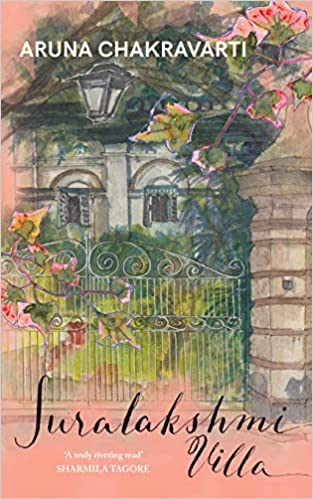
Title: Suralakshmi Villa

Author: Aruna Chakravarti

Publisher: Pan Macmillan, 2020

Suralakshmi Villa (2020) is a novel based on a short story in a previous collection of short stories by Aruna Chakravarti. In the afterword to the novel, the author explains how the novel came about: Ruth Prawer Jhabvala, on whose fiction Chakravarti had done her Ph.D thesis many years ago, commented how the short story had possibilities of being extended into a novel. In doing so, the author’s redoubtable skills have come to the fore yet again.

In Suralakshmi Villa, Aruna Chakravarti has woven a rich tapestry of narratives of human interest, focusing particularly on women(which is the author’s strong suit)  intertwined with narratives of Bengal’s Hindu and Muslim culture, history , religion art, architecture, myths and folklore in a fusion which can be described as syncretic. All these elements are woven into the narrative in a seamless way, which is in no small  measure  a testament to the author’s immense  storytelling skills.

The novel is essentially plot driven with a diverse and complex cast of characters; it intersperses the main plot of Suralakshmi’s  seemingly inexplicable decision to leave her flourishing career as a gynaecologist, her marriage and life in Delhi with the subplots of a fairly large set of characters, spanning about 6-7 decades across most of the twentieth century. The story narrates the varying fortunes of the family of ICS officer Indra Nath Chaudhuri who chooses to settle in South Delhi, in a milieu which is relatively free of the stranglehold of traditional family norms and customs, along with his wife and five daughters, Mahalakshmi, Kanaklakshmi, Suralakshmi,Dhanalakshmi and Rajlakshmi.  For  all his professional stature, Indra Nath is putty in the hands of his larger-than-life wife, Lakshmi, who rules the roost . Prostrated by depression after the premature widowhood of her sixteen-year-old daughter, Mahalakshmi, she decides to educate her daughters rather than prioritise or focus on their marriages and have them choose their husbands, if at all, in their own time. This decision has varying repercussions. Suralakshmi decides to marry a married man seventeen years older than her, that too at the age of 31.     

Suralakshmi’s  story however is not the only plotline in the novel; in the tangled skein of the novel is also the disparate-but-intertwined story of Eidun and her family, which links this story of domestic abuse with a rescue and redemption narrative of sorts. It also maps the story of Indra Nath’s nephew, Pratul, his coming of age and marriage with Nayantara and  that of their children– Kinshuk and Joymita.  

For a story with such a large cast of characters, the parallel plots are juggled with amazing skill and dexterity. What also redounds to the author’s credit is her handling of the complex timelines as well, as the novel loops back and forth chronologically, covering the better part of the twentieth century from the 1930s to 1998. The plot works in a cyclical and circular way, as it spirals and hurtles  towards its final conclusion, which seems random until its causality is made evident.  There is a conscious and carefully calibrated  structure and architectonics involved in the apparent seamlessness of the novel.

The predominance of the plot and the large cast of characters however come at a cost, albeit a minor one, in the light of what the novel achieves. Chakravarti does not explore the interior psychology of most of her characters barring a few crucial briefly sketched in character traits. Characterisation  is often done through a mirroring effect where the response of other characters convey character traits; also, analogues, contrasts and conversations are used  to convey the varied workings of people’s minds. Thus , Suralakshmi’s decision to marry a philandering bigamist Moinak Sen is conveyed through the outrage of her sisters and her stubbornness and intransigence comes up in the course of Pratul’s conversation with his docile wife, Tara or Nayantara. Her impulsiveness is conveyed but  not the inner-workings of her mind and both her ‘love’ and the conjugal bliss that follow are not entirely  convincing.

In a different register, while Eidun and her sisters-Ojju, Meeru and Jeeni’s stories are convincing in their depiction of the oppression  and  travails  of women in impoverished Muslim families, the tale of domestic abuse raises some questions. There is of course the generational aspect of it with the saga of dispossession  portrayed  in the stories of their mother, Ruksana  and the grandmother, Zaitoon-Bibi` as well, but the depiction of the Muslim male as depraved and amoral does leave one with an edge of discomfort. It seems too stereotypical, too pat and cliched,  too two-dimensional. While misogynistic patriarchies and toxic masculinity is not restricted  to  one religious group, in the novel it is one religious group that bears a disproportionate burden of it. The uneducated lower class Muslim men hardly bear comparison with the educated  upper class Bengali men (mostly Hindu) in the novel, and while this disjunction may have  been  created by the exigencies of the plot, it does leave one with a niggling sense of discomfort.

Having said that, Suralakshmi Villa is a tale well told, on almost every count. The unsentimental treatment of motherhood is worth commenting on and when Suralakshmi decides to leave Kinshuk in Delhi with his father, we are made to realise her alienation and her affiliations. She comes across as a dignified and idealistic figure, in her steadfast commitment to protect Eidun, a responsibility she has taken on herself. Even if Suralakshmi’s — and others’ — lives are embedded in a web of materiality, her decision, dignified and noble, transcends her immediate material conditions.

Suralakshmi’s decision to go away and start a charitable hospital in Malda, is depicted in the novel as an act of conscious choice, although it  is  a choice which elicits surprise from others since she leaves her house to Moinak, her errant husband and his offspring. 

Suralakshmi goes away with Eidun, leaving  her son  Kinshuk in the care of his father, with no evident sign of regret or a backward glance.  Her decisiveness here comes as no surprise since it chimes  in with what we know of her already. Even if there is no formal separation, we (and the characters in the novel) are left in no doubt about her intentions. I would go so far as to describe her choice — and her power to choose and live by her choices as feminist, since,  there is definitely an element of agency in the way she decides on a significant moment of transition and then goes ahead with its execution.

Suralakshmi Villa is definitely a welcome addition to the canon of women’s writing in India, multi-textured and multi-layered. Its complexity does not take away from its readability but  adds to its depth and power to attract and hold the attention of the reader.    

    Dr Meenakshi Malhotra is Associate Professor in English at Hansraj College, University of Delhi. She  has edited two books on Women and Lifewriting, Representing the Self and Claiming the I, in addition  to numerous published articles on gender and/in literature and feminist theory. Some of her recent publications include articles on lifewriting as an archive for GWSS, Women and Gender Studies in  India: Crossings (Routledge,2019),on ‘’The Engendering of Hurt’’  in The State of Hurt, (Sage,2016) ,on Kali in Unveiling Desire,(Rutgers University Press,2018) and ‘Ecofeminism and its Discontents’ (Primus,2018). She has been a part of the curriculum framing team for masters programme in Women and gender Studies at Indira Gandhi National Open University(IGNOU) and in Ambedkar University, Delhi and has also been an editorial consultant for ICSE textbooks (Grades1-8) with Pearson publishers. She has recently taught a course as a visiting fellow in Grinnell College, Iowa. She has bylines in Kitaab and Book review