I went to Kerala for Christmas, travelling from Bangalore on the night bus. It wasn’t the first time I had taken a night bus in India. The first time was when I went to Madikeri, high in the hills of Coorg. That bus was one with berths that one can lie completely flat on. In fact, you have no choice but to lie flat because there are no seats. It should be more comfortable than sitting upright all night, and I am sure many passengers find it so, but the vibrations of the engine made my body vibrate in sympathy and every bend in the road made me slide around the berth uncontrollably and when the bus climbed a slope all the blood rushed to my head, which was oriented towards the rear of the vehicle. I decided never to use this restful method of travel again.
This is why I chose a more old-fashioned style of bus in order to journey to Kerala. I understand seats. Your head is always up and your feet always down, and if this happens not to be the case then it quickly becomes obvious that some disaster has happened. Head up, feet down, seems to me the natural order of the universe when travelling a great distance. It was a twelve-hour journey. In India that might not be so remarkable, but I come from a small country where twelve hours on a bus is sufficient time to drive right across the land and a fair way out to sea. “Captain, there seems to be a bus overtaking us!” “Have you been at the rum again, bosun?” The immensity of India is something I doubt I will ever get used to. It is big even in terms of bigness.
Not that the bus with seats was completely free of problems. The seats had a lever by the side of them, and if this lever was pulled, the seats reclined. I was expecting something of this nature, but I was completely taken by surprise at the extreme angle they adopted. They reclined to an excessive degree. All was fine for the first fifty kilometres or so, then the young lady in the seat in front of me decided it was bedtime. She reclined the seat so precipitously that it whacked on my knees, and I was given no choice but to stare directly at the top of her head which was almost touching my chin. The only solution was to recline my own seat. I did so and heard a yowl from behind. I had taken my turn to crush some other innocent knees. And so I lay in this absurd position, sandwiched between two sleepers as the hours slowly passed.
The bus was soon filled with snorers and all of them were out of time with each other. I am a jazz aficionado, I love music with complex rhythms, and I also love polyrhythms, but the point of such intricate music is that there is resolution at some point along the melody lines. The contrasting rhythms ought to come together at least sometimes, in order to provide structure, but the snoring was far too avant garde for that. It was atonal and without time signatures. A man in a forest of lumberjack gnomes probably feels the same way I did, as the sawing takes place and the trees topple with a crash. There was no crash for me during that night, thank goodness, but plenty of jolting as the bus ran over potholes in the highway or swerved around unseen obstacles or accelerated to overtake rival night buses also full of snoring passengers.
Well, all this is a nuisance but one that is necessary for travellers to endure. I reached my destination safely and that’s what really counts. It was morning in Kerala and the heat was already intense. Bangalore is at altitude and altitude is a restrainer of temperature. The landscape shimmered and the port city of Kochi pulsated under the sun. No matter! Time to find my hotel and rest for a while in order to catch up on all the sleep I had missed on the night bus, whose motto is ‘sleep like a baby’, which turned out to be accurate, for I slept not at all and felt like wailing for hours. I went to the correct address and found that the hotel had been closed for the past two years. Ah well!
We are always advised to expect the unexpected, and we do this well, but I don’t think we are ever prepared for the types of unexpectedness we encounter. I was ready for the bus to break down, or for me to lose my way in the narrow entangled city streets, or for crows to swoop and peck my head. I wasn’t ready for a hotel to not exist. I soon found another and it was a better establishment with two ceiling fans instead of one, a balcony, even a fridge that was on the verge of working. That fridge later held two bottles of beer and cooled them from hot to lukewarm, and I drank them one evening and regretted it because I have no stomach for beer. Because of that warm beery incident, I missed out on sampling the palm wine that Kerala is so famous for.
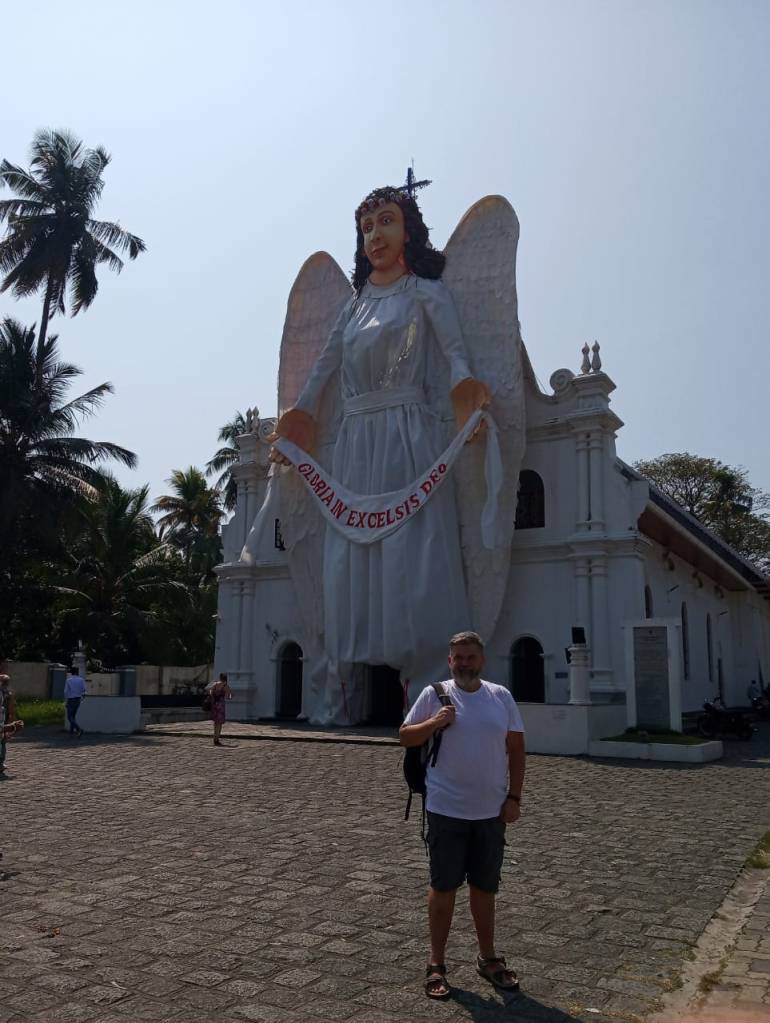
The old part of Kochi is picturesque and labyrinthine. I wandered where I would and ended up somewhere, but I’m still not sure where. Christmas lights were strung between the buildings, large glowing stars had been erected on the summits of walls, on roofs, or dangled from gables. One church I passed had a façade in the form of a gigantic angel. This was really quite surreal. We tend to think of angels as radiant beings with a human form, perfect men and women, but if you read the Bible you will soon see that most angels have an appearance that is not human at all. The highest rank of angels, the Ophanim, resemble sets of interlocking gold wheels with each wheel’s rim covered with eyes. They float through the air without needing wings. A church façade based on one of these angels would be an example of experimental architecture. But the church in the shape of a personable angel was endearing.
I walked past another church and saw a fleet of Santa Clauses mounted on bicycles about to set off. Is ‘Clauses’ the plural of ‘Claus’? I have no idea, for it has never occurred to me that there might be more than one of them. This fleet consisted of children in costume and I have no notion of where they were going or what they would do when they arrived. I strolled onwards and they rode past me, guided by two men on a scooter, one steering and the other holding in his arms a loudspeaker and facing backwards, like a Pied Piper who has entered the Electronic Age. One by the one, the Santa Clauses pedalled past, laughing, waving, generally enjoying themselves.
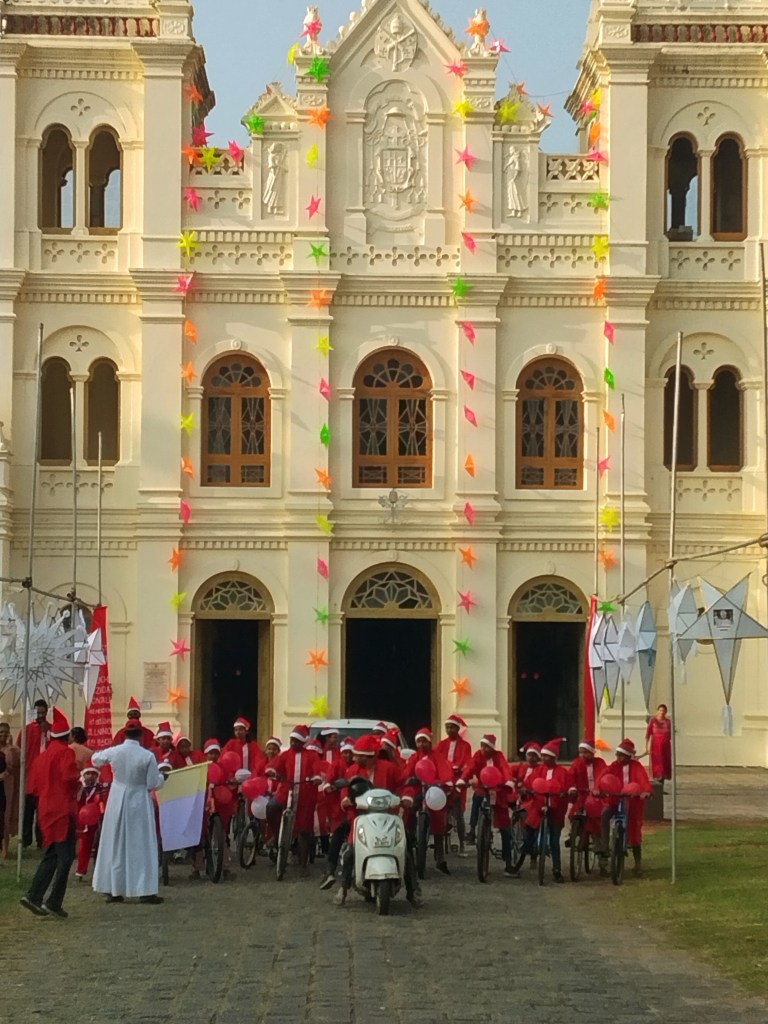
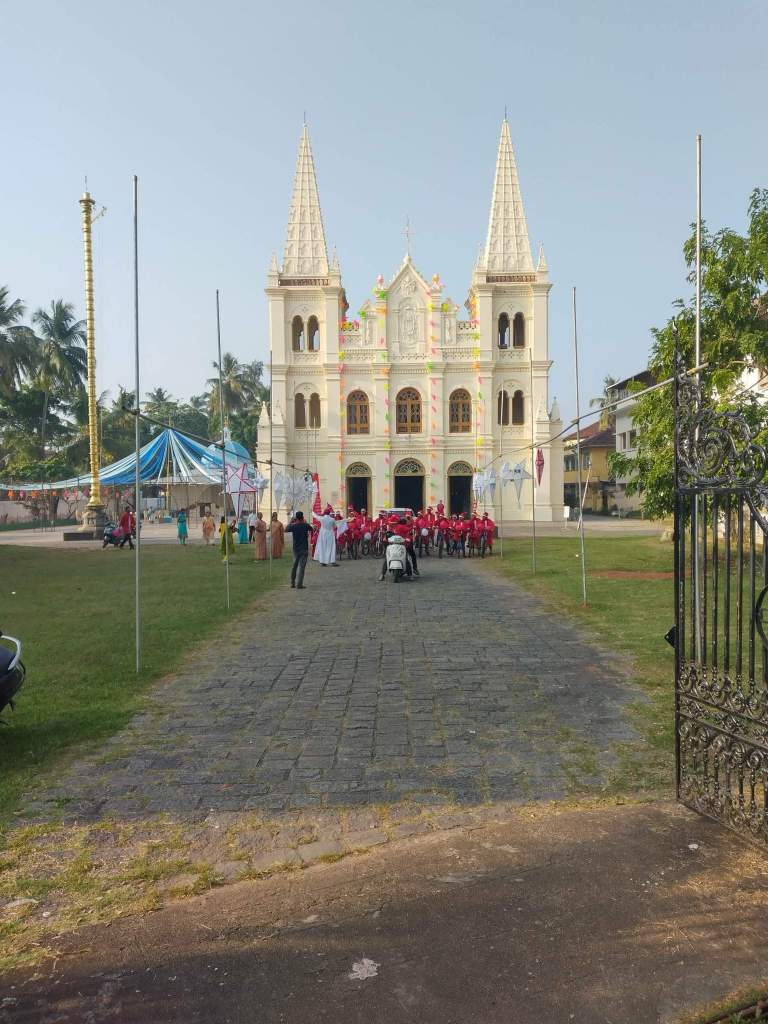
This was Christmas at its most gentle, innocent and benevolent, a far cry from the Christmas ritual I witnessed exactly thirty years ago in Prague, where the tradition involves a saint, an angel and a devil chained together who stalk pedestrians in order to give them lumps of coal that represent the sins of the year. Prague was freezing, Kochi was broiling, and I know which I prefer, but the beer in Prague is certainly better. I reached the waterfront and sat under a tree and wondered if the mass migration of Santa Clauses I had seen was truly a fleet. Maybe it was an armada instead, or a division? Is there a collective noun for Father Christmas? A Splurge of Santas?
Kochi is riddled with waterways, and it feels like an excellent location for a port, which it is. No wonder it was established at that spot. I felt a small connection to the ancient mariners who had sailed here from the West long ago, from Europe and around the tip of Africa and across the Indian Ocean. One day I will travel from this very place to the islands of Lakshadweep. This has been a dream of mine for a long time, since I was eight or nine years old. I had entered a competition run by the Twinings tea company and I won. A map of the Indian Ocean was given with the names of islands removed and the entrants had to fill in those missing names. I consulted an atlas to do this, as I imagine every other entrant did, but I had an unknown advantage.
My atlas was very old, a green battered thing, and the Lakshadweep islands were marked by that very name. In other atlases the island chain was apparently named as the Laccadives. The administrators were looking for Lakshadweep and that is how I won a year’s supply of tea. It came regularly via the postman in an endless series of little tubs, Earl Grey, Lapsang Souchong, Peach Oolong. But in the end, this endless series finally ended, and my tea luck turned out only to feel inexhaustible rather than to be so. I have never won a competition since or even come close. But I have had a fondness for tea and Lakshadweep ever since, so it is imperative that I sail to those islands one day.
During my time in Kochi, I travelled on a boat only once, from Fort Kochi to Vypin Island. A battered rusty ferry crammed with foot passengers, cars and motorcycles. Cost of ticket? The equivalent of three British pennies. This is far cheaper than the cost of any ferry I have ever been on, with the exception of the occasional free ferries that I have encountered around the world, such as the one that takes passengers across the Suez Canal from one side of Port Said to the other, or the ferry that travels back and forth between Mombasa, which is on an island, and the African mainland. Sea travel is something special and I have done too little of it in my life. If I could have sailed back to Bangalore, I would have. As it happens, I went back on another night bus, but this time the person in the seat in front of me only reclined their seat to a reasonable angle. My knees were not crushed, and in return I did not crush the knees of the person behind me. I like and admire reasonable angles. They make geometry sweet.
.
Rhys Hughes has lived in many countries. He graduated as an engineer but currently works as a tutor of mathematics. Since his first book was published in 1995 he has had fifty other books published and his work has been translated into ten languages.
.
PLEASE NOTE: ARTICLES CAN ONLY BE REPRODUCED IN OTHER SITES WITH DUE ACKNOWLEDGEMENT TO BORDERLESS JOURNAL.
Click here to access the Borderless anthology, Monalisa No Longer Smiles

 Borderless