Categories
Review

A Story from Manipur

Book review by Rakhi Dalal

Title: Waiting for the Dust to Settle

Author: Veio Pou

Publisher: Speaking Tiger, 2020

In his debut novel, Veio Pou weaves fiction to chronicle the forgotten history of Naga people, a past whose dust, even after three long decades, is yet to settle. Waiting for the Dust to Settle is set against the backdrop of Indo-Naga conflict in Northeastern India.

The story of this novel follows the life of a ten-year-old Rokovei from Senapati district in Manipur from late 1980s onward. He lives a peaceful life with his parents. Fascinated by the convoy of army trucks passing daily in front of his home, he secretly wishes to become an army officer. Once, while visiting his native village of Phyamaichi, he witnesses atrocities committed by the soldiers on the villagers. His disenchantment with the army comes to the fore when he becomes aware of his people’s sufferings as a consequence of confrontation between Naga undergrounds and the Indian Army. At the center of this novel is the Operation Bluebird, carried out in the state in 1987.

In September 1958, the Government of India enacted Armed Forces Special Powers Act (AFSPA) in the North-Eastern states to quell Naga resistance. In July 1987, the National Socialist Council of Nagaland (NSCN) attacked an Assam Rifles post at Oinam village, in Manipur’s Senapati district. The Naga undergrounds of NSCN looted large arms and ammunition from the post. The Assam Rifles launched a counter-insurgency operation code-named “Operation Bluebird” to recover the looted arms and ammunition. This intense search operation, which was carried for three months in nearly thirty villages, was a torturous period for the residents of those villages. The Rifles committed large-scale human rights violation, including forcing two pregnant women to give birth to their babies in full view of the soldiers.

By spinning the narrative around the operation, the author attempts to give voice to the otherwise erased account of a people’s history from the consciousness of a country. The final erasure came when in 2019 the Manipur High Court disposed case against the Assam Rifles, filed by Naga Peoples Movement for Human Rights (NPMHR), after twenty eight years citing dislocation of entire record of the case. Nandita Haksar, who was the lawyer who filed the case on behalf of NPMHR, wrote in an essay that the entire record consisted of twelve volumes of evidence and ran into thousands of pages.

Through account of Rokovei and his family’s life after Operation Bluebird, Veio Pou brings to notice the physical as well as mental sufferings endured by the victims of army brutality.  Disillusionment of natives with respect to Naga undergrounds and their cause, the splitting of NSCN and rivalry between Naga factions, increased awareness among natives for better education, the issue of racism that people from North East face in Mainland India, are the themes dealt prominently within this novel.

Rokovei, while studying in Imphal, witnesses the hostility between Kuki and Naga factions after their conflict in the 1990s. When he moves to University of Delhi few years later, he comes in contact with Lalboi – a Kuki, but does make friends with him because he is the only other boy from the state in his class. After coming to Delhi, he realises the difference of living in a place where no ASFPA is enacted, an experience which should have come as a breather but is marred by racism which he confronts and leaves him astounded. The prejudice that he faces makes him wonder about his identity. Rokovei wishes to find answers. His conversations with his cousin Joyson, with whom he lives in Delhi, gives him a clearer perspective on the history, issues and realities of his people and state. 

Finally, keeping in mind better prospects for the future, he settles down in Delhi. It is the year 2008, five years after the leaders of NSCN visited Delhi to meet PM Vajpayee and yet a solution to the political question his people face is nowhere near. Rokovei ponders over the relevance of Naga resistance which had once started with the dream of a sovereign state but was subsequently made weaker by the split in the party. He reflects upon the corollaries of a struggle which had left the natives disappointed because at stake was a peaceful existence that has long been denied them. For him the dust hasn’t settled yet and his hopes are tinged with despair. 

The history of a place is essentially the history of its people. To recapitulate it, especially when it is complex and painful to remember, must be an arduous task for the people who have witnessed harrowing times and have lived every subsequent day of their lives watching the repercussions unfold. To pen a fictional account of such history therefore requires conviction and also courage to endure the trauma all over again.

This book is not only an attempt at chronicling the events which led to the political question that kept haunting the lives of the Naga people but is also an effort to bring their predicament to the attention of people who have little idea about their sufferings and about the gravity of denial of justice to them.

.

Rakhi Dalal is an educator by profession. When not working, she can usually be found reading books or writing about reading them. She writes at https://rakhidalal.blogspot.com/ .

.

PLEASE NOTE: ARTICLES CAN ONLY BE REPRODUCED IN OTHER SITES WITH DUE ACKNOWLEDGEMENT TO BORDERLESS JOURNAL. 

Categories
Interview

In conversation with Devaki Jain

Devaki Jain: With Permission from Devaki Jain and Speaking Tiger Books

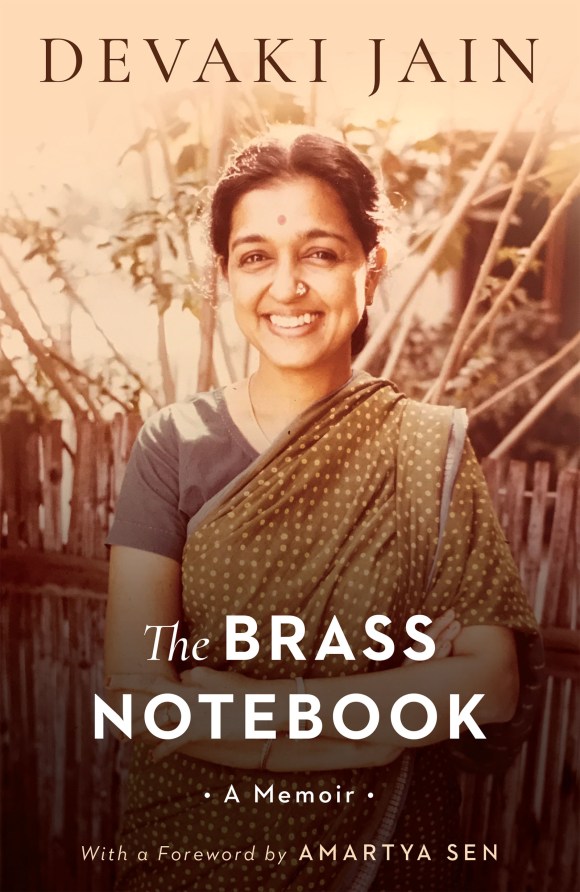
A woman who at eighty-eight brought out her autobiography based on the urgings of among others, Alice Walker, author of  the Pulitzer Prize winning novel, The Colour Purple , and  Doris Lessing, the Nobel Laureate — only much later. Like Lessing’s The Golden Notebook, her biography is called The Brass Notebook. Does it talk anti-war or feminism or womanism? I am not sure. What it does show is a woman who despite being surrounded by patriarchal norms managed to live her life as she wanted without resorting to schools of ‘isms’ or feeling injured. In the process, she met many great people and tried to bring in changes or reforms.

Devaki Jain, born in 1933,  graduated in economics and philosophy from St Anne’s College, Oxford and is an Honorary Fellow of the college. She is a recipient of the Padma Bhushan (2006) and an honorary doctorate from the University of Westville, Durban, South Africa.

Needless to say the best introduction to her work and her person comes from well-known feminist journalist,  Gloria Steinem: “Your heart and world will be opened by reading The Brass Notebook the intimate and political life of Devaki Jain, a young woman who dares to become independent even as a country of India does. Because she’s also my oldest friend I can tell you there is no one like her, yet only here in her writings have I learned the depth, breadth and universality of adventures.”

The interview probably reinforces her non-conformist outlook. In an age when intellectuals bicker over terminology and social media becomes the fulcrum of our lives, she lives by her convictions. Despite writing an absolutely gripping autobiography, she has revealed only a bit of herself. Through the interview, I tried to entice more but I got only a very brief glimmer. Her autobiography painted a liberal, liberated and open thinker who fearlessly fought her way against patriarchal and colonial mindsets. In this exclusive, I invite you to savour her spirit at a stage in life when most talk mainly of geriatric issues. Devaki Jain for you —

You were a very independent lady for your times. Could you find parallels of women like yourself in diverse cultures?

Women have been revolutionaries, radical thinkers, resistance leaders, dissenters for centuries. There are not many records of this but one of my colleagues found that there were groups of women, for example, in China even as far as the 12th century who were dissenters. Therefore, the knowledge may not have been recorded but striking for independence and striking for justice has been a part of women’s lives for centuries. 

What drove you to be as you were? What made you feel that marriage was not the ultimate aim of all existence in the 1950s and 1960s?

(a)What drives people to do things differently? This is not an easy question to answer, people are born differently with different aspirations and different nervous systems. It is like asking an artist what helped you to be such a brilliant artist. Such questions are not appropriate. 

(b) I think this question is badly framed that I felt that marriage was not the ultimate aim, it was not like that. It was just that I felt there were other things that I wanted to do.

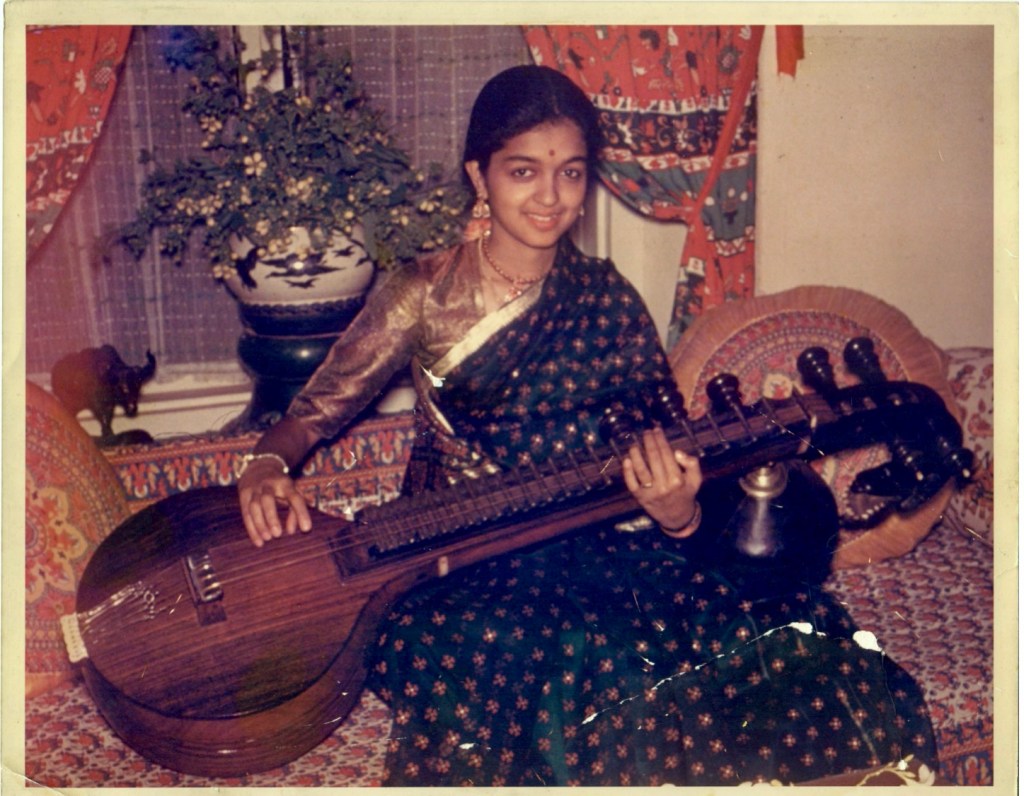
A young Devaki Jain. With permission from Devaki Jain & Speaking Tiger Books

How supportive was your family, especially your father, of your sense of independence?

My father was an enigma, while he wanted to submit to orthodoxy, he was also very respectful of those who wanted to do things differently. So, in a sense, I think he was supportive of my desire for independence. 

You did face some amount of familial sexual harassment. Did it scar you for life? How did you get over the trauma?

My uncle’s sexual assault on me did not scar me for life, there was no particular need to get over the trauma. In a situation of living in cloisters with family bounds there is no space for lifelong traumas.

You spoke of how funding went inadvertently hand in hand with a different kind of colonial outlook. Would you say that is still true?

No, currently I think both the donors and the receivers have understood the difference and respect the difference.

Womanism is a term you have spoken of in your book. How is this different from feminism in your perspective?

I was basically supporting Alice Walker’s definition and I support her perspective. Please refer to my quotation from Alice Walker*.

[*Alice Walker quote from Pg 173-174, The Brass Notebook, Speaking Tiger, 2020: “As long as the world is dominated by racial ideology that places whites above people of colour, the angle of vision of the womanist, coming from a culture of colour, will be of a deeper, more radical penetration. This is only logical. Generally speaking, for instance, white feminists are dealing with the oppression they receive from white men, while women of colour are oppressed by men of colour as well as white men, as well as by many white women. But on the joyful side, which we must insist on honouring, the womanist is, like the creator of the word, intent on connecting with the earth and cosmos, with dance and song. With roundness, thankfulness and joy. Given a fighting chance at living her own life, under oppression that she resists, the womanist has no or few complaints. Her history has been so rough—captured from her home, centuries of enslavement, apartheid, etc—she honours Harriet Tubman by daily choosing freedom over the fetters of any internalized slavery she might find still lurking within herself. Whatever women’s liberation is called, it is about freedom. This she knows. Having said this, I have no problem being called “feminist” or “womanist.” In coining the term, I was simply trying myself to see more clearly what sets women of colour apart in the rainbow that is a world movement of women who have had enough of being second–and third–class citizens of the earth. One day, if earth and our species survive, we will again be called sacred and free. Our proper names.”]

Do you think women’s issues across the world are similar? How should they be dealt with?

It is believed that women’s oppression comes from patriarchy which of course is worldwide. I do not think I can answer the second part of the question – “how should it be dealt with?” — except writing three other books.

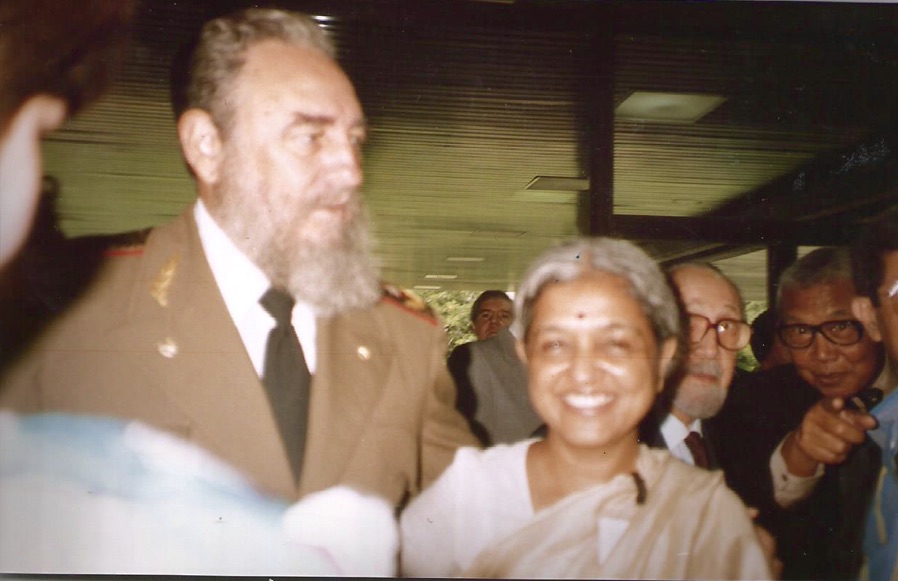
With Fidel Castro in Cuba as a member of the South Commission. With permission from Devaki Jain & Speaking Tiger Books

You have spoken of how the South Commission fell through. Can you tell us why? Is this what happens very often?

The South Commission fell apart because of a failure of solidarity between the south countries. It was a political statement to join the South together as an economic platform. When it failed, it failed all that. 

You tried to bring many changes for the welfare of women across India and beyond. Will you tell us a bit about the perceived problems and solutions that we could find?

I do not think I attempted to bring changes for the welfare of women. I think I was basically pointing out the contribution that women made to the economy and how they were being discriminated against. 

What are your future plans, presuming you are going to be a grand dame of 150 years?

I would like to write, write and write.

What would be the advice you would like to give young women living in today’s world?

Follow your dreams and don’t be frightened of orthodoxy. 

Thank you for giving us some of your time.

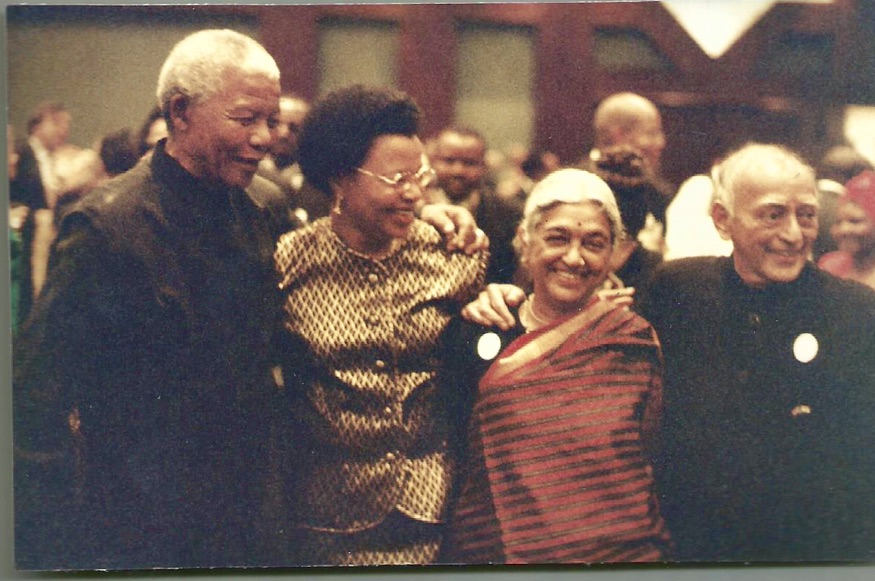
Nelson Mandela, Graca Machel, Devaki Jain, Lakshmi Jain at a reception. With permission of Devaki Jain & Speaking Tiger
With Dr Julius Nyere (centre) in Cuba, 1989. With permission from Devaki Jain & Speaking Tiger Books
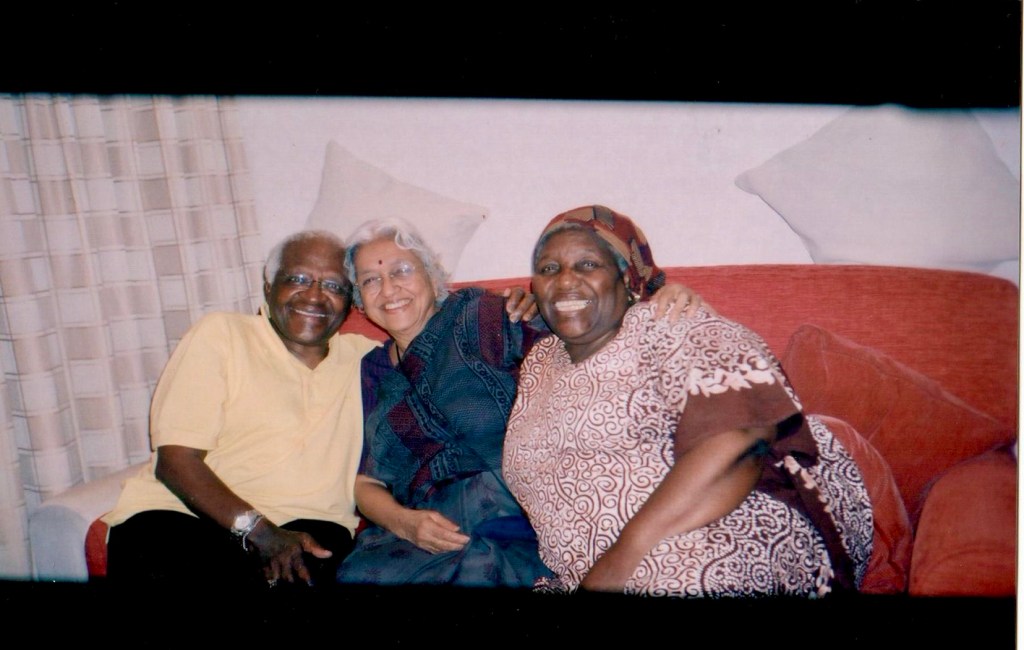
With Desmond & Leah Tutu, Pretoria, 1998. with permission from Devaki Jain & Speaking Tiger Books

All the photographs are published with thanks to the author, Devaki Jain, and the publisher, Speaking Tiger Books.

.

This has been an online interview conducted by Mitali Chakravarty.

PLEASE NOTE: ARTICLES CAN ONLY BE REPRODUCED IN OTHER SITES WITH DUE ACKNOWLEDGEMENT TO BORDERLESS JOURNAL

Categories
Excerpt

The Brass Notebook: A Memoir by Devaki Jain

Excerpted from The Brass Notebook: A Memoir by Devaki Jain. Published by Speaking Tiger Books, 2020.

Upturning Hierarchies

‘She has wheels on her feet’: I think this phrase is used in several Indian languages to describe women who are constantly travelling (‘kaalile chakram’ in my own language, Tamil). The phrase sometimes carries with it a sense of exasperation or dismissal: why can’t she stay in one place? I was just the sort of person to whom that phrase applies. In retrospect, it amazes me to find that over a span of about fifty years, starting 1955, I have travelled to ninety-four different countries. I have also had the privilege of visiting every one of the twenty-nine states and seven Union Territories in India. In most of them, I have visited some of the poorest and most marginalized villages to meet women and to try to understand their struggles. Very little of this travel was for tourism or holidays. Nearly all of it was professional travel with my costs covered.

This cycle of constant travel began in a sense in childhood, when I accompanied my father on his trips and safaris. So many of my memories of childhood are of me in the back seat of a car, en route to somewhere unfamiliar. But I really became a self-sufficient traveller in my own right in 1962, when I found myself part of an unusual, and now almost impossible, overland trip from Oxford to Delhi. The leader of this bold travelling party was Elizabeth Whitcombe, an Oxford student who had studied ‘Greats’: that is to say, the four-year degree in Greek and Latin languages, literature, history and philosophy. She had only two conditions for members of her party: one had to be able to drive, and to contribute £100 to the kitty. In the end, there were four of us: two men and two women in a hardy Land Rover.

We started, of course, from where we were, in Oxford, and took the ferry across the English Channel into France. We drove across France and Switzerland, all the way down to Greece and then Turkey. Throughout, we stayed in what were called ‘mocamps’—camps for motorists to park their cars and spend the night. Sometimes, we slept out in the open in our sleeping bags. Elizabeth, a seasoned camper who had climbed mountains in New Zealand, brought all the necessary equipment. A well-read scholar, she could educate us about the antiquities in Greece and Turkey—archaeological sites and ancient monuments—that we visited.

From Ankara in Turkey, we went on through Trebizond, Batumi, Erzurum, Tabriz, stopping in each town, walking through and occasionally shopping in the bazaars. We all bought leather coats in the market in Istanbul, where the sturdiest and cheapest leather goods were to be found. The one memory of that part of the trip that stayed with me as a traumatic experience was seeing the decapitated heads of cattle being used to hang things on—bags, hats and so forth. The heads still had eyes and it was like they were staring right back at me when I looked at them.

One of my co-travellers, a mathematician from New Zealand called David Vere Jones, wrote to me recently with some of his memories from this leg of the journey: of a mosque with a wooden floor and many squares of old carpets, of leaving the mosque after dark in search of a camping ground, of eventually settling down for the night in a dry riverbed where some nomads were camping opposite. Some of the children and old men in their encampment came to visit us, bringing us melons; we accepted gratefully, offering them cigarettes and brandy in return. They sang for us, and one old man chose a particularly bawdy number that sent his companions into convulsions of laughter. David can also remember swimming in lakes, and the constant stomach upsets to which we all fell prey during the journey.

About the Book:

In this no-holds-barred memoir, Devaki Jain begins with her childhood in south India, a life of comfort and ease with a father who served as dewan in the Princely States of Mysore and Gwalior. But there were restrictions too, that come with growing up in an orthodox Tamil Brahmin family, as well as the rarely spoken about dangers of predatory male relatives. Ruskin College, Oxford, gave her her first taste of freedom in 1955, at the age of 22. Oxford brought her a degree in philosophy and economics—as well as hardship, as she washed dishes in a cafe to pay her fees. It was here, too, that she had her early encounters with the sensual life. With rare candour, she writes of her romantic liaisons in Oxford and Harvard, and falling in love with her ‘unsuitable boy’—her husband, Lakshmi Jain, whom she married against her beloved father’s wishes.

Devaki’s professional life saw her becoming deeply involved with the cause of ‘poor’ women—workers in the informal economy, for whom she strove to get a better deal. In the international arena, she joined cause with the concerns of the colonized nations of the south, as they fought to make their voices heard against the rich and powerful nations of the former colonizers. Her work brought her into contact with world leaders and thinkers, amongst them, Vinoba Bhave, Nelson Mandela, Henry Kissinger, and Iris Murdoch.

 About the Author

Devaki Jain graduated in economics and philosophy from St Anne’s College, Oxford and is an Honorary Fellow of the college. She is a recipient of the Padma Bhushan (2006) and an honorary doctorate from the University of Westville, Durban, South Africa.

PLEASE NOTE: ARTICLES CAN ONLY BE REPRODUCED IN OTHER SITES WITH DUE ACKNOWLEDGEMENT TO BORDERLESS JOURNAL

Categories
Review

The Brass Notebook

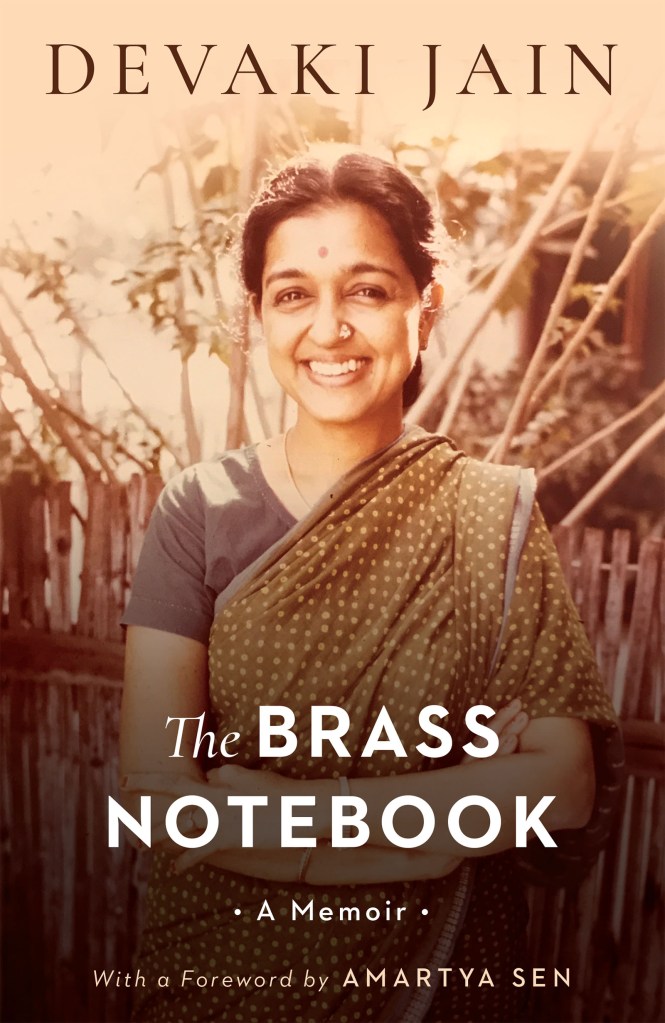
 A recently penned autobiography by eminent economist Devaki Jain, written based on a suggestion made by Doris Lessings in 1958, with a forward by Amartya Sen and reviewed by Bhaskar Parichha.

Title: The Brass Notebook – A memoir

Author: Devaki Jain

Publisher: Speaking Tiger, 2020

This is an unusual memoir. Unusual because it isn’t archetypal, not old-fashioned nor even written in a sequential order. The autobiography is set apart into personal and professional years, covering all that happened in a long and distinguished career.

The Brass Notebook by the celebrated economist-writer, Devaki Jain, is structured in such a way that it is no-holds-barred and edifying. In the brilliant life account, she recounts her own story and also that of an entire generation and a nation coming into its own.

Born in 1933, in Mysore, Karnataka, Devaki Jain was the daughter of the Dewan (prime minister) in the Princely States of Mysore and Gwalior. A student of Mysore University, where she studied Mathematics and Economics, she furthered her education in St Anne’s College, Oxford University and graduated in Economics and Philosophy, where she is now an Honorary Fellow.


Devaki Jain made significant contributions to feminist economics, social justice, and women’s empowerment in India. From 1963 to 69, she was a lecturer in economics at Miranda House, Delhi University. She moved on from teaching to full-time research and publication as the director of the Institute of Social Studies Trust.

Over the years, Devaki Jain founded a wide range of institutions such as the Development Alternatives for Women for a New Era (DAWN), a Third World network of women social scientists, and a research Centre in Delhi — Institute of Social Studies Trust (ISST). She had been a member of several policy-making bodies in India and abroad, including the State Planning Board of Karnataka; the erstwhile South Commission, established in 1987 under the chairmanship of Dr Julius Nyerere; the Advisory Committee for UNDP Human Development Report on Poverty (1997), and the Eminent Persons Group associated with the Graca Machel Committee (UN) on the impact on children of armed conflict.

A recipient of the Padma Bhushan (2006) and an honorary doctorate from the University of Westville, Durban, South Africa, the eighty-seven-year-old wrote: “It was difficult to reveal my personal life, but because I felt that my story could be a source of strength for many women, I decided to share both my political engagements and my personal adventures.” Her earlier works include Close Encounters of Another Kind: Women and Development Economics and Harvesting Feminist Knowledge for Public Policy: Rebuilding Progress.

With a ‘Foreword’ by Amartya Sen, The Brass Notebook has been inspired by Doris Lessing’s The Golden Notebook. Not just the title, but the idea of the book itself was suggested by Lessing when Jain first met her in 1958. It took Jain 60 years to honour that advice.

In the memoir, Devaki Jain begins with her childhood in south India — a life of comfort and ease. But there were restrictions too, that come with growing up in an orthodox Tamil Brahmin family, and the rarely spoken about dangers of predatory male relatives. 

She writes in the autobiography, “While most of the other students, largely Anglo-Indian or Goan Christians, would walk or cycle from their nearby homes, my younger sister and I came to school every day, to our great embarrassment, in a coach drawn by a beautiful chestnut brown horse. There were no buses or any form of public transport from where we lived to the Cantonment. It was like two different cities. We wore the standard school uniform: a blue serge pleated skirt with a white shirt, tucked neatly in, and a brown-and-gold tie with diagonal stripes. We all sang the school anthem–‘Brown and Gold’–with great fervor, every morning at assembly.

I loved the various prayers and litanies that were part of the Roman Catholic tradition of the school. I would go to the chapel, make the sign of the cross, and sing all the hymns, ‘do’ the rosary (a friend gave me one to pray with). The rosary had to be hidden when I was at home, and my private devotions restricted to the bathroom. Like so many girls who feel the aesthetic appeal of Catholicism, I wanted more than anything to be a nun. Of course, I breathed nothing of these thoughts to my family at home, upper-caste Hindus who would have been shocked at one of their children abandoning both her family’s religion and hopes of a happy domestic life.

“As it was, we were not allowed to enter the house proper without first shedding our uniforms, bathing and changing in the bathroom which we were to enter by the back door. We had two very orthodox grandmothers living with us who regarded close proximity to Christians as polluting.”

Elsewhere in the memoir she writes about the Gandhian way of life at Wardha Ashram: “Another experience, which took me deeply into the ethos of India’s freedom movement, while I was still cocooned in the orthodox family, was a student seminar in Bangalore in 1953. This was convened by the Quakers, in this case the American Friends Service Committee (AFSC). Normally I would not be allowed to go to such workshops and conferences, but as I have mentioned earlier in this memoir, my brother Sreedhar had me invited. He was studying in the US and was drawn to the spirit and culture of the Quakers.

“At the seminar, I was gripped by the simple attire and eclectic ideas of two young men, aged twenty-one and nineteen, who had come all the way from Gandhi’s ashram in Wardha–one British, David Hoggett, and the other Indian, Vasant Palshikar. I was fascinated by their attitude, behaviour, clothing and ideas. They were living in Wardha at the Sarva Seva Sangh Ashram. They dressed like Gandhi–that is, dhotis made of khadi, tucked high up between their legs, a light sleeveless banyan, vest, also made of khadi, and coarse handmade leather chappals. They were very calm, friendly and totally at ease with the mixed bag of people that we were.”

Ruskin College, Oxford, gave Devaki Jain her first taste of freedom in 1955, at the age of twenty-two. Oxford brought her a degree in philosophy and economics — and hardship, as she washed dishes in a cafe to pay her fees. It was here, too, that she had her early encounters with the sensual life. With rare candor, she writes of her romantic liaisons in Oxford and Harvard and falling in love with her ‘unsuitable boy’– her husband, Lakshmi Chand Jain, whom she married against her father’s wishes. 

Devaki’s professional life saw her becoming deeply involved with the cause of ‘poor’ women — workers in the informal economy, for whom she strove to get a better deal. In the international arena, she joined cause with the concerns of the colonized nations of the south, as they fought to make their voices heard against the rich and powerful nations of the former colonizers. 

The book — divided into seven parts and running into a little over two hundred pages and with photographs from the album —  is as absorbing as thought-provoking. In all these encounters and anecdotes, what sparkles is Devaki Jain’s uprightness in telling the story. In the chronicle, there is a message for women across generations: one can experience the good, the bad and the ugly, and remain standing to tell the story. Honesty permeates the narrative in whatever challenges Devaki Jain has faced in her life.

An entrancing memoir, The Brass Notebook is a must-read for women who want to know how to survive and succeed in a patriarchal society, for men to know that women are not a weaker sex but just uninformed about their inherent strength, and for policymakers to know that even seven decades after Independence, the basic flaws in their policies on women’s empowerment have still not been addressed.

.

Bhaskar Parichha is a journalist and author of No Strings Attached: Writings on Odisha and Biju Patnaik – A Political Biography. He lives in Bhubaneswar and writes bilingually. Besides writing for newspapers, he also reviews books on various media platforms.

.

.

PLEASE NOTE: ARTICLES CAN ONLY BE REPRODUCED IN OTHER SITES WITH DUE ACKNOWLEDGEMENT TO BORDERLESS JOURNAL

Categories
Review

What is the idea of India?


On the first anniversary of a movement that seems to be a reaffirmation of democratic processes in a nation torn with angst, Meenakshi Malhotra reviews Shaheen Bagh and the Idea of India

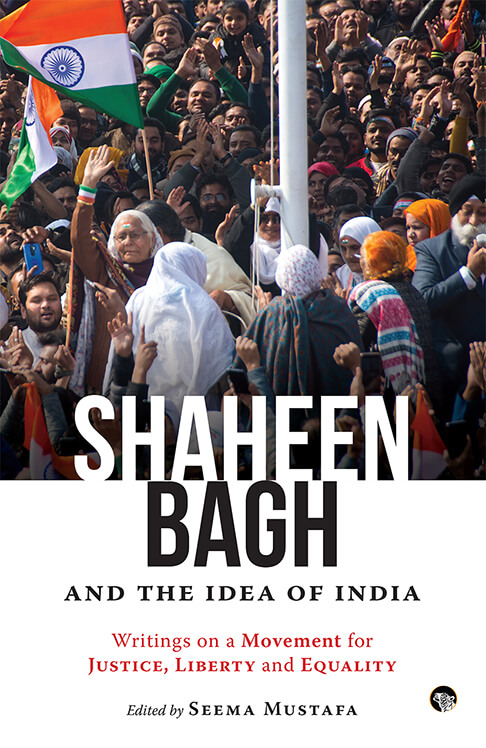
Title: Shaheen Bagh and the Idea of India: Writings on a Movement for Justice, Liberty and Equality

Editor: Seema Mustafa

Publisher: Speaking Tiger Books, 2020

Shaheen Bagh is a compendium of writings that document and comment on a watershed moment in India’s history, evoking memories of that other flashpoint in India’s history, the Partition. For Nayantara Sahgal, the nonagenarian writer, it is all too reminiscent of that other critical event in Indian history. Narrated and recounted by journalists, writers, social and political activists, it represents both the uniqueness of that moment when a movement propelled by one of the most dispossessed groups in Indian history took up cudgels on behalf of their communities, the men in their communities. It was a registering of both solidarity and political awareness, capturing moments of protest in a tone that was at times exhilarating, at times despairing.

The narrative incorporates the accounts of various women protestors who recount that significant moment when they were catapulted into assuming  unexpected and unlikely roles as torchbearers of democracy and custodians of democratic rights of citizenship. Shaheen Bagh, a Muslim neighbourhood in the capital city of Delhi in India became the epicentre of an unprecedented protest, an unbroken continuous sitting for over 70 days by citizens with Muslim women coming out in large numbers against the Citizenship Amendment Act adopted with a huge majority by the national parliament in December 2019 and also the National Register of Citizens, a notified national population register perceived rightly or wrongly to be hugely discriminatory against the Muslims and some marginalised groups. The CAA or the Citizenship Amendment Act is also perceived and presented by sections of the population as violating the spirit of the Indian Constitution adopted in 1950 as a sovereign democratic republic with the preamble adding the word ‘secular’, distinguishing it from a theocracy in 1976. The government however has refuted these claims and fears and with the counter claim that the CAA is only intended to grant citizenship to migrants, read as persecuted minorities, Hindu, Sikh, Buddhist, Christian and Parsi communities who came to the country from Pakistan, Bangladesh and Afghanistan on or before December 31st, 2014. Clearly the Muslims of all sects have been kept out of this particular dispensation. Just to remind us all, India has 11% of the world’s Muslim population around 16% of the Indian population , at least 226million of one billion population are Muslim. Interestingly the Supreme Court of India has refused to order a stay on its implementation which has been requested by about 144 petitioners and has granted the government time to come up with a response. It has also restrained other courts, the high courts for example from hearing please against the CAA till it arrives at a decision to take it forward.

Shaheen Bagh captured the imagination of the youth in India and of women’s groups in particular. India is still a young country, 50% of its population is below the age of 25, 65% below 35 years of age. The people that converge here everyday in large numbers are young women. Shaheen Bagh evokes memories of earlier resistances that the world has witnessed or known. US campuses against the Vietnam war, Occupy Wall Street, Tiananmen Square, Ken State University, Tahrir Square, the student uprising in Paris in the 60’s closer home to the US Montgomery March and Nashville Tennessee. But this was all that and more as many women  in burkhas and  hijabs crossed several boundaries, broke several barriers and some even stepped out of conservative homes and conventional customs and taboos for the first time in a civil disobedience vigil to uphold the values of equality and freedoms enshrined in articles 15 and 19 of the Indian Constitution. Placards that these women used often said: ‘Don’t be silent but don’t be violent’.

As the Introduction to the book Shaheen Bagh and the Idea of India pithily states: Shaheen Bagh became a “first in living memory. As the days passed, Shaheen Bagh acquired greater strength, for the women ,” brought no malice, no anger, no abuse into their protest, and countered every allegation hurled at them with a smile and an honest and forthright response. Moreover, “the idea of Shaheen Bagh ignited, and became, the idea of India for hundreds, because the women sitting in protest spoke a language that came from the compassion of the matriarch.   It was born of the love for children, and brought with it a smile and an embrace for the youth who spent the nights sitting and singing with the women.”

In the process, the protest empowered women. They played an agential role in the proceedings and the experience helped to develop their confidence in their own abilities, in their judgment and their decisions.  There was never any doubt that the women were in the lead. They were sitting on protest, they commanded the stage, they spoke to the media.

Shaheen Bagh became the site of a major exercise in the dance of democracy. It became a site which enabled and catalysed a kind of consciousness-raising for both the participants and the witnesses. While I would stop short of calling it a great leveller, it offered a kind of space for forging solidarities, of experiencing community and of practising democracy. Shaheen Bagh assumed a unique significance since it presented a vignette of inclusiveness from the start. “There was no religion or caste here. “

In a somewhat romanticised vein, a scholar who had spent a substantial chunk of time in Delhi , described it as a  “pilgrimage’’ for many Delhiites. A young professor from Delhi University  who spent time at the protest site said that “I come to Shaheen Bagh whenever the world outside depresses me. I find solace and peace here.” Whether to seek social salvation or rub shoulders with the Delhi literati, who were also here  from time to time, Shaheen Bagh represented an experience of democracy that few had imagined possible in the gloom and doom of our recent history. Many privileged youngsters also joined the milling groups around the protest site, preferring to savour this experience over their usual modes of entertainment. Some sat with the women as they collectively , and in solidarity, sang Faiz’s song, “Hum Dekhenge” ( “We shall see” in Urdu and Hindi) a stirring anthem raising a flag to unity and harmony .  All axes of identity — religion, castes, class — seemed to recede and fade in this space that helped  “Delhi find its conscience”. The moment seemed to resonate with other similar moments in the course of the freedom struggle. This laying claim to democracy and its variegated symbols by lower and lower middle class Muslim women, people  who were probably among the most dispossessed and marginalised groups, and among the most disaffiliated from the lineages of class and economic power, struck a chord. The question that had come up here was an enormously significant one: to whom does the nation belong?
The book captures the mood-defiant yet resolute-of the protest told in a racy journalistic idiom, conveying both its political implications and its historical significance. The mood of the nation — which was simmering with rabble — rousing hate speeches the order of the day and condoned and overlooked by the ruling dispensation, was brought to a boil by the unlikely protestors of Shaheen Bagh. Wearing their hijabs and burkhas in February 2020, the unlikely political actors of this moment were also making “history” or “herstory”. It was a unique moment of historical significance, as the women fought their numerous fears and limitations. It was also a moment of political and feminist assertion with women occupying the centre, not huddling on the margins or periphery.

The segment, ‘Timeline’ , covers the chronology and clarifies that it was the deliberately rigged  Delhi riots and then the lockdown in March 2020 that brought the gathering of crowds to a grinding halt. Seema Pasha’s chapter on ‘Women , Violence and Democracy’ presents witness and participant accounts as “Ground Reports from a Protest. “This engagement with people  and facts on the ground, the micro-histories of the protest constitutes one of the features which add to the readability of the book . Instead of an academic or theoretical approach, the book takes a lively “ankhon dekhi” (a vividly visual and engaging account, translated from Hindi) approach and this works well. In addition to this is the fact that the book brings in voices and narrative accounts  of some sane voices like that of Harsh Mander — of writers and activists– who represent a holistic and secular, democratic and not divisive, vision of Indian history and democracy. Collectively, these voices maybe said to articulate a vision which upholds an “idea of India” which is not idealised or utopic but reflects the vision of many of its founding fathers. It is in that vein that Seemi Pasha writes, that in spite of the terror unleashed in the run-up to the Delhi Assembly elections, “Shaheen Bagh endured, and continued to showcase the best of India’s tradition of secularism, liberalism and ethical, non-violent resistance.” It was a reminder that the idea of India was premised on a vision of democracy and freedom, which stands threatened  today. Shaheen Bagh was an attempt at reclaiming some of these affirmations which are in grave danger of erosion and violation.

Moving and poignant,the book is both a testimony and paean  to a beleaguered  idea  of India, as it is to the courage of  some of its marginalised citizens. It is also an interrogation of the protectors and ‘custodians’ of India and the idea of India.Till we all wake up to an awareness of our roles as active citizens, the idea of India continues to be a threatened and endangered  one.

Acknowledgements

The discussion of the CAA-NRC is drawn from Dr Meenakshi Gopinath’s observations as part of a feminist conversation on Shaheen Bagh and Citizenship, conducted under the aegis of the “International Feminist Journal of Politics.”

Dr Meenakshi Malhotra is Associate Professor in English at Hansraj College, University of Delhi. She  has edited two books on Women and Lifewriting, Representing the Self and Claiming the I, in addition  to numerous published articles on gender and/in literature and feminist theory. Some of her recent publications include articles on lifewriting as an archive for GWSS, Women and Gender Studies in  India: Crossings (Routledge,2019),on ‘’The Engendering of Hurt’’  in The State of Hurt, (Sage,2016) ,on Kali in Unveiling Desire,(Rutgers University Press,2018) and ‘Ecofeminism and its Discontents’ (Primus,2018). She has been a part of the curriculum framing team for masters programme in Women and gender Studies at Indira Gandhi National Open University(IGNOU) and in Ambedkar University, Delhi and has also been an editorial consultant for ICSE textbooks (Grades1-8) with Pearson publishers. She has recently taught a course as a visiting fellow in Grinnell College, Iowa. She has bylines in Kitaab and Book review.

.

PLEASE NOTE: ARTICLES CAN ONLY BE REPRODUCED IN OTHER SITES WITH DUE ACKNOWLEDGEMENT TO BORDERLESS JOURNAL.             

Categories
Review

How Non-nonsensical is Sukumar Ray’s Nonsense Verse?

Book review by Nivedita Sen

Title: Habber-Jabber Law:  Nonsense Adventure.

Author: Sukumar Ray; translated from Bengali to English by Arunava Sinha  

Publisher: Speaking Tiger Books, 2020

It is believed by and large that Ha Ja Ba Ra La (1921) by Sukumar Ray, the father of Satyajit Ray, was attempted as an adaptation of Lewis Carroll’s Alice in Wonderland. Both start with the child protagonist going off to sleep out of doors on a hot summer’s day, under the shade of a tree, and entering a dreamscape in which creatures that are a mix of the real and the fantastic live out their lives. These characters are caught in situations where they constantly argue with one another and the protagonist about the strangest of words, events and ideas. Yet the very normalcy, credibility and sanity offered through the voice of the first person protagonist, juxtaposed and tested against the curious and the implausible in their formulations, is portrayed satirically, critical of some of the assumptions and values we take for granted, and interrogated for their logical fallacies.

Although Alice travels down a rabbit hole that leads her to Wonderland, Sukumar Ray changed everything from this point onward to match the ambience of an Indian, more specifically Bengali, way of life. And in the process, he not only crafted an original which is a milestone in the genre of nonsense writing in Bengali for children but offered food for adult thought to anyone who could read between the lines.

The book has an attractive cover and design and includes all the delightful original illustrations by the author. But it is a colossal task to actually translate line by line, if not word by word, this early twentieth century Bengali classic into English. Over the last forty years, language based translations have moved to culture based translations. This initial spadework was taken care of by Sukumar Ray in his adaptation of Alice.

When Arunava Sinha translates this text into English, we can assume that it is meant for an Indian readership. A crow (read human being) that traces its upper caste pedigree to the pure-blooded Rex Ravenus, a man who coyly appeals to people not to ask him to sing only because he wants his singing to be heard, and a court case for defamation in which the number of witnesses goes up because they get paid (bribed) for the ‘work’ are not unfamiliar across a pan-Indian spectrum. But the facetiousness and irony also extends to a universal human predicament in which the child encounters the worldly wisdom of ‘money is time’ that has to be factored in every calculation (reminiscent of a railway journey scene in Caroll’s Through the Looking Glass), when he iterates a multiplication table correctly but naively. Or in the utopian make-believe of making the world a happier place, when he learns, to his bewilderment, of an odd reversal in which the ages of people turn backward after they are forty, so that nobody dies old age.

Sukumar Ray’s Ha Ja Ba Ra La provides undiluted amusement to child readers but communicates more seriously to adult readers. Ashish Lahiri, an academic and writer, in an essay in 1982 in a magazine called Prabashi, had underlined the significant dichotomy between the first and second parts of the story. In the first, the current ‘scientific culture’ with its discourses of temporal and spatial relativity is tried to absurd extremes by the nonsensical utterances of the cat, the crow and the two dwarfish brothers. To start with, the handkerchief-turned-cat deconstructs our accepted structures of logic and common sense by arguing that he can be called cat chief, kerchief or capital zed, and extending its reasoning to spell out the ridiculous combination of alphabets that can identify it. Exact nomenclatures and absolute definitions are challenged in this episode.

Similarly, in keeping with findings in astrophysics and geography about the rotation of the earth, the cat says that we will never find anyone where we expect to find them, because no creature remains rooted in the anticipated spot, even if they are stationary. This hilarious observation while looking for someone called Big Tree Brother dwells on the relativity of time. It is corroborated by the logic of the crow who says that seven times two is not always fourteen because time is forever on the move and the arithmetical calculation changes by the time one works it out. Yet, all the bodily measurements of the first-person protagonist are fixed at twenty-six inches by the very creatures who make a case for the idea and practice of relativity, perhaps because he carries a baggage of absolute and rigid assumptions imposed on him by the adult world of common sense.

Hzzbuzzbuzz (whose original Bengali name Hijibijbij suggests hijibiji, a scribble that is garbled and meaningless) connects the two parts of the story with his compulsive need to laugh at the most hypothetical and incredible of situations. The second part, set in the open air courtroom of fantastic creatures, is resonant of human society at large for its dishonesty and deceit. It keeps the reader’s focus on the incongruity, dissonance and comicality of everything we ever learned or cultivated, from science and philosophy to the legal arbitration of civilised, educated, middle class life.

The court scene includes the moss-ridden coat or camouflage of the fraudulent lawyer, the book of law that epitomises a theoretical and meaningless justice and the owl-judge who cannot see things that are obvious by the clear light of day but only when they are under cover of nocturnal darkness. The crocodile’s convoluted questions for the sake of questions and his own weird interpretations suggest the ambivalences and distortions involved in the legal process. That the entire organisation of law and other human institutions and systems is based on big, unintelligible and fancy words that are absurd lies is critiqued in Hzzbuzzbuzz’s incoherent, unrelated but irreverent ramblings that tickle his funny bone. These anomalies, it suggests, are extant not only in law but every template of our civic rights and duties.

The transference of culture, except for very Bengali-specific ways of talking, social and professional behaviour, is not required in an Indian context. The simplicity and transparency of the situations would also not be difficult to translate verbatim if they were not based on tongue in cheek utterances that are apparently nonsensical. The translator’s credit lies in his translating each and every one of the nonsense rhymes, and much of the word play, including alliteration, assonance, puns, internal rhymes and onomatopaea. Evaluating what is technically termed as the aesthetic equivalence of the source text against the target text, these word and sound-related fragments are commendably done.

Sinha has, at times, morphed the nonsense expressions to equally incredible but compatibly bizarre sounding words and phrases that maintain an altered meter and matter in an attempt to integrate the English language within the coordinates of an indigenous linguistic culture. In a rhyme, for instance, that uses three different words for female ghosts – petni pishi, shankchuni and ultaburi, for example, the translator uses banshee aunty, ghouless and crone to cover all of them. Rhythms and cadences can hardly be the same in both languages, but Sinha struggles with and juggles the nonsense vocabulary by muting certain words, mutating others but also ends up mutilating a few. That, of course, is unavoidable in the linguistic upheaval of such a landmark of nonsense prose.

.

Nivedita Sen is Associate Professor in English at Hansraj College, University of Delhi. She works on Bangla children’s literature, and has translated authors like Tagore, Sukumar Ray, Asha Purna Devi, Leela Majumdar and others for Harvard University Press, Vishwabharati Press, Sahitya Akademi, Katha, Tulika and more. Some of her works on children’s literature are Family, School and Nation: The Child and Literary Constructions in Twentieth Century Bengal. (Routledge, 2015), The Gopal-Rakhal Dialectic: Colonialism and Children’s Literature in Bengal (Tulika, 2015), translated from Sibaji Bandyopadhyay’s book, and articles on Alice in Wonderland and Alice Through the Looking Glass in Alice in a World of Wonderlands (New Castle: Oak Knoll Press, 2015) and Libri et Liberi: Journal of Research on Children’s Literature and Culture (2016).

.

PLEASE NOTE: ARTICLES CAN ONLY BE REPRODUCED IN OTHER SITES WITH DUE ACKNOWLEDGEMENT TO BORDERLESS JOURNAL. 

Categories
Review

The Dissent of Man –Asserting Humanity by Raising Voices

Book review by Debraj Mookerjee

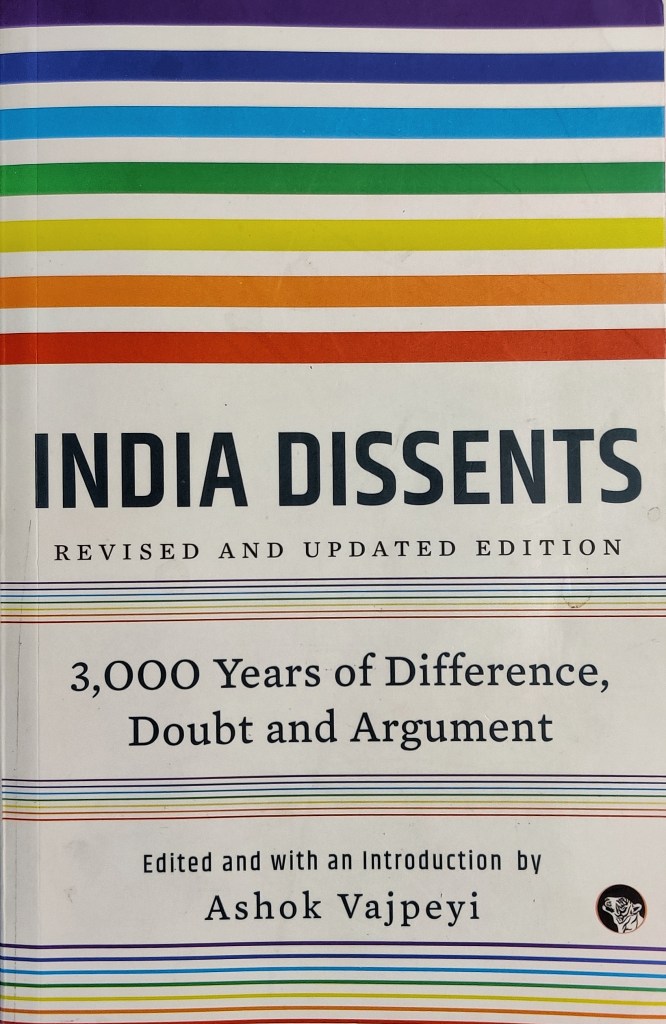
Title: India Dissents — 3,000 Years of Difference, Doubt and Argument

Editor: Ashok Vajpeyi

Publisher: Speaking Tiger, 2020

Every man loves liberty and freedom.
Do not interfere with another’s freedom.

– Gautam Buddha

They say inside the heart of a black hole there is a point of singularity. A point of singularity is where no laws of nature exist, like in the instant before the big bang. That point is so powerful that it obliterates all the rules of the universe. It is a place where the laws of nature collapse. We cannot know what happens inside a black hole, because we do not have the tools with which to predict what might be happening inside. There is no physics. Essentially there are no bearings. There is a lesson in the analogy presented here. When power becomes absolute, it freezes everything within its domain. The only way to prevent power from becoming absolute is to check it. Edited, and with an introduction, by poet Ashok Vajpeyi, India Dissents (Revised and updated edition: 2017, 2020) is a critically important book at a time when many believe India might be hurtling towards its own tryst with ‘singularity’. This timely tome is an attempt to articulate the contrarian views inherent in the Indian tradition, spanning from times of yore, to the present. It is an attempt to chart the organic link between freedom and the courage to check power and its manifestations, whether spiritual, social or political.

The most effective way to check power, as demonstrated by this compendium of ‘3,000 years of difference, doubt and argument’, is to call it out. Dissent is at the heart of the human desire for freedom. And without freedom, we are not human. Lord Acton (who’s by and large more quoted than understood) defines liberty thus: “the assurance that every man shall be protected in doing what he believes his duty against the influence of authority and majorities, custom and opinion” (The History of Freedom in Antiquity).

Critical moments in history have seen the suppression of freedoms. The progress of the human race has not been linear. Ancient India experienced great enlightenment in thought and philosophy. Those who have had to endure the attempt – by contemporary media platforms and concomitant experts – at manufacturing consent vis-à-vis a  narrow world with narrow identities, via appeals to visceral emotions and spurious theories of hurt and cultural assault,  might be surprised to read from the Brihaspati Sutra (foundational text of the Charavak school of Indian philosophy, composed in 600 BCE):

“There is no heaven, no final liberation, not any soul in another world,
Nor do the actions of the four castes, orders or priesthoods produce any real effect.
The Agnihotra, the three Vedas, the ascetic’s three staves, and smearing one’s self with ashes,
Were made by Nature as the livelihood of those destitute of knowledge and manliness …”

The Classical Age saw the birth of Democracy in ancient Greece. Absolute power was kept in check by the voice of the people within the Senate. In India, the counsel of wise voices ensured virtuous actions by Kings. When power heeded the voice of the people or the counsel of the wise, society remained enlightened. But there were intermittent periods of darkness, such as the 1,000 year long dark ages in Europe. The modern world had apparently understood this, which is why modern societies were founded on the principles of liberty, fraternity and equality, the call of the French Revolution against the singularity of power enjoyed under feudalism. But that world is at risk, not only in India but in so many other nations that are otherwise functioning democracies.

Vajpeyi’s book does weigh heavily on recent dissenters whose works are widely in circulation. There is no new ground broken here. And yet it is important for those who have not transcended the plethora of voices that are constantly articulating views smoke-screened by the cacophony of mainstream opinions, championed uncritically by the media, that has long forgotten its mandated role as the Fourth Estate. Some attention is also paid to the freedom struggle, and the thinkers and freedom fighters who left with us a rich legacy of dissent. Amartya Sen traces India’s argumentative nature to our ancient text. He observes how the national penchant for dharnas (strikes) and protests are seared into souls by the struggle against colonial oppression. These voices feature in the book. But the real meat of the book is in the voices of minor poets and dissenting voices (little voices if you like) from our past, unknown perhaps to most.

Here are some voices from the book for you to gauge the diversity of dissent articulated in it. Ghalib in his plaint against God, “Whenever I open my mouth you snap: And who are you? / Is it your culture that I must not speak, only listen to you?” Raja Rammohun Roy against social customs: “Men are in general able to read and write and manage public affairs by which means they easily promulgate such faults women occasionally commit but never consider as criminal the misconduct of men towards women.” And then there is Kazi Nazrul, who along with Tagore, is revered as Bengal’s poetic voice:

“Blow your horn of universal cataclysm!
Let the flag of destruction
Rise amidst the rubbles of prison walls
Of the East!
Who’s the master? Who’s the king?
Who is it that gives punishment
Having snatched away the truth of freedom?”

These words of Nazrul would speak to power, were they to be voiced today. Whether it is Gandhi’s articulation of dissent against colonial rule, or Tagore’s denunciation of the idolisation (literally the worship of the nation as Mother, venerated via the slogan: ‘Vande Mataram’) of the nation over humanity, or even Periyar’s cry against superstition and caste oppression, and of course Bhagat Singh’s sharp critique of the world of oppression around him, India Dissents reminds us of what lies at the core of who we are: a plural society shaped by myriad traditions and cultures bearing the influence of peoples from faraway places. No one ruler, no one rule, no one singular identity, can ever define ‘the wonder that is India’ (to misquote A L Basham slightly).

Particularly amusing is the inclusion of the ‘obscenity’ trial against Chugatai and Manto (who was a born dissenter), presented in Chugtai’s voice. The presiding judge being perceptive decided he needed to talk to the contestants in his chambers and had drawn them therein. Chugtai: “The judge called me into the anteroom attached to the court and said quite informally, ‘I’ve read most of your stories. They aren’t obscene. Neither is ‘Lihaf’. But Manto’s writings are littered with filth.’ ‘The world is also littered with filth,’ I said in a feeble voice. ‘Is it necessary to rake it up then?’ ‘If it is raked up it becomes visible and people feel the need to clean it up.’” The judge laughed. Today, no anchor on prime news TV would laugh if told someone needs to rake up what’s wrong with our system so that we could work together to fix it.  Such a person would be labelled ‘anti-national’. 

India is at the crossroads. Not because its politics is troubled. Politics is all about rotation, and every moment in history is contested by that which is to follow. The world so far has witnessed many ups and downs and so shall India. What is troubling is the anger throbbing inside the people who are ready to rake offense, at almost anything. This is particularly true of the entitled, the middle classes — those with a modicum of education and material wealth. The facile credulity of the great mass of people who can be led by fake news, ‘What’s App University’, misogyny and the willing suspension of disbelief is what is truly threatening I contemporary India. To dissent is to grow. To accent without questioning is to shrink. To read India Dissents is in a way therefore an attempt to try and rediscover India’s soul.

India’s strength lies in its diversity, best explained in the words of Maheswata Devi’s words, reproduced from the book: “Indian culture is a tapestry of many weaves, many threads. The weaving is endless as are the shades of the pattern. Somewhere dark, somewhere light, somewhere saffron, somewhere as green as the fields of new paddy, somewhere flecked with blood, somewhere washed cool by the waters of a Himalayan spring. Somewhere the red of a watermelon slice. Somewhere the blue of an autumn sky in Bengal. Somewhere the purple of a musk deer’s eye. Somewhere the red of a new bride’s sindoor. Somewhere the threads from words in Urdu, somewhere in Bengali, somewhere in Kannada, somewhere in Assamese, yet elsewhere in Marathi. Somewhere the clothes frays. Somewhere the threads tear. But still it holds. Still. It holds.”

Diversity and dissent go hand in hand. To be able to dissent is also to be able to accept the dissent of others. Dissent is not always angry. It is questioning and it is curious. It is at the heart of what it means to be human. It is what makes us modern and free of the prejudices that have often laid civilization low. It is Des Cartes’ great call ‘Cogito Ergo Sum’ (I think therefore I am). The method of doubt foregrounded by the advent of reason, as it were, led not just to political emancipation, but also to the great scientific discoveries that define modern existence. Dissent is the source of discovery and research. Dissent is our door to adulthood, our way of finding ourselves. Any society that demonises dissent shuts the door to what it can become; it shuts the door to as yet unmapped possibilities. By crushing dissent, a society seals its tryst with negativity and slides into the prison-house of its worst fears and anxieties.

But then who is the most distinguished dissenter among them all? My choice is clear: It is none other than Mahatma Gandhi himself. To understand the nature of Gandhi’s dissent, one must first recognise the fact that perhaps along with Emperor Ashoka and the Prophet Muhammad, he was among those who believed in the imperitive of morality in politics, and in the politics of morality. Said he: “In my opinion, non-cooperation with evil is as much a duty as is cooperation with good.” By imbuing a moral quality to political action, Gandhi brought to bear exacting standards to politics, unheard of in the modern era. His very politics dissents against the existing dictum of political action: That politics is the art of the possible.

But Gandhi’s is not merely a great dissenter in politics. He is, in the words of the author of the internationally recognised novel Samskara (1965), and litterateur, UR Ananthamurthy, a ‘critical insider’. Gandhi, avers Ananthamurthy, allowed himself to be absorbed by the traditions of India, and from within that position, articulated his critique of what he saw as wrong with that tradition. He was a devout Hindu who was secular to a fault, and against the evils inherent in Hindu society. It is precisely because of this that Gandhi was so successful in mobilising India both politically and socially.

Alas today, those who are critical are seen as outsiders: westernised, liberal, socialists, and so on. And those who are insiders are not critical: they are viewed as provincial, obsequious, bigoted and belligerent. India will have to find the will to shake itself free of the straight jacket it finds itself in at the moment. That can happen with only more, and not less, dissent.

.

Debraj Mookerjee has taught literature at the University of Delhi for close to thirty years. He claims he never gets bored. Ever. And that is his highest skill in life. No moment for him is not worth the while. He embraces life and allows life to embrace him.

.

PLEASE NOTE: ARTICLES CAN ONLY BE REPRODUCED IN OTHER SITES WITH DUE ACKNOWLEDGEMENT TO BORDERLESS JOURNAL.

.

Disclaimer: The opinions expressed are solely that of the author.
Categories
Review

The Myriad Hues of Love

Book Review by Meenakshi Malhotra

Title: Love is not a word: The Culture and Politics of Desire

Editor:  Debotri Dhar

Publisher: Speaking Tiger, 2020

Love is not a word: The Culture and Politics of Desire edited by Debotri Dhar is a timely and illuminating book. It asks the right questions, sets up the debate on issues which need to be debated in order to bring the many hues of love and desire out of stranglehood of monolithic constructions. Dhar has brought together some interesting essays  by noted academics, art historians and curators, cultural and literary  historians  and writers  musing on the theme of love, its histories and its manifestations in religious mythography.

In the first essay in the anthology, ‘Swayamvara, Arranged Marriage, Desi Romance’, Professor Malashri Lal brings her considerable acumen and expertise to offer “some fascinating perspectives on Indian love, mapping both continuity and change, possibility and paradox.” She draws upon a spectrum of sources to unsettle some of the binaries and clichés about love and marriage in India. She points out the very heterogeneous nature of Indian realities and the simultaneous existence of designer weddings along with the prevalence of child marriage, the latter motivated by  stark poverty and custom. In this heterogeneous context, where contradictions exist and jostle with one another, it is difficult to formulate one overarching reality which collapses every aspect of Indian reality into one single, overwhelming truth.  Drawing upon a diverse set of sources from the Indian epics like Ramayan and Mahabharata to the writings of diasporic women writers in the US, to Bollywood films, Lal problematises the question of women’s choice in love and marriage, even when it is arranged. In her essay, she highlights the exercise of agency enabled by the ancient practice of  swayamvara, where the  bride reviews a number of suitors and selects one as her husband to the popular Hindi film, Queen (2014), where the ‘bride’, jilted by her suitor at the eleventh hour when practically at the altar, sets off alone on a ‘honeymoon’ to Paris and Amsterdam. All these vignettes, according to Lal, point to a long history of critiques of compelled marriages for women. Decoding the history of marriage and the space both accorded to and  negotiated by women within it, the author traces both continuities as well as complicating questions of love versus arranged marriage, choice, desire and agency.

Some of the themes and issues initiated by the first essay are questions that come up elsewhere, albeit in varying registers. Professor Makarand Paranjape’s essay focuses on immortal love and on the lover-God Krishna and his consort Radha, who is “a milkmaid elevated to the status of the erotic and holy beloved of the Supreme Godhead”. Paranjape reads the figure of Radha in the context of Indian history, art, culture and metaphysics, traces the genealogy and argues that the increasing importance of Radha acted as a corrective to the male-dominated theology which lacked a strong Goddess prior to the emergence of Radha. According to the author, she is largely absent in the classical sources and in the scriptures, her origins shrouded in obscurity, but assumes importance later as Krishna’s chosen paramour in Jayadev’s Gitagovinda, which is how medieval poets like Chandidas, Vidyapati and Surdas write of her.

A common theme which is indicated in the previous essay is developed by Paranjape and then later, by Alka Pande in the subsequent essay on ‘Love, Longing and Desire: A Nayika’s tale’. The flattening out of desire in keeping with the imperial puritanical norms of social control dwell on how desirous voices create discomfort. The messiness of love and desire is sought to be controlled and circumscribed into the heteronormative frame of marriage. Both imperial control and nationalistic schemes of reform collude to silence and erase traces of lascivious female desire and the erotic is therefore subdued and subsumed into the discourse of female purity, with which it sits uncomfortably. Thus, Prof Paranjape discusses how, “with the beginnings  of colonial modernity in India, Radha the Goddess underwent another drastic modification, now coming to often represent illegitimate sexual desire. In the new Puritanism fostered during the so-called Indian renaissance(18th to 19th century), Radha and her dalliance with Krishna proved an embarrassment to the agenda of social reform that the proponents of Hindu respectability espoused.”

By the 20th century, Radha was represented as “a victim of patriarchy” — as a symbol of the degraded and exploited woman, a fallen or abandoned woman. This is a far cry from the tantric version of Radha , which exalts her, sometimes over Krishna. In other traditions, she is often domesticated and shown to be a “chaste and jealous wife”, very possessive of Krishna, given to fits of rage. The theme of romantic love  is played out in varying registers and the sacred and profane so intermingled and intertwined that it is difficult to separate the two.

Alka  Pande’s essay on ‘Love, Longing and Desire: A Nayika’s Tale’ is deliciously erotic in its texture as it  narrates the tale of Amrapali, the “nagarvadhu”(bride of the city) of Patliputra, who lives life and fulfils her desire on her own terms. It shows the courtesan as an empowered figure, who exercises considerable agency in her choice of partner after the demise of her royal consort. As a reader and an editor of Vatsyayana’s Kamasutra, she claims to have transformed the book “from a compendium of living a deeply enriched and sexually fulfilled life to much more: strategies of romance, love, longing, desire, seduction and an unabashed valorization of carnal love.” (Pande,44) The essay also sets the record straight about the popular reception in the public imagination which sees the book as a manual of sex; rather it conforms to the Indian philosophy of “Purusharthas” which includes the goals of “dharma”, “artha”, “kama” and “moksha”, roughly translatable as virtuous living, material prosperity, aesthetics and pleasure and salvation, respectively. Kamasutra, in this narrative, emerges  as  a document which explores the art of living life to the fullest. Love and its many facets are explored along a spectrum of aestheticism, in a way that elevates it to a level beyond hedonism.

Christina Dhanaraj’s essay on ‘Swipe me Left, I’m Dalit’ explores the world of possibilities of romantic love for Dalit women, and finds the odds heavily weighted against them on account of caste prejudice. She therefore finds the optimistic and celebratory accounts on social media and /or dating apps like tinder which declare ‘caste’ as a thing of the past to be false and facile. Dalit women, according to the author, “carry the double burden of gender and caste, and are one of the most socially undervalued in India, are therefore under constant pressure to project an acceptable version that mimics the ‘savarna’ (upper caste) ideal.”

From the problems besetting inter-faith Hindu-Muslims relationships because of a persistent polarisation intensified by right-wing ideologies to the variegated spectrum of love’s vows and woes in Urdu poetry, are some of the themes explored in some of the subsequent essays.

 Rakhshanda Jalil, the eminent literary historian , points out interesting aspects of the “Barahmasa”( Twelve Months)which are songs of love, separation and yearning, both mystic and secular, in a woman’s voice. However, while the form concerned itself with the “women’s world, adopted a woman’s voice and spoke of a woman’s needs , none were actually written by women poets.’’(Jalil,125)Further, a study of the “barahmasas show how the word was lost to text, and orality to textuality, but also how pluralism was replaced by Unitarianism, multi-culturalism by puritanism, the feminine-gendered narration by the masculine, and inclusion by exclusion.”(Jalil,112)

Debotri Dhar’s thought-provoking musings on the profoundly gendered nature of love and waiting is a delightful read, punctuated with valuable insights into women’s writing and experiences. So are the other essays by Sumana Roy, Parvati Sharma and Didier Coste.

In its exploration of the variegated hues and discourses of love and its analysis of its many histories, the essays in the book demonstrate that love — as text, as play, pain and pleasure, in somewhat unequal measure —  is truly a many-splendoured thing and makes the world go around. These essays also illustrate the peculiarly gendered nature of love, where we are tempted to echo Byron’s  lines from Don Juan

Man’s love is of man’s life a thing apart,

‘Tis woman’s whole existence

  .

Dr Meenakshi Malhotra is Associate Professor in English at Hansraj College, University of Delhi. She  has edited two books on Women and Lifewriting, Representing the Self and Claiming the I, in addition  to numerous published articles on gender and/in literature and feminist theory. Some of her recent publications include articles on lifewriting as an archive for GWSS, Women and Gender Studies in  India: Crossings (Routledge,2019),on ‘’The Engendering of Hurt’’  in The State of Hurt, (Sage,2016) ,on Kali in Unveiling Desire,(Rutgers University Press,2018) and ‘Ecofeminism and its Discontents’ (Primus,2018). She has been a part of the curriculum framing team for masters programme in Women and gender Studies at Indira Gandhi National Open University(IGNOU) and in Ambedkar University, Delhi and has also been an editorial consultant for ICSE textbooks (Grades1-8) with Pearson publishers. She has recently taught a course as a visiting fellow in Grinnell College, Iowa. She has bylines in Kitaab and Book review.

.

PLEASE NOTE: ARTICLES CAN ONLY BE REPRODUCED IN OTHER SITES WITH DUE ACKNOWLEDGEMENT TO BORDERLESS JOURNAL.             

Categories
Review

How old is the Kashmir Dispute?

Book review by Bhaskar Parichha

Title: Understanding Kashmir and Kashmiris

Author: Christopher Snedden

Publisher: Speaking Tiger, 2020

There can be, and have been, countless books on Kashmir and Kashmiris. Given its geopolitical importance in the Indian subcontinent and the constant needling by Pakistan, Kashmir has been a boiling point in the relationship between the two disagreeing neighbors. It has now been a year since the Indian government changed the status of Kashmir by making amendments to Articles 370 and 35A. Since then, Pakistan’s efforts to highlight this unilateral change and the human rights violations within it have been under the spotlight.

The challenge in writing a book on undivided Jammu & Kashmir — the only Muslim majority state in India — in the backdrop of four wars with Pakistan in 1948, 1965, 1971, and 1999 and also in the context of Chinese conflict in 1962 is enormous. Fortuitously, Christopher Snedden has come out with a book that is unprejudiced and at the same time comprehensive. Understanding Kashmir and Kashmiris is just the book you want to read on Kashmir.

Australian politico-strategic analyst, author and academic specializing in South Asia, Snedden has worked with governments, businesses, and universities. Currently, a professor at the Asia-Pacific Center for Security Studies, Honolulu, Hawaii, he  visited J&K frequently to undertake research for this and has interviewed many elder statesmen involved in the Kashmir dispute. This authoritative book is the result of that endeavor.

Reads the blurb: “In 1846, the British created the state of Jammu and Kashmir and then quickly sold this prized region to the wily and powerful Raja Gulab Singh. Intriguingly, had they retained it, the India-Pakistan dispute over possession of the state may never have arisen, but Britain’s concerns lay elsewhere — expansionist Russia, beguiling Tibet and unstable China — and their agents played the ‘Great Game’ in Afghanistan and what was then known as ‘Turkistan’.”

Snedden contextualizes the geo-strategic and historical circumstances surrounding the British decision to relinquish Kashmir and explains how they and four Dogra maharajas consolidated and controlled J&K subsequently. He details the distant borders and disintegrated peoples that comprised the diverse princely state. It explains the Maharaja of Jammu and Kashmir’s controversial accession to India in 1947 — and its unpremeditated consequences.

Writes Snedden in the introduction, “The Kashmir dispute is now seventy years old. This makes it older more than ninety percent of Indians and Pakistanis. Its longevity surpasses the average life expectancy of a Pakistani male (65.16 years) and an Indian male (66.68 years)…Wistfully, some of my friends in J&K, India, and Pakistan tell me that the Kashmir dispute would continue for another two-thirds of a century…This book provides sufficient background information for a reader to understand why such a woeful scenario is possible.

Surely, the ground situation in J&K has changed since the book was written and, particularly, after 5th August 2019. But the dispute is far from over because  Pakistan constantly harks back that Kashmir cannot be removed from the agenda of the United Nation Security Council, which was committed to resolving the issue according to the wishes of the Kashmiri people.

Coming back to the politico-historical analysis of Kashmir, Snedden weaves a compelling narrative that frames the ‘K’ dispute, explains why it continues, and assesses what it means politically and administratively for the divided peoples of the state and their undecided futures.

Divided into five parts and punctiliously done chapters, Snedden begins with the Sikhs:  “We now come to an intriguing matter concerning the Sikh Empire: the significant role played by two powerful and influential brothers from Jammu, Gulab, and Dhyan (Dhian) Singh. In particular, as we shall see, the British took Raja Gulab Singh very seriously. The Sikh Empire had many non-Sikhs serving as soldiers and administrators. These included Gulab and Dhyan Singh, plus their other brother, Suchet, from the Jammu area that was located immediately to the south of Kashmir and north of the Sikh Empire’s Punjab heartland. Jammu had some strategic importance as its hilly uplands were relatively remote from traditional invasion routes into India that crossed Punjab. People had sought refuge from invaders in such areas, including most recently from marauding Afghans. Nevertheless, there was no distinct geographic division between Jammu and Punjab. Essentially, Jammu was an undulating-to-hilly extension of the Punjab plains that rose northwards to the Pir Panjal range located at the southern edge of the Kashmir Valley, with this range providing a natural boundary between Kashmir and Jammu.

Because Gulab Singh was a brave and capable soldier, in the 1810s, he caught the eye of the Sikh Maharaja. This was significant as both men thereafter engaged in a mutually beneficial partnership that brought them extensive benefits. For the effective but vigilant Maharaja Ranjit Singh, Gulab provided a non-Sikh ally whom the ruler could trust, an important factor in a fractious empire in which Ranjit was the senior Sikh. The ambitious Gulab Singh used Ranjit as a vehicle for Gulab to advance himself and his interests. Gulab Singh apparently first came to Ranjit Singh’s notice in the Kashmir campaign of 1813, after which Gulab was given control of the Reasi area, north of Jammu, in 1815. Later, because of his actions suppressing the uprising in Jammu in 1819, Ranjit Singh recognized the Jammuite as ruler of Jammu in 1822.”

What enhances the beauty of this 360- page is the in-depth analysis is the lucid explanation. Written in a language that is most nourishing and generous, this book is by far the best chronicle on Kashmir. Snedden has adroitly handled the dispute along with its intricate political and geo-strategic dimensions. He goes that extra mile to probe at length the history of the oft-neglected Kashmiris too.

An excellent account of Kashmiri identity and the conflict between India and Pakistan, the book is peerless on one of the world’s most ‘intractable disputes.’

PLEASE NOTE: ARTICLES CAN ONLY BE REPRODUCED IN OTHER SITES WITH DUE ACKNOWLEDGEMENT TO BORDERLESS JOURNAL. 

Categories
Review

“I am waiting to be at home; where, I don’t know yet”– Dom Moraes

Book Review by Rakhi Dalal

Title: Never at Home

Author: Dom Moraes

Publisher: Speaking Tiger, 2020

Never at Home is the third memoir in the trilogy of memoirs written by Dom Moraes. The others being Gone Away (1960) and My Son’s Father (1968). This volume was first published by Penguin India in 1992. Here the author writes about his life from 1960 onwards.

The first chapter is a brief account of the phase of his life after winning the prestigious Hawthornden prize at the age of twenty. By the time he turned twenty two, Moraes already had two poetry collections and a memoir to his name. In order to earn a livelihood, he then started writing features and reviews for newspapers. In 1965, he brought out his third poetry collection John Nobody. After James Cameron impelled him to take up journalism, Moraes started travelling and for the next seventeen years he couldn’t write poetry. For someone, who from his childhood knew that he wanted to be a poet and to live in England, he spent a considerable period of his life in transit without writing any substantial poetry. Never at Home chronicles those years he was engaged in navigating the world to collect stories and interviews.

This volume is the third and final in his collective memoirs – A Variety of Absences, which take its name from the poem Absences written by him after a long hiatus from poetic fervour. The book focuses more on Moraes’ professional life as compared to his personal life taken up in his second memoir so that its prose is not as poetic or intense as in My Son’s Father but nevertheless, it is a notable piece of literary writing. It may also be deemed as a historical archive because it records some very important and interesting snippets and observations from the political world he traversed and eminent leaders he met.

The critical success of Gone Away, his first memoir, brought him writing assignments which included scriptwriting for a documentary on India. As a journalist, he covered Eichmann’s trial in Jerusalem and wars in Algeria and Israel. In his mind he had always been an English poet in England and had no idea of the tribulations other immigrants faced. A BBC documentary commissioned to him made him look at the living conditions of Asian immigrants, specifically from India and Pakistan. This documentary brought him closer to the reality of being an outsider in a foreign country.

While writing articles for The New York Times Sunday Magazine, Daily Telegraph, Nova and many others magazines, he met and interviewed many distinguished personalities and important world leaders but perhaps none left as deep an impression upon him as Indira Gandhi, whose biography he was later to write. The liberation of East Pakistan, now Bangladesh, had made her a star in the eyes of its natives who were till then hostile to Indians. Moraes writes at length about his meetings with her, about her charismatic personality, political astuteness and her almost invincible demeanor.

His descriptions of the journalistic assignments, which took him across many countries and gave him the opportunity to bring out stories to the world, are finely detailed. His keen eye presents a balanced perspective on the stories he covered, never going too far and never delivering too less. His most important works included a story on political prisoners in Buru and on the tribal people in Dani in Indonesia, the titles of the articles being ‘The Prisoners of Buru,’ and ‘The People Time Forgot’. His Buru piece evoked a violent response in Indonesia. Moraes was banned from entering the country again. But this piece was the first one to come out from the place and the issue was picked up by some human rights organisations leading to a release of seven thousand from the imprisoned ten thousand people. This, if anything, is a proof of the important voice he had become in journalism.

Although, Moraes’ work kept him busy in the world but he could somehow never get rid of the images of his traumatised childhood. As in the case of his second memoir,here also he writes considerably about his fear of confronting his mother. The accounts of his meetings with her are laced with the anguish and anxiety he had experienced in her presence always. Except his mother, all the other women in his life are only addressed in passing. He never dwells much upon his relationship with either his second wife, Judith, mother of their son Francis, or with his third wife, Leela Naidu. In comparison, his association with his friends and work colleagues occupy more space in this memoir. His regret for not becoming the father he thought he was when he wrote My Son’s Father comes perhaps due to his inability to express what he felt before others, including his family.  

Moraes picked up journalism as a vocation to earn a living but it brought him closer to real life. His punctuated visits to India, whether to write on Naxalbari movement, to meet Indira Gandhi, King of Sikkim or to explore Rajasthan, led to an increased understanding of the country of his birth. Nonetheless, he was never at home in India or in the country he had adopted as a youngster.

The disquiet that marked his life is perhaps most poignantly conveyed in this line towards the end:

“I am waiting to be at home; where, I don’t know yet.”

As he settled in the country of his birth, after all the travelling, his muse did eventually return to him. The various absences – of a mother, a father, his friends from the youth or his son — at different times in his life and their memories, continued to haunt him. Yet this memoir ends with a hopeful note. In author’s words, “the best thing to do is to preserve some form of balance on the constantly moving ground tectonic plates of this planet.”

.

Rakhi Dalal is an educator by profession. When not working, she can usually be found reading books or writing about reading them. She writes at https://rakhidalal.blogspot.com/ . She lives with her husband and a teenage son, who being sports lovers themselves are yet, after all these years, left surprised each time a book finds its way to their home.

.

PLEASE NOTE: ARTICLES CAN ONLY BE REPRODUCED IN OTHER SITES WITH DUE ACKNOWLEDGEMENT TO BORDERLESS JOURNAL.