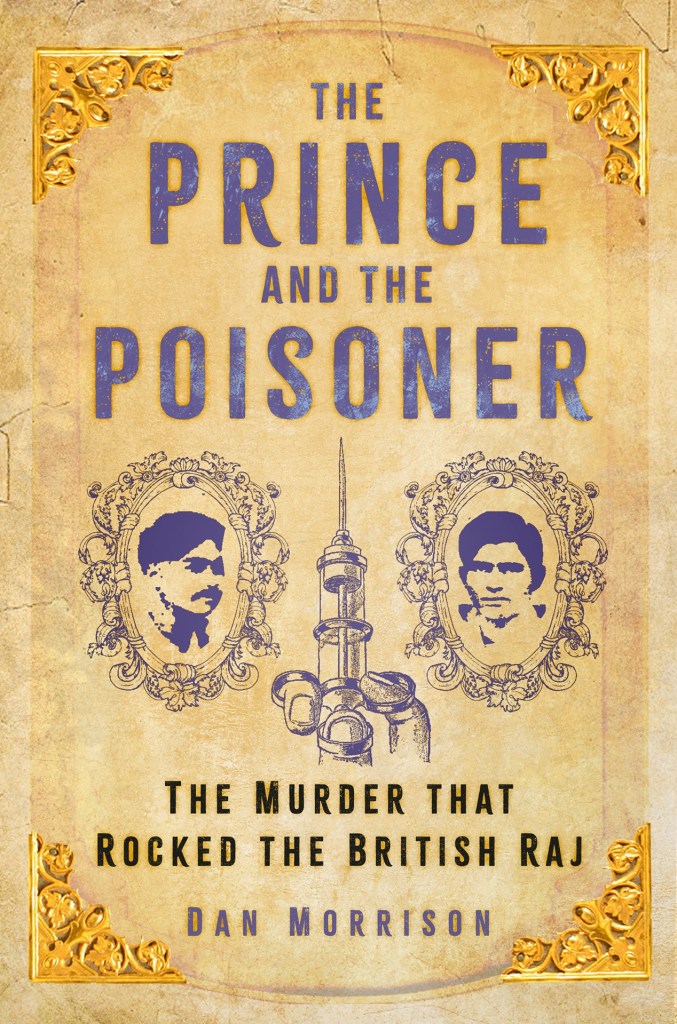
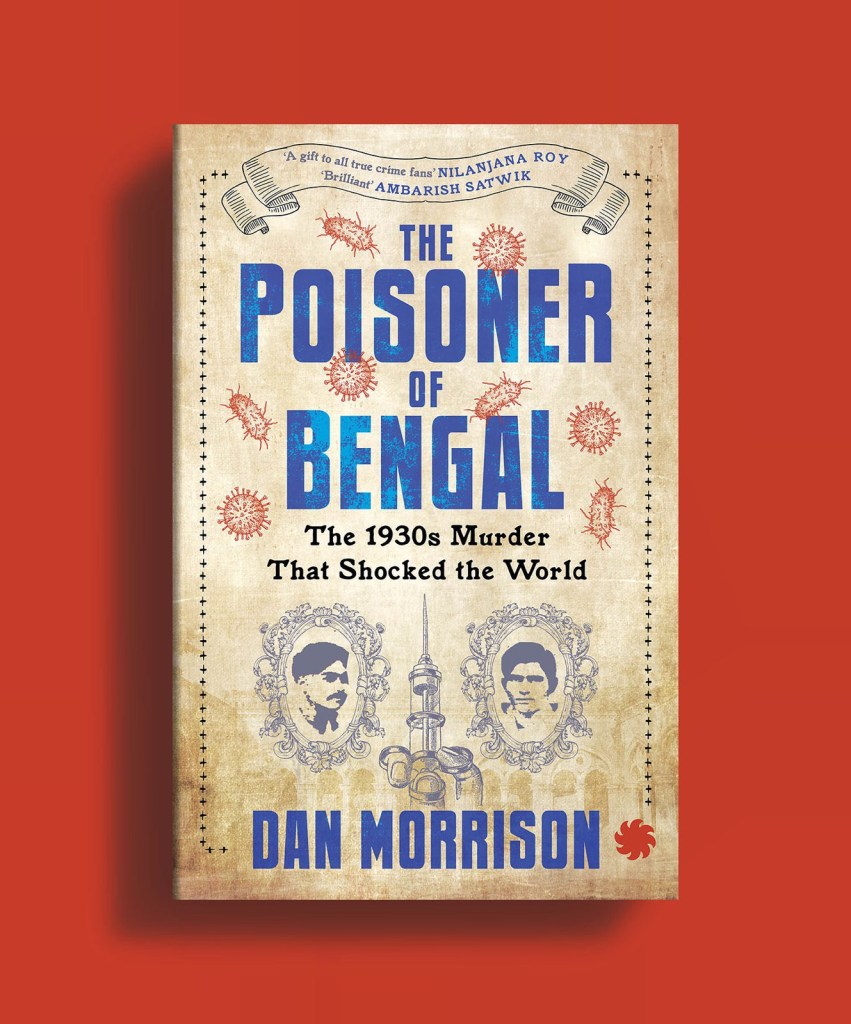
Titles: The Poisoner of Bengal/The Prince and the Poisoner
Author: Dan Morrison
Publishers: Juggernaut (India)/ The History Press (UK)
November1933:HowrahStation
For most of the year, Calcutta is a city of steam, a purgatory of sweaty shirt-backs, fogged spectacles, and dampened décolletage. A place for melting. In summer the cart horses pull their wagons bent low under the weight of the sun, nostrils brushing hooves, eyes without hope, like survivors of a high desert massacre. The streets are ‘the desolate earth of some volcanic valley’, where stevedores nap on pavements in the shade of merchant houses, deaf to the music of clinking ice and whirring fans behind the shuttered windows above.
The hot season gives way to monsoon and, for a while, Calcuttans take relief in the lightning-charged air, the moody day- time sky, and swaying trees that carpet the street with wet leaves, until the monotony of downpour and confinement drives them to misery. The cars of the rich lie stalled in the downpour, their bonnets enveloped in steam, while city trams scrape along the tracks. Then the heat returns, wetter this time, to torment again.
Each winter there comes an unexpected reprieve from the furious summer and the monsoon’s biblical flooding. For a few fleeting months, the brow remains dry for much of each day, the mind refreshingly clear. It is a season of enjoyment, of shopping for Kashmiri shawls and attending the races. Their memories of the recently passed Puja holidays still fresh, residents begin decking the avenues in red and gold in anticipation of Christmas. With the season’s cool nights and determined merriment, to breathe becomes, at last, a pleasure.
Winter is a gift, providing a forgiving interval in which, sur- rounded by goodwill and a merciful breeze, even the most determined man might pause to reconsider the murderous urges born of a more oppressive season.
Or so you would think.
On 26 November 1933, the mercury in the former capital of the British Raj peaked at a temperate 28°C, with just a spot of rain and seasonally low humidity. On Chowringhee Road, the colonial quarter’s posh main drag, managers at the white- columned Grand Hotel awaited the arrival of the Arab-American bandleader Herbert Flemming and his International Rhythm Aces for an extended engagement of exotic jazz numbers. Such was Flemming’s popularity that the Grand had provided his band with suites overlooking Calcutta’s majestic, lordly, central Maidan with its generous lawns and arcing pathways, as well as a platoon of servants including cooks, bearers, valets, a housekeeper, and a pair of taciturn Gurkha guardsmen armed with their signature curved kukri machetes. Calcuttans, Flemming later recalled, ‘were fond lovers of jazz music’. A mile south of the Grand, just off Park Street, John Abriani’s Six, featuring the dimple-chinned South African Al Bowlly, were midway through a two-year stand entertaining well-heeled and well-connected audiences at the stylish Saturday Club.
The city was full of diversions.
Despite the differences in culture and climate, if an Englishman were to look at the empire’s second city through just the right lens, he might sometimes be reminded of London. The glimmer- ing of the Chowringhee streetlights ‘calls back to many the similar reflection from the Embankment to be witnessed in the Thames’, one chronicler wrote. Calcutta’s cinemas and restaurants were no less stuffed with patrons than those in London or New York, even if police had recently shuttered the nightly cabaret acts that were common in popular European eateries, and even if the Great Depression could now be felt lapping at India’s shores, leaving a worrisome slick of unemployment in its wake.
With a million and a half people, a thriving port, and as the former seat of government for a nation stretching from the plains of Afghanistan to the Burma frontier, Calcutta was a thrumming engine of politics, culture, commerce – and crime. Detectives had just corralled a gang of looters for making off with a small fortune in gold idols and jewellery – worth £500,000 today – from a Hindu temple dedicated to the goddess Kali. In the unpaved, unlit countryside, families lived in fear of an ‘orgy’ of abductions in which young, disaffected wives were manipulated into deserting their husbands, carried away in the dead of night by boat or on horseback, and forced into lives of sexual bondage.
Every day, it seemed, another boy or girl from a ‘good’ middle- class family was arrested with bomb-making materials, counterfeit rupees, or nationalist literature. Each month seemed to bring another assassination attempt targeting high officials of the Raj. The bloodshed, and growing public support for it, was disturbing proof that Britain had lost the Indian middle class – if it had ever had them.
Non-violence was far from a universal creed among Indians yearning to expel the English, but it had mass support thanks to the moral authority of Mohandas Gandhi. Gandhi, the ascetic spiritual leader whose campaigns of civil disobedience had galvanised tens of millions, was then touring central India, and trying to balance the social aspirations of India’s untouchables with the virulent opposition of orthodox Hindus – a tightrope that neither he nor his movement would ever manage to cross.
And from his palatial family seat at Allahabad, the decidedly non-ascetic Jawaharlal Nehru, the energetic general secretary of the Indian National Congress, issued a broadside condemning his country’s Hindu and Muslim hardliners as saboteurs to the cause of a free and secular India. Nehru had already spent more than 1,200 days behind bars for his pro-independence speeches and organising. Soon the son of one of India’s most prominent would again return to the custody of His Majesty’s Government, this time in Calcutta, accused of sedition.
It was in this thriving metropolis, the booming heart of the world’s mightiest empire, that, shortly after two o’clock in the afternoon on that last Sunday in November, well below the radar of world events, a young, slim aristocrat threaded his way through a crowd of turbaned porters, frantic passengers, and sweating ticket collectors at Howrah, British India’s busiest railway station.
He had less than eight days to live.
About the Book:
A crowded train platform. A painful jolt to the arm. A mysterious fever. And a fortune in the balance. Welcome to a Calcutta murder so diabolical in planning and so cold in execution that it made headlines from London to Sydney to New York.
Amarendra Chandra Pandey, 22, was the scion of a prominent zamindari family, a model son, and heir to half the Pakur Raj estate. Benoyendra Chandra Pandey, 32, was his rebellious, hardpartying halfbrother – and heir to the other half. Their dispute became the germ for a crime that, with its elements of science, sex, and cinema, sent shockwaves across the British Raj.
Working his way through archives and libraries on three continents, Dan Morrison has dug deep into trial records, police files, witness testimonies, and newspaper clippings to investigate what he calls ‘the oldest of crimes, fratricide, executed with utterly modern tools’. He expertly plots every twist and turn of this repelling yet riveting story –right up to the killer’s cinematic last stand.
About the Author:
Dan Morrison is a regular contributor to The New York Times, Guardian, BBC News and the San Francisco Chronicle. He is the author of The Black Nile (Viking US, 2010), an account of his voyage from Lake Victoria to Rosetta, through Uganda, Sudan and Egypt. Having lived in India for five years, he currently splits his time between his native Brooklyn, Ireland and Chennai.
.
PLEASE NOTE: ARTICLES CAN ONLY BE REPRODUCED IN OTHER SITES WITH DUE ACKNOWLEDGEMENT TO BORDERLESS JOURNAL
An Indian newspaper published an article about adults who still read Tintin and I realised that although I would have liked to be interviewed for that article, my qualifications were inadequate, for there is no ‘still’ in my particular case. I only began reading the comic when I was grown up. In fact, I only read it properly in the past few years, and I am more than half a century old. True, I did read one or two of his adventures when I was young, but I read them half-heartedly, I don’t know why, instead of with unalloyed delight, as they ought to be read. Possibly they were too elaborate for me back then.
Yes, Tintin is elaborate, but this doesn’t mean it isn’t simple. Yet it has the kind of simplicity that seems complex to the very young reader. There are plots and subplots, conspiracies and clues, and all of this is perhaps a bit much for the mind of a child more familiar with the primitive antics of Dennis the Menace or The Bash Street Kids from The Beano. Each of Tintin’s exploits seemed beyond reasonable length to me, too adult and requiring a heavy investment of my time and intelligence. I speak, naturally enough, only from a personal perspective. In some households, Tintin was read by minds younger than mine, understood and enjoyed too. I was clearly a late developer.
Thanks to a remarkable bookshop in Bangalore, I have been able to obtain the comic books in omnibus editions and catch up with what I missed out on. It intrigued me to learn that the elements I had regarded as impossibly modern in my youth are now quaintly dated. Tintin’s adventures are not hugely dissimilar in tone and setting to the adventure stories of John Buchan1 and they even put me in mind of Somerset Maugham2 at his most sensational, with their heavy reliance on seaplanes and tramp steamers and open-topped automobiles. The pacing is as fast as The Thirty-Nine Steps or Greenmantle, the atmosphere as exotic-colonial as The Moon and Sixpence or The Narrow Corner. There are differences too, of course, but the differences are less surprising.
The pacing is incredibly fast and Tintin blunders his way into scrapes and pickles almost as if destiny has chosen him for the role of spanner in the cogs of the workings of villains, which in a way it has (if we regard Hergé as Fate). He is highly competent most of the time, but can also be inefficient and even inept, often hampered as well as helped by his dog, Snowy. But no quantity or quality of hampering can keep him down for long, he is deft at seizing the opportunities of coincidence that extreme contrivance throws his way. He is fully the equal of any ancient hero from legend or mythology.
And he is mentally strong: no amount of trauma, no near-death incidents or hair-breadth escapes affect him psychologically. He falls out of an aeroplane, an assassination attempt by a dastardly pilot, and his parachute malfunctions. A flat character on a flat page is about to be flattened on the flat ground, but no, he has the singular good fortune to land in a hayrick being transported on a cart. There are no broken bones and no gasping for breath. He picks himself up, dusts off a few straws, resumes his mission with perfect aplomb. One might even say he is inhuman in his attitude to danger. A touch of psychopathy, perhaps? But he is a friend of goodness, an enemy of criminality.
He is also weirdly tolerant of the pompous ineffectiveness of all the sundry supporting characters who populate his existence. Thomson and Thompson, the detectives who never get it right but always take credit for cases solved in their vicinity, provide comic relief, which justifies itself, but even a cursory analysis of their deeds raises a few awkward questions. How on earth are they entrusted continually with missions requiring the utmost delicacy, tact and cunning? They are negative factors in the field of detection, hindrances rather than boons, a pair of slim buffoons (we normally regard buffoons as portly) with a strange sartorial taste and peculiar speech patterns, dramatically underperforming sleuths who are prone to take what they are told at face value. They are worse than useless; they are beneficial to the continuance of evil.
It was a long time before I was able to tell them apart but now, I know they are doubles rather than twins, and that the one with the drooping moustache is Thompson and the one with the flaring moustache is Thomson. In the original French, they were Dupont and Dupond, which is a little less confusing but not much. Tintin ought to have nothing to do with them, but he is always delighted to see them and treats them as highly competent and valuable colleagues. This is a symptom of his own occasional incompetence. But this has nothing to do with India and so we must regretfully forget them.
Tintin travels to India on several occasions. In Egypt, he daringly escapes a firing squad, requisitions an aeroplane, a 1929 de Hallivand DH-80 Puss Moth, one of the highest performing aircraft of its time, with a 130 hp (97 kW) Gipsy Major engine (this aircraft is also notable for being the first to cross the Atlantic from east to west, in 1932) and he courageously, some might say foolishly, sets off for India. Unlike the pilot Nevill Vintcent3, who flew the exact same aircraft from Britain to Sri Lanka (Ceylon, as it once was) without crashing, Tintin runs out of fuel and comes down in the jungle.
Although extremely absurd, the idea of piloting such a plane so far isn’t as implausible as it might appear. We should remember Maurice Wilson4, that very noble but eccentric mystic who planned to climb Mount Everest solo in 1934, forty-six years before Reinhold Messner5 managed the feat, and of course it was inevitable that he would fail, for all the odds were against him. Despite his lack of flying experience, he purchased a de Havilland DH.60 Moth, a more rickety aircraft than the one Tintin used, and flew it from Britain to India in a series of hops. It was a lunatic thing to attempt and yet he succeeded. His failure was on the mountainside, not in the air. Therefore, we have established that Tintin really could have flown to India from Egypt.
Tintin, after his crash landing, meets elephants in the jungle and he wishes to solicit their aid but he doesn’t know their language. He decides to learn it and improvises a trumpet in order to do so, carving the instrument from a block of wood with a penknife, an amazing feat of carpentry (but in Land of the Soviets he creates a new propeller in a similar manner). Now he can fluently talk to all elephants in their own tongue, for elephants apparently speak in a kind of jazz. It is good to have such magnificent animals on your side. One elephant is worth a dozen human friends when it comes to strength and endurance. And they will never forget a service rendered. That, as far as I’m aware, was Tintin’s first visit to India, but he had another a little later.
Tintin in Tibet, often regarded as his finest adventure, finds Tintin visiting Delhi in the company of Captain Haddock, that boisterous, drunken, bumbling, loquacious master mariner who frequently makes matters worse rather than better. They admire the Qutab Minar, as I did, awestruck, when I was in Delhi. I have since learned that the Qutab Minar was based on a tower in Afghanistan, the Minaret of Jam, which must be the most marvellous name ever devised for a tower. I imagine it is made from apricots and strawberries and I lick my lips as I contemplate it. But this has nothing to do with Tintin, who after leaving Delhi travels to Kathmandu and then overland into the mountains. He meets a Yeti and scares it off with the flash of his camera.
The Tintin comics always had a very substantial fanbase in India and letters from Indian readers often were mailed to Hergé. It is therefore unfortunate that a Tintin adventure set entirely in India doesn’t exist. Personally, I would be happy to see one set in Goa. In the 1990s, a nameless artist designed a series of t-shirts bearing images that are parodies of the Tintin book covers with the title “Tintin in Goa” on them. They show the intrepid reporter doing nothing intrepid at all, simply lounging about the beach or going for a joy ride on a motorcycle. Even a comic character as psychologically resolute as Tintin needs a holiday once in a while. What better place for a relaxing stay?
John Buchan ((1875–1940), Scottish peer, writer and editor ↩︎
Neville Vintcent (!902-1942), South African aviator ↩︎
Maurice Wilson (1898-1934), British soldier, mystic and aviator, who died trying to climb Mt Everest solo ↩︎
First mountaineer to ascend Mt Everest solo, without oxygen in 1970 ↩︎
Rhys Hughes has lived in many countries. He graduated as an engineer but currently works as a tutor of mathematics. Since his first book was published in 1995 he has had fifty other books published and his work has been translated into ten languages.
.
PLEASE NOTE: ARTICLES CAN ONLY BE REPRODUCED IN OTHER SITES WITH DUE ACKNOWLEDGEMENT TO BORDERLESS JOURNAL
An innovative rap contest between Gandhi and Martin Luther King, Gandhi as a stand-up comedian, his life as a musical, and at least seventeen actors portraying him across numerous films. No other political and spiritual leader has influenced our cultural discourse as much as M.K. Gandhi. This despite Gandhi’s deep-rooted aversion to cinema and theatre. Shantanu Ray Chaudhuri looks at the legacy of Gandhi in films, plays, songs and TV shows.
“Slim be a combination of an actual kamikaze and Gandhi.” This is Eminem, seventy years after the Mahatma was assassinated, in a song from his 2018 album Kamikaze, that also became the theme song of the Marvel film Venom. It is interesting to conjecture what the bhajan-loving apostle of peace and non-violence would have to say about being referenced by the hip-hop rapper in a song whose very next lines talk of killing and use the F-word.
Probably no other political leader anywhere in the world has been part of popular culture – films, songs, music videos, animation shows, graphic novels – as much as Mohandas Karamchand Gandhi. Newsreels on him run into hundreds of hours. A China-based journalist, A.K. Chattier, put together one of the first celluloid versions of the Mahatma’s life and times from archival material available, sourcing rare footage. Unfortunately, both the print and the negative have been lost.
Beginning with the American feature documentary Mahatma Gandhi: Twentieth-century Prophet in 1953, to The Gandhi Murder, a conspiracy theory film on the assassination, in 2019, he has been part of at least thirty films. Even the Marvel film Age of Ultron has his footage. As many as seventeen actors have played him onscreen: J.S. Casshyap, Ben Kingsley, Sam Dastor, Jay Levey, Yashwant Satvik, Annu Kapur, Rajit Kapur, Mohan Gokhale, Naseeruddin Shah, Surendra Rajan, Mohan Jhangiani (voiced by Zul Vilani), Dilip Prabhavalkar, Dr Shikaripura Krishnamurthy, Avijit Datta, S. Kanagaraj, Neeraj Kabi and Jesus Sans.
Of these, Sam Dastor featured as the Mahatma in Lord Mountbatten: The Last Viceroy (1986) and Jinnah (1998), while Surendra Rajan has donned Gandhi’s garb as many as six times, in Veer Savarkar (2001), The Legend of Bhagat Singh (2002), Netaji Subhash Chandra Bose: The Forgotten Hero (2005), the TV movie The Last Days of the Raj (2007), the short film Gandhi: The Silent Gun (2012) and Srijit Mukherji’s Gumnaami (2019).
Gandhi and Early Indian Cinema
It was common in the 1930s and 1940s for film hoardings to have life-size pictures of Gandhi over the photographs of the stars. The protagonist of Kanjibhai Rathod’s mythological Bhakta Vidura (1921), the first film to be banned in India, resembled Gandhi, cap and all. Ajanta Cinetone’s Mazdoor (1934), written by Munshi Premchand, too was banned, and promoted as ‘the banned film’, as it dealt with Gandhian principles. Produced by Imperial Film Company and directed by R.S. Chaudhary, Wrath (1931) had a character called Garibdas who fights untouchability. The censors cut out many of its scenes and renamed it Khuda Ki Shaan. Vinayak Damodar Karnataki’s Brandy Ki Botal (1939) took up Bapu’s campaign against liquor and referred to Gandhi as ‘azadi ka devta’.
The Feature Biopics
The most well-known of these is Richard Attenborough’s 1982 film. In the making for over twenty years, it remains, warts and all, the definitive film on Gandhi. And though Attenborough made the cardinal error of falling prey to what Nehru had warned him against at the outset when the director had met him with the proposal in 1963 – “Whatever you do, do not deify him … that is what we have done in India … and he was too great a man to be deified” – there is no doubt that this is an epic labour of love that delivers a series of spectacular set-pieces of great emotional heft.
As the filmmaker himself observed, “It took me 20 years to get the money to get that movie made. I remember my pitch to 20th Century Fox. The guy said: ‘Dickie, it’s sweet of you to come here. You’re obviously obsessed. But who the f***ing hell will be interested in a little brown man wrapped in a sheet carrying a beanpole?’” As it turned out, the whole world was, as was the Oscar committee. And Ben Kingsley set a benchmark for the onscreen Gandhi that has been impossible to top over forty years later. So complete was the identification that a few years later a popular Hindi film, Peechha Karro (d: Pankaj Parashar, 1986), had a character swear by Ben Kingsley instead of Gandhi.
Ben Kingsley
Surprisingly, despite the many incarnations of the Mahatma on cinema, Gandhi is only one of two full-length feature films to deal with his life. The other one being Shyam Benegal’s The Making of the Mahatma (with Rajit Kapoor essaying the role), which as its Hindi title, Gandhi Se Mahatma Tak, suggests, deals primarily with his experiences as a barrister and in South Africa. Several biopics on national leaders of the freedom movement feature Gandhi in important cameos. These include Sardar (d: Ketan Mehta, 1993, Annu Kapoor as Gandhi) and Jabbar Patel’s Dr B.R. Ambedkar (2000, with Mohan Gokhale as Gandhi), probably the first time the Mahatma was shown in a negative light. There was also the 2011 film Dear Friend Hitler, based on his correspondences with Adolf Hitler (played by Raghubir Yadav).
These biographical films include Gandhi, My Father, which deals with his tortured and tumultuous relationship with his son, Harilal Gandhi. Based on the latter’s biography Harilal Gandhi: A Life by Chandulal Bhagubhai Dalal, the film was directed by Feroz Abbas Khan, who had earlier helmed a stage version, Mahatma Vs Gandhi (based on Dinkar Joshi’s Gujarati novel Prakashno Padchhayo), starring Naseeruddin Shah and Kay Kay Menon as Gandhi and Hiralal respectively. The film version starred Darshan Jariwala and Akshaye Khanna as father and son respectively.
The Adversarial Gaze
Existing with the eulogies are a handful of films that portray the world of his adversaries – people like Nathuram Godse and Veer Savarkar, in particular. Unfortunately, none of these have the rigour of the works of Richard Attenborough and Shyam Benegal and have been rightly dismissed as sensationalist. Ashok Tyagi’s 2017 short film Why I Killed Gandhi, which released in early 2022, became controversial for allegedly showing Godse as a hero, forcing its lead actor to apologise for playing the role of Godse. In the same vein is Ved Rahi’s Veer Savarkar (2001). Kamal Haasan’s Hey Ram (2000), a fictional tale of the moral dilemmas facing a would-be assassin of Gandhi, is in comparison a more nuanced take, though Naseeruddin Shah is probably the healthiest Gandhi onscreen ever.
Naseeruddin Shah as Gandhi
But by far the more interesting fiction came close to sixty years ago. In 1963, around the time that Attenborough was talking to Pandit Nehru about his film on Gandhi, Nine Hours to Rama created quite a flutter for its purportedly ‘sympathetic’ take on Nathuram Godse. Narrating the last nine hours of the life of Gandhi’s assassin, this one is a strange beast. Dismissed by academic Ravinder Singh as “a heady concoction of a little history and too much fiction”, the film shows Godse involved in an affair with a married woman and even an encounter with a prostitute. Godse tries to lure the former into sharing a room with him, describing the sexual encounter likely to follow as ‘dessert’ after a meal. No wonder, the film, as well as the novel of the same name by Stanley Wolpert on which it was based, faced protests from both Congress and Godse’s supporters, and an eventual ban.
A laughable enterprise in all respects – the only thing it probably gets right are the three bullets, and even that scene is followed by a ridiculous one where Gandhi forgives Godse who is shown as repenting his act immediately afterwards – what is surprising about it are the credentials of the people involved with the project. The director Mark Robson is well known for Hollywood blockbusters like The Bridges of Toko Ri, The Harder They Hall, Peyton Place and Von Ryan’s Express. The screenwriter Nelson Gidding scripted critically acclaimed ones like The Haunting and Andromeda Strain. And among the cast, we have respected actors such as Jose Ferrer (who essayed the definitive Cyrano de Bergerac on stage and screen) and Robert Morley.
What makes this somewhat of a curio are the smattering of Indian actors in cameos, including David as a policeman, Achala Sachdeva (as Godse’s mother) and P. Jairaj as G.D. Birla. By far the most interesting and innovative aspect of the film is its credit titles – comprising the ticking of an old-fashioned pocket watch – designed by Saul Bass, which is deserving of a full-length article.
The Shadow of Gandhi: Gandhigiri
Gandhi’s life and philosophy have cast long shadows, particularly in Hindi cinema. Almost all films that show a police station invariably have his photograph up there on the wall as part of the background décor. However, it is in the subtle messaging of Hindi cinema that his influence is most strongly felt, particularly the way our films have for the longest time made a virtue of being poor, equating money with all evil.
Possibly the one film that epitomises the enduring legacy of the Mahatma and was instrumental in reintroducing him in popular discourse is Raju Hirani’s Lage RahoMunna Bhai (2006). In a stroke of genius, the filmmakers have a goonda hallucinating about the Mahatma, who inspires him to ‘Gandhigiri’ (the term caught on in a big way, leading to a 2016 film starring Om Puri titled Gandhigiri) instead of gundagiri as a tool to get your way
Munnabhai and Gandhi
Though not as influential as the Munna Bhai film, Jahnu Barua’s Maine Gandhi Ko Nahin Mara (2005) is as important. The film, about a retired professor whose dementia-wasted mind begins to believe that he was accused of killing Gandhi, is a metaphoric exposition of what Gandhi and the values he espoused mean today, how he has been reduced to a statute, a road and a stamp. If Munna Bhai has the two goondas recalling Gandhi only from his photo on currency notes and on account of 2 October being a dry day, Barua’s film highlights how we remember the man only on two days – 2 October and 30 January
Gandhi’s influence on the national psyche has been part of many other films tangentially. The 2009 film Road to Sangam is the story of a Muslim mechanic entrusted the job of repairing an old V8 ford engine, little knowing that the car had once carried Gandhi’s ashes to the sangam for immersion. While Shah Rukh Khan’s character in Swades is named Mohan, and the film, according to Mahatma Gandhi’s grandson Tushar Gandhi, “epitomises Gandhi’s values”, A. Balakrishnan’s Welcome Back Gandhi (2012) imagines the leader returning to contemporary India and dealing with a country he barely recognises.
Girish Kasaravalli’s Koormavatara (2011) tells the story of a government employee who is selected to portray Gandhi in a TV series, owing to his strong resemblance to the leader. Having never acted before and not a believer in Gandhian principles, he resists before reluctantly taking up the assignment. Reading on Gandhi and his philosophies transforms his life as people start flocking to him and he must negotiate the tricky terrain of being regarded as a modern-day Gandhi.
Different Strokes
Imagine Gandhi and and civil rights champion Martin Luther King Jr engaged in a battle of rap! That is exactly what Keegan Michael Key and Jordan Peele did in the popular web series Key and Peele, which has Gandhi and King going the hip-hop way to decide who is the better pacifist.
While the inspiration behind the name of the Canadian punk rock band, Propagandhi, is not hard to ascertain, the animated TV series Clone High, made by Phil Lord, Christopher Miller and Bill Lawrence, imagined teenage versions of legends, among them Gandhi, who is shown as a ‘fun-loving, hyperactive teenage slacker’. An episode in the popular TV show Seinfeld has a character claiming to have met Gandhi and having an affair with him. In the TV series FamilyGuy, Gandhi shows up as a stand-up comedian while South Park has a character meeting Gandhi in hell.
Following in the footsteps of Mahatma Vs Gandhi and Lillete Dubey’s Sammy, from Pratap Sharma’s play (the title derived from the word ‘swami’ which was used by South African whites as a demeaning term for Indian workers), Danesh Khambata went the Broadway-style musical way with his theatrical production, Gandhi: The Musical. The play covers the leader’s life through sixteen songs, a dozen dances, featuring a cast of over forty dancers, incredibly introducing song-and-dance routines into the Mahatma’s life.
The impact that playing Gandhi has on an actor and the process that it involves also need to be explored at greater length as it provides insights on how influential he continues to be. Joy Sengupta, who portrayed Gandhi in Sammy, says, “It changed my perspective in life. I was all revolutionary and fashionably loathing Gandhi. I had even directed a play on Bhagat Singh, taking pot-shots at Gandhi. Sohail Hashmi told me not to do that, as Gandhi was the only and the most powerful secular symbol surviving in India. That kind of opened a few clogs in my head regarding what secularism is, whether it could coexist with spiritualism, etc. Ten years later, Sammy happened. I gave up all mainstream work for four months to focus on the play. I went to every Gandhi institution I could, pored over every photograph to imbibe the body language. Every films division reel to get his body rhythm. Recording of his speeches gave me his intonation and pitch. I switched to a Gandhian diet and lost 12 kg. I travelled by local transport. I took in all the hardships and drew strength from the Gandhian perspective of using your negatives by turning them into your strengths. This is something I had read when I was a kid in a school textbook, and it had remained with me. Now it became my full-blown philosophy – hardships and punishment can go on to make you a better man. I did not go for any complicated process – Gandhi believed in simplicity and executed everything in its simple organic form (something the intellectual Nehru found difficult to understand). It was simple. Be transparent, rely on truth, accept faults and do penance, forgive others, do it yourself, and always look at the poorest and most vulnerable as a consequence of your actions. Most importantly, listen to your inner voice for guidance. If you really mix all that, you get a simple childlike man who was always busy doing simple things to improve his inner being. I aimed for his essence, focussing on catching his spirit on stage and not mimicking him.”
Songs eulogising Gandhi are dime a dozen in India, of course. These include the reverential non-film ‘Suno-suno ae duniya waalon Bapu ki ye amar kahani’(Mohammad Rafi) and ‘Gundham hamare Gandhiji’ (S.D Burman).
While the celebrated ‘De di hamme azadi bina khadag bina dhal, Sabarmati ke sant tune kar diya kamal’ (Jagriti, 1953) spoke of Gandhi as someone to look up to, to emulate, Lage Raho Munna Bhai’s sensational ‘Bande mein tha dum’ made Gandhi cool, a buddy you can count on when in trouble, giving us a Gandhi for Generation Z.
For someone who has been such an integral part of popular culture, and for someone almost deified for his pacifism, Gandhi’s views on cinema are stridently illiberal. In fact, some of his pronouncements almost echo those of the bigoted ‘right’ that keeps calling for bans and boycotts. Describing cinema as a ‘sinful technology’ and a ‘corrupting influence [as bad as] a drinking bout, he said, “If I was made prime minister, I would close all the cinemas and theatres…” and “if I had my way, I would see to it that all cinemas and theatres in this country were converted into spinning halls”.
He watched just two films in his life, and hated both. The first one was Mission to Moscow (1943), which Miraben insisted he watch. The film, based on the memoirs of Joseph Davies, the US ambassador to Russia, featured scantily clad women in a few dancing scene. Horrified, Gandhi admonished the people there ‘for showing such nude dances’ to him. Soon after, he happened to watch Vijay Bhatt’s production Ram Rajya, at the insistence of the film’s art director, Kanti Desai. Extremely reluctant, Gandhi agreed only because, as he said, “I will have to see an Indian film as I have made the mistake of watching an English one.” And contrary to popular opinion, as industrialist Shanti Kumar Morarje mentioned, he disliked it ‘especially because of the shouting and uproar in the film’.
Such was his abhorrence for cinema – “The cinema, the stage, the race-course, the drink-booth and the opium-den – all these [are] enemies of society …” – that industry stalwarts like Khwaja Ahmad Abbas and Baburao Patel wrote open letters and editorials to Gandhi, articulating “the positive contribution of cinema to entertainment and its utility as a tool to further the cause of Indian freedom movement.” Patel wrote: “Let this champion of Daridra Narayan come down and meet us and we shall try to convince him, or be convinced. Surely as workers in the film field, we are not worse than the poor untouchables for whom the old Mahatma’s heart so often bleeds. And if he thinks we are, the more reason why he should come to our rescue.”
But to no avail. Gandhi remained unmoved. As he said, “I refuse to be enthused about [cinema] and waste God-given time [on it] … in Ahmedabad children get headaches, lose power of thinking, get fever and die … The disease is caused by going to cinemas.”
The dislike defied all logic and was so deep-rooted that it probably needs a psychiatric assessment. Or better still, a film that addresses the great man’s aversion to cinema.
(Parts of this essay was first published in The Telegraph)
Shantanu Ray Chaudhuriis a film buff, editor, publisher, film critic and writer. Books commissioned and edited by him have won the National Award for Best Book on Cinema twice and the inaugural MAMI (Mumbai Academy of Moving Images) Award for Best Writing on Cinema. In 2017, he was named Editor of the Year by the apex publishing body, Publishing Next. He has contributed to a number of magazines and websites like The Daily Eye, Cinemaazi, Film Companion, The Wire, Outlook, The Taj, and others. He is the author of two books: Whims – A Book of Poems(published by Writers Workshop) and Icons from Bollywood (published by Penguin/Puffin).
PLEASE NOTE: ARTICLES CAN ONLY BE REPRODUCED IN OTHER SITES WITH DUE ACKNOWLEDGEMENT TO BORDERLESS JOURNAL


 Borderless