Categories
Slices from Life

Onsen and Hot Springs

Meredith Stephens explores Japanese and Californian hot springs with her camera and narrative.

One of the pleasures of living in Japan is taking a dip in the hot springs, otherwise known as onsen. Although I lived in Japan for more than twenty years, it was ten years before I could bring myself to regularly visit an onsen. This is because I could not bring myself to accept the notion of communal (albeit segregated) nude bathing, which would be taboo in the West. My long-term expat English friend in Japan continued to entreat me to visit the onsen, and so I eventually capitulated. Would everyone in the onsen be slim, and would they look down on a curvy westerner? Would I attract glances because of my physical difference? I visited one of the many onsen in Matsuyama with my two daughters. Nobody appeared to look at me. The onsen was not full of young slim women. There were many elderly and infirm in the onsen. Maybe the young were already healthy, and they did not need to visit an onsen.

There was a wide range of pools at the onsen. One had a walking pool, in which you walked anti-clockwise. Another had pools with jets that could be turned on to massage your back, a carbonated pool, and stone beds to lie on while watching a television screen placed on the wall which faced you. Another had an outdoor area, with separate bathtubs, a communal pool, a communal cold pool, and a pool inside a cave. There was also a sauna. Inside was a bucket of salt. You could scoop some salt out of the bucket and throw it over your shoulders. There was a clock in the sauna. I could not bear to stay in as long as the other patrons and would sometimes let myself in the door and then walk straight back out again.

I made up for the ten years of not visiting the onsen by becoming a regular patron, usually visiting at least once a week. I returned to Australia at the beginning of the pandemic, and one of the many things I missed about Japan was visits to the onsen. The next time I was able to visit an onsen was over three years later, on a visit to California.

My companion Alex and I drove from Shaver Lake to Mono Hot Springs Resort, both in the Sierra Nevada. We wound up the mountains through the site of the Big Creek Fire. On each side of the road were charred tree trunks.

Huntingdon Lake, California

As we drew closer to the resort, we turned onto a narrow road with large granite boulders on each side. Dump trucks charged towards us, and we took shelter in the many turn-outs.

After this hair-raising drive we arrived at our destination at 4 pm. We collected the key to our hut from the office and made our way there. I remembered an experience from an onsen resort in Japan, where patrons boasted how many times they had bathed in the various pools, and decided I would do the same at this Californian hot spring. We consulted the map and decided to visit the bath house. We had purchased swimsuits for this purpose. In Japan being clothed in an onsen is taboo, but in America it is quite the contrary. The first thing I noticed outside the bath house was the sign saying, ‘No Dogs Allowed’.

Why would you bring a dog into a bath house? In Japan, I had seen a sign saying, ‘No-one with tatoos can enter’, but never — ‘No dogs’.

I entered the bath house expecting to see large communal pools as in Japan, but instead discovered individual showers and baths in separate rooms with doors that could be locked. Apparently, the water was piped into the bath house from the source across the valley. Next, we decided to cross the valley to take a dip in one of the outdoor springs. In order to cross, you had to wade through a river gripping on to a rope, and tread across river rocks.

Alex went ahead of me, and I slipped into the icy cold water onto the river rocks. I tried to grasp the rope, but it eluded me. After several attempts, I managed to grasp it.

“Alex! Help!” I shouted.

I was aware of the glance of onlookers on the rocks witnessing my panic. Alex climbed onto the rock on the other side, extended a hand, and pulled me to the other side. The onlookers offered words of encouragement. We walked across the granite rocks and up the grassy hill, to find El Padro baths. Other bathers kindly and unnecessarily stepped out of the bath to offer us a place. Unlike Japanese baths it was muddy underfoot. We bathed there for twenty minutes, then continued up the grassy hill to the Iodine Bath.

This was similar to El Padro. We bathed here for another twenty minutes and chatted to a fellow bather. Then we headed back to our hut, this time walking a considerable distance out of our way in order to cross the bridge rather than wade through the river again.

The next morning, we decided to return to the baths before breakfast, in the hope of having them to ourselves. We went back across the bridge and headed up the grassy hill to the mud bath. The mud bath was shallow, just deep enough to sit in. The base of the pool at one end felt like grains of granite, and at the other end soft slimy mud. We could feel the heat pulsing from the edge of the pool. We spread mud over our neck, shoulders and legs, soiling our new swimsuits. We lay in the pool for twenty minutes enjoying the sensation of the warm mud on our bodies. Then we stepped out and washed the mud off in a metal bath.

We returned to our hut to wash off the rest of the mud, and rest, before visiting another pool called Li’l Eden. We trudged up the road in the sunshine for about thirty minutes, before spotting a downhill path leading to the pool. The path turned into a steep granite decline. A rope had been placed there to assist in ab-sailing. I had never ab-sailed before, but I followed Alex’ example, placing the rope in between my legs, clutching it, while carefully placing my feet in suitable footholds. I descended safely, albeit with muddy sleeves and sodden shoes. We spotted Li’l Eden and entered. It was a large muddy pool. If I sat on the mud at the bottom of the pool, I could feel the heat pulsating through the mud. After luxuriating in the mud, we hopped out and decided to return to the hut via the path and cross the river, rather than the bridge. We trod through the long muddy grass back down the hill. This time, instead of wading through the river across the river rocks to get to the other side, we decided to walk along a log which had been placed there for this purpose. What if I fell into the cold waters below? At least the log was a shorter distance than wading through the river holding the rope, so I decided to try. I quickly placed one foot in front of the other and a few seconds later I was safely on the other side.

We had two lengthy conversations with fellow visitors, and what struck me was that both of them said that this was their favourite place in the world. One said he had come here over one hundred times and preferred it to more famous destinations such as Yosemite and Kings Canyon. The other said she loved it so much that she spent her entire summers here. (In winter the road is closed because of the snow.)

I’m glad I had the chance to visit Californian hot springs after having spent so many years visiting Japanese ones. The latter are much more manicured. Each bath has a unique quality, and clothed attendants come in regularly to test the water quality. The Californian hot springs were more rustic. Other than the bath house, they required physical effort to get to each one, and the floor of each springwas unsealed. Many bathers had tattoos, but this was unremarkable. Both the Japanese onsen and the Californian hot springs are charming in their own ways. Yet, it was only because I had succumbed to the encouragement of my friends in Japan to indulge in frequenting onsen that I had braved the almost inaccessible roads to reach Mono Hot Springs in California.

Meredith Stephens is an applied linguist from South Australia. Her work has appeared in Transnational Literature, The Muse, The Font – A Literary Journal for Language Teachers, The Journal of Literature in Language Teaching, The Writers’ and Readers’ Magazine, Reading in a Foreign Language, and in chapters in anthologies published by Demeter Press, Canada.

PLEASE NOTE: ARTICLES CAN ONLY BE REPRODUCED IN OTHER SITES WITH DUE ACKNOWLEDGEMENT TO BORDERLESS JOURNAL

Click here to access the Borderless anthology, Monalisa No Longer Smiles

Click here to access Monalisa No Longer Smiles on Kindle Amazon International

Categories
Slices from Life

Black Pines and Red Trucks

A narrative set against the 2020 impact of Californian forest fires, a community bent on healing the Earth and a travelogue with photographs by Meredith Stephens

The drive up the mountains to the town of Shaver Lake, California, continues to shock me, even though it has been three years since the 2020 fires. Where there formerly stood proud ponderosa pines extending into the sky, there are now barren mountains exposing charred tree trunks and the view beyond of granite boulders previously hidden. The bottom half of the mountain is scarred on both sides of the road, but the upper half is charred and desolate on one side and partially untouched on the other. As you ascend the mountain you notice gates announcing the entrance to where ranches once stood. Some have positioned a caravan or two on the site where their house was. Once you have passed through the town, at an elevation of almost six thousand feet, you notice a line of ponderosa pines adjoining a barren landscape indicating the point where fire-fighters saved the community.

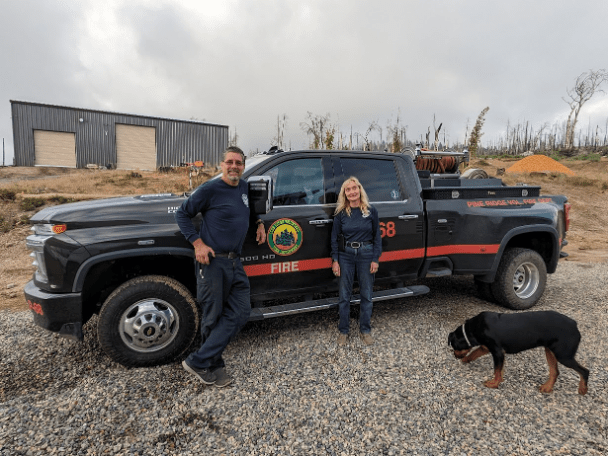
As the Assistant Chief of the Shaver Lake Volunteer Fire Department, James and his team were saving Shaver Lake, while his own property further down the mountain was under threat. His wife Janet, also a fire-fighter, received a mandate to evacuate. Janet was reluctant to leave her home, but obeyed the order, and left with her two dogs. This was just as well, because their house and property were ravaged by the wildfire and she and her dogs would not have survived had they remained at home.

My partner, Alex, had been put into contact with James and Janet when the fires had begun ravaging the mountain in 2020. A mutual acquaintance sent an email to Alex at his home in Adelaide, Australia, asking whether he could offer his holiday house in Shaver Lake to James and Janet. Alex had been focussed on watching the nightly news of the fires back in Adelaide, and scrutinised the maps of the fires every evening to see whether they would engulf his holiday house. It was spared, so he was able to offer it to James and Janet. Alex was unable to visit California himself because of international travel restrictions during the pandemic.

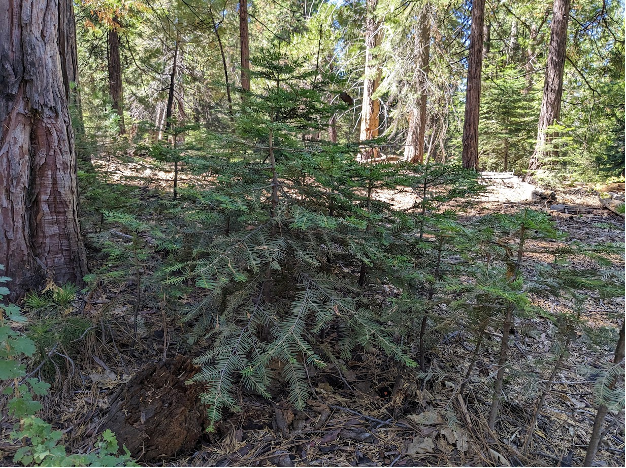
Cluster of Baby Ponderosas

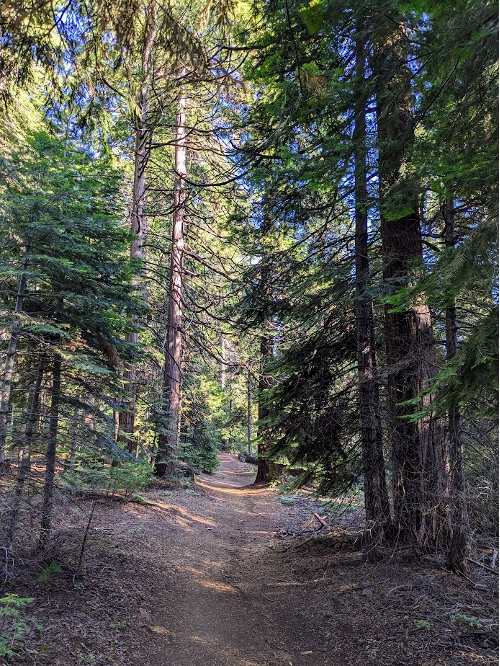
In 2023, Alex and I made the eight-thousand-mile trip from Adelaide to Shaver Lake. Once we arrived, we indulged in morning and evening walks on an undulating path through the ponderosa pines, Douglas firs, and cedars. The path was soft beneath our feet in the aftermath of rain the day before. There was a scent of pine which was immediately calming. In places it is fashionable to pursue ‘forest-bathing’, but here you can simply walk out of your back door and experience biophilia without having to consciously seek it out. 

Lupins alongside the Forest Path

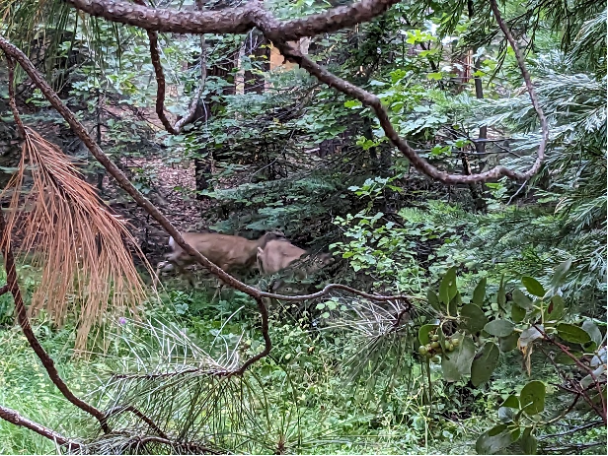
Whenever I heard a rustle I half-expected to see a kangaroo, as I would have in Australia, but instead spotted squirrels hiding behind tree trunks, or a pair of deer cantering away from us as they heard our voices. The path was adjacent to a national park where hunters could hunt deer with a permit in the hunting season.

“When is the deer hunting season?” I asked Alex.

“Not until autumn.”

Phew! It was still late summer, so I needn’t have worried.

“Best wear a fluorescent top in the hunting season,” he advised.

Can you spot the deer?

When I chatted to residents further down the mountain, some said that they could not bear to rebuild their lives on their beloved mountain, such was the shock and devastation of their loss. They had left the site of their former home and relocated to the city of Fresno at the base of the mountain. Others, like James and Janet, have bravely rebuilt their house and are busily engaged in revegetation.

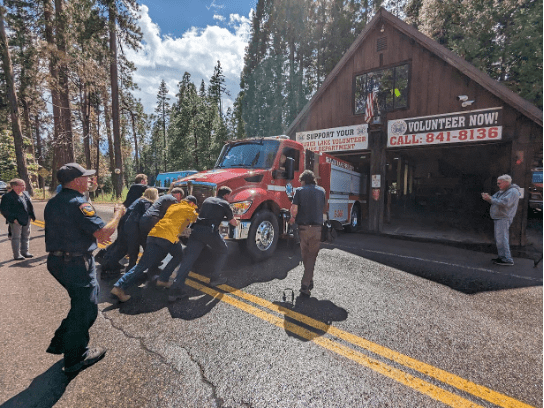
In August, 2023, James and Janet invited us to a fire-truck “push-in ceremony” at Shaver Lake, to celebrate the arrival of a new firetruck. We drove to the township the next day at three pm. The road was blocked by the flashing lights of the sheriff’s patrol cars. We turned back and parked the car, and then entered the township on foot. A crowd of well-wishers was cheering the volunteer fire-fighters, who were pushing the shiny new firetruck into its new home. They strained as they pushed it into the narrow confines where it will be housed. Once it was pushed in, the crowd cheered, and everyone was offered a free ice-cream.

I hope the firetruck remains shiny and new, and never has to confront smoke and flames, so that the people of Shaver Lake, the deer, the squirrels, and the ponderosa pines, can live in peace.

.

Meredith Stephens is an applied linguist from South Australia. Her work has appeared in Transnational Literature, The Muse, The Font – A Literary Journal for Language Teachers, The Journal of Literature in Language Teaching, The Writers’ and Readers’ Magazine, Reading in a Foreign Language, and in chapters in anthologies published by Demeter Press, Canada.

PLEASE NOTE: ARTICLES CAN ONLY BE REPRODUCED IN OTHER SITES WITH DUE ACKNOWLEDGEMENT TO BORDERLESS JOURNAL

Click here to access the Borderless anthology, Monalisa No Longer Smiles

Click here to access Monalisa No Longer Smiles on Kindle Amazon International
Categories
Slices from Life

Sleepless in the High Desert, Slumber in the Sierra

Narrative and photographs by Meredith Stephens

Alex and I had completed our road trip from California to Colorado and now it was time to make the two-day drive back along the interminable desert roads.

Every time we stopped, I would try to get into the driver’s side of the vehicle, thinking it was the passenger side. My brain would not adapt to a car with the steering wheel on the left. Once back in the passenger seat, the sun blazed on my temple, so I manoeuvred my visor to cover the right window to block it from penetrating my eyes. It was hard sitting still, so I stretched my legs before me, then slid them beneath me to elevate my height.

“As soon as we hit the Nevada border you will see a casino town,” Alex informed me.

Sure enough, we crossed the border into Nevada from Utah and a town immediately arose from the desert. Alex made a detour into the town to get some fuel.

“Can we drive down the strip?” I asked.

“Sure,” he replied. “Are you hoping to find a hotel here?”

Yes, I thought, but kept my silence. I was too proud to confess that I wanted to stay anywhere near a casino, but I would have welcomed clean sheets and hot water.

I took hold of Alex’s phone and searched for campsites en route, but they all involved deviations that would rob us of precious time.

“We can always stop at a rest area,” suggested Alex.

He searched his phone and found a rest area nestled into a hill, with outdoor tables surrounded by trees. We arrived at sunset and parked the car at the far end, away from other vehicles. We gratefully hopped out, picked up the ice box, and headed for the picnic tables, which we had to ourselves. No sooner had we started anticipating our picnic than we heard the murmur of a refrigerated truck.

“He probably has to keep his engine on to keep the food cool,” observed Alex.

The din was inescapable, so we decided to park back near the entrance to the rest area. I noticed a car parked with sheets draping the windows. Clearly, we were not the only ones seeking sleep in the rest area. Alex parked the car at an angle contrary to the parking lines so that nobody would be tempted to park right next to us. We hauled the icebox to a nearby picnic table to consume our leftovers. Alex proceeded to pour us a glass of wine, and we snacked on sourdough, cheese, avocado, deli meats, and corn chips.

I ate a little too quickly because it was getting late, and I was hungry. It was high desert, so the air was cool, even though it was mid-June. We packed up our picnic and headed for the car, where Alex moved all of our goods to the front seat and made up our bed in the back.

It was nearly 9 pm and we went to bed in the twilight. I revelled in the sensation of the thick flannelette cotton sheets, but I could not slip into a deep sleep. The overhead lights snuck through cracks in the fabric I had put up to cover the window, and the traffic rumbled on the adjoining freeway. Then, a few hours into the night, I heard a clanging outside the car. I peered myopically outside.

“That’s just a dumpster diver,” explained Alex, who turned back to sleep, obviously not too alarmed.

I had never heard that expression before, but I realised that some poor soul was working their way through the bins in the rest area in the wee hours when nobody could see them. I reflected on what I had thrown out after dinner, which had included a nectarine seed, and hoped their fingers did not come into contact with its slime. Then I started worrying whether the dumpster diver would come after us in the night. The next morning Alex explained to me that they were probably collecting cans to sell to a recycling centre. That, at least, was preferable to scrounging around in the bins for food.

We left early the next morning because Alex wanted to show me Lake Tahoe en route to California.

“That reminds me of Lac Leman in Switzerland,” I told him.

“Yes, there’s California on one side, and Nevada on the other. They share the lake.”

We stopped for photos, then resumed our way, winding through snowy mountains, and passing cattle, horses and foals down below. It was a huge relief after the deserts of Utah and Nevada. Then we wound our way through a canyon, following a rushing river, passing through picturesque towns adjoining Yosemite National Park.

“I need a coffee,” lamented Alex, typing ‘coffee shop’ into Google Maps. We entered the town of Columbia, heeding Google’s directions. We were directed down a narrow road through wooded hills. We passed a large car park the size of an oval, much too large for this rolling wooded area. Then Google Maps told us we had arrived. We parked under some shady trees to arrive at a tea shop from another place and time.

We wandered inside. They had a wide range of teas but no coffee, so we took our leave. The voice on Google Maps kept insisting we take a detour, so we followed her urgings past what seemed to be a historical town.

We turned the corner to find the coffee shop Google Maps had been directing us to. We entered and ordered Americano coffee, which despite the 19th-century decor was served in 21st-century paper cups.

We then realised in our quest to find a roadside coffee shop we had stumbled on Columbia Historic Park. The buildings which had been used in the town in the gold rush had been restored and made available to tourists. I wanted to linger in this authentic setting. Unlike a theme park, this was not a re-creation. Alex was worried that we still had several hours driving to go, so we had to resume our journey.

We wound back home through gentle valleys, passing cattle and horses. The sun in my eyes gave me an aura; a circle of lights started appearing in my vision. After 25 hours of driving, we arrived at our cabin at Shaver Lake. I crashed on the sofa, while Alex made a fire. He made up a bed in cotton flannelette sheets in front of the fire, and I rolled onto it from the sofa. What a relief it was to sleep in comfort, in contrast to the person in the rest area scrounging for cans in the wee hours. For us, sleeping in a rest area was a novelty, but for others, it was a way of life.

Meredith Stephens is an applied linguist from South Australia. Her work has appeared in Transnational Literature, The Muse, The Font – A Literary Journal for Language Teachers, The Journal of Literature in Language Teaching, The Writers’ and Readers’ Magazine, Reading in a Foreign Language, and in chapters in anthologies published by Demeter Press, Canada.

PLEASE NOTE: ARTICLES CAN ONLY BE REPRODUCED IN OTHER SITES WITH DUE ACKNOWLEDGEMENT TO BORDERLESS JOURNAL

Click here to access the Borderless anthology, Monalisa No Longer Smiles

Click here to access Monalisa No Longer Smiles on Kindle Amazon International

Categories
Slices from Life

Spring Surprise in the Sierra

Narrative and photographs by Meredith Stephens

Grief was something I thought I could run away from. If I created as much physical distance as I could from my place of loss, surely I could find healing. I had just lost my beautiful sister Stephanie after more than five decades of sisterhood and hoped that I could find healing in travelling to distant climes. There couldn’t be anywhere more distant than the Sierra Nevada Mountains in California. The time zone is sixteen hours behind Adelaide, and the season is contrasting. Surely by distancing myself in time and space I could recover from my grief.

My partner Alex’s chief pleasures are planting trees, sailing, and hiking. In the Sierra Nevada, he could indulge his passion for hiking. We arrived in the Sierra in early June and stayed in a cedar house surrounded by ponderosa pines, Douglas firs and junipers, yawning into the sky. Every day we planned a hike along the numerous trails winding through the mountains. Even in June, it was pleasantly cool. Alex lit a fire in the fireplace every evening, and I donned a thick jumper. On our third day, our chosen hike followed a trail alongside the northern shoreline of Shaver Lake.

“If a bear approaches, the worst thing you can do is run away. Hold your ground and shout at them. Otherwise, they will think you are prey,” warned Alex.

Till then, I had been enjoying my stroll through the mountains at an elevation of almost 1800 metres, and it never occurred to me that we could cross paths with a bear. In Australia we often crossed paths with kangaroos, who would hold our gaze for a few seconds before gracefully hopping away. I had never considered that wild animals could be predators. Then, on second thoughts, I thought it would be nice to see a bear, and with Alex alongside me, felt less vulnerable.

“You have encountered wild bears before in California, haven’t you?” I quizzed Alex.

“Oh yes, several times,” he confirmed.

“Wasn’t there one time when you were alarmed?”

“Yes. That was when I was hiking alone in Montana. They couldn’t hear me. If a bear can hear you, they are more likely to stay out of your way. Some people use whistles.”

I started scanning the hillside for signs of large moving creatures, but instead my attention was drawn to the abundant wildflowers that I had never seen in Australia. I noticed bright red flowers protruding beneath the huge pine trees, known as Snow plants.

Snow plant (Sarcodes sanguinea)

I kept longing to spot a bear, but instead continued to notice wildflowers. The most common wildflowers were sensed by smell before I sighted them, small creamy flowers with a heady fragrance of rich honey. I wished I could photograph the smell.

Buck brush (Ceanothus cuneatus)

The nearby town of Shaver Lake had been saved by the firefighters in the 2020 wildfire known as the Creek Fire, the largest fire in California’s history. You could see the line where the fire had been stopped. On one side were scarred mountains which had lost their vegetation, and on the other remained majestic pine and fir trees.

Fire Devastation

On the side that had been spared, some pink flowers, known as mountain pride, asserted themselves through a crack in a boulder.

Mountain pride (Penstemon newberry)

I had been looking for bears, but instead found myself in the midst of a North American spring. Splashes of colour of ever more exotic wildflowers emerged along the roadsides and the trails.

Path through the forest

My hope to overcome grief through travel to a distant land had been in vain. Moving from a southern hemispheric autumn to a northern spring, and moving back sixteen hours in time to yesterday, was not enough to relieve me of my mourning. I missed phone calls and text messages from my sister Stephanie, and especially the opportunity to recount the tales of my travels when I returned home. Stephanie was my most avid listener, and never expressed any envy when I regaled my travel tales. Her concentration propelled me to provide ever more details of my travels. Now, I honour her memory by continuing to pursue the kinds of activities that she took delight in and writing the kinds of stories that she enjoyed.

In Loving Memory of Stephanie, Entrusted to God’s Care

Meredith Stephens is an applied linguist from South Australia. Her work has appeared in Transnational Literature, The Muse, The Font – A Literary Journal for Language Teachers, The Journal of Literature in Language Teaching, The Writers’ and Readers’ Magazine, Reading in a Foreign Language, and in chapters in anthologies published by Demeter Press, Canada.

PLEASE NOTE: ARTICLES CAN ONLY BE REPRODUCED IN OTHER SITES WITH DUE ACKNOWLEDGEMENT TO BORDERLESS JOURNAL

Click here to access the Borderless anthology, Monalisa No Longer Smiles

Click here to access Monalisa No Longer Smiles on Kindle Amazon International