Categories
Conversation

A Toothsome Exploration of Poetry, Life and Values

In Conversation with Kiriti Sengupta

Based on Paul Gauguin’s life is a book by Somerset Maugham[1] called Moon and the Sixpence[2], a novel about a stockbroker who abandons his profession to become an artist. Gauguin[3] was a stockbroker turned artist, and Maugham was trained a physician but opted to write books and became a famed novelist. While earning a living as solely a writer has become increasingly difficult through the world unless you make it very big like JK Rowling[4], and therefore, most writers opt for being part time writers while holding full time jobs, we do have a few strange aberrations. One of them is Dr Kiriti Sengupta, who turned to publishing and poetry abandoning his profession — that of a dentist.
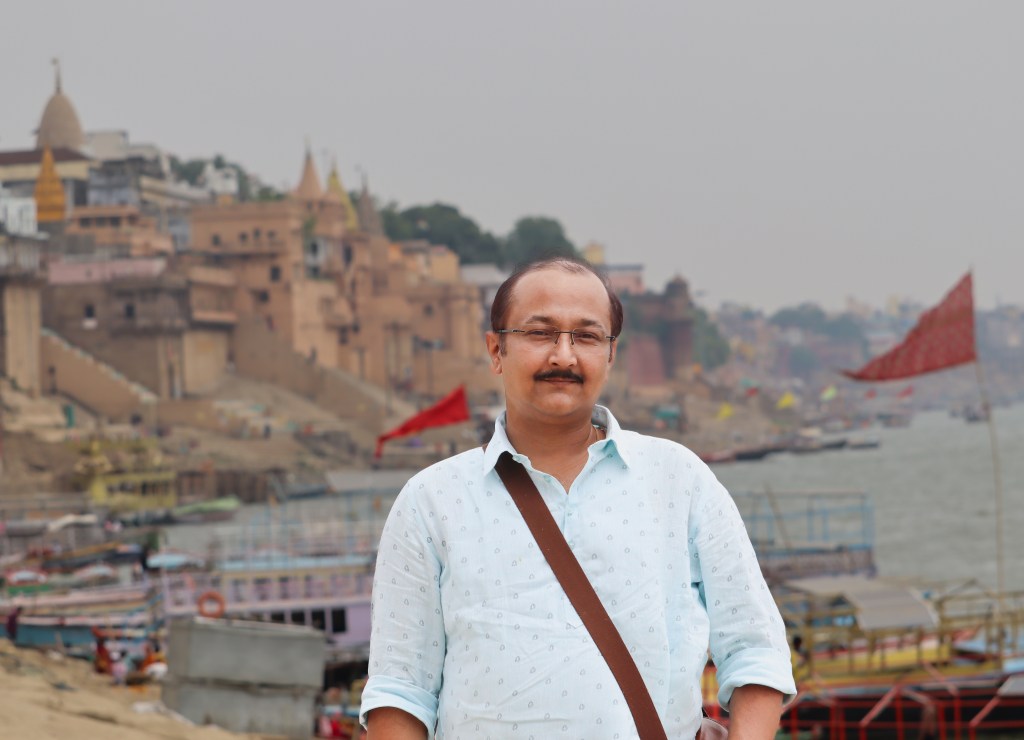
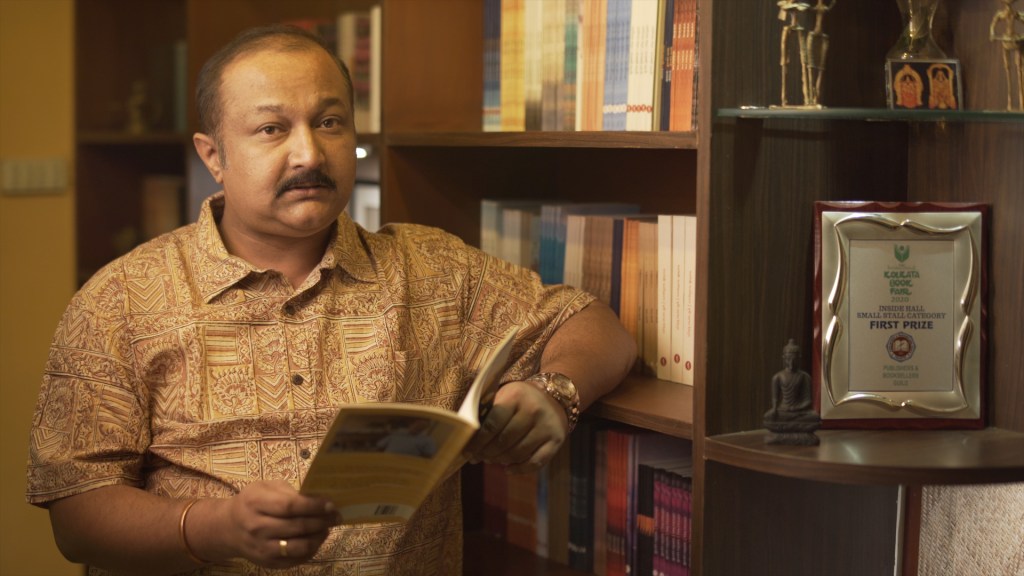
Kiriti Sengupta: Photo Courtesy: Bitan Chakraborty

He ran away from his home and started writing in a small, rented accommodation in 2011-2012. And now he writes, works as a director in one of India’s top upcoming publishing concerns, Hawakal, and rolls out poetry. Sengupta describes his former profession with, an underlined sense of irony, and perhaps with tongue-in-cheek humour:

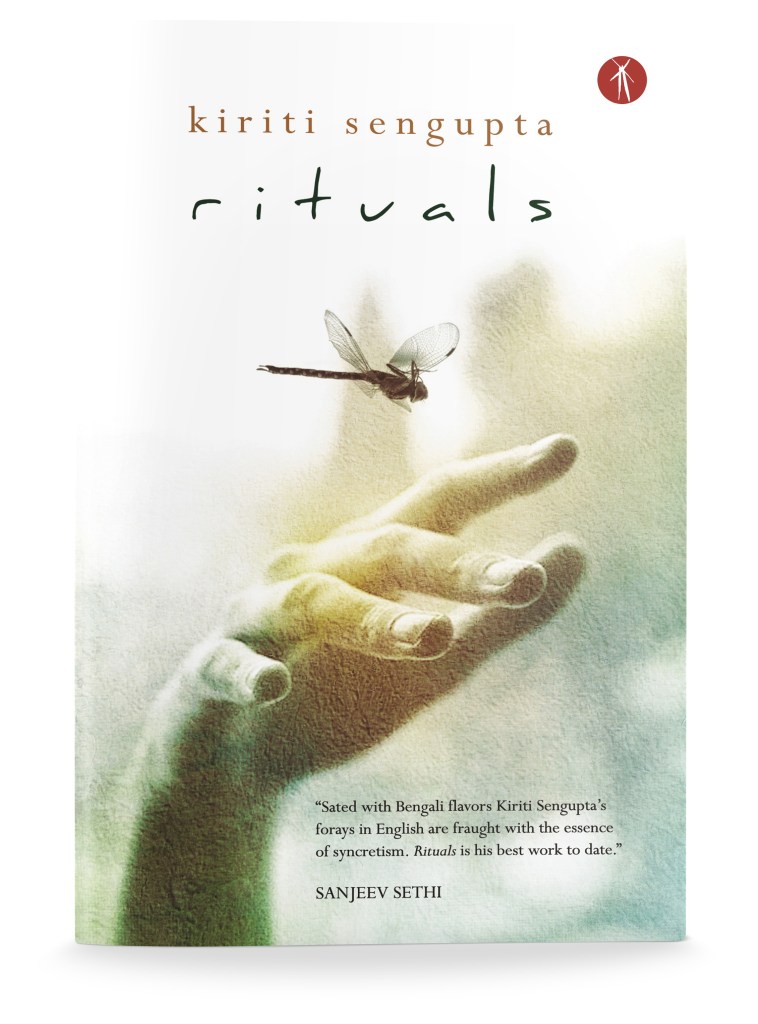
I prefer patients who are edentulous. I dread
a tooth will wrangle my expertise, and I’ll fail
to make an impression.
(Rituals, 2019)

Wisdom
the third molar adds
to the surgeon’s expertise
(Oneness, 2024)

He writes about water and the environment:

Water has many colors, 
smudging pebbles
along its path

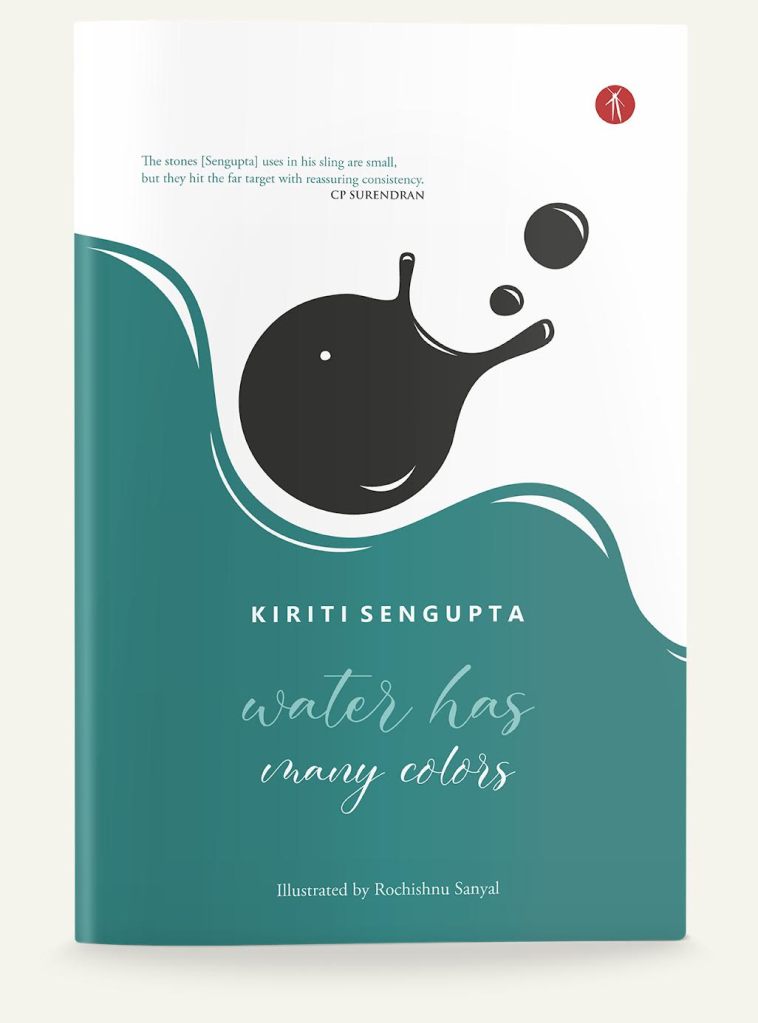
(‘Spectrum’, Water has Many Colours, 2022)


Feed the earth water
she flows in abundance.
Allow the planet to breathe:
the air is her consort.
(‘Hibiscus’, Water has Many Colours, 2022)

He writes for and about women:

How many mujras dwell in a kotha ? 

How many neonates hew to a bordello?

Like her admirers
God is silent.
In her sinews
hides a hint of soil
from the yard of courtesans.

*Mujras are courtesan’s song and dance performances
*Kothas are brothels
(‘When God is a Woman’, Rituals, 2019)

And yet critiques stances with a twisted questions:

You define women as Durga
or Kali. Are you a believer? Are you
being kind? You could have convinced
them to fight the evil.
Instead, when you imply the goddess,
do you illustrate
sisterhood with many limbs? Would you
like men to act as Shiva—the destroyer?

(‘Primordial Learning’, Oneness, 2024)

Underlying all of Sengupta’s poetry, is a strong sense of irony which like a veil drapes words with double entendres. While the poems are layered, he dwells on human frailties too…  like procrastination with a soupçon of sarcastic humour as in ‘From Being Late in Calcutta’ (Rituals):

As soon as you mark me
I’ll talk about events
that guide me to the records
you maintain.

I’d say crowded buses invite passengers
from unscheduled halts.
I’d emphasize the number of speed-breakers on road,
and their poor performance in preventing accidents.

I’d tell you trains run late.
Signals are laggy between stations.
I won’t forget to mention how
a sudden protest
makes the train stand still for hours.

I’d discuss about the day I reported late,
owing to instantaneous suspension
of underground train services
as a man killed himself on the railway lane.

I’d ask you to remember why I came late the other day.

If you can recall,
I had indigestion despite eating at home.
I blamed farmers for sprinkling pesticides on crops.
I pointed at my salary that failed to buy organic veggies.

And then,
I’d invariably argue about maintenance and population.

I’d appreciate China, one-child policy, and their claim on
how the government prevented four hundred million births.
And how India thrives on the revenues earned
from selling nicotine and condoms.

I’ll explore other issues
the next time I reach late.

He pours out lines on stars, film stars and politicians. Sengupta responds to life with poetry, often terse, brief… sometimes with a wry sense of humour. But in the brevity, lies a depth of mystery, which you can mull and cogitate over endlessly. A flickering of spiritual beliefs and a seriousness of intent despite the apparent lightness of words create a conversation within the poems. In this exclusive, an award-winning author of more than fourteen books, Kiriti Sengupta takes us on whirlwind tour of his life, his ideas and his work.
When and how did you start writing poetry? Why did you switch professions — from a dentist to a poet-publisher? What compulsion made you turn from a lucrative to an uncertain profession? Were you sure you’d succeed? Please share your story with us.

First of all, thank you for inviting me to Borderless for a heart-to-heart, Mitali. I greatly appreciate your dedication to literature, especially quality work. Coming to your first question (a bundle of questions, actually), I don’t remember when I first wrote a poem. Coming from a dentistry background, I never imagined that I would write poems. Until then, I was well acquainted with journalistic articles, critical responses, cultural essays, and, of course, scientific papers. Poetry was out of the question. I believe in karma. Maybe I was destined to write poetry. It wasn’t a deliberate choice. It wasn’t a spontaneous stance either.

I was passing through an obnoxious personal crisis that compelled me to reconsider my career in dentistry. I was comfortably placed in a government institution, enjoying a considerably thick monthly salary. In early 2012, I decided to leave my job and spend some time with myself. However, as you can understand, it was risky, as I was the only breadwinner in my family, which consisted of my wife and son. I had no career options to pursue. 

I was new to social media back then. I had the opportunity to become involved with a virtual group, Indies In Action (IIA), run by Stephen L. Wilson. They were raising funds for the victims of the devastating earthquake in Oklahoma. I contributed a few poems to the literary anthology Twist of Fate (ToF), which Steve edited. It was hugely successful, and all proceeds went to the May Tornadoes Relief Fund, managed by United Way. For the promotion of the book, I interviewed a few eminent contributors, such as Bill Lantry, Terry Lucas, Colin Dardis, Marshall G Kent Sr., Allison Bruning, Maggie Rascal, Don Martin, Linda Bonney Olin, Maria Edwards (the then President of the American Authors’ Association), Ency Bearis, among others. Honestly, they all helped me become familiar with the world of poetry. 

In 2013, my first book, The Unheard I, was published. It was released simultaneously in India by Dhansere Prakashan and in the United States by Inner Child Press Limited. It was non-fiction, although it contained two chapters dedicated to poetry. In his commentary, Stuart Aken remarked, “It is a scholarly [collection] that will appeal to those with an interest in poetry, particularly spiritual poetry expressed as literature, as well as [to] those who have a leaning toward or a significant interest in Indian myth and religion.”

Even then, I had no plans to pursue writing (or publishing, for that matter) as my career. Gradually, I evolved, and here I stand today. Do I call myself successful? I’m not sure whether I have turned into a consummate writer. Since I write poetry in a niche market worldwide, it is challenging to become a “successful” poet and earn enough royalties to sustain my family. As a publisher, oh yes, Hawakal has emerged as a leading traditional press that has published several writers and poets and enjoys its presence in New Delhi, Kolkata and Nokomis (Florida). 

How long have you been in the literary framework? Was it a tough journey moving from dentistry to writing? How did your family respond?

My first essay was published in 1995 in the college magazine. I remember it was written for students suffering from anxiety and family expectations. While studying dentistry at North Bengal Dental College, I joined the All-India Freelance Journalists Association (AFJA, Chennai). My senior colleague, Dr. Falguni Maji and I were commissioned by Uttarbanga Sambad to write an article on the pottery art in Matigara (Siliguri). I was a regular contributor to “The Third Law” in The Telegraph (India). Later, I regularly wrote health-related articles for Ganashakti.

As I said before, I was initiated into poetry quite late. It was a challenging move as I had no formal training, but I was immensely blessed to have a few mentors who honed my skills and taught me the basics of writing poetry. 

My family suffered badly from my career-shift. They had to compromise on their living standards. The initial years of becoming a full-time writer were dreadful, to say the least. From only one wholesome meal a day to just a pack of instant noodles for the day — I have personally experienced it all. I ensured that my family didn’t starve, nor did my son lose his schooling. However, their ceaseless support enabled me to survive as a writer and publisher. 

How many books have you authored/translated and how many poetry collections, and within how many years? Do you see yourself more as a poet or as a publisher/editor?

I have written fourteen books of prose and poetry, and as a translator, I have two full-length collections of poems. I have also edited nine literary anthologies, including Shimmer Spring, an all-colour, hardback coffee-table book published during the pandemic, which addresses our perceptions of light.

Honestly, I see myself as a patron of Indian arts, literature and fine arts (painting, sculpture, etc.). I’m an admirer of Indian textiles, too! I love buying drapes, be it a saree, a shawl, or a dhoti, in rich fabrics. Bitan and I have plans to start a men’s brand of drapes. We are working on it.

You claim you are a slow writer, and you isolate yourself in a ‘studio’. Tell us about your poetic process. How do you write? What inspires you to write? Are you influenced by any writers/musicians, or artists?

You know, Mitali, we have two studios in India: one in Kolkata and the other in Delhi. These ateliers are essentially stations where we work on the submissions from authors — we read, select, edit, and design the books we publish. We invite authors and readers to have a one-on-one. Readers also drop by to buy a book or two they want. You see, these studios are not meant for our writing. I say “our” because Hawakal is the collective enterprise of Bitan Chakraborty (the founder director) and me. While Bitan oversees the Bengali department, I supervise the English-language division of Hawakal.

It’s difficult to describe how I write. Anything that stirs my imagination or fancy, whether a line from a song, an incident, or a tragedy, often inspires me to pen my thoughts. I am fond of ekphrastic poems and frequently visit art exhibitions to catch a thread or two. However, it takes days or weeks to write a poem, although most of my poems are short or very short. I believe in condensing my thoughts, which is a time-consuming affair.  

Your first collection of poems, Healing Waters Floating Lamps (2015), was largely spiritual, while your latest, Oneness (2024), covers multiple aspects of life that may not be purely spiritual. Some of the poems in your later works are also ironic or verge on humour. A gap of nine years and multiple publications reside between the two books. Has there been a change or a progression in your poetry through your journey? Do you feel your poetry has changed?

Healing Waters marks my debut full-length collection of poems. Prior to this, I released 4 books, including My Glass of Wine (2013), which featured autobiographical poetry. My journey as a poet has led to a noticeable evolution. Scholars are more suited to examine these transformations. Some observe that my language and craft have become significantly more refined. They argue that my recent works display a level of sophistication. Conversely, others suggest that my earlier poems felt more spontaneous and grounded. Embracing evolution is crucial; without it, my growth as a writer would stagnate.

You translate from Bengali. Tell us who all you have translated. Have the translations impacted your own poetry. Do you feel translations should be literal or more focussed on capturing the essence of the language?

As I said before, I translated two volumes of Bengali poetry into English: Sumita Nandy’s Desirous Water and Bibhas Roy Chowdhury’s Poem Continuous—Reincarnated Expressions. I am delighted that these books have received rave reviews in India and overseas. Moreover, Hawakal recently released the 10th-anniversary edition of Poem Continuous, which has garnered critical appreciation.

Other than these books, I have translated a few contemporary Bengali poets as well: Ranadeb Dasgupta, Gourob Chakraborty, Rajeswari Sarangi, to name but a few. I can confidently tell you that translating Bengali poems has hardly influenced my work.

Whether translations of poems should be literal or more focussed on capturing the essence of the original is debatable. However, it is even more critical to ensure that the translated piece qualifies as poetry in the first place. If the piece does not read like a poem, regardless of the sincerity of the translator, the labour of translating the original work goes into vain. Every language comes with its own nuances. So, the translator should possess an excellent understanding of both the source and target languages.

Hawakal is regarded as one of the most important publishing houses for poetry in India. When and how did you join Hawakal as the director of the English section? How did you meet Bitan? Could you tell us about the journey?

Thank you for your kind comments on Hawakal, Mitali. Bitan Chakraborty established Hawakal in 2008 in Kolkata. He published numerous Bengali poets until I joined him in 2015. A common friend Kishore Ghosh introduced Bitan to me. Ghosh, a Bengali poet of some renown and a journalist, urged Bitan to publish a collection of literary criticism based on my work and that of Sharmila Ray. The book was titled Rhapsodies and Musings: poets in the mirrors of other eyes and authored by Ketaki Datta and Tania Chakravertty. So, we started our collaboration. Eventually, Bitan induced me to become one of the Directors of Hawakal.

Where do you see Hawakal travels as a publishing concern? What is the scenario like? Do you only bring out writers of Indian origin, or are you open to writers from other backgrounds? What does Hawakal look for in writers to publish with you?

For the past few years, Hawakal has been more focussed on fiction and non-fiction manuscripts. There is no dearth of poetry submissions, though. However, it’s challenging to find an authentic voice. We have published American poets like Dustin Pickering, t. kilgore splake, Marshall G. Kent Sr., Gary Manz, and others. Ethnicity isn’t a limiting factor for someone who wants to get published by Hawakal.

We really want to establish a steady foothold in the United States. Our tiny outlet in Nokomis is currently managed by Dr. Robertson James Short II. It has to grow big. Hawakal seeks original work, and we yearn for quality submissions.

Do you have any suggestions for young writers?

Aspiring writers or poets should read more and be well-versed with the works of contemporary authors. It is important to get published in journals, and accepting rejections from the editors is equally beneficial. Getting published should be a slow process. As the saying goes, there is no shortcut through the forest of life…

Thank you for your time and poetry.

Click here to read more poems by Kiriti Sengupta

[1] Somerset Maugham (1874-1965), British writer

[2] First published in 1919

[3] Paul Gauguin (1848-1903), French writer
[4] Author of Harry Potter


CLICK HERE TO SAMPLE KIRITI SENGUPTA’S POETRY

(This online interview has been conducted by Mitali Chakravarty.)

PLEASE NOTE: ARTICLES CAN ONLY BE REPRODUCED IN OTHER SITES WITH DUE ACKNOWLEDGEMENT TO BORDERLESS JOURNAL. 

Click here to access the Borderless anthology, Monalisa No Longer Smiles

Click here to access Monalisa No Longer Smiles on Kindle Amazon International

Categories
Essay

Bengaliness and Recent Trends in Indian English Poetry: Some Random Thoughts

By Somdatta Mandal

It is clear that English is employed here not as a language on loan, but as the rich, spluttering resource of the marrow and the bloodstream.-- Arundhathi Subramaniam.

At the outset, let me make a candid statement. I am a very prosaic person, someone who in her long teaching career and academic writing as well as translation, has never ventured to write poetry myself. I might seem like the odd woman out, but somehow, I have been closely following the recent trends in which Indian Poetry in English has been rapidly spreading its wings and with new volumes being published every other day, it is now a force to be reckoned with.

Tomb of Henry Louis Vivian Derozio at the South Park Street Cemetery, Kolkata.

Recapitulating literary history briefly, it is well known that Indian English Poetry (or often called Anglophone poetry in India) is the oldest form of Indian English literature. Beginning roughly from 1850 to 1900, it went through the ‘imitative’ phase when Indian poets were primarily ‘romantic’ and tried to imitate the British masters. Beginning with Derozio[1], many poets of the time — namely Rabindranath Tagore, Sri Aurobindo, Sarojini Naidu, Michael Madhusudan Dutt, Toru Dutt — were also Bengalis by birth. The poetry written between 1900 to 1947 belonged to the ‘assimilative’ period and often questions were asked why the poets didn’t write in their ‘own’ languages. Post-independence poetry was primarily experimental, and when we come to contemporary Indian English poetry, we find it becoming wholly urban and middle-class. The poets are realistic and intellectually critical in the expression of their individualised experience. They go in for precision at all levels and do not stick to one genre but experiment with multiple poetic forms.

Interestingly, I realised that a whole host of Indian English poets writing at present (some have several volumes of poetry published already, whereas others have just given birth to one or two), but coincidentally many of them happen to be Bengalis — Bashabi Fraser, Sudeep Sen, Kiriti Sengupta, Sanjukta Dasgupta, Mitali Chakravarty, Angshuman Kar, Shyamasri Maji, Basudhara Roy, Radha Chakravarty, and others. It is not a complete list at all, and what makes this study more interesting is that except for a couple of them, all these poets come from an English literature background. It is also not a coincidence that most of them teach English as their profession. So, whether it be personal lyrics, free verse, memories, experiences, observations, or even translation, the English muse therefore gives them the impetus to experiment with all forms, and at the same time helps them to move away from themes like nationalism, nature, Indian culture, love etc. that dominated Indian English Poetry in earlier times.

Bashabi Fraser receiving her CBE (2021 The Queen’s New Year Honours) from Prince Charles, now King Charles III.

Bashabi Fraser is an Indian-born Bengali and a Scottish academic, editor, translator, and writer. She is a Professor Emerita of English and Creative Writing at Edinburgh Napier University. Fraser’s work traverse continents in bridge-building literary projects. She was appointed a Commander of the Order of the British Empire (CBE) in the 2021 New Year  Honours for services to education, culture and cultural integration in Scotland, in particular for her projects linking Scotland and India. Among her several volumes of poetry the Bengal and Bengali connection comes out in volumes like From the Ganga to the Tay: a poetic conversation between the Ganges and the Tay (2009), Letters to My Mother and Other Mothers (2015), My Mum’s Sari (2019), and Lakshmi’s Footprints and Paisely Patterns: Perspectives on Scoto-Indian Literary and Cultural Interrelations (2023). Fraser has worked extensively on a project about the Bengal Partition and the angst resulting from this divide expresses itself in the following poem.

This Border
Can shadow lines on the earth’s surface divide language and literature, rituals and customs, rivers…and memories?

There was a time when you and I
Chased the same butterfly
Climbed the same stolid trees
With the fearless expertise
That children take for granted
Before their faith is daunted
Do you remember how we balanced a wheel
Down dusty paths with childish zeal
Do you remember the ripples that shivered
As we ducked and dived in our river
Do you remember what we shared
Of love and meals, and all we dared
Together – without fears
Because we were one
In all those years
Before we knew that butterflies
Were free to share our separate skies
That they could cross with graceful ease
To alight on stationary trees
On either side of this strange line
That separates yours from mine
For whose existence we rely
Entirely on our inward eye
This border by whose callous side
Our inert wheel lies stultified
This border that cuts like a knife
Through the waters of our life
Slicing fluid rivers with
The absurdity of a new myth
That denies centuries
Of friendships and families
This border that now decrees
One shared past with two histories
This border that now decides
The sky between us as two skies
This border born of blood spilt free
Makes you my friend, my enemy.

Another well-established poet is Sudeep Sen who studied in New Delhi and in the United States and is a global citizen, so to say. Sudeep’s literary output is enormous and some of the titles of his volumes of poetry have subtle references to Indianness and Bengaliness embedded in them as well. Mention may be made of volumes like Leaning Against the Lamp-Post (1983), The Man in the Hut (1986), Kali in Ottava Rima (1992), Postmarked India: New & Selected Poems (1997), and several others. Though he might not do it consciously, his Bengaliness remains embedded in his psyche.

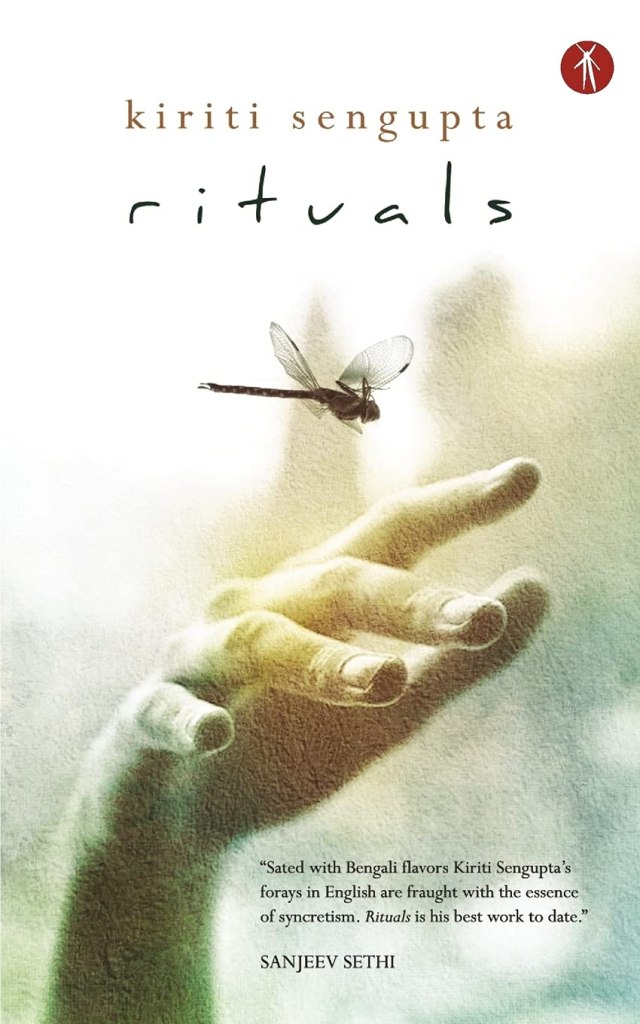
Kiriti Sengupta who has been awarded the Rabindranath Tagore Literary Prize (2018) for his contribution to literature, is a poet, editor, translator, and publisher. What is more significant is that along with Bitan Chakraborty, he mans the publishing house Hawakal, which has already carved a niche for itself as the largest publisher of Indian Poetry in English. Several poets mentioned in this essay have seen their creations see the light of the day through Hawakal Publishers and they have done yeomen service in this regard. As an established poet, Sengupta has several volumes of poetry to his credit. His collection from 2019, called Rituals, is very different from the work readers usually read in that there is a narrative thread in many poems that is not there simply to tell a story but to ultimately present a meditation on an aspect of life and the modern world that they haven’t considered before. “Fleeing the house and leaving the doors ajar. Is it perversion or fallacy?”

In an earlier volume entitled Solitary Stillness (2018), Sengupta does not give away the traits that have pervaded his poetry, he has not forgotten his Bengali roots, and has once again drawn his poetry on the canvas of the time that has been rooted in Calcutta. As he elaborates upon this point in his professional website, here, he makes a reference to Lapierre, and indeed, the ‘city of joy’ tag sounds fake just as we read that particular poem, which is so natural, that it almost appears to have been spoken by a resident of a city, one who is not a poet. According to him, that person who complains about water logging or that person for whom any tag of romanticism about the city is bourgeois, it is nothing but a label that’s needed to promote consumerism.

Mitali Chakravarty, the indefatigable editor of Borderless Journal, wrote to me saying that she is happy I feel she belongs to Bengal, “I call myself a Bengali and a human”. Though a non-resident Bengali, her perception of her own work and Bengali cultural identity is clearly revealed in a poem published in The Daily Star (Bangladesh)[2].

Confused

I am mixed up – cannot help
English and Bengali under my belt

I can read a bit of Hindi
Cannot understand much of French
A little Chinese …low class, they said…
I am mixed up – cannot help
English and Bengali under my belt

I grew up thinking I will find a way
But now pidgin is all that I can say
I write in English – the language borrowed from the West
The language that taught us or brought us unrest
The language that through The Raj spread
Importing Nationalism in its tread
I am mixed-up – cannot help
English and Bengali under my belt

But my life is that of the non-English
A probashi Bengali at best

People say I am not typical, not quite the right type
A mixed-up Bengali – I said
Culture is something I dread at every tread
Because what Culture I have is mine
- Not of a Race, a Country or Religion –
Human Being is the only race to which I belong

Help protect my home, the Earth – its every drop, its every stone

In a world of 7.7 billion, can I be alone?
I am mixed up – cannot help
English and Bengali under my belt

Though she has been writing poetry for a long time, Mitali’s first poetry collection, Flight of the Angsana Oriole: Poems was published by Hawakal only in October 2023. In the ‘Introduction’ to this volume, she states that her random collection of poems “are sometimes of the past” as she knew it and “sometimes of the present. And sometimes in quest of a future or a dream that she hopes will go to create a more hopeful future than the world presents to us currently.” The poems in this volume are personal; some talk of her journey through life, the world as she sees it, some even influenced by her travels across the world. She further states: “Inherent in each line is not just the influence of my experiences in many countries but the nurturing I had in India, where I was born, educated and spent the first two decades of my earthly existence.” So, poems like ‘Death of Lalon’, ‘Shivratri’, ‘Kali Rise’, ‘Shraddha‘ [last respects] and a few others do convey the subconscious Bengaliness embedded in her psyche, irrespective of where she physically resides now.

Radha Chakravarty, a prolific writer and translator, Former Professor of Comparative Literature and Translation Studies at Ambedkar University, Delhi, has recently joined the bandwagon of Indian Poetry in English with her debut collection of poems Subliminal published by Hawakal Publishers in 2023. In a detailed interview given to Mitali Chakravarty for the March issue of Borderless Journal[3], she tells us about her aims and ambitions as a poet and how most of the poems in Subliminal are independent compositions, not planned for pre-conceived anthology.

My poetry actually delves beneath surfaces to tease out the hidden stories and submerged realities that drive our lives. And very often, those concealed
truths are startlingly different from outward appearances. I think much of my poetry derives its energy from the tensions between our illusory outer lives and the realities that lurk within.

Many of Radha Chakravarty’s poems express the feeling of Bengaliness in different perspectives. We read about the typically soft quilt called kantha in Bengali in the poem ‘Designs in Kantha‘ thus:

Sewn into soft, worn layers,
forgotten fabric of grandmother tales –
patterns of the past,
secret memories, hidden designs,
intriguing patterns in silk strands
dyed in delicate dreamy shades—
embroidered storylines
in exquisite, dainty kantha-stitch.

When Mitali Chakravarty asks her why she writes in English though it isn’t her mother tongue, she answers:

Having grown up outside Bengal, I have no formal training in Bengali. I was taught advanced Bengali at home by my grandfather and acquired my deep love for the language through my wide exposure to books, music, and performances in Bengali, from a very early age. I was educated in an English medium school. At University too, I studied English Literature. Hence, like many others who have grown up in Indian cities, I am habituated to writing in English. I translate from Bengali, but write and publish in English, the language of my education and professional experience. Bengali belongs more to my personal, more intimate domain, less to my field of public interactions….
Both Bengali and English are integral to my consciousness, and I guess this bilingual sensibility often surfaces in my poetry. In many poems, such as ‘The Casket of Secret Stories,’ ‘The Homecoming’ or ‘In Search of Shantiniketan’, Bengali words come in naturally because of the cultural matrix in which such poems are embedded.

 Of course, the poet also mentions that all her poetry is not steeped in Bengali. In fact, in most of her poems, Bengali expressions don’t feature at all, because the subjects have a much wider range of reference. As a globe trotter, Radha has written about different places and journeys between places.

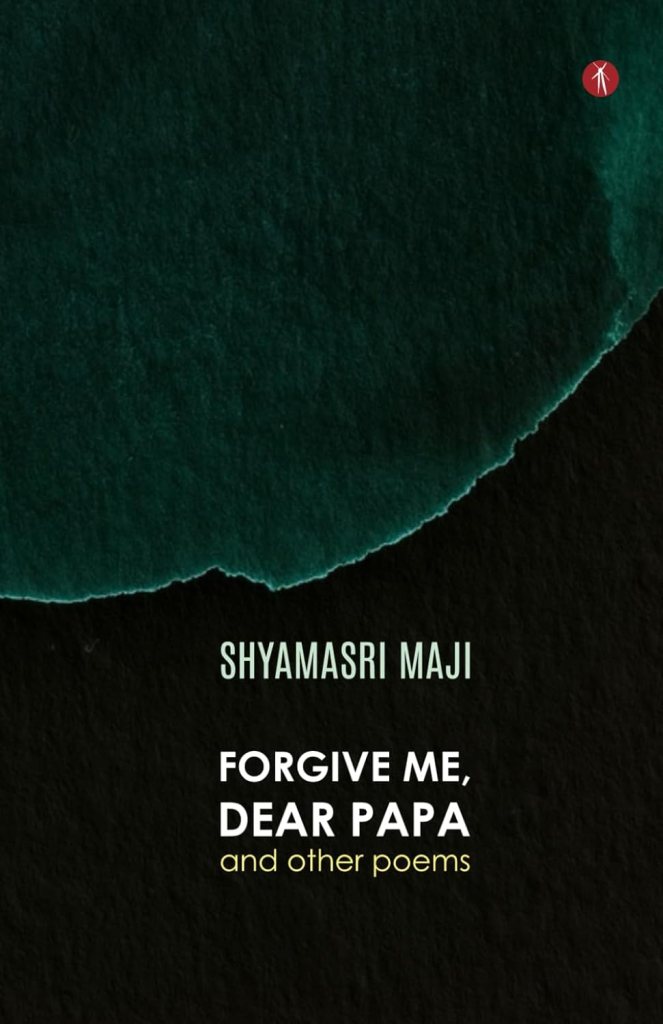
Another debut book of poems that Hawakal Publishers brought to light in December 2023 entitled Forgive Me, Dear Papa and other poems is written by Shyamasri Maji, an Assistant Professor of English teaching at Durgapur Women’s College, West Bengal. Dedicating this collection of poems to her “incurably romantic self,” Maji feels that “being ‘romantic’ in this context is being imaginative, reflective, puerile, rebellious and emotional.” The poems are a mixed bag, belonging to different thematic issues. Some focus on a woman’s radical views on the gender hierarchies in our society, in some nature plays the role of mediator between the narrator and the world, the idea of loss of love, which is closely linked with thoughts of death, while a few poems also represent an interpersonal dialogue between the self and the other. Some of Maji’s poems focus on the role of memory whereas some are experimental in the sense that they portray a woman’s comprehension of a man’s thoughts. Stressing upon the fluidity of identities, she shows how love, pain, pandemic, separation and grief affect all human beings irrespective of an individual’s gender and sexual orientation.

Six books of published poems and twenty-five years of creative journey has been a consistent exploration by the poet Sanjukta Dasgupta as she tries to find the path of freedom from among the misleading mesmeric mazes that threaten and stifle both sense and sensibility. As a woman poet with a strong feminist stance, Dasgupta admits in an online interview given to Basudhara Roy[4]:

Though I read Bangla poetry since my schooldays, I wrote my poems in English. It was an unconscious choice. Much later I learnt that I should have been embarrassed about writing in English rather than in my home language, my mother tongue Bangla. The poems written in English kept on being born on the page with embarrassing regularity.

She further states in the same interview[5]:

Writing poetry is an irrepressible urge for me. It is, in a way, far more intense than the biological labour pain. This labour pain of creativity leaves me restless till the words are born on the page. But the creative process allows endless revisions; a biological production is largely about acceptance, neither revision nor deletion are considered ethical practices. In the case of poetry, it is not about choice, it is a compulsion which is intense and gratifying and multiple revisions often lead to the emergence of the perfect product.

The title of Dasgupta’s poetry book Lakshmi Unbound (Chitrangi, 2017) is very significant. Lakshmi being an intrinsic part of the fabric of Bengali culture, the radicality and dissidence of the idea of ‘Alakshmi[6]’ will require no explanation to a Bengali reader.

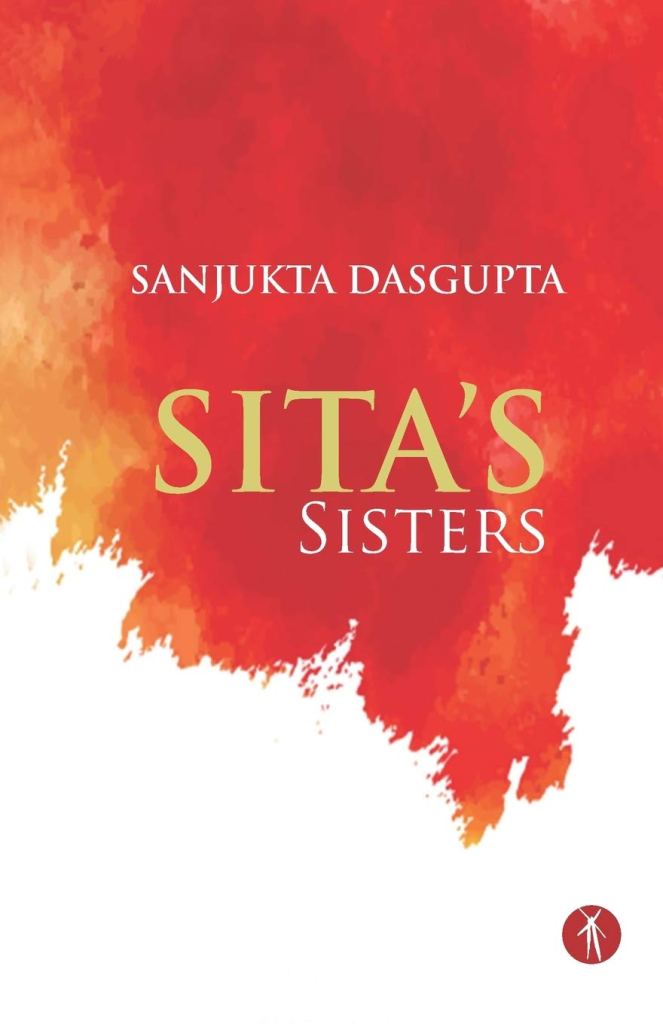
She thinks the core agenda in Lakshmi Unbound is a defiant, determined search for freedom.  So, it is not just deconstruction, it is an endeavour to call attention to the need to destabilize the deep-rooted stereotypes that have controlled the minds and mobility of women. In Sita’s Sisters (Hawakal, 2019), she crafts a revisionist feminist mythology by taking up familiar figures like Sita, Lakshmi, Kali, Mira and attempts to free these mythic figures from their claustrophobic space so that they can be re-invented in sync with the contemporary times. 

Residing in Jamshedpur, in the state of Jharkhand, Basudhara Roy is an established poet and has several books and publications to her credit. In her own website, is stated: “Committed to an undying affair with words, Basudhara finds in poetry an epistemological and existential skylight. She writes because she feels she must test words on her tongue, pulse, moods, agitation, abstraction and satire. She is convinced that words can change the world and hence, she works at them in her own culinary way – washing, peeling, grating, pounding, baking, sautéing, kneading, roasting, often flaming them for what they might yield.”

The following poem from Stitching a Home (Red River, 2021) considers the eternal problem of a woman that plagues women writers a lot.

The Right Kind of Woman

The right kind of woman will
inspire affection, regard, trust.
Not promiscuity, never lust.

Bred by a mother equally right,
she knows to avert her eyes to
innuendoes, telling smiles.

In crowded buses, shops, streets,
she knows to shut tight, bud-like,
relinquish space, circumscribe limbs.

Above all, she knows the prudence
of holding her tongue, of choosing
silence’s worth over wordy rebellion.

Schooled to surrender in dark
rooms, she knows, unasked, to
feign desire, moan, stifle, sigh on cue.

On her forehead, she had a
third eye to emit fire, take sides,
rake storms. Last night, its lid rusted

with disuse fell out, and the right kind
of woman laughed herself to death
over all she had left undone, unsaid.

“Writing poetry is an isolation exercise” says Angshuman Kar, an established Bengali poet who by profession is also an English Professor at a university in West Bengal. His book of poems Wound is the Shelter (Hawakal, June 2023) is unique and different from the other volumes discussed here because the poems are all translated by the poet himself from his original Bengali poems. In the ‘Introduction’, Kar tells us that authors who translate themselves often seem to be unhappy about the task of translating their own works. The Marathi poet Arun Kolkatkar likens it to incest, — “like making love to your own daughters.” Critics of translation studies have both supported and criticised self-translation. Those who support it argue that the author knows their work the best and hence s/he is the best translator of their own work. Those who oppose self-translation argue that the author-translator takes too much liberty while translating his/her own work; thus, the translation hardly remains faithful to the original. In such a situation Kar says, “Without being critical, I must say that I love self-translation. I enjoy translating my own work, I love committing incest. It makes me a better poet…. As a self-translator, I find incest healthy. It makes me a better poet – il miglior fabbro.

Coming to the individual poems in Wound is the Shelter, it need not be reiterated that most of them portray universal feelings but at the same time are seeped in Bengali culture as well. In “My Poems” Kar talks about Jungle Mahal, the three districts of West Bengal that are full of jungles; in “World,” he writes about blooms of a sal tree and shiuli flowers; in “Memory Card” he talks about a bus ride to reach his maternal uncle’s house in Bankura from where he went to the studio to take a family photograph — “Grandma in the middle/On either side we – three brothers, two sisters and a cousin”. In “Father” he mentions how his father’s bereavement fades with time and how his portrait adorns the wooden throne in which gods and goddesses are kept and he stands with Kali, Shiva and Durga. In “Neelkantha” he refers to Shiva; in “Park” he states how man forgets grief when he comes to a park, “That is why in a city as sad and lonely as Kolkata the number of parks is always high.” The five-part poem “Tiger” is also very powerful, “there is a tiger inside every human being” he states. Kar also mentions about the mask of a demon of Chhou dance of Purulia, the aal path in paddy fields, the Chandi mandap[7] of a small village, the man called Bhagaban Das who labours in a factory, and the man called Shubhasis Babu who rents him cars, whose voice he hears but has not seen him. Thus, even in his transcreated poems, Kar’s Bengaliness expresses itself overtly.

It is not possible to analyse the poems of each of the Bengali poets that I have mentioned above within the purview of this single essay, and so I have just selected a few of them (especially the poets who have one or two volumes to their credit at present). As mentioned earlier, though Bengali by birth, all the poets rendering their emotions in English, do often consciously or unconsciously express multicultural elements, Bengali cultural nuances, and idiomatic force in their poems. As the trend for providing glossary is passe now, much is left to the readers’ imagination, but still certain occasional Bengali words and phrases make their poems even more appealing.

After sharing my random thoughts about Indian Poetry in English in general and selectively mentioning a few Indian English poets who also happen to be Bengali and often unconsciously exude a sort of Bengaliness in some of their poems, without attempting to sound rather parochial, I wholeheartedly wish to see more volumes of their poetry being published in future. I conclude by quoting a very salient observation made by Arundhathi Subramaniam who is not wholly optimistic about the situation, but believes that despite hurdles in publishing, the voices of Indian poets writing in English would be heard [8]:

Despite the clunky discourse that continues to hover around it, however, Indian poetry in English endures, even flourishes, seventy years after Independence. Publishers may be few and far between, the royalties meagre, the critical climate thick with indifference or theoretical bluster, and the poets themselves bewildered by disputes over their identity, even their existence. But poetry, in its mysteriously resilient fashion, continues to be written, shared and discussed (if sometimes with more passion than discernment). … I am not ecstatic about the state of Indian poetry in English. (But then I am not ecstatic about poetry; only, at times, about poems.) What I do know is that Indian poetry in English is alive. And like all things alive, it engages, it annoys, it provokes, it excites. On several occasions, it has given me the jolt of wonder for which I turn to poetry in the first place.

Considering the slightly mellow tone in Subramaniam’s observation, I personally feel Indian English Poetry has become a significant force in the literary arena at present and will grow stronger with time. Seasoned poets who have several volumes of poetry published already, as well as the fresher ones whose debut volumes promise a lot more to come in future, can all look forward to seeing their ‘spontaneous overflow of powerful emotions’ in print and carry on the legacy of Indian Poetry in English to newer heights. And sure enough, the sub-genre of Bengali Indian English poetry can be researched in greater details in future.

.

[1] Henry Louis Vivian Derozio (1809–1831), poet and assistant headmaster of Hindu College, Calcutta, a radical thinker and started the Young Bengal Movement.

[2] Published in November, 2019. See http://www.thedailystar.net

[3] https://borderlessjournal.com/2024/03/14/the-subliminal-world-of-radha-chakravartys-poetry/

[4] https://lucywritersplatform.com/2022/05/12/sanjukta-dasgupta-in-conversation-with-basudhara-roy/

[5] Ibid.

[6] Alakshmi is one who is opposite of Lakshmi, a goddess who embodies prosperity and well being.

[7] Chandi Temple

[8] Subramaniam, Arundhathi. “Beyond the Hashtag: Exploring Contemporary Indian Poetry in English.” Indian Writing In English Online, 6 May 2022, https://indianwritinginenglish.uohyd.ac.in/beyond-the-hashtag-exploring-contemporary-indian-poetry-in-english-by-arundhathi-subramaniam/.

Somdatta Mandal, critic and translator, is a former Professor of English from Visva-Bharati University, Santiniketan, India.

.

PLEASE NOTE: ARTICLES CAN ONLY BE REPRODUCED IN OTHER SITES WITH DUE ACKNOWLEDGEMENT TO BORDERLESS JOURNAL

Click here to access the Borderless anthology, Monalisa No Longer Smiles

Click here to access Monalisa No Longer Smiles on Kindle Amazon International

Categories
Excerpt Poetry

Poems from Rituals

By Kiriti Sengupta

A Place Like Home

Lights turned off,

three glasses retire

as the bar closes.

The first stands upright,

the other upside down,

another lies horizontal.

.

For last few hours

the crystals held liquor,

ice, scent and comfort.

They also witnessed

eyes that spoke volumes

while lashes refused

to flutter.

.

The pub reopens

the next day

to the riff of unrest.

.

Observance

1

Visitors, who checked in 

to see my father post-surgery, 

appeared stressed.

After his discharge several came home.

Eyes moistened, they wished him Godspeed.

All of us except Baba knew… 

Ma informed him months later.

.

No one pays a call anymore. 

Three decades…

2

Tittle-tattle halts.

The mother waves a goodbye

as the school bus sets off.

.

Both these poems are excerpted from Kiriti Sengupta’s collection, Rituals (March 2019, Hawkal Publishers), with permission from the author

.

Kiriti Sengupta is a poet, editor, translator, and publisher from Calcutta. He is the recipient of the 2018 Rabindranath Tagore Literary Prize for his contribution to literature. He has published eleven books of poetry and prose and two books of translation and co-edited five anthologies. Sengupta is the chief editor of the Ethos Literary Journal.

.

PLEASE NOTE: ARTICLES CAN ONLY BE REPRODUCED IN OTHER SITES WITH DUE ACKNOWLEDGEMENT TO BORDERLESS JOURNAL.