As the author of Jorasanko and Daughters of Jorasanko, which map the life of the greatest visionaries of the world, Aruna Chakravarti gives us a brief summation of the genius of Rabindranath Tagore.
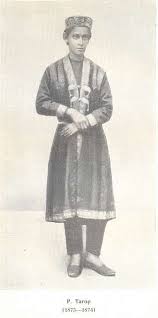
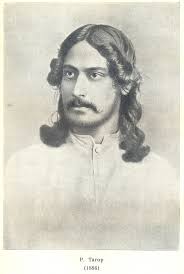
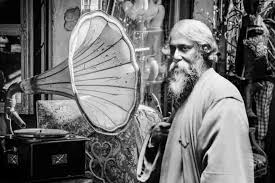
Young Tagore in 1870sTagore in 1886Photos from Public Domain
Rabindranath Tagore was born in 1861 in the throes of the Bengal Renaissance. A unique movement which took place during the latter half of the nineteenth century, it saw the germination and the slow stirring into life of a social and religious consciousness and the emergence of a middle class that idealised British rule and used its support to usher in considerable social change. The revolutionising of values and the social, political and literary awakening that followed gradually came to encompass the whole of India.
The Bengal Renaissance, like its European counterpart, swung precariously for a while, between two worlds. One old, decrepit and dying by degrees — the other struggling to be born. A host of great personalities emerged during this time; household names to this day.
All were protagonists engaged in battle. Some to keep alive and perpetuate the old; some to hasten its death and bring about the birth of the new. Needless to say, it was the latter who prevailed. Bengal saw an upsurge of activity, the like of which had never been seen before, in fields as diverse from each other as politics and religion to literature and the performing arts. In this, Bengal’s close contact with the British served as a catalyst.
Yet the same movement, in its latter years, saw the first stirrings of resentment against British domination. India’s acceptance of English education and her faith in the scientific discoveries of the West was countered by a new revivalism. An assertion of political independence and the growth of a nationalist consciousness. A need for introspection became the call of the hour. Rabindranath was among the first to articulate this need. In an essay, entitled Byadhi-o-pratikar[1]written in the early years of the twentieth century Rabindranath expressed his doubts regarding the changed Indian psyche wrought by the West. Reflecting on the French Revolution, the efforts to abolish slavery and the upsurge of literary activity in Europe he wrote: “Western civilisation seemed to proclaim an inclusiveness for all humanity irrespective of race and colour. We were spell bound by Europe. We contrasted the generosity of that civilisation with the narrow mindedness of our own and applauded the West.” He goes on to say, however, that the scales had fallen from the nation’s eyes. The supposedly Western ideal had failed Indians. European education and adoption of its values hadn’t helped them to achieve equality with the white race.
Thus, the movement came full circle. Rabindranath had not been part of it from its inception. Yet, if one were to look for and identify a single persona in whom the entire Bengal Renaissance may be said to be epitomised, it would, without doubt, be the persona of Rabindranath Tagore.
Poet, playwright, novelist, painter, composer, educationist, nationalist and internationalist, Rabindranath was not only a myriad minded genius but a Renaissance Man in the truest sense of the word. In fact, the dawn or awakening of Rabindranath’s creative inspiration is synonymous with the awakening of a whole nation.
The cultural identity of India and the place in it of religion, caste, class and gender which much of Rabindranath’s prose and poetry explores, continue to retain their relevance even today, a hundred years later, in a post-colonial time frame. His novels offer masterly insights and analyses of the complexities of Indian life with its teeming contradictions; its rootedness in tradition as well its ability to assimilate and accommodate change.
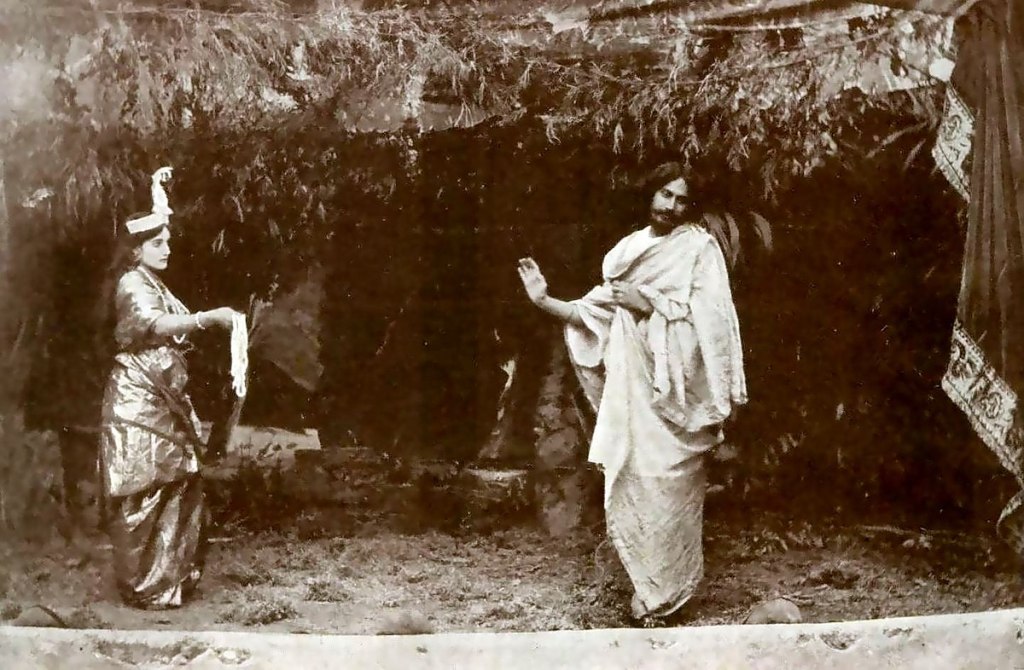
Rabindranath Tagore and Pratibha Devi (his neice) performing in his dance-drama, Valmiki-Pratibha (The Genius of Valmiki) 1881. Photo from Public Domain
Rabindranath, however, is best known as a poet. His poetry, drawn from ancient cultural memory as well as the immediate present, is in a class of its own. For there is a third dimension to it. He not only wrote of what he saw and remembered but what he saw only in his mind — a world that lay a vast space away from reality. ” There are two kinds of reality in the world,” Rabindranath said[2] of his paintings. “One of them is true; the other truer.” He could have said this of his poetry too. The real and surreal quality of his images in the vast span of his poems and lyrics; their indefinable nuances and evocative power are comparable to the works of the great Impressionists.
Interestingly, Rabindranath arrived at the canvas through his poetry. The calligraphic erasures and corrections with which he embellished many of his poems became sketches of a special kind. “I try to make my corrections dance,” he said[3] once, “connect them in a rhythmic relationship and transform accumulation into adornment.”
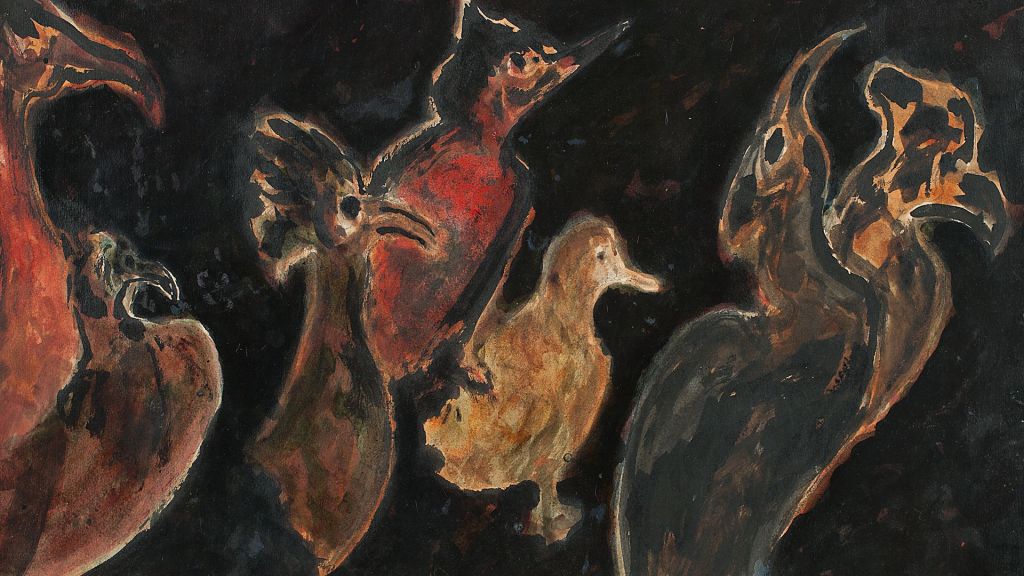
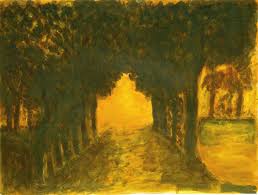
Later, in the last thirteen years of his life he threw himself into frenzied bouts of painting leaving behind more than two thousand and five hundred art works. Strange, haunting faces with eyes that look deep into one’s soul; surreal landscapes the like of which were never seen this side of the horizon; trees and flowers painted in violent colours that erupt from the artist’s palette in volcanic bursts — his paintings, as an artist once said, reflect “emotions recollected more in turmoil than in tranquillity.”
Art of Rabindranath Tagore. Photos from Public Domain
Yet, though famed the world over for his poetry and painting, it is as a music maker that Rabindranath has stayed entrenched in the hearts of his own people. His songs, loved and sung by generations of Bengalis, range in theme from celebrations of nature and yearning for freedom to love of God and Man. They convey the poet’s profound philosophy of life, his deep faith in humanity and his sensitive exploration of the Universe, often touching on the quest of the unattainable. Rabindranath once said that, though he could not predict how future generations would receive the rest of his work, he was confident that his songs would live. The increasing popularity of Rabindra Sangeet, both in India and abroad, bears ample testimony to the fact that his prophecy was based on a certainty born out of self-knowledge. Vast and varied though his genius was — music was its mainspring. He wrote of his songs: “I feel as if music wells up from within some unconscious depth of my mind; that is why it has a certain completeness.”
[2] Quoted from Tagore’s Galpa Salpa (Conversations) by Soumendranath Bandopadhyay in Expressionism and Rabindranath
[3] Quoted in An Artist in Life by Niharranjan Ray
Aruna Chakravartihas been the principal of a prestigious women’s college of Delhi University for ten years. She is also a well-known academic, creative writer and translator with fourteen published books on record. Her novels Jorasanko, Daughters of Jorasanko, The Inheritors, Suralakshmi Villa have sold widely and received rave reviews. The Mendicant Prince and her short story collection, Through a Looking Glass, are her most recent books. She has also received awards such as the Vaitalik Award, Sahitya Akademi Award and Sarat Puraskar for her translations.
.
PLEASE NOTE: ARTICLES CAN ONLY BE REPRODUCED IN OTHER SITES WITH DUE ACKNOWLEDGEMENT TO BORDERLESS JOURNAL
Paul Mirabile travels to 1970s Italy to a crime inside a sixteenth century well
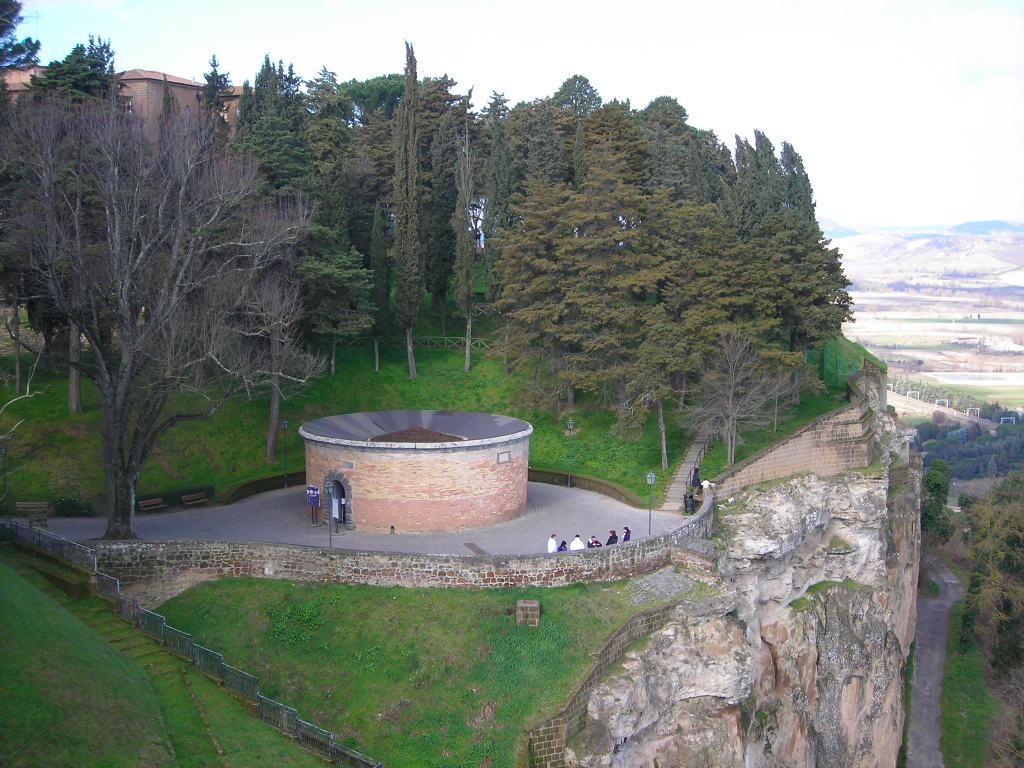
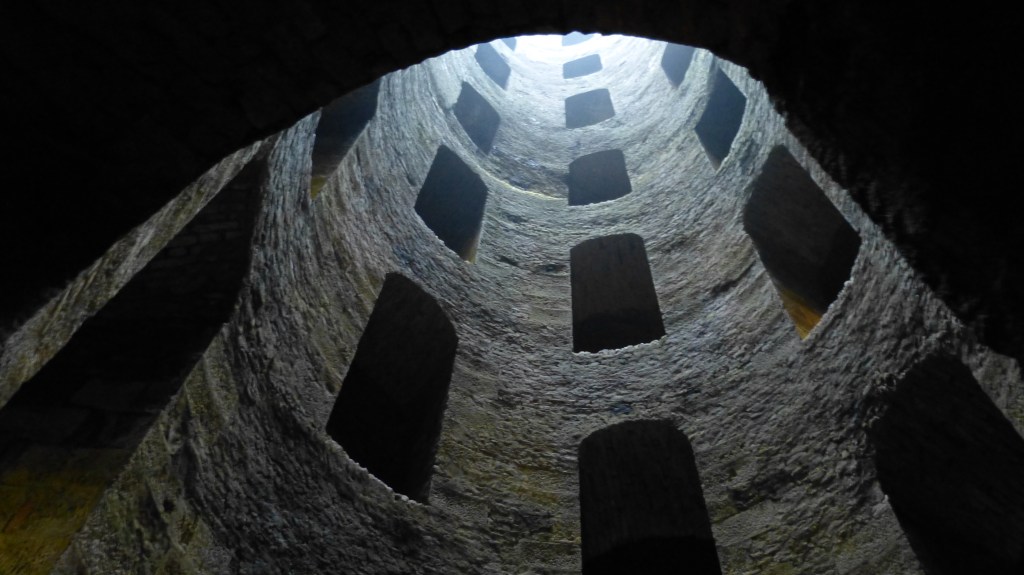
St Patrick’s WellInside the wellThe Pozzo di San Patrizio ( “St. Patrick’s Well”) is a historic well in Orvieto, Umbria. Built between 1527 and 1537, it was inspired by an Irish pit that was said to give access to purgatory. The cylindrical well, 53.15 metres deep with a base diameter of 13 metres, has 248 steps and 70 windows providing illumination.
A visit to Italy would certainly do me wonders; I hoped my migraines and other aches and pains would disappear, and my academic life regain its habitual vitality and éclat. Yet, in spite of my joyous resolution, I couldn’t see myself going alone to a country so different from my own. I thus decided to bring along a girlfriend of mine, a colleague from the university who had been working with me on various projects both at the university and at my summer home. She would be an excellent companion for such an excursion; the long distances by bus and train would be spent in ardent conversation, the sites and experiences could be discussed with a sympathetic companion. Also, if my health would fail at any given moment, she could surely offer her fine qualities as a physical and spiritual healer.
We left at the end of June, taking a night train through sunny France then directly to Rome. After spending a stimulating week there, bathing in the glory and debauchery of the Roman Empire, exalting the works of the great Renaissance artists, strolling through the still present Pasolinian streets of proletarian squalor, we took a bus to Orvieto, a mediaeval town located in the lush green hills of Umbria, noted especially for its white wine. I like a good white wine, and I was sure this ancient Etruscan town would revive and rejuvenate my spirits. Rome had plunged me in a numbing, cultural lethargy ; it was much too theatrical for my tastes, too saturated in enormous works of art for me to assimilate. I needed a stimulus less exacting, less pompous, more submissive. Orvieto was just that submissiveness …
The cathedral drew me towards her like a lascivious hussy. The queenly black and white columns and the lightly faded frescoes depicting scenes from the ‘Apocalypse’ painted at both ends of the transept[1] heightened my appetite for the imaginative and the unknown. The ceiling towered ever so high above me. At times the long and lofty naves appeared like soaring prehistoric animals, zebra-coloured, ready to devour their squealing prey below. At these awesome moments, I forgot that my colleague was close at hand, a hand so tender, fresh. Her presence became unreal, fading away beyond the muslin ramparts of my intimate sanctuary.
When I returned to the real world, I took my girlfriend by the hand and pressed it firmly. She appreciated those penetrating instances, although I will confess they were few and far between.
After our visit to the Duomo, we stopped for lunch, and had some lovely Orvieto wine. I ate and drank like I never had before, gobbling down plates of pasta that I never dared touch at home. I felt like I was in a reverie, drinking, eating, laughing … even joking ! I had never joked in my life: Was I possessed by some spirit, or simply by the trellis of polychromatic vines creeping up the trattoria[2]walls that emitted the most sensuous perfumes?
We stopped off at our hotel to change after lunch. I threw around my neck my favourite silk scarf stained a violent red. As to my companion, she too dressed very smartly for the occasion, draped in a long, milky white muslin skirt, a resplendent black satin blouse and sporting a large hat with crape rose. Yes, it would to be a most rewarding plunge into the underworld, I thought cheerfully.
We left the hotel. Arm in arm we strolled like two young lovers towards the famous Pozzo di San Patrizio, a curiosity that attracted me for its absolute banality: a well dug out of volcanic tuft, hellishly profound, spiralling down and down into the bowels of the earth, where the coolness of its universe preserves and petrifies all that stumble into and within its dark, dank apertures. Are all wells similar ?
We descended the cool, glistening, humid steps, smoothed over by moss. Oddly enough, we were the only visitors. My colleague, startled by our chilly surroundings, grasped my arm tightly in an almost man-like grip. She slipped, nearly sliding over the low stone wall that separated the steps from the brackish waters far below. I peered down into them ; a diminutive bridge connected the two spiralling stairways on each side of the darkened waters. The bridge seemed so far away, so distant from our weary lives spent on the surface of the earth, working like slaves to earn a meagre living. I had been toiling so much, trying to gather new ideas for a book or short-story. But nothing emerged, no matter how deep I sounded ; only a spittle of words drooled on paper without meaning, and oftentimes, without form.
My mind wandered nervously from the moist walls to the lightless, stagnant waters … A story would surely form out of those dank elements, a murder committed on the spur of the moment as the killer descended ever deeper into the bowels of Hell … Yes, Saint Theresa’s Hell as she so vividly depicted it in her autobiographical writings; a depiction that I had memorised to comfort me during long sleepless nights, twisting and turning in moist, smelly sheets :
“…Whilst she knelt in prayer, she suddenly found herself amongst demons in a place which appeared to her like the entrance of a long, narrow small street, a sort of low furnace, obscure and anguishing. The floor seemed to be of a very foul-smelling muddy water, swarming with terrible vermin or worms. At the end of this road appeared a cavity with a sort of closet, cabinet or store-room where the saintly nun felt cramped. Here she felt as if she were imprisoned. Hence, I reiterate that the descent into Hell was one of the greatest boons that the Lord granted me because I gained greatly from it, losing thus my fears of the trials and contradictions of this life, so as to strengthen myself to endure them ; and I thank the Lord who delivered me from what appears to me to be such terrible and perpetual evils …”
How comforting did those words ring in my tortured ears under the weighty silence of starless nights. A murder, yes a murder … without premeditation, without vindictiveness … without meaning ! A murder pure in act, taintless of any scrupulous criminality to which mankind has been accustomed. A murder to be executed in this very well, in its unholy, hellish, malodorous enveloping coil. Its slimy aureole would indeed produce a horror-filled effect.
As I turned to my colleague to expound my budding thoughts, a hard, clanking noise disturbed us from above. It sounded like a rotating, iron machine, grinding, pounding, droning … droning like a million wasps or hornets. A torturing engine, perhaps, twisting and tearing the limbs of its hysterical victims. The weird cranking sounds made my head spin. I felt a pang of involuntary emotion for its victims, his or her sorrows and misfortunes, trials and tribulations. My girlfriend stared at me out of empty orbits. Above the cranking din, the droning wasps and hornets, now receded now grew louder. I poured out my soul to her about the imagined murder. My animation caused her to laugh meekly, albeit I sensed in her voice an anguish that if magnified would have echoed off the well walls. She noted my need to expurgate this relevant project, the desire to couch it on paper, the need to fulfil its account. She realised this tale could only be discussed in whispers, here in the bowels of Hell. Yet, how delighted, how encouraged, how spellbound even was I to enlist her sympathy.
Our footfalls were endless. The sun’s rays had long since left us to grope our way along the smooth, rounded walls. The clanking and droning had ceased for an instant, but again took up its place amongst the horrors of my imagination, in rhythm with the melodious words of Saint Theresa, still drumming inside my temples. And my tale thickened with obsolete details amongst those uncanny rhythms. The cranking lent it beauty and balance, the drake-like light, ruddy and rutilant, form and volume. But the tiny bridge still appeared so remote, so aloof, far below us. Would we ever reach the damn thing ? Its razor-sharp crossing? The descent … the razor-sharp bridge : “ ..it was the bridge over cold water … it was strong and stiff like a sword … and it had the length of two lances..…” murmured creepily into my ear a fey voice from some remote, unearthly Time and Space; one that I could not fathom for the life of me. I shook my head, ridding it of that vexing nuisance …
The story that poured out from my entrails would surely please my future readers. But did it have to occur at the bridge ? Could it not, for example, happen elsewhere, along the slimy passage downwards, high above the stinking waters ? Could the killer, anxious to carry out his crime, impatient of the countless steps, not throw his victim to a watery death from the smooth, slimy, low, protecting, stone wall ?
I submitted these new image-filled details to my colleague who merrily agreed to the novel developments. She deemed it amusing, and even cautioned a detail or two, apropos the way in which the murder was to be effected. Was the victim to be strangled or merely thrown over the stone wall ? I shook my head fiercely, no violence would be condoned, a simple push over the side. The killer would observe the frightened face of his defenceless prey as she plunged over the stone wall. Yes ! It had to be a woman ! One who was easily terrified, especially of well deaths ! I laughed so loud that its echo clanged above the clanging, iron clamour … the droning hordes of wasps and hornets. My girlfriend stepped back against the low wall, noticing that the laugh resounded far greater than the gyrating engines. She turned a ghastly white, her eyes frozen in their sockets. Her sudden soft smile eased my inner tensions, soothed my painful need to perform a physical achievement. Yet, I had to do something to alleviate the mounting tension in my chest and temples : that spiralling Theresian plummet into Hell …
I touched her arm, absorbed by the intensity of her presence. She suddenly slapped me away as if the torturous pounding had been impounded in the palm of my hand. Her face transformed into a mutilated horror, her lips stretched bloodlessly across her already livid, pallid face. Those lips curled into a snarl and sneered at me. Those hollow eyes tunnelled out two fiery rays in the inky darkness. Her slow and steady transformation, along with the droning machines drove me back a few steps. The well seemed so much deeper ; and where was that bridge ? The iron clanking and wasp-like droning came to a sudden halt … The silence grew unworldly, and as it did, all the terrors of the subterranean world began to jump at me in tainted colours. Indeed, the Luciferian world would soon gain on my own. I wanted to run back up those long steps, back to light and hope.
She caught my shoulder. I lashed out to protect myself. Who’s side would she be on ? There would be no turning back now, my mind was running amok. My story was not evolving any further, and there I was trapped within the entrails of Hell in company not with Saint Theresa but with a witch-like demon. A strong impulse grew terribly painful and seized my heart, a killer’s impulse that shot adrenalin through my arm as it involuntarily stretched out to grasp the witch’s leathery neck … to wring it to death. But ever so gently, as not to leave any ungainly marks on that creamy, pasty, ashen skin. Those marks never attracted me in the least ; they were done in the most barbaric fashion, passionately and without reflexion.
We are not savages, are we not ? We are children of mild words and sober acts. And here I was forced to perform such undistinguished rituals … I deemed it repugnant to prostrate before these base and besmirching deeds. Her lips touched mine. They were dry, wilting like the dying petals of a black tulip, no longer tempting, but welcoming infectious lust. My strength, however, did not yield, and lifting up this mindless, mirthless creature, I threw it over the wall, its screams in perfect harmony with the churning machines, the droning hornets. The screams vanished with a distant thud … and splash … I peered over the low stone wall : the body floated listlessly upon the calm, clammy waters. Suddenly it disappeared, and only the large hat with crape rose lay stiff on the oily surface waters like some dead gelatinous marine creature …
I continued to peer into those waters, so still, so tranquil, like my nerves, still and tranquil. A decomposing odour soon filled the air. Already ? It made me think of a slaughter-house on the edge of a polluted river-bank. Perhaps even of a burial vault. I searched for my colleague but she was nowhere to be found. Had she returned to the surface? She did seem so distraught at the stillness and profoundness of that Hell-hole. Someone did caution me about her oftentimes awkward, even odd, unpredictable behaviour.
Apparently she was capable of standing you up at any time for any given reason. I now believed it. She had left me to wane alone in Saint Theresa’s realm. But I was undaunted, unafraid of what others would say if they should find me amongst the dead. Their words could never pierce my brazen heart. I had been there before and knew how to handle poisonous platitudes. And besides, I could at last write my story… my beloved story that would earn me a grand reputation amongst my so called peers, they who, to tell the truth, were no more than the lackeys of market-targeting editors and courtiers of government officials. Perhaps they would all laugh at my naivety, at my indefatigable efforts. But I feared not their calloused mockery. I would not lock myself up like some raving maniac and let them tear me to pieces. Let them come ! The dark walls of Hell had welcomed Saint Theresa … They shall welcome me ! They shall be my lichened ramparts, my spiralling stairway to fame and fortune ! Hell will transform the cranking machine and droning nests of wasps and hornets into a deadly weapon of defence … cranking and droning my enemies to atoning tears. Had the goodly saint not whispered to me the bitter but bountiful benefits of Lucifer’s diabolical gardens ?
There on the diminutive bridge, razor-sharp (I finally gained the bridge), I waited for them, my indistinguishable peers, cranking my neck high up to the creamy waxing rays of a lunar light ; waited at that precipitous bridge for the great Crossing. Ô Theresa ! Ô Theresa ! Will my story rise to the dawn of rosy day, expurgated of its entombed overweening bondage ?
[1] Either of the two sides of a cross-shaped church that are at a perpendicular angle to the main part
Paul Mirabile is a retired professor of philology now living in France. He has published mostly academic works centred on philology, history, pedagogy and religion. He has also published stories of his travels throughout Asia, where he spent thirty years.
.
PLEASE NOTE: ARTICLES CAN ONLY BE REPRODUCED IN OTHER SITES WITH DUE ACKNOWLEDGEMENT TO BORDERLESS JOURNAL
 Borderless