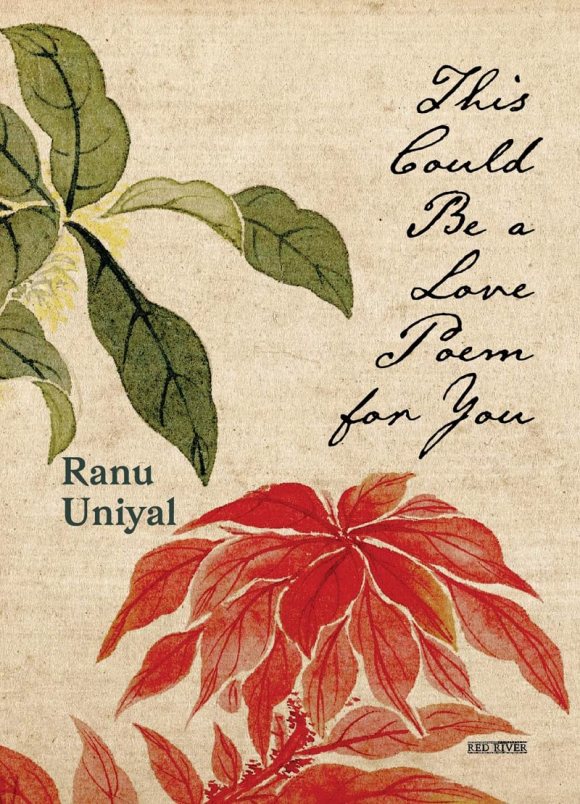
This Could Be a Love Poem for You by Ranu Uniyal, is her fifth collection of poems. Uniyal is a passionate bilingual poet at heart, a retired professor of English literature by profession and an inspiration to many budding poets. Across the Divide (2006), The Day We Went Strawberry Picking in Scarborough (2018), December Poems (2012) and Saeeda Ke Ghar (In Saeeda’s home, Hindi, 2021) are some other significant contributions made by the poet.
“Poetry and beauty are always making peace. When you read something beautiful, you find co-existence; it breaks walls down.” A quote by Mahmoud Darwish is reflective of Dr Uniyal’s poignant portrayal of human existence layered with love, grief, crises and relationships with the One (Self) and the World.
The collection is an aesthetic delight that traverses the heart of the readers with astute directness and a distinct confessional tone. It has three segments: ‘Dust My Regrets’, ‘Be a Good Girl’ and ‘Thy Eternal Grace’. Collectively, there are 62 poems in all.
The poems start from the personal and move to the universal with their intricate details. The poetic sensibilities take us to the female imaginary of the physical, psychological and spiritual domains. If Kamala Das in the 20th century introduced the readers to her brazenness in poetry, then Ranu Uniyal in the 21st century coerces her readers to travel from the common routine to the coveted spiritual abode found in the creative doctrine of poetry. The poetic depth can also be inferred through the rhythmic structure, the play with the words through alliteration and rhymes introduce jibes in poems such as ‘The Shop and the Shutter’.
The themes of love, identity, self-expression, language and power, old age, body’s fragility, vulnerability, precarity, loss, women and domesticity, motherhood, death and memory are persistent throughout the collection. She poetically contours the theme of human existence and its distinct flavours like WB Yeats in Sailing to Byzantium with — “That is no country for old men.”
The poetic pondering over the question of ‘Self’ or recurrent declaration of ‘I’ is developed through linguistic, racial, and geographical temporal identities. For example, the poet’s ‘Garhwali’ identity is camouflaged with the the more modern Anglophone identity. The declaration of the personal “self” and dedication to some personalities like Mohini Mangalik, S. A. Hamid and Amma takes us to the glints of the poet’s biography in the most poetic manner. Gulzar once uttered that, “we poets are errant grains of dust… life takes us and tosses us, we do not know where it will end.” The poems hail the essence of life’s evolutionary journey, especially the one of experience and the mature years of life.
Her poems present multiple binaries: of love and grief, seller and buyer, life and death, through picturesque imagery. Additionally, the poet familiarises the readers with the references to the pagan myths from diverse cultures, Christ, Nachiketa, Yama, Isis, which also introduce us to the eco-folklorists’ traditions which is a delight to explore.
She writes in aphorisms at times and critiques the personal and public crises. The poem, ‘Only Grief’, provocatively emotes the climate crisis as an apocalyptic warning through a distant voice from the future, wherein, critiquing the war-torn present world and the catastrophic space left for the progeny of the future.
We sang dangerously of the failure.
Of our prodigal ancestors.
Another poem, ‘From One Life to Another’, reflects a similar concern about the cataclysmic/tragic climate situations left for the future:
Sparrows and crows have
been hushed to silence.
The once-green acacia shrieked
as they chopped her limbs.
Nature and motherhood hold each other’s hands in sharing the identity of exploration and exploitation. Furthermore, the intricate details through the lens of the ecofeminist poetic sensibilities highlight the diversified literary corpus in the anthology. The same poem states further:
I was once a tree- all green.
Very tall, bobbing in the wind.
I had leaves, branches.
And occasional flowers.
I, too, had a name.
A woman. A mother.
Once a tree.
I brush them aside,
My tears, an upright foliage
Lying heavy on my chest.
Dr Uniyal can be set alongside the “literary greats” like Kamla Das and Sujata Bhatt.
The usage of the colloquial vernacular Hindi words and phrases makes it more personal, tinctured with cultural aesthetics.
The eponymous poem in the anthology, ‘This Could Be a Love Poem for You’ is raw and personal between the one waiting for the other partner far away from a distance is the talisman of the relationship, the theme that finds its way again and again in the poet’s poetic oeuvre. This colourful and mature anthology glossed with distinct sonorous imagery could indeed be a reflective love poem for the present and for our progeny, the rightful claimants, who would reminisce over the past. It’s a love poem about resilience and human existence that shall follow the hearts of the readers for a long, dialogic course of expressions and insights.
Gazala Khan teaches in the Department of English at Doon University, Dehradun, India. She has published poetry in magazines such as Setu, Borderless, and The Fictional Café and has been consistently working on creative and literary projects.
.
PLEASE NOTE: ARTICLES CAN ONLY BE REPRODUCED IN OTHER SITES WITH DUE ACKNOWLEDGEMENT TO BORDERLESS JOURNAL
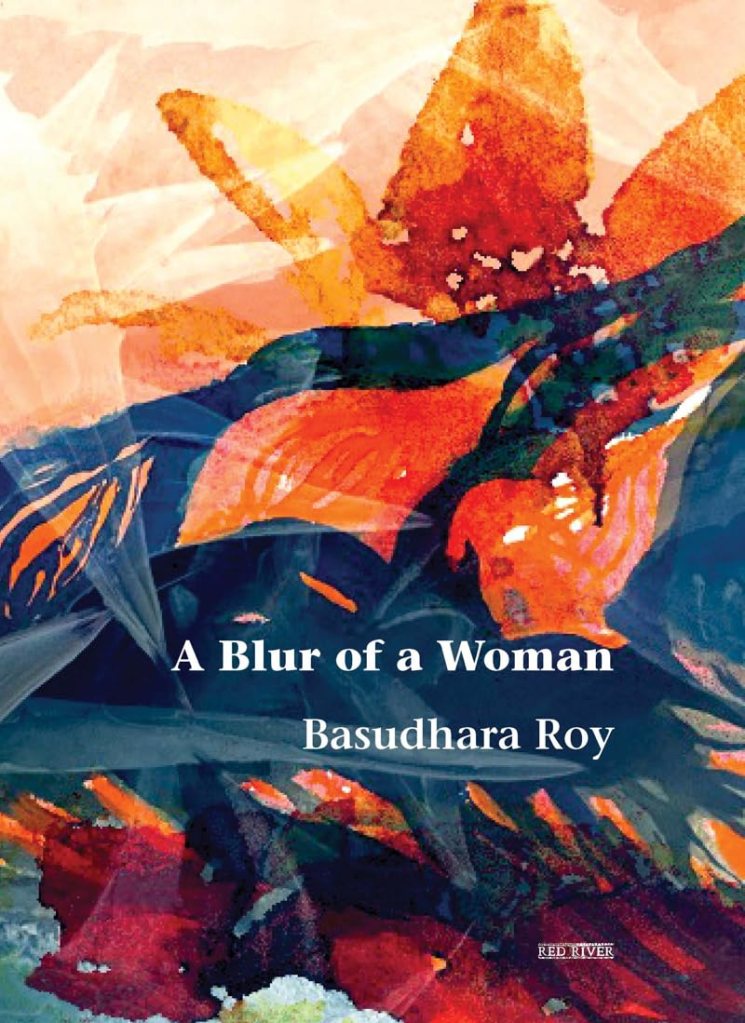
The feminine mystique has defied every attempt to capture its attributes. If clusters of stories surround a goddess, dilemmas are embedded in them. If the pavement-dwelling mother with children clinging to her skirt images economic deprivation, there are stories hidden in her grey-flecked eyes. Basudhara Roy recognises this amorphous, protean aspect of the feminine and titles her collection A Blur of a Woman, poetically declaring; “she owns the place/and the little magic she has earned…she will use it someday to unbuild herself/disappear dissolve/ become a blur”.
This collection is a subtle attack on patriarchy as it encompasses the history and socio-cultural conditions that have moulded women into being mercurial yet tangible, pliant as well as resistive, buoyant but also vulnerable. As the poems flow in a drumroll of many contexts, vignettes of the journey are captured, symbolically strong and offering a plethora of layered meanings. The lines encourage a dialogic exchange whether with the poet, or with one’s own half-acknowledged self that is suddenly confronted by Medusa’s mirror.
The first two sections begin with poems titled ‘Duhkha’ and ‘Soka’[1], directing us towards the Buddhist principle of inevitable mutability and the need for acceptance.
I have seen hearts shut and bolt doors
from within, their windows walled while
on love the mold of ingratitude thrives
With such adaptations, the contemporary takes precedence over the philosophical teachings, and the identification with thwarted expectations, social discord, betrayal and helpless sorrow is almost immediate. If solace is to be found it is now individual—and, in this instance, by turning to the gnarled trunks of trees where tears have watered the serrated bark. Speaking of the imagistic density of Roy’s phrases, this kind of interlinking through poetic shorthand is perceived in much of her narrativisation. The ‘betrayal’ that causes sorrow and also the maturity of recovery is a process resonant through the history of women’s writing. ‘Soka: A Triptych’ strings this further through contemplating the elegiac notes of death and mourning—yet birth and death are twins: “If life alone can be seen/all this emptiness must surely be death.”
A sizeable section of the book charts a trajectory of feminist fables, gleaning references from Rabindranath Tagore, Jayadev’s Geet Govinda, Philomela’s story, Virgo’s distress, and others. In Roy’s hands, irony becomes a viable and effective tool of social critique as in the poem
‘In Which Bimala Agrees to an Interview for a Special Issue of Post-Text Feminism’. Tagore’s popular novel Ghare Baire/ The Home and the World presents Bimala as the conventional woman who is persuaded to discover the turmoil of the world outside the threshold. Basudhara devises an imaginary conversation, some of which is quoted:
Where, then, would you locate yourself?
Here. Now.
Come on! I am hardly lost
and need no GPS of theory to find myself!
Such a startling reinvention of a canonical text subverts many assumptions with sharp, clear strokes: the jargon of literary theory, the leap into digital alignments, the confidence of the liberated woman, and the time travel that feminism has enabled.
My other favourite piece is about ‘Lalita’, a sakhi or friend of the beauteous Radha who is always the heroine in the traditional tale. In Lalita’s version of the mysterious raas leela where Krishna is perceived by each woman as her partner, she is jubilant about her societal escape and physical abandon;
limbs supple like vines we danced,
thrilled to be
where love was recklessly returned.
This may be the right time to refer to the Author’s Note which is titled ‘I Write from the Body’ and seems to carry forward the feminist discourse of theorists such as Hélène Cixous who invented the term écriture feminine, or Julia Kristevawho perceived the chora as a specially maternal zone. According to Roy, “In the earth-bed of this woman’s life that I live, poetry runs as a river, its plenitude being both a lesson and an antidote to the prosaic borders of my world.” In which case, “Blur” is the right metaphor for attempting to break the boundaries through word-play and subversive themes expanded in poems such ‘Aid to Forgetting’, ‘Praise for the Subaltern’, ‘Dis/enfranchised’—and several other poems are expressions of resistance to the bastions of control. Philomela’s severed tongue has again learned to speak– but it’s a new language of assertion and intertextuality.
The semiotic breakthrough in Roy’s poems is accompanied by stylist experiments too, the Ghazal section being one such. The transcreated use of the Urdu structure allows for couplets on a variety of subjects—for example, the seasons in the manner of the Baramasa (songs of the twelve months) with a twist that the woman is no longer the bereft, perpetually waiting figure uttering her woes to the firmament. She says confidently now:
You etch every constellation on your  palm
Yet secrets line the arcane of the body
In all, A Blur of a Woman, offers poems for the intellect and the heart which are indivisible aspects of a woman’s existence. That she is mercurial and evasive is once again a reminder of a fascinating mystery that has prevailed over time — and perhaps its more exciting to keep it that way.
Malashri Lal, writer and academic, with twenty one books, retired as Professor, English Department, University of Delhi. Publications include Tagore and the Feminine, and the ‘goddess trilogy’ (co-edited with Namita Gokhale) In Search of Sita, Finding Radha, and Treasures of Lakshmi. Betrayed by Hope: A Play on the Life of Michael Madhusudan Dutt received the Kalinga Fiction Award. Lal’s poems Mandalas of Time has recently been translated into Hindi as Mandal Dhwani. She is currently Convener, English Advisory Board of the Sahitya Akademi.
.
PLEASE NOTE: ARTICLES CAN ONLY BE REPRODUCED IN OTHER SITES WITH DUE ACKNOWLEDGEMENT TO BORDERLESS JOURNAL
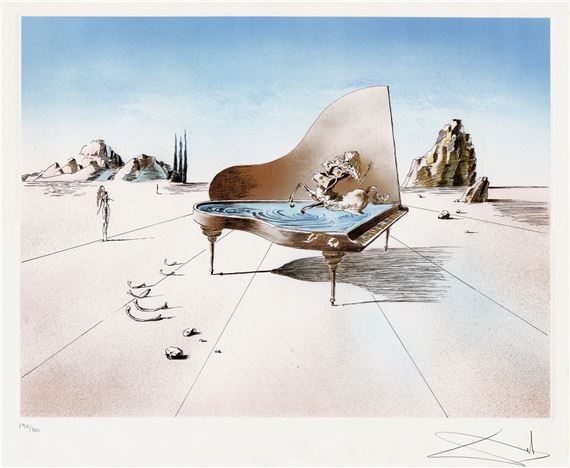
Art by Salvador Dali (1904-1989). From Public Domain
A LOVE SONG IN THE BATTLEFIELD

1

we inhabit a battlefield,
blood and bodies around.
nothing to wrap except deadly weapons.

yet
our songs are flowery
hued in green
as we dream a quiet solitude.

2

we walk along the rivers
imagining an ocean at the end of our eyes,
never knowing
what connects a river and an ocean.

rivers end up in a desert and
oceans fly into unknown skies,

as our gods and goddesses await immersion.

3

we devour sacred foods
dance around all possible divinities,
and share a hundred stories
of joy or sadness that
flow into our blood, seeping deep
into the lower depths of the body.


4

we meet quite surprisingly at crossroads,
embrace each other.
we spread our arms to the horizon,
all set for the day of lights and kites
knowing fully well that
we’re those little lamps left in the glowing river.

5

breathing next to the bombshells,
limping around blood canals
we still walk through huge utsav pandals,
perform namaz amidst thousands of believers,

then, we vanish into our narrow lanes
shutting down every innermost chord of the heart.

6

didn’t you see that
me and you remain
all alone
on this day of
lights and kites…

*Utsav – festive/festival
Afsar Mohammad teaches at the University of Pennsylvania, and he has published five volumes of poetry in Telugu. His English poetry collection is forthcoming. He has also published a monograph with the Oxford University Press titled, The Festival of Pirs: Popular Islam and Shared Devotion in South India. His current work, Remaking History: 1948 Police Action and the Muslims of Hyderabad, has been published from Cambridge University Press. His poetry collection, Evening with a Sufi, was published by Red River.
PLEASE NOTE: ARTICLES CAN ONLY BE REPRODUCED IN OTHER SITES WITH DUE ACKNOWLEDGEMENT TO BORDERLESS JOURNAL
It is clear that English is employed here not as a language on loan, but as the rich, spluttering resource of the marrow and the bloodstream.-- Arundhathi Subramaniam.
At the outset, let me make a candid statement. I am a very prosaic person, someone who in her long teaching career and academic writing as well as translation, has never ventured to write poetry myself. I might seem like the odd woman out, but somehow, I have been closely following the recent trends in which Indian Poetry in English has been rapidly spreading its wings and with new volumes being published every other day, it is now a force to be reckoned with.
Tomb of Henry Louis Vivian Derozio at the South Park Street Cemetery, Kolkata.
Recapitulating literary history briefly, it is well known that Indian English Poetry (or often called Anglophone poetry in India) is the oldest form of Indian English literature. Beginning roughly from 1850 to 1900, it went through the ‘imitative’ phase when Indian poets were primarily ‘romantic’ and tried to imitate the British masters. Beginning with Derozio[1], many poets of the time — namely Rabindranath Tagore, Sri Aurobindo, Sarojini Naidu, Michael Madhusudan Dutt, Toru Dutt — were also Bengalis by birth. The poetry written between 1900 to 1947 belonged to the ‘assimilative’ period and often questions were asked why the poets didn’t write in their ‘own’ languages. Post-independence poetry was primarily experimental, and when we come to contemporary Indian English poetry, we find it becoming wholly urban and middle-class. The poets are realistic and intellectually critical in the expression of their individualised experience. They go in for precision at all levels and do not stick to one genre but experiment with multiple poetic forms.
Interestingly, I realised that a whole host of Indian English poets writing at present (some have several volumes of poetry published already, whereas others have just given birth to one or two), but coincidentally many of them happen to be Bengalis — Bashabi Fraser, Sudeep Sen, Kiriti Sengupta, Sanjukta Dasgupta, Mitali Chakravarty, Angshuman Kar, Shyamasri Maji, Basudhara Roy,Radha Chakravarty, and others. It is not a complete list at all, and what makes this study more interesting is that except for a couple of them, all these poets come from an English literature background. It is also not a coincidence that most of them teach English as their profession. So, whether it be personal lyrics, free verse, memories, experiences, observations, or even translation, the English muse therefore gives them the impetus to experiment with all forms, and at the same time helps them to move away from themes like nationalism, nature, Indian culture, love etc. that dominated Indian English Poetry in earlier times.
Bashabi Fraser receiving her CBE (2021 The Queen’s New Year Honours) from Prince Charles, now King Charles III.
Bashabi Fraser is an Indian-born Bengali and a Scottish academic, editor, translator, and writer. She is a Professor Emerita of English and Creative Writing at Edinburgh Napier University. Fraser’s work traverse continents in bridge-building literary projects. She was appointed a Commander of the Order of the British Empire (CBE) in the 2021 New Year Honours for services to education, culture and cultural integration in Scotland, in particular for her projects linking Scotland and India. Among her several volumes of poetry the Bengal and Bengali connection comes out in volumes like From the Ganga to the Tay: a poetic conversation between the Ganges and the Tay (2009), Letters to My Mother and Other Mothers (2015), My Mum’s Sari (2019), and Lakshmi’s Footprints and Paisely Patterns: Perspectives on Scoto-Indian Literary and Cultural Interrelations (2023). Fraser has worked extensively on a project about the Bengal Partition and the angst resulting from this divide expresses itself in the following poem.
This Border
Can shadow lines on the earth’s surface divide language and literature, rituals and customs, rivers…and memories?

There was a time when you and I
Chased the same butterfly
Climbed the same stolid trees
With the fearless expertise
That children take for granted
Before their faith is daunted
Do you remember how we balanced a wheel
Down dusty paths with childish zeal
Do you remember the ripples that shivered
As we ducked and dived in our river
Do you remember what we shared
Of love and meals, and all we dared
Together – without fears
Because we were one
In all those years
Before we knew that butterflies
Were free to share our separate skies
That they could cross with graceful ease
To alight on stationary trees
On either side of this strange line
That separates yours from mine
For whose existence we rely
Entirely on our inward eye
This border by whose callous side
Our inert wheel lies stultified
This border that cuts like a knife
Through the waters of our life
Slicing fluid rivers with
The absurdity of a new myth
That denies centuries
Of friendships and families
This border that now decrees
One shared past with two histories
This border that now decides
The sky between us as two skies
This border born of blood spilt free
Makes you my friend, my enemy.
Another well-established poet is Sudeep Sen who studied in New Delhi and in the United States and is a global citizen, so to say. Sudeep’s literary output is enormous and some of the titles of his volumes of poetry have subtle references to Indianness and Bengaliness embedded in them as well. Mention may be made of volumes like Leaning Against the Lamp-Post (1983), The Man in the Hut (1986), Kali in Ottava Rima (1992), Postmarked India: New & Selected Poems (1997), and several others. Though he might not do it consciously, his Bengaliness remains embedded in his psyche.
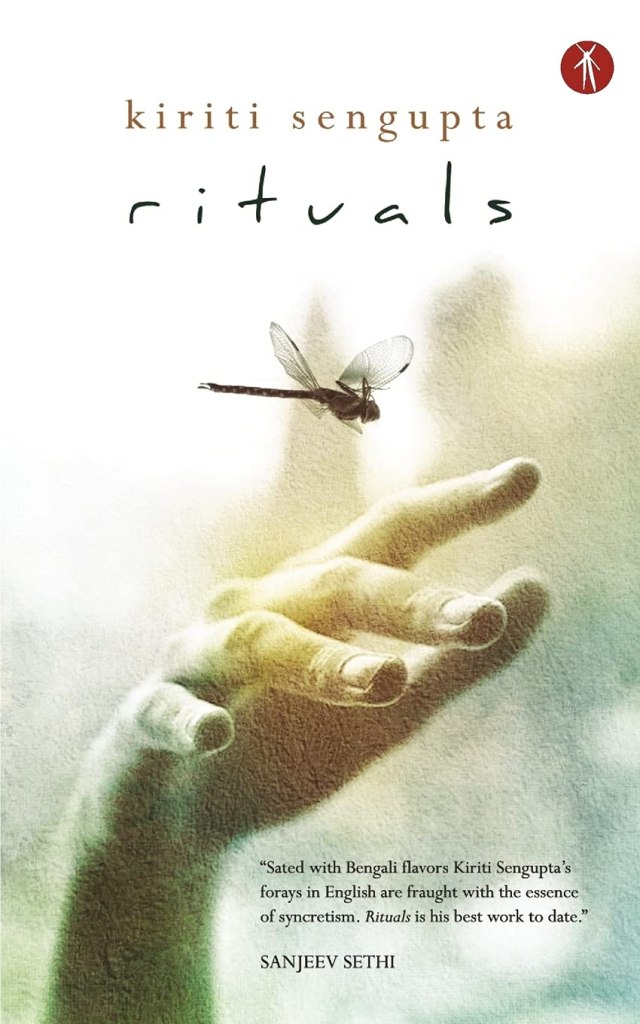
Kiriti Sengupta who has been awarded the Rabindranath Tagore Literary Prize (2018) for his contribution to literature, is a poet, editor, translator, and publisher. What is more significant is that along with Bitan Chakraborty, he mans the publishing house Hawakal, which has already carved a niche for itself as the largest publisher of Indian Poetry in English. Several poets mentioned in this essay have seen their creations see the light of the day through Hawakal Publishers and they have done yeomen service in this regard. As an established poet, Sengupta has several volumes of poetry to his credit. His collection from 2019, called Rituals, is very different from the work readers usually read in that there is a narrative thread in many poems that is not there simply to tell a story but to ultimately present a meditation on an aspect of life and the modern world that they haven’t considered before. “Fleeing the house and leaving the doors ajar. Is it perversion or fallacy?”
In an earlier volume entitled Solitary Stillness (2018), Sengupta does not give away the traits that have pervaded his poetry, he has not forgotten his Bengali roots, and has once again drawn his poetry on the canvas of the time that has been rooted in Calcutta. As he elaborates upon this point in his professional website, here, he makes a reference to Lapierre, and indeed, the ‘city of joy’ tag sounds fake just as we read that particular poem, which is so natural, that it almost appears to have been spoken by a resident of a city, one who is not a poet. According to him, that person who complains about water logging or that person for whom any tag of romanticism about the city is bourgeois, it is nothing but a label that’s needed to promote consumerism.
Mitali Chakravarty, the indefatigable editor of Borderless Journal, wrote to me saying that she is happy I feel she belongs to Bengal, “I call myself a Bengali and a human”. Though a non-resident Bengali, her perception of her own work and Bengali cultural identity is clearly revealed in a poem published in The Daily Star (Bangladesh)[2].
Confused

I am mixed up – cannot help
English and Bengali under my belt

I can read a bit of Hindi
Cannot understand much of French
A little Chinese …low class, they said…
I am mixed up – cannot help
English and Bengali under my belt

I grew up thinking I will find a way
But now pidgin is all that I can say
I write in English – the language borrowed from the West
The language that taught us or brought us unrest
The language that through The Raj spread
Importing Nationalism in its tread
I am mixed-up – cannot help
English and Bengali under my belt

But my life is that of the non-English
A probashi Bengali at best

People say I am not typical, not quite the right type
A mixed-up Bengali – I said
Culture is something I dread at every tread
Because what Culture I have is mine
- Not of a Race, a Country or Religion –
Human Being is the only race to which I belong

Help protect my home, the Earth – its every drop, its every stone

In a world of 7.7 billion, can I be alone?
I am mixed up – cannot help
English and Bengali under my belt
Though she has been writing poetry for a long time, Mitali’s first poetry collection, Flight of the Angsana Oriole: Poemswas published by Hawakal only in October 2023. In the ‘Introduction’ to this volume, she states that her random collection of poems “are sometimes of the past” as she knew it and “sometimes of the present. And sometimes in quest of a future or a dream that she hopes will go to create a more hopeful future than the world presents to us currently.” The poems in this volume are personal; some talk of her journey through life, the world as she sees it, some even influenced by her travels across the world. She further states: “Inherent in each line is not just the influence of my experiences in many countries but the nurturing I had in India, where I was born, educated and spent the first two decades of my earthly existence.” So, poems like ‘Death of Lalon’, ‘Shivratri’, ‘Kali Rise’, ‘Shraddha‘ [last respects] and a few others do convey the subconscious Bengaliness embedded in her psyche, irrespective of where she physically resides now.
Radha Chakravarty, a prolific writer and translator, Former Professor of Comparative Literature and Translation Studies at Ambedkar University, Delhi, has recently joined the bandwagon of Indian Poetry in English with her debut collection of poems Subliminal published by Hawakal Publishers in 2023. In a detailed interview given to Mitali Chakravarty for the March issue of Borderless Journal[3], she tells us about her aims and ambitions as a poet and how most of the poems in Subliminal are independent compositions, not planned for pre-conceived anthology.
My poetry actually delves beneath surfaces to tease out the hidden stories and submerged realities that drive our lives. And very often, those concealed
truths are startlingly different from outward appearances. I think much of my poetry derives its energy from the tensions between our illusory outer lives and the realities that lurk within.
Many of Radha Chakravarty’s poems express the feeling of Bengaliness in different perspectives. We read about the typically soft quilt called kantha in Bengali in the poem ‘Designs in Kantha‘ thus:
Sewn into soft, worn layers,
forgotten fabric of grandmother tales –
patterns of the past,
secret memories, hidden designs,
intriguing patterns in silk strands
dyed in delicate dreamy shades—
embroidered storylines
in exquisite, dainty kantha-stitch.
When Mitali Chakravarty asks her why she writes in English though it isn’t her mother tongue, she answers:
Having grown up outside Bengal, I have no formal training in Bengali. I was taught advanced Bengali at home by my grandfather and acquired my deep love for the language through my wide exposure to books, music, and performances in Bengali, from a very early age. I was educated in an English medium school. At University too, I studied English Literature. Hence, like many others who have grown up in Indian cities, I am habituated to writing in English. I translate from Bengali, but write and publish in English, the language of my education and professional experience. Bengali belongs more to my personal, more intimate domain, less to my field of public interactions….
Both Bengali and English are integral to my consciousness, and I guess this bilingual sensibility often surfaces in my poetry. In many poems, such as ‘The Casket of Secret Stories,’ ‘The Homecoming’ or ‘In Search of Shantiniketan’, Bengali words come in naturally because of the cultural matrix in which such poems are embedded.
Of course, the poet also mentions that all her poetry is not steeped in Bengali. In fact, in most of her poems, Bengali expressions don’t feature at all, because the subjects have a much wider range of reference. As a globe trotter, Radha has written about different places and journeys between places.
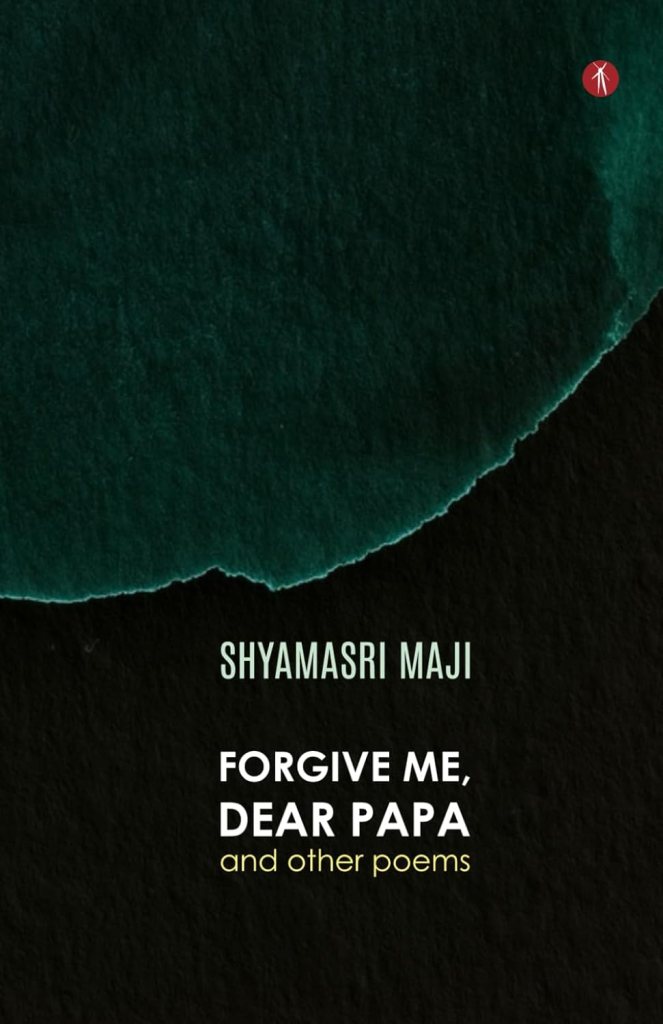
Another debut book of poems that Hawakal Publishers brought to light in December 2023 entitled Forgive Me, Dear Papa and other poems is written by Shyamasri Maji, an Assistant Professor of English teaching at Durgapur Women’s College, West Bengal. Dedicating this collection of poems to her “incurably romantic self,” Maji feels that “being ‘romantic’ in this context is being imaginative, reflective, puerile, rebellious and emotional.” The poems are a mixed bag, belonging to different thematic issues. Some focus on a woman’s radical views on the gender hierarchies in our society, in some nature plays the role of mediator between the narrator and the world, the idea of loss of love, which is closely linked with thoughts of death, while a few poems also represent an interpersonal dialogue between the self and the other. Some of Maji’s poems focus on the role of memory whereas some are experimental in the sense that they portray a woman’s comprehension of a man’s thoughts. Stressing upon the fluidity of identities, she shows how love, pain, pandemic, separation and grief affect all human beings irrespective of an individual’s gender and sexual orientation.
Six books of published poems and twenty-five years of creative journey has been a consistent exploration by the poet Sanjukta Dasgupta as she tries to find the path of freedom from among the misleading mesmeric mazes that threaten and stifle both sense and sensibility. As a woman poet with a strong feminist stance, Dasgupta admits in an online interview given to Basudhara Roy[4]:
Though I read Bangla poetry since my schooldays, I wrote my poems in English. It was an unconscious choice. Much later I learnt that I should have been embarrassed about writing in English rather than in my home language, my mother tongue Bangla. The poems written in English kept on being born on the page with embarrassing regularity.
Writing poetry is an irrepressible urge for me. It is, in a way, far more intense than the biological labour pain. This labour pain of creativity leaves me restless till the words are born on the page. But the creative process allows endless revisions; a biological production is largely about acceptance, neither revision nor deletion are considered ethical practices. In the case of poetry, it is not about choice, it is a compulsion which is intense and gratifying and multiple revisions often lead to the emergence of the perfect product.
The title of Dasgupta’s poetry book Lakshmi Unbound (Chitrangi, 2017) is very significant. Lakshmi being an intrinsic part of the fabric of Bengali culture, the radicality and dissidence of the idea of ‘Alakshmi[6]’ will require no explanation to a Bengali reader.
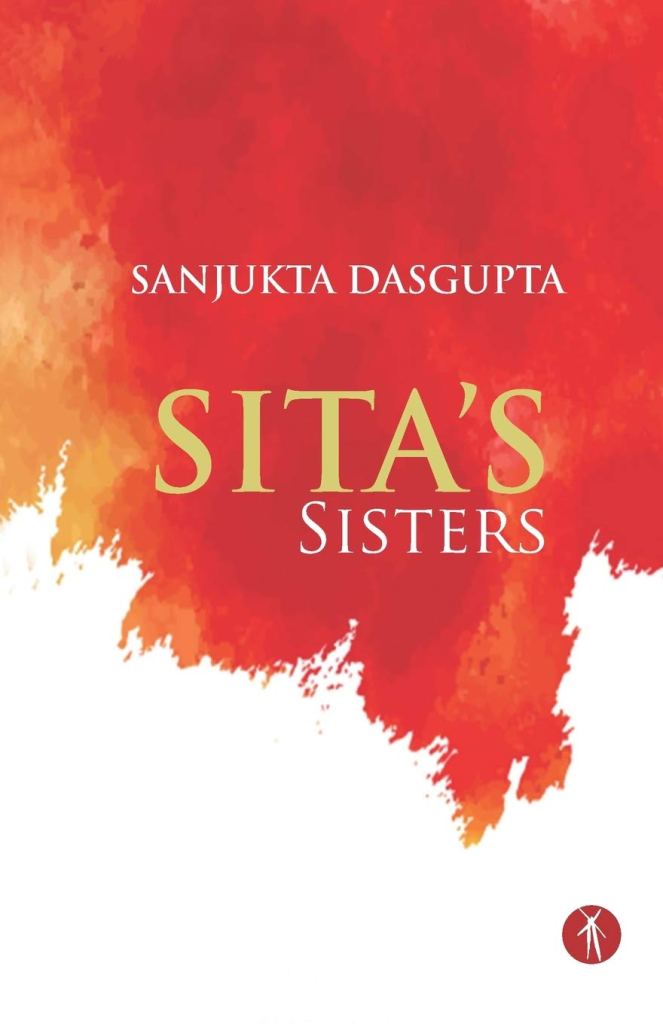
She thinks the core agenda in Lakshmi Unbound is a defiant, determined search for freedom. So, it is not just deconstruction, it is an endeavour to call attention to the need to destabilize the deep-rooted stereotypes that have controlled the minds and mobility of women. In Sita’s Sisters (Hawakal, 2019), she crafts a revisionist feminist mythology by taking up familiar figures like Sita, Lakshmi, Kali, Mira and attempts to free these mythic figures from their claustrophobic space so that they can be re-invented in sync with the contemporary times.
Residing in Jamshedpur, in the state of Jharkhand, Basudhara Roy is an established poet and has several books and publications to her credit. In her own website, is stated: “Committed to an undying affair with words, Basudhara finds in poetry an epistemological and existential skylight. She writes because she feels she must test words on her tongue, pulse, moods, agitation, abstraction and satire. She is convinced that words can change the world and hence, she works at them in her own culinary way – washing, peeling, grating, pounding, baking, sautéing, kneading, roasting, often flaming them for what they might yield.”
The following poem from Stitching a Home (Red River, 2021) considers the eternal problem of a woman that plagues women writers a lot.
The Right Kind of Woman

The right kind of woman will
inspire affection, regard, trust.
Not promiscuity, never lust.

Bred by a mother equally right,
she knows to avert her eyes to
innuendoes, telling smiles.

In crowded buses, shops, streets,
she knows to shut tight, bud-like,
relinquish space, circumscribe limbs.

Above all, she knows the prudence
of holding her tongue, of choosing
silence’s worth over wordy rebellion.

Schooled to surrender in dark
rooms, she knows, unasked, to
feign desire, moan, stifle, sigh on cue.

On her forehead, she had a
third eye to emit fire, take sides,
rake storms. Last night, its lid rusted

with disuse fell out, and the right kind
of woman laughed herself to death
over all she had left undone, unsaid.
“Writing poetry is an isolation exercise” says Angshuman Kar, an established Bengali poet who by profession is also an English Professor at a university in West Bengal. His book of poems Wound is the Shelter (Hawakal, June 2023) is unique and different from the other volumes discussed here because the poems are all translated by the poet himself from his original Bengali poems. In the ‘Introduction’, Kar tells us that authors who translate themselves often seem to be unhappy about the task of translating their own works. The Marathi poet Arun Kolkatkar likens it to incest, — “like making love to your own daughters.” Critics of translation studies have both supported and criticised self-translation. Those who support it argue that the author knows their work the best and hence s/he is the best translator of their own work. Those who oppose self-translation argue that the author-translator takes too much liberty while translating his/her own work; thus, the translation hardly remains faithful to the original. In such a situation Kar says, “Without being critical, I must say that I love self-translation. I enjoy translating my own work, I love committing incest. It makes me a better poet…. As a self-translator, I find incest healthy. It makes me a better poet – il miglior fabbro.“
Coming to the individual poems in Wound is the Shelter, it need not be reiterated that most of them portray universal feelings but at the same time are seeped in Bengali culture as well. In “My Poems” Kar talks about Jungle Mahal, the three districts of West Bengal that are full of jungles; in “World,” he writes about blooms of a sal tree and shiuli flowers; in “Memory Card” he talks about a bus ride to reach his maternal uncle’s house in Bankura from where he went to the studio to take a family photograph — “Grandma in the middle/On either side we – three brothers, two sisters and a cousin”. In “Father” he mentions how his father’s bereavement fades with time and how his portrait adorns the wooden throne in which gods and goddesses are kept and he stands with Kali, Shiva and Durga. In “Neelkantha” he refers to Shiva; in “Park” he states how man forgets grief when he comes to a park, “That is why in a city as sad and lonely as Kolkata the number of parks is always high.” The five-part poem “Tiger” is also very powerful, “there is a tiger inside every human being” he states. Kar also mentions about the mask of a demon of Chhou dance of Purulia, the aal path in paddy fields, the Chandi mandap[7] of a small village, the man called Bhagaban Das who labours in a factory, and the man called Shubhasis Babu who rents him cars, whose voice he hears but has not seen him. Thus, even in his transcreated poems, Kar’s Bengaliness expresses itself overtly.
It is not possible to analyse the poems of each of the Bengali poets that I have mentioned above within the purview of this single essay, and so I have just selected a few of them (especially the poets who have one or two volumes to their credit at present). As mentioned earlier, though Bengali by birth, all the poets rendering their emotions in English, do often consciously or unconsciously express multicultural elements, Bengali cultural nuances, and idiomatic force in their poems. As the trend for providing glossary is passe now, much is left to the readers’ imagination, but still certain occasional Bengali words and phrases make their poems even more appealing.
After sharing my random thoughts about Indian Poetry in English in general and selectively mentioning a few Indian English poets who also happen to be Bengali and often unconsciously exude a sort of Bengaliness in some of their poems, without attempting to sound rather parochial, I wholeheartedly wish to see more volumes of their poetry being published in future. I conclude by quoting a very salient observation made by Arundhathi Subramaniam who is not wholly optimistic about the situation, but believes that despite hurdles in publishing, the voices of Indian poets writing in English would be heard [8]:
Despite the clunky discourse that continues to hover around it, however, Indian poetry in English endures, even flourishes, seventy years after Independence. Publishers may be few and far between, the royalties meagre, the critical climate thick with indifference or theoretical bluster, and the poets themselves bewildered by disputes over their identity, even their existence. But poetry, in its mysteriously resilient fashion, continues to be written, shared and discussed (if sometimes with more passion than discernment). … I am not ecstatic about the state of Indian poetry in English. (But then I am not ecstatic about poetry; only, at times, about poems.) What I do know is that Indian poetry in English is alive. And like all things alive, it engages, it annoys, it provokes, it excites. On several occasions, it has given me the jolt of wonder for which I turn to poetry in the first place.
Considering the slightly mellow tone in Subramaniam’s observation, I personally feel Indian English Poetry has become a significant force in the literary arena at present and will grow stronger with time. Seasoned poets who have several volumes of poetry published already, as well as the fresher ones whose debut volumes promise a lot more to come in future, can all look forward to seeing their ‘spontaneous overflow of powerful emotions’ in print and carry on the legacy of Indian Poetry in English to newer heights. And sure enough, the sub-genre of Bengali Indian English poetry can be researched in greater details in future.
.
[1] Henry Louis Vivian Derozio (1809–1831), poet and assistant headmaster of Hindu College, Calcutta, a radical thinker and started the Young Bengal Movement.
In Conversation with Ramesh Karthik Nayak, author of Chakmak, with an afterword on Banjaras bySurya Dhananjay and art by Ramavath Sreenivas Nayak, published by Red River.
They always wish they wander
into black clouds like Banjara Tribes:
the people with no address on the earth,
gypsies in the tales of time.
Here are stories of a people who have never voiced their lores in English. The Banjaras had oral folk lore as old as the hills. They relocated to various places in the world. One group wandered down to the South, where some learnt to write their spoken language — Gor Boli — in Telugu. To this group belongs young Ramesh Karthik Nayak who has given us a wonderful book of poems describing the life of Banjaras as well as concern that in the process of integration, they seem to be losing parts of their heritage. Called Chakmak[1], the book leaves a lingering aftertaste not just with words but also with the vibrant artwork by Ramavath Sreenivas Nayak and an informative essay on Banjaras by Surya Dhananjay.
Banjara art in Chakmak by Ramavath Sreenivas Nayak
You travel with the book to a place of wonder and yet it’s not all smooth sailing as the poems introduce notes of accord and discord into the conversation. Reality and discontent creep in.The poetry is layered with images, simple and yet of a definitive flavour. There is poignancy in the poet’s lines when he says:
The ippa flowers grieve
releasing inebriety
listening to the story of our tanda*.

*tanda: settlement
And:
No ghunghtos*  were left in the tanda,
all have disappeared
along with the people
who were born
and grew
within the ghunghtos.

*ghungtos: veils
And yet the culture seems to have had an innate wisdom as the tribe harmonised with nature:
The thunders devour our huts and us.
So, to threaten thunder, we howled.
We should raise our voices whenever we need to.
Or else we die.
In the titular poem ‘Chakmak’, Nayak tells us about his life as a Banjara and then reflects:
The world is trying to heap the chakmak together,
ransack our tribe for stones
and change the tanda into a haat*
of banjara tribes.

The chakmak in the haat were ready to burst
with chronicles untold.
You gather the people.
The flute disappears.
I try fabricating the remaining tale.

*haat: market at a fair
Nayak for all his flavour and wisdom experiences a severe disconnect and finds himself in almost perhaps, an immigrant’s world, where it is hard to adjust to the reality of the ethos that connects him to the larger world and he feels an outsider in the world that he was born into. Torn between these two, the young writer is fascinated by death. He tells us –
Since my childhood
I saw death as an untouchable
In this candid conversation, Ramesh Karthik Nayakn– a young lecturer, presenter on Doordarshan[2] and an upcoming voice for a people who have remained voiceless over centuries following oral traditions — talks of this strange position he finds himself in. He tells us more about his people, his perceptions and his poetry.
Ramesh Karthik Nayak
Congratulations on being the first Banjara writer to have done a full book in English. Reading your book, one gets a whiff of Banjara life as it was in the past. Can you tell us about their life and beliefs? The creation myth seems unique… maybe you can tell us a bit about the colours you have reflected in your poetry?
Thank you. There is a vacuum in indigenous literature. Not enough indigenous literature has been produced till now. This vacuum won’t be filled until we the insiders turn outsiders. After some time, when we question our identity, we start seeking our own history and go back into the past. In this process, we practise a few things (writing, singing, painting, dancing or sculpting) which slowly turn us into an insider.
Each and every colour has a significance in our lives. All colours will be seen in our attire. If there are any colours missing, they will be reflected in the mirrors embroidered into our garments while we travel.
There are many beliefs and occupations seen among us.
If, the calf’s ceremony (Bhessi Puchre). When a buffalo gives birth to a calf, based on the calf’s gender, after 5 or 7 days, we conduct a ceremony with seven triangle-shaped stones (Shaathi Bhavani[3] :Manthrali, Kankali, Hinglaj, Mariamma, Thulja, Sheetla, and Dhavalagar) by offering lapsi (rice boiled in milk and cooked in jaggery). The Saathi Bhavani look after their children (who share their arts and crafts with nature for free) and their cattle safely and provide them with natural resources abundantly. Only after this ceremony, the milk from the lactating cow can be shared with others. Until then, no single drop could be shared outside the home. If the milk was shared with others before the ceremony, the calf’s life would be in danger. Thus, we respect animal needs too.
Another very distinctive ritual is a death ritual of a young married person. Friends or family members of the deceased pierce pins under the dead person’s feet so that the corpse is hindered from walking back without pain. They believe that the young person will have a yearning for their hamlet and children. So, the ghost might want to haunt their homes. Also, while taking the body to its final destination, the deceased’s friends throw mustard seeds along the way. While coming back home, they pluck off the pins off the feet and pick up each grain. They keep picking the grains the whole day. The cycle keeps repeating.
Did Banjaras — who at the end you call gypsies — ever grow roots and become farmers? You have a poem about a farmer. Did your ancestors give up their nomadic lifestyle to opt for farming?
Our ancestors used to sell salt by wandering from place to place. They used to thatch roofs and transport stuff from place to place. They sang songs handed down orally and embossed traditional tattoos. They would stitch clothes with infinite designs, etc. Now everything has turned upside down. Now, we are growing up eating many types of leafy and root vegetables, rice, corn and sorghum instead of our traditional foods.
In Telangana, wherever you travel by the highway, you will see Banjaras on both sides of the roads selling fruits and vegetables. Other common occupations among us are farming, driving auto rickshaws, selling crafts, making bricks in kilns, etc.
Your dialect/ language Gor Boli had no written script and I read in the afterword that the traditions were oral. So, did you learn about your culture purely from oral traditions? Are your two books written in Gor Boli written in Telugu or in just plain Telugu? Which language are you most comfortable in? Which language did you grow up speaking?
I have learnt many things by seeing and listening. Whenever I ask my parents about something they simply smiled instead of giving an answer. They did not want to share any cultural things about our community. They always asked me to concentrate on my studies. That might be one of the reasons that I always keep thinking of my people and their history.
I grew up with the Telugu language. In 1999/ 2000, I was sent to a private school for my education. From then onwards, I thought I was a Telugu. Later, I realised I’m a Gor (Banjara/ Lambadi). Now I am a hybrid Gor. I want to localise myself from hybridity. I have published two books in Telugu. One is in English. These three books are just an introduction to an existing community. To write down the sensibilities and other things, I think this life won’t be enough. There is only one book which I haven’t been able to publish yet, written in Gor Boli with Telugu script. I’m comfortable with Telugu. People tell me that I stammer when I speak Gor Boli. They also say my way of speaking is like that of a child. Nowadays, I believe I’m comfortable with Telugu, Banjara (Gor Boli) and English.
In your poem, ‘Who am I?’, you mention eviction. Did you or your tribe face displacement? Tell us your story.
Yes, it happened with my grandparents. Before that, they used to stay in abandoned lands. They would stay in one area for two to five years and then migrate to a different place to get enough grass for the cattle or herd they had. Earlier, my grandparents were settled near a hilly place, where there was a pond. Then, in 1970s, the then-state government relocated my grandparents to Jakranpally Thanda, also called VV Nagar Tanda, near to the highway road NH44 and a village Jakranpally (now known as Mandal) near to our tanda.
Still, in our state, some nomadic communities face eviction.
TheBanjaras depicted in the art in your book seem to be a musical lot. Does music impact your poetry?
Yes indeed. Women are trained to sing their plights in a song, which we call Dhavlo. This was the name of my short story collections in Telugu. The event could be happy or sad, but everything would be sung in a song. Some of the lyrics can be so heartrending that listeners could start to cry. Our people cannot survive without singing. Some people also misunderstand our Dhavlo as Rudali’s[4]song. Each and every moment is made into a song for self or for children or just to survive. I hope the flow of my blood has music, then automatically my words would atleast carry a little bit of music with it. So that could turn into a poem that you read.
You seem to be steeped in lores from the past, and yet you bring it all to us in English. How did you develop your fascination for words? Tell us how from a tanda you moved into school textbooks?
It started when I was admitted into private school. I stopped talking to others. I would stare at our school ground, where there were some other nomadic families sheltered in the tarpaulin tents. I felt like going to them. They were not Banjaras, but they had donkeys and horses. I still remember the scene. In the summer, near our school, a canal was being dug. Accidentally, a boy fell under a heavy vehicle and died. His mother picked him and kept him in her lap and wept.
I was fascinated. I thought of killing myself. And in this way, death always put herself first in my words.
Later, as I changed many schools, I grew lonelier and started drawing landscapes. I started writing to create captions for my drawings. Thus, my drawing drove me into writing. Writing turned into a habit; later it became a compulsion. When I came across Toni Morrison’s quote, “If you find a book you really want to read but it hasn’t been written yet, then you must write it”, I could connect and also to the stories of Mahasweta Devi. Because of my writing, I have developed my skill in Telugu and English — at least I can express the way I feel. Later, after getting published, with the help of my friends, Aparna Thota and Chaitanya Pingali, the Balder Bandi (Bullock Cart) attracted readers and an autonomous college prescribed a poem in the under-graduate curriculum and the book was prescribed in the post-graduate curriculum.
Why did you name your book Chakmak, a flintstone. Is the poem named as such at the centre of the story you want to share with the readers?
In our community, we bow down to the earth in front of a rock or stone to offer ourselves. We also use the rocks for other things like I have mentioned in the poem. So, in our community, things which are regarded as sacred should also be useful in other ways. They should not sit idle or be untouchable. In our daily lives, we do see many stone and pebbles, but we don’t even take a look at them, instead we kick them off. I wanted to highlight that even rocks have history.
Also, many rock were getting blasted in our areas. We are just losing our natural resources. We are losing the peacock and fox cries that echo from the top of rocks.
I sensed a sense of regret in your poems for the loss of a way of life. Do you feel that it is better to stay indigenously and not integrate with the mainstream? Do you think it helps integrate with the mainstream?
I’m afraid for my people. They are losing their sensibilities. Their fascination for modern lifestyle is making them disregard their identity as Banjaras. Sometimes, I even feel like I should go to each and every one and explain to them why we should choose ourselves as we have been. Being segregated from the mainstream is also part of our identity. So, I hope for now there will not be any integration with the mainstream population. Of course, you may be wondering that Ramesh Karthik Nayak is now living with mainstream society and telling this. Yes, I’m living with this society, where I feel suffocated with the artificial lifestyle. I know I will be just a guest to my land, where I keep cheating my people, writing their lives on paper. Mainstream society once had pity on indigenous communities, but now it has turned envious, because our people are getting benefits like reservation from the government.
In ‘A Day in the Rainy Season’, you have spoken of a rain ritual where people howl: in ‘Roseland’ you have written of how roses is not what Banjaras grow and in ‘On the Forest’, you reaffirm that the Banjaras are in harmony with the green. Given the need for a greener world, would you say that Banjaras lived in harmony with nature? If so, how?
Nomadic or Adivasi people always believed in nature. And they still insist that they are an extension of the greenery, which is a quarter part of this cosmos. And the harmony that the reader experiences in my poems cannot be explained except as part of our traditions. But I want to make a point. In tribal communities, love and hatred are two different things that resonate at different wavelengths. Their way of living reflects love always to the outsiders. Without beliefs and rituals offered to the trivial things, you cannot even imagine a single day in the life of tribals. It will be incomplete.
You have mentioned untouchability. Have you or yours ever faced it in the present day or is it something from the past? In ‘Death’, you equate death with untouchability.
I have had my education in distance mode. So, I don’t know about the discrimination that happens in schools and colleges. But I heard many things related to discrimination from friends. Now, I regularly hear that these nomads (Banjaras) migrated from somewhere and they even have reservations now. They don’t belong to this land, they say.
To support my studies, I used to distribute leaflets in bus stops. I used to work in a photocopy shop operating machines, sold books at events, did catering, and helped as an air-conditioning mechanic. While working, few people did not want me to work for them because I was a Banjara.
In the past, our people were herders. They were not allowed to touch the water that the owners’ animals drank. And they were always accused of stealing. They were always treated as thieves and murderers (Criminal Tribes Act, 1871) in some areas. In some areas of course, Banjaras were treated with due respect because of their hard work. However, there have been times when they would not be allowed to get into the bus to sit with others, especially when they were in Banjara attire.
In 2016, I visited a tanda near Medchal. On my third visit, a group of women told me their plight about selling fruits and vegetables, how people bargained with them because of their indigenous identity or because of their broken Telugu, how some people took credit and never paid. Later, an older woman, Kokhli, talked about the well. Whenever these Banjaras want to fetch water from the well, which belonged to a landlord near their tanda, the farm workers used to excrete into the water so that the Banjaras could not quench their thirst. But unfortunately, they had no other choice. So, they had to draw from the same well for drinking. The same thing also happened recently in Tamil Nadu. I’m trying to record all these in my stories and poems.
Since my childhood, I have had a great love towards death. I even dreamed of dying many times. That’s how death came and repeated more in my poems.
What are your future plans? Any other book in the offing?
In our Telugu states, we have 35 tribal communities, which includes Girijanas — nomads dwell near to the hills or abandoned lands, and Adivasis — people dwell within the forest (Gond, Koya, Nayak Pod, Gutthi Koya, Pardhan, Banjara, Matura Lambadi, etc). I want to write more about all the tribes in Telugu and in English languages. It might be in any genre. Sometimes a single topic can be expressed in multiple formats like in a poem, short story or essay.
Presently, I am co-editing (with Prof Surya Dhananjya) a compilation of Telangana Banjara stories in Telugu. I am also working on my second short story collection Banjara Hills in Telugu along with English poems (which I am rewriting from Telugu).
Thanks for giving us your time and for a brush with your people through the book.
Afsar Mohammad teaches at the University of Pennsylvania, and he has published five volumes of poetry in Telugu. His English poetry collection is forthcoming. He has also published a monograph with the Oxford University Press titled, The Festival of Pirs: Popular Islam and Shared Devotion in South India. His current work, Remaking History: 1948 Police Action and the Muslims of Hyderabad, has been published from Cambridge University Press. His poetry collection, Evening with a Sufi, was published by Red River.
PLEASE NOTE: ARTICLES CAN ONLY BE REPRODUCED IN OTHER SITES WITH DUE ACKNOWLEDGEMENT TO BORDERLESS JOURNAL
GUN

It always
hides metal seeds
of volcanoes and
new wars inside.

They are as heavy
as human lives.

The bullets pumped into
the flesh of soil
tears the tissue of earth
into pieces as the blood
spreads as roots into the ground.

Not one seed —
There are thousands that
yearn for the effigies of
tribal people.

There won't be
a reason for
the deluge of bullets
but, they say
It has to be done.
Ramesh Karthik Nayak is the author of three books in Telugu—Balder Bandi (Ox Cart, 2018), a poetry collection, Dhaavlo (Song of Lament, 2021), a short story collection, and co-editor of Kesula (Modugu Flower, 2022), a compilation of Banjara stories. His debut collection of poetry Chakmak is forthcoming from Red River Press.
PLEASE NOTE: ARTICLES CAN ONLY BE REPRODUCED IN OTHER SITES WITH DUE ACKNOWLEDGEMENT TO BORDERLESS JOURNAL
The wonder of art acknowledges and affirms the potency of stillness, its pregnancy vouching for a revelation that is both vital and imminent. Ambitious as the thought is, is it possible to engage in a dialogue with stillness, to distil the flurry of a day into the transcendence of a moment, and to transform that moment, in turn, into a metaphoric prism for the illumination of all our hereafters? In her recent collection of poems Ukiyo-e Days… Haiku Moments, Bina Sarkar Ellias can justifiably claim to have assayed each of these tasks with remarkable felicity and quiet grace.
A form of Japanese art that flourished between the 17th and the 19th centuries, ‘ukiyo-e’ is a composite of three words – ‘uki’ (floating), ‘yo’ (world) and ‘e’ (pictures), literally meaning “pictures of the floating world”. The ‘floating world’ referred to the theatre districts and (licensed) courtesan quarters that flourished in Japan’s major cities during the Edo period and constituted an important source of attraction for the nouveau-riche of the era. Inhabited largely by courtesans and the traditional kabuki actors, this floating world, despite its low status in the social hierarchy of the times, made its impact as valuable cultural capital, its sartorial customs and mannerisms becoming quite effectively, a rage among common people.
Since paintings could be afforded only by the prosperous, the ukiyo-e artists made a distinct historical move to democratise art by being the first to experiment with woodblock prints which could be produced cheaply and in large numbers, thus making ukiyo-e widely accessible to the populace. Actors, courtesans, legends, folklore, and landscapes were some of the common subjects that marked this art, the heroic and the erotic being significant thematic notes within it.
Ukiyo-e Days… Haiku Moments revisits this memorable Japanese artform to bring to the reader a remarkable collection of 68 ukiyo-e by 28 artists from across the seventeenth to the early twentieth century, showcasing a delectable mix of the traditional and the modern in Japanese art and its unique blend of native and foreign influences. Compounding the effect of the Ukiyo-e here, is a set of 62 haiku by Bina that excavate, explore and expand the meaning and value of the artworks by bringing them into dense ekphrastic conversation with her own mind and times. “My haiku travels with each of the ukiyo-e works as a companion through this journey, responding with a deep kinship I feel with the artworks,” she writes in her Preface.
In this collaborative project of creativity, the haiku become a companion to the historical journey of the ukiyo-e, illuminating them in a transcultural framework which even as it asserts the omnipotent significance of art, helps draw attention to its omniscience across temporal and cultural divides. “To read a haiku,” says Jane Hirshfield, “is to become its co-author, to place yourself inside its words until they reveal one of the proteus-shapes of your own life.” As Bina places her contemporary and complex historical self within the sensibility of the ukiyo-e, her unravelling of meaning through the haiku becomes yet another act of seeking connection and consolation in an alienated world.
As a poetic form, the haiku establishes a constant romance with the brevity of expression on the one hand and the expanse of space on the other. Its sharp imagism helps to illumine both the moment and the emotional ambience that will render this moment organic in every context. Scale, speed, succinctness and surrealism can all work in concert within the seemingly fragile universe of the haiku to make it an emblem of and testimony to the wide-ranging historical forces within which it is birthed. The animated and tender conversation between colour, form and script in Ukiyo-e Days… Haiku Moments works similarly holding both word and beauty in suspension, mirroring the moment as self and self as moment, and asking us to return to the quintessential celebration of both:
you want to be free
but maya mesmerises-
locks all the doors
The haiku is, often, a lesson in perception. It is characteristic of the haiku to be profoundly epiphanic and in many of her pieces, Bina ascends to that level of quiet illumination wherein an inner truth becomes simpler by the sole virtue of its lucid expression. Art, life, hope, faith, poetry, war, human vulnerability — all emerge as important themes here. One cannot help noticing, however, the collection’s loving partiality toward women. Women and their myriad-layered lives constitute a recurrent thematic motif in these poems:
into the long night
her toil of pleasure-giving
a tale of two worlds
Since in much of the ukiyo-e, the women represented were courtesans, Bina brings a profound sense of tenderness and understanding in reinterpreting their situation for modern women whose lives, in different contexts, remain emotively the same. In their intensity and in the overall poignance with which these haiku delineate women’s ever-shifting roles in terms of profession, domesticity and relationships with the world, Bina evinces a deep knowledge of women’s spiritual multiplicity. To Torii Kiiyonaga’s delicate artwork ‘Bathhouse Women’, for instance, Bina, deflecting attention from the voyeuristic potential of the scene to give the bathhouse a larger cultural and political logic, responds:
a day for washing
wash away patriarchy
energise our souls
Another beautiful narrative turn in haiku is offered in response to Kitagawa Utamaro’s print ‘Naniwa Okita Admiring Herself in a Mirror’ in which Bina imagines a different (more youthful) face emerging from the mirror. While the mirror has mostly been used as a truth-telling device in literature and a means of shattering illusion, this particular mirror becomes a gateway to the discovery of the magical self within, unmarred by the winter of time:
i see a mirage
see my youth in winter years
does the mirror lie?
With Chobunsai Eishi’s ‘The Courtesan Hanaogi of the Ogiya Brothel’, Bina communicates thus:
within the prose
of her pleasure-house living
she breathes poetry
Here is a mature and perceptive weaving of art and life — a recognition of art as art and of life as life with the potential of building strong and tenable bridges across them. It is noteworthy how each haiku stands independently even as it adds a significant hermeneutic or experiential dimension to the ukiyo-e, imparting a certain luminosity to this book. There is a distinct sensation of time-travel in this collection, of moving through the slow whirl of centuries while remaining undivorced from the crises and flavours of the present:
realisation
we were not born violent
let’s repair ourselves
Empathy becomes a powerful voice in Ukiyo-e Days as Bina’s haiku touches raw spots within our shredding cultural fabric to draw attention to greed, war, exploitation and the relentless process of needing to find our integral human selves:
all the world’s armies
trained as cannon fodder
they live to die
In these delicate and consummately-crafted pieces, one finds doors open to deep investigation of the moment and what it stands for in life’s ever-shifting landscape. There is a stillness that the collection speaks from and to, a stillness that characterises both the ukiyo-e and the haiku as art forms. Invested with extraordinary visual and tactile charm and an interesting Preface that throws light on the genesis and growth of the ukiyo-e in Japan, this book accomplishes a unique synthesis between two valuable Japanese art forms, bringing to a connoisseur-reader the unforgettable enchantment of both.
Basudhara Roy teaches English at Karim City College affiliated to Kolhan University, Chaibasa. Author of three collections of poems, her latest work has been featured in EPW, The Pine Cone Review, Live Wire, Lucy Writers Platform, Setu and The Aleph Review among others.
.
PLEASE NOTE: ARTICLES CAN ONLY BE REPRODUCED IN OTHER SITES WITH DUE ACKNOWLEDGEMENT TO BORDERLESS JOURNAL
Across from the Char Minar

You see how one butterfly
left us a trace of its colour,
before killing itself
on this busy street.

Here one thousand people,
one then the other
crossed and walked on
without even looking.

Any afternoon, when the sun
smiles like a white flower
on the head of the Char Minar,
just walk straight into his look.

It’s not so hard
to pour one look into
an ever-burning oven,
a house of molten sights.

Here where the butterfly forgot
its colour and flew off into the dark,
stay and stare straight into life.
Tell me how it looks.

The thousand people who walked,
limped, and ran by this road
told me at least a thousand lies
but in innocent tongues.

Another Word

At the end of crying out,
my word is a dwarf.

How long can I live on a dwarf?

The tear that sang before my beginning
never leaves me a gasp of shore.

I can’t become your sea or sky.

I am just a tearlet
beneath your eye.

The drop
that can swallow a desert.


In the Middle of the Poem

The line gasps, interrupted.
Quick gulp of silence.
Someone pants at the rear.

The road flies back.
A scene flits past,
along with the footsteps.
Silence has so many faces.

Someone walks on either side,
hazy, indistinct.
Someone sighs behind the shoulder.
The poem stops.

A Rain Lost in Hyderabad
1

Since there is nothing like evening here,
I just dream an evening
in every bit of my sleep.

When the trees erase their shades,
when the sky dries out its final sunshine,
a cold wave scoops me.

I rush to my nest and hide in its wings
before the dark night takes me.

2

Never know if this was raining since morning
or just began this noon.
The lives that unfurl in the noons
don’t know morning breezes.

Getting up past noon,
I realise the alarm was tired
of alarming me and sighed itself off.

I am best at reading time
in reverse.

3

I am the crooked one

who is born when all the rains and winters
lose their hope of moving.

4

Hyderabad is my altered self —

a dreamless sleep,
a sleepless dream,

awaking slipped under a nap.
(Excerpted from Evening with a Sufi: Selected Poems by Afsar Mohammad, translated from the Telugu by Afsar Mohammad & Shamala Gallagher. Published by Red River, 2022)
About the book
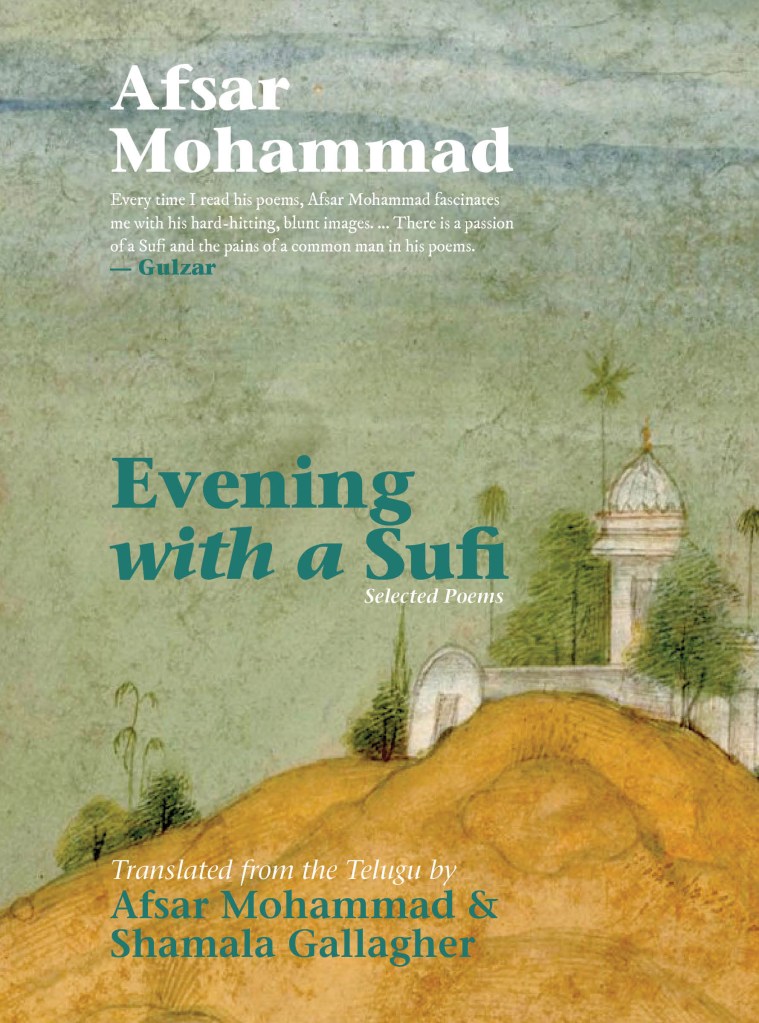
Evening with a Sufi: Selected Poems volume brings together, for the first time in English translation (translated by the poet in collaboration with Shamala Gallagher) the selected, and often groundbreaking poetry of the celebrated Telugu poet Afsar Mohammad, known for his trendsetting poetry and literary criticism in the post-1980s Telugu literary culture. Beside an erudite translator’s note from Gallagher, Evening with a Sufi also contains two in-depth essays on Afsar Mohammad’s poetry by David Shulman and Cheran Rudhramoorthy, plus an interview with the poet by poet and translator Rohith.
About the Author
Born in a small village in the South Indian state of Telangana, Afsar Mohammad now teaches South Asian Studies at the University of Pennsylvania. Known as a trendsetting poet and literary critic in the post-1980s Telugu literary culture, Afsar has published five volumes of poetry, one collection of short stories and two volumes of literary theory essays. Afsar is also a distinguished scholar of Indian studies and has published extensively with various international presses, including Oxford and Cambridge. He is now working on a translation of Sufi poetry from Telugu to English. He can be reached at afsartelugu@gmail.com
About the translator
Shamala Gallagher is a mixed-race Indian American writer, community college teacher, and mother to a preschooler. She is the author of a poetry collection, Late Morning When the World Burns (The Cultural Society, 2019), and her writing has been published in several literary journals, including Poetry, Gulf Coast, Black Warrior Review, and the Missouri Review. She lives in a hundred-year-old house in Athens, Georgia, USA with her family and cats.
I’m sorry, my Lord.

My poem is not your slave,
it’s a sickle with its head to the sky.

My poem is not a damsel timid in your moonlight,
it’s a tiger prowling in a shadowed forest.

My poem won’t be your grand constitution,
devoted to your happiness
at all costs.

-	‘Outcast’s Grief’ from Evening with a Sufi
Not all poetry can be read with the same eye or ear. Certain poems demand to be seen and heard on their own terms, offering to the reader their own canons of understanding and appreciation in imaging an idea that, through them, has just been born into thought. Afsar Mohammad’s Evening with a Sufi sets out to be one such thought-provoking book of poems.
A slim collection of twenty-six verses selected and translated from Afsar Mohammad’s extensive oeuvre in Telugu by Shamala Gallagher and the poet himself, these are existential political poems that are as theoretically perspicacious as they are urgent and astounding in their overwhelming sincerity. Like Eliot’s The Waste Land, Afsar Mohammad’s Evening with a Sufi aesthetically documents a difficult world, especially one criss-crossed with systemic hegemony, and bereft of equality. An engagement with these poems is a direct invitation to the reader to embark on an epistemological tour into a sharp symbolic landscape that encapsulates visceral records of social meaning.
The title, to begin with, itself upholds a strong symbolism. Its ‘evening’ bespeaks the twilight of civilisation, the personal-social moment of the unleashing of despair, and a decadent global landscape thriving on inequity and deprivation. And yet, evening, in these poems, is also the transitional period of awareness, self-reflection, evaluation, and the collective envisioning of an egalitarian dawn. These poems, therefore, become investigations and articulations of both fatigue and rest, of falling apart and re-gathering, and of old failures and new beginnings, leading us to look at the idea of the Sufi or Sufism anew.
“For me, Sufism is nothing but a tool of resistance,” avers the poet, indicating how Sufism, as a philosophy, offers a vigorous counternarrative to transnational policies and practices of discrimination, marginalisation, disempowerment and exclusion. “In my village Sufism, I see how people of diverse colours and castes share food, rituals and stories. As a village person, it’s not a far-fetched utopia for me — but an everyday reality. My writings are nothing but reminders of that shared realm of life.”
In Afsar’s poems, Sufism becomes a political as well as existential search for a vision of oneness. This vision is, at the same time, philosophical and social, local and global, integrating and intimidating in the way that most revolutions are – “The drop that can swallow a desert” (‘Another Word’) or “Where walls are knocked down,/ we won’t need the splendour of curtains” (‘The Spectator is Dead’) or “I always speak the language of war.” (‘A Green Bird and the Nest of Light’)
Identity surfaces as a significant theme in this book. Most of the twenty-six poems in Evening with a Sufi embark on a complex exploration of identity on geographical, cultural, social, historical or linguistic terrains. However, the book’s conceptualisation of identity is far from monolithic. Germane to the vision of these poems is the essentially dialogic space of identity and its characterization as an ever-contingent work-in-progress.
Mark the first poem in the collection, for instance. Titled ‘Name Calling’, an ambiguous phrase that poignantly addresses the phenomenon of naming as an act of use and abuse, the poem captures the essential seamlessness of names and identities. The protagonist of the piece is a boyhood contemporary called Usman who is visibly an ‘other’ to the speaker of the poem, the difference between them marked out distinctly in class terms and perhaps also (less evidently) in terms of physical ability – “You scared all the children/ away from the river./ A body like a wound/ peeks from your torn shirt.” It is, however, to this social pariah – “the one street dog doggedly haunted by a ball” that the speaker feels affiliated in his later life:
Now I don’t see much difference between you and me.
We are the same.[…]
Usman, times never change
only the roles change.
Muslim, Telugu and Third-world migrant, the poet reads the theory and experience of otherness on a number of sociological axes and through a variety of cultural lenses. In ‘The Accented Word’, he uses the idea of accent to explore the complex genealogies of language on the intersections of purism and cultural hegemony, contemplating variously, through the three sections of the poem, on linguistic integrity, capitalist subordination, and postcolonial erasure:
Words
are stillborn babies.

Their blood has gone bad with white poison,
their words have gone bad from the accent.

I’ve been poured, shared, and bathed in white poison
since I was little
and now I want to speak out for myself.

But my voice is in chains
and my language is poisoned,

and the language of my time is poisoned.

We live on the brackish water of life.
While Shakespeare’s Caliban in The Tempest felt that the colonizer’s language profited him by teaching him “how to curse”, Afsar’s poems approach language with utmost caution, forever mindful of the possibility of trampling and obscuring buried histories of domination and betrayal. Many of the poems, here, are metapoetic in their thrust, assiduously exploring the value of meaningful postcolonial poetic creation from the inescapable inequities and ideological loopholes of language: “a market piles up words sounding like poetry” (‘The Accented Word’) or “How long this slavery to white poems?” (‘Outcast’s Grief’) or again as in “Poetry: / just one dried leaf.” (‘Walking’)
In ‘A Piece of Bread, a Country, and a Shehnai’, bread, music, war and pain – all come together to avow our subcontinent’s shared heritage of poverty and cultural intimacy brutally shredded by politico-religious separation. In ‘No Birthplace’, the speaker of the poem is as much the Indian subcontinent as its hapless postcolonial citizen faced with the inability to reconcile its historical legacy of cultural plurality with the blind spots in its mythological and ideological machinery:
Come, divide me by myself, I say.
Not by forty-seven.

My laughs, screams, harangues, deaths, and rapes —
They’re all yours too!
It is interesting to note how Afsar’s poems consistently invigorate and socially translate the idea of spirituality through sinewy sociological imagery with the result that spirituality is transformed from a closeted and socially-indifferent personal practice to a welfare-oriented everyday social ritual. In ‘Iftar Siren’, the idea of fasting as self-purification is ironically brought to bear on the understanding of the hunger-stricken socially dispossessed as perpetually cleansed while the overfed victimisers walk about unconcerned:
What a great life.
In the holy month,

do you see how you are all becoming pure?
I’ve been like this for years

burning in the divine fire.
Unable to turn into ashes.

I’m a fire-pit you try
and try to stamp out.

Yes, the fire-pit
is tired too.
The haunting and incendiary metaphor of hunger as fire and the stomach/body as the fire-pit, tired of being stamped out or dispossessed, makes these poems powerful bandages for social injustices as well as flaming flags of protest. In ‘Qibla’, the posture of prayer, again, pivots on the stomach – “a belly turned deep/ into itself/ in which I obscure my body,/ feet, hands and everything/ for a long time” – suggesting the omnipotence of hunger as surpassing all acts of asocial faith. The poem concludes with considerable uncertainty of the efficacy of prayer and with an ideological pun on “arms” (arm/armament) as a means of erasing human hatred.
The stupendous yet composed energy of the book needs no forestatement. Every single word here is deftly chosen, well-placed, and tersely poised to make emotional leaps on command. The images are taut, the sentiments thoroughly grilled in the fire of creative originality, and everywhere, there is a sense of potential unruliness held firmly in check by a balanced and farsighted imagination.
In considering these poems, one must not forget, also, their complex linguistic history. Though translated from the original Telugu, the Telugu language itself includes, for the poet, “the entangled history of Urdu, Hindi and English — the languages that indeed shaped my emotional realm.” Arriving into English via such multi-layered linguistic travails and travels, these exceptionally well-translated poems infuse postcolonial English with a visceral depth, a spiritual profundity and a razor-sharp urgency that would be difficult to come by in the original English.
Accompanied by a very relevant author interview and insightful essays by the translator and valuable first readers of this collection, Evening with a Sufi arrives, in its essential philosophy and call for humanitarian action, with a new theory and praxis for the world, determined to reconstruct rather than redeem it.
Basudhara Roy teaches English at Karim City College affiliated to Kolhan University, Chaibasa. Drawn to gender and ecological studies, her four published books include a monograph and three poetry collections. Her recent works are available at Outlook India, The Dhaka Tribune, EPW, Madras Courier and Live Wire among others.








 Borderless