Categories
Poetry

To Days that are Now Spent

By Shahalam Tariq

TO DAYS THAT ARE NOW SPENT 

No longer does this heart sing the way it did,
In those days of years past, when it's abode
Was in your arms; when in your eyes it lived
Or under the calm shadow of your locks.

It would sleep when the days got all too harsh.
Now it but murmurs rarely a few songs
From days of old, as the book of the past
Lies open on the table half read and torn.

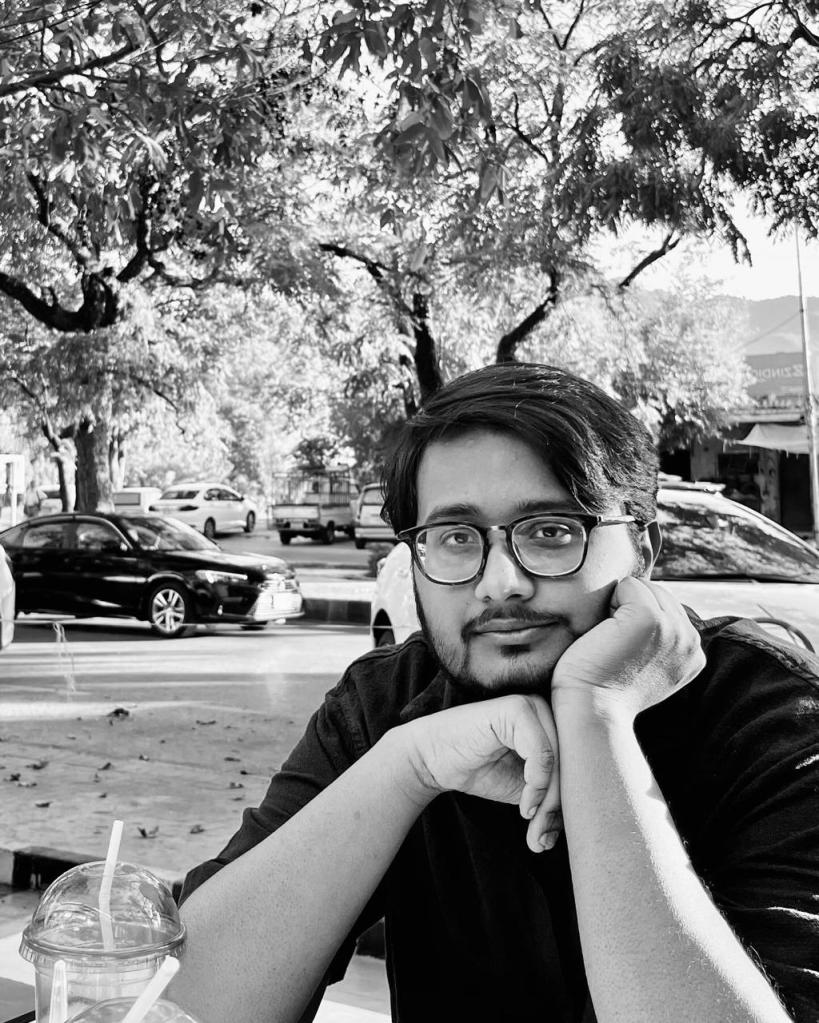
Shahalam Tariq is based in Rawalpindi, Pakistan. His writings on history, theory and literature have appeared in The Friday Times and Bazm e Dana. His poems have appeared in The Writers Sanctuary, an anthology of poetry.

.

PLEASE NOTE: ARTICLES CAN ONLY BE REPRODUCED IN OTHER SITES WITH DUE ACKNOWLEDGEMENT TO BORDERLESS JOURNAL

Click here to access the Borderless anthology, Monalisa No Longer Smiles

Click here to access Monalisa No Longer Smiles on Amazon International

Categories
Review

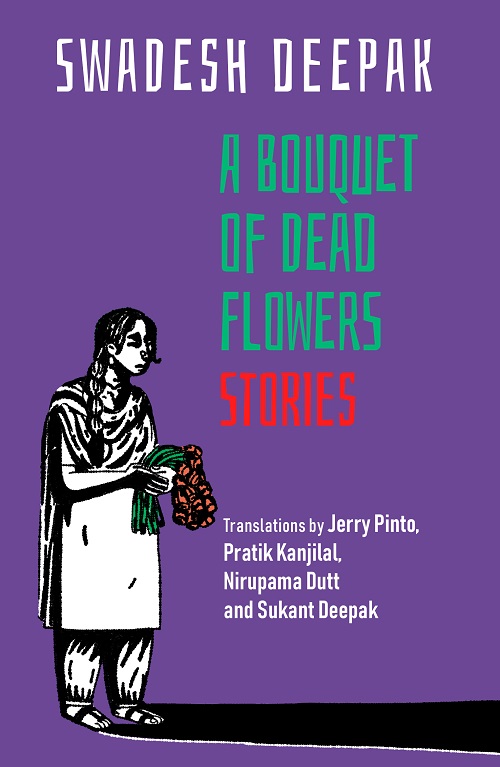
A Bouquet of Dead Flowers

Book Review by Rakhi Dalal

Book Title: A Bouquet of Dead Flowers

Author: Swadesh Deepak

Translators: Jerry Pinto, Pratik Kanjilal, Nirupama Dutt, Sukant Deepak

Publisher: Speaking Tiger Books

“Hindi literature, Swadesh Deepak maintained, had to be forced out of its comfort zone. The reader here is treated no less savagely,” writes Jerry Pinto in his introduction to this collection of ten stories by Swadesh Deepak, an author and playwright who was born in Rawalpindi on 6th  August, 1942. After his masters in English Literature, he taught for a long time at the Gandhi Memorial National College, Ambala Cantonment. Following a period of illness from 1991 to 1997, when he had little contact with anyone other than his family and close friends, he made a momentous return to the world of letters with an autobiographical account of his illness, Maine Mandu Nahin Dekha[1], and the play Sabse Udaas Kavita[2]. He received the Sangeet Natak Akademi Award in 2004. He has a total of 15 published books to his name including short-story collections such as TamashaBaal Bhagwan[3]and Kisi Ek Pedh Ka Naam Lo[4]and hugely successful plays such as Court Martial and Kaal Kothri[5]. In 2006 he left home for a walk and never returned. He has been missing ever since.

These stories, deeply unsettling, challenge readers by taking them into a world where unknown forces work mysteriously, upending and affecting the lives of its characters, leaving them vulnerable at the mercy of chance happenings which rarely bring them relief. Much akin to what Thomas Hardy called as the Immanent Will — a blind and indifferent force determining the fates (and generally blighting the lives) of the privileged and the common people alike.

Whether it is the hunger for food, a ravenous longing of the starved and the deprived as portrayed in the stories ‘Hunger’ and ‘The Child God’, the mystery around the fate of a loved one in ‘For the Wind Cannot Read’, the struggle with depression in ‘Pears from Rawalpindi’ or ‘Horsemen’[, the unrequited yearning for a life of togetherness in ‘Dread and Dead End’, the author’s masterful play of the elements comes to the fore with an intensity that shakes and stuns the reader. Pinto refers to the author as the master of neo gothic,

The sunlight, the wind, the trees, the figure of a broken man, appears again and again. It seems as if it is just not the fate but also the forces of natural elements that keep rattling the course of the lives of the characters.     The trees stand as guards, or sway in delight or offer a refuge, the sunlight “makes a hesitant arrival” sitting quietly or climbing the hills or sometimes streaking in the rooms, the wind is at times playful and at others vindictive. Then there are the flowers, the dead flowers of memories, whose bouquets one keeps holding, clinging to and clasping. And then there is the poetic play of words – “a pale yellow georgette afternoon in Novemberbringing to life the patchy sunlight of autumn.

In the figure of broken man which appears again and again in stories, the author seems to be questioning the role that society has forced upon a man – that of a provider of the family, a role sometimes begrudgingly assumed in the stories because “no one respects a man without work, no matter how talented he is.” 

In each story, the author weaves a tale that becomes a commentary — on society and its inherent evils, on relationships within a family stifled by arrogance, ignorance or circumstances and quietly working on the minds of those inhabiting it, on human greed engendered by depravity, hunger or lust, on the mysteriousness of fate whose force makes the mighty cower.  

The translation, well executed, offers a closer reading experience and leaves a bilingual reader with the wish to approach the author’s works in original as well. I must make a special note on the introduction by the acclaimed writer and translator Jerry Pinto who offers a peek into the mind of Swadesh Deepak through a couple of excerpts of the author’s conversations with his psychiatrist and also with a convict brought to the hospital for evaluation. Perhaps these ideas had haunted him in the mental ward of the hospital and later seeped into his stories. Pinto in the introduction not only seeks to make sense of Deepak’s writing but also makes for a compelling reason to read his works – to read on without looking over one’s shoulders.

.

[1] I have not seen Mandu

[2] The Saddest Poem ever Written

[3] The Child God

[4] Name a Tree, any Tree

[5] Dark Chamber

Rakhi Dalal is an educator by profession. When not working, she can usually be found reading books or writing about reading them. She writes at https://rakhidalal.blogspot.com/ .

.

PLEASE NOTE: ARTICLES CAN ONLY BE REPRODUCED IN OTHER SITES WITH DUE ACKNOWLEDGEMENT TO BORDERLESS JOURNAL

Click here to access the Borderless anthology, Monalisa No Longer Smiles

Click here to access Monalisa No Longer Smiles on Kindle Amazon International
Categories
Poetry

‘Only Endings and Beginnings are Real…’

By Shahalam Tariq

JANUARY: DECEMBER 

December and January
are not real months – they do not seem to be;
They are like translucent blurs
in the puddle of the whole year’s colours.
But,
Perhaps it’s the other way around
and only December and January
are real.
Maybe our lives are translucent
colourless blurs.
And all the colours are just
our assumptions, expectations,
our dreams and hopes,
which we fill into our days ourselves
– so that life may seem a bit bearable.
And maybe,
only endings and beginnings are real.
Perhaps, that’s why
beginnings always seem so difficult,
and endings are so heartbreaking.

Shahalam Tariq is a writer and student based in Rawalpindi, Pakistan. His writings on history, theory and literature have appeared in The Friday Times and Bazm e Dana. His poems have appeared in The Writers Sanctuary, an anthology of poetry.

PLEASE NOTE: ARTICLES CAN ONLY BE REPRODUCED IN OTHER SITES WITH DUE ACKNOWLEDGEMENT TO BORDERLESS JOURNAL

Click here to access the Borderless anthology, Monalisa No Longer Smiles

Click here to access Monalisa No Longer Smiles on Amazon International

Categories
Poetry

In 1947

By Masha Hassan

Art by Amrita Sher-Gil (1913-1941)
It is the beginning of a saffron day.
She tinges her white salwar with colour.
The walls are thin and we listen,
Offered prayers to Sikh Saints,
Inside a room of crippled faith.
We wait,
We wait for the devotion to finish,
For her to step out,
To tsk at our negligence,
To sigh at us heretics…
Chiffon is what covers her head,
Falls over so elegantly onto her shoulders,
Only to be quickly put back to its position.
She bends over in much pain.
‘Nanak’ she says is the medicine --
Handing out the sacred sweet.
We roll our eyes but stretch our hands,
Whilst scuffling her salwar,
Remembering the sun of 1947
She’d narrate,
 
In silent murmurs and naked
Soles,
 
She had covered miles to feel
Uninhabited,
 
She remembered intervals
On makeshift mornings,
 
Toppling over bodies with
No sound,
 
On footpaths familiar she remembered
Runnels painted with blood,
 
Leaving behind dupattas* and flags,
Flying spirits in the sky,
 
She was certain she’d return,
To unlocked doors,
 
To obscure meanderings
 
To Bitter-sweet memories
Of abandoned and burnt
Homes,
 
Rest assured,
She never did
 
She found refuge in language. 

*Veils or Scarves that are almost the size of stoles
This poem is about the journey made by the late Kuldeep Kaur (seated on the left). She was originally from Rawalpindi (now in Pakistan). As a child, she had to travel on foot, stepping over heaps of dead bodies from Rawalpindi to an army base camp and finally settled in New Delhi, Patel Nagar. This photograph was taken in 1993. She is seated next to her daughter, both of who also witnessed the 1984 Sikh-Hindu riots, another face of fundamentalism. Photo provided by Masha Hassan.

Masha Hassan is a PhD student at the University of Bologna, Italy. Her research entails identity constructions at the margins, the ‘liminal identities’, focusing on the South Asian diaspora.  You would occasionally find her wandering in Kebab shops in Italy talking in Urdu, Hindi or Punjabi with the shop owners, listening to their journeys. Her articles have been published in The Speaking Tree, Times of India, Jamhoor Magazine, and online Italian magazines such as OgZero and connessioneprecarie. Her first poem, ‘Main, Junaid’, (dedicated to Hafiz Junaid who was lynched on a moving train on the suspicion of carrying beef) was published on the cover of a local Marathi magazine called Purogrami Jangarjana, Mumbai, India in June 2017.

PLEASE NOTE: ARTICLES CAN ONLY BE REPRODUCED IN OTHER SITES WITH DUE ACKNOWLEDGEMENT TO BORDERLESS JOURNAL. 

Click here to access the Borderless anthology, Monalisa No Longer Smiles

Click here to access Monalisa No Longer Smiles on Kindle Amazon International
Categories
Poetry

Bringing along their homeland

Poetry by Abdul Jamil Urfi

Delhi in the 1960’s:
Nostalgia about Lahore was high.
Partition displaced refugees spoke of 
misery, mayhem, murder. Deda Ji regretted 
that, at the time of leaving, a pillowcase of house jewels
was misplaced. Bhabhi Ji had similar regrets--
leaving priceless possessions behind in Lahore
and friends.
 
But what struck us-- newcomers to the grand city
were the names of shops.
So many of them were
named after places in Western Punjab,
or those now in Pakistan. For instance, 
A popular eatery called ‘Lahorian di Hatti’
‘Quetta DAV School’.
Small eateries served dishes called ‘Pindi ke Chholey Bhatoorey’. 
A shop with the name ‘New Lyallpur Cloth House’. 
There were ‘Lahorian Jewellers’, ‘Sindh Wood & Ply’, 
Karachi Sweet Shop, Karachi Stationery Mart, Quetta Store, 
Peshawar Sweet Bhandar, Lahore Watch Co., Sialkot Jewellers 
and also ‘Abbott Drycleaner’s’, whose shop, it turned out, 
had not been named after some monastery’s abbot 
but after ‘Abbottabad’ --a town in Pakistan 
(made famous by the capture of Osama Bin Laden by US Navy Seals)
Thus, many places in erstwhile undivided India, 
but no more in India now.
Lahore, Quetta, Rawalpindi, Lyallpur, Sindh, 
Abbottabad, Karachi, Peshawar, Sialkot 
made their presence felt in a walk in any area of Delhi. 
The Partition displaced people had suffered immense tragedies and losses
And had also brought a little bit of their homeland with them.

Abdul Jamil Urfi published ‘Memoirs of the bygone century, Beeswin Sadi- Growing up in Delhi during the 1960’s and 70’s’, which was extracted and reviewed in The Friday Times (Lahore)FirstpostIndia of the PastCaleidescopeNew Asian WritingScroll.in and The Quint. He works in Delhi as a university teacher. His poems have appeared in ‘Skylark’,  NAW and Vayavya.

.

PLEASE NOTE: ARTICLES CAN ONLY BE REPRODUCED IN OTHER SITES WITH DUE ACKNOWLEDGEMENT TO BORDERLESS JOURNAL

Click here to access the Borderless anthology, Monalisa No Longer Smiles

Click here to access Monalisa No Longer Smiles on Kindle Amazon International